



Abstract
This paper analyzed the effects of boundary conditions on the stress distribution of hydraulic support with the static finite element (FE) model. Five loading conditions are considered in this study, including: 1) canopy torsional loading, 2) canopy eccentric loading, 3) base torsional loading, 4) base diagonal loading, and 5) base symmetrical loading. In order to verify the simulation results obtained from the FE model, the corresponding experiments have also been performed. Based on the comparison between simulation and experimental results, the effects of pin-joint simplified methods and boundary conditions are evaluated in terms of accuracy and efficiency. Moreover, the new elastic-support boundary is also proposed to improve the simulation accuracy under conditions 2, 3, 4, and 5. The results show that bonded contact between the pin and shaft hole has high efficiency and accuracy compared with the frictional contact. The frictional contact boundary is reasonable under condition 1. However, the elastic-support boundary is suggested to be adopted to improve calculation accuracy for the stress distribution of the constraint components (canopy or base) under conditions 2, 3, 4, and 5.
Introduction
The hydraulic support is one of the important safety supporting equipment in the process of coal mining.1–3 Its safety and reliability are very important for the safe mining of coal mines. In order to improve design quality, many researchers have carried out a lot of research on static strength4–7 and dynamic behaviors8–10 of hydraulic support. At present, static strength calculation by equivalent loads is widely used to assure the design quality. Due to the complex structures and loading conditions of hydraulic support, it is difficult to carry out the strength check by material mechanics method. The FE method with the ideas of numerical approximation and discretization has high precision and can deal with large structures with complex shapes,11–17 such as turbine bladed disks, 12 gear pairs14,15 and gas formed structures. 16 The FE method has been adopted for calculating the strength of hydraulic support in many researches.18–29 A FE model needs reasonable simplification and assumptions such as boundary conditions and equivalent treatment of joints to ensure the validity of simulation results. In order to establish the FE model better, the model verification, and modification should be carried out by experiments. 18
Lu et al. 18 established a beam-shell combined the FE model of hydraulic support, in which a pin-joint adopted the beam element, and the other components adopted the shell element. They analyzed the influence of boundary constraints, various loads, and different support heights on the simulated stresses and verified the proposed model with measured stresses. He et al. 19 established an overall FE model of hydraulic support with shell elements and performed the strength simulation analysis under the canopy and base torsional loading conditions respectively. Li et al. 20 established a shell-solid combined FE model of hydraulic support, in which the welding among all parts adopted the common use of nodes, and the constraint between the cushion block and canopy or base adopted the frictional contact boundary. Considering the pin-joint with the frictional contact element, Gao and Zhou 21 also established a similar shell-solid FE model and the constraint boundary is similar to that in Li et al. 20 Li 22 established a FE model of hydraulic support by using tetrahedral and hexahedral mixed elements, analyzed the stress distribution under the canopy and base concentrated loading conditions respectively, and verified the effectiveness of the simulated results by experiment. Under three loading conditions, Ma et al.23,24 established a solid FE model of ZF5000/16/28 hydraulic support with a mesh size of 60 mm and compared the simulated stress distribution with that obtained from the experiment. Liu and Liu 25 established a 3D FE model of ZT650/19.5/34 hydraulic support and analyzed the stress and deformation distribution of the support under four working conditions.
Based on ABAQUS software, Li and Zheng 26 established a FE model of ZF5000/16/28 hydraulic support and analyzed the stress and displacement distribution under the canopy eccentric and base torsional loading conditions by simplifying the pin-joint as coupling hinge, describing the contact between the cushion block and the canopy or the base by contact element, and setting the jack as rigid connection. Based on a bilinear constitutive model, Zhao et al. 27 established a static FE model of hydraulic support, and analyzed the static strength of the support and the fatigue characteristics of the welded box structure. Wu et al. 28 established a 3D FE model of six-column hydraulic support, and analyzed the stress distribution of each component under the base two-end concentrated and torsional loading conditions, respectively. Kong et al. 29 adopted the frictional contact to simulate the rotation of pin-joint, established a FE model of hydraulic support, and analyzed the strength characteristics of the system under three loading conditions.
The above literature survey shows that the boundary conditions for the contact between the canopy/base and working table mainly adopt fixed constraint and frictional contact boundary. Some researchers point out that the frictional contact boundary is consistent with the actual situation. Some simulated results are also verified by experiments. However, it is difficult to accurately assess the influence of boundary conditions on the stress distribution of the whole hydraulic support due to the lack of measured points. In order to bridge this gap, under the canopy torsional loading condition, this paper compares the simulated stress distribution considering different traditional boundary and pin-joint simplification assumptions with measured stress distribution and different pin-joint assumptions. The reason for the error between the simulation and experiment is analyzed. In order to improve the simulation accuracy, a new elastic-support boundary is proposed to simulate the local contact phenomenon caused by eccentric loading, assembly error and unevenness of canopy, on the base and working table surface. This study can provide theoretical support for the accurate evaluation of the stress distribution of hydraulic support.
Finite element model and experiment description of hydraulic support
CAD model simplification and finite element modelling
The actual structure of hydraulic support has many auxiliary parts, such as guard plates and legs. Consequently, before the FE modelling, it is necessary to simplify the CAD model of hydraulic support. The model simplification principles are as follows: ① The non-load bearing parts are removed, such as the canopy protection plate at the left and right sides of the canopy, hydraulic components, etc. Only the key bearing parts such as the canopy, goaf shield, base, front, and rear linkages are retained. ② The load-bearing parts are also removed, such as the lifting ring for mounting hydraulic hoses of the canopy part, the hydraulic cylinders, and the small hydraulic oil ports. ③ Geometrical features of bearing parts are processed, such as deleting the edge chamfering, rounded corners, and processing holes, and filling some welding seams, and fine clearance.
In the experiment, the hydraulic system of hydraulic support provides pressure, and then the positions of the cushion blocks are changed to simulate different loading forms of hydraulic support, so as to evaluate the hydraulic support performance more comprehensively. 30
In this paper, only five dangerous conditions are selected to carry out the simulation and experiment: Canopy torsional loading condition is condition 1, and canopy eccentric loading condition is condition 2. The cushion block layouts of condition 1 and condition 2 are shown in Figure 1(a) and (b), and the base is in direct contact with the upper surface of the lower working table. Base torsional loading condition is condition 3, base diagonal loading condition is condition 4, and base symmetrical loading condition is condition 5. The cushion block layouts of conditions 3, 4, and 5 are shown in Figure 1(c) to (e), and the canopy is in direct contact with the upper working table.
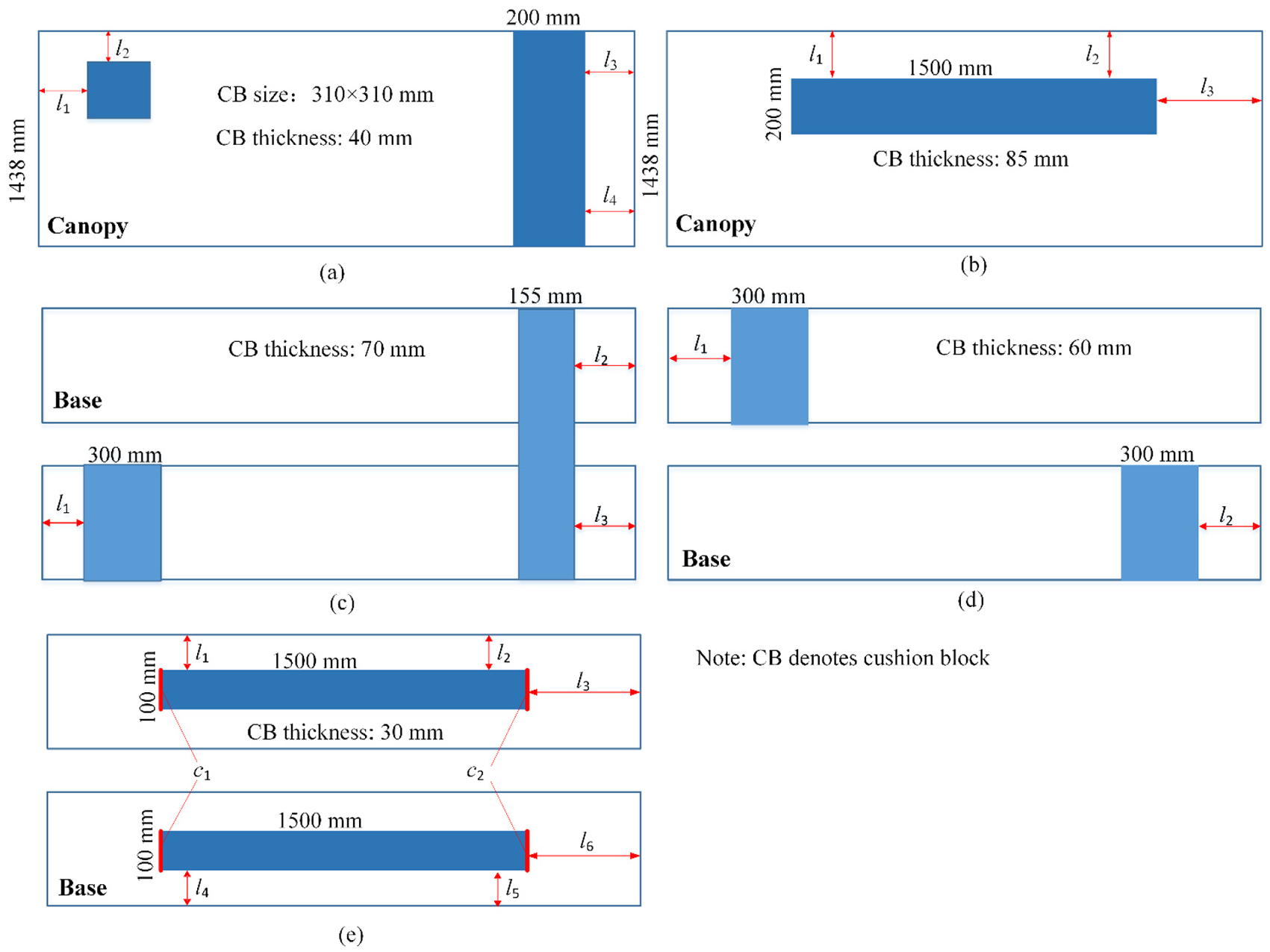
Five loading conditions: (a) condition 1: canopy torsional loading condition, (b) condition 2: canopy eccentric loading condition, (c) condition 3: base torsional loading condition, (d) condition 4: base diagonal loading condition, and (e) condition 5: base symmetrical loading condition.
It should be noted that there are some small differences between the actual conditions and specified conditions in GB 25974.1-2010, 30 due to the limitation of the experiment. For example, the small cushion block thickness can lead to the contact between the canopy and working table, so the block thickness is increased by stacking multiple cushion blocks. In addition, the positions of the cushion block may change during the loading process. The detailed parameters during the experiment are provided in Section 2.2.
According to Huangfu, 14 the legs of hydraulic support can be regarded as a two-force bar, which applies a pair of equal and opposite forces to the sockets of the canopy and the base. The rated working pressure of the hydraulic cylinder of the leg is p = 42.3 MPa, and the inner diameter of the cylinder is D = 320 mm. According to the standard of GB25974.1-2010, 30 the applied loading of the single leg F is 4080 kN which is set as 1.2 times the rated load. The FE model of hydraulic support is established in ANSYS Workbench. The applied loading and FE model (condition 1) are shown in Figure 2. It should be noted that the equilibrium cylinder has little effect on the static stress of the whole hydraulic support, so the applied force of the equilibrium cylinder is ignored in this paper. 31 The main structural material of hydraulic support is steel (a Young’s modulus E = 210 GPa, a density ρ = 7850 kg/m3, a Poisson’s ratio υ = 0.3). The FE model of hydraulic support is established by SOLID186 and SOLID187 elements and the element size is set as 35 mm. SOLID186 element is a high order 3-D 20-node solid element, which is used to mesh some regular shaped parts with 6 facets, while SOLID187 is a high order 3-D 10-node solid element, which is used to mesh irregular or complex parts better. Using SOLID186 and SOLID187 elements, not only ensures the FE mesh quality, but also effectively reduces the calculation scale and improves the calculation efficiency.

(a) Schematic of applied loading and (b) FE model under condition 1.
Different boundary conditions will lead to different finite element simulation results. Therefore, for the above five experiment conditions, how to set the appropriate boundary conditions is the focus of this paper.
Description of experimental equipment and measurement process
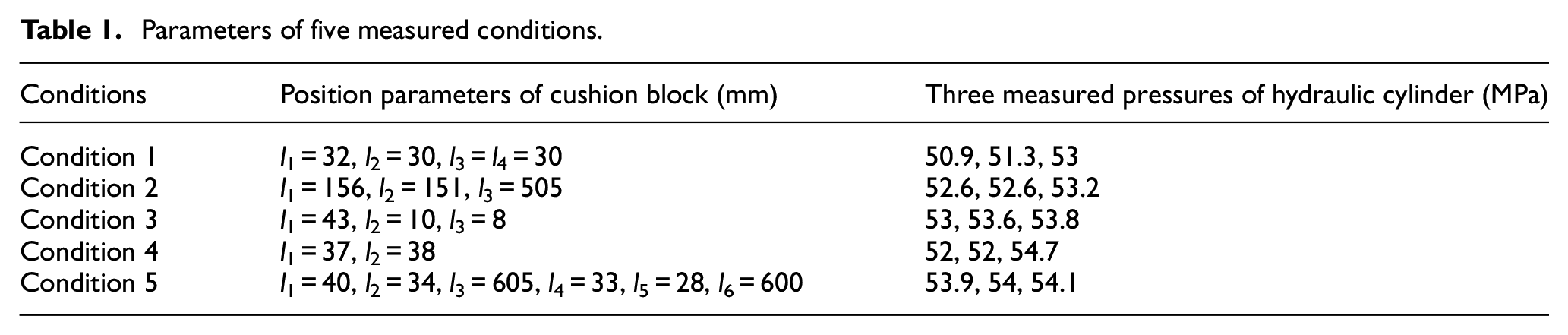
The hydraulic support is tested on a 3000 t hydraulic experiment rig (see Figure 3(a)), and the Von Mises equivalent stresses of the measured points are obtained by the LMS data acquisition instrument (VB8E, DB8 board card, 128 channels) and the strain gauge produced by Zhonghang Electronic Measuring Instruments Co., Ltd (rectangular strain rosette, 120 Ω), as is shown in Figure 3(b). The parameters for five loading conditions are listed in Table 1. Three groups of data are collected, and the average values of Von Mises stresses under the stable state are used as the final experimental results. The photos and position schematic of measured points are shown in Figure 4. It should be noted that auxiliary measured points are added in the region where the stress gradient varies. The measured points are named as follows: three measured points of 23′ (main measured point), 23′′ (auxiliary measured point 1), and 23′′′ (auxiliary measured point 2) are arranged on the canopy. Only one measured point is named as measured point i (i = 1, 10, 12, 13, 25). The number of measured points is discontinuous because some measured points with small stresses are removed, such as measured points 2, 3, 21, and 22.
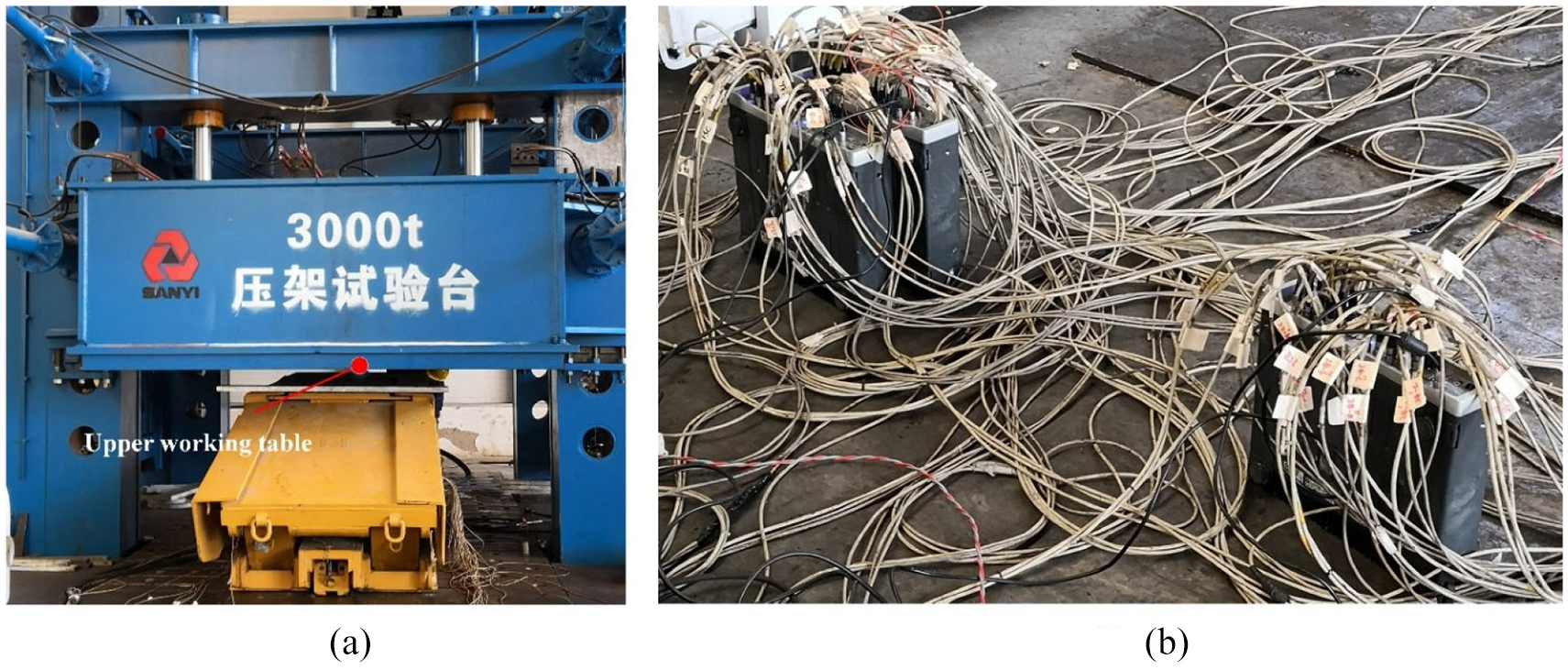
(a) Experiment rig and (b) LMS data acquisition instrument.
Parameters of five measured conditions.
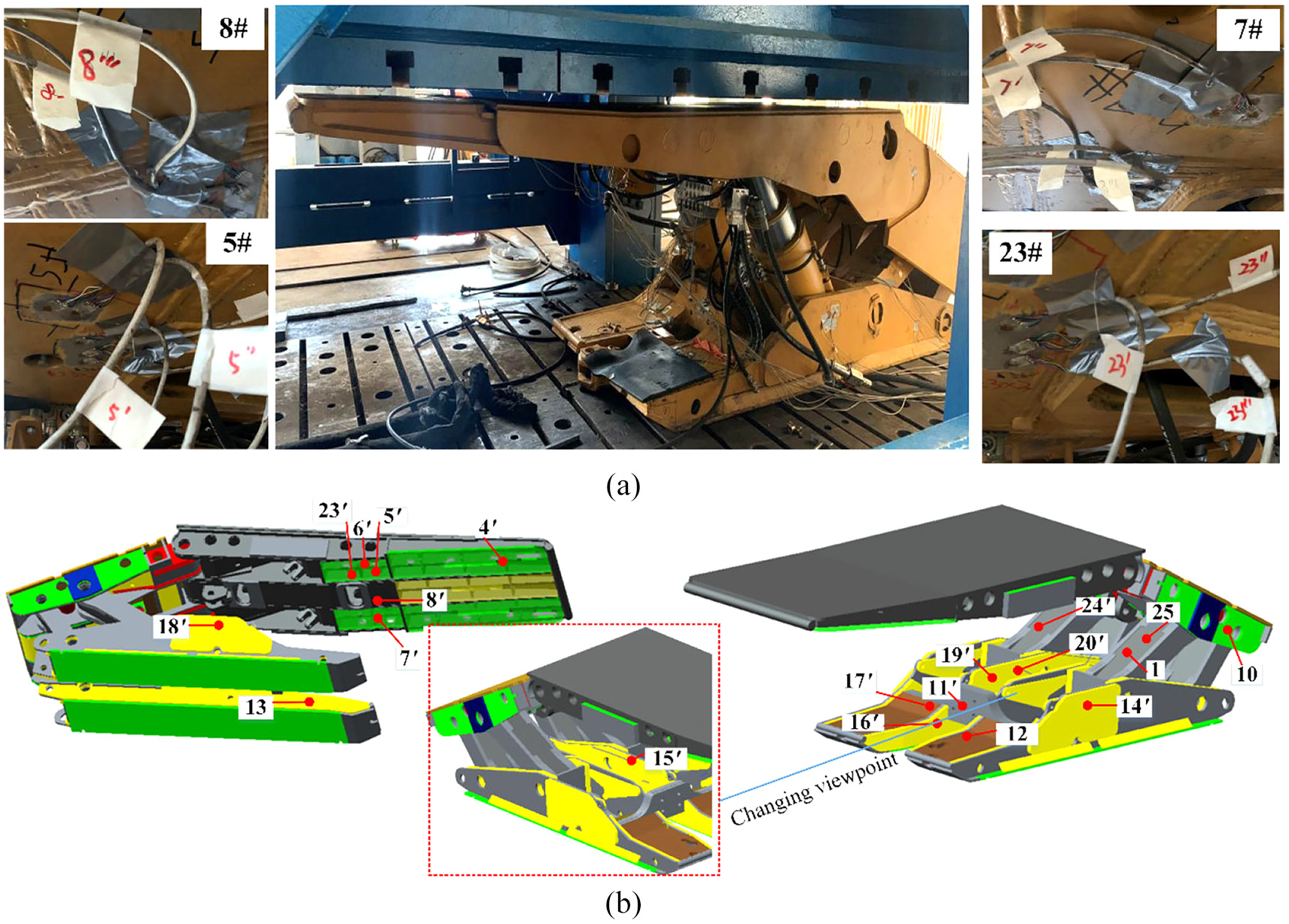
(a) Partial measured points in experiment and (b) schematic of measured point locations.
Taking condition 1 as an example, the Von Mises stress curves of four main and auxiliary measured points are shown in Figure 5. The figure shows that the experiment process has a stable process from the loading, and the stress value tends to be stable after 105 s. The stress in the stable stage is selected as the final experimental result.

Von Mises stresses of different measured points: (a) 5#, (b) 7#, (c) 8#, and (d) 23#.
The stress gradient of some measured points varies greatly, such as measured point 8# (see Figure 5(c)). There are many welds around this measured point, and both the surrounding structure and the applied load are complex. In order to analyze the deformation of measured point 8# in detail, the uniaxial strain curves in three directions are shown in Figure 6. It can be seen that the variation gradient of uniaxial strains is also large. Compressive strain mainly appears in a-direction, where the strain value is greater than tensile strain, and the compressive strain of measured point 8′ is the largest. The tensile strains of measured point 8′′′ in b-direction and measured point 8′ in c-direction are the largest.
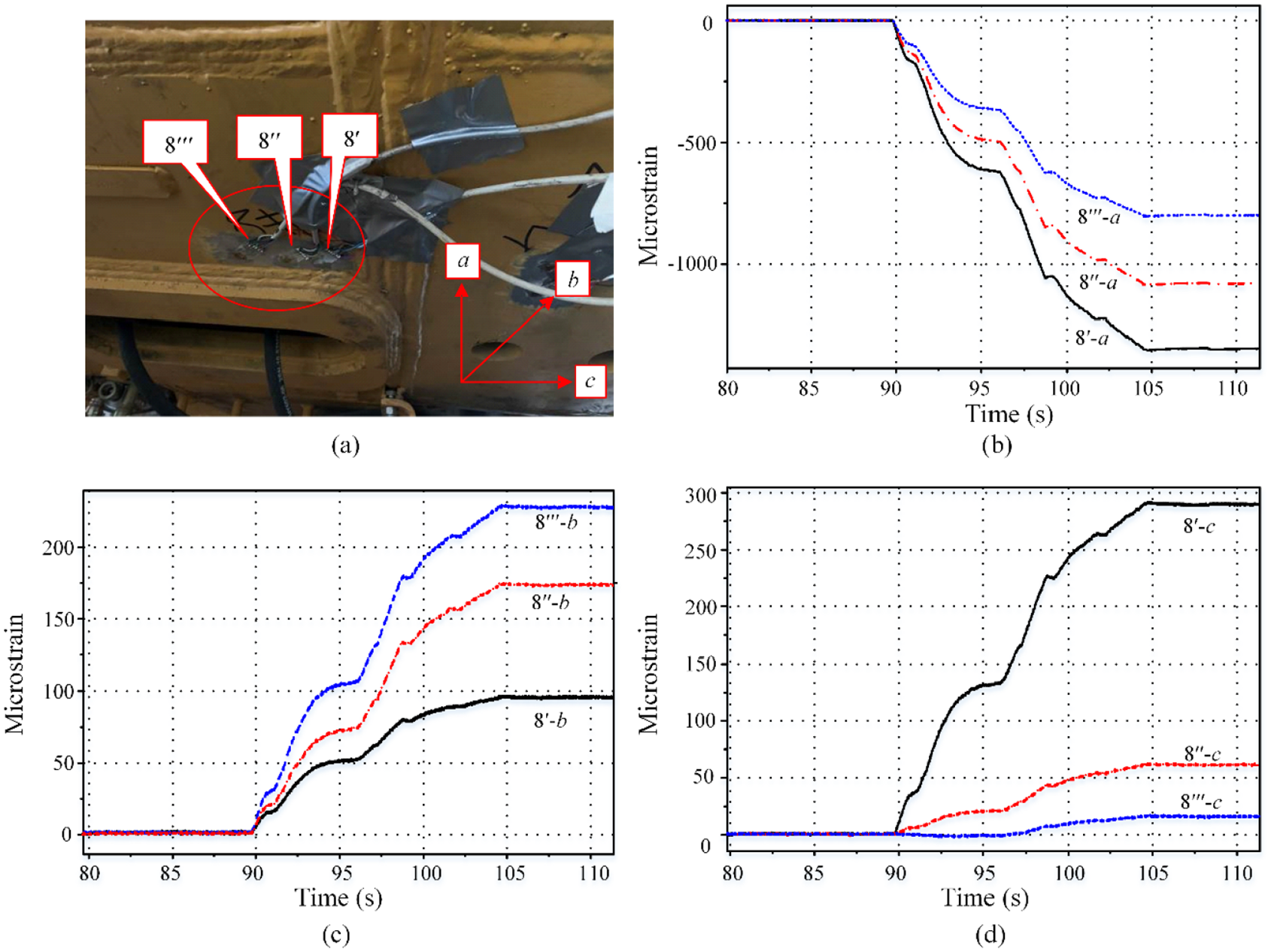
(a) Schematic of three strain directions, (b) microstrain in a-direction, (c) microstrain in b-direction, and (d) microstrain in c-direction.
Comparison of simulated and measured stress under different conditions
Stress comparison under canopy torsional loading condition (condition 1)
The bottom surface of the lower working table is set as fixed constraint during the experiment. For condition 1, the experiment state is indicated by setting the upper surface of cushion blocks as fixed constraint, the bottom surface of cushion blocks as bonded contact, and setting the base as frictional contact with the upper surface of lower working table (in this paper, the friction coefficient is set as 0.2). Li et al. 20 shows that such boundary conditions can get results that are more consistent with experimental data. Under the above boundary and loading conditions, four simplified methods of pin-joint will be discussed which are listed in Table 2.
Simplified methods of pin-joint.

The stress distributions of the hydraulic support under four simplified methods are shown in Figure 7. The comparison between the simulated and measured stress at measured points 24# is shown in Figure 8. The calculation time and accuracy for every simplified method are also compared (see Table 3). It should be noted that the simulation result is considered to be consistent with the experimental result when the error between the simulated and measured stress is no more than 15%. The calculation time is obtained on a 64-bit processor (i7-6700 CPU 3.40 GHz) with 16 GB RAM. The compared results are shown as follows:
The stress distribution at Case 1.1 shows that the stress at the connection surface between linkages and goaf shield is very small, for example, the stress of the measured point 10 is only 5.24 MPa, which is far less than the measured stress 102.4 MPa. It also indicates that the pin-joint connection between the goaf shield and linkages at Case 1.1 increases the stiffness of the connection regions, which restrains the deformation of the connecting parts. The errors of six measured points (measured point 23‴, 10, 19′, 19″ and 20′) are greater than 15% and the maximum error is about 94.9%, which appears at measured point 10 (see Table 3). The calculation time is about 1 h 58 min.
Under Case 1.2, the pin-joint connection positions are replaced by revolute joint connections and removing pin joints. Compared with Case 1.1, this calculation accuracy of this case has a great improvement and only four measured points (measured point 4′, 4″, 20′, and 20″) have great errors (>15%). The maximum error is about 106.4%, which appears at measured point 4′ and the calculation time is about 6 h 22 min (see Table 3).
Under Case 1.3, the pin-joints are bonded with the shaft hole. Under this case, the simulated stress agrees well with measured stress, and the maximum error is about 13.1%, which appears at measured point 20″. In addition, the computation time is the shortest (see Table 3).
Under Case 1.4, frictional contact between the pin and the shaft hole is adopted. The errors of four measured points (measured point 4′, 4″, 14′, and 14″) are greater than 15%, and the maximum error is about 24.4% at measured point 4′. The computational efficiency under Case 1.4 is the lowest among the four cases, and the calculation time is about 13 h 38 min.

Stress distributions of four simplification methods: (a) Case 1.1, (b) Case 1.2, (c) Case 1.3, and (d) Case 1.4.

Comparison on simulated and measured stresses under different pin-joint simplified methods.
Comparison on the calculation time and accuracy of four pin-joint simplification methods.

The above comparison results show that the calculation accuracy and efficiency are optimal at Case 1.3. In the following analysis, the pin-joint simplified methods at Case 1.3 is adopted.
Stress comparison under the base torsional, diagonal and symmetrical loading conditions
This section will discuss the effects of two traditional boundaries (compression only support, frictional contact boundary) and a new elastic-support boundary on the stress distribution of the hydraulic support under three base loading conditions (condition 3: torsional loading, condition 4: diagonal loading, condition 5: symmetrical loading).
Compression only support and frictional contact boundary
Based on the above analysis in Section 3.1, it is obvious that two traditional methods can well simulate the boundary of the canopy. Under conditions 3 and 4, the fixed constraint is applied to the bottom surfaces of cushion blocks and the contact between the cushion blocks and the base is set as bonded contact. (1) The contact between the canopy and the upper working table is regarded as complete contact. There is only a compression status, that is, the compression only support is applied to the canopy. (2) The frictional contact between the canopy and the upper working table is adopted. This approach can simulate the real boundary conditions well, but the calculation efficiency is relatively low.
The comparison between the simulated and measured stresses is shown in Figure 9. The figure shows that the simulated stresses at the frictional contact boundary are closer to the measured stresses. However, the stress values of measured points in canopy and base are smaller than experimental results, and the simulated stress value of canopy is especially small. The possible reason is that the constraints of the canopy are excessive under the strength simulation of the above two conditions. The contact status and contact stresses of condition 3 and condition 4 under the frictional contact boundary are shown in Figure 10.

Stress comparison: (a) condition 3 and (b) condition 4.

Contact status and stress distributions under the friction contact boundaries: (a) condition 3 and (b) condition 4.
Adopting the same boundary constraint method as conditions 3 and 4, the comparison between the simulated and measured stresses of condition 5 is shown in Figure 11(a). The figure shows there exist large errors between the simulation and experiment and the simulated stresses are almost all less than the measured stresses except for measured points 24′ and 24′′. This shows the constraint generates a large local and whole stiffness which leads to a small deformation and stresses. In order to revise this deficiency, two short edges of two cushion blocks are fixed (see c1 and c2 lines in Figure 1(e)), and the contact between the cushion blocks and the base is set as the bonded contact. The contact between the canopy and the upper working table is set as the compression only support and the frictional contact, respectively. Under the revised boundary, the stress comparison is shown in Figure 11(b). The simulated stresses have a great improvement which agrees well with the measured stresses except for the canopy. The contact status and contact stress distributions also show that the boundary of the base has a slight influence on the frictional contact boundary, as is shown in Figure 12. The figure shows that the local contact phenomenon appears due to the concentrated load at socket positions. Due to the unevenness of the contact surface in real conditions, it is difficult to simulate the real experiment status by frictional contact boundary.

Stress comparison at condition 5: (a) fixed constraint of bottom surfaces of two cushion blocks and (b) fixed constraint of short edges of two cushion blocks.

Contact status and contact stress distributions under condition 5: (a) fixed constraint of bottom surfaces of two cushion blocks and (b) fixed constraint of short edges of two cushion blocks.
Elastic-support boundary conditions
The comparison results in Section 3.2.1 show that the frictional contact boundary can not accurately simulate the stress distribution of the canopy. It is found that there is a warping angle of about 2° between the front half and the rear half of the canopy. During the experiment, the canopy and the upper working table are not fully in contact at the beginning, but four points or lines around the canopy contact the upper working table first. With the increasing pressure load, the contact area will gradually increase.
By analyzing the actual condition characteristics, a new boundary condition is proposed to revise this deficiency (see Figure 13). Four corner points P1, P2, P3, and P4 on the canopy are fixed, and a spring constraint in Y-direction is added at the midpoint of line L1 on the canopy. It should be noted that the Y-direction displacement of line L2 is also constrained under condition 4 (see Figure 13(b)). The constraint of the bottom surfaces of cushion blocks and the contact between the upper surfaces of cushion blocks and the base are the same as those set in Section 3.2.1.

Schematics of elastic support boundaries: (a) condition 3, (b) condition 4, and (c) condition 5.
Under three loading conditions, the effects of spring stiffness on the errors between the simulated and measured stresses are shown in Figure 14. It should be noted that spring stiffness “∞” denotes the Y-direction displacement of the line L1 is constrained. Under condition 3, the error decreases first in the stiffness range of 0.1–1000 kN/mm and then increases in the stiffness range of 1000–∞ kN/mm. An optimal stiffness value can be determined as 1000 kN/mm (see Figure 14(a)). The optimal stiffness values for conditions 4 and 5 are about 100 and 5000 kN/mm, respectively (see Figure 14(b) and (c)).

Stress errors comparison under different spring stiffness: (a) condition 3, (b) condition 4, and (c) condition 5.
The stress comparison under different spring stiffness is shown in Figure 15. The figure shows the spring stiffness has a great influence on the stress distribution of the canopy.

Stress comparison: (a) condition 3, (b) condition 4, and (c) condition 5.
The stress nephograms under the frictional contact and elastic support boundaries (k = 1000, 50, and 5000 kN/mm for conditions 3, 4, and 5) are shown in Figure 16. The figure shows that the stress of the canopy is very small except for the socket positions in which the stress is about 50–100 MPa under the frictional contact boundary. When a reasonable elastic support boundary is adopted, the stress distribution is in good agreement with the experimental results.

Comparison of stress nephograms: (a) condition 3, (b) condition 4, and (c) condition 5.
Stress comparison under the canopy eccentric loading condition (condition 2)
Compression only support and frictional contact boundary conditions
In this section, the boundary conditions between the base and the lower working table are set as frictional contact and compression only support, respectively. The contact between the cushion blocks and the canopy is set as bonded contact, and frictionless support boundary is applied to the upper surface of the cushion blocks.
The simulated stress results under the two boundaries are compared with the experimental results, as shown in Figure 17. The figure shows that the simulation result under the frictional contact boundary is closer to the experimental result than that under compression only support boundary. But there still exist large errors between the simulated and measured stresses at most measured points. The contact status shows that the local contact phenomenon is obvious due to the eccentric loading (see Figure 18).
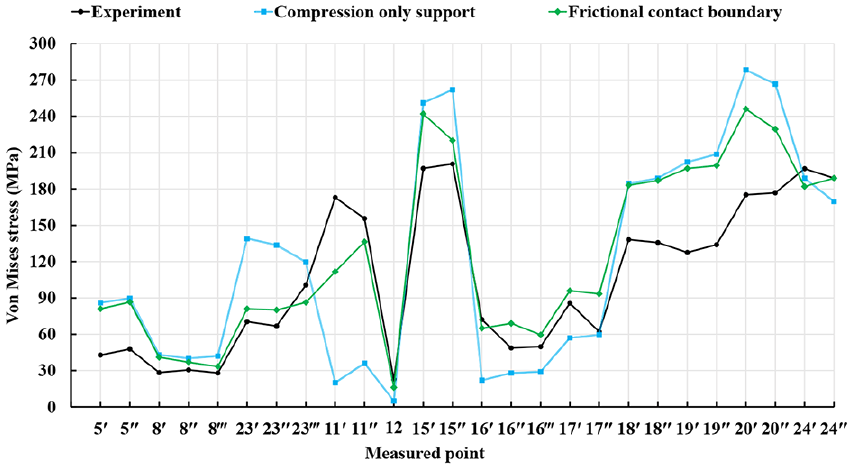
Stress comparison under condition 2.

Contact status of base.
Elastic-support boundary conditions
According to the contact status, a proposed elastic-support boundary is established, the spring constraint is applied to the base of hydraulic support in Y-direction, and the fixed constraint is applied in X-direction and Z-direction, as is shown in Figure 19. In the figure, the left-side spring number and stiffness are larger than those at the right-side base, and k1 = 10k2.

Schematic of elastic-support boundary under condition 2.
The effects of spring stiffness k1 on the errors between simulated and measured stresses are shown in Figure 20(a), which indicates there exists a minimum error at k1 = 200 kN/mm. The stress distributions at k1 = 40, 200 kN/mm also show a similar trend as the experimental results (see Figure 20(b)). In summary, the total stiffness value of the right-side base is 1600 kN/mm (eight identical springs with stiffness of k1), and the total stiffness value of the left-side base is 240 kN/mm (a spring with stiffness of k1 and two springs with stiffness of k2).

(a) Stress error comparison and (b) stress comparison under different spring stiffness.
The upwarping angle phenomenon under the two boundary conditions is shown in Figure 21. It can be seen that Y-direction maximum displacement is 7.6 mm under the elastic-support boundary, which is smaller than 37.2 mm under the frictional contact boundary. It is clear that the larger deformation will result in the larger stress and this will cause the inaccuracy simulation result under the frictional contact boundary. The stress distribution under the elastic-support boundary is lower than that under the frictional contact boundary. The measured Y-direction maximum displacement is about 10–20 mm, which is closer to the simulated 7.6 mm. This also verifies the effectiveness of the elastic-support boundary.

Local deformations (left figure) and stress distribution (right figure) under two boundaries: (a) frictional contact boundary and (b) elastic-support boundary.
Conclusions
The effects of the contact between the pin and shaft hole, and the boundary conditions on the stress distribution of hydraulic support are discussed based on the finite element simulation and experiment. Based on the experimental results, the reasonable pin-joint simplification and constraint boundaries are determined under five loading conditions. The main conclusions are summarized as follows:
The bonded contact and frictional contact between the pin and shaft hole all have a high accuracy, however, the former is more efficient. The bonded contact can be used as a better choice to evaluate the stress distribution of hydraulic support.
Traditional frictional contact boundary has a high accuracy under canopy torsional loading condition, however, there exist large errors at measured points on canopy or base due to the uneven phenomena (local contact phenomena) in the bottom surface of the base and top surface of the canopy. A new elastic-support boundary is proposed to revise this deficiency. The value range of elastic support stiffness is determined based on measured stress. For example, appropriate stiffness values are recommended such as 1000, 50, and 5000 kN/mm for base torsional, diagonal, and symmetrical loading conditions, respectively. For the canopy eccentric loading condition, the total stiffness value is 1600 kN/mm (eight identical springs with stiffness of the 200 kN/mm) at the right side of the base and it is 240 kN/mm (a spring with the stiffness of 200 kN/mm and two identical springs with the stiffness of 20 kN/mm) at the left side of the base.
Supplemental Material
sj-pdf-1-ade-10.1177_16878140211001194 – Supplemental material for Effects of boundary conditions on stress distribution of hydraulic support: A simulation and experimental study
Supplemental material, sj-pdf-1-ade-10.1177_16878140211001194 for Effects of boundary conditions on stress distribution of hydraulic support: A simulation and experimental study by Junzhe Lin, Tianrui Yang, Kaixuan Ni, Chenyi Han, Hui Ma, Ang Gao and Chunliang Xiao in Advances in Mechanical Engineering
Footnotes
Handling Editor: James Baldwin
Declaration of conflicting interests
The author(s) declared no potential conflicts of interest with respect to the research, authorship, and/or publication of this article.
Funding
The author(s) disclosed receipt of the following financial support for the research, authorship, and/or publication of this article: This project is supported by the National Natural Science Foundation (Grant nos. 11972112, 11772089), the Fundamental Research Funds for the Central Universities (Grant nos. N2003008, N2003014, and N180708009) and Liaoning Revitalization Talents Program (Grant No. XLYC1807008).

Supplemental material
Supplemental material for this article is available online.
References
Supplementary Material
Please find the following supplemental material available below.
For Open Access articles published under a Creative Commons License, all supplemental material carries the same license as the article it is associated with.
For non-Open Access articles published, all supplemental material carries a non-exclusive license, and permission requests for re-use of supplemental material or any part of supplemental material shall be sent directly to the copyright owner as specified in the copyright notice associated with the article.
