




Abstract
Seal element is an important component of roller-cone bit. In order to improve the sealing performance and service life of roller-cone bit under high temperature, a new seal structure with multi-segment arcs is designed and the structural parameters of this sealing ring are optimized by response surface method and finite element method. Firstly, the hydrogenated nitrile-butadiene rubber is used to improve the seal performance under high temperature, and the uniaxial, planar, and biaxial tensile experiments are carried out to study the constitutive model of this rubber. Then, a three-dimension transient thermo-mechanical coupling model is established. The comparison of sealing performance between the new structural seal and the traditional O-ring seal is implemented under high temperature through the proposed FEM and laboratory experiments. The results show that the new structural seal has lower contact pressure and Mises stress than the standard O-ring seal, and the service life of the former is almost twice of the later one. Additionally, a composite drill bit using the new structural seal is applied to a deep drilling. After servicing a certain time, it shows that the wearing capacity is very small. The results show that the new structure seal ring can adapt to high temperature environment and the optimization method is feasible.
Keywords
Introduction
Roller-cone bits are widely used in the oil and gas exploration and development, especially in the hard and abrasive formations. The temperature of the formation increases with the drilling depth. With the increase of the temperature of the formation, the failure of the roller-cone bits is serious. It causes significant economic loss and the down-hole accidents. The seal ring in the cone bit is confined laterally between a metal journal and a rigid cone, and the other two side surfaces contact with the surrounding drilling mud and the grease. Figure 1(a) is a schematic description of roller-cone bit and the location of the rubber seal, and Figure 1(b) shows the working environment of the seal. According to the field data, the sealing failure is one of the main reasons caused the cone bit failure. This failure will lead to the seal chamber linked with the drilling mud, then the grease will leak into the drilling mud and the cuttings go through the chamber, which will cause the failure of the cone bit rapidly. For the rubber seal, large contact pressure and area, severe deformation, and high heat accumulation are considered as the main causes. Hence, a rubber seal with reasonable stress distribution and high-temperature resistant material is required urgently in the deep and ultra-deep drilling.

(a) The components of roller-cone bit, 1-tooth claw; 2-teeth; 3-rubber seal ring; 4-journal; 5-cone and (b) the working environment of the rubber seal for cone bit.
In deep well drilling, the contact pressure, contact arc length and Mises stress are the basical indexes to evaluate the sealing performance. In order to improve the sealing performance of the rubber seal for the cone bit, a great deal of theoretical and experimental works have been carried out,
1
including the newly structured design, the rubber constitutive model study,2–4 even the metal seal investigation. To reduce the contact pressure and contact area, Zhou and Liu
5
and Zeng et al.
6
designed a bionic non-smooth surface seal with conical teeth. Cui et al.
7
analyzed the failure of a kind of Y-ring rubber seal and found that greater contact pressure would result in bitten phenomenon or aggravate wear. Zheng et al.
8
used computer-aided simulation technology to optimize a kind of
The present work design a new structural rubber seal to improve the sealing performance. The hydrogenated nitrile-butadiene rubber (HNBR) is selected as the material of the new seal, and its constitutive model is studied experimentally. According to the uniaxial, planar, and biaxial tensile experiments, the Yeoh model is selected as the constitutive model of the HNBR. Special attention should be given to the optimization of the designed parameters using the response surface method (RSM). Based on this optimization method and 2D finite element analysis, the regression model between the designed parameters and the subjective targets is established, and the optimal structure of the rubber seal is obtained. Compared with the standard O-ring seal, the distribution of the contact pressure and Mises stress of the new seal are more reasonable. The service life is almost twice of the standard O-ring seal. The main contributions of the current work are: (1) the HNBR constitutive model is studied at high temperature by laboratory tensile experiments; and (2) a new multi-segment arcs seal is designed for the roller-cone bit by RSM, which is validated to have a good sealing performance in deep well drilling.
The rest of the paper is organized as follows. In Section 2, a new structure seal is proposed and the sealing mechanism will be studied. The constitutive model of the HNBR material used to this new seal will be studied at high temperature environment in Section . In Section 3, the RSM will be used to obtain the optimal parameters of the new structure. The sealing performance of the new structural seal will be compared to the standard O-ring seal by using FEM and laboratory experiments in Section 4. Section 5 will analyze the field application performance of this new structural seal. Finally, some concluding remarks are drawn in the last Section.
New structural design and sealing mechanism
Figure 2 shows the cross-section of the new designed seal ring which is used to seal the chamber formed by the roller-cone and the journal. Eight parameters determine the details of this new structure:

The new designed rubber seal for roller-cone bit: (a) the cross-section of the new seal,
The sealing mechanism of the new designed seal ring is the same as O-ring seal. Elastomeric seal relies on the elasticity and incompressibility of the elastomer material, and the existence of an initial interference or ’preload’.

This means that the maximum sealing contact pressure

where
HNBR constitutive model and experimental study
In deep drilling operation, sealing elements are working at high temperature. However, the material of the sealing elements are sensitive to high temperature, which may cause mature failure of the drill-bit. Therefore, it is necessary to use a high-temperature resistant material to avoid the rubber ageing and wear. HNBR is a product obtained by hydrogenating the carbon-carbon double bonds in the molecular chain of nitrile rubber. HHBR has good oil resistance, and due to its highly saturated structure, it has good heat resistance and excellent chemical resistance. Most studies about HNBR constitutive model base on the normal temperature. So, this section focuses on determining the constitutive parameters of HNBR material at high temperature. The uni-axial, planar, and biaxial tensile experiments are carried out to obtain the constitutive parameters.
Constitutive model
For the elastomer material, it is almost incompressible, that is, the Poisons ratio

For the incompressible rubber material, the volume keeps constant. Therefore, the third deviatoric strain invariant

For hyperelastic mterials, many constitutive models are used to describe the relationship between strain and stress, including Mooney-Rivlin (M-R), Yeoh, Neo Hooks, and Ogden Models. In this section, the widely used model Yeoh is discussed based on the continuum medium mechanic theory. The relationships between stress, strain and strain energy density are as follows: 21
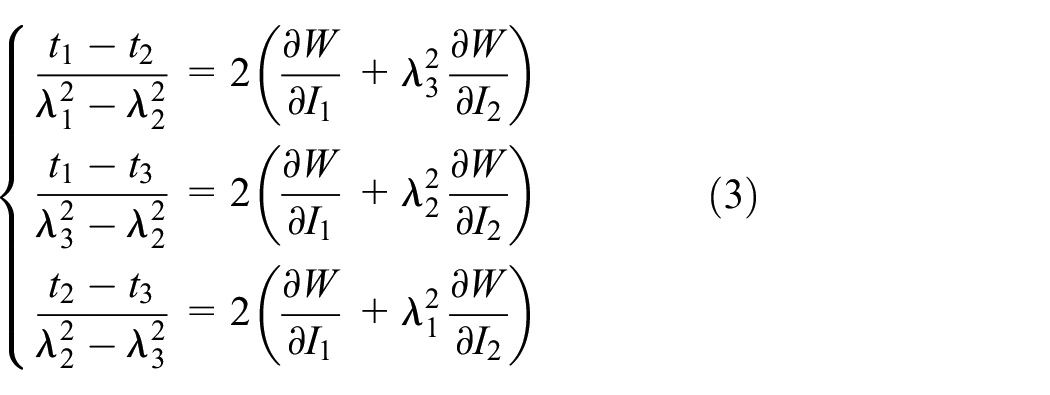
where
For the Yeoh constitutive model, 2 leading terms of Rivlin’s strain energy function can be readily expressed:

which is a cubic equation in

The constants
Uniaxial tensile
For the uniaxial tension, the relationships between three main tension ratios can be clearly given by:

Then, the uniaxial tensile stress-strain relation can be written as

Planar tensile
For the planar tension, the following relationship between three main tension ratios can be clearly given by:

The planar tensile stress-strain relation is now given by

Biaxial tensile
For the biaxial tension, the following relationship between three main tension ratios can be clearly given by:

The biaxial tensile stress-strain relation is now given by

Tensile experiment and results
The parameters of the HNBR material constitutive model are obtained based on the stress-strain data in the test results of unaxial tensile, planar tensile, and biaxial tensile. In this section, the tensile experiments are performed at 120°C environment temperature. The experimental equipments are shown in Figure 3.

The lab-experiment of the tension experiment 22 : (a) uniaxial tensile experiment, (b) planar tensile experiment, and (c) biaxial tensile experiment.
According to the test data, the curves of different constitutive models are obtained by using Abaqus fitting function. In the uniaxial tensile experiment, the loading strain level and strain rate are 39

The uniaxial tension fitting curves of the Ogden model, Mooney Rivlin model, Neo Hooke model, and Yeoh model based on the uniaxial tension data.
The planar tensile experiments were carried out under the condition of 39

The planar tension fitting curves of the Ogden model, Mooney Rivlin model, Neo Hooke model, and Yeoh model based on the planar tension data.
In the biaxial tensile experiment, the loading strain level and strain rate were set up as 39

The biaxial tension fitting curves of the Ogden model, Mooney Rivlin model, Neo Hooke model, and Yeoh model based on the biaxial tension data.
Due to the complication of the non-linear behaviours of the rubber material, all the experimental data were taken into consideration to identify the constitutive parameters. According to matching degree of the fitting curves, Yeoh model was selected to present the HNBR material constitutive. Fitting the experimental results of uniaxial, planar, and biaxial tension by Abaqus, the constants
Optimization of the structure parameters
Finite element model
A 2D axisymmetric model is established to simulate the seal behaviours and obtain Mises stress, contact pressure, and contact length. Compared with the rubber material, the steel cone and bearing are regarded as rigid body. A 2D four-node hyperelastic element (CAX4H) is used to simulate the rubber material. The rubber constitutive parameters are set using the parameters in section 3 and the compression ratio of the rubber seal is set 12
Response surface method
Response surface methodology23,24 is a collection of mathematical and statistical techniques that are useful for the modelling and analysis of problems in which a response of interest is influenced by several quantifiable variables (or factors), with the objective of optimizing the response. RSM seeks to identify the relationship between the response and the control factors. It is a sequential procedure, starting from current operating conditions and moving toward the optimum condition. Points on the response surface that are remote from the optimum condition, such as current operating conditions, often exhibit little curvature.
In this section, RSM is applied to improve the sealing performance and service life of the new rubber seal. It aims to reduce the Mises stress, contact pressure, and contact length using multi-objective optimization. The structure parameters of length
In this study, the RSM is employed to regress the relationship between the optimization objectives (

Multi-objective optimization flowchart using RSM.
Seventeen group orthogonal tests are conducted by using the proposed FEM, and the results are presented in Table 1. A prediction model between the optimization targets and the three individual factors donated as


The results of the orthogonal tests with eight parameters.

Equations (12)–(14) are the quadratic regression model, including the terms of
ANOVA table for M.

ANOVA table for C.

ANOVA table for L.

As shown in Table 2, the F-value and the p-value of the regression model
As shown in Table 3, the F-value and the p-value of the regression model
To the regression model
Based on the confidence analysis, the regression model is accurate to represent the relationship between the designed parameters and the responses. Then, the least-squares method is used to obtain the multi-objective optimization solution. The requirement of the seal is that the contact pressure is greater than the drilling mud pressure in the bottom hole. For the rubber seal, the structure parameters must meet the assembly space. Finally, the objective function of the seal can be expressed as

The function can be solved by the optimization method in Design-Expert. The optimal parameters of the new seal structure are obtained, which is shown in Table 5.
The optimal parameters for the new structural rubber seal.

Simulation and experimental analysis
FEA comparison
In this section, a three-dimension(3D) transient thermo-mechanical coupling model is established to simulate the actual working conditions by ABAQUS, including the rotational speed, differential pressure, and high temperature. In the thermo-mechanical analysis, the influence of temperature on the seal rubber mechanics can be considered. The 3D FEM assemblies are shown in Figure 8, which is composed of sealing groove, seal ring, and the journal. The environment temperature is 120°C, environment pressure on the inner surface and outer surface are 20 MPa and 20.5 MPa, respectively. The outer and inner diameters of the rubber seal are 67 mm and 55 mm.

The finite element model including sealing groove, seal ring and the roller-cone bit journal.
A comparison between standard O-ring and the new structure seal is implemented under the same compression ratio 12

(a) The components of roller-cone bit, 1-tooth claw; 2-cone; 3-steel ball; 4-pin; 5-bearing; 6-seal rings and (b) the structure of seal ring.
The contact pressure along the cross-section of the O-ring seal and new structural seal are presented in Figure 10. The profile of the new structure is divided into 10 segments according to the shape features. They are almost symmetry, excluding the segment P9–P10, which is the corner of the outer surface. The result shows that differential pressure push the seal ring to the cone and they have contact at this corner.
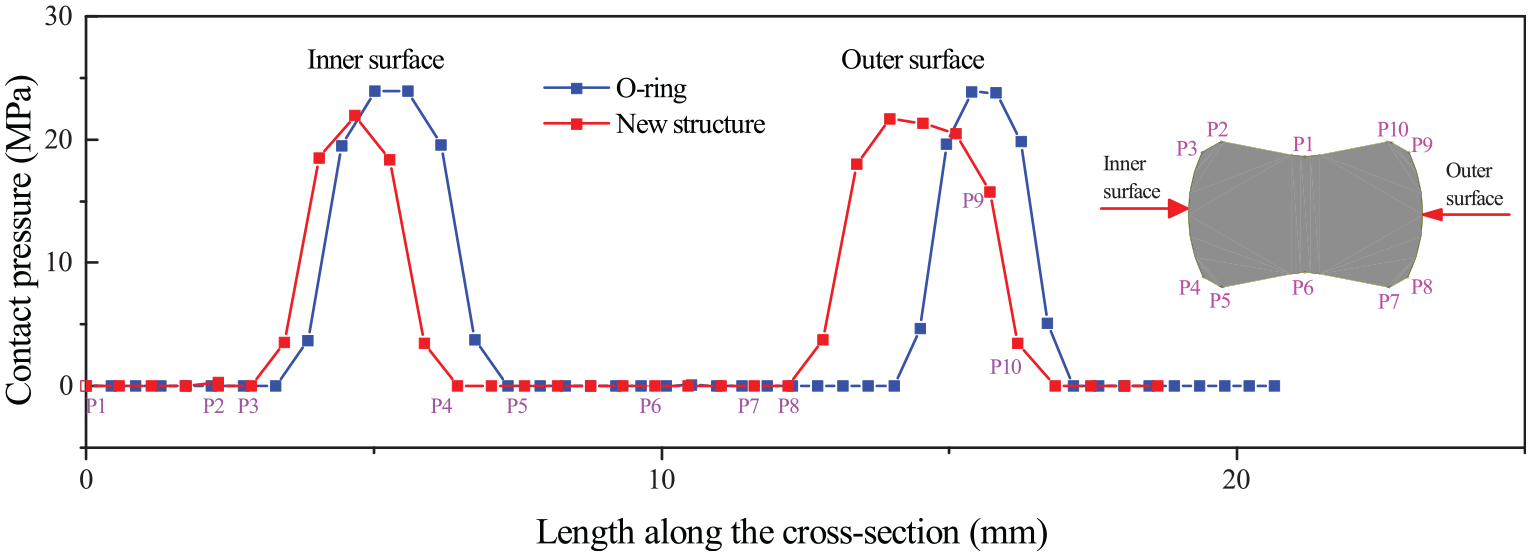
The contact pressure of O-ring seal and new structure seal along cross-section.
Based on the FEM, the influences of rotational speed and environment temperature on Mises stress, contact pressure, and the working temperature are studied. The results are shown in Figure 11.

Comparison of Mises stress, contact pressure, and the working temperature between O-ring seal and new structure seal: (a) the influences of rotational speed and (b) the influences of the environment temperature.
As shown in Figure 11(a), the Mises stress and the contact pressure emerges no change as the rotational speed increases. While, the working temperature increases with the rotational speed linearly. Compared with the O-ring seal, the Mises stress, the contact pressure, and the working temperature of new structure are lower, which presents a good working performance.
Experimental study
To measure the sealing performance of the new structure, a series of comparative tests are carried out between the new structure seal and O-ring seal. Two sets of experiment are conducted with the rotational speed 260 RPM and 450 RPM, respectively. The schematic of the seal tester is shown in Figure 12.
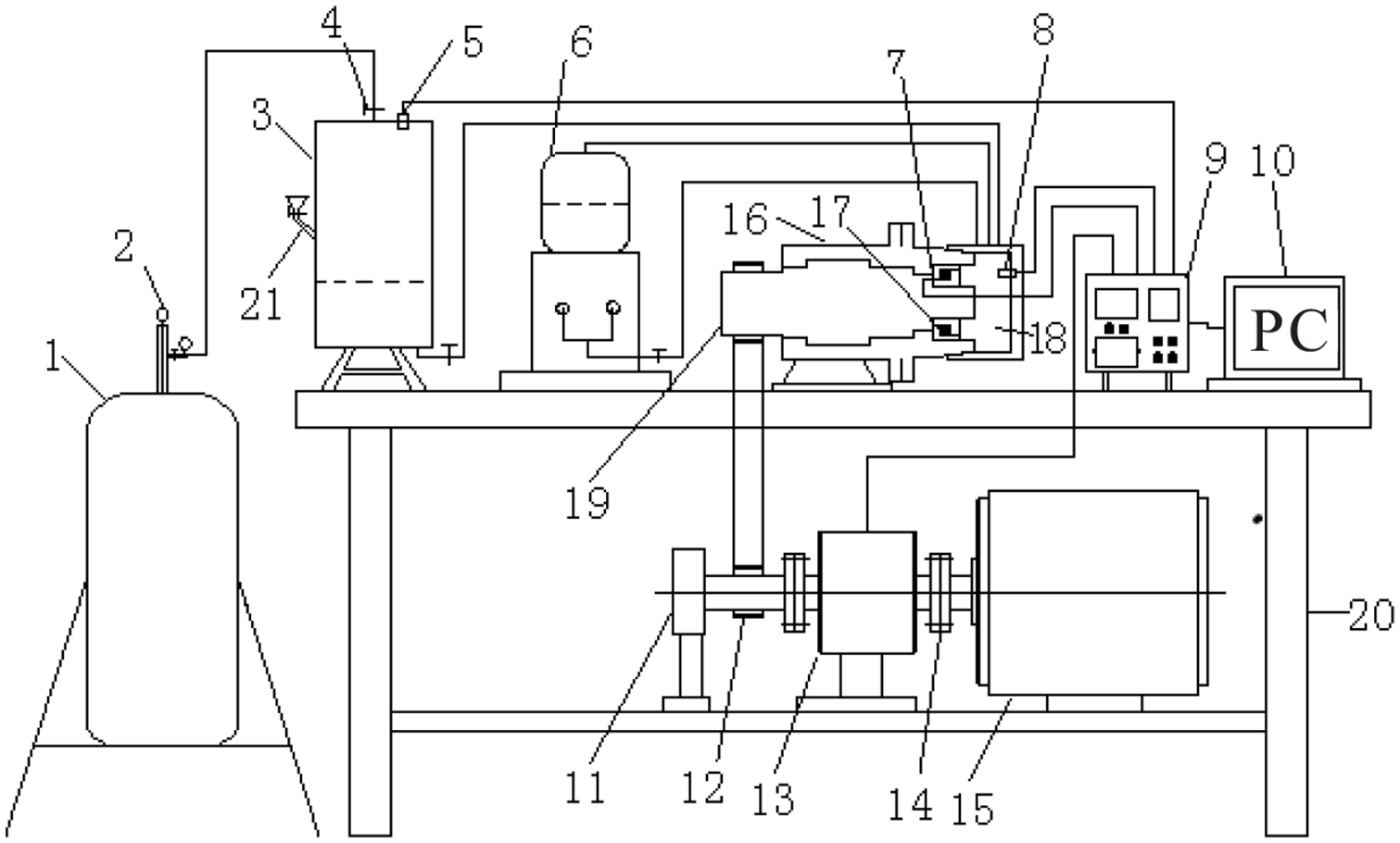
Schematic of sealing tester, 1-nitrogen gas cylinder; 2-pressure gage; 3-stabilization tank; 4-throttle valve; 5-pressure sensor; 6-heating medium temperature control equipment; 7-electrode; 8-temperature sensor; 9-instrument panel; 10-PC; 11-bearing house; 12-belt pulley; 13-torque sensor; 14-flange; 15-motor; 16-outer sleeve; 17-sealing element; 18-seal chamber; 19-rotating shaft; 20-frame; 21-funnel.
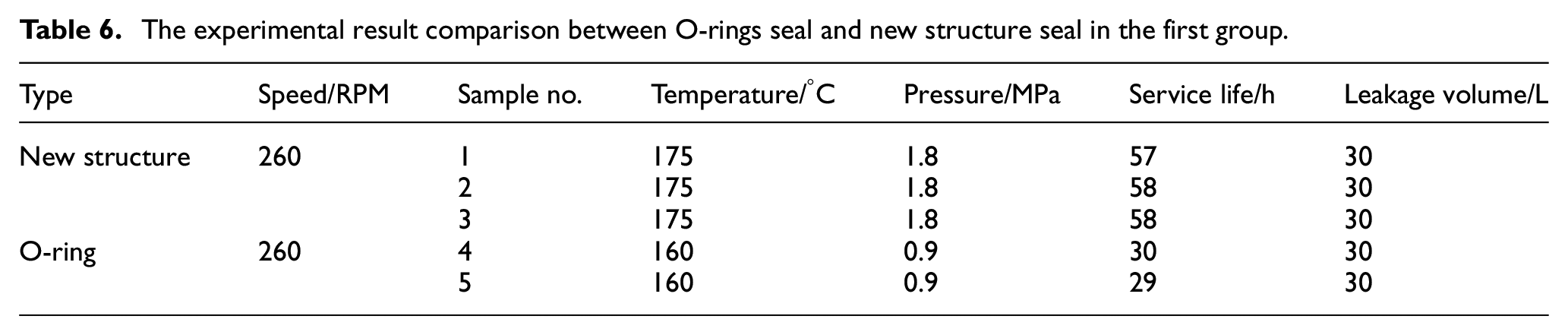
In the process of the experiment, it is difficult to measure the contact pressure, so the leakage volume is used to present the sealing performance. When the leakage volume is equal to 30 L, the test is considered as failure. In the drilling operation, both sides of the rubber seal rings work at high environment pressure. the sealing test just simulates the differential pressure between the two sides of the seal ring. Tables 6 and 7 show the experimental parameters and the test results. In these tests, the differential pressures are 1.8 MPa and 0.8 MPa, the environment temperature of the new structure seal and O-ring seal is 175°C and 160°C in the first group, respectively. In the second group the temperature is 160°C and 150°C, which indicates that the new structure works in a worse environment.
The experimental result comparison between O-rings seal and new structure seal in the first group.
The experimental result comparison between O-rings seal and new structure seal in the second group.

Table 6 presents the results of the first group. The three samples of the new structure work well for 57, 58, and 58 h. The two samples of O-ring seal have a service life of 30 h and 29 h respectively. It can be seen that although the new structure works in higher environment temperature and differential pressure, it still has a longer service life.
A higher rotational speed 450 RPM in the second experiment group is applied, and the result is shown in Table 7. In this test, the service life of the new structure seal is 70 and 68 h respectively, and the O-ring is 28 and 26 h. According to the test results of the two groups, the service life of the new structure is almost twice of the O-ring, although it works in a worse working environment.
Field application of the new structural rubber seal
The new structural seal is used to a 8 1/2 inch hybrid drill-bit (shown in Figure 13(a)). This drill-bit drilled from 2970 m to 3304 m with compound drilling and sliding drilling. have a service life of 30 h and 29 h, respectively, which is longer than the standard O-ring, the weight on bit was 50 kN, the formation temperature was about 118°C, and the mean rate of penetration was 3.05 m/h. According to the calculation, the working revolution of the roller-cone was about 980,000. After pulling out the hybrid drill-bit from the deep well, the roller-cone still can rotate smoothly and had no looseness. Then we separate the rubber seal from the drill-bit, which are shown in Figure 13.

Field application of the new structural seal: (a) the used hybrid drill-bit, (b) the new structural seal, (c) the inner and outer surface, and (d) two sides of the surface.
Figure 13(c) shows the inner and outer surface situation of the used seal. It can be seen that the wear of the two surfaces is not serious. The two side surfaces (Figure 13(d)) looks smooth. This result indicates that the new structural seal has a good sealing performance for the roller-cone bit at high temperature.
Conclusion
This paper designed a new rubber seal structure with multi-segment arcs for roller-cone bits in deep well drilling. Our studies focused on the analysis of the HNBR constitutive model under high temperature and the improvement of the sealing performances by the optimization of structural parameters. The sealing performances of our new designed seal was validated experimentally by using the lab experiment and the field application. The main results can be summarized as follows.
HNBR, which can stand high temperature, was selected as the material of the new seal. The constitutive model of the HNBR was analyzed theoretically based on Yeoh model, and the fundamental parameters of the model at high temperature were determined by the uniaxial, planar, and biaxial tensile experiments.
The optimization of the structure parameters had been conducted. We established a regression model between the optimal parameters (length
A 3D transient thermo-mechanical coupling FEM was proposed to compare the sealing performance between the traditional O-ring seal and the new structural seal. The maximum values of the Mises stress and the contact pressure of the new structural seal were both lower than the traditional O-ring. Moreover, the distribution of the Mises stress was more reasonable. According to the analysis of rotational speed and environment temperature, we found that the rotational speed has a significant influence on the heat accumulation, which means high temperature will cause a premature failure. Based on the experimental results, the service life was about twice of the O-ring seal. In addition, this new structural rubber seal was applied to a hybrid drill-bit in a deep well. After working 111 h, it is longer than the mean service life of the O-ring, it can still work well. The results indicate that the new structural seal has a good sealing performance and can be used in the deep well drilling under high temperature. Also the RSM is validated to feasible to the seal optimization.
Footnotes
Handling Editor: James Baldwin
Declaration of conflicting interests
The author(s) declared no potential conflicts of interest with respect to the research, authorship, and/or publication of this article.
Funding
The author(s) disclosed receipt of the following financial support for the research, authorship, and/or publication of this article: This work has been supported by Joint fund of National Natural Science Foundation of China (NFSC) (Grant No. U19A2097).
