




Abstract
To improve the trapping efficiency of respiratory dust by aerodynamic atomization, reduce the energy consumption and the requirements for the working conditions of nozzles and maintain the health and safety of workers, a comparative experiment evaluating aerodynamic atomization dust removal characteristics was conducted with a self-developed supersonic siphon atomization nozzle, which utilizes a Laval nozzle as the core, and an existing ultrasonic atomization nozzle. The experimental results showed that the new type of nozzle, from the perspectives of droplet speed, conservation of water and pressure, range, and attenuation view, completely surpasses the traditional pneumatic atomization nozzle. A supersonic antigravity siphon atomizer produces a cloud fog curtain composed of high-speed droplets and high-speed air. The particle size of the droplets is less than 10 µ. At the same flow rate of water, its dust removal rate is twice as high as that of ultrasonic nozzles. When the dust removal efficiency is the same, the water consumption of the supersonic siphon atomizer nozzle is 1/2, the air flow rate is 1/3, and the power consumption is 1/2 that of the ultrasonic atomizing nozzles. Siphon atomization can siphon at a total air pressure of 0.2 MPa, and the siphon pressure can reach 0.03 MPa at a total air pressure of 0.4 MPa, which increases with the increase in total inlet air pressure. For the first time, the process of siphoning and nozzle internal atomizing in the field of supersonic atomization dust removal is truly realized. The ultrafine sized droplets with high speeds produced by the new nozzle allow them to cover the limited working space in a shorter time, have a more effective trapping effect for a large number of fine dust particles, and quickly suppress the dust with greater kinetic energy. Therefore, the requirements for the working conditions are reduced, which will save more energy compared to the currently used nozzles available on the market.
Keywords
Introduction
Based on newly modeled data from the World Health Organization, 92% of the world’s population lives in places where air quality levels exceed the “WHO’s Ambient Air Quality Guidelines” for the annual mean of particulate matter with a diameter of less than 2.5 µm (PM2.5). 1 This kind of dust with a very small particle size is called respiratory dust, and it comes from many industries, such as mining, machining, civilian use, etc.2–4 In addition to inhalation endangering human health, PM2.5 can also attach to many toxic and harmful substances and cause complex chemical reactions.5–7 Aerodynamic spray is one of the primary methods in the field of dust removal, and its efficiency mainly depends on the atomization fineness and particle speed. In the process of collecting and catching dust, the droplet size needs to be close to that of the target dust particles, which is an extremely high requirement for the atomization efficiency.8–12
A supersonic aerodynamic atomization nozzle is a device based on the Laval nozzle proposed by researchers in recent years and is used in the field of dust removal. Its working principle is that by using the characteristics of the Laval nozzle, the nozzle can accelerate the velocity of the air flow to a supersonic speed. 13 The high-speed air then interacts with water and realizes the atomization process of water. 14 Therefore, many scholars have attempted to use the Laval nozzle as the core of aerodynamic atomization, including approaches in which water is jetted axially and broken up by the shear flow on both sides, water is jetted from the circumferential gap of the Laval expansion section, 15 a vibrating piece is added at the sidewall, etc. By adding surfactants (CaCl2 and Na2SO4) with high pressure atomization, and the promotion effect of surfactants on the dust-reduction efficiency of spraying decreased with the increase of pressure.16,17
A better optimization method is the ultrasonic atomization nozzle. It uses the air accelerated by a Laval nozzle to stimulate the ultrasonic vibration cavity, produces ultrasonic waves, and mixes a large number of high-speed air flows to form a microscale pneumatic fog curtain, thus realizing wet dust isolation and dust removal.18,20 In recent years, due to the world’s gradual exploitation of energy, nonrenewable resources are facing the danger of being gradually depleted, and for the widespread and long-term application of this approach, energy-saving has become an indicator of performance. However, because the air flow acceleration principle of the Laval nozzle has the characteristic of maintaining a high pressure (>0.5 MPa) at the entrance and, at the same time, has high requirements for the water injection pressure (>0.12 MPa), the airflow consumption exceeds 100 L/min, and this high energy consumption has become its deficiency in practical applications, although it has excellent atomization performance.20–22 How to save energy, that is, to reduce the pressure flow requirements of air and water and to maintain or further improve the atomization efficiency, has become a difficult problem in the industry.
Through previous research and experiments, we find that the existing aerodynamic atomization nozzles with a Laval structure cannot completely be called “supersonic” aerodynamic atomization because under ordinary jet pressure, the liquid column is unable to reach the supersonic region and cannot be combined with supersonic air. In contrast, the liquid is “blown” out of the nozzle at the edge, and many unbroken large-grained droplets overflow at the edge of the nozzle. Therefore, in this process, a large amount of supersonic flow deep in the flow field is wasted, which is the essential reason for its high energy consumption.
Thus, to solve the above problems, we put forward the principle of supersonic siphon atomization, and according to this principle, we designed and fabricated a standardized sprinkler that can be widely used in industrial fields. Furthermore, the advantages of the new nozzle are verified by a comparison experiment with the dust removal of the ultrasonic atomizing nozzle. This approach solves the problem of high energy consumption, further improves the atomization effect, realizes the process of supersonic crushing and siphon water injection, and provides a new choice for the field of fine atomization and dust removal.
Principle of the siphon nozzle
Simulation analysis of the supersonic flow field
As shown in Figure 1, the distributions of the air velocity, pressure, density and other basic indexes in the flow field of the Laval structure are approximately banded along the normal direction of the axis. When the molecules expand in the direction of the wall, they will be hindered by the wall. The air flow near the wall shows a relatively high density and high pressure, while the flow in the axial vicinity has a low density and low pressure.23,24

Supersonic flow field.
Siphon condition
In the experiment and simulation of droplet atomization, particles should be subjected to airflow expansion forces based on the density distribution in addition to the drag force. 25
When the gravity of the particle itself is ignored, the total force on the droplet is:

where Ftot is the total force of the droplets, Fl is the force from injection as determined by the initial velocity v0 of the particles, Fe is the air expansion force which should be mainly determined by the density of the air flow rather than the velocity, and Fg is determined by the velocity of the air flow field by Stokes on the wall between the two kinds of flow. It is assumed that the flow of water can enter the Laval by siphon when Fl = 1 atm is used. Therefore, if we want to save energy by reducing the pressure of the jet, we should avoid the expansion force and the high-speed pressure surface as much as possible. This requirement necessitates the probe having the right position, depth, and angle.
Design of the nozzle structure
Different from any of the atomization methods, atomizing processes are outside the nozzle, including the ultrasonic mode, which makes use of the atomizing vibration cavity outside the nozzle, the supersonic siphon atomization uses the supersonic and anti-gravity siphon principle to complete the fine atomization in the nozzle. This must be an unprecedented process.
As shown in Figure 1, the main difference between the supersonic aerodynamic atomization nozzle with a probe structure and ordinary nozzles is the addition of a probe for the water injection, which is a key structure connecting the tank and the route of air flow; the outlet and air flow are maintained at a certain angle but are not at an upwind section to avoid the expansion force and the high-speed pressure surface as much as possible.
Therefore, under the action of atmospheric pressure, the probe can directly lead the liquid flow into the high-speed zone of the supersonic flow field, and the velocity difference between the jet liquid and the air flow can reach the maximum. When the liquid flow is broken the smaller the particle size of the produced droplets is, the larger the number of droplets for dust removal is. Thus, a large amount of water energy is simultaneously saved in subsequent experiments.
In Figure 2, the following labels are shown: 1-protective cap of exposed probe, 2-exposed probe, 3-Laval structure nozzle, 4-probe outlet, 5-sealing ring, 6-supersonic airflow generator, 7-connection thread, 8-inlet, 9-inlet of air flow, 10-shell, 11-water storage cavity, 12-inlet gap.

Details of the supersonic siphon atomizing nozzle.
Experiment of dust removal by atomization
Arrangement of experiment
Equipment and measuring instruments
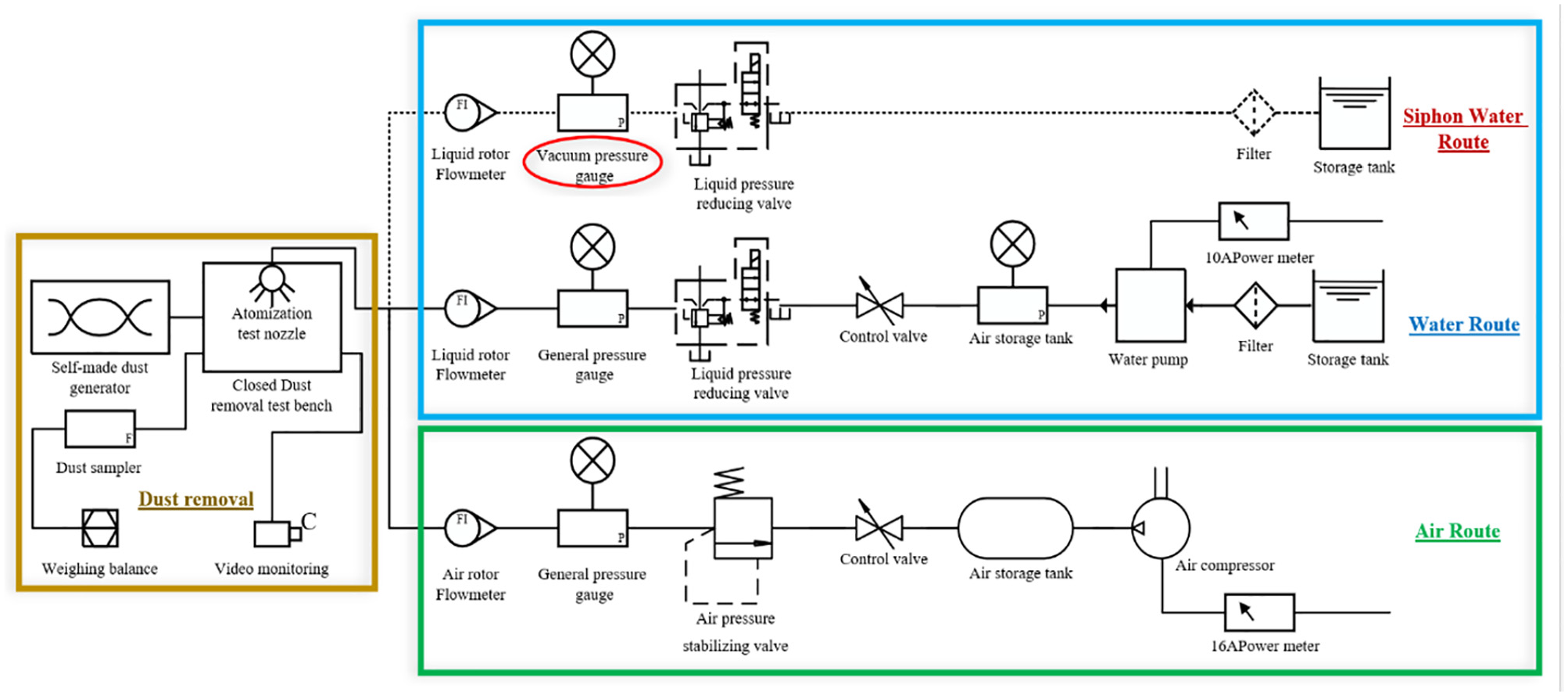
Equipment and instruments were arranged as shown in Figure 3.
Arrangement of equipment and instrument.
Equipment: ultrasonic atomizing nozzle, supersonic siphon nozzle, air pump, water pump, liquid pressure reducing valve, air stabilizing valve, conduit, water tank, homemade dust generator, fully closed experimental platform, high-speed camera measuring.
Instrument: air flowmeter, air pressure gauge, liquid flowmeter, liquid vacuum gauge, liquid pressure gauge, electric power meter, dust sampler, precision balance.
To ensure the effectiveness of the comparative experimental results, and in line with the purpose of energy saving and water saving, the parameters of the experiment are set in Table 1:
Parameters for the experiment.

Procedure
Weigh and number the filter membrane;
Connect the equipment and instruments according to the experimental layout to adjust the air path and water path to the established working condition parameters in Table 1;
Dust for 1 min and perform dust sampling every 30 s for 1 min;
Open the spray at the beginning of the dust sampling; simultaneously record the power consumption of the spray and take pictures;
After dust sampling, dry the filter membrane and weigh it immediately.
Calculate the dust concentration and dust removal efficiency at each time. The supersonic siphon nozzle can be evaluated by using the siphon water supply, and the water pressure data are collected by the vacuum meter.
Experimental results and analysis
Observation and analysis of the atomization fog field of the siphon nozzle
As shown in Figure 4 and in contrast with Figure 5, the atomization output of the siphon nozzle is extremely stable, atomizing into a cloud shape. The color near the nozzle is close to translucent; it has a very small particle size and a very high particle velocity so that the particles can quickly penetrate the dust area. In a very short time, the droplets cover the limited working space, and the very small particle size dust particles are quickly captured by impact, wetting, agglomeration and other means, so that the dust concentration decreases rapidly. The fog curtain formed by a large number of high-speed droplets and high-speed airflow completely separates the dust source from the staff, which ensures the health and safety of the staff. By entrusting the particle size test by laser diffraction (by Sympatec or Malvern) of Company of Jinan Winner (Shandong, China), it is basically proved that the D50 (the cumulative particle size distribution percentage of a sample reaches 50. Its physical meaning is that the particle size is larger than its particle size is 50%, and the particle smaller than it is 50%, D50 also called median particle size or median particle size. D50 is often used to represent the average particle size of powders) is about 6 µ at 300 mm from the nozzle outlet. The more detailed comparative data are shown in Table 2. The process of atomization, there is a large loss of non-atomization ability, which provides energy support for the increase of noise intensity. In the supersonic siphon atomization mode, the shock intensity in the Laval nozzle is small, the rigidity of the probe avoids the hedging of the gas-water energy, the energy loss is small, and the noise intensity is smaller than that of the ultrasonic atomization mode.

Nozzle and fog field of siphon atomizing.

Nozzle and fog field of ultrasonic atomizing.
Comparison of the performance parameters for two kinds of nozzles.

Analysis of the dust removal experiment results
The direct reading dust meter does cause the error of the experiment because of its law, so we use the dust sampler to calculate the dust concentration by the mass difference before and after the dry filter membrane experiment, thus avoiding the interference of water mist. The dust sample is collected by a mine dust sampler. The sampling position is the center outside the fog curtain of the experimental box body, which is used to represent the dust concentration in the experimental box.
The results of dust sampling experiment were obtained after drying, and the two kinds of atomization nozzles are shown in Figure 6. With the prolongation of spray time, the color of the filter membrane becomes lighter, and the color of the filter film with the ultrasonic atomization (top) is obviously darker than that of the supersonic siphon dust removal filter film (bottom).

Contrast of the filter membranes from the dust sampling experiment.
Analysis of the dust concentration variation
As shown in Figure 7, although the dust concentration in the wet dust removal space of both nozzles decreases very rapidly, the concentration in the supersonic atomization siphon mode dropped below 10 mg/m3 at 250 s, which is a well-known dust concentration control standard in the industry. For the ultrasonic mode, this time was extended to 420 s. Due to the higher speed and finer particle size of the droplets produced by the supersonic atomization, which makes them able to cover the limited working space in a shorter time, in addition to having a more effective trapping effect for a large number of fine dust particles and being able to quickly suppress the dust with greater kinetic energy.

Comparison of the dust concentration for two kinds of nozzles.
Analysis of the dust removal efficiency
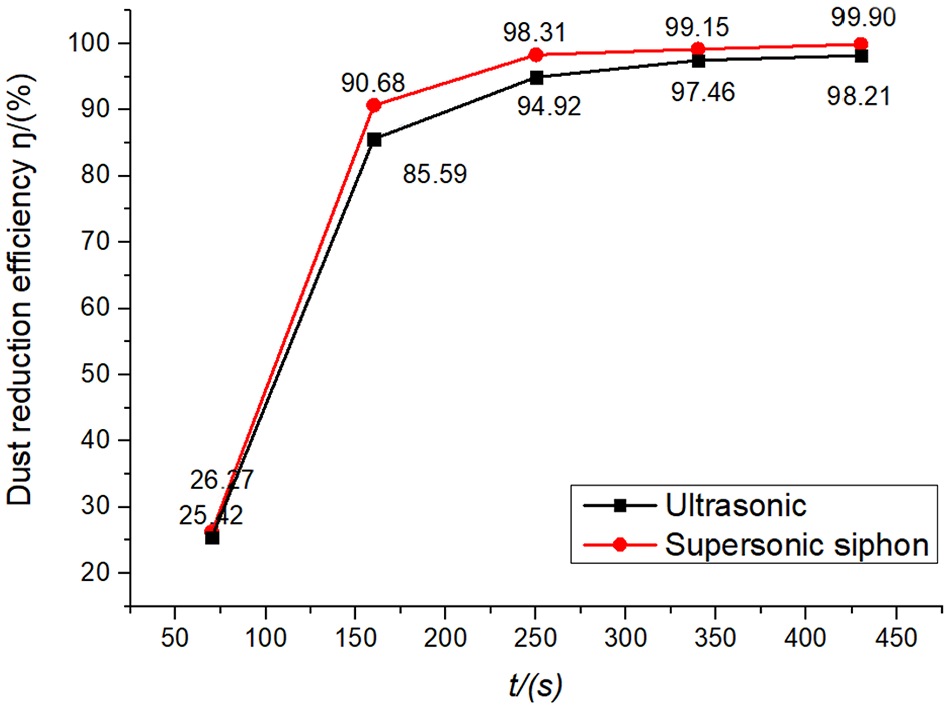
As shown in Figure 8, although both nozzles can achieve a very high efficiency of dust removal in a short period of time, the supersonic siphon atomization nozzle is faster, reaching 98% in 250 s, which is due to the finer atomization that occurs at the same rate of water flow, and the larger number of droplets, which increases the probability of collision with dust particles. At the same time, with faster the particle speed, the dust settles faster after it is captured, and a smaller amount of respirable dust escapes from the fog.
Comparison of the dust removal efficiency for two kinds of nozzles.
Analysis of conservation of energy
The power values of the air and water pumps are measured by using a power meter, and the power of the siphon atomization mode is measured by the air pump only. When the water flow rate is 0.05 L/min, the supersonic siphon atomization power is 1.5 kW, and the ultrasonic atomization power is 3.6 kW. As shown in Figure 9, the ultrasonic atomization consumes far more power than the siphon. As shown in Figure 10, compared with the supersonic siphon atomization mode, the ultrasonic atomization mode requires a higher boundary pressure and higher air consumption under the same total pressure of the gas path, which requires an almost continuous operation of air pump. Maintaining the boundary condition of a higher demand consumes more electricity and more compressed air at the same time.

Comparison of the energy consumption of two kinds of nozzles.

Comparison of the air consumption of two kinds of nozzles.
Analysis of the dust removal characteristics
According to industry standards, the total dust concentration in the workplace needs to be controlled below 10 mg/m3; considering time t0 for intercepting dust concentrations <10 mg/m3, the following parameters should be calculated to compare the dust removal performance:
When S is the dust intensity and t is the total dust time, the reduction rate of total dust can be calculated as follows:

When Ql is the water flow rate, the water consumption of the dust removal rate can be calculated as follows:

When Qg is the air flow rate, the water consumption rate of the dust removal can be calculated as follows:

The results of these calculations are shown in Tables 3–5. With the same efficiency of dust removal, the water consumption of the supersonic siphon nozzle is 1/2, and the reduction rate of the total dust is two times that of the ultrasonic atomizing nozzle. The siphon pressure of siphon atomization can reach 0.03 MPa at a total air pressure of 0.4 MPa, as opposed to the ultrasonic atomization nozzle, which needs to provide the water injection pressure of 0.12 MPa through the water pump.
Performance parameters for the comprehensive dusting of air and water route.

Characteristic of ultrasonic atomization dust removal.

Characteristic of

Analysis of uncertainty and error
Experimental accuracy error
This error occurs primarily because of the large number of measuring instruments used and readings estimated by the human eye. Because the experiment adopts the comparative method, the fluctuation of the pressure determined by the same pump and air pump is the same in the test, and the difference between the connecting systems is very small; thus, the bias error caused by the spray system is not taken into account. The power meter is digital, and the pump gas pump uses the same standard power meter; as such, the power comparison results are credible.
Dust concentration error
The balance used in the experiment is digital, and the error is 95% of the confidence level of b = ±0.1 mg. At the same time, due to the ash drop or ash removal in the process of filter membrane disassembly, a very small part of the data fluctuates; because the confidence level is 95%, the estimated increase or decrease range accounts for approximately 1% of the total, and the data are uncertain. The proportion of error at high concentrations is very small, and the relative error of the dust concentration measurement concentration is 10%. Because the dust falling rate is too fast and the measurement time is very limited, the volume cardinal number of the suction air flow is small, which leads to the relative error of the result that increases to 50% at low concentrations. The overall uncertainty is calculated in the following formula:

The uncertainty after propagation is ±7.07 mg/m3 (at low concentration ±5 mg/m3)
Dust removal efficiency error
As the calculation of the dust removal efficiency uses the initial concentration as the base, the initial concentration is approximately 100 times the uncertainty error; thus, the relative error of the dust removal efficiency is reduced by 100 times. The relative error is 0.81%, and the uncertainty is ±1.18%.
Conclusion and discussion
A supersonic siphon atomization nozzle is a highly efficient and energy saving dust removal nozzle that was designed with Laval as the core to realize siphon water injection. The water injection is achieved on the basis of supersonic crushing atomization, which is reflected in the following three aspects.
First, the atomization performance of the supersonic siphon atomization nozzle is very good; its fog curtain presents a cloud shape and is composed of high-speed droplets and high-speed gases. The particle size of droplets is approximately 10 µ, which has a longer range and wider coverage. Second, from the dust removal perspective, the performance of the supersonic siphon atomization nozzle is much better than that of the ultrasonic nozzle at the same water flow rate. The higher speed and finer particle size of droplets produced by supersonic atomization makes them able to cover the limited working space in a shorter time; additionally, these droplets have a more effective trapping effect for a large number of fine dust particles and can quickly suppress the dust with greater kinetic energy. The dust removal rate the supersonic siphon atomization nozzle is twice as fast as that of ultrasonic nozzles.
Finally, considering energy savings when the dust removal efficiency is the same, the water consumption of the supersonic siphon atomization nozzle is 1/2 that of the ultrasonic atomizing nozzle, the gas flow rate is 1/3, and the power consumption is 1/2. These decreases mean that the same energy supply can drive more supersonic siphon atomizing nozzles than ultrasonic atomization nozzles and can achieve an extremely high dust removal efficiency in a short period of time. The siphon pressure of siphon atomization can reach 0.03 MPa when a total gas pressure of 0.4 MPa is used; that is to say, by using siphon atomization, the flow can be lifted by 3 m in the vertical direction without adding pump pressure, and the distance will increase with an increase in the total gas pressure. Thus, this method will be a good choice in many places where it is difficult to install pumps and lay pump lines, and because of the siphon of the waterway pressure, the demand for pump performance will be greatly reduced in locations with higher fog. In addition, compared with an ultrasonic atomizing nozzle, a supersonic siphon atomizer can siphon at 0.3 MPa, and at <0.5 MPa, the supersonic siphon atomizer still operates stably and efficiently at low pressure.
Footnotes
Handling Editor: James Baldwin
Declaration of conflicting interests
The author(s) declared no potential conflicts of interest with respect to the research, authorship, and/or publication of this article.
Funding
The author(s) disclosed receipt of the following financial support for the research, authorship, and/or publication of this article: The authors gratefully acknowledge the financial support from the National Natural Science Foundation of China (51704145, 51704146, 51274116).
