




Abstract
This article investigates the heat and mass transfer in flow of bi-viscosity fluid through a porous saturated curved channel with sinusoidally deformed walls. The magnetic field and Joule heating effects are also taken into account. The equations describing the flow and heat/mass transfer are developed using curvilinear coordinates. A reduction of these equations is made based on lubrication approximation. The reduced linear ordinary differential equations are integrated numerically using an implicit finite difference scheme. It is observed that, the bi-viscosity fluid parameter, permeability parameter, and Hartmann number have analogous effects on the longitudinal velocity. Moreover, temperature of the fluid, heat coefficient, and mass concentration increase by increasing bi-viscosity fluid parameter, Brinkmann number, and Hartmann number. Further, mass concentration increases by increasing the rate of chemical reaction and bi-viscosity parameter. The size of circulating roll in lower half of the channel boosts up with larger variation of bi-viscosity parameter and permeability parameter. The flow patterns in the channel illustrating the effects of bi-viscosity parameter, permeability parameter, and Hartmann number are also displayed.
Keywords
Introduction
Flow due to sinusoidally deformed vessel walls is commonly known as peristaltic flow. Peristaltic flows are caused by rhythmic contractions and relaxations of smooth muscles of the vessel. Peristalsis is a major mechanism found in the human body for physiological fluid transport. Examples of physiological fluids transported by peristaltic activity are urine, blood, chyme, spermatic fluid, etc. Modern machines which operate on the principle of peristalsis are heart-lung machine, diabetic pumps, roller and finger pumps, pharmacological delivery systems, etc.
The fluid dynamics of peristalsis are extensively investigated in the literature in past few decades. The first theoretical and experimental investigation on peristaltic flows was presented by Shapiro et al. 1 based on the absence of curvature and inertial features. This prestigious investigation has been further extended for nonlinear fluid models,2–9 curvature consequences,10–14 magnetohydrodynamic prospective,15,16 electro-osmotic effects, 17 and slip effects.18–20 The important phenomena of heat and mass transfer have also been investigated by researchers for peristaltic transport as it involves motivated significance in area of laser therapy, hemodialysis, chemotherapy, and cryosurgery.21–27 More recently peristaltic flow of nanofluids is an active area of research because of novel applications in micropumps, drug delivery systems, and pharmacological engineering. 28
Due to multidisciplinary applications of non-Newtonian materials, researchers have concentrated on explanation of complex physical properties in recent days. It is well justified fact that all physical properties of non-Newtonian liquids cannot be completely predicted by intruding a single mathematical relation. Following such distinguish rheological features, bi-viscosity fluid characterizes to non-Newtonian fluids because of complex rheological properties. The relation for shear stress and deformation rate is extensively different from traditional viscous fluid model. The unique feature associated with this fluid model behaves like solid when yield stress is larger as compared to shear stress and deforms continuously when amount of stress becomes dominant with respect to yield stress. The motivated application encountered by bi-viscosity liquid reports physical applications in food processing, metallurgy and drilling processes. Biviscosity fluid materials include priceless applications in many biological fluids, blood, synovial liquids, plasma, lubricants, many pharmaceutical products, proteins, sewage sludge, china clay, and many more. Number of researchers investigated rheological impact of this model in various flow scenarios. For instance Dash et al. 29 described the flow characteristics of bi-viscosity fluid through a homogeneous porous medium bounded by a circular tube. The mixed convection and variable thermal features for dissipative flow of bi-viscosity nanofluid have been intended by Hayat et al. 30 The effects of chemical reaction on flow of biviscosity fluid are thoroughly studied by Shehzad et al. 31 and Reddy et al. 32 Further, studies regarding flows of bi-viscosity fluids can be found in references.33–35
The porous medium is a stuff that encompasses spaces between solid areas through which fluid can pass. In recent years, considerable interest has been noticed to examine the flow through saturated porous space due to its fundamental applications in petroleum engineering, soil sickness, geophysical processes, and medical applications. Some fundamental applications for saturated porous media flow include filtration and extraction of oil from wells, water draining applications for irrigation, oil flow in porous rocks, energy extraction associated with geo-thermal systems, the fluid flow in ion-exchange beds, and oil-spills cleaning. The foremost contribution on flows through porous media was made by Brinkman, 36 who calculated the viscous force exerted by a flowing fluid through a porous media. Peristaltic flows through porous medium are also an active area of research. Several authors contributed to this area. Mention may be made to the work of El Shehawey, 37 Mekheimer, 38 Kothandapani and Srinivas, 39 and Hayat et al. 40 in various scenarios. Javed et al. 41 studied the effect of mixed convection through micropolar nanofluid under the impact of magnetohydrodynamics. In a separate study Javed et al. 42 examined the effect of heat transfer in water–Cu nanofluid saturated porous medium through trapezoidal cavities under the influence of magnetic field. Javed et al. 43 investigated effect of natural convection in a ferro-fluid filled square cavity in the presence of uniform magnetic field. Mehmood et al. 44 investigated the combined effect of MHD-Mixed convection flow in a lid driven trapezoidal cavity in presence of heated bottom wall. In a separate study Mehmood 45 simulated numerically the effect of mixed thermomagnetic convection through two lid-driven entrapped trapezoidal cavities enclosing ferrofluid saturated porous medium. Mehmood and Javed 46 considered the impact of MHD on energy transmission through ferrofluid saturating porous medium contained in a lid-driven trapezoidal container with triangular notched heater configuration.
The phenomenon of heat transfer in flowing materials involves a variety of applications in many chemical and mechanical industries, thermal engineering, electronic devices, nuclear thermal-hydraulic processes, etc. Owing to such interesting applications, many authors analyzed the heat transfer characteristics in flow of different fluids. For instance, Belhocine 47 examined the heat transfer analysis in flow developed flow configured by a circular tube. The work of Belhocine and Omar 48 deals with study of convective heat transfer due to circular tube where analytical solution were computed for formulated flow problem. In another useful contribution, Belhocine and Abdullah 49 deals the flow and heat transfer of viscous fluid by using constant wall temperature assumptions, usually called the Graetz problem. The thermal boundary layer analysis for modified Levèque problem has been performed by Belhocine and Abdullah. 50 Joule heating appears due to the resistance offered to electric current passing through some conductive material. There are number of systems in which Joule heating effect has vital role such as dielectrophoretic trapping, electric fuses, PCR reactors, hot plate, microvalves for fluid control, electric heaters and stoves, thermistors and soldering irons, etc. The effect of Joule heating in peristalsis has also been investigated. For detail see references.51–55
From literature cited above, some investigations regarding the peristaltic flow of bi-viscosity model encountered by a porous saturated straight vessel have been performed but no continuation has been utilized to explore the peristaltic phenomenon in a curved porous-saturated channel. Such motivated applications insist us to report the heat and mass transportation in magnetized bi-viscosity fluid configured by a curved channel in presence of porous medium. The objective here is to report the consequences of formulated dimensionless parameters namely Brinkmann number, bi-viscosity fluid constant, radius of curvature, Hartmann number, and porous medium permeability on combined heat/mass transportation. It is remarked that although variety of studies are available in the literature regarding the peristaltic flow of non-Newtonian fluids in curved channel but analysis regarding peristaltic transport of magnetized bi-viscosity fluid in presence of Joule heating, porous medium and heat and mass transfer phenomenon has not be investigated yet. The aim of current contribution is to fulfill this research gap. The governing equations for the concerned flow model are constituted under the assumption of dominant viscous effects as compared to the inertial features. The solution for formulated flow problem has been suggested by employing implicit finite difference scheme with desirable accuracy. Later on, a comprehensive graphical analysis for each flow parameters is reported with relevant physical consequences.
Modeling of flow problem
We assume a curved porous channel having width


where


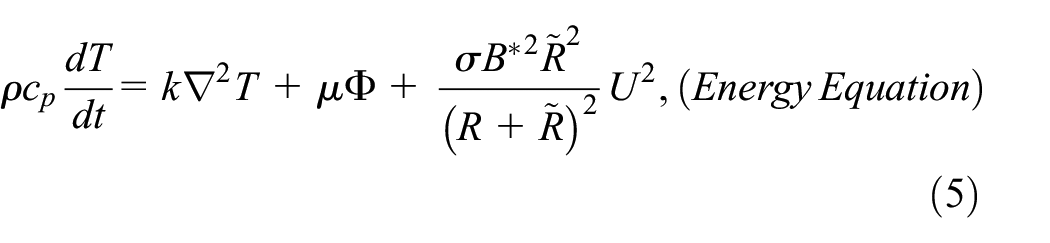

where
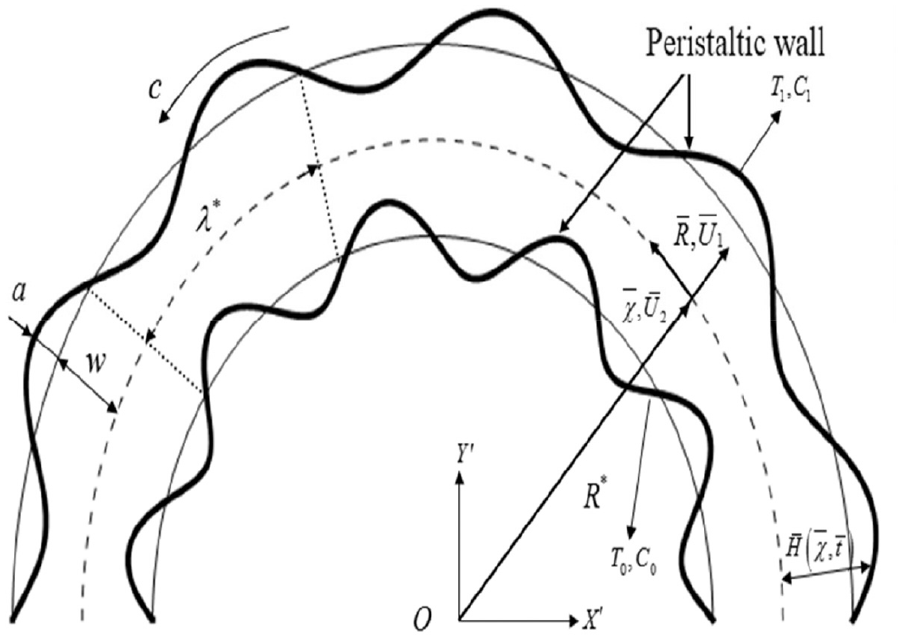
Geometry of the problem.
For bi-viscosity fluid model 29

where

in which

Using equations (8) and (9), we get stress tensor for bi-viscosity fluid flow

In view of equation (10), equation (4) becomes 29

The form of the radial magnetic field

where
Using equation (12), the term

where
Assuming

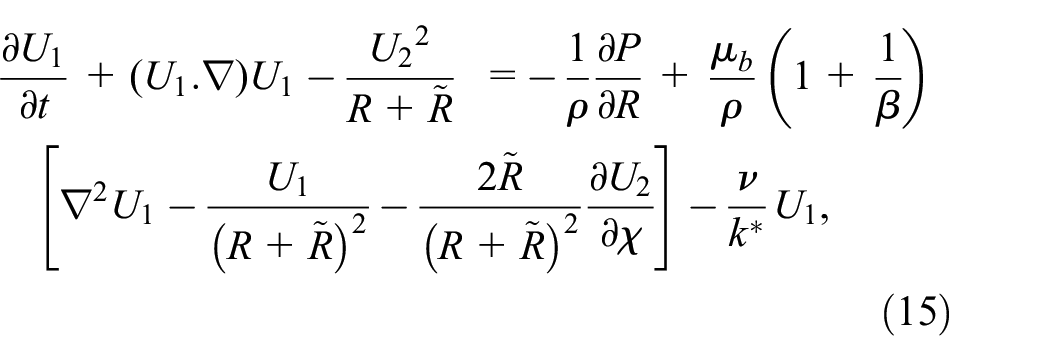

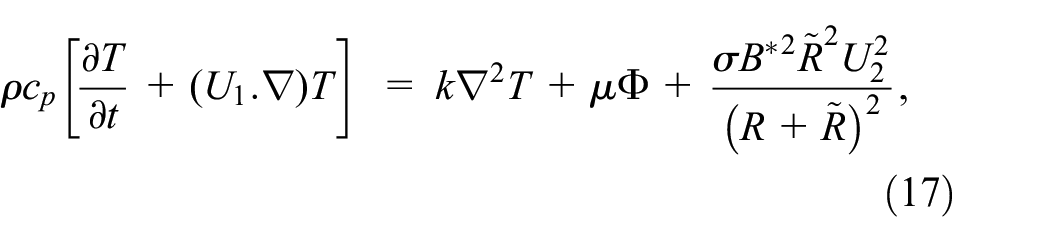

where



The boundary conditions associated with equations (14) to (18) are 23


In order to shift from fixed frame

The governing equations are transformed to wave frame by using above transformations. These equations after defining the dimensionless variables22,23


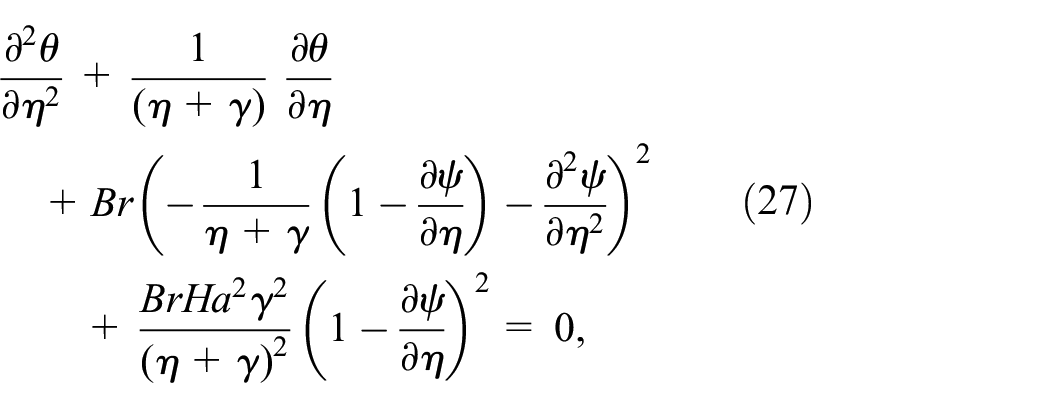

In above equations Re, δ,

After eliminating pressure between equations (25) and (26), we get

The transmuted boundary conditions (22) and (23) are


where



Finite difference scheme
The set of equations (27), (28), and (30) subject to boundary conditions given in equations (31) and (32) are quite complex and highly nonlinear for which analytical solution is not possible. On this end, we follow finite difference approach to simulate the numerical solution of such highly complex equations. This method successfully tacked nonlinear differential equations with excellent accuracy. This method is also sufficient to compute the solution of problem associated with curved boundaries and complex boundary conditions. The numerical computations are performed by using FORTRAN software. This method is based on following four steps:
(i) First step is to construct an iterative technique to allow the new nonlinear boundary value problem (BVP) to be transformed into a linear one at the (m + 1)th iterative stage. For this specific problem, the subsequent iterative technique is suggested:


Here, the index (m) shows the iterative step. It is now clear that above BVP is linear in
(ii) In this step, we insert finite difference approximations of
(iii) In third step, the system of algebraic equations obtained in previous step are solved at each cross-section to get numerical results of
(iv) In this step, we employed method of successive under-relaxation to get rapid convergent solution. In this method the values of


where
Usually,
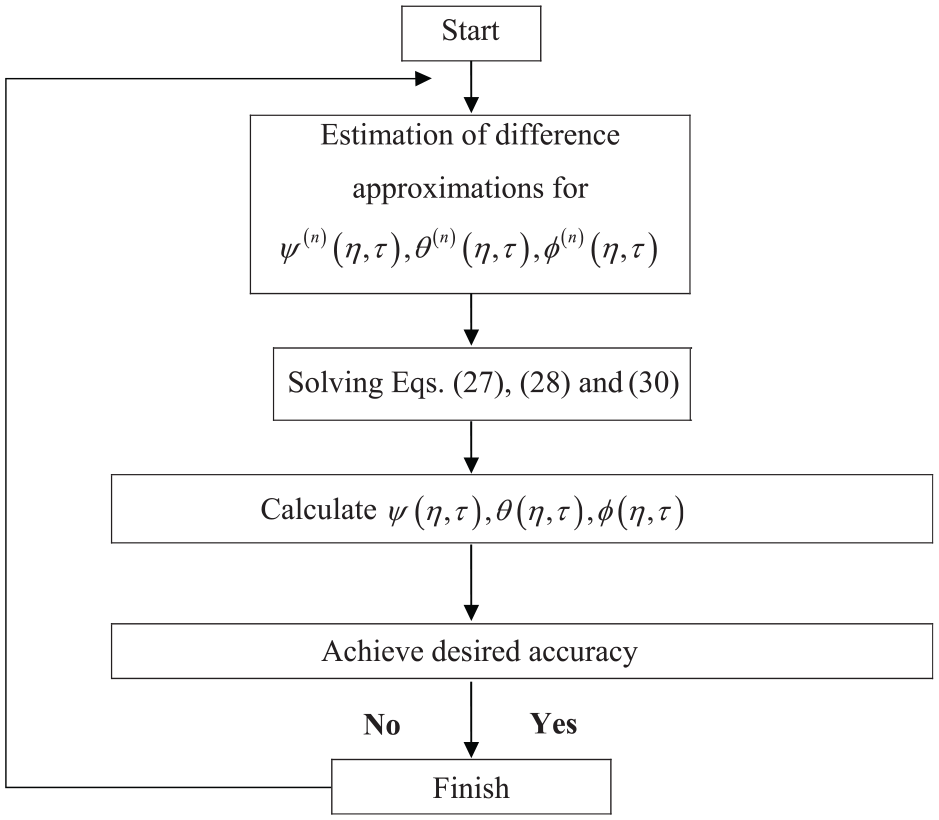
The flow chart of the numerical method.
Verification of solution
The numerical solution computed in previous section is compared for velocity profile with work of Ali et al.
22
as a limiting case

Comparison of solution for velocity: superimposed line denotes the work of Ali et al. 11 while solid line represents numerical solution.
Results and discussion
In this section, it is intended to analyze the important features of peristaltic motion such as velocity, pressure rise, temperature distribution, mass concentration and trapping for various values of the curvature parameter




z at upper wall for
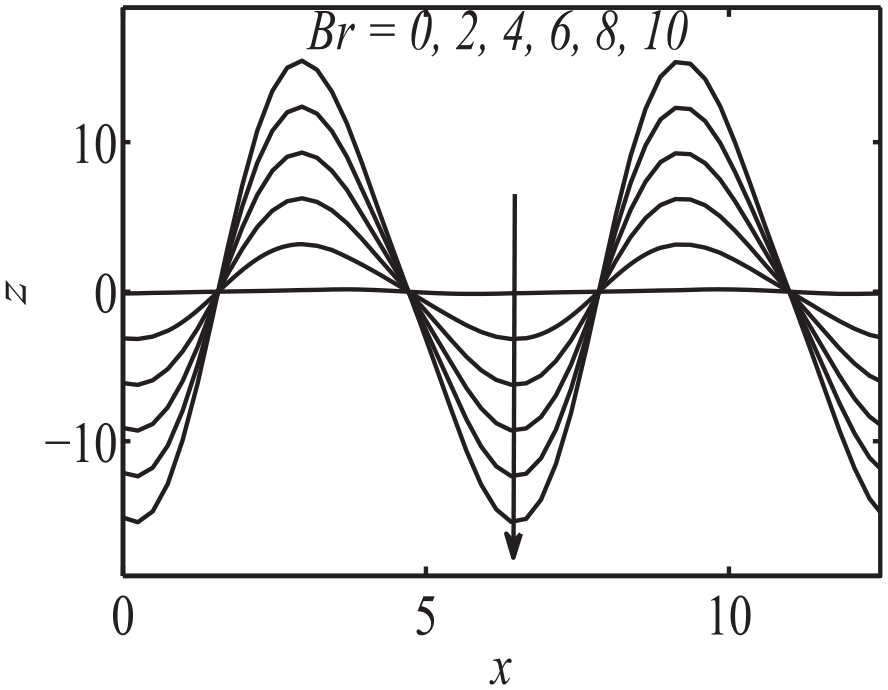
z at upper wall for Br with

z at upper wall

z at upper wall for

ϕ
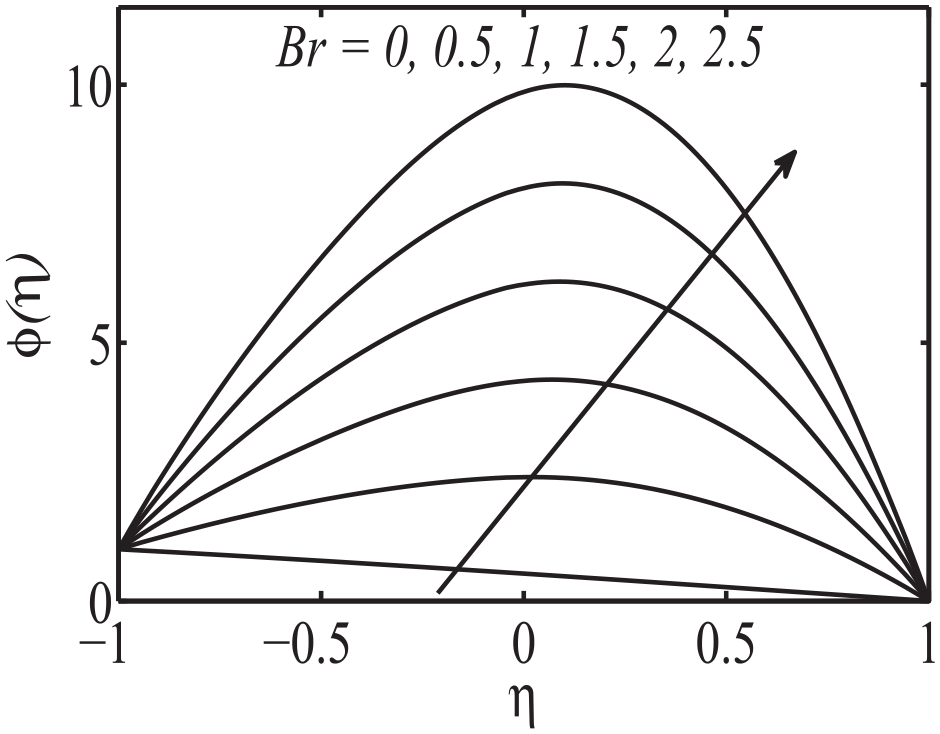
ϕ

ϕ
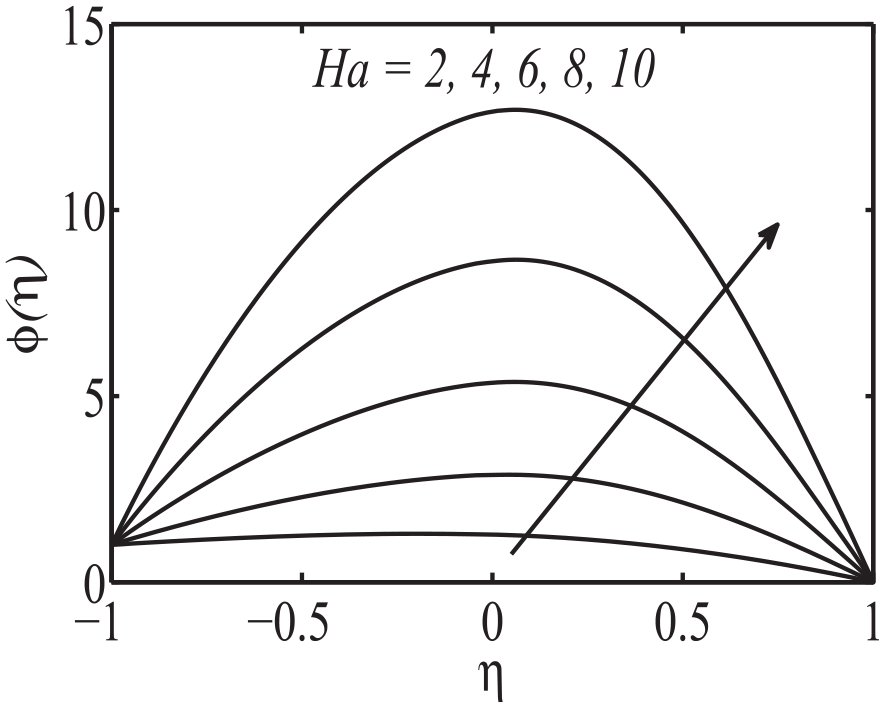
ϕ

ϕ

ϕ

Streamlines in wave frame for (a)

Streamlines in wave frame for (a)

Streamlines in wave frame for (a)
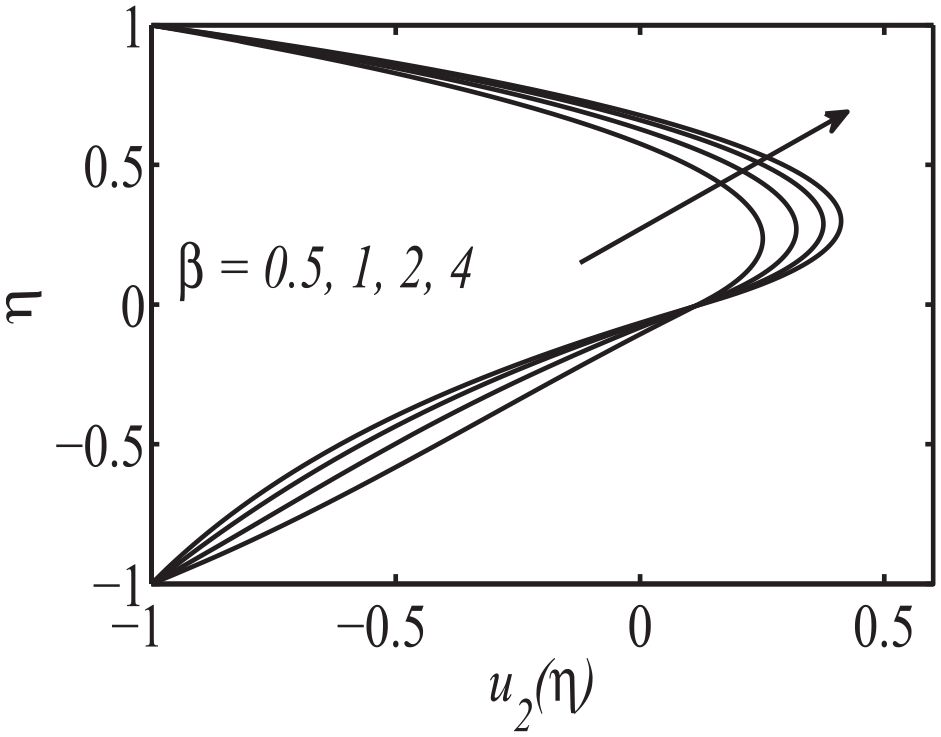
The axial velocity distribution for some specific values of bi-viscosity parameter
The mass concentration variation inside the channel for several values of bi-viscosity parameter, Brinkmann number, rate of chemical reaction, Hartmann number, Schmidt number and Soret number are shown in Figures 20–25. It is observed that mass concentration inside the channel increases with increasing each of these parameters. The streamlines of flow inside the channel for different values of bi-viscosity parameter
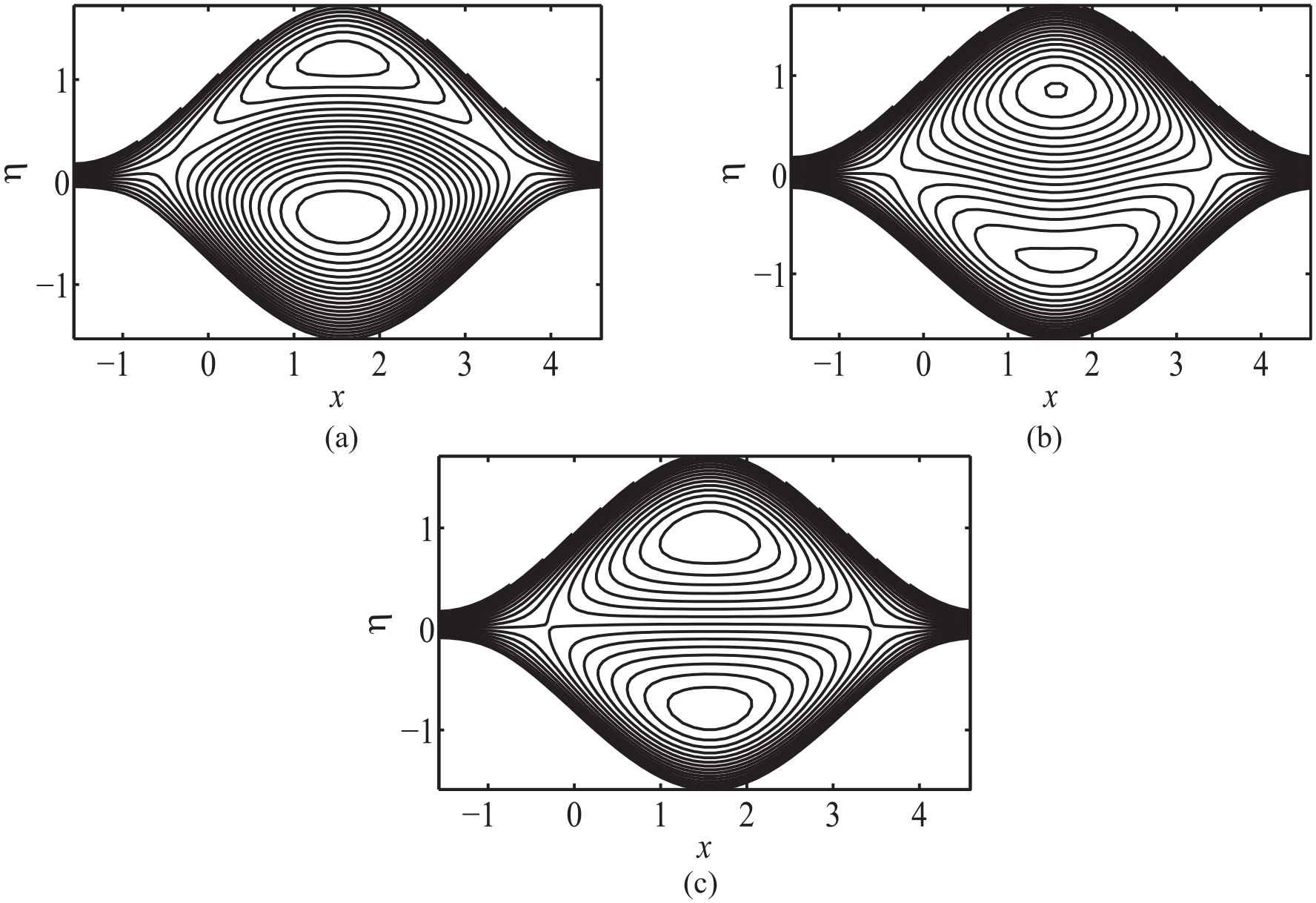
Streamlines in wave frame for (a)
Concluding remarks
The peristaltic flow of bi-viscosity fluid in a curved porous channel with extended and contracting walls has been studied under the assumptions of long wavelength. The channel with sinusoidally deformed walls is assumed to be porous. Rheological non-Newtonian material characteristics are evaluated by using bi-viscosity fluid model. The heat and mass transfer features are examined in presence of Joule heating effects. The numerical simulations based on finite difference scheme are performed with desirable accuracy. The novel characteristics of pressure, velocity, temperature, concentration and streamlines are graphically underlined. This analysis predicts following interesting observations:
The flow velocity is observed up to maximum level with variation of
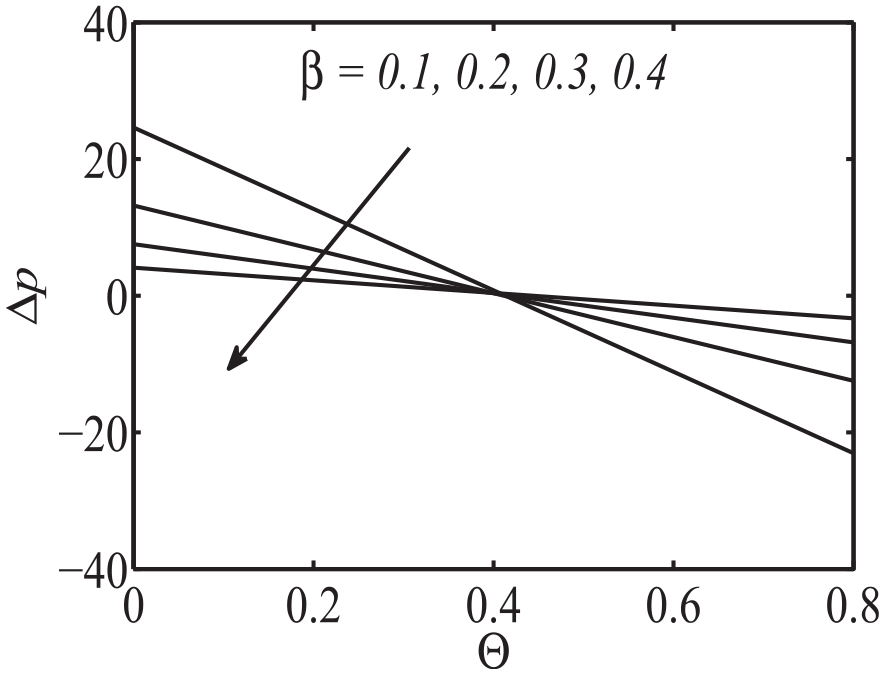
Pressure rise per wavelength decreases with increasing
A declining temperature variation has been observed due to impact of
The mass concentration increases with increasing
The size of circulating roll in lower half of the channel boosts up with larger variation of
The symmetry in velocity and streamlines pattern is observed when
The results for Newtonian fluid are achieved for larger values of
Supplemental Material
Appendix – Supplemental material for Heat and mass transfer characteristics in flow of bi-viscosity fluid through a curved channel with contracting and expanding walls: A finite difference approach
Supplemental material, Appendix for Heat and mass transfer characteristics in flow of bi-viscosity fluid through a curved channel with contracting and expanding walls: A finite difference approach by Raheel Ahmed, Nasir Ali, Sami Ullah Khan, Ali Chamkha and Iskander Tlili in Advances in Mechanical Engineering
Footnotes
Appendix
Handling Editor: James Baldwin
Declaration of conflicting interests
The author(s) declared no potential conflicts of interest with respect to the research, authorship, and/or publication of this article.
Funding
The author(s) received no financial support for the research, authorship, and/or publication of this article.
Supplemental material
Supplemental material for this article is available online.
References
Supplementary Material
Please find the following supplemental material available below.
For Open Access articles published under a Creative Commons License, all supplemental material carries the same license as the article it is associated with.
For non-Open Access articles published, all supplemental material carries a non-exclusive license, and permission requests for re-use of supplemental material or any part of supplemental material shall be sent directly to the copyright owner as specified in the copyright notice associated with the article.
