




Abstract
Thermal performance of Al2O3 nanoparticles dispersed in water was evaluated experimentally in a fully instrumented circular tube under turbulent flow conditions. Thermophysical properties of Al2O3 nanofluids at three different volumetric concentrations (0.38%, 0.81%, and 1.30%) were determined as a function of temperature. Pressure drop and heat transfer experiments were carried out at different volumetric concentrations and inlet fluid temperatures (10°C–30°C). The overall performance of the Al2O3 nanofluids was evaluated by considering both their hydraulic and heat transfer characteristics. The experimental results showed that the use of Al2O3 nanofluids increases the pressure drop by up to about 13% due to the greater viscosity. In addition, the heat transfer coefficient of nanofluids increased with the volumetric concentration by up to approximately 19% induced by the enhanced thermal conductivity. Furthermore, the experimental results indicated that the nanofluid with a volume fraction of 0.81% at the highest inlet fluid temperature increases the overall performance by up to around 8% and performs better than the other volume fractions. Enhancement in the overall performance increases with increasing inlet fluid temperature because of both the enhanced effective thermal conductivity and the decreased viscosity, which increases the energy exchange and decreases the pressure loss, respectively.
Introduction
As energy demand increases, the energy consumed by heating and cooling in buildings has increased significantly. However, conventional heat transfer fluids (HTFs) are still widely used in heat transfer applications, and a considerable amount of pumping power is consumed as a result of their poor thermal properties. To enhance heat transfer performance, nanofluids have been attractive in the past three decades because of their enhanced thermal properties. Nanofluids consist of nanoparticles and a base fluid and the effective thermal conductivity increases by the nanoparticles in a nanofluid, which can significantly improve heat transfer. 1 In particular, nanofluids with Al2O3 nanoparticles have been widely researched and utilized owing to the superior thermal properties, stability, and high productivity of these nanoparticles. 2 Thus, many researches about Al2O3 nanofluids in heat transfer applications have been performed.3–5
Thermophysical properties of Al2O3 need to be investigated to identify how Al2O3 nanoparticles affect the hydraulic and heat transfer characteristics of nanofluids. 6 Pak and Cho 7 characterized the thermophysical properties of Al2O3 nanofluids and TiO2 nanofluids. Density was measured, which increased with the volume fraction. Viscosity was measured with varying the volume fraction ranging from 1% to 10%. The experimental results show that the viscosity is nearly independent of shear rate and increases with the volume fraction. Agarwal et al. 8 synthesized Al2O3 nanoparticles and evaluated the thermal conductivities. Al2O3 nanoparticles dispersed in water or ethylene glycol with different concentrations. They found that the Al2O3 nanoparticles synthesized at 1000°C are mostly stable and the nanoparticles enhance the thermal conductivity. Kiruba et al. 9 evaluated the rheological characteristics of Al2O3 nanofluids including polyethylenimine as an additive. They suggested that using polyethylenimine enhances the gel formation and the viscosity is approximately independent of fluid temperature. Kumar et al. 10 measured the thermal conductivity of water based Al2O3 nanofluid with varying the temperatures (30°C, 40°C, 50°C). They found that increasing the volume fraction of nanoparticles in water from 0.01 to 0.08 vol.% enhanced the thermal conductivity, and that the higher temperature increases the thermal conductivity. It was found that the enhanced thermal conductivity is effective in improving the heat transfer performance. Teng et al. 11 investigated the effect of Al2O3 particle size on thermal conductivity and the experimental results showed that the lower particle size enhance the thermal conductivity of Al2O3 nanofluids. Viscosity of water based Al2O3 nanofluid with two different particle sizes, 36 and 47 nm was measured by Nguyen et al. 12 They found that increasing the particle loading and decreasing the temperature significantly increase the nanofluid dynamic viscosity. Elias et al. 13 found that the viscosity of Al2O3 nanofluid with a volume fraction ranging from 0 to 1 vol.% increases with the increase of volume concentrations and the higher temperature decreases the viscosity.
Al2O3 nanofluids were experimentally assessed as enhanced HTFs by many researchers14–16 Pak and Cho 7 experimentally characterized the flow and heat transfer behaviors of two different nanofluids in a circular pipe. The experimental results indicated that nanoparticle concentrations increase pressure drop because of the increased viscosity. In addition, a greater particle concentration increases heat transfer coefficient (HTC) under the same Reynolds number. Nusselt number correlation for nanofluids with the nanoparticle volumetric concentrations ranging from 0% to 3.0% was postulated. Heyhat et al. 17 investigated the convective heat transfer and friction factor of Al2O3 nanofluids in a circular tube with constant wall temperature under turbulent flow conditions. Experimental results showed that the convective heat transfer coefficient of the nanofluids increases with the volume concentrations of nanoparticles in the fluid by up to about 23% at 2.0 vol.% when compared to pure water. Convective heat transfer characteristics of a water-Al2O3 nanofluid in a circular tube under turbulent flow were observed by Colla et al. 18 Experimental results showed that heat transfer coefficients increase with an increase in flow rate and nanoparticle concentrations. They suggested that it is more effective to employ a water-Al2O3 nanofluid at low volumetric concentration less than 1.0%. Fotukian and Esfahany 19 performed an experimental study of turbulent forced convective heat transfer of Al2O3-water nanofluid in a circular tube with constant wall temperature. Results showed that adding nanoparticles enhanced considerably heat transfer coefficient by up to 48% at 0.054 vol.% concentration compared to pure water. Heris et al. 20 observed laminar flow convective heat transfer characteristics of Al2O3 nanofluids through circular tube with constant wall temperature conditions. Experimental results clearly indicated that nanofluids can increase the heat transfer coefficient even at low concentration. They emphasized that the single phase correlation is not able to predict the heat transfer coefficient of nanofluids. Mojarrad et al. 21 experimentally observed the hydrodynamic and thermal behaviors of alumina/water and alumina/water–ethylene glycol 50–50 by volume (WEG50) nanofluids in the thermal entrance region of a circular tube with constant wall temperature. Thermal conductivity and the viscosity of nanofluids increase with nanoparticles concentration in the base fluid, which were greater than those of the base fluids. Convective heat transfer coefficient and pressure drop of the nanofluids increase with an increase of Reynolds number as well as the particle concentration. Experimental results showed that adding nanoparticles to WEG50 have more effect on the heat transfer performance compared to water. It was found that adding nanoparticles to the base fluids can improve the energy ratio at constant Reynolds number, which suggests that nanofluids can be used as an enhanced working fluid at heat transfer engineering applications. Kim et al. 22 experimentally observed the effects of the concentration of Al2O3 nanofluid and the size of nanoparticles on the efficiency of a U-tube solar collector. They found that adding nanoparticles into a base fluid improves the thermal conductivity and the greater nanoparticle size decreases it. The solar collector with Al2O3 nanofluid (1.0 vol.% and 20 nm nanoparticles) has the highest efficiency, 24.1%, which was higher than that of water. Under the constant nanoparticle concentrations, the efficiency of the solar collector increases with a decrease in nanoparticle size due to the enhanced effective thermal conductivity. Wen and Ding 23 studied convective heat transfer of nanofluids, Al2O3 nanoparticles dispersed in de-ionized water, in a copper tube under laminar flow regime. Experimental results showed that using nanofluids can enhance heat transfer performance remarkably and the previous correlation for the single phase flow is not able to predict the heat transfer behavior of Al2O3 nanofluids because of the migration of nanoparticles. Sharma et al. 24 experimentally investigated the heat transfer coefficient and friction factor of Al2O3/water nanofluid in a tube including twisted tape inserts. The results showed that the heat transfer coefficient of 0.1 vol.% nanofluid is 23.7% greater than that of water at Reynolds number of 9000. It was found that the friction factor of 0.1 vol.% nanofluid flowing through a circular tube including the twisted tape is 1.21 times greater than that of water flowing in a plain tube. They claimed that the correlations for the single phase fluids are not able to predict flow and heat transfer behavior of nanofluids properly. Saeed and Kim 25 evaluated the heat transfer performance (HTP) of Al2O3 nanofluids in a mini-channel-heat-sink experimentally and numerically. The effects of volume fraction (0%–2.5%), flow rate (0.5–1.5 LPM), and fin spacing in a channel (0.5–1.5 mm) on the HTP were observed. They found that nanofluids improve the HTP by up 31.1% when compared to water. It was obviously presented that numerical simulation results with two-phase model are close to the experimental data. Mansour et al. 26 experimentally investigated the laminar convective heat transfer of Al2O3 aqueous solution in an inclined copper pipe. Particles in the nanofluid slightly decrease the heat transfer performance. Nusselt number correlations for Al2O3 nanofluids flowing through an inclined copper tube were postulated (5 × 10⁵ < Ra < 9.6 × 10⁵, 350 < Re < 900, and 0 <φ < 4.0%). Rahimi et al. 27 studied Al2O3 + EG (60%)/W (40%) fluids in multiple-pipe-heat-exchanger with respect to the HTP. They found that Rayleigh number improves the average Nusselt number. In addition, total entropy generation and Bejan number increases and decreases as an increase in Rayleigh number. Karimzadehkhouei et al. 28 experimented TiO2 and Al2O3 nanoparticle fluids in horizontal-smooth-hypodermic-microtubes (HSHM) having an inner diameter (ID) of about 502 μm. They investigated heat transfer and frictional loss under thermally developing regions and observed that higher Reynolds number increases HTCs due to the enhanced nanoparticle mixing. Cieslinski et al. 29 investigated the performance of a plate heat exchanger with water-Al2O3 nanofluid as a working fluid. They found that adding nanoparticles resulted in deterioration of an overall heat transfer coefficient due to agglomeration of nanoparticle. Sahin et al. 30 observed that Al2O3 nanofluid enhanced heat transfer performance by up to the particle volume concentration of 1% and the higher values of the volume concentration over 1 vol.% negatively affected the heat transfer.
In summary, many experimental studies about Al2O3 nanofluids were performed and observed enhancement in heat transfer performance by adding nanoparticles to base fluids because of the enhanced effective thermal conductivity. On the other hand, the increased viscosity due to adding nanoparticles increased the pressure drop resulting in the decrease in thermal performance. However, little is known about which volumetric concentration of nanoparticles dispersed in base fluids is optimal to maximize the benefits of using Al2O3 nanofluids in terms of their overall performance while taking into account the hydrodynamic and heat transfer behavior of nanofluids. In this study, Al2O3 nanofluids with three different nanoparticle concentrations flowing through a fully instrumented circular tube were tested to investigate the pressure drop and heat transfer characteristics. Thermophysical properties of the nanofluids were determined by varying the fluid temperature and nanoparticle concentration. Effects of a flow rate, nanoparticle concentration, and inlet fluid temperature on the flow and heat transfer behavior were also explored. Furthermore, the overall performance of Al2O3 nanofluids was evaluated by considering both heat transfer performance and pressure drop to find the optimal nanoparticle concentration.
Experimental setup
For characterizing heat transfer and flow resistance of Al2O3 nanofluids, a test facility was built which consisted of a test section, centrifugal pump, double pipe heat exchanger, chiller, fluid intake, and fluid sampling station, as illustrated in Figure 1. In addition, the test loop was fully instrumented to measure flow rates, pressure drop, and fluid and tube wall temperatures.
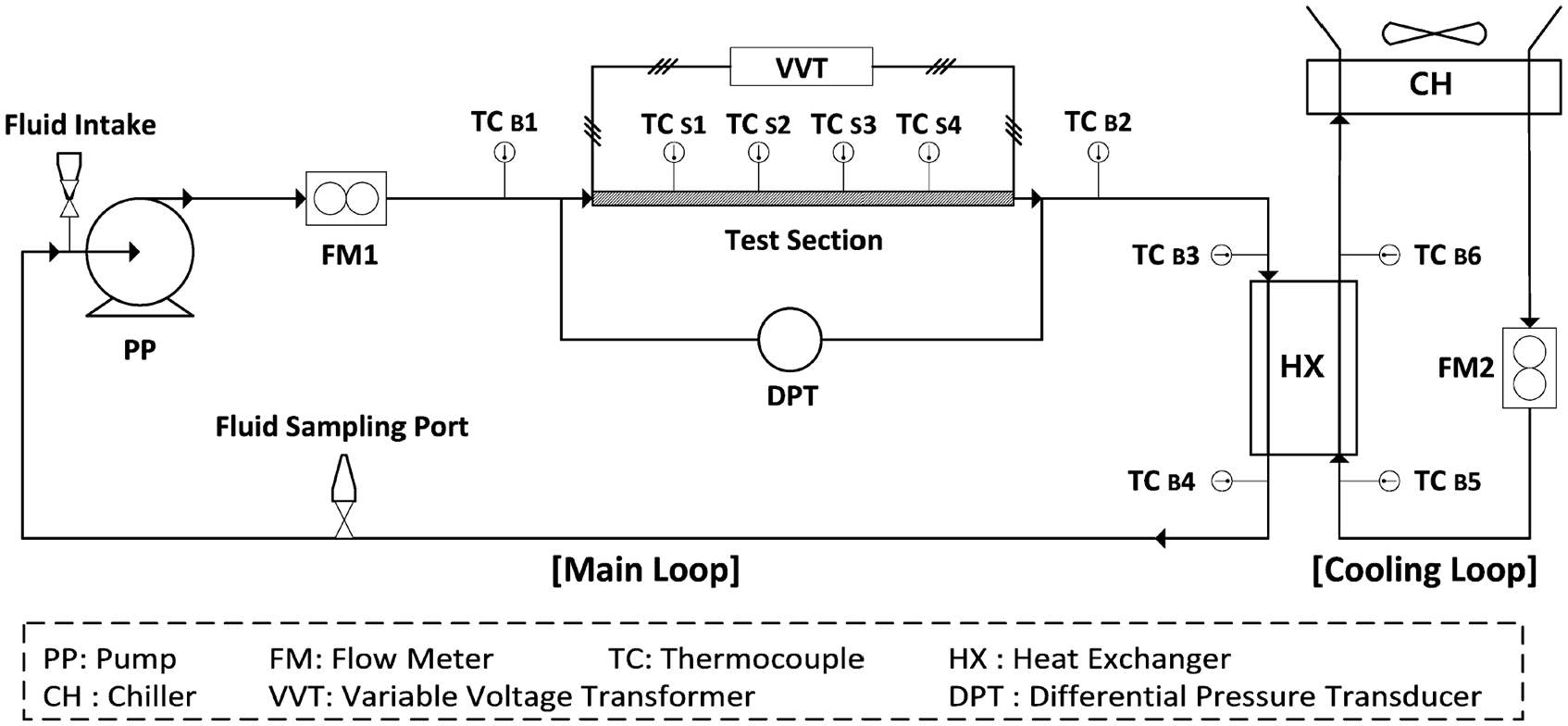
Schematic of the experimental setup.
A 1.2 m circular copper tube (ID: 12.573 mm) was used as a test section. The circular copper tube was wrapped with insulated nichrome wires which were connected to a variable voltage transformer (Staco Energy Products Company, 3PN1520B) to provide a uniform wall heat flux (31.65 kW/m2). Four T-type thermocouples (Omega, 5TC-TT-20, accuracy: ±0.4%) were soldered at four locations spaced evenly along the copper tube (test section) for the tube wall temperature measurement. Plastic connectors were used for thermal isolation and fiberglass thermal insulation wrapped the test section for minimizing heat loss. To measure the pressure drop across the test section, pressure tap connectors were installed. Two immersion T-type thermocouples (Omega, TQSS-18, accuracy: ±0.4%) were installed for the inlet and outlet fluid temperatures. In addition, a straight circular copper tube (ID: 12.573 mm) 0.5 m in length was installed before the test section for providing stable inlet flow condition. The centrifugal pump (PP) and an air-cooled water chiller (CH) circulated working fluids in the main loop and cooling loop, respectively. The chiller (CH) also provided cold water to the heat exchanger (HX) to remove heat from the nanofluids flowing through the main loop. To monitor the heat transfer performance of the HX, four immersion T-type thermocouples (Omega, TQSS-18, accuracy: ±0.4%) were installed across the HX. Flow rates of the working fluids in the main loop and cooling loop were measured with electromagnetic flow meters (Omega, FMG82A, accuracy: ±1.0%). A differential pressure transducer (Rosemount, 3051CD, accuracy: ±0.14%) was used for the pressure drop measurement. To adjust the volumetric concentration of nanoparticles dispersed in water, sample Al2O3 nanofluids were poured into the test loop through a fluid intake. In addition, a fluid sampling port was utilized to take samples of the nanofluids to determine the nanoparticle concentrations in the base fluid and their thermophysical properties. Data were recorded in real time with a Keysight data logger (34970A). Prior to the experiments, four surface temperature thermocouples and six fluid temperature thermocouples were calibrated under isothermal conditions. All the temperatures were measured at steady state conditions and experimental measurements were taken for all the thermocouples under equilibrium isothermal conditions for a period of 10 days. To get the average temperature value for each thermocouple, an arithmetic mean was determined, a total average temperature was calculated using the average temperature values of the thermocouples, and finally the correction factor was found for each of the corresponding thermocouple based on the deviation from the total average temperature value.
Characterizations of Al2O3 nanofluids
Al2O3 nanoparticles aqueous dispersion was used as the heat transfer fluid in these experiments. A scanning electron microscope image of Al2O3 nanoparticles aqueous dispersion is shown in Figure 2. The nanoparticles with an average diameter of approximately 30 nm formed as a spherical shape. Three different concentrations of Al2O3 nanoparticles in water were investigated (0.38, 0.81, and 1.30 vol.%). Thermophysical properties of these three nanofluids were determined to analyze pressure drop and heat transfer results. Brookfield laboratory viscometer (accuracy: ±1.0%) was used to determine the rheological behavior. Figure 3 shows the apparent viscosity results, which definitely indicates that the apparent viscosities of the nanofluids strongly depend on the nanoparticles volume fraction in solution and fluid temperature. As plotted in Figure 3, the greater nanoparticle volume fraction and the lower fluid temperature lead to the increased apparent viscosities of the nanofluids. It was observed that the present results are in good agreement with the previous results reported by Wang et al. 31 and deviate less than 2.9%. Specifically, the viscosities of the Al2O3 nanofluids are approximately 1.02 to 1.09 times greater than that of pure water. This can be attributed to the nanoparticle’s interactions, which negatively affect the heat transfer performance and increase the pumping power.

SEM of Al2O3 nanoparticles aqueous dispersion (US Research Nanomaterials, Inc.).
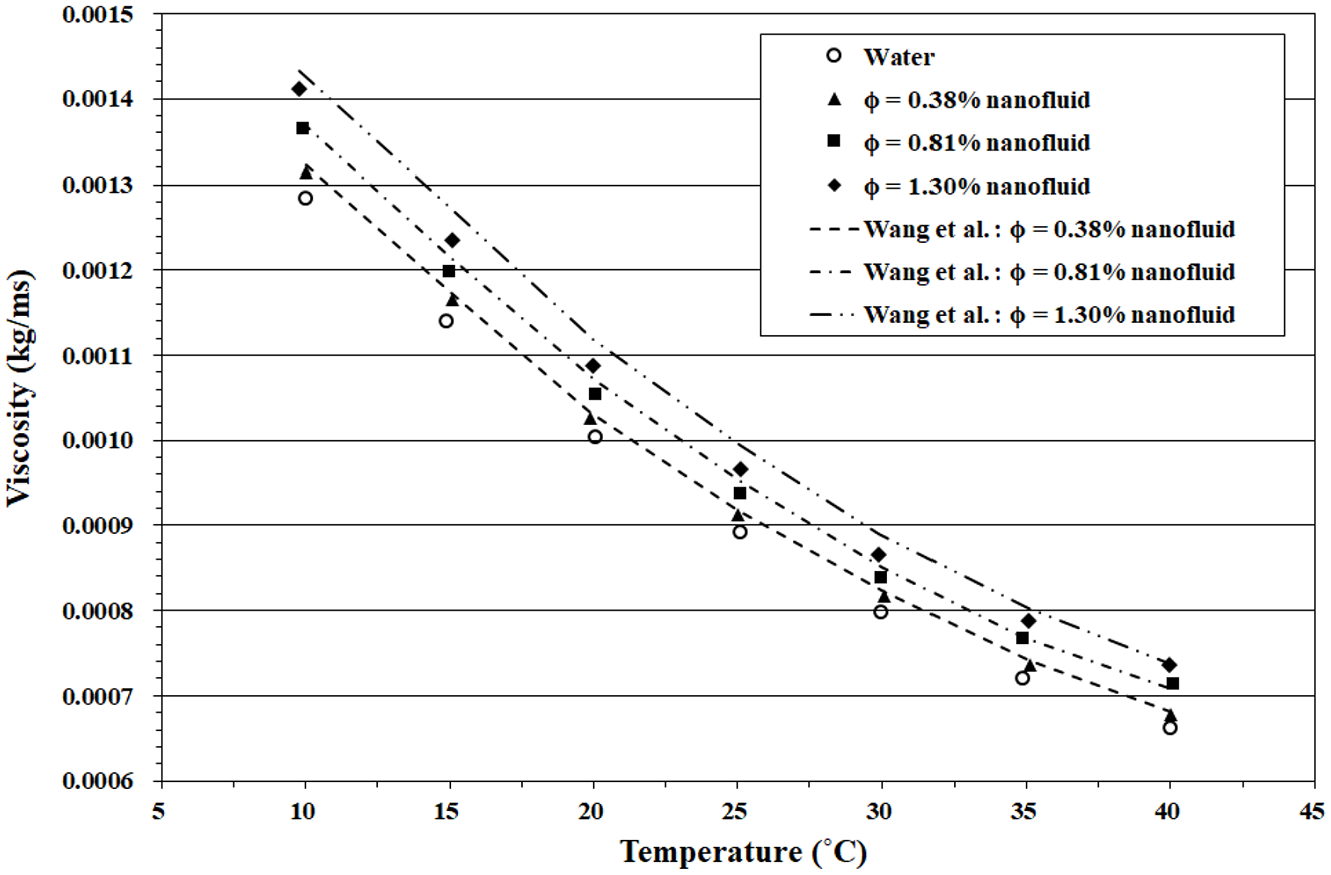
Viscosities of nanofluids at different fluid temperatures.
A Decagon Devices thermal properties analyzer (KD-2-Pro) was used to determine thermal conductivities for the Al2O3 nanofluids. The KD-2-Pro (accuracy: ±5%) consists of a controller and probes that can be inserted into the fluid. Figure 4 shows the thermal conductivity results with volume fraction and fluid temperature. These results present that the increased volume fraction and fluid temperature increase the thermal conductivities. This is because both adding nanoparticles and higher fluid temperatures lead to increased interaction between nanoparticles and a base fluid, resulting in increasing effective thermal conductivity. With respect to an improvement of thermal conductivity resulting in an enhancement in energy exchange, temperature is an important factor. Temperature rise increases the particle agglomeration and decreases the viscosity, which would improve the Brownian motion of nanoparticles in base fluid. 10 Enhancement in thermal conductivities ranged from 1.02 to 1.12 compared to water, which can play a major role in improving the thermal performance. It was found that the values of thermal conductivities in the present study agree well with those from the previous study 7 and deviate less than 1.6%.

Thermal conductivities of nanofluids at different fluid temperatures.
The density and specific heat for the Al2O3 nanofluids were calculated by using equations (1) and (2) below,32,33 respectively.

where

where
Validation of pressure drop and heat transfer experiments
Pressure drop and heat transfer tests with water were performed under constant a heat flux of 31.65 kW/m2 for the validation purpose. The flow rate was varied from 4 to 9 LPM (Reynolds number: 5300–19,500). The experiments were carried out at fluid inlet temperatures ranging from 10°C to 30°C. After reaching steady state conditions for the fluid temperature and the flow rate, experimental data were recorded by using the data acquisition system. Experimental uncertainty analysis was conducted using the multivariate error formula as described in NIST Technical Note 1297 34 and the experimental uncertainties associated with the friction factor and Nusselt number were ±5.4% and ±3.1%, respectively.
Friction factors for water were determined by the equation (3) 35 and were plotted in Figure 5 in terms of Re.

where ρ, L, d, ΔP, and v are the water density, tube length, tube inner diameter, pressure drop, and fluid velocity, respectively.
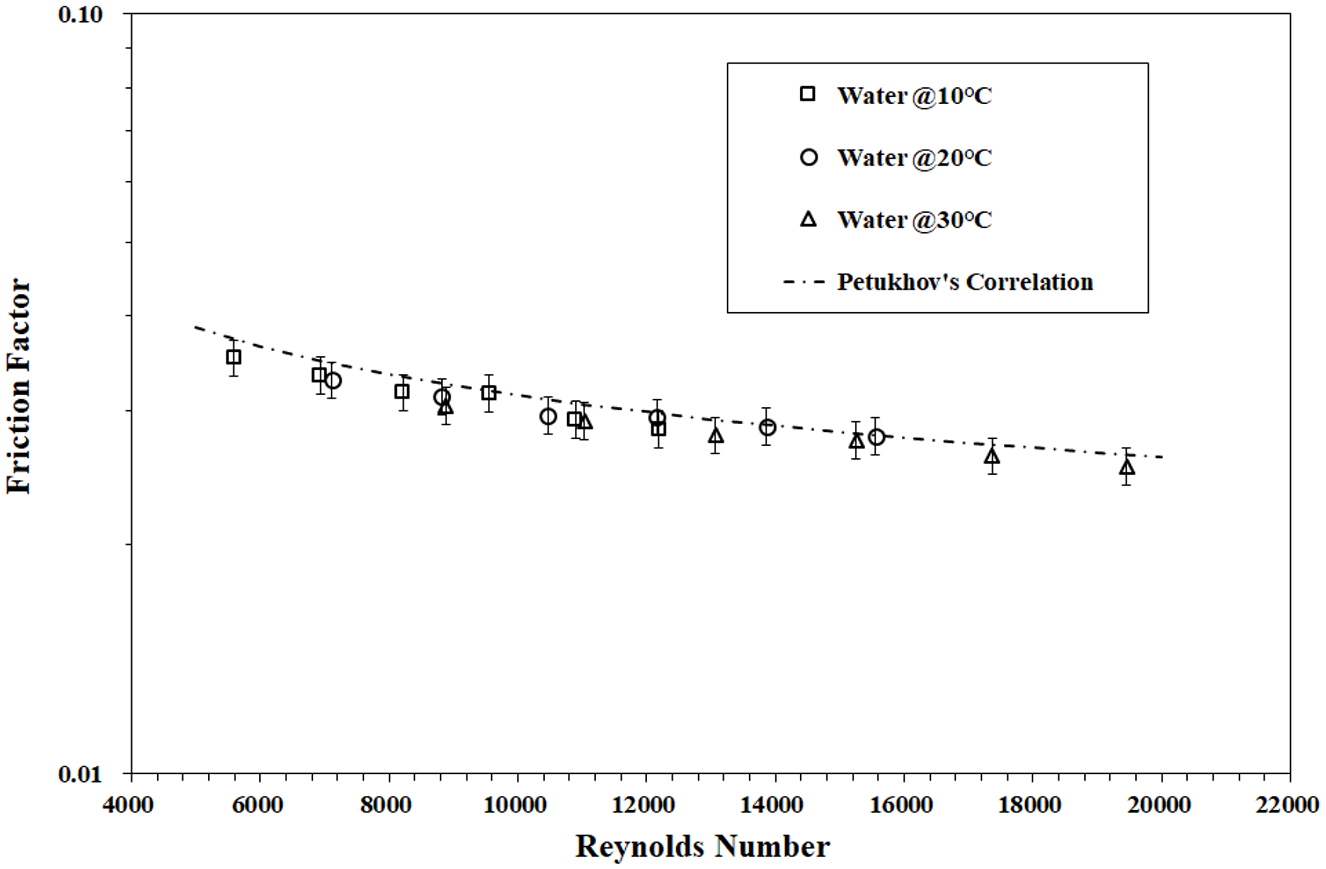
Friction factor of water as a function of the Reynolds number.
Friction factors for water determined in the present study were compared with the results determined by Petukhov’s correlation, 36 and the results indicate that the measured values are nearly close to the calculated values, deviating by less than 4.5%.
Based on the heat transfer experiments, Nusselt number was determined as follows:

where h, d, and k are heat transfer coefficient, tube inner diameter, and thermal conductivity of fluid (i.e. water for the reference experiment or Al2O3 nanofluids), respectively.
Figure 6 presents Nusselt number results, which were validated by comparing to the values determined by Gnielinski’s correlation. 37 The results indicate that the increased Reynolds number and Prandtl number lead to the increased Nusselt number, and agree well with the values obtained with Gnielinski’s correlation, 37 deviating by less than approximately 5%.

Nusselt number of water as a function of the Reynolds number.
Flow characteristics of Al2O3 nanofluids
Pressure drop of Al2O3 nanofluids across a test section was measured at three different nanoparticles concentrations dispersed in water. In addition, the pressure drop was measured at varying fluid inlet temperatures (10°C–30°C) and flow rate was varied from 4 to 9 LPM for each fluid inlet temperature condition. After reaching steady state conditions, experimental data were collected by using the data acquisition system.
Figure 7 presents pressure drop of nanofluids with a volumetric flow rate at the constant inlet fluid temperature of 20°C. The results clearly show that the greater flow rate and Al2O3 nanoparticle concentration increases pressure drops, which were up to 1.14 times higher than those of water because of the greater viscosity of the nanofluids. This increases the pumping power negatively affecting the overall performance. Figure 8 shows the pressure drop of a 0.81 vol.% Al2O3 nanofluid in terms of flow rates at the different fluid inlet temperatures. As indicated in the experimental results, the pressure drop decreases with increasing fluid temperature because of the corresponding reduction in fluid viscosity. At the same volumetric flow rate, the greater pressure drop indicates more pumping power, therefore, this may suggest that nanofluids working at higher fluid temperatures could be more effective in terms of energy efficiency.

Pressure drop of nanofluids at a 20°C inlet fluid temperature.

Pressure drop of a 0.81 vol.% nanofluid at three different inlet fluid temperatures (10°C, 20°C, and 30°C).
Heat transfer characteristics of Al2O3 nanofluids
Convective heat transfer tests were performed for the three different nanoparticles concentrations of nanofluids under a uniform wall heat flux of 31.65 kW/m2. The flow rate was varied from 4 to 9 LPM (Reynolds number: 5300–19,500). In addition, three different inlet fluid temperatures were used (10°C, 20°C, and 30°C).
After reaching steady state conditions for the fluid temperature and the flow rate, heat transfer results were recorded by using the data acquisition system. The heat balance was evaluated for all test conditions to ensure that the experimental data were reliable, and the heat loss was less than 5%. Based on the uncertainty propagation analysis, the experimental uncertainties for determining heat transfer coefficients and performance efficiency coefficients (PEC) were ±2.9% and ±3.7%, respectively.
Figure 9 shows the heat transfer coefficients (HTCs) for different nanoparticle concentrations of nanofluids at a 20°C inlet fluid temperature. Experimental result clearly presents that HTCs increase with the flow rate because of the intensified fluid momentum transfer, and that higher nanoparticle concentration increases HTCs at a same volumetric flow rate. This confirms that heat transfer performance can be improved by the existence of Al2O3 nanoparticles, and this enhancement can be seen even at low concentrations when compared to water. There are two reasons: the improved effective thermal conductivity and the enhanced heat transfer induced by the combination of active particle migration. Suspended Al2O3 nanoparticles increase the effective heat transfer area and the turbulence of the fluid resulting in increasing the convective heat transfer performance. In addition, even though the HTC was greatest for the 1.30 vol.% nanofluid, the improvement in the HTCs was not proportional to the nanoparticles concentration. This is because the reduced momentum transfer induced by higher viscosity decreases enhancement in heat transfer performance led by enhanced thermal conductivity. It suggests that appropriate nanoparticle concentration in nanofluids should be determined by considering both the hydraulic and heat transfer characteristics.

Heat transfer coefficient of nanofluids at a 20°C inlet fluid temperature.
Heat transfer coefficients (HTCs) of a 0.81 vol.% nanofluid in terms of flow rates for the different inlet fluid temperatures are plotted in Figure 10. The experimental data clearly present that increasing the inlet fluid temperature increases the HTC. This is because the increase in fluid temperature increases the collisions between nanoparticles and a base fluid, resulting in the improved thermal conductivity, as shown in Figure 4. In addition, it was found that higher working temperatures increase Reynolds number and intensifies the fluid turbulence. Thus, the combination of the enhanced momentum and the intensified collisions between the nanoparticles and tube’s wall could lead to the enhanced convective heat transfer. This suggests that heat transfer performance of nanofluids is sensitive to both the mass flux and the heat flux.
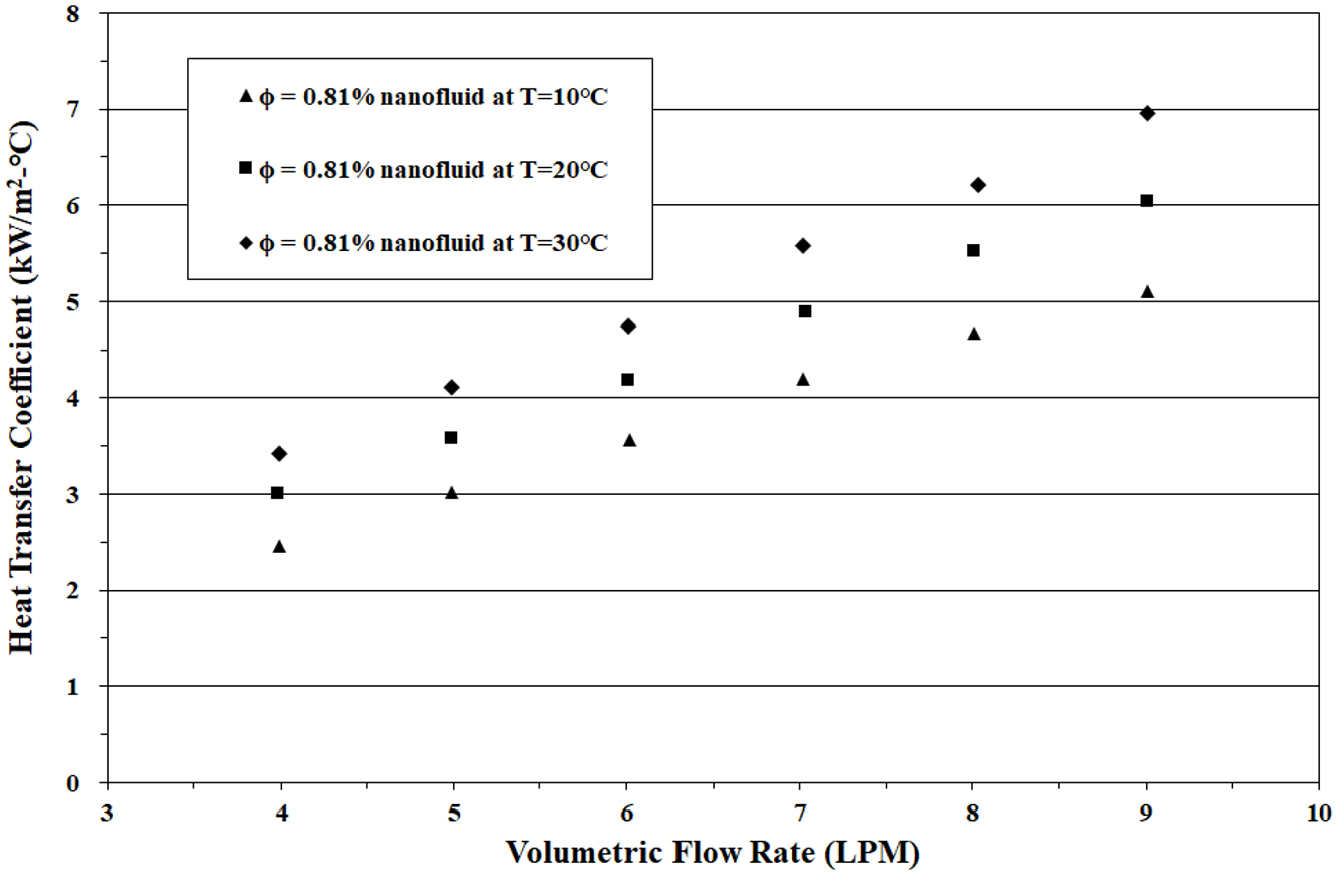
Heat transfer coefficient of a 0.81 vol.% Al2O3 nanofluid at three different inlet fluid temperatures (10°C, 20°C, and 30°C).
Figure 11 shows Nusselt number as a function of Reynolds number. The values of Nusselt number were compared with the results from the previous correlations of Pak and Cho 7 and Xuan and Li. 38 The results clearly show that Nusselt number increases with Reynolds number and the greater Prandtl number increases Nusselt number at the same Reynolds number. It was observed that the values of Nusselt number in the present study agree with those of previous correlations and deviate by up to 8.7%.

Nusselt number of nanofluids at a 20°C inlet fluid temperature.
Performance evaluations of Al2O3 nanofluids
For the use of enhanced heat transfer fluid, the overall performance of nanofluids should be assessed by considering both their heat transfer and hydraulic characteristics. 39 The performance efficiency coefficient (PEC) was used as the following equation. The PEC is a ratio of heat transfer coefficient to pressure drop between the nanofluid and water.

Figure 12 shows the PEC of the nanofluids in terms of volumetric flow rates at an inlet fluid temperature of 20°C. The experimental data obviously indicate that the PEC of the nanofluids used in the study is always greater than one. It is evident that nanofluids perform better than water by significantly improving the heat transfer performance, even though the greater viscosities increase the pressure drop. In addition, the PEC tends to increase with increasing volumetric flow rate. This could be because the higher flow rate leads to intensified turbulence and consequently more particle collisions, resulting in greater heat transfer. The experimental results show that the 0.81 vol.% Al2O3 nanofluid has the highest PEC value (approximately 1.06). It could be inferred from this result that greater concentrations of nanoparticles in the base fluid cannot guarantee better overall performance. This is because the higher concentration causes increased viscosity, which increases the pressure drop and decreases the momentum transfer. PEC values of the 0.81 vol.% Al2O3 nanofluid at different inlet fluid temperatures are plotted in Figure 13, which shows the PEC enhanced by the greater inlet fluid temperature. The maximum PEC of approximately 1.08 is obtained at a 30°C fluid inlet temperature. This is attributed to a combination of the enhanced effective thermal conductivity and the decreased viscosity, which leads to an increase in energy exchange with lower pressure losses. Thus, this suggests that nanofluids must be working under suitable conditions (volume concentration, working temperature, flow rate, etc.) to achieve the best performance.

Performance efficiency coefficient of nanofluids at a 20°C inlet fluid temperature.

Performance efficiency coefficient of a 0.81 vol.% Al2O3 nanofluid at three different inlet fluid temperatures.
Conclusion
Thermal performance of Al2O3 nanofluids was evaluated under turbulent flow, when flowing through a horizontal circular tube to find the optimal volume concentration of Al2O3 nanoparticles dispersed in water to maximize the benefits of using the nanofluids. The findings obtained from this study are presented as follows:
– The higher concentration of nanoparticles increased the apparent viscosities of Al2O3 nanofluids by up to approximately 9% greater than water due to the particle interactions. The thermal conductivities increased with nanoparticle concentration, and the enhancement was approximately 12% for a 1.3 vol.% Al2O3 nanofluid compared to water.
– Adding Al2O3 nanoparticles to water led to around 19% enhancement in the heat transfer coefficient (HTC) and approximately 13% increase in the pressure drop. In addition, higher inlet fluid temperatures enhanced the HTC owing to the improved effective thermal conductivity and decreased pressure drop resulting from the lower apparent viscosity.
– The performance efficiency coefficient (PEC) of the Al2O3 nanofluids was greater than one in all cases, and had a maximum value of approximately 1.08. It was evident that Al2O3 nanofluids perform better than water by significantly improving the heat transfer performance, even though the greater viscosities increase the pressure loss. In addition, the PEC values increased with the inlet fluid temperature led by a combination of the enhanced thermal conductivity and the decreased viscosity, which increases the energy exchange and decreases the pressure loss, respectively.
– Nanofluid with a volume fraction of 0.81% at the higher inlet fluid temperature (30°C) increases the overall performance by up to around 8% and performs better than the other volume fractions. It was implied that a higher concentration of nanoparticles in the base fluid does not guarantee better overall performance. This would be used to provide a guideline for engineers applying the nanofluids to the heat transfer applications.
In the future, a numerical study should be performed to understand how nanoparticles can enhance the heat transfer performance. In addition, the effects of the physical characteristics of the nanoparticles, such as their size and shape on the overall performance of nanofluids should be further investigated to determine the optimum conditions for achieving the maximum benefit from using nanofluids as heat transfer fluids.
Footnotes
Appendix
Handling Editor: James Baldwin
Declaration of conflicting interests
The author(s) declared no potential conflicts of interest with respect to the research, authorship, and/or publication of this article.
Funding
The author(s) received no financial support for the research, authorship, and/or publication of this article.
