



Abstract
The gaseous low-pressure nanofluid flow of a steady-state two-dimensional laminar forced convection heat transfer in the entrance region of pipes is numerically investigated. Such flows are of interest for many engineering applications like the nuclear reactor and electronic equipment cooling, heat exchangers, and many others. Physical parameters considered in this study are Reynolds number (Re), Prandtl number (Pr), nanosolid particles volume fraction
Introduction
Dispersing nanosolid particles in the base fluid has attracted great attention and motivated researchers to investigate such flows in the past few decades. This is mainly due to their role in heat transfer enhancement that can be found in many engineering applications such as automotive and electronic equipment’s cooling, heat exchangers, reduction of the flue gases temperature in boilers, and many others.
The goal of this study is to investigate the effect of adding Al2O3 nanoparticles on the flow and heat characteristics on the low-pressure laminar slip gaseous air flow in the entrance region of a circular pipe. Moreover, the effect of Knudsen number, aspect ratio, Reynolds number, Prandtl number, and volume fraction of the nanoparticles on these characteristics will be addressed and discussed thoroughly.
A low-pressure flow is classified based on Knudsen number (Kn). According to Schaaf and Chambre; 1 Cercignani and Lampis, 2 four different flow regimes are identified—continuum regime, slip regime, transitional regime, and free molecular regime. For slip flows, Navier–Stokes equations can be used along with both slip velocity and temperature jump boundary conditions applied at the surfaces.
Akbari et al. 3 studied forced turbulent convection of Al2O3–water and Cu–water inside horizontal tubes. They showed that dispersing the nanosolid particles in the flow improves thermophysical properties and hence enhances heat transfer. However, some penalties are paid due to the increase in pressure drop. Balandin et al. 4 reported that by adding graphene to the base fluid, the resulting thermal conductivity will enhance heat transfer.
Many experimental and numerical works investigated and discussed different types of nanoparticles such as metals and oxide metals that have been used in order to enhance the heat transfer. In this research, we will consider dispersing Al2O3 to the base fluid (low-pressure air) in circular tubes with constant surface temperature.
Wang and Mujumdar, 5 Yu et al., 6 Sarkar et al., 7 Saidur et al., 8 Suresh et al., 9 and Hussien et al. 10 presented an excellent review of the heat transfer characteristics of nanofluid in forced and free convection flows. Al-Kouz et al. 11 investigated numerically the effect of dispersing nanoparticles of Al2O3 to the low-pressure air flow inside a square cavity in which the hot wall is attached to two fins, and they concluded that dispersing such particles will enhance heat transfer. Moreover, a correlation that describes the relationship of Nusselt number among all the investigated parameters is proposed.
Characteristics of the nanoparticles such as the type and concentration play a very important role in determining the thermal behavior of the resulting nanofluid. Many researches have tackled this issue such as Akbari et al., 3 Balandin et al., 4 Kalteh et al., 12 and Hussien et al. 10
In the work carried out by Labib et al., 13 the effect of base fluid on convective heat transfer utilizing Al2O3 nanoparticles is numerically investigated. They concluded that ethylene glycol base fluid would give better heat transfer enhancement than that of water.
Heris et al. 14 investigated experimentally convective heat transfer of Al2O3 water nanofluid in circular tube. They studied the effect of Reynolds number, Peclet number, and the nanoparticle concentration on the heat transfer characteristics. Their experimental results show that by adding nanoparticles to the base fluid, a better heat transfer is achieved.
Moghadassi et al. 15 used a computational fluid dynamics model to study the effect of nanofluids on laminar forced convective heat transfer in horizontal circular tube. They used water-based Al2O3 and Al2O3–Cu hybrid nanofluid. Their results show that the hybrid nanofluid is superior as far as that heat transfer enhancement is concerned.
In Salman et al., 16 a numerical solution of the laminar convective heat transfer in a two-dimensional microtube with constant heat flux is presented. They investigated the effect of the type, size, and volume fraction of nanoparticles on the heat transfer characteristics. They concluded that Nusselt number is directly proportional to the volume fraction and Reynolds number and inversely proportional with the nanoparticle size for the investigated range they considered. Experimental work to investigate the turbulent convective heat transfer and pressure loss of aluminum water nanofluid in horizontal tube with different particle concentrations was carried out by Williams et al. 17 A comparison of their results with the available traditional single-phase correlations for fully developed flow is presented. It was found that there is no abnormal heat transfer enhancement is observed in the study.
It is true the fact that there are lots of research that deals with the heat transfer characteristics utilizing nanofluid. However, there is lack of studies that consider heat transfer characteristics of low-pressure gaseous nanofluid. In this article, further insight on adding nanoparticles to the low-pressure gaseous flow and heat transfer characteristics in the entrance region of laminar forced convective heat transfer for isothermal circular pipes is provided. Computational fluid dynamics (CFD) is used to obtain the solution for such flows. Effects of Knudsen number (Kn), Reynolds number (Re), Prandtl number (Pr), aspect ratio (AR), and nanoparticles volume fraction on the flow and heat transfer characteristics are investigated.
Mathematical formulation
Governing equations
In this study, two-dimensional laminar and steady-state forced convection gas flow in the entrance region of isothermal pipes with T = 70°C is investigated. Figure 1 represents flow in the geometry under investigation, with diameter D and length L, continuum and slip flow regimes are considered.

Schematic diagram of the problem under investigation.
Following Hussien et al., 10 the properties of the resulting nanofluid can be calculated based on the following equations assuming that the suspension of the nanoparticles is homogeneous with well-dispersed nanoparticles, and the nanosolids are considered to be stable. The nanoparticles are introduced in the base fluid by certain techniques such as loading the particles using wall jet:
Viscosity

Density

Heat capacitance

Thermal expansion coefficient

Thermal conductivity

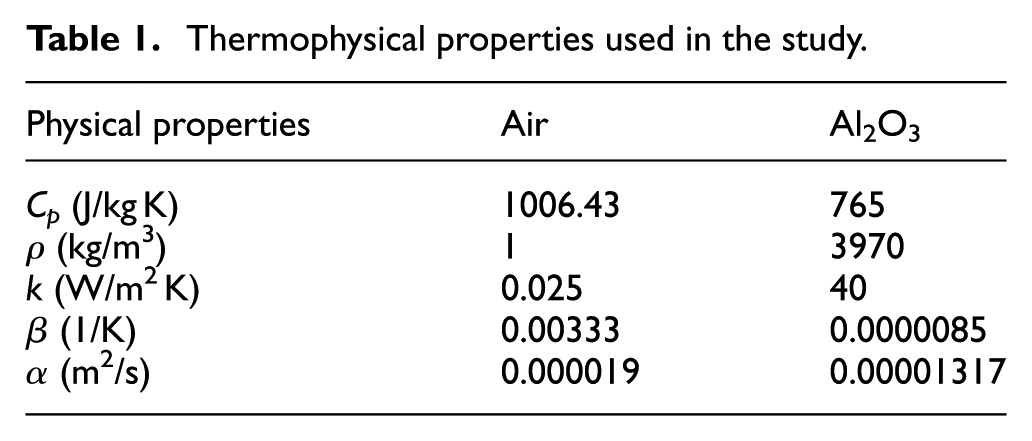
Table 1 summarizes the thermophysical properties used to obtain the resulting properties of the Al2O3–air nanofluid.
Thermophysical properties used in the study.
It should be noted that the resulting physical properties of air–Al2O3 nanofluid were calculated by introducing user-defined functions (UDF) in Fluent 18 commercial software.
By referring to Incropera et al., 18 the governing equations that describe the problem under investigation are summarized below:
Continuity

z-momentum

r-momentum

Energy

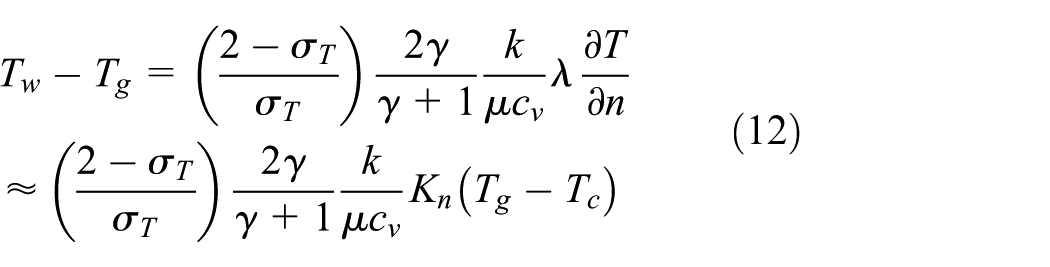
Referring to Karniadakis et al., 19 Lockerby et al., 20 and Kandlikar et al., 21 the boundary conditions applied for the slip flow regime are slip velocity and the temperature jump at the surfaces are summarized as follows


where

where

The local heat transfer coefficient and Nusselt number are computed using equations (15) and (16), respectively


where Ts(x) and Tm(x) are the nanofluid temperature at the surface and the mean fluid temperature in the axial location, respectively. The mean fluid temperature can be calculated as follows

Then, the average heat transfer coefficient along the wall is calculated by combining equations (15)–(17)

From equation (18), the average Nusselt number can be calculated as follows

The relative enhancement of heat transfer coefficient computed as

Solution methodology
A finite volume technique is used to solve the problem under investigation in which the semi-implicit method for pressure-linked equations (SIMPLE) algorithm presented by Versteeg and Malalasekera 22 and Patankar and Spalding 23 is utilized for pressure–velocity decoupling purposes. Moreover, to calculate the pressure field, PRESTO algorithm is used. In addition, a hybrid second-order accuracy scheme of central and upwind difference is used to differentiate the convective terms. A starting mesh of 100 × 100 elements is considered. In this study, all momentum and thermal accommodation coefficients are assumed unity for all simulations. Effects of momentum and thermal accommodation coefficients were investigated for different values, and it was found that their effects on Nusselt number is negligible compared to other parameters considered in this study. The convergence criteria are set so that the maximum of the normalized absolute residual across all nodes is less than 10−6.
Sample of the grid that was used in the simulations is illustrated in Figure 2. It consists of a two-dimensional mesh. Initially and in order to capture the gradients near the solid-fluid interface, the grid step sizes are increasing in the x and r directions with expansion factors of 1.06 and 1.15, respectively, after that the mesh was adapted such that velocity gradients near the solid surfaces are calculated. If required, additional cells were added to reduce the gradients below a certain value as illustrated in the case of the right outlet in the figure. Grid independency test is performed and shown in Figure 3 by monitoring the average Nusselt number at the wall in which different numbers of grid nodes were considered. It was found that adding more cells will not change the value of the average Nusselt number at the surface of the pipe with a maximum error of 1% compared to the minimum number of elements chosen for the initial mesh. It is worth mentioning here that the mesh that was utilized for all simulations is of 650,000 nodes.

Adaptive grid system technique used in the simulations.

Grid independency test.
Figure 3 demonstrates that the solution is mesh-independent for a grid of 100 × 100 nodes. This grid size is used for all simulations conducted in this research.To verify the numerical code, results of the current code are compared with the results obtained by De Vahl Davis and Jones, 24 De Vahl Davis, 25 and Nag et al. 26 for the case of gaseous Boussinesq laminar steady-state air flow inside a square cavity with no fins attached to the hot wall and Pr = 0.71. Boundary conditions considered for this case are as follows: adiabatic upper and lower walls of the cavity. The hot left wall dimensionless temperature is set to one while the cold right wall dimensionless temperature is set to zero.
Table 2 shows a comparison between the mean Nusselt number at the cold surface obtained by the current code and that obtained by De Vahl Davis and Jones, 24 De Vahl Davis, 25 and Nag et al. 26 at Ra = 104, 105, and 106; where Ra = (gβ(T1 – T2)L3/αν). Comparisons show excellent agreement with an error of less than 1%.

Also, Figure 4 shows a comparison of the current code results with the results obtained by Taamneh and Bataineh 27 for the case of a lid driven cavity in which nanofluid particles of Al2O3 is dispersed inside the cavity, ϕ = 0.01 and different Richardson numbers were considered. Where Ri = gβ(T1 – T2)L/V2. The hot wall dimensionless temperature which corresponds to T1 of the cavity is set to 1, and the cold wall dimensionless temperature that corresponds to T2 of the lid driven cavity is set to 0; while the other two walls are adiabatic. The figure illustrates that there is a maximum error of 3% in the average Nusselt number between the results obtained from the current code to those obtained by Taamneh and Bataineh. 27 Moreover, the code was validated with correlation given by Sieder and Tate 28 for the case of developing thermal and hydrodynamic boundary layers

In this validation, air is used as the base fluid, Re = 1000, Pr = 0.7, and L/D = 10; the correlation yields a value of 7.655 for the average Nusselt number while the current code yields a value of 7.99 with a maximum error of 4% compared to the correlation result.

Comparison between results obtained from the current code to results obtained by Taamneh and Bataineh. 27
In addition, a comparison between results obtained from the current code for the local Nusselt number and the experimental results obtained by Akhavan-Zanjani et al. 29 is presented in Figure 5. The comparison is for the case of laminar convective heat transfer of water and graphene nanofluid fully developed flow in circular pipe at different Reynolds numbers and constant surface heat flux. The nanofluid flowed in a straight copper tube with inner diameter, outer diameter, and length of 4.20, 6.00, and 2740.2 mm, respectively. The volume fraction of the nanosolid particles of graphene is set to 0.01%. The figure shows that there is a maximum error of less than 3% between the obtained results from the current code and these obtained by Akhavan-Zanjani et al. 29

Comparison between results obtained from the current code to results obtained by Akhavan-Zanjani et al. 29
Finally, a comparison between the average Nusselt number against Reynolds number obtained from the current code and the experimental results obtained by Trivedi and Johansen 30 is presented in Figure 6. The comparison is carried out for the forced convective heat transfer in Al2O3–air nanoaerosol for three different cases, namely, air flow, nanofluid with mass fraction of 0.02%, and nanofluid with mass fraction of 0.1%. The figure shows an excellent agreement between the experimental results and the results obtained by the current code with a maximum error of less than 4%.

Comparison between results obtained from the current code to results obtained by Trivedi and Johansen. 30
Authors believe that the error in all the comparisons is because of the discretization method used as well as the mesh. In order to reduce the error, higher order discretization techniques can be used.
Results and discussion
Figure 7 shows the velocity magnitude along the radial direction for the case where AR = 10 at different axial locations x of 0.1, 0.5, and 1. Reynolds number (Re) is fixed to 1000, Knudsen numbers (Kn) of 0, 0.05, and 0.1 to cover the continuum, and slip flow regimes were considered. Nanoparticles volume fractions

Variation of the velocity magnitude (V) at different x locations for different Knudsen numbers (Kn) and different values of nanoparticles volume fraction
Figure 8 illustrates temperature profiles along the radial direction for the case where AR = 10 at different axial locations x of 0.1, 0.5, and 1. Reynolds number (Re) is fixed to 1000, Knudsen numbers (Kn) of 0, 0.05, and 0.1 to cover the continuum, and slip flow regimes were considered. Nanoparticles volume fractions
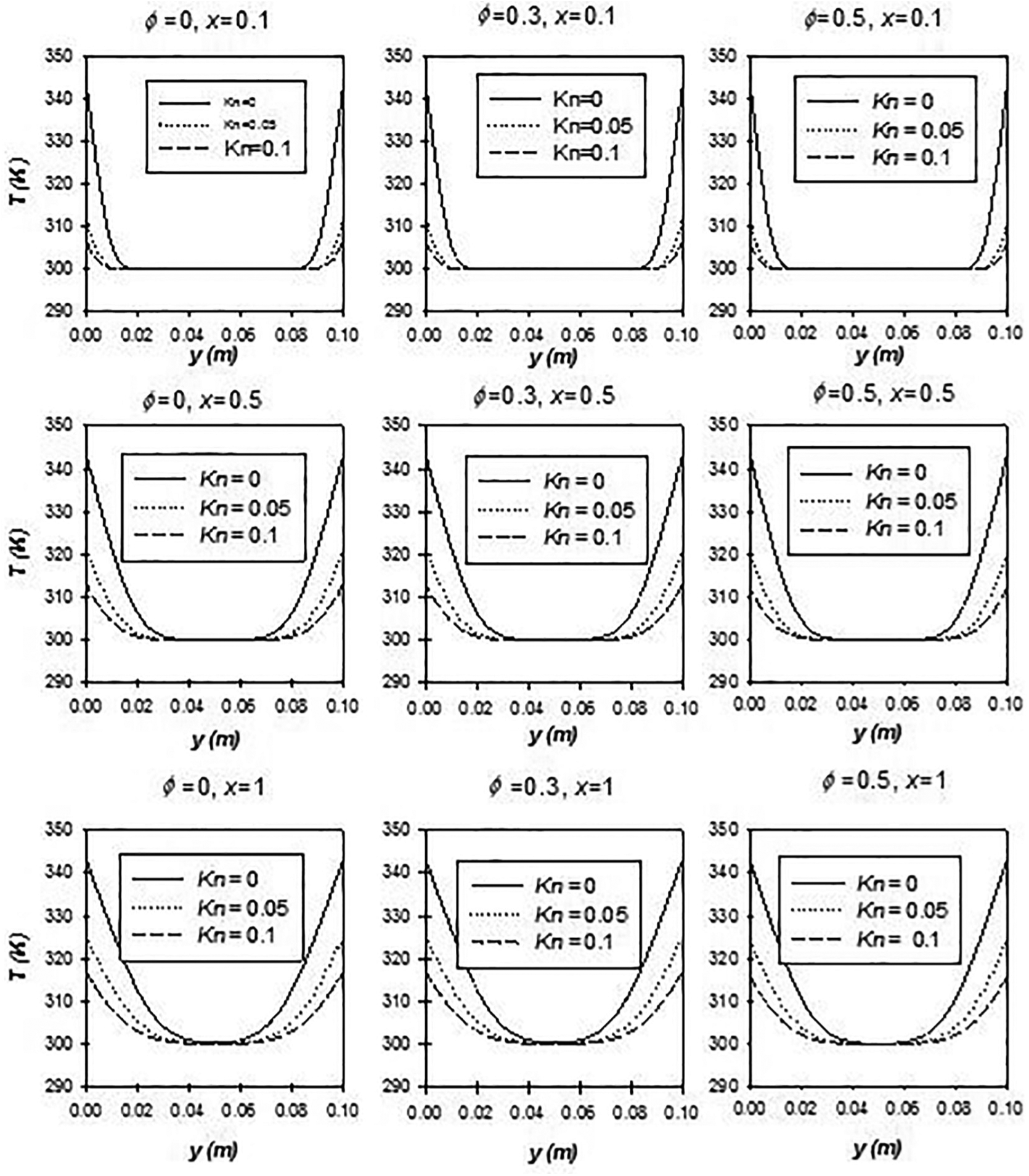
Variation of the temperature (T) at different x locations for different Knudsen numbers (Kn) and different values of nanoparticles volume fraction
Figure 9 illustrates the variation in the average Nusselt number
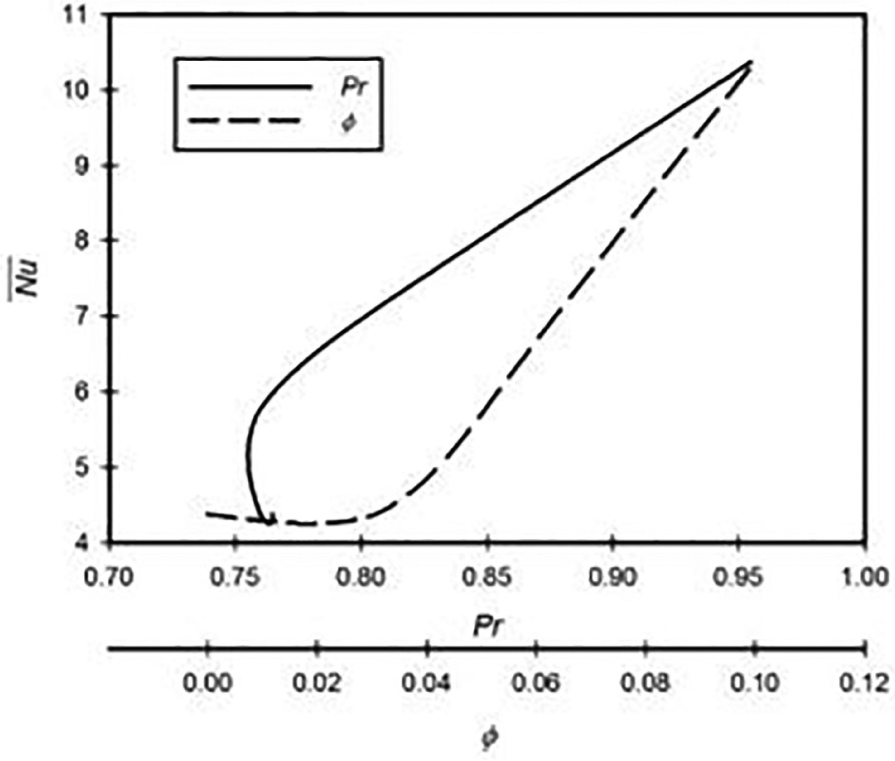
Variation in the average Nusselt number
In Figure 10, the average Nusselt number

Variation of the average Nusselt number
Figure 11 demonstrates the average Nusselt number

Variation of the average Nusselt number
Finally, a correlation for the average Nusselt number

Conclusion
A steady two-dimensional analysis of low-pressure gaseous laminar nanofluid flow in the entrance region of pipes in which a constant surface temperature of 70°C is carried out. This type of flow serves in many engineering applications such as those found in nuclear reactor and electronic equipment cooling and many others. Rarefaction, Reynolds number (Re), aspect ratio (AR), and the volume fraction of the nanoparticles
Footnotes
Appendix 1
Handling Editor: Bo Yu
Declaration of conflicting interests
The author(s) declared no potential conflicts of interest with respect to the research, authorship, and/or publication of this article.
Funding
The author(s) received no financial support for the research, authorship, and/or publication of this article.
