



Abstract
Natural convection between a cold square porous enclosure and a hot corrugated cylinder is studied numerically in the current article. The enclosure is filled with a water-base nanofluids suspending metal nanoparticles and the porous layer is modelled applying the Brinkman-Forchheimer law. The finite element method has been utilised to solve the governing equations. Analysis in this studies are: the amplitude of corrugated surface, the number of corrugated surface and the concentration are considered. It is found that the heat transfer of the corrugated cylinder might be slightly better than the heat transfer of the smooth cylinder under specific circumstances, but in general, the heat transfer is reduced by applying the corrugated surface. The heat transfer enhances up to
Introduction
Nanoscience and nanotechnology work with extreme tiny things which make human able to figure and design the bonds between atoms inside materials. Choi 1 introduced the engineered nanoparticles inside the host fluid to boost thermal performance of the system such as electronic devices and heat exchangers. The latest technological method is applying a porous medium with the nanofluids. This innovative technique was applied by Sun and Pop 2 for a porous triangle enclosure where the flush-mounted heater attached to the wall. The conjugate convection were studied by Chamkha and Ismael, 3 Sheremet et al., 4 Ismael et al. 5 and Mehryan et al. 6 They studied the impact of the finite wall and nanofluids conductivity on the overall thermal performance. Localised heated enclosure was considered by Chamkha and Ismael, 7 Ghalambaz et al. 8 and Sheremet et al. 9 applied the modified Tiwari and Das model for the nanofluid properties. Mahdi et al. 10 gave a critical examination of utilizing nanofluid with a porous medium. Ghasemi and Siavashi 11 studied the influence of various linear temperature distribution of sidewalls on the thermal performance. Mehryan et al. 12 considered hybrid nanofluids or suspending more different nanoparticles into the base fluid. They concluded that the reduction of the heat transfer rate is much greater for hybrid fluid compared to the ordinary nanofluids. Emami et al. 13 simulated nanofluid free convection in an inclined porous enclosure. The porous medium treated using the Brinkman–Forchheimer model and they did not recommend utilizing of nanofluids with porous media for strong convection.
Phenomena of natural convection due to a hot circular cylinder inside enclosures are analysed extensively. One of the practical applications occurs in pipe bringing hot water passes through an enclosure formed by geological building components. The enclosure is often partly filled with the saturated porous insulating material to reduce the thermal performance from the pipe. The convective flows between a cylinder and its surrounding fluid medium lead to a formation of convective cells. In every cell, the fluid circulates in the specific direction of rotation. Oosthuizen and Naylor 14 studied the below and sides walls in adiabatic condition while the top wall is cold and the cylinder surface maintains in hot temperature. They found that slightly modification in the heat transfer rate with adjusting the cylinder radius. Misirlioglu 15 investigated the rotating cylinder put in the midle of the differentially heated enclosure. Saleh and Hashim 16 utilised Darcy model and filled Ag, Cu, Al2O3, or TiO2 nanoparticles into the water. Chamkha et al. 17 found that the cylinder size has a profound effect on the convective flow in the upper half of the enclosure at high Darcy number. Nazari et al. 18 studied heat transfer convection from a hot elliptical cylinder attached with a porous medium. Sheikholeslami and Shehzad 19 investigated the annulus enclosure with Darcy model for the porous layer. The annulus enclosure with multilayers of nanofluid and porous medium having sinusoidal cylinders was investigated by Abdulkadhim et al. 20 They suggested that the sinusoidal cylinder need to move upward to convective flow enhancements. Dogonchi et al. 21 filled nanofluid in a porous chamber between the warm outer rectangular cylinder and cold inner circular cylinder. They found that the heat transfer enhances with the convection intensity, porosity, concentration and nanoparticles shape aspect. Dogonchi et al. 22 simulated nanofluids free convection within a porous annulus with diverse configurations of heater. Recently, Alhashash 23 applied Brinkman-Forchheimer model for the porous layer and found that the thermal performance is enhanced for the half thermally active surface for suspending Al2O3 nanoparticles.
Corrugated surfaces are used in enhancing heat transport performance. The literature survey concerning the corrugated surface with porous media has shown that this topic is limited because of the following reason. The first, it is challenging to build the grid generation of the corrugated surface. The second, non-uniformity of the wall orientation brings complexity to apply the numerical technique. In addition, several parameters are needed to be considered in the formulation such as the amplitude, wave number, wave ratio and inter-wall spacing. Murthy et al. 24 studied impact of the corrugated surface at the bottom wall and concluded that the heat transfer rate is reduced by using the corrugated surface. Kumar 25 concluded that the high corrugation frequency enhances the free convection. Kumar and Shalin 26 investigated impact of corrugations surface and a thermally stratified at the vertical wall. Later, Kumar and Shalin 27 demonstrated that the heat flux has a periodical structure of frequency in the non-Darcian model equal to the vertical corrugated surface. Misirlioglu et al. 28 applied the cosine corrugation profile and compared their computations with the literature results for an enclosure with smooth walls. They considered some values of Rayleigh number, enclosure aspect ratio and corrugation frequency parameters. Later, Misirlioglu et al. 29 concluded that the flow circulation and temperature distribution were observed to be sensitive on surface corrugations for tilt angles below 45° at high Rayleigh numbers. The surface waviness influenced heat transfer behaviours were showed by Khanafer et al. 30 Mansour et al. 31 added the effect of thermal radiation under non-equilibrium model and found that the thermal performance decreases by enhancing the material conductivity. Sheremet et al. 32 filled the porous enclosure with nanofluids and the impact of thermal dispersion has been considered using the Forchheimer-Buongiorno model. They reported the heat transfer enhancement with Rayleigh number, corrugation number and dispersion parameter. Cheong et al. 33 studied the effect of sinusoidal external heating and combustion to the wavy geometry. Hoghoughi et al. 34 investigated the effect of waviness on heat transfer of nanofluid over a cylindrical heater using local thermal non-equilibrium formulation. They found that at lower corrugation amplitudes, the heat transfer rate is reduced when the cylindrical heater is elevated. Recently, Alhashash and Saleh 35 treated the porous media using Darcy model and found that the thermal performance were sensitive to the varying of corrugation property, Rayleigh number and nanoparticle volume fraction. Parveen and Mahapatra 36 studied double diffusive free convection in a wavy enclosure filled with nanofluid under partial heating. Free convection in a heat generating porous medium-filled wavy enclosures using Buongiorno’s nanofluid model was investigated by Ahmed and Rashed. 37 Selimefendigil and Oztop 38 concluded that the dimension of the porous layer has a small effect on heat transfer and curvature of the upper wall has large effect on heat transfer. Recently, Selimefendigil and Oztop 39 reported that the amount of enhancement by adding nanoparticle is 112% and the effect is moved backward for the highest value of Darcy number and the waviness was found to be utilised as a useful tool for convective flow features.
The main objective of the current work is to perform a numerical simulation of free convection between a cold square enclosure and a hot corrugated cylinder filled with metal-water nanofluids. The numerical investigation is considered for different non-dimensional governing parameters such as the fractional volume fraction, the amplitude of corrugated surface, the number of corrugated surface, nanoparticles concentration and the Darcy number. The waviness and porous material is predicted to contribute a better energy harvesting for example in a solar collector with a composite absorber made of porous material where the absorber is made of a corrugated iron sheet. 40 To the best of our knowledge, investigation of the effect of corrugation parameters on convective flows in a porous enclosure having a hot inner sinusoidal cylinder has not received due attention. Similar research conducted by Nabavizadeh et al. 41 and Sheikholeslami et al. 42 for clear fluid found that the vortices, isotherms, and the number, magnitude and formation of the cells inside the non-porous enclosure strongly depend on the corrugation parameters. Hatami and Safari 43 studied a hot cylinder on the free convection heat transfer of nanofluids inside a wavy enclosure. Later, sequences investigation by Selimefendigil and Oztop44–48 concluded that corrugated surface and nanoparticle concentration parameters can be utilised to control the heat transfer rate.
Mathematical formulation
A schematic illustration of a porous enclosure with a corrugated hot cylinder is given in Figure 1(a). Bottom, left, right and top walls has constant low temperature. The cylinder having radius

where

(a) Schematic illustration of the model, (b) Domain element.
All of the walls are considered to be impermeable, the fluids within the enclosure is a water-based nanofluids containing Ag, Al2O3, Cu or TiO2 nanoparticles. Thermophysical properties of these particles were given in. 16 Hot cylinder surface brings a heat transfer problem that is, free convection. Brinkman–Forchheimer model is assumed to satisfied and the Boussinesq approximation is considered valid. Based on these assumptions, the continuity, momentum and energy equations can be written as follows:



where

where

The nanofluids diffusivity

The nanofluids density

The thermal expansion coefficient of the nanofluids

The viscosity ratio for

The thermal conductivity ratio is given by Corcione 49 as follows:

Where


Where

Where

Now the following non-dimensional variables were introduced:
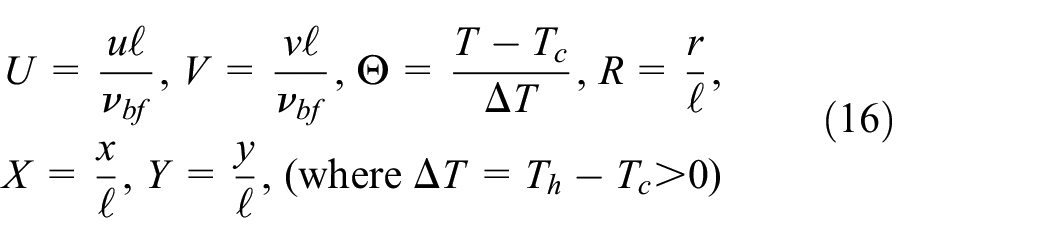
This then yields the dimensionless governing equations are: Continuity equation:

Momentum equation in the
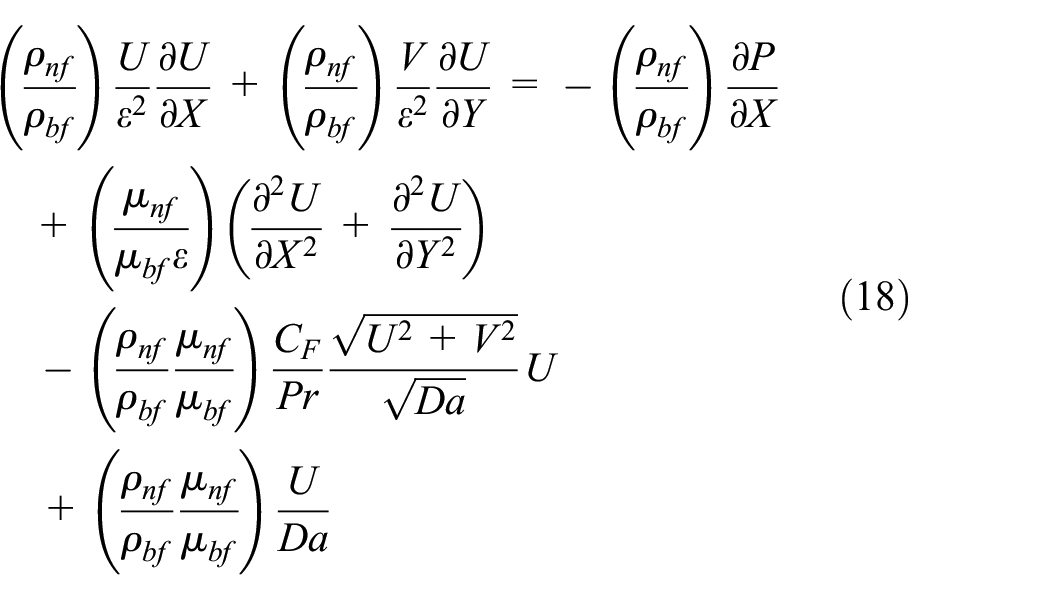
Momentum equation in the

Energy equation:

The flow pattern is represented by the streamfunctions which is derived from the fluid velocity that can be written as


The physical quantity of interest in this investigation is the Nusselt number or heat transfer rate. The dimensionless heat transfer is:

with

Computational methodology
The dimensionless governing equations are solved numerically by employing finite element method (FEM). The basic idea of finite element is dividing the computational domain into smaller elements or sub-domains (finite elements). The solution element of the mathematical calculation is generated by a triangular mesh. The triangular mesh arrangements calibrate specifically for fluid dynamics problem as shown in Figure 1(b) for an extra fine mesh size selection. The governing equations are transformed into a set of integral equations by utilising Galerkin weighted residual technique. Calculating of residuals is done by changing the approximations into the governing equations. The integration involved in each term of the continuity, momentum and energy equations is done by using Gauss’s quadrature method. An automatic Newton method is applied to solve the system nonlinear algebraic equations in the form of matrix. The iteration approach is adapted through PDEs solver Comsol. The convergence criterion of the Comsol solver is set to the default setting.
To achieve grid-independence, some tests were performed to make certain of the results are free from the mesh calibration. Comsol default mesh size, that is, coarser, coarse, normal, fine, finer, extra fine and extremely fine are considered as tabulated in Table 1. The results in this table are found to be consistent by refining the mesh size. The test suggests that an extra fine mesh size was chosen for all the calculations performed in this work. As a validation, present results (left) of streamlines are compared with that obtained by Kumar
25
(right) for the sinusoidal corrugation surface at
Grid sensitivity checks for the average Nusselt number and the maximum value of stream function at


Comparison of current streamlines with literature results for the sinusoidal corrugation surface at
Additional validation in Figure 3 is performed by a comparison with the published work of Nabavizadeh et al.
41
which is a natural convection inside non-porous annulus at

Comparison of current isotherms and
Results and discussion
The analysis in this simulation are performed in the following domain of the related dimensionless groups: the amplitude of corrugated surface,
Figure 4 exhibits the influences of various values of Darcy numbers and corrugated amplitude on streamlines at

Streamlines for different Darcy numbers and adjusting the amplitude corrugation,
The influences of Darcy numbers and corrugation amplitude on isotherms at
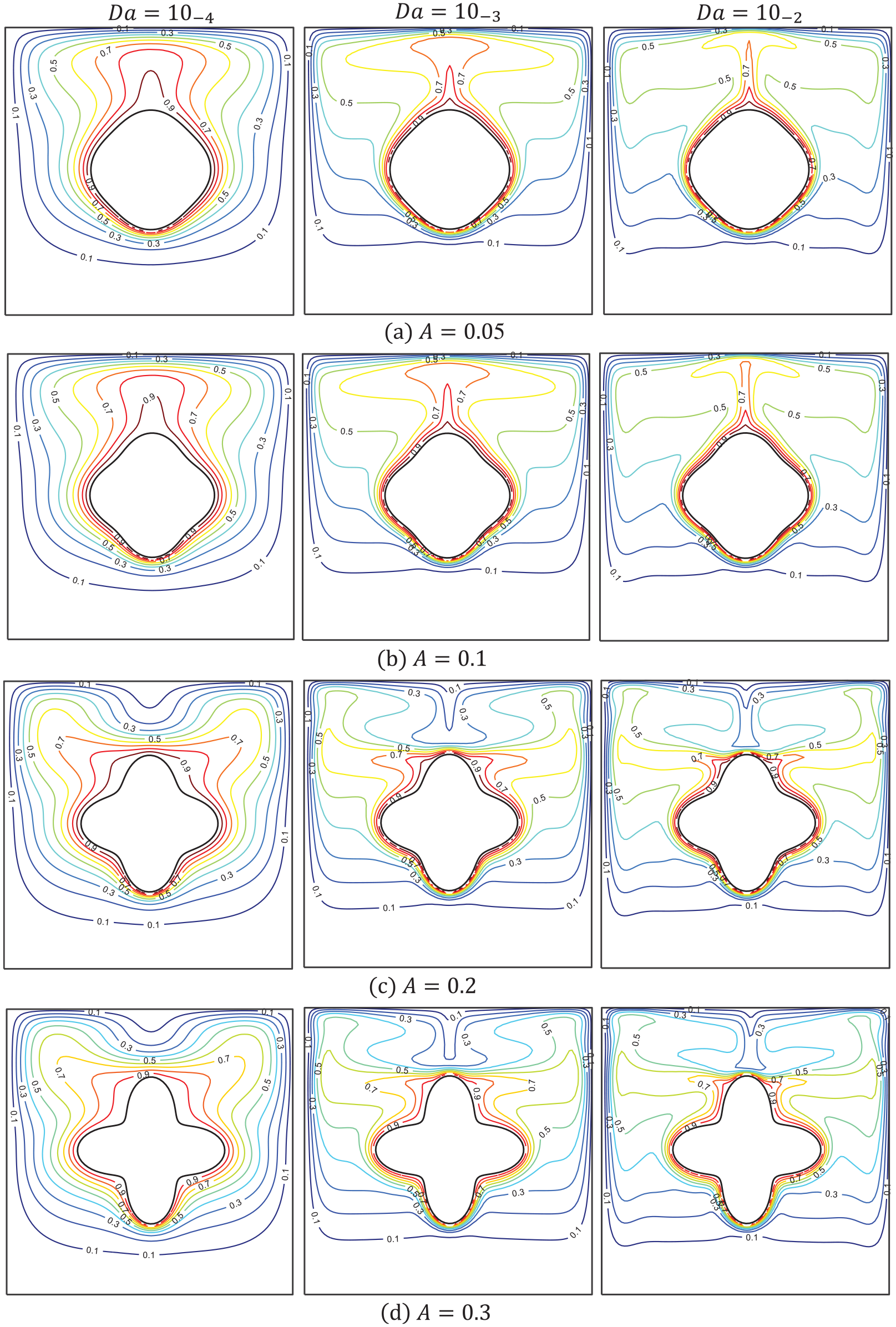
Isotherms for different Darcy numbers and adjusting the amplitude
Figure 6 shows the effects of Darcy numbers and number of corrugated surface on streamlines at

Streamlines for different Darcy numbers and adjusting the corrugation number,
Figure 7 displays the effects Darcy numbers and corrugation number on isotherms for

Isotherms for different Darcy numbers and adjusting the corrugation number,
Figure 8 shows the effects of Darcy numbers and radius on streamlines for
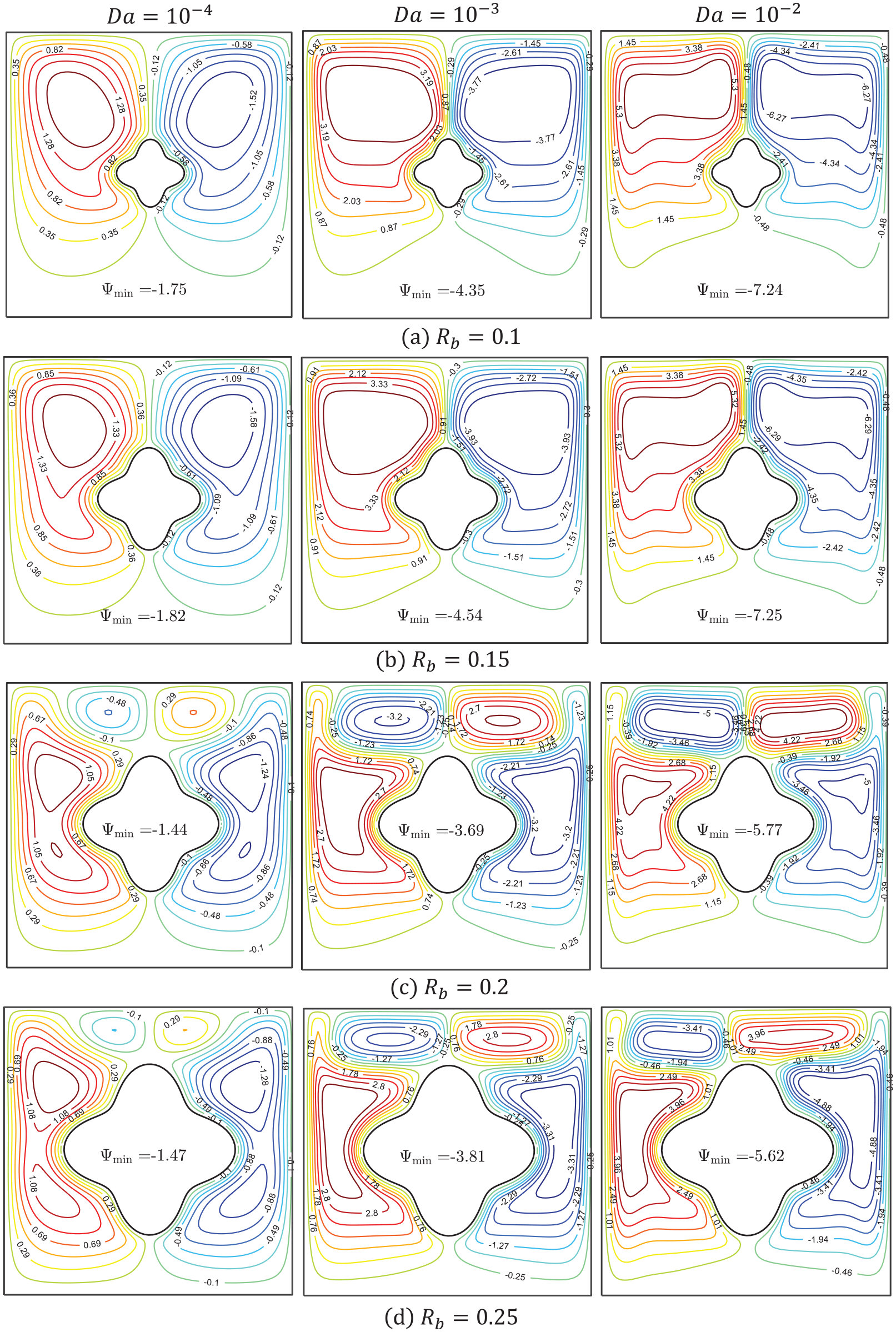
Streamlines for different Darcy numbers and adjusting the radius,
Figure 9 displays the effects Darcy numbers and radius on isotherms for

Isotherms for different Darcy numbers and varying the base radius,
Figure 10 shows the effect of the corrugation amplitude on the Nusselt number versus the concentration at

Influences of the corrugation amplitude on the mean Nusselt number versus the concentration at
Figure 11 illustrates the ratio Nusselt number versus Darcy number for various amplitude corrugation at

Influences of Darcy number and the corrugation amplitude on the ratio of Nusselt number for the undulated cylinder and Nusselt number for a smooth cylinder.
The influences of different number of corrugation on the ratio Nusselt number against number of amplitude of corrugation surface at
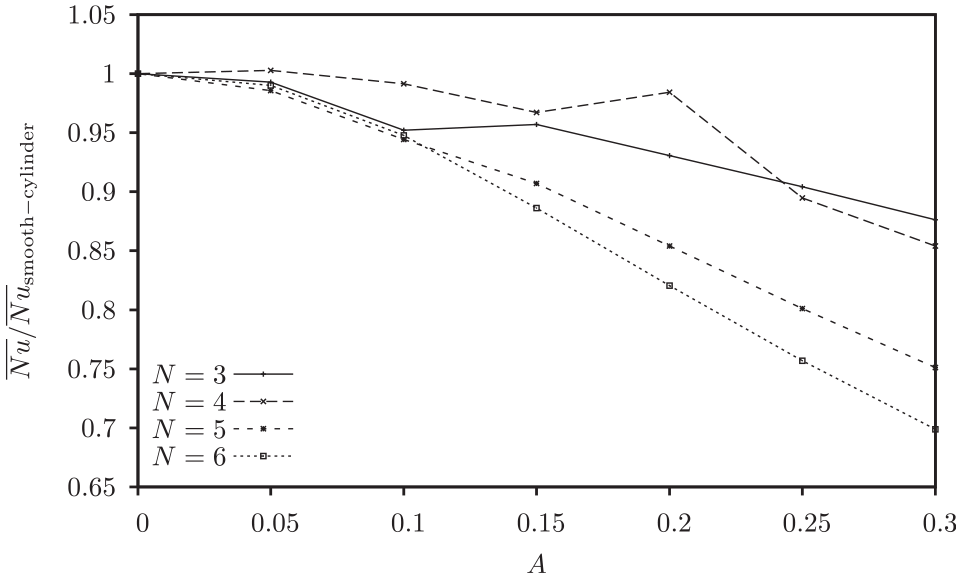
Effect of the amplitude and the number of corrugation surface on the ratio of Nusselt number for the undulated cylinder and Nusselt number for a smooth cylinder.
Figure 13 shows the effect of different nanoparticles type (a) and different cylinder position (b) on the Nusselt number versus the concentration at

Influences of different nanoparticles type (a) and different cylinder position (b) on the mean Nusselt number versus the concentration at
Conclusion
The present study scrutinised the free convection due to different temperature level between a cold enclosure and a hot corrugated cylinder. The partial differential equations of the governing equations are solved numerically utilising the Galerkin finite element method via COMSOL. The computational results for flow and thermal distribution and the heat transfer have been visualised graphically. The corrugation frequencies, nanoparticle properties and Darcy number connected closely to the pattern of streamlines vortices, thermal distribution and heat transfer profiles. The important finding of the present simulation are as follows:
The circulation flow structure and thermal pattern of nanofluids depend on the Darcy number, cylinder size, amplitude and number of corrugations. The corrugation parameters capable to control the flow circulation strength, the number of contra-rotative cells and the formation of the thermal plume inside the annulus.
The heat transfer of the corrugated cylinder might be better than the heat transfer of the smooth cylinder. However, in general the heat transfer is reduced by applying the corrugated surface.
The highest heat transfer performance was observed for the argentum. A relatively unimportant feature of the cylinder position was found for heat transfer enhancement.
In general, the heat transfer rate does not increase linearly by increasing the nanoparticle concentration, but it is proportional to the square root of the concentration.
To gain a better physical insight of free convection in the complex annulus filled with nanofluids, experiments should be conducted to see real interaction among waviness, porous material and nanoparticles. All problem considered here could be extended to other type of heat transfer such as in mixed or forced convection where these convection types often happen in real circumstances.
Footnotes
Appendix
Handling Editor: James Baldwin
Declaration of conflicting interests
The author declared no potential conflicts of interest with respect to the research, authorship, and/or publication of this article.
Funding
The author received no financial support for the research, authorship, and/or publication of this article.
