In this article, we aim to analyze the dual solutions for the flow of non-Newtonian material (Carreau fluid) over a radially shrinking surface. Magnetohydrodynamics fluid is considered. Concept of Stefan Boltzmann constant and mean absorption coefficient is used in the mathematical modeling of energy expression. Mass transfer is discussed. The upper and lower branch solutions for the Sherwood number, skin friction coefficient, and Nusselt number are calculated for different pertinent flow variables. Appropriate transformation variables are employed for reduction of partial differential equations system into ordinary differential equations. Dual solutions are obtained for the non-dimensional concentration, temperature, velocity, gradient of concentration, gradient of temperature, and gradient of velocity. The critical values for each upper and lower solutions are obtained for the case of gradient of velocity, gradient of temperature, and gradient of concentration. It is formed that concentration and temperature fields display same impact regarding both upper and lower branch solutions for velocity ratio and temperature ratio parameters.
It is very well recognized that the non-Newtonian materials are more applicable than viscous materials in processes of engineering, geophysics, and biomechanics.1,2 Many non-Newtonian materials exist in nature for their different characteristics. The difference between these materials can be distinguished from the functional relation between shear stress, the force per unit area mandatory to tolerate a constant rate of shear rate and liquid movement, and rate of velocity change when different layers of fluid or one layer passes through an adjacent layer. In terms of the rheological impact, the non-Newtonian materials are also classified as either shear thickening or shear thinning materials. The apparent viscosity of shear thinning materials like foams, solutions, polymer melts and emulsions, and suspensions decay via applied shear stress. Numerous models have been introduced to investigate the theological impact of such types of materials. The most common ones are the Jeffrey model, Maxwell model, second grade, third grade, Williamson fluid model, Carreau model, Power law model, and many others. Here, we study the flow behavior of Carreau model over a stretched and shrinking sheet. The Carreau model is able to capture both shear thickening and shear thinning behaviors; Carreau3 gave an innovative constitutive model for the rheological impact of carbon nanotubes (CNTs)/polymer composites. Grabski and Kolodziej4 reported flow of Carreau fluid between corrugated plates. Kumar et al.5 examined radiated flow of non-Newtonian liquid subject to temperature jump and fluid particle suspension over a stretched plate. Hashim et al.6 worked for fluid flow of Carreau liquid with magnetohydrodynamics (MHD). Kefayati and Tang7 discussed three-dimensional (3D) natural convection in entropy optimized flow of Carreau fluid in heated enclosure.
Stretched flows play an important role in mechanical and industrial engineering including crystal growing, glass fiber, hot rolling, extrusion of plastic sheet, wire drawing, and so many others. Initially, Crane8 closed from solution for flow over stretching surface. Behavior of viscous liquid over a stretchable surface with radiative flux is addressed by Cortell.9 Malvandi et al.10 investigated time-dependent slip stagnation point flow of nanomaterial over a stretchable sheet. Khan et al.11 studied flow of different species over a stretching surface for Casson fluid subject to stretched sheet. Hayat et al.12 inspected Jeffrey fluid flow with variable fluid properties and Cattaneo–Christov model. Previous studies13–32 scrutinized flow of Newtonian and non-Newtonian fluids with various aspects and surface conditions.
Motivated by the aforementioned attempts, the main propose here is to address the stagnation point flow when Carreau fluid is taken over a radially shrinking sheet. Dual solutions are obtained. The concepts of Stefan Bolzman constant and mean absorption coefficient is used in the mathematical modeling. Special consideration is given to numerical study of the lower and upper branch solutions for skin friction coefficient, Nusselt number, and Sherwood number. Runge–Kutta Fehlberg integration technique33,34 is employed. It is concluded from the obtained outcomes that velocity portrays both decreasing and increasing impact at the upper and lower branch. However, concentration and temperature fields have same impact at both upper and lower branch solutions for velocity ratio and temperature ratio parameters.
Flow modeling and viscosity relation
Here, mathematical modeling is presented for the MHD flow of Carreau fluid over a stretched/shrinking surface. The mathematical form of viscosity for Carreau fluid is described as follows6
in which denotes the material constant, is the flow behavior index, and and represent the zero and infinity shear rate viscosities. For simplicity, the infinity shear rate is ignored and the shear rate is addressed as follows
For or the above relation reduce to viscous fluid.
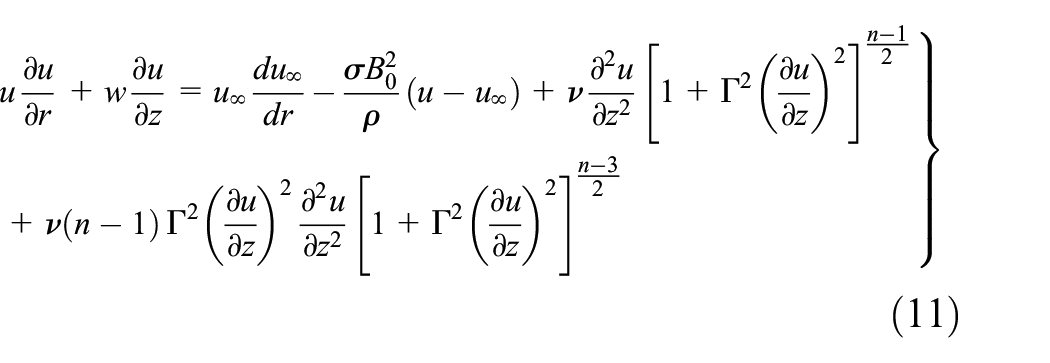
The governing flow equations are as follows
where ∇ is the gradient operator, is the velocity, is the density, is the pressure, is an extra stress tensor, is the total magnetic field, and is the current density. For present flow analysis, the velocity field is defined as
where and signify the velocity components in radial and axial directions.
The shear rate for non-Newtonian fluid (Carreau model) is written as
We now have the following expressions
Flow analysis
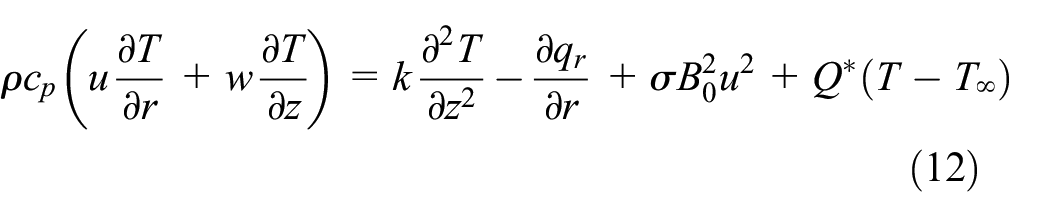
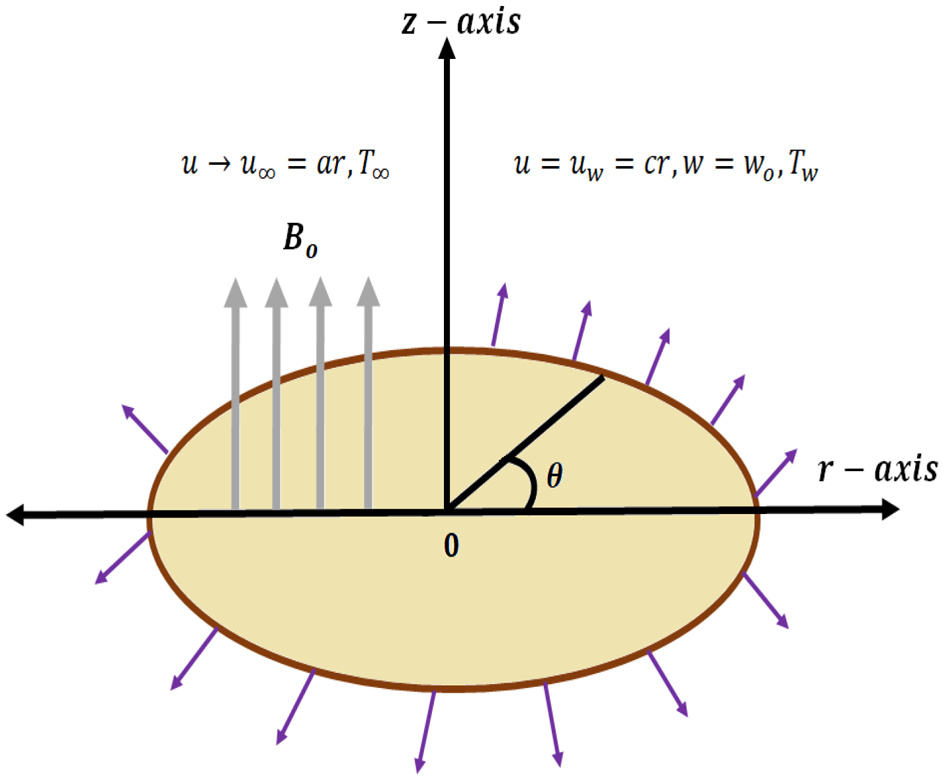
Figure 1 depicts the schematic flow geometry. Here, we investigate axisymmetric electrically conducting flow of Carreau fluid by a shrinking stretched sheet at . Magnetic field of constant strength is applied. Impact of induced magnetic field is absent due to small Reynolds number. The flow expressions in components form are mathematically after implementation of boundary layer approximations are subject to
with
where denotes the coordinates system, is the velocity components, is the free stream velocity, is the density, is the kinematic viscosity, is the material parameter, is the flow behavior index, is the specific heat, is the temperature, is the thermal conductivity, is the radiative heat flux, is the concentration, is the diffusion, are the rates, is the sheet temperature, is the stretching velocity, is the sheet concentration, and and are the ambient temperature and concentration.
Flow diagram.
By Roseland approximation, the radiative heat flux satisfies
or
where and stand for Stefan Boltzmann constant and mean absorption coefficient. Energy equation (12) takes the form
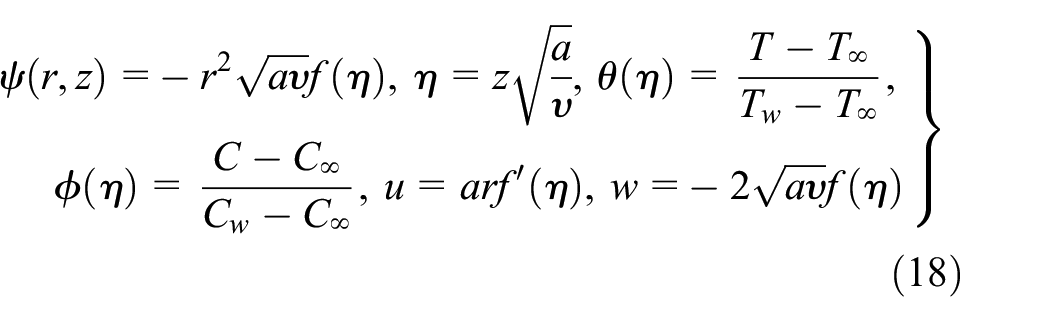
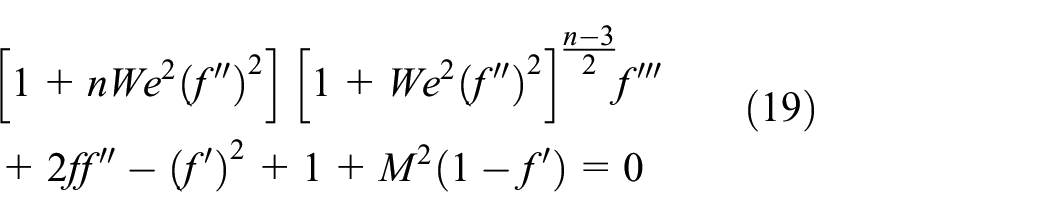
Setting
We obtain
Note that denote the local Weissenberg number, is the magnetic parameter, is the Prandtl number, is the temperature ratio parameter, is the Eckert number, is the suction/shrinking parameter, is the stretching ratio parameter, is the Schmidt number, is the heat source/sink parameter, and is the radiation parameter. These dimensionless parameters are mathematically defined as follows
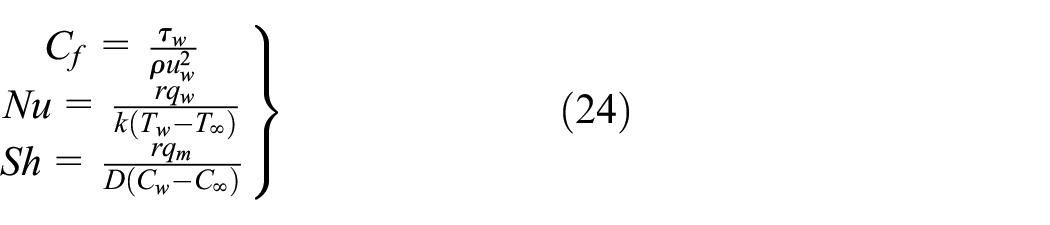
The skin friction coefficient , Nusselt number , and Sherwood number are as follows
where , respectively, depict the shear stress and heat and mass fluxes, that is
Finally, we obtain
where denotes the local Reynolds number.
Methodology
Numerical results are constructed for the nonlinear problem by using Runge–Kutta Fehlberg integration. In this algorithm, outcomes are obtained by converting the nonlinear ODEs into first-order ODEs. Thus we set
with
For implementing of the numerical algorithm by Runge–Kutta Fehlberg integration, we need three initial conditions which satisfy the conditions . The initial guesses are taken from domain where the convergence condition for the Newton Rapshan method is satisfied .
Discussion
In this section, we investigate the effects of magnetic parameter and Weissenberg number on Nusselt number, skin friction, and Sherwood number with shrinking parameter by retaining all other parameters fixed. Dual solutions exist for shrinking parameter . The fact of the dual solution is studied by Miklavčrč and Wang,35 Fang,36 and Wang.37 Godstien essentially gives the concept of backward flow. He stated that new type of flow occurs for shrinking case. There is always a region near the sheet where reverse flow starts. Backflow means that fluid particles starts flowing opposite to the normal direction.
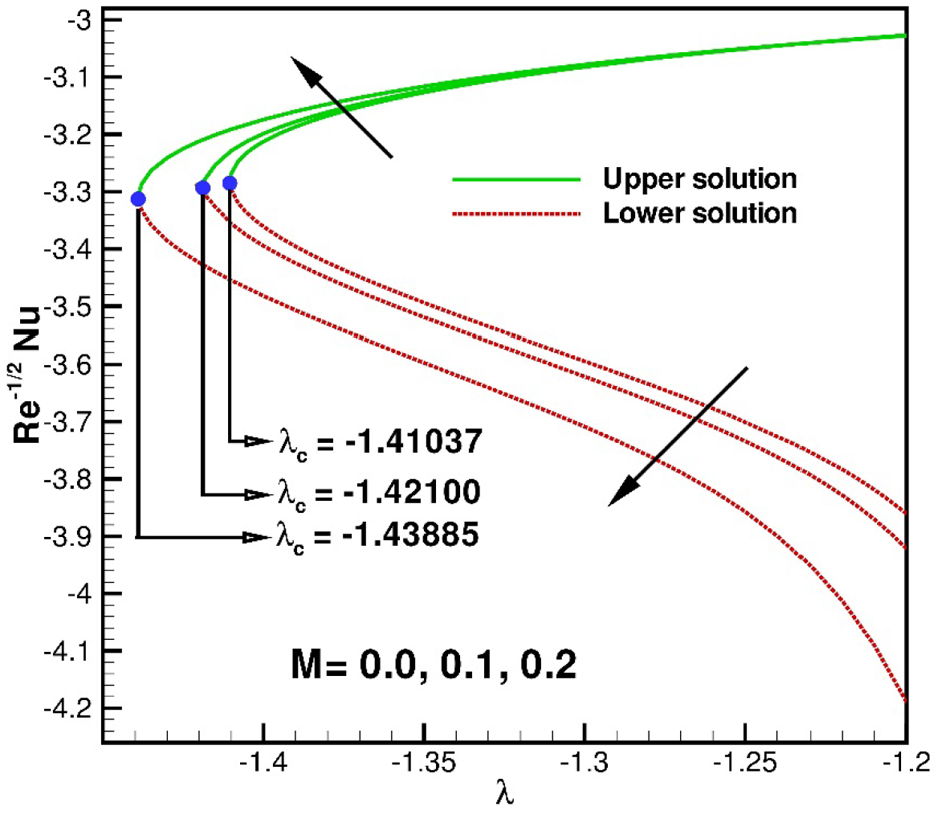
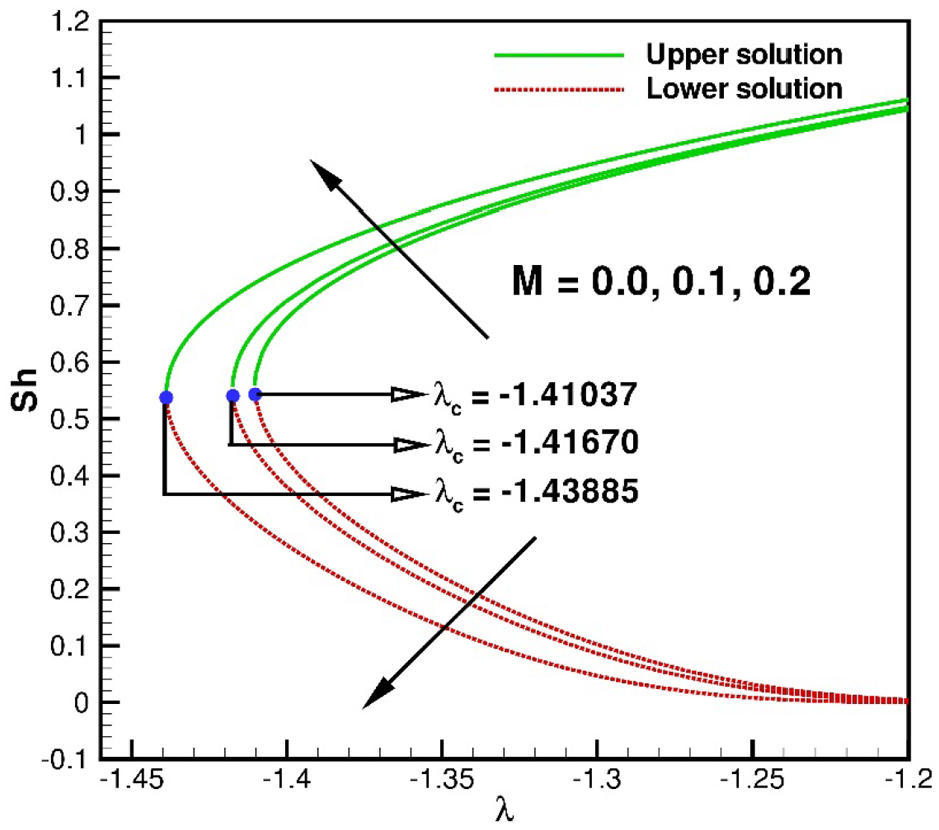
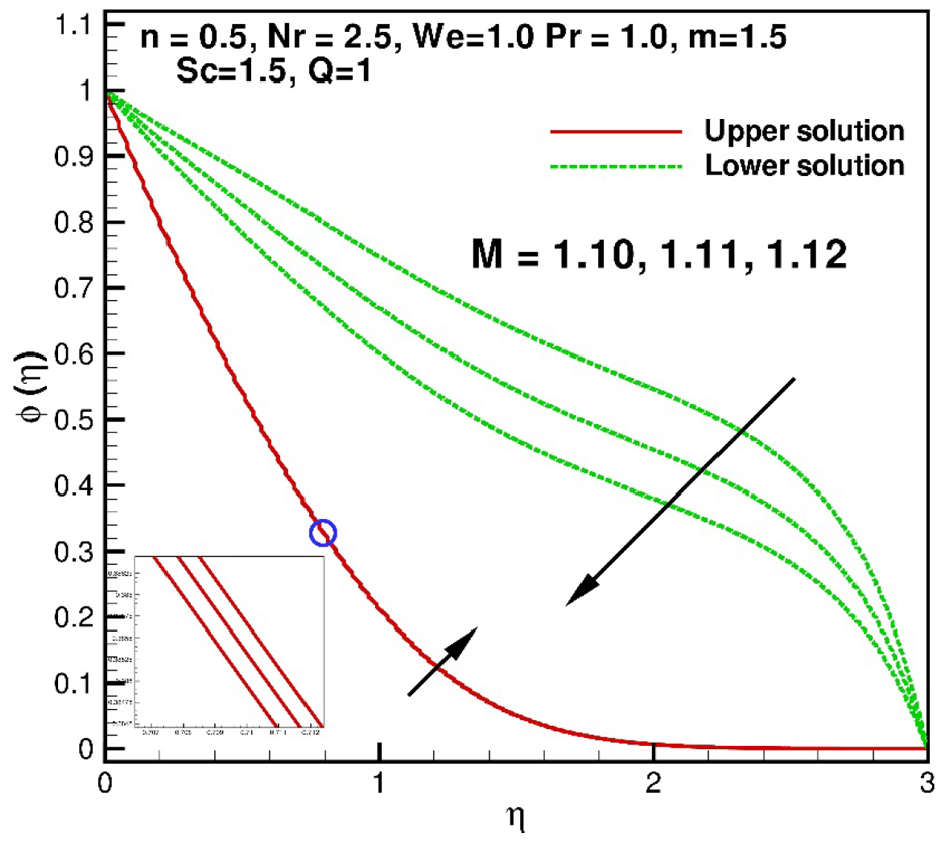
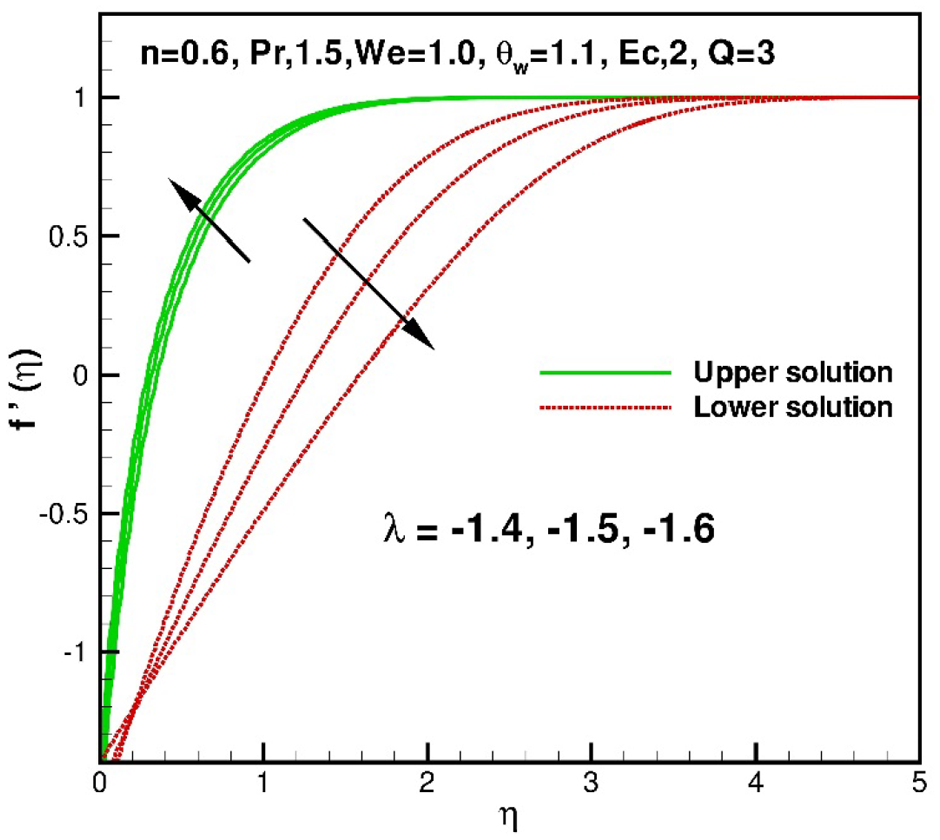
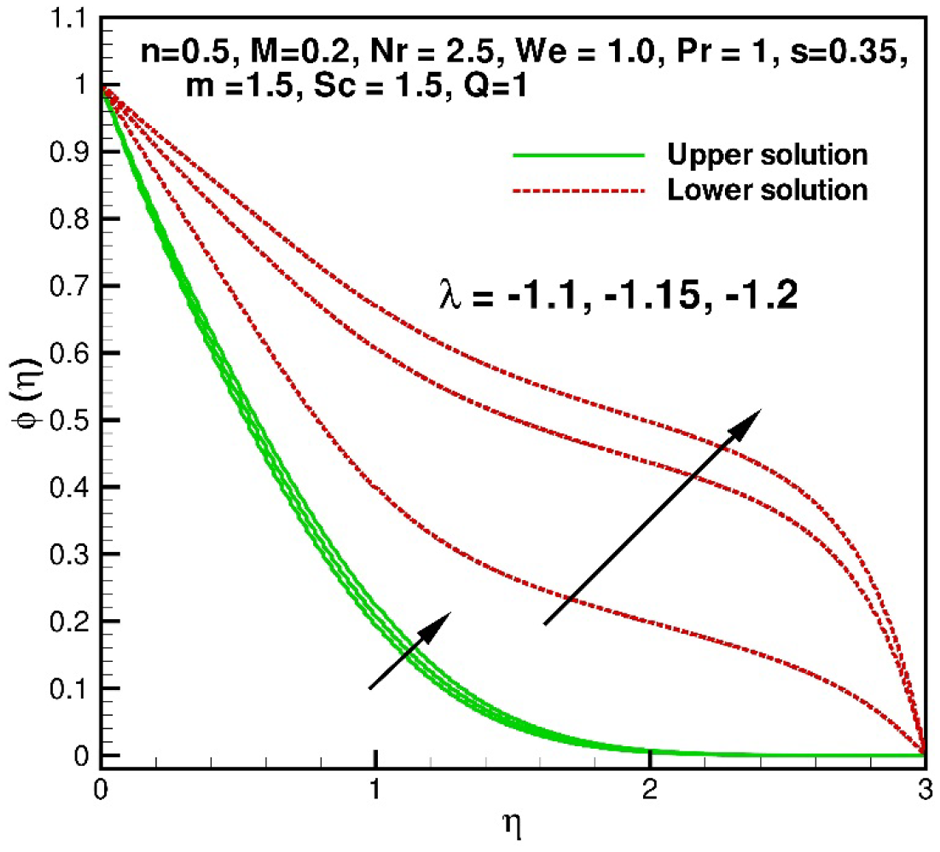
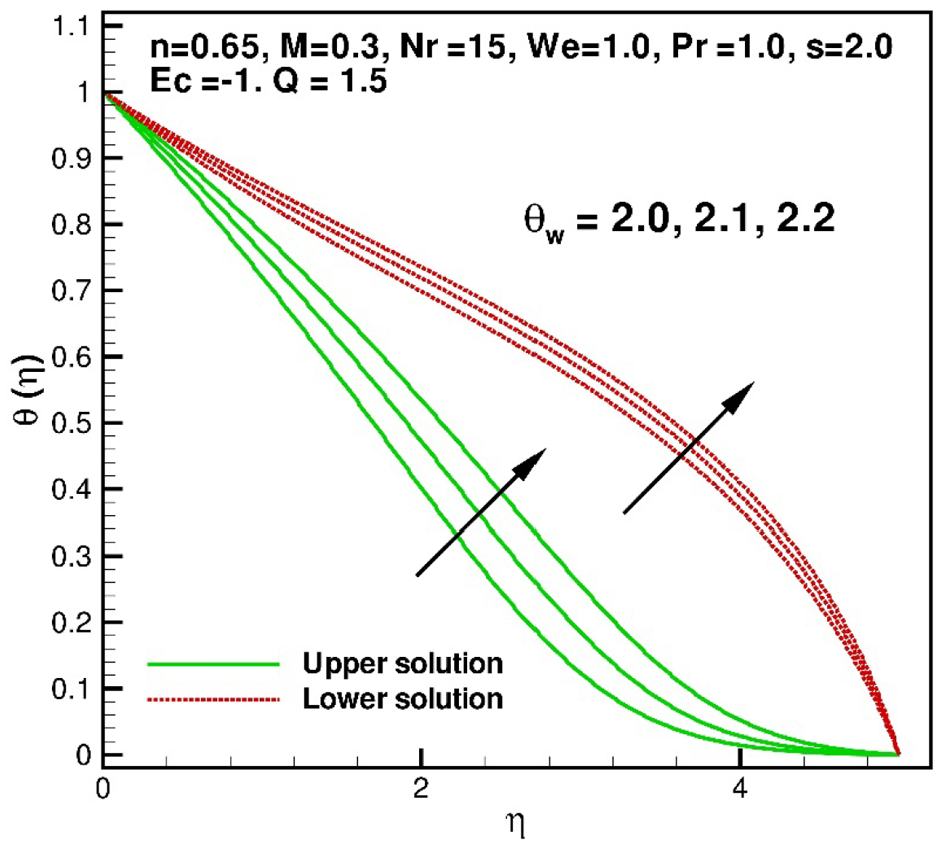
In this article, the dual solution is found due to the irregularity of shrinking sheet flow. Figures 2–7 show the dual solution for skin friction, Nusselt number, and Sherwood number. There are two types of solutions, namely, upper branch solution and lower branch solution. Effect of magnetic parameter on Nusselt number, skin friction, and Sherwood number is shown in Figures 2–4. We noticed that dual solution also increases for higher . Dual solution exists in range . Figures 5–7 are portrayed for effect of We against skin friction, Nusselt number, and Sherwood number. Here, one can easily observe that there are two solutions for two different initial guesses. These figures also show that domain of the dual solution is higher for larger We. Figures 8 and 9 are sketched for velocity and concentration against . We can see that the dual solution exists for both velocity and concentration distribution. By taking higher magnetic field strength, the upper solution of velocity and concentration increases whereas lower solution decays. The stronger magnetic field accelerates more of the lower solution when compared with upper solution. Effect of suction and shrinking parameter on velocity , temperature , and concentration are discussed in Figures 10–13. Figure 10 sketches the impact of on velocity. It is observed that upper branch solution enhances for larger while lower branch solution behaves in opposite manner. Figure 11 displays the upper and lower branch solutions of temperature against . Here, we see that upper branch solution is decreasing and lower branch solution is increasing for higher . Figures 12 and 13 display the effect of on velocity and concentration. It is witnessed that for lower , the upper branch solution of velocity increases while a decay is noticed in lower branch solution (see Figure 12). Figure 13 shows that for lower shrinking parameter , the concentration enhances. We can see that both lower and upper solutions of concentration are increased. Figure 14 displayed Prandtl number effect on temperature. There are two different types of results for upper and lower solutions. For higher , the temperature reduces for upper solution while it shows increasing behavior for lower solution. Temperature ratio parameter effect on temperature is sketched in Figure 15. It is evident from figure that upper and lower solutions are increasing functions of . Variation in the upper solution is greater than the lower solution. Figure 16 show the effect of thermal radiation parameter on . We can conclude opposite behavior of both solutions is possible through . Furthermore, for higher thermal radiation parameter, the behavior of the upper solution decreases while lower solution has increasing behavior.
Magnetic parameter effects on heat transfer rate.
Magnetic parameter effects on skin friction coefficient.
Magnetic parameter effects on Sherwood number.
Weissenberg number effects on heat transfer rate.
Weissenberg number effects on Skin friction coefficient.
Weissenberg number effects on Sherwood number.
Impact of M on velocity.
Impact of M on concentration.
Impact of s on velocity.
Impact of s on temperature.
Impact of λ on velocity.
Impact of λ on concentration.
Impact of Pr on temperature.
Impact of θw on temperature.
Impact of Nr on temperature.
Concluding remarks
Main results of presented study include the following points:
Thickness of the upper branch solution is always thinner than the lower branch solution via maximum range of variables.
Velocity shows both decreasing and increasing impact at the upper and lower branches of solutions for higher values of magnetic parameter, suction parameter, and shrinking variable.
Temperature and concentration have similar impact at both upper and lower branches subject to higher velocity and temperature ratio parameters.
Skin friction is more for higher magnetic variable.
Thermal field increases for lower branch, and decreases for upper branch via higher Prandtl number.
Footnotes
Handling Editor: James Baldwin
Declaration of conflicting interests
The author(s) declared no potential conflicts of interest with respect to the research, authorship, and/or publication of this article.
Funding
The author(s) received no financial support for the research, authorship, and/or publication of this article.
ORCID iD
M Ijaz Khan
References
1.
IkbalMAChakravartySWongKKL, et al. Unsteady response of non-Newtonian blood flow through a stenosed artery in magnetic field. J Comput Appl Math2009; 230: 243.
2.
HayatTAhmedNSajidM.Analytic solution for MHD flow of a third order fluid in a porous channel. J Comput Appl Math2008; 214: 572.
3.
CarreauPJ.Rheological equations from molecular network theories. J Rheol1972; 16: 99–127.
4.
GrabskiJKKołodziejJA.Analysis of Carreau fluid flow between corrugated plates. Comput Math Appl2016; 72: 1501–1514.
5.
KumarKGGireeshaBJRudraswamyNG, et al. Radiative heat transfers of Carreau fluid flow over a stretching sheet with fluid particle suspension and temperature jump. Results Phys2017; 7: 3976–3983.
6.
Hashim KhanMSaleh AlshomraniA.Numerical simulation for flow and heat transfer to Carreau fluid with magnetic field effect: dual nature study. J Magn Magn Mater2017; 443: 13–21.
7.
KefayatiGRTangH.Double-diffusive laminar natural convection and entropy generation of Carreau fluid in a heated enclosure with an inner circular cold cylinder (Part II: entropy generation). Int J Heat Mass Tran2018; 120: 683–713.
8.
CraneLJ.Flow past a stretching plate. J Appl Math Mech (ZAMP)1970; 21: 645–647.
9.
CortellR.Fluid flow and radiative nonlinear heat transfer over stretching sheet. J King Saud Univ—Sci2013; 26: 161–167.
10.
MalvandiAHedayatiFGanjiDD.Slip effects on unsteady stagnation point flow of a nanofluid over a stretching sheet. Powder Technol2014; 253: 377–384.
11.
KhanMIWaqasMHayatT, et al. A comparative study of Casson fluid with homogeneous-heterogeneous reactions. J Colloid Interface Sci2017; 498: 85–90.
12.
HayatTKhanMIFarooqM, et al. Impact of Cattaneo-Christov heat flux model in flow of variable thermal conductivity fluid over a variable thicked surface. Int J Heat Mass Tran2016; 99: 702–710.
13.
HamidMUsmanMKhanZH, et al. Dual solutions and stability analysis of flow and heat transfer of Casson fluid over a stretching sheet. Phy Lett A2019; 383: 2400–2408.
14.
HayatTAhmadSKhanMI, et al. Modeling and analyzing flow of third grade nanofluid due to rotating stretchable disk with chemical reaction and heat source. Physica B2018; 537: 116–126.
15.
Mohyud-DinSTHamidMUsmanM, et al. Rotating flow of nanofluid due to exponentially stretching surface: an optimal study. J Algorithm Comput Technol2019; 13: 1–14.
16.
HayatTKhanMIAlsaediA, et al. Joule heating and viscous dissipation in flow of nanomaterial by a rotating disk. Int Commun Heat Mass Trans2017; 89: 190–197.
17.
HamidMKhanZHKhanWA, et al. Natural convection of water-based carbon nanotubes in a partially heated rectangular fin-shaped cavity with an inner cylindrical obstacle. Phys Fluids2019; 31: 103607.
18.
RashidMKhanMIHayatT, et al. Entropy generation in flow of ferromagnetic liquid with nonlinear radiation and slip condition. J Mol Liq2019; 276: 441–452.
19.
UsmanMHamidMRashidiMM.Gegenbauer wavelets collocation-based scheme to explore the solution of free bio-convection of nanofluid in 3D nearby stagnation point. Neural Comput Appl2019; 31: 8003–8019.
20.
KhanMIKumarAHayatT, et al. Entropy generation in flow of Carreau nanofluid. J Mol Liq2019; 278: 677–687.
21.
HamidMUsmanMUl HaqR.Wavelet investigation of soret and dufour effects on stagnation point fluid flow in two dimensions with variable thermal conductivity and diffusivity. Physica Scripta2019; 94: 115219.
22.
AbbasSZKhanMIKadryS, et al. Fully developed entropy optimized second order velocity slip MHD nanofluid flow with activation energy. Comput Methods Prog Biomed2020; 190: 105362.
23.
RajuCSKHoqueMMPriyadharshiniP, et al. Cross diffusion effects on magnetohydrodynamic slip flow of Carreau liquid over a slendering sheet with non-uniform heat source/sink. J Braz Soc Mech Sci Eng2018; 40: 222.
24.
AbbasSZKhanWAKadryS, et al. Entropy optimized Darcy-Forchheimer nanofluid (silicon dioxide, molybdenum disulfide) subject to temperature dependent viscosity. Comput Methods Prog Biomed2020; 190: 105363.
25.
MahantheshBGireeshaBJShashikumarNS, et al. Marangoni convection in Casson liquid flow due to an infinite disk with exponential space dependent heat source and cross-diffusion effects. Results Phys2018; 9: 78–85.
26.
WangJKhanMIKhanWA, et al. Transportation of heat generation/absorption and radiative heat flux in homogeneous–heterogeneous catalytic reactions of non-Newtonian fluid (Oldroyd-B model). Comput Methods Prog Biomed2020; 189: 105310.
27.
MahantheshBGireeshaBJAnimasaunIL, et al. MHD flow of SWCNT and MWCNT nanoliquids past a rotating stretchable disk with thermal and exponential space dependent heat source. Physica Scripta2019; 94: 085214.
28.
MuhammadRKhanMIKhanNB, et al. Magnetohydrodynamics (MHD) radiated nanomaterial viscous material flow by a curved surface with second order slip and entropy generation. Comput Methods Prog Biomed2020; 189: 105294.
29.
MahantheshBLorenziniGOudinaFM, et al. Significance of exponential space- and thermal-dependent heat source effects on nanofluid flow due to radially elongated disk with Coriolis and Lorentz forces. J Therm Anal Calorim. 2019; 141: 37–44.
30.
MuhammadRKhanMIJameelM, et al. Fully developed Darcy-Forchheimer mixed convective flow over a curved surface with activation energy and entropy generation. Comput Methods Prog Biomed2020; 188: 105298.
31.
KorikoOKAnimasaunILMahantheshB, et al. Heat transfer in the flow of blood-gold Carreau nanofluid induced by partial slip and buoyancy. Heat Tran Asian Res2019; 47: 806–823.
32.
KhanMIAlzahraniFHobinyA, et al. Modeling of Cattaneo-Christov double diffusions (CCDD) in Williamson nanomaterial slip flow subject to porous medium. J Mater Res Technol2020; 9: 6172–6177.
33.
AfridiMIQasimM.Second law analysis of Blasius flow with nonlinear Rosseland thermal radiation in the presence of viscous dissipation. Propuls Power Res2019; 8: 234–242.
34.
IrfanMKhanWAKhanM, et al. Influence of arrhenius activation energy in chemically reactive radiative flow of 3D Carreau nanofluid with nonlinear mixed convection. J Phys Chem Solids2019; 125: 141–152.
35.
MiklavcicMWangCY.Viscous flow due to a shrinking sheet. Quart Appl Math2006; 64: 283–290.
36.
FangT.Boundary layer flow over a shrinking sheet with power-law velocity. Int J Heat Mass Tran2008; 51: 5838–5843.
37.
WangCY.Stagnation flow towards a shrinking sheet. Int J Non-linear Mech2008; 43: 377–382.