



Abstract
The purpose of this work is to investigate the heat transport on water suspended by aluminium alloy nanomaterials. The analysis is conducted by incorporating the influence of imposed magnetic field and viscous dissipation over convective surface. The self-similar version of the model is treated numerically and the results for the flow field are presented. It is perceived that the velocity of AA7072-H2O and AA7075-H2O declines for stronger magnetic field effects. Due to convective condition, the temperature rises abruptly. Moreover, increasing trends in the local heat transfer rate are examined for higher Biot effects.
Introduction
Heat transfer analysis in viscous incompressible fluid over a stretching sheet either rotating or nonrotating is one of the potential research areas because of its variety of applications. These comprised in wire drawing, manufacturing of glass fibre, production of rubber sheets and cooling of large metallic plates like electrolyte and so on.
First of all, Crane
1
investigated the fluid flow past a stretching plate. Afterwards, researchers focused on the analysis of fluid over a stretchable surface by considering various physical flow conditions like convective condition and slip condition. For precedence, we can study Mukhopadhyay,
2
Sahoo
3
and Rashidi et al.
4
The stimulations of suction/injection of flow over a stretchable surface were described by Gupta and Gupta.
5
The behaviour of heat and mass transfer due to various nondimensional physical quantities is comprised in their study. The analysis of rotating fluid over a stretchable surface is discussed by Wang.
6
They observed fascinating behaviour of parameter
The influences of Lorentz forces on the flow regimes are very significant. In many industrial processes, flow of fluid in different channels and tubes may contain impurities. In order to purify the flowing liquid, Lorentz forces were applied on it. Due to applied Lorentz forces, the motion of fluid become slowdown and impurities remain at the bottom. Thus, researchers targeted on the analysis of heat and mass transfer by considering the effects of Lorentz forces. In 2016, Reddy and Chamkha 7 reported magnetohydrodynamic (MHD) flow by encountering the influences of various parameters. Time-dependent flow of non-Newtonian fluid over a surface was reported in Ullah et al. 8 They also highlighted the hidden phenomena of thermal and concentration gradients in the velocity and concentration fields. For numerical computation, they employed Keller-box technique. Very recently, Ahmed et al. 9 presented novel analysis on flow of Newtonian fluid over convective nature of unsteady stretching surface. They examined the impact of thermal radiations on chemically reacting fluid. The study of fluids (including micropolar fluids) by considering the remarkable Soret and Dufour stimulations and convective boundary condition is comprised in Sharidan et al., 10 Aurangzaib et al. 11 and Sharidan et al. 12 and references therein.
Studies made for the improvement of less thermally conductive fluids suspended by solid particles began more than a century ago. First, a theoretical model which developed to improve thermal conductivity of heterogeneous nature of solid particles is known as Maxwell model. In order to investigate thermal conductivity of the fluids diluted with solid micrometre- or millimetre-sized particles, the Maxwell model was adopted. The major issue with the use of micro-sized particles in the conventional fluids is that the particles dilute in the liquids very rapidly. Furthermore, drop in pressure, abrasion and clogging is caused by these phenomena. In order to obtain remarkable improvement in thermal conductivities of these compositions, particles with high concentration are required.
For many industrial and technological processes, fluids are required to have rapid thermal conductivity properties. For such processes, regular liquids, such as water, kerosene oil, engine oil, ethylene glycol, tri-ethylene glycol, lubricants and bio-fluids, are failed because of poor thermal conductivity properties. To fill aforementioned gap in the industrial and technological sides, a new class of fluids developed known as nanofluids. The term nanoparticle fluid suspensions or nanofluids is coined by Choi 13 in 1995. This newly developed class of fluids solved many technological and industrial issues. Nanofluids are the compositions of nanosized particles in the conventional liquids. The nanoparticles are oxide ceramic, metals (Al-Cu), metal carbides (SiC), nitrides and other functionalized nanoparticles. For useful study regarding nanofluids in varying geometries by considering the various flow parameters and conditions like convective and slip conditions, we can study Sheikholeslami and Seyednezhad, 14 Khan et al. 15 and Ahmed et al. 16 Significant analysis related to the heat transport characteristics in the colloidal suspensions and regular liquids under various flow conditions in different flow scenarios was examined in Khan and colleagues.17–27 The analysis of magnetized Maxwell liquid, micropolar fluid characteristics, stagnation MHD flow with mixed convection and the novel analysis of activation energy in Carreau nanofluid was perceived in Hsiao.28–31
The unique composition of characteristics provided by aluminium and its alloys makes it one of the multifarious and economical materials from engineering point of view. Aluminium has less density (2.7 g/cm3) compared to that of steel (7.83 g/cm3). Furthermore, weight of steel in one cubic foot is about 490 lb which is greater compared to that of aluminium alloys having weight only 170 lb. Thus, aluminium alloys are used in wheel manufacturing that are advantageous for air crafts and vehicles and all types of water-borne and land vehicles.
Aluminium alloys are alloys in which aluminium play a dominant role. Furthermore, in aluminium alloys, copper, silicon, zinc and magnesium are used as a typical alloying element. Aluminium alloys are characterized into two further sub-disciplines called heat treatable and heat non-treatable aluminium alloys. The aluminium alloys are widely used in household wiring and in manufacturing of wheels and air crafts. Among aluminium alloys, two important alloys are known as AA7072-H2O and AA7075-H2O (for precedence, we can study Khan et al.
32
). These aluminium alloys contain 90% Al, 2%–3% Mg, 5%–6% Zn and 1%–2% copper with the addition of Cu, Fe and
In this work, incompressible flow of water suspended by aluminium alloys particles, namely, AA7072-H2O and AA7075-H2O, is taken over a stretchable surface. The impact of resistive heating and convective nature of boundary condition is also under consideration. Section ‘Model formulation’ describes the modelling of the particular flow model. Solution procedure (Runge–Kutta scheme) is given in section ‘Solution of the model’. The stimulations of various nondimensional quantities particularly resistive heating and convective condition are embedded in section ‘Graphical results’. Finally, remarkable outcomes are described in section ‘Conclusion’.
Model formulation
The steady two-dimensional (2D) laminar flow of water suspended by

Physical theme of the model.
The equations that govern the flow of AA7072-H2O and AA7075-H2O nanofluids in the existence of applied Lorentz force and ohmic heating over a stretchable surface are as follows 33



Equation (1) shows the law of conservation of mass, while momentum and energy equations in the existence of Lorentz force and resistive heating are described in equations (2) and (3), respectively. Moreover,
The conditions at the sheet surface and away from it are as follows
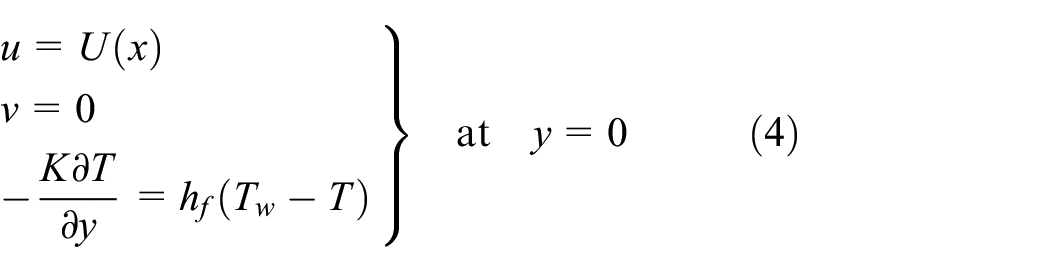

where u, v and T are functions of x and y. For effective dynamic viscosity, effective thermal conductivity, effective density and effective electrical conductivity, the following nanofluid models are adopted


In equations (6)–(8), volume fraction of aluminium alloys is denoted by
Thermophysical characteristics of aluminium alloys and conventional fluid. 32

The similarity variables for particular flow model are defined in the following manner 33




Using suitable differentiation and nanofluids models given in Table 1, we attained the following model


and self-similar version of the auxiliary equations is as follows


Nondimensional quantities embedded in the model are magnetic number




Using thermal and physical properties for aluminium alloys and water shown in Table 1, we have the following two models.
AA7072-H2O model
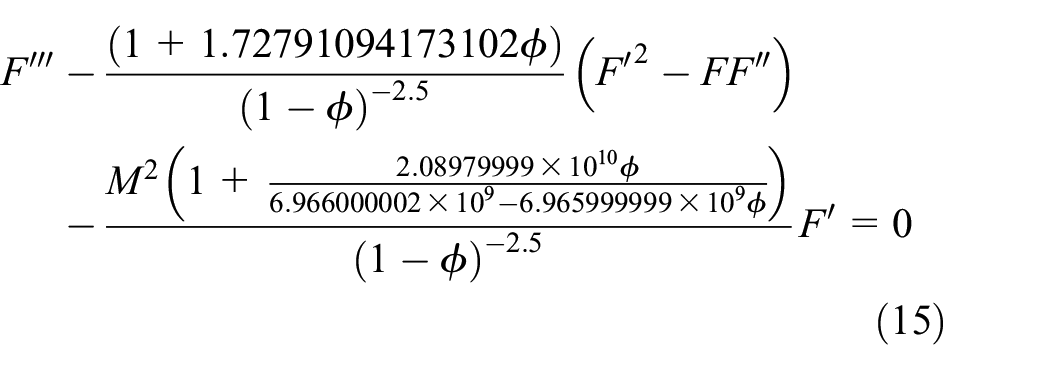

AA7075-H2O model


The feasible boundary conditions for both AA7072-H2O and AA7075-H2O models are given in equations (13) and (14).
The dimensional form for shear stress and local Nusselt number at the convective surface is in the following form


By entreating feasible differentiation in equations (19) and (20) and after some calculation, mathematical expressions for shear stresses and local Nusselt number transformed into the following dimensionless version

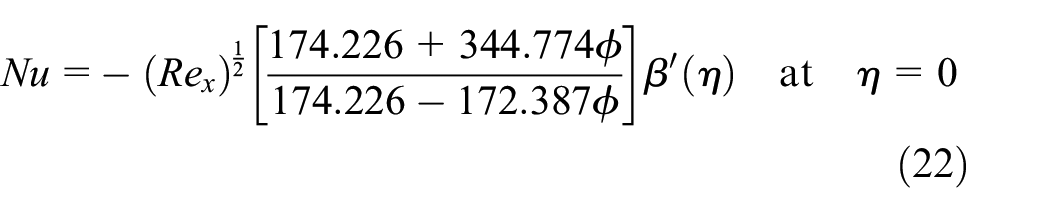
Here,
Solution of the model
Both the flow models (AA7072-H2O and AA7075-H2O) are nonlinear. It is not easy to calculate exact solutions for these models. Thus, we imposed our attention to solve the models numerically. For this, we adopted Runge–Kutta numerical scheme (for precedence, we can study Ahmed and colleagues9,15,16). To initiate the Runge scheme, first, one need to introduce the following transformations


Before employing the above substitutions, first, we write both the models in the following pattern.
AA7072-H2O model


Now, entreating the transformations made in equations (23) and (24), we have the following system of first-order ordinary differential equations

AA7075-H2O model
The AA7075-H2O model described in equations (17) and (18) can be written as


Using substitutions, we have the following system
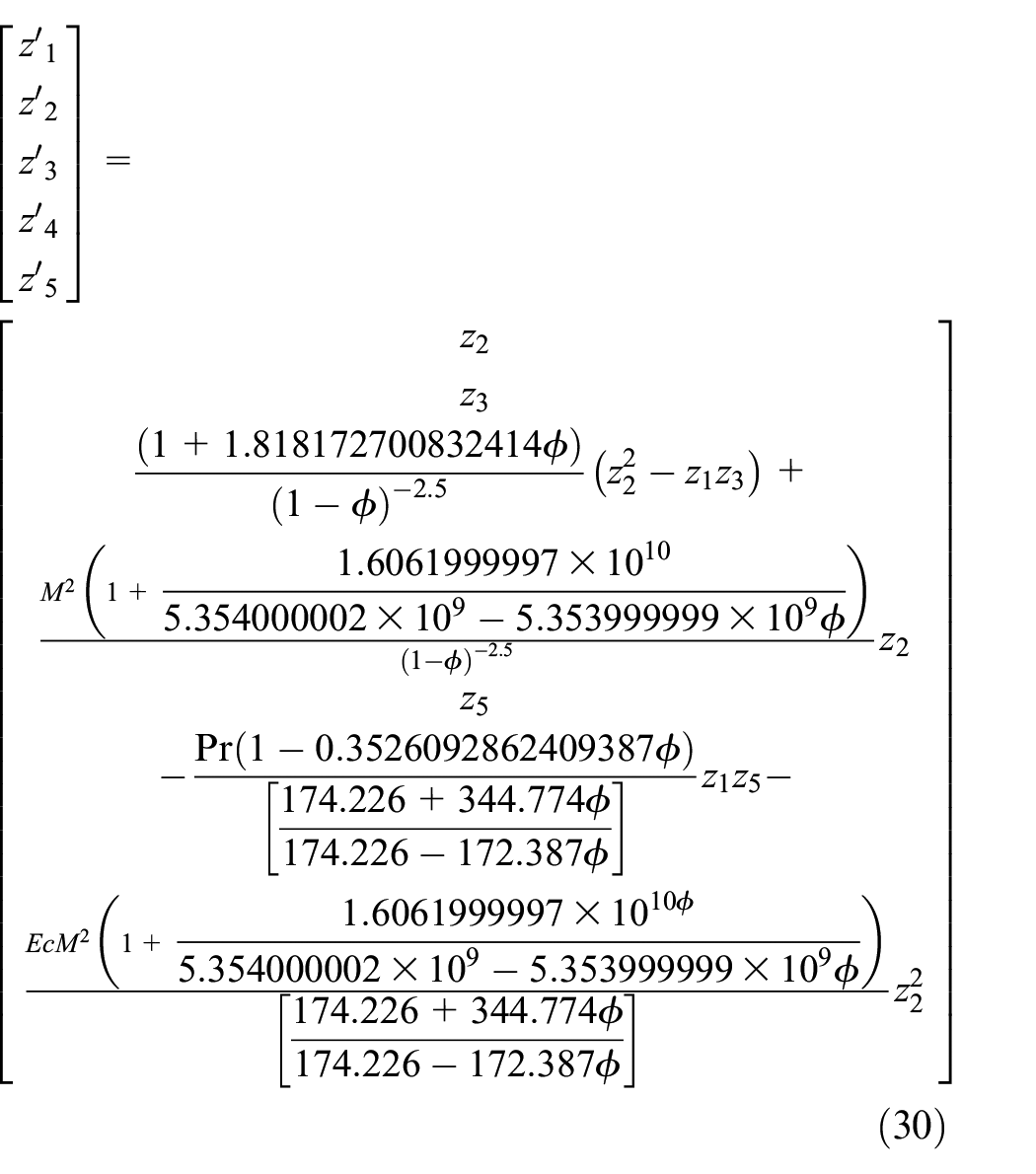
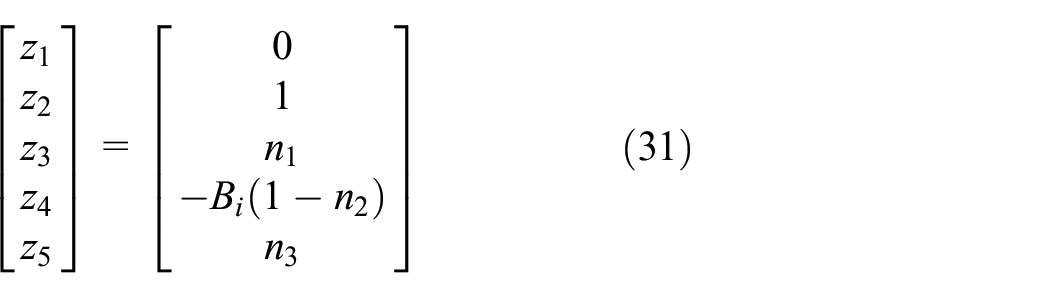
Transformed initial conditions are as follows
Finally, numerical computation is carried out with the help of Mathematica 10.0.
Graphical results
The stimulations in the flow characteristics due to fluctuating quantities ingrained in the models are described in this section. Furthermore, to provoke the validation of the analysis, a fruitful comparison is carried out.
Velocity field
The influences of
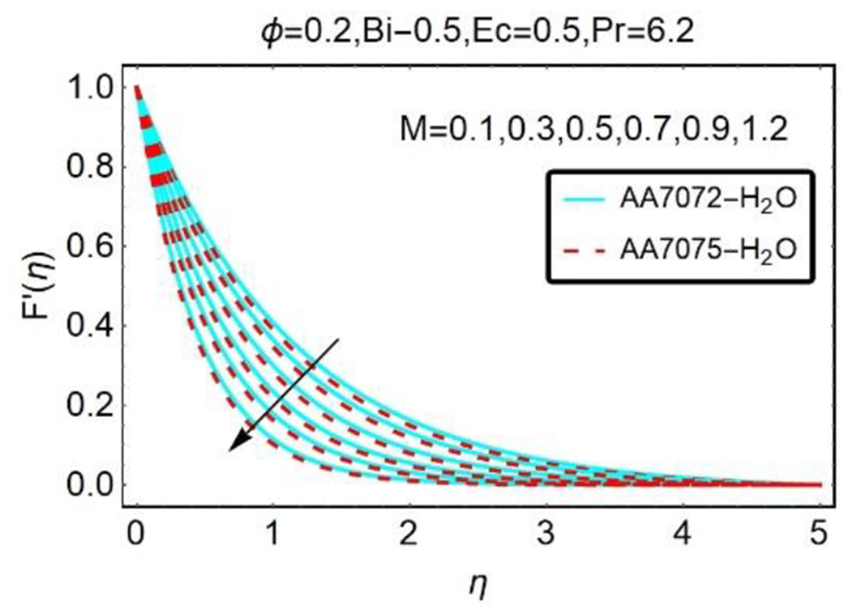
Stimulus of

Stimulus of
It is imperative to mention that volumetric fraction

Stimulus of
Thermal field
The properties of nanofluids like effective dynamic viscosity, effective density, specific heat capacitance, thermal conductivity and electrical conductivity play a key role in the study of nanofluids. These imperative physical quantities are embedded in magnetic number

Stimulus of

Stimulus of

Stimulus of
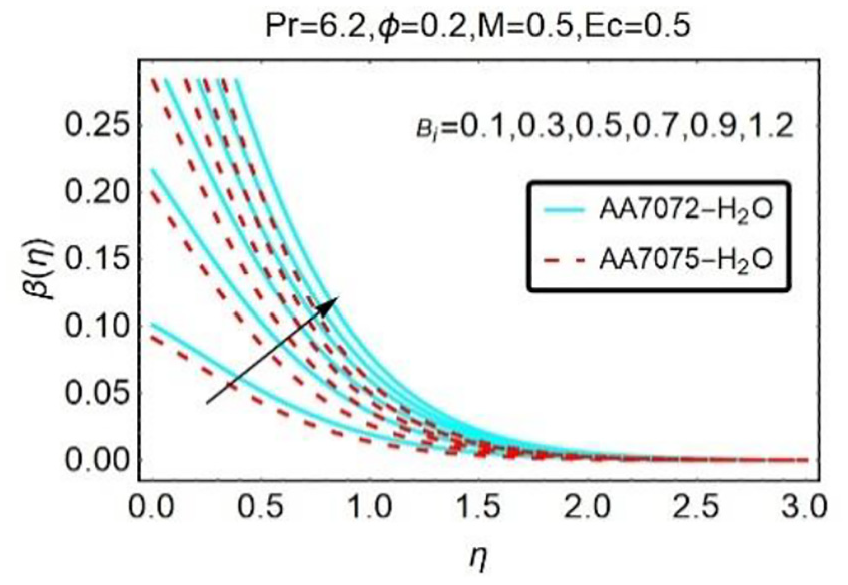
Stimulus of
The influence of Hartmann number, which is a quotient of electromagnetic force to the viscous forces, is shown in Figure 5. As electrical conductivity of AA7072 alloys is greater than that of AA7075 alloys due to which temperature of AA7072-H2O nanofluids increases. Furthermore, for stronger magnetic field, temperature for both AA7072-H2O and AA7075-H2O nanofluids rises. Near the stretchable surface, that is, at
Eckert number, which is a relation of advective transport to the heat dissipation potential (
An imperative dimensionless physical quantity called Biot’s number has a wide range of applications which comprised in transient heat transfer and so on. Fluid mechanics problem having smaller Biot’s number are (less than one) thermally easy to study because of uniform thermal field inside the body. However, high Biot’s number (much greater than one) signals the nonuniformity of thermal field inside the body. The stimuli of Biot’s number
Skin friction and Nusselt number
Shear stresses and local Nusselt number attained much interest due to vital role in industries. These quantities alter due to various flow parameters like magnetic number, Pr, Ec and Biot’s number significantly. For the above said purpose, Figures 9–15 are plotted in which effects of aforementioned self-similar physical quantities are embedded.

Stimulus of

Stimulus of

Stimulus of

Stimulus of

Stimulus of
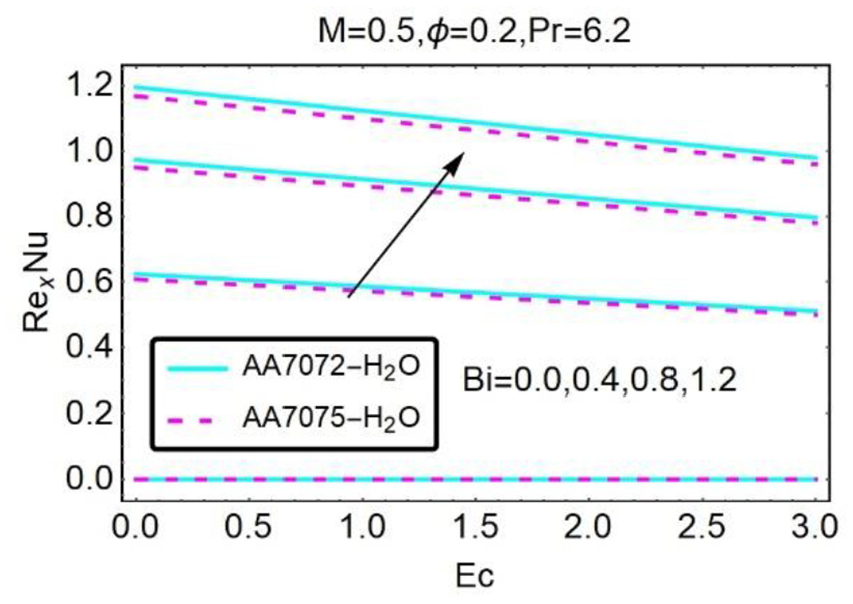
Stimulus of

Stimulus of volume fraction of Nusselt number.
Figure 9 depicts the alterations in the shear stress for increasing M versus
Figures 13–15 illustrate the variations in the local Nusselt number for Eckert number, Biot’s number and
Validity of the analysis
For
Comparative analysis for F″(0), M = 0 and

The numerical values for

Conclusion
A novel analysis on flow of water by considering aluminium alloys (AA7072 and AA7075) over a convectively heated surface is investigated. The major output of the analysis is
The parameter
For AA7075-H2O nanofluids, the velocity field decreases quite rapidly because of their low electrical conductivity.
The nanofluids temperature increases very rapidly for more convective surface and in the case of AA7075-H2O nanofluids temperature increases slowly because of their low thermal and electrical conductivities as compared to that of AA7075-H2O nanofluids.
The presence of resistive heating in the energy equations favours the temperature of under consideration nanofluids.
The volumetric fraction
The shear stresses decrease for stronger magnetic parameter and increasing
The local rate of heat transfer rises for convective stretching surface.
Footnotes
Appendix 1
Handling Editor: James Baldwin
Declaration of conflicting interests
The author(s) declared no potential conflicts of interest with respect to the research, authorship and/or publication of this article.
Funding
The author(s) received no financial support for the research, authorship and/or publication of this article.
