The purpose of this research is to investigate the impact of magnetic dipole on the flow of nanofluids over the extending surface. This study is based on steady and non-porous medium with no-slip conditions. Two types of nanofluids are examined under the effect of operative Prandtl model and thermal convection. The experimental results comprising the spreading of and have been used from the existing literature with and without the magnetic dipole. The basic governing equations are transformed using the transformation into a set of nonlinear differential equations for both categories of nanofluids. The fourth-order Runge Kutta numerical scheme has been executed to solve the nonlinear ordinary differential equations. The impacts of the embedded parameters such as nanofluid volume fraction, Prandtl number, and dissipation term have been examined and discussed. The important features of the study such as Curie temperature, skin friction, and local Nusselt number are also analyzed physically and numerically. (1) It is perceived that ethylene glycol–based nanofluids are more effective due to their strong thermophysical properties compared to water-based nanofluids. By increasing the volume fraction , the temperature of the nanofluids and is increased, and this is due to the fact that nanofluids exhibit high thermal conductivity compared to ordinary heat transfer fluids. (2) It is observed from the obtained results that the magnetic dipole is usually used to control the turbulence behavior of the fluid flow.
Nanofluids are effective agents for energy resources. These fluids play a vibrant part in the enhancement of heat transmission devices used in various industries and engineering fields. Both energy gain and regulation of the consumption of energy by nanofluids are not sufficient, and these are possible only by opting for advance heat transfer liquids to control the wastage of energy and to gain the most heat transmission, which are the demands of the industry and other relevant scientific fields. Prior to the utilization of nanotechnology, analysts and engineers have confronted such large numbers of issues in identifying the heat transfer fluids; however, the advancement of nanometer-sized particles and their use in the heat transfer fluids have together enhanced thermal conductivity. The mixture of small-sized metal atoms up to 5% of the base liquids is known as nanofluids. The popular small-sized particles of metal and their oxides are ,, , and so on, and the base liquids are water, lamp oil, motor oil, ethylene glycol (EG), and so forth. Generally, common liquids have low thermal efficiency, and the addition of nanoparticles of metals 1–100 nm in size expectedly improves the thermal efficiency of the nanofluids as a whole.
In 1995, a Chinese researcher exhibited his primary document about nanofluid in the field of nanotechnology.1 He projected another category of liquid with increasing thermal properties. These nanofluids included dense particles (1–100 nm) of different metals like alumina, copper, gold, and so on and base fluids like , EG, engine oil, and so on. After the advent of this technology, numerous engineering issues have been tackled—particularly problems relating to low thermal conductivity of ordinary liquids were overcome because of the pioneering work in the field of nanotechnology. Due to these properties of nanofluid, many analysts started investigating the nanofluid flow in different geometries. Sandeep et al.2 examined the thermal improvement in the time-dependent nano liquid, including aluminum alloy nanoparticles AA7072 and AA7075, and applied magnetic field. They examined the characteristics of these cited nanoparticle alloys on the momentum and thermal boundary layers. Ahmed et al.3 examined the impact of carbon nanotube (CNT) nanofluids considering the stream between Riga plates. Sheikholeslami4 analyzed copper oxide–water nanofluid using the Darcy law. Sheikholeslami and Vajravelu5 scrutinized heat transfer of nano liquid flow in a cavity by applying various magnetic fields. Aman et al.6 described the impact of golden particles of size 1–100 nm on Poiseuille flow passed through an absorbent medium and observed the variation in the thermal fields. Khan et al.7 mathematically examined the squeezed flow of nano liquid in a rotating conduit. Nguyen et al.8 experimentally analyzed properties and the degree of temperature improvement of water-based nanofluid flow in a closed scheme. Kulkarni et al.9 used nanofluid in a diesel generator as a coolant to enhance the efficiency of precise heat capacity measurements. Zamzamian et al.10 calculated the turbulent flow of and nano liquids in the existence of forced convicted flow. Sebdani et al.11 deliberated the impact of nano liquid and various convection movements inside a tetragonal opening. Gul et al.12 observed the shape study of nanoparticles considering mixed convection of the nano liquids. The shape effect of the nanoparticles during fluid motion is also examined by Ahmed et al.13 Gul et al.14 explored the heat transmission in ferrofluid in the existence of a magnetic field. Imran Ullah et al.15,16 examined the impact of various embedded parameters using the Casson fluid. Sheikholeslami17 and Sheikholeslami and Shehzad18 studied the flow of the nano liquid considering the heat flux boundary conditions and control volume finite element method (CVFEM) analysis. Malvandi and Ganji19 explored the nanoparticle migration of alumina dispersed water nanofluid. They showed graphically that nanoparticles are more concentrated near the central section of the waterway and less concentrated near the heated wall, so the nanoparticles migrated from the heated wall toward the colder section. Ganguly et al.20 examined the forced convection heat transmission augmentation using a magnetic fluid under the effect of line dipole. They correlated the rise in heat transmission due to thermomagnetic convection with those properties of nanofluid under the effect of the applied magnetic field. Malvandi and Ganji21 theoretically studied the effect of nanoparticle movement in a perpendicular conduit under the effect of magnetic dipole. Haghshenas Fard et al.22 calculated arithmetically the laminar convective heat transfer of nanofluid in a circular tube using a single-phase versus a two-phase model. They showed that particle concentration had increased heat transfer coefficient. Bahremand et al.23 examined the turbulent nanofluid flow using the experimental approach. Lee et al.24 examined nano liquids comprising oxide nanoparticles and measured their thermal conductivity using transient hot-wire methods and experimentally showed that nanofluids containing a small number of nanoparticles have high thermal conductivity compared to the same liquid containing no nanoparticles.
particles of size 1–100 nm are divided into two types: and . Maciver et al.25 explored the characteristics of two classes of models: and . The thermophysical properties of nanofluids comprising alumina through experimental results are clearly defined in previous works.26–29 on account of various physical properties and its stable dispersion in water and EG play a vital part in the enhancement of heat transmission devices. Ahmed et al.30 explored the impact of an operative Prandtl model flow of and nanofluids. Approximate solution is attained using the homotopy analysis method (HAM), and for mathematical computation of the model, the fourth-order Runge Kutta (RK-4) method was adopted. Rashidi et al.31 examined the influence of the same nanofluids over an upright extending sheet. They studied the impact of the various embedded parameters including entropy regime. Hayat et al.32 have examined the same nanofluid under the effect of entropy generation.
Andersson and Valnes33 are pioneers in developing the idea of the magnetic field generated by the magnetic dipole to produce the resistive force and to slow down the fluid motion. The impact of magnetic dipole comprising the Jeffrey fluid flow over spreading surface is established by Zeeshan et al.34 Noor and Nadeem35 have examined the nanofluid flow under the influence of magnetic dipole.
Sarafraz and Safaei36 experimentally showed the thermal performance of a solar collector, equipped with evacuated tubes using graphene–menthol nanofluids. Sarafraz et al.37 conducted an experimental study of convective heat transfer in graphene nanoplatelets mixed in water–EG. Sarafraz and Arjomandi38 experimentally investigated the increase in heat transfer coefficient, pressure drop, and fraction factors of the microchannel heat sink for different concentrations and temperatures of the liquid metal nanofluid. Sarafraz et al.39 in his work synthesized particles of silver that were mixed in coconut oil to obtain nanofluid and then experimentally examined whether the thermal conductivity and viscosity of that nanofluid were enhanced due to silver particles in the oil. Salari et al.40 highlighted the thermal performance of alumina nanofluids during the quenching process of a surface at the boiling condition and also investigated the potential application of alumina mixed water nanofluids for cooling as well as heat transfer mechanism. Arya et al.41 experimentally investigated the thermal performance of a flat heat pipe working with CNTs and showed that by increasing CNTs/water, the heat transfer coefficient increased by 40% over the deionized water.
The main purpose of this work is to examine the behavior of and nanofluid flow in the existence of magnetic dipole. Experimental results from the available literature containing the steady dispersal of and have been used. The influence of the physical parameters over the momentum and thermal boundary layers under the influence of the magnetic dipole has been investigated. The researchers have used the various analytical and numerical techniques42–44 to find solution to nonlinear problems. Sheikholeslami et al.45 investigated the cooling process using nanofluid spray on an inclined rotating disk. They used the RK-4 technique to find a solution to the nonlinear problem.
A numerical method known as RK-4 scheme7,46–49,50 has been implemented in solving the current problem.
The impact of the physical parameters has been investigated under the effect of magnetic dipole and discussed.
Mathematical formulation
The flow of two types of nanofluids comprise dispersed in water and in EG .
Magnetic dipole applies to the nanofluid models in such a manner that its center lies along the y-axis and apart at from the x-axis. The flow of the nanofluids is due to the stretching of the sheet. signifies the velocity of the extending sheet, while stand for the initial and ambient temperatures, respectively. Here, we consider as the temperature of fluid above the surface, such that . The nanofluid flow is considered only along the positive direction, and hence the magnetic dipole effect is applied accordingly.
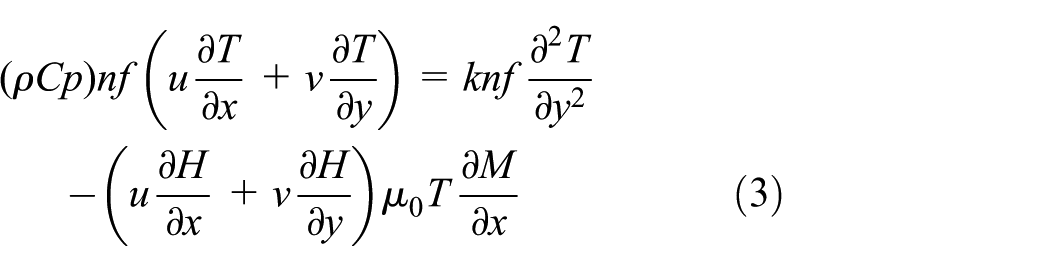
The nanofluid flow analysis and all other assumptions are used as in previous works.33,35 The basic flow and thermal equations are settled as
In the existence of viscous dissipation, the above three equations are taken for solving the problem. The velocity component along the x-axis is u and along the y-axis is v, while is the density of the nanofluid, is the dynamic viscosity, and is the specific heat of the nano liquid. In equation (3), is the thermal conductivity of the nanofluids and is the permeable magnetic field. The symbols P, T, M, and H indicate pressure, temperature, magnetization, and the magnetic field, respectively. Appropriate boundary conditions for the boundary value problem are supposed to be of the form33,35
In equation (4), is the extending velocity and S is the dimensionless constant; appropriate temperature condition will be at and ; define various boundary temperatures: is the Curie temperature and is the ambient fluid temperature.
Magnetic dipoles
Magnetic dipole affects the flow of the nanofluid stretched over an extending surface. Magnetic scalar potential denoted by representing the magnetic dipole region can be expressed as34,35
Here, the symbol shows the strong point of the magnetic field at the base and c denotes the length apart from the x-axis. The magnetic field (H) has two components and are expressed as35
Equations (6) and (7) are obtained from the differentiation of equation (5) with respect to x and y, respectively. A mathematical expression for H is given as35
The magnetic body force corresponds to the gradient of the magnitude of H.
Plug values in equation (8) to get the associated equations as
Magnetization M is affected by the temperature T and mathematically can be written as
In the above expression, the Pyro magnetic coefficient is represented by . The round lines in the physical formation of the problem as indicated in Figure 1 specify the magnetic field.
Geometry of the flow problem.
Transformation
For the transformation of the main equations, the dimensionless variables are introduced as defined by Andersson and Valnes,33 and Noor and Nadeem35
where and are the dimensionless temperature terms and is the dynamic viscosity. The dimensionless and consistent coordinates are as stated
Continuity equations are satisfied directly by the function described above and the velocity components achieved as
Thermophysical properties of and
Thermophysical properties including density, specific heat, and thermal conductivity of nanoparticles and base fluids are shown in Table 1. The nanoparticles have been chosen on the basis of thermophysical properties, possess high thermal conductivity, and have large surface area as can be seen in Table 1.
Thermal and physical properties of water, ethylene glycol, and .
Contents
Density
Specific heat
Thermal conductivity
Water
998.3
4182
0.60
Ethylene glycol
1116.6
2382
0.249
Gamma-alumina
3970
765
40
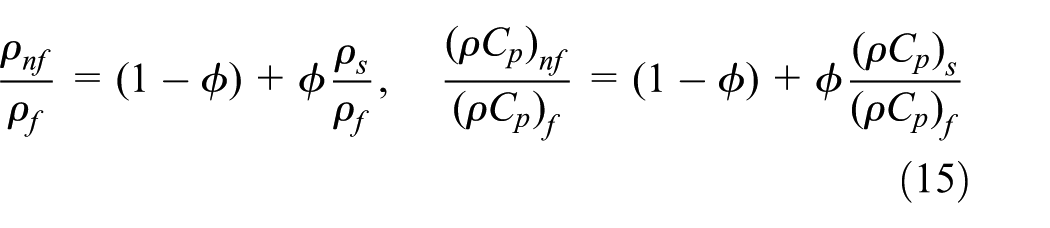
The active density and heat capacitance of the nanofluids satisfy31,32 as follows
In the above model equations, represents the solid particle volume fraction. The density and heat capacitance of the base liquids and solid particles are, respectively, represented by the parameters .
The dynamic viscosity of the two types of nanofluids satisfies31,32 and is calculated as
The operative thermal conductivity of the dispersion in and EG to perform nanomaterial synthesis satisfies24,27
The effective Prandtl number modeled for the two types of nanofluids satisfies28,29
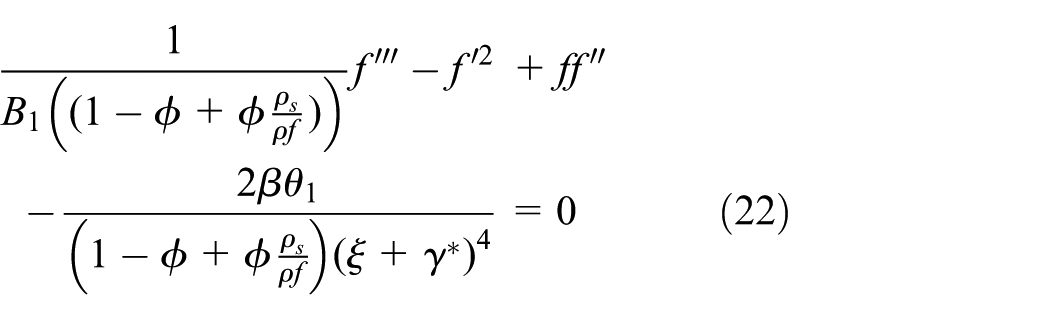
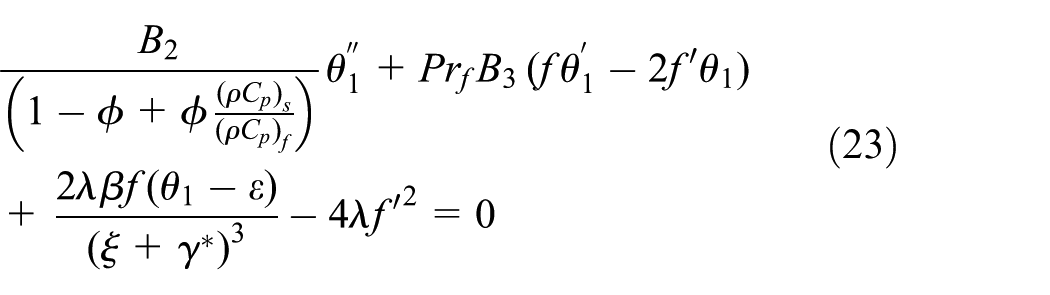
For , by inserting the above thermophysical properties and transformation equations (12)–(14) mentioned above, the momentum and thermal boundary layers yield the form
For , by inserting the above thermophysical properties and transformation mentioned in equations (12)–(14), the momentum and thermal boundary layers yield the form
In the above linear equations, represents the hydrodynamic interaction33,34 and is defined by
Prandtl number Pr is expressed as , Curie temperature as , viscous dissipation as , and magnetic field strength as.
Expression for skin friction coefficient is given by , where .
The Nusselt number is defined as
Thus, the skin friction coefficient and the Nusselt number having dimensionless equations are obtained as follows34,35
where local Reynolds number is denoted by , based on the extending velocity , is the local skin friction coefficient, and is the Nusselt number.
Solution methodology
The variables are selected to alter the equations7–9 into the system of first-order differential equations for RK-4 scheme42–48
For nanofluid , the system with physical conditions is given as
For nanofluid the system with physical conditions is given as
Results and discussion
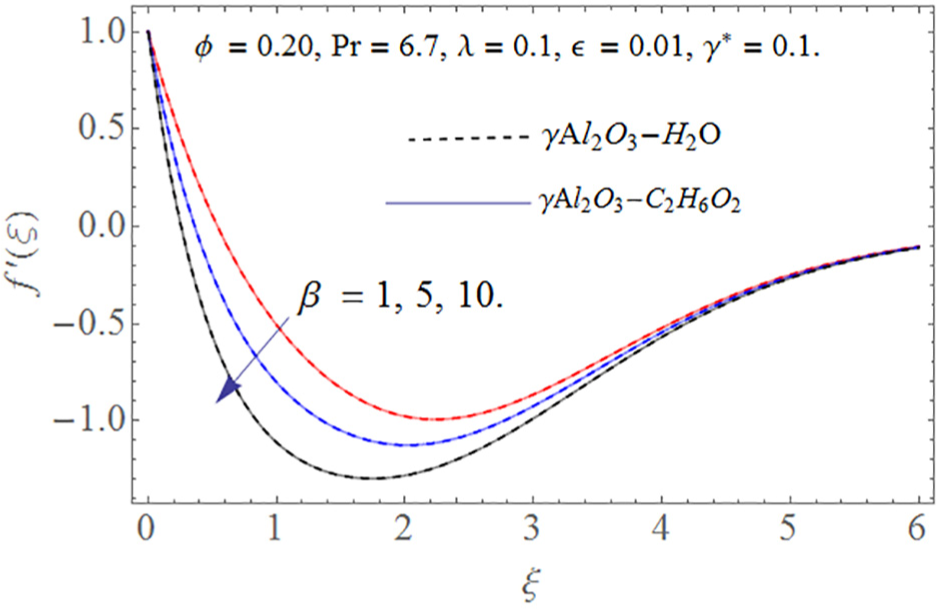
Two types of nanofluids and have been used for the heat enhancement applications. The thermophysical properties of the nanomaterials have been used from the experimental data available in the literature. The flow analysis is settled over an extending surface in the existence of magnetic dipole and viscous dissipation. Solution to the problem has been tackled through the RK-4 method. The obtained results have been highlighted through Figures 2–10. Figure 1 demonstrates the geometry of the problem. Figure 2 indicates the velocity variation with the increasing concentration of volume fraction. In fact, the concentration of the fluid by adding nanoparticles decreases the speed of the nano liquid. Here, we see in the case of that the velocity of the fluid decreases as we enhance the concentration of the nanoparticles. In fact, adding solid particles in the base fluid enhances the density of nanofluid, in turn reducing the axial velocity. Furthermore, the existence of magnetic dipole creates a magnetic field for the nanoparticles and consequently the velocity declines. This implies that the magnetic dipole plays a vital part to control the motion of the nanoparticles. The increasing strength of the magnetic dipole declines the flow motion, and this effect is almost the same for both nanofluids and , as depicted in Figure 3.
The impact of versus .
The impact of versus .
The impact of versus .
The impact of versus .
The impact of versus .
The impact of versus .
The impact of versus .
The impact of versus .
The impact of versus .
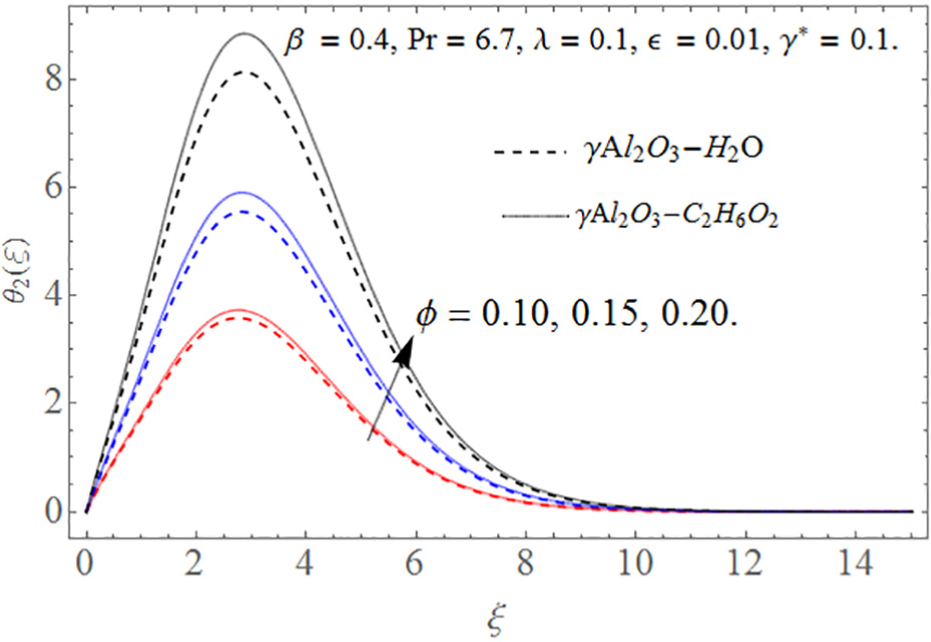
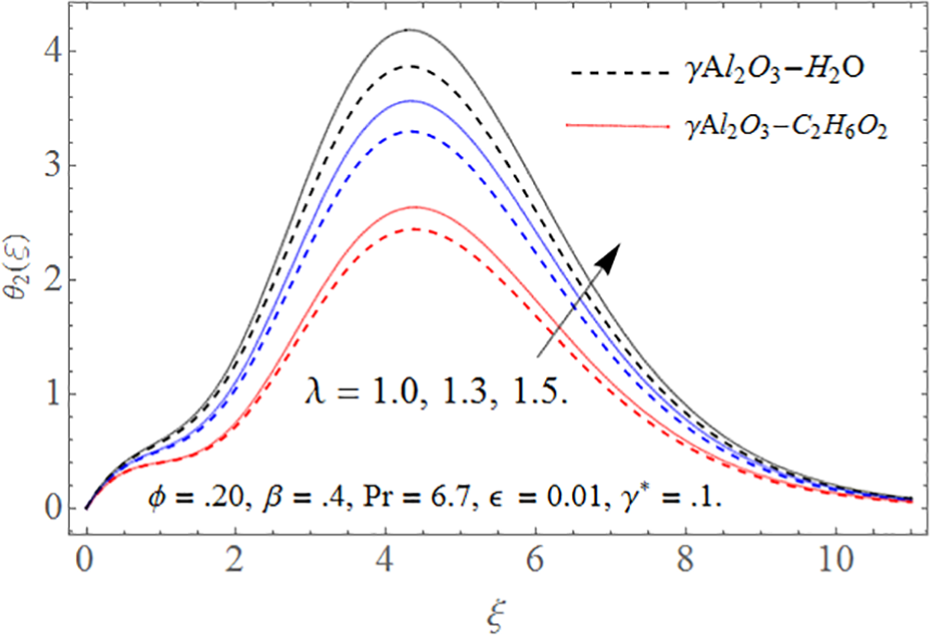
Figure 4, displays the effect of the ferrohydrodynamic interaction . We see that velocity of the fluid is enhanced when the magnetic effect is zero, but with the application of magnetic dipole, the velocity of the fluid reduces as we increase the effect of magnetic dipole. This result verifies the well-known argument that the magnetic field is usually used to control the turbulence behavior of the fluid flow. Magnetic effect on nanofluids and is comparatively similar. Hence, we can say that the nanofluid flow can be organized by the magnetic field. Figure 5 shows that by enhancing the volume fraction , the temperature of the nanofluids and is increased, and this is due to the fact that nanofluids exhibit high thermal conductivity compared to ordinary heat transfer fluids. The nanoparticles, due to the large surface area, produce high thermal conductivity in nano liquids. Hence, in the case of nanofluid , the temperature increases with the increasing volume fraction better than the nanofluid . In fact, the thermal conductivity of is comparatively stronger than the nanofluid. The same effect has been observed for the larger amount of nanoparticle volume fraction versus temperature field in Figure 6. The impact is clearer using the nanofluid. Because of the thermophysical properties, nanofluid is stronger than nanofluid, which concedes to enhance the temperature field more effectively. The increasing amount of the Curie temperature parameter enhances the fluid temperature as shown in Figures 7 and 8. Definitely, the larger amount of increases the thermal efficiency of the nanofluids. The increasing effect is more effective using the nanofluid compared to the nanofluid, and the effective thermophysical properties of EG are responsible for this enhancement. Figures 9 and 10 display the impact of viscous dissipation parameter on the temperature field. It is clear from the figure that by enhancing the value of viscous dissipation, the temperature field boosts up and this impact is comparatively better by means of the nanofluid.
Table 1 depicts the thermophysical properties of the materials. The effects of the greater amount of versus the skin friction comprising and nanofluids have been shown in Table 2. The greater values of these constraints enhance the skin friction. Increasing the volume fraction of the nanoparticles and the greater values of the magnetic constraints generate the resistance force, consequently enhancing the skin friction, and this effect is relatively more effective using the nanofluid. The increasing values of enhance the cooling effect and consequently the Nusselt number, as displayed in Table 3, which enhances the skin friction and declines the heat transfer rate. The strong thermophysical properties of the nanofluid provide rapid cooling with the enhancement of Prandtl number. The increasing values of the hydrodynamic interaction constraint and viscous dissipation term decrease the Nusselt number. Physically, the heat enhancement ability of the nanofluids enhances with these parameters, and therefore, the larger amount of these parameters declines the Nusselt number.
Comparison of the skin friction for the two nanofluids when .
0.01
1
0.2
0.529705
0.52471
0.03
0.897501
0.879547
0.05
0.54147
0.50264
2
2.00877
1.96994
3
2.47608
2.43724
0.3
3.68432
3.1646
0.4
4.68448
4.14641
Comparison of the Nusselt number for the two nanofluids when .
5.6
1
0.3
1.8123
1.89077
6.6
2.29341
2.39237
7.6
2.77451
2.89397
2
1.85614
1.93647
3
0.937765
0.978975
0.35
0.47953
0.501218
0.4
0.0212945
0.0234611
Conclusion
The main aim of this research is to analyze the applicability of the idea of two nanofluids and , while aluminum oxide nanoparticles are used for two different base fluids (water and EG). The properties of aluminum oxides and base liquids are shown in Table 1. Phenomena of thermal conduction have been mentioned in the consequent nanofluids. The solution of the problem is numerically obtained with the help of the RK-4 method. Analysis has been made through graphical representation using Mathematica software. The main points of the flow problem are given below:
An increment in volume fraction causes reduction in the axial velocity and hence increases the temperature under the effect of magnetic dipole.
The increasing value of ferromagnetic interaction in the temperature field is enhanced and the velocity domain is reduced when magnetic dipole is applied.
Curie temperature parameter () also enhances the temperature field.
It is perceived that by enhancing the value of viscous dissipation, the temperature field boosts up and this impact is comparatively better by means of the nanofluid.
The increasing strength of the magnetic dipole declines the flow motion, and this effect is more important in the case of turbulent flows to control the flow.
The strong thermophysical properties of the nanofluid provide rapid cooling with the enhancement of Prandtl number, consequently leading to the increase in Nusselt number.
Footnotes
Handling Editor: James Baldwin
Declaration of conflicting interests
The author(s) declared no potential conflicts of interest with respect to the research, authorship, and/or publication of this article.
Funding
The author(s) received no financial support for the research, authorship, and/or publication of this article.
ORCID iD
Taza Gul
References
1.
ChoiS.Enhancing thermal conductivity of fluids with nanoparticles in developments and applications of non-Newtonians flow. ASME1995; 66: 99–105.
2.
SandeepNSharmaRPFerdowsM.Enhanced heat transfer in unsteady magnetohydrodynamic nanofluid flow embedded with aluminum alloy nanoparticles. J Mol Liq2017; 234: 437–443.
3.
AhmedNKhanUMohyud-DinST, et al. Influence of thermal radiation and viscous dissipation on squeezed flow of water between Riga plates saturated with carbon nanotubes. Colloid Surface A2017; 522: 389–398.
4.
SheikholeslamiM.CuO-water nanofluid free convection in a porous cavity considering Darcy law. Eur Phys J Plus2017; 132: 55.
5.
SheikholeslamiMVajraveluK.Nanofluid flow and heat transfer in a cavity with variable magnetic field. Appl Math Comput2017; 298: 272–282.
6.
AmanSKhanIIsmailZ, et al. Impacts of gold nanoparticles on MHD mixed convection Poiseuille flow of nanofluid passing through a porous medium in the presence of thermal radiation, thermal diffusion and chemical reaction. Neural Comput Appl2018; 30: 789–797.
7.
KhanUAhmedNMohyud-DinST.Numerical investigation for three dimensional squeezing flow of nanofluid in a rotating channel with lower stretching wall suspended by carbon nanotubes. Appl Therm Eng2017; 113: 1107–1117.
8.
NguyenCTRoyGGauthierC, et al. Heat transfer enhancement using Al2O3-water nanofluid for an electronic liquid cooling system. Appl Therm Eng2007; 27: 1501–1506.
9.
KulkarniDPVajjhaRSDasDK, et al. Application of aluminum oxide nanofluids in diesel electric generator as jacket water coolant. Appl Therm Eng2008; 28: 1774–1781.
10.
ZamzamianAOskouieSNDoosthoseiniA, et al. Experimental investigation of forced convective heat transfer coefficient in nanofluids Al2O3/EG and CuO/EG in a double pipe and plate heat exchangers under turbulent flow. Exper Therm Fluid Sci2011; 35: 495–502.
11.
SebdaniSMahmoodiMHashemiSM.Effect of nanofluid variable properties on mixed convection in a square cavity. Int J Therm Sci2012; 52: 112–126.
12.
GulAKhanIShafieS.Energy transfer in mixed convection MHD flow of nanofluid containing different shapes of nanoparticles in a channel filled with saturated porous medium. Nanoscale Res Lett2015; 10: 490.
13.
AhmedNAdnan KhanU, et al. Shape effects of nanoparticles on the squeezed flow between two Riga plates in the presence of thermal radiation. Eur Phys J Plus2017; 132: 321.
14.
GulAKhanIShafieS, et al. Heat transfer in MHD mixed convection flow of a ferrofluid along a vertical channel. PLoS ONE2015; 11: e0141213.
15.
UllahIShafieSKhanI.Effects of slip condition and Newtonian heating on MHD flow of Casson fluid over a nonlinearly stretching sheet saturated in a porous medium. J King Saud Univ2016; 29: 250–259.
16.
UllahIKhanIShafieS.MHD natural convection flow of Casson nanofluid over nonlinearly stretching sheet through porous medium with chemical reaction and thermal radiation. Nanoscale Res Lett2016; 11: 527.
17.
SheikholeslamiM.CVFEM for magnetic nanofluid convective heat transfer in a porous curved enclosure. Eur Phys J Plus2016; 131: 413.
18.
SheikholeslamiMShehzadSA.Magnetohydrodynamic nanofluid convection in a porous enclosure considering heat flux boundary condition. Int J Heat Mass Tran2017; 106: 1261–1269.
19.
MalvandiAGanjiDD.Magnetic field effect on nanoparticles migration and heat transfer of water/alumina nanofluid in a channel. J Magn Magn Mater2014; 362: 172–179.
20.
GangulyRSenSPuriIK.Heat transfer augmentation using a magnetic fluid under the influence of a line dipole. J Magn Magn Mater2004; 271: 63–73.
21.
MalvandiAGanjiDD.Effects of nanoparticle migration on hydromagnetic mixed convection of alumina/water nanofluid in vertical channels with asymmetric heating. Phys E2015; 66: 181–196.
22.
Haghshenas FardMNasr EsfahanyMTalaieMR. Numerical study of convective heat transfer of nanofluids in a circular tube two-phase model versus single-phase model. Int Commun Heat Mass2010; 37: 91–97.
23.
BahremandHAbbassiASaffar-AvvalM.Experimental and numerical investigation of turbulent nanofluid flow in helically coiled tubes under constant wall heat flux using Eulerian-Lagrangian approach. Powder Technol2015; 269: 93–100.
24.
LeeSChoi SUS LiS, et al. Measuring thermal conductivity of fluids containing oxide nanoparticles. J Heat Transf1992; 121: 280–289.
25.
MaciverDSTobinHHBarthRT.Catalytic aluminas I: surface chemistry of eta and gamma alumina. J Catal1963; 2: 487–497.
26.
SheikhzadehGAFakhariMMKhorasanizadehH.Experimental investigation of Laminar convection heat transfer of Al2O3-ethylene glycol-water nanofluid as a coolant in a car radiator. J Appl Fluid Mech2017; 10: 209–219.
HamiltonRLCrosserOK.Thermal conductivity of heterogeneous two-component systems. Ind Eng Chem Fund1962; 1: 187–191.
29.
MaigaSEBNguyenCTGalanisN, et al. Heat transfer behaviours of nanofluids in a uniformly heated tube. Superlattice Microst2004; 35: 543–555.
30.
AhmedNAdnan KhanU, et al. Influence of an effective Prandtl number model on squeezed flow of γAl2O3-H2O and γAl2O3-C2H6O2 nanofluids. J Mol Liq2017; 238: 447–454.
31.
RashidiMMVishnu GaneshNAbdul HakeemAK, et al. Influences of an effective Prandtl number model on nano boundary layer flow of γ Al2O3-H2O and γ Al2O3-C2H6O2 over a vertical stretching sheet. Int Commun Heat Mass2016; 98: 616–623.
32.
HayatTShahFIjaz KhanM, et al. Entropy analysis for comparative study of effective Prandtl number and without effective Prandtl number via γAl2O3-H2O and γAl2O3-C2H6O2 nanoparticles. J Mol Liq2018; 266: 814–823.
33.
AnderssonHIValnesOA.Flow of a heated ferrofluid over a stretching sheet in the presence of a magnetic dipole. Acta Mech1998; 128: 39–47.
34.
ZeeshanAMajeedAEllahiR.Effect of magnetic dipole on viscous ferro-fluid past a stretching surface with thermal radiation. J Mol Liq2016; 215: 549–554.
35.
NoorMNadeemS.Ferrite nanoparticles Ni-ZnFe2O4, Mn-ZnFe2O4 and Fe2O4 in the flow of ferromagnetic nanofluid. Eur Phys J Plus2017; 132: 377.
36.
SarafrazMMSafaeiMR.Diurnal thermal evaluation of an evacuated tube solar collector (ETSC) charged with graphene nanoplatelets-methanol nano-suspension. Renew Energ2019; 142: 364–372.
37.
SarafrazMMSafaeiMRTianZ, et al. Thermal assessment of nano-particulate graphene-water/ethylene glycol (WEG 60:40) nano-suspension in a compact heat exchanger. Energies2019; 12: 1929.
38.
SarafrazMMArjomandiM.Thermal performance analysis of a microchannel heat sink cooling with copper oxide-indium (CuO/In) nano-suspensions at high-temperatures. Appl Therm Eng2018; 137: 700–709.
39.
SarafrazMMAryaANikkhahV, et al. Thermal performance and viscosity of biologically produced silver/coconut oil nanofluids. Chem Biochem Eng Q2016; 30: 489–500.
40.
SalariEPeyghambarzadehMSarafrazMM, et al. Boiling heat transfer of alumina nano-fluids: role of nanoparticle deposition on the boiling heat transfer coefficient. Period Polytech Chem2016; 60: 252–258.
41.
AryaASarafrazMMShahmiriS, et al. Thermal performance analysis of a flat heat pipe working with carbon nanotube-water nanofluid for cooling of a high heat flux heater. Heat Mass Transfer2018; 54: 985–997.
42.
GulTNomanWSohailM, et al. Impact of the Marangoni and thermal radiation convection on the graphene-oxide-water-based and ethylene-glycol-based nanofluids. Adv Mech Eng2019; 11: 856773.
43.
KhanMAAhmadMUllahS, et al. Modeling the transmission dynamics of tuberculosis in Khyber Pakhtunkhwa Pakistan. Adv Mech Eng2019; 11: 854835.
44.
GulTHaleemIUllahI, et al. The study of the entropy generation in a thin film flow with variable fluid properties past over a stretching sheet. Adv Mech Eng2018; 10: 789522.
45.
SheikholeslamiMHatamiMGanjiDD.Numerical investigation of nanofluid spraying on an inclined rotating disk for cooling process. J Mol Liq2015; 211: 577–583.
46.
YoshinoMHottaYHirozaneT, et al. A numerical method for incompressible non-Newtonian fluid flows based on the lattice Boltzmann method. J Non Newton Fluid2007; 147: 69–78.
47.
SahebiSARPourziaeiHFeiziAR, et al. Numerical analysis of natural convection for non-Newtonian fluid conveying nanoparticles between two vertical parallel plates. Eur Phys J Plus2015; 130: 238.
48.
AbbasZSheikhMMotsaSS.Numerical solution of binary chemical reaction on stagnation point flow of Casson fluid over a stretching/shrinking sheet with thermal radiation. Energy2016; 95: 12–20.
49.
AkbarNSBegOAKhanZH.Magneto-nanofluid flow with heat transfer past a stretching surface for the new heat flux model using numerical approach. Int J Numer Method H2017; 27: 1215–1230.
50.
AhmedNAdnan KhanU, et al. Influence of thermal and concentration gradients on unsteady flow over a stretchable surface. Results Phys2017; 7: 3153–3162.