




Abstract
The governing equation of the bending problem of simply supported thin plate on Pasternak foundation is degraded into two coupled lower order differential equations using the intermediate variable, which are a Helmholtz equation and a Laplace equation. A new solution of two-dimensional Helmholtz operator is proposed as shown in Appendix 1. The R-function and basic solutions of two-dimensional Helmholtz operator and Laplace operator are used to construct the corresponding quasi-Green function. The quasi-Green’s functions satisfy the homogeneous boundary conditions of the problem. The Helmholtz equation and Laplace equation are transformed into integral equations applying corresponding Green’s formula, the fundamental solution of the operator, and the boundary condition. A new boundary normalization equation is constructed to ensure the continuity of the integral kernels. The integral equations are discretized into the nonhomogeneous linear algebraic equations to proceed with numerical computing. Some numerical examples are given to verify the validity of the proposed method in calculating the problem with simple boundary conditions and polygonal boundary conditions. The required results are obtained through MATLAB programming. The convergence of the method is discussed. The comparison with the analytic solution shows a good agreement, and it demonstrates the feasibility and efficiency of the method in this article.
Keywords
Introduction
In the bending problem of Pasternak foundation plate, its governing differential equation is a higher order equation and contains biharmonic operator. 1 Therefore, it is difficult to study the plate with complex boundary conditions in depth. R-function theory and Green’s function method can always get the corresponding boundary normalization equation for the thin plate with complex boundary conditions and transform the high-order control differential equation into the low-order equations which are a Helmholtz equation 2 and a Laplace equation 3 and then get the effective corresponding solution. Scholars at home and abroad have conducted extensive research on the plate problem on Pasternak foundation, Helmholtz equation, and Laplace equation.
The solution of the bending problem of rectangular plate with free edge on Pasternak foundation was obtained by Cai 4 using the Fourier series. The vibration characteristics of elastic rotation constrained laminated plates on Pasternak foundation was studied by Yang et al. 5 using differential quadrature (DQ)–Galerkin semi-analytical method. The analytical solution of the bending problem of rectangular thin plates with four sides simply supported on Pasternak foundation was studied by Wang. 6 The bending of rectangular plate with free edge on Pasternak foundation was studied by Liu and Peng 7 using DQ method of control equation. The axisymmetric large deflection of circular plates on Pasternak foundation was studied by Liu 8 using the perturbation method combined with the integral equation method. Vibration analysis of a thin functionally graded plate having an out-of-plane material inhomogeneity resting on Winkler–Pasternak foundation under different combinations of boundary conditions was researched by Piyush et al. 9 The exact nonstationary responses of rectangular thin plate on Pasternak foundation excited by stochastic moving loads was researched by Chen et al. 10 A Frobenius exact solution method for stability analysis of orthotropic rectangular thin plate under biaxial nonlinear in-plane loading resting on Pasternak foundation was researched by Hosein et al. 11 A semi-analytical closed-form solution on static behavior of thin skew plates on Winkler and Pasternak foundations was researched by Amin Joodaky and Iman Joodaky. 12 Dual reciprocity hybrid radial boundary node method for Winkler and Pasternak foundation thin plate was researched by Yan et al. 13 Vibration analysis of thin plates resting on Pasternak foundations was researched by Ehsan et al. 14 using element free Galerkin method. Three approximate analytical solutions for thermal buckling of clamped thin rectangular functionally graded material plates resting on Pasternak elastic foundation were researched by Kiani et al. 15 The performance of a rotated 5-point Laplacian operator for computing the harmonic potentials was investigated by Dahalan et al. 16 Koyunbakan et al. 17 analyzed a nonlinear eigenvalue problem for the p-Laplacian operator with zero Dirichlet boundary conditions. A metaheuristic optimization method for discretization of fractional Laplacian without discretization operator was studied by Mahata et al. 18 Tan and Li 19 studied the solutions for nonlinear fractional differential equations with p-Laplacian operator nonlocal boundary value problem in a Banach space. The existence and uniqueness of solutions for fractional boundary value problems with p-Laplacian operator were studied by Bai. 20 The edge extraction of quantum image based on Laplace operator and zero-crossing method was studied by Fan et al. 21 The several positive solutions of nonlinear mixed fractional differential equation with p-Laplacian operator were studied by Li. 22 The stereo-matching algorithm of weighted guided image filter based on Gauss Laplace operator was studied by Bo et al. 23 The damage detection of building after disaster based on local Laplace operator was studied by Li et al. 24 Assari et al. 2 provided a numerical method for solving logarithmic Fredholm integral equations which occur as a reformulation of two-dimensional Helmholtz equations over the unit circle with the Robin boundary conditions. Kravcenko et al. 3 proposed a distributed fast boundary element methods for Helmholtz problems. Tian et al. 25 devoted their work to study the error analysis and stability of the method of fundamental solutions for the case of the modified Helmholtz equation. A wavelet collocation method was proposed by Chen et al. 26 for solving the linear boundary integral equations reformulated from the modified Helmholtz equation with Robin boundary conditions. Wang et al. 27 made a first attempt to use a new localized method of fundamental solutions to accurately and stably solve the inverse Cauchy problems of two-dimensional Laplace and biharmonic equations in complex geometries.
Li and Yuan28–31 studied the thin plate and shell problems using the mathematical method of Laplace equation. In this article, R-function theory and quasi-Green function methods of Helmholtz equation as shown in Appendix 1 and Laplace equation are used to study the bending of thin plates on Pasternak foundation. First, the biharmonic operator of the plate bending problem on Pasternak foundation is reduced to Helmholtz equation and Laplace equation. Using Green’s function, the Helmholtz equation and Laplace equation are transformed into two integral equations, and a new boundary normalization equation is constructed to ensure the continuity of the integral kernels. Then the two integral equations can be discretized and programmed by MATLAB, and the bending result of thin plate can be obtained. The R-function theory guarantees that the corresponding boundary normalization equation can be found for any complex region. Thus, the original problem can be transformed into the second kind of Fredholm integral equation without singularity. Five numerical examples are given to verify the validity of the proposed method as shown in Appendix 1 which uses the quasi-Green function method of Helmholtz equation combing with the quasi-Green function method of Laplace equation.
Basic equation
According to the Kirchhoff hypothesis, under transverse load


in which
Introducing intermediate variable

where

By substituting equation (2) into differential equation (1), the differential equation for bending problem of thin plates on Pasternak foundation can be degraded into Helmholtz equation and Laplace equation


where
Boundary constraints
The deflection on the plate boundary should be zero and the bending moment should be equal to zero under simply supported constraint boundary conditions


The integral equations
Using the solution of two-dimensional Helmholtz operator, the boundary value problems (equations (4) and (7)) are integrated as (according to Appendix 1)



Using the quasi-Green’s function method of Laplace operator in references,28–31 the boundary value problems (equations (5) and (6)) are integrated as



According to the corresponding formulas in references28–31 and Appendix 1, the following is obtained


In the formulas,
The integral equations (8) and (11) are discretized by the method of references.28–31 The natural frequencies and corresponding modes can be obtained by programming of MATLAB.
Numerical examples
Example 1
Simply supported thin plate on Pasternak foundation model is shown in Figure 1. We set a = b = 1, Poisson’s ratio v = 0.3, thickness t = 0.1, Elastic modulus E = 4 × 10⁶, the coefficient of elastic foundation k = 4 × 10⁴, k = 5 × 10⁴, and k = 6 × 10⁴, respectively, Shear modulus of foundation G P = 1 × 10⁴, and uniform load subjected Z = 1000. According to R-function theory,33–35 the following is obtained

in which
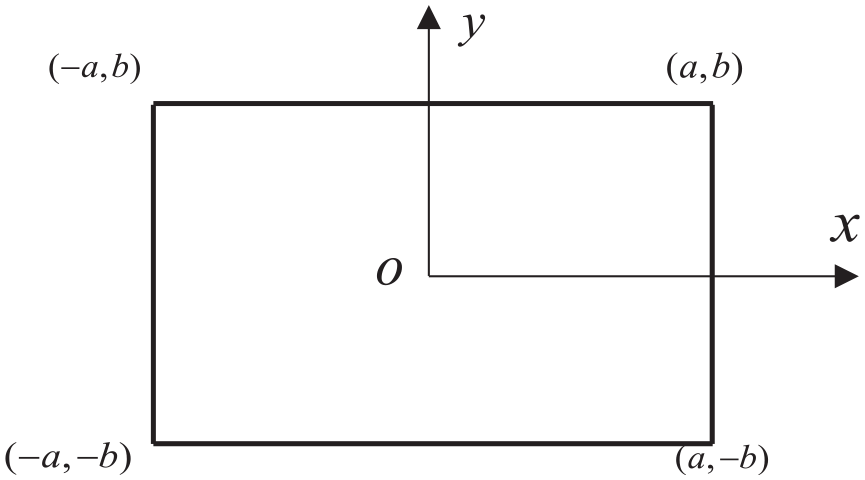
Simply supported plates on Pasternak foundation.
25 (5 × 5), 49 (7 × 7), 81 (9 × 9), 121 (11 × 11), and 169 (13 × 13) grid layout schemes are adopted for square plates, respectively. The results are shown in Table 1 and Figure 2.
Maximum deflection w of square plate.

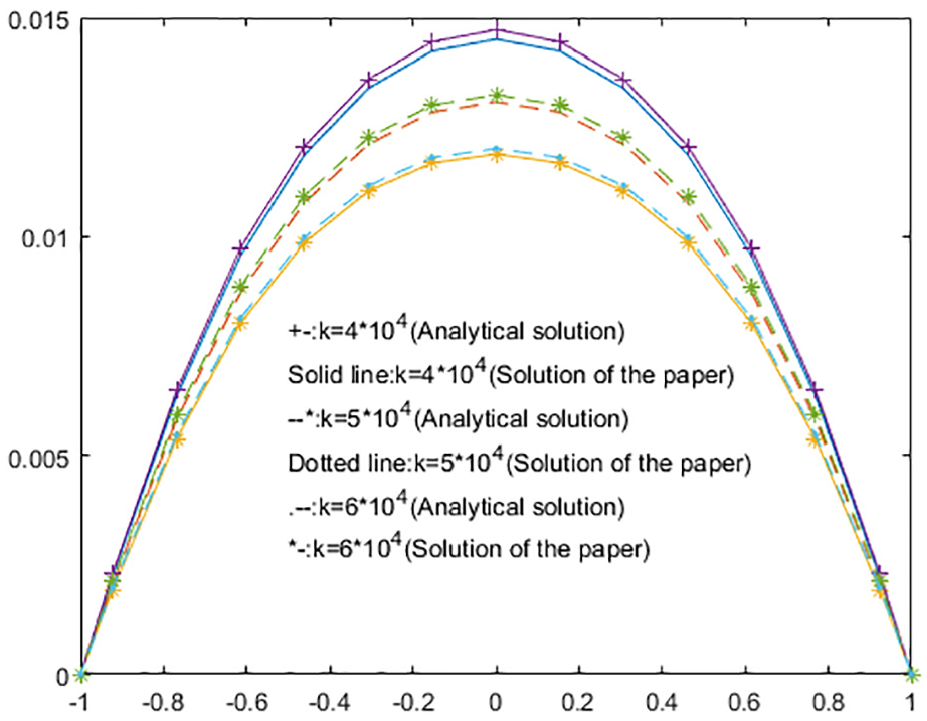
Deflection of square plate x = 0.
Deflection diagrams of square plate deflection of x = 0 with different elastic foundation coefficients k using 169 (13 × 13) grids are shown in Figure 2.
Example 2
Simply supported thin plate on Pasternak foundation model is shown in Figure 1. We set a = 1.25, b = 1; other parameters applied are shown in example 1. According to R-function theory,33–35 the following is obtained

in which
The results are shown in Table 2 and Figure 3.
Maximum deflection w of rectangular plate.


Rectangular deflection of x = 0.
Deflection diagrams of rectangular plate deflection of x = 0 with different elastic foundation coefficients k using 169 (13 × 13) grids are shown in Figure 3.
Example 3
Simply supported trapezoidal thin plates Pasternak foundation model is shown in Figure 4. We set a = 1.5, b = 1, c = 2. Other parameters applied are shown in Example 1. According to R-function theory,33–35 the following is obtained
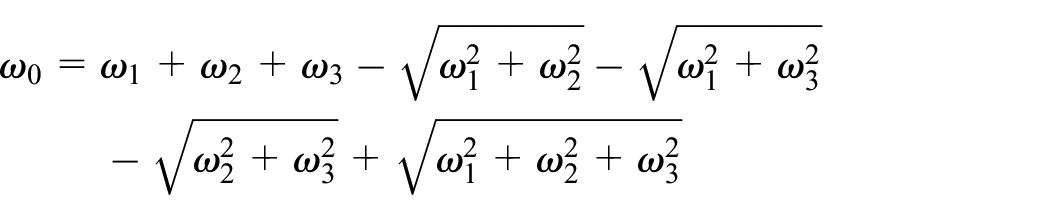
in which
and
Then
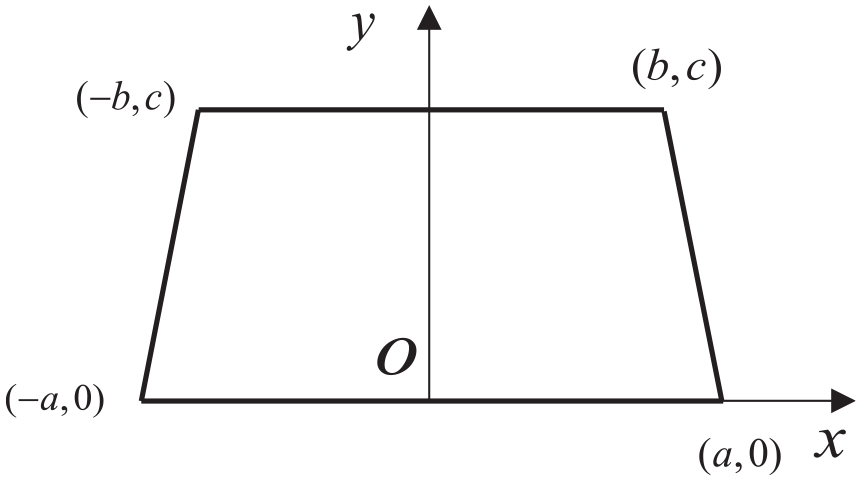
Simply supported trapezoidal plates on Pasternak foundation.
Deflection diagrams of trapezoidal plate deflection of x = 0 with different elastic foundation coefficients k using 169 (13 × 13) grids are shown in Figure 5.

Trapezoidal plate deflection of x = 0.
Example 4
Simply supported L-shaped thin plates on Pasternak foundation model are shown in Figure 6. We set a = 1.5, b = 2.0, c = 0.75, d = 1.0, uniform load subjected Z = 800. Other parameters applied are shown in Example 1. According to R-function theory,33–35 the following is obtained

in which
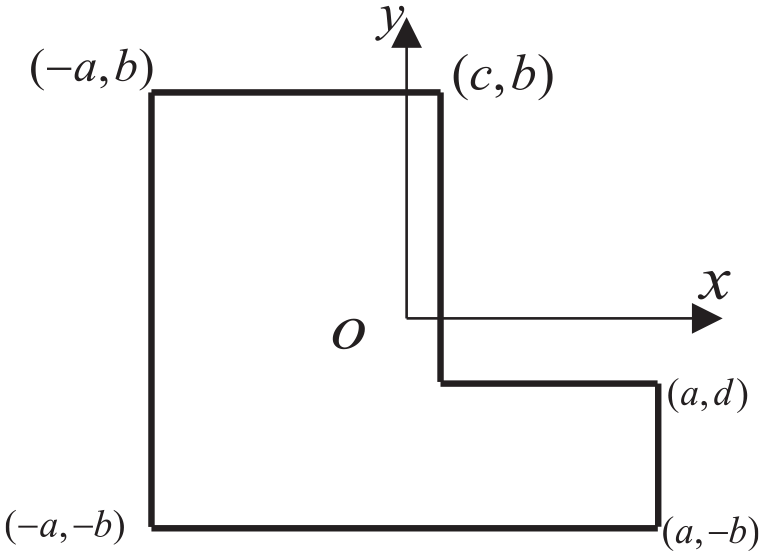
Simply supported L-shaped plates on Pasternak foundation.
Deflection diagrams of L-shaped plate deflection of x = −0.0536 with different elastic foundation coefficients k using 147 (49 × 3) grids are shown in Figure 7.

L-shaped plate deflection of x = −0.0536.
Example 5
A simply supported I-shaped thin plate on Pasternak foundation model is shown in Figure 8. We set a = 1.2, b = 1.5, c = 1, d = 1, uniform load subjected Z = 800. Other parameters applied are shown in example 1. According to R-function theory,33–35 the following is obtained

in which
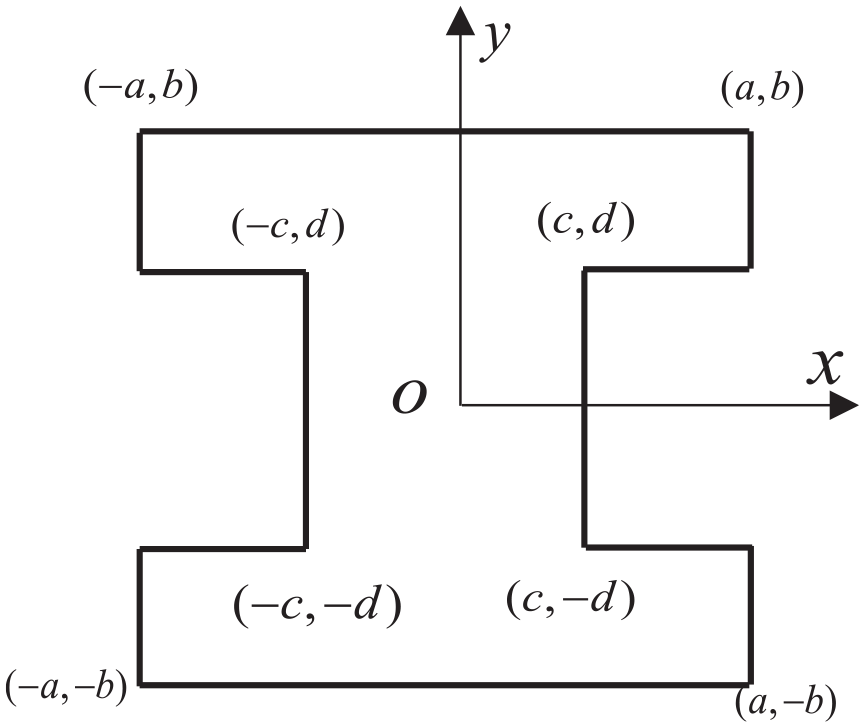
Simply supported I-shaped plates on Pasternak foundation.
Deflection diagrams of I-shaped plate deflection of x = 0 with different elastic foundation coefficients k using 147 (49 × 3) grids are shown in Figure 9.

I-shaped plate deflection of x = 0.
Conclusion
Maximum deflections w of square plate and rectangular plate shown in Tables 1 and 2 are convergent with the increasing number of grids, and the results are compared with those of analytic solution, which shows the convergence and high accuracy of the proposed method. Maximum deflections w of square plate and rectangular plate shown in Tables 1 and 2 are decreasing with the increasing of the elastic foundation coefficient k. Deflection diagrams of square plate deflection of x = 0, rectangular plate deflection of x = 0, trapezoidal plate deflection of x = 0, L-shaped plate deflection of x = −0.0536, and I-shaped plate deflection of x = 0 shown in Figures 2, 3, 5, 7, and 9 demonstrate that deflections are bigger in middle and become smaller in the sides. Deflection diagrams also show that they are decreasing with the increasing of the elastic foundation coefficient k. By describing the shape of square plate, rectangular plate, trapezoidal plate, L-shaped plate, and I-shaped plate, it demonstrates R-function theory is effective to express complicated shape. The advantages of the present solutions are to solve irregular shape plate problem such as L-shaped thin plate in Example 4 which is a six-sided shape and I-shaped thin plate in Example 5 which is a 12-sided shape, and the irregular shape plates have some extension of the boundary extends into it.
In this article, the convergence of the method is discussed. The comparison with the analytic solution shows a good agreement, and it demonstrates the feasibility and efficiency of the method in this article. The proposed method as shown in Appendix 1 applied to solve the elastic bending problems of simply supported thin plates on Pasternak foundation with various shapes is effective. R-function theory method is a very effective method to solve boundary value problems, which needs to be further developed in the field of cross-science.
Footnotes
Appendix 1
Handling Editor: James Baldwin
Data availability statement
The data used to support the findings of this study are available from the corresponding author upon request.
Declaration of conflicting interests
The author(s) declared no potential conflicts of interest with respect to the research, authorship, and/or publication of this article.
Funding
The author(s) disclosed receipt of the following financial support for the research, authorship, and/or publication of this article: The authors gratefully acknowledge the financial support provided by the Science and Technology Scheme of Guangzhou City (no. 201904010141).
