




Abstract
In view of the lack of reliability research with correlated failure modes of the hoist disk shoes, the stochastic finite element method was used to analyze the reliability of multi-failure mode under emergency braking condition of disk shoe for deep well hoist. First, the finite element model of friction pair of brake disk and brake shoe was established based on the theory of heat conduction, the stress of brake shoe was simulated, and the influence of different initial braking speeds on friction pair temperature and thermal stress is analyzed. Second, the Latin hypercube sampling method was used to perform the design of experiment and the data of the random experiment are obtained. The Kriging model was used to establish the functional relationship between the random variables and the stress and temperature of the brake shoe. Then, based on the method of saddlepoint approximation, the reliability evaluation was carried out considering stress and temperature failure. Finally, the system reliability evaluation of brake shoe considering the correlation of the two failure modes is carried out based on Frank copula.
Introduction
Hoist is the main way of transporting materials and workers in underground mining operation. High reliability mine hoist can protect workers, reduce safety accidents, and improve productivity of mine. Braking system is the most critical safety equipment of hoist, and the failure of which will lead to serious accidents. Disk brake as an indispensable part of mine hoist needs braking during operation frequently and braking safely in time in the case of emergency. Because of high-speed and heavy-loaded working characteristics, hoist disk brakes have higher requirements on braking performance comparing with disk brakes on vehicles.1–6 Its reliability will greatly affect the normal operation of the hoist. The reliability index can be used to measure the reliability of the product directly. Reliability indicators such as reliability and failure probability can be used to evaluate the ability of a product to complete specified functions without failure. Reliability analysis evaluates the reliability or failure probability of a brake by considering the randomness and uncertainty of specific parameters. The probability density function or joint probability density function of random variable is needed to calculate the reliability, but it is difficult to determine in engineering practice. At the same time, numerical integration is difficult to calculate, so it is better to choose approximate methods. Existing methods include moment method, response surface method, Monte-Carlo method, random finite element method, and so on. In addition, there are many possible failure modes during the operation of the brake which can lead to the failure of the brake. Therefore, it is necessary to analyze the reliability of correlated failure modes in the design of disk brakes.
Stochastic finite element method is a very useful method in reliability analysis. The essence of stochastic finite element is to change the input constant to random variable X on the basis of conventional finite element. Since stress and temperature are functions of random variable X, the limit state functions can be established, and then the reliability index of failure mode can be calculated. At present, stochastic finite element method has become an effective numerical method for uncertainty analysis of stochastic parametric structures.
The schematic diagram of the brake structure of mine hoist is shown in Figure 1. The disk is hydraulically driven; the main components are brake disk, brake shoe, piston, and disk spring. When braking is required, the pre-tightening force of the disk spring forces the brake shoe to move toward the brake disk, which contacts with the brake disk, and generates positive pressure, forming friction and generating braking torque. When braking is not required, the oil cylinder cavity is filled with high-pressure oil, so that the piston compresses the disk spring and drives the brake shoe away from the brake disk to release the braking force. Because disk is a kind of braking device that produces braking torque due to friction action, brake shoe will contact and rub with the brake disk under the action of braking pressure during braking, and at the same time, friction pair will release a large amount of heat and generate thermal stress. Brake shoes are mostly composite materials. When the temperature rises to a certain degree, some components’ characteristics of brake shoes will change. The coefficient of friction will change, which will lead to the sudden change of friction force. The sudden change of braking force may lead to serious consequences in the process of braking, thus the sudden change of friction caused by excessive temperature will lead to failure. During the braking process, the brake will generate thermal stress due to the local temperature rise. Therefore, the influence of temperature and stress on the structure or material should be considered at the same time when analyzing the reliability of the brake with correlated failure modes.
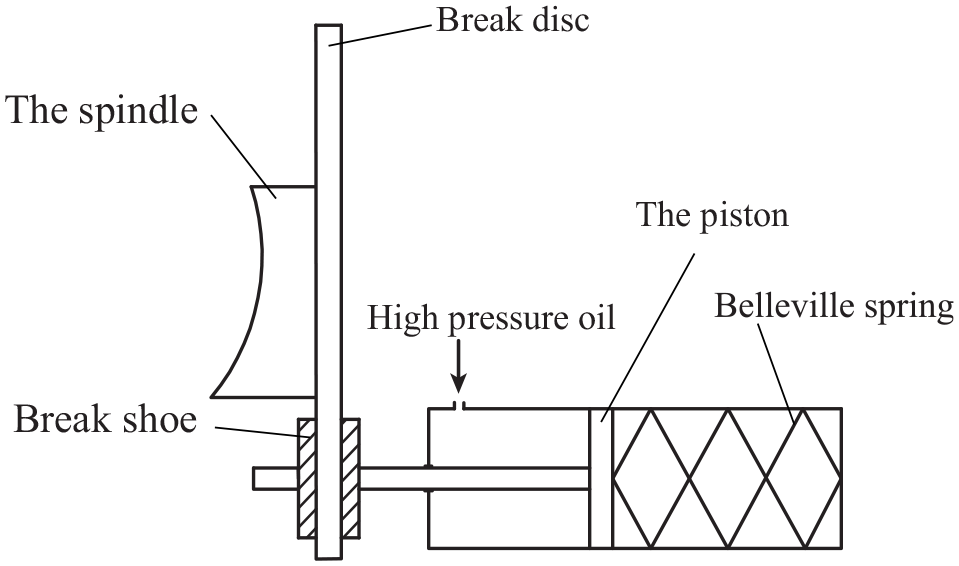
Schematic diagram of disk for mine hoist.
Studies on the thermo-mechanical coupling of disk brakes have been ongoing for decades in the world. Barber 7 began to study the “hot spots” that appeared locally on the train brake first and pointed out that the braking process of the brake belonged to the research scope of thermo-mechanical coupling. Gao and Lin 3 suggested that the braking process of a disk is equivalent to the problem of moving a heat source around the disk. Researches were carried out to analyze the thermal stress coupling of ventilated disk brakes by NASTRAN and ABAQUS in Apte and Ravi. 8 Voldřich 9 established a two-dimensional finite element model of disk and calculated the temperature field and stress field during the braking process by means of numerical analysis. Orłowicz et al. 10 used ABAQUS to simulate the influence of different coefficients of friction on the fluctuation of braking torque, indicating that the coefficient of friction would change during the braking process, resulting in the fluctuation of normal force and tangential force on the surface of the brake disk. Mahmoudi et al. 11 used functionally gradient materials to solve the problems of fast aging, early wear, thermal crack, and brake decay caused by thermal shock. In order to obtain better performance, Jaiswal et al. 12 selected low-stress materials for thermal analysis and analyzed their thermal properties such as stress concentration, structural deformation, and thermal gradient. Han et al. 13 conducted thermo-mechanical coupling analysis on the braking system and determined the relationship between non-uniform contact and non-uniform wear by measuring the wear amount of brake pads.
A lot of researches have been done on the thermo-mechanical coupling of disk brakes. Researchers studied the temperature and stress distribution of the brake by numerical simulation. However, failure problems caused by excessive temperature and stress were not analyzed.1–3 Mackin et al. 5 analyzed temperature and thermal stress of the disk emergency braking and discussed thermal fatigue of the rotor during braking. But the reliability problem is not further analyzed according to the thermal fatigue phenomenon. Yevtushenko and Ivanyk 14 analyzed the transient heat conduction problem in the braking process of the braking system, but did not conduct the reliability analysis of the correlated failure modes. At present, the analysis of the reliability of disk with correlated failure modes is still not well studied. The reliability analysis method with correlated failure modes can be used to evaluate the reliability of the hoist disk and provide theoretical basis for the optimal design of the product.
The reliability analysis method with multi-failure mode is used to analyze the disk shoe. The temperature field and stress field of disk are obtained by finite element analysis. The design of experiment (DOE) was carried out and the data of random experiment are obtained. The relationship between random variables and brake shoe temperature and stress is established using the Kriging model. Based on the multi-failure modes, the reliability analysis of disk shoe is carried out and the failure probability of disk shoe is obtained.
The rest of this article is organized as follows. In section “Random response modeling of the brake shoe,” the stress field and temperature field of the disk shoe are simulated by finite element analysis. Stochastic response of the disk shoe is calculated and the metamodel is established in section “Stochastic response modeling.” The system reliability analysis is carried out using saddlepoint approximation and copula function in section “Reliability analysis of brake shoes.” Conclusions are made in the last section.
Random response modeling of the brake shoe
Thermo-mechanical coupling model of the brake shoe
According to the actual working conditions, the stress change of friction pair between brake disk and brake shoe during the braking process is mainly studied, so the finite element model is only established for brake shoe and brake disk. Due to the sliding friction between the brake disk and brake shoe during braking, a large amount of friction heat is generated on the contact surface. According to the characteristics of heat conduction, heat accumulates on the friction surface and rapidly attenuates with the thickness of the brake shoe, which will lead to the increase of the thermal stress alteration ratio toward the contact surface of the friction pair. Therefore, in the mesh division, brake disk and brake shoe were divided into two parts; the part close to the contact surface is divided into two parts again to achieve the purpose of dense mesh near the contact surface. The brake disk and brake shoe were classified by hexahedral sweep, and the unit type was C3D8RT 3D thermal structure coupling unit. The brake disk contains 3240 nodes and 2160 elements, and the brake shoe contains 168 nodes and 90 elements. Figure 2 shows the finite element mesh diagram.

Brake disk–brake shoe gridding map.
According to the actual working conditions of kilometer deep well hoist, the setting of braking conditions is shown in Table 1.
Braking condition of hoist.

The material of brake disk is Q345 alloy steel and the material of brake shoe is WSM-3 non-asbestos brake shoe. Relevant material parameters are shown in Tables 2 and 3.
Material parameters of brake disk and brake shoe.

Basic physical and mechanical parameters of WSM-3 material.

During the braking process, because of the friction effect, there is difference between the temperature of brake disk and environment temperature, so the heat exchange between the brake disk and the surrounding air is determined by the convection heat transfer coefficient. In the study by Zhao et al., 15 solid brake disk and external convection heat transfer coefficient are expressed as

where Re is the Reynolds number,
The rear side of the brake shoe can be regarded as insulation. Four sides of brake shoe can be treated as plate. Convection heat transfer coefficient of vertical plate and horizontal plate 16 can be expressed as


where
In brake thermal analysis, it is assumed that the average temperature of the friction surface is equal and the heat flow is continuous and it is considered generally that the distribution of heat generated by friction between the contact surfaces is only related to the thermal resistance of the two friction surfaces. If assumed that the heat input to the brake disk and brake shoe can be determined by the equivalent thermal resistance network, based on Charron’s formula, under stable condition, the partition coefficient of heat flow to brake disk and brake shoe can be expressed as

where k is the partition coefficient of heat flow; ρ is the density, kg/m3; c is the specific heat capacity, J/kg K; λ is the heat conductivity, W/m K; subscripts d and s represent brake disk and brake shoe, respectively.
According to the above formula and combined with the material parameters of Q345 alloy steel and WSM-3 non-asbestos brake shoe, calculating with formula (3), the proportion of heat flow to brake disk and brake shoe during braking is 83.26% and 16.38%, respectively.
Boundary conditions
According to the disk geometry, the temperature field calculating model of disk can be established as shown in Figure 3.

Temperature field calculating model of brake shoe.
The following assumptions are made to facilitate the calculation:
The brake shoe and the pad are isotropic material.
All friction works are converted into friction heat.
The friction heat absorbed by brake shoe and brake pad is taken as the heat flow input of boundary condition.
Deceleration remains constant during braking.
Braking pressure remains constant during braking.
Because there is no heat source inside the model, differential heat conduction equation can be expressed as

where
The heat flux during emergency braking 16 can be calculated by the following formula

where
Based on the above assumptions, coefficient of friction and braking pressure remain constant during braking. Therefore, simplified formula of heat flux during emergency braking is shown as follows

where
Heat flux that surface of brake shoe obtained in an emergency braking combining formula (3) can be shown as
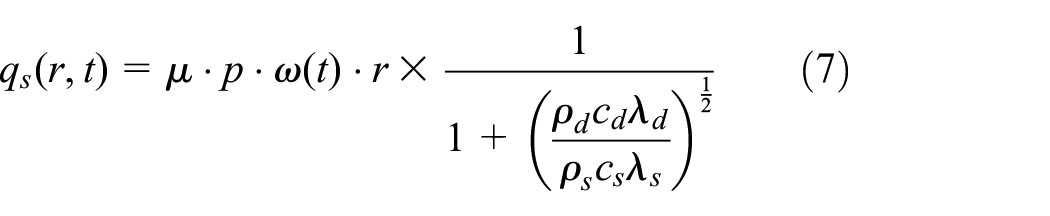
Heat flux that surface of brake pad obtained in an emergency braking combining formula (3) can be shown as

where
From the above analysis, it can be concluded that the calculation boundary conditions of three-dimensional temperature field in the process of emergency braking are as follows:
1. Brake shoe
(a) Initial temperature
In an emergency braking, the initial temperature is taken as the ambient temperature

where
(b) Rubbing surface
Heat flux input to friction surface of brake shoe can be expressed as

where
(c) Non-rubbing surface
The sides of brake shoe apply boundary condition of convective heat transfer, and adiabatic boundary condition applied on the rear side of brake shoe.
Sides


Rear side

2. Brake disk
(a) Initial temperature
In an emergency braking, the initial temperature is taken as the ambient temperature

where
(b) Rubbing surface
Heat flux input to friction surface of brake disk can be expressed as

where
(c) Non-rubbing surface
The sides of brake disk apply boundary condition of convective heat transfer, and adiabatic boundary condition applied on the rear side of brake disk
Sides

Rear side

Deterministic analysis of thermal stress and temperature responses
The initial braking speed has a very important influence on the hoisting mechanism, especially the emergency braking in wells over a 1000 m deep. In an emergency braking process, the magnitude of the initial braking speed determines the amount of heat generated. And the friction heat will greatly affect the braking effect. At the same time, a lot of friction heat causes the stress of friction pair to rise rapidly, which affects the reliability of hoist brake.
The finite element simulation stress nephogram diagram of emergency braking at an initial speed of 20 m/s for the brake disk–shoe braking model is shown in Figures 4–7.

Stress nephogram of brake shoe of brake disk braking for 2.04 s.

Temperature nephogram of brake shoe of brake disk braking for 2.04 s.
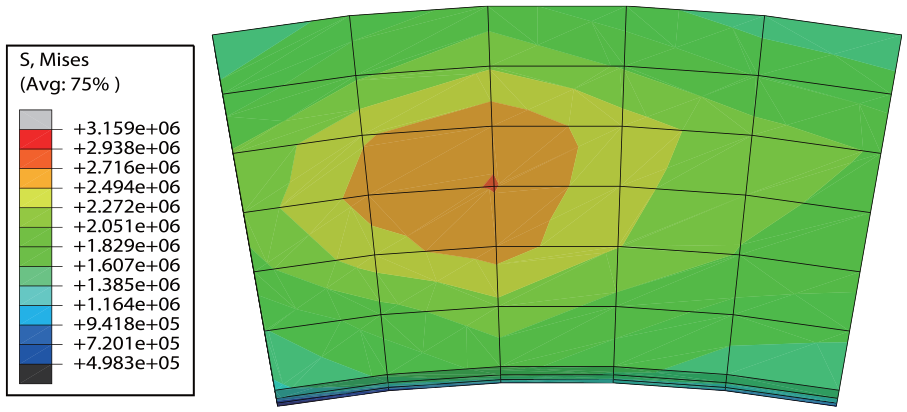
Stress nephogram of brake shoe friction surface braking for 2.04 s.

Temperature nephogram of brake shoe friction surface braking for 2.04 s.
In the process of braking, heat is generated due to friction, and the source of heat is on the friction surface of brake disk and brake shoe. The combination of temperature change and constraint conditions will cause thermal stress. It can be seen from Figures 4 and 5 that during the braking process, the surface temperature and stress of the brake disk are mainly concentrated in the middle ring area of the surface friction with the brake shoe and gradually reduce along the radial direction to both sides. The surface temperature of the brake shoe is the highest in the middle and decreases gradually along the radial direction. The thermal stress on the brake shoes is high in only a small part of the area, up to 3.1 MPa, and the thermal stress in the other areas is small, about 2.0 MPa.
As we know that 83.62% of the heat generated by friction is transferred to the brake disk, while only 16.38% is transferred to the brake shoe. The brake disk bearing 83.62% friction heat has higher thermal stress due to higher temperature. Since the brake shoe only absorbs a small amount of heat, the thermal stress generated is lower than that of the brake disk, so the friction surface stress of the brake shoe is lower. According to Figures 4–7, the maximum stress of the brake disk is 146 MPa and the maximum temperature is 102.3°C. The maximum stress of brake shoe is only 3.1 MPa and the maximum temperature is 102.3°C.
It is easy to know from Figure 8 that high initial braking speed and long braking time will lead to high surface temperature of the friction pair. Higher temperature will lead to higher thermal stress, so this article only discusses the case of initial braking speed of 20 m/s.

Surface temperature curves of friction pairs with different braking initial velocities.
Stochastic response modeling
To calculate the failure probability of mechanical structure by reliability method, it is necessary to known the limit state function of each failure mode. Computing reliability in modern engineering problems usually requires the assistance of computers. The more complicated the mechanical structure, the more difficult the reliability analysis is. For some simple mechanical mechanism, the expressions of stress in fragile region can be easily obtained. This kind of problem can establish explicit limit state function. However, for complex mechanical structures, some software such as finite element analysis software is needed. The implicit limit state function problem is caused by the difficulty in deriving the expression from the formula. At this point, since the explicit limit state function cannot be obtained, the structure response expression is needed to be established if the reliability theory is to be applied. Therefore, the DOE is adopted to obtain the relationship between the random variable and the response.
Therefore, it is necessary to establish the surrogate model before the reliability analysis. The process is shown as follows:
According to the number and range of reference random variables in actual working conditions, pick the appropriate sampling method and determine the number of samples.
Calculate the sampling point response. Normally, put the designed parameter matrix into the finite element software, calculating the corresponding response value.
Select the appropriate surrogate model. Establish the relationship between random variables and response values, and the surrogate model is usually selected by combining the fitting regression algorithm.
Replace the complex and time-consuming computer finite element analysis process into a surrogate model to greatly improve the computational efficiency within the allowable error bound.
In this article, some software such as Creo, iSIGHT, and ABAQUS were used to solve the implicit limit state function problem, and MATLAB was used to solve the reliability. Creo was used for parametric three-dimensional modeling, and ABAQUS was imported to complete the establishment of the finite element model. The Python scripts and batch commands were used to integrate ABAQUS into iSIGHT. The ABAQUS component in iSIGHT is used to identify and read the shape size parameters that cannot be directly extracted from the text model file (.inp). Then, the analysis model file (.cae) and text model file (.inp) are transformed through Simcode component and then ABAQUS is called for simulation. Finally, Simcode component is used to extract the stress, temperature, and other parameters in the required result file. The specific analysis frame is shown in Figure 9.

Establishment process of limit state function.
Coefficient of friction, contact area between shoe and friction disk, shoe thickness, shoe density, shoe elastic modulus, and braking pressure were selected as random variables. During the braking process, the coefficient of friction also changes due to the combined effects of surface temperature, heat dissipation, friction surface flatness, particles, and so on. Therefore, the friction coefficient is selected as one of random variables. In the process of brake shoe production, it is difficult to guarantee the complete homogeneity of each brake shoe and the complete consistency of material properties. At the same time, the material properties will fluctuate slightly under the influence of external conditions, so the density and elastic modulus are selected as two random variables. During the braking process, due to deviation or equipment aging, the brake shoe surface and the brake disk surface cannot be completely parallel, which will lead to different degrees of reduction in the contact area of the friction pair. Therefore, the contact area between the brake shoe and the friction disk is selected as one of the random variables. Friction will lead to wear and tear of brake shoes to some extent, which means the thickness will reduce. Due to the slight difference in material properties between different brake shoes, the wear degree of the same batch of brake shoes may be different, so the thickness of brake shoes is selected as one of the random variables. Because of the vibration and the stability of the disk spring, the braking pressure will fluctuate to some extent, so the braking pressure is chosen as a random variable.
It is assumed that the random characteristics of all variables follow normal distribution, and the statistical characteristics of random variables are shown in Table 4.
Statistical characteristics of random variables of brake of hoist.

Latin hypercube sampling (LHS) 17 is a stratified sampling method. Suppose there are N random variables in a problem, LHS needs to divide each random variable into M intervals with the same probability. A sample is selected independently and randomly in each interval. And then make the selected samples into an M×N matrix.
Suppose that M samples need to be selected in the N-dimensional vector, and the steps of LHS are as follows:
Each dimension can be divided into non-overlapping M intervals, makes each interval with the same probability.
In each interval of each dimension, select a sample independently and randomly.
Make the selected samples in Step 2 into an M×N matrix.
LHS method was adopted for the experimental design in this article, with a total of 6 experimental design variables and 400 groups of sampling points, which is shown in Table 5 in Appendix 1.
When the system model is greatly affected by random factors, the regression fitting accuracy of the Kriging model is higher. 18 The Kriging method was used to perform regression fitting on the numerical simulation results of multiple groups, and the relationship between the stress and temperature on the brake shoe and the brake shoe structure parameters, material property parameters, and braking pressure was obtained. Four hundred groups of simulation results were substituted into Kriging algorithm by MATLAB for function fitting. Figure 10 shows a comparison diagram of brake shoe stress sample points and regression prediction points. Figure 11 shows the comparison between the sample point of brake shoe temperature and the regression prediction point. Figure 12 shows the error of the predicted point of brake shoe stress relative to the sample point. Its value is the absolute value of the difference between the predicted value and the sample point value divided by the sample point value. Figure 13 shows the error of the predicted point of brake shoe temperature relative to the sample point. Its value is the absolute value of the difference between the predicted value and the sample point value divided by the sample point value.
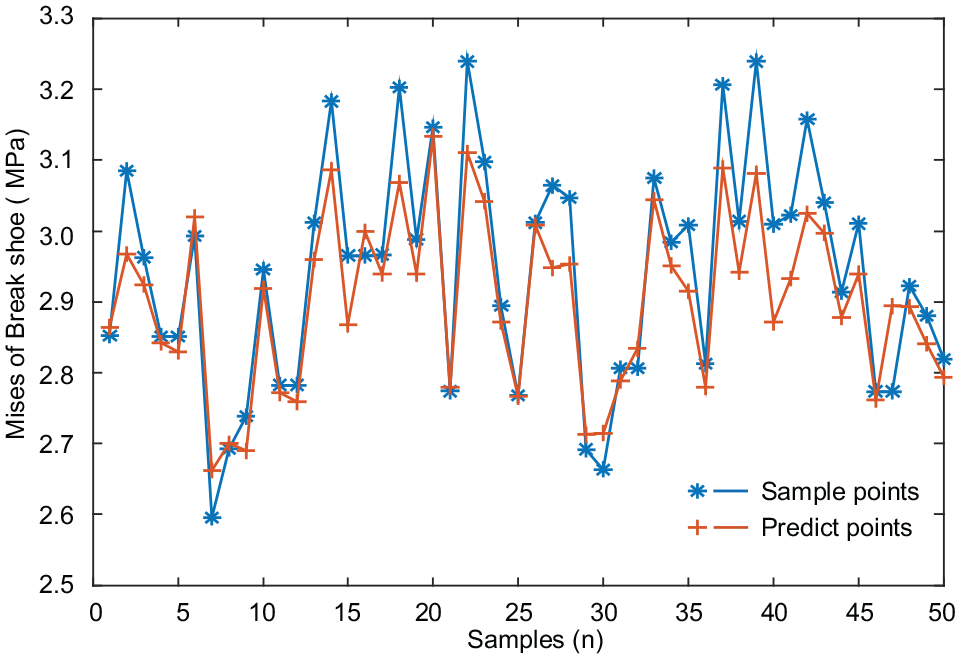
Comparisons between numerical simulation sample points and regression prediction points about stress of break shoe.
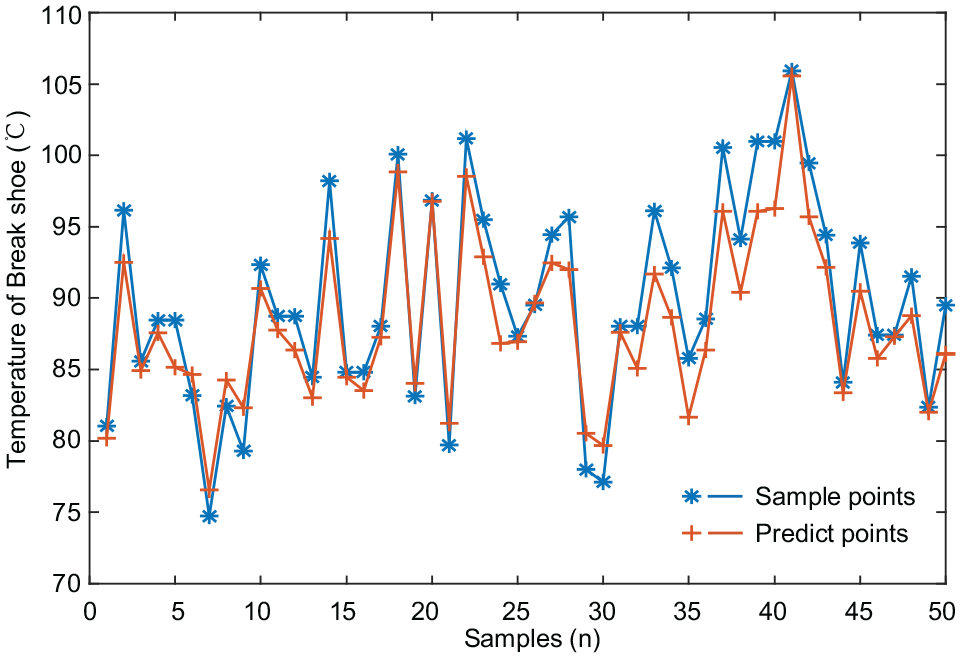
Comparisons between numerical simulation sample points and regression prediction points about temperature of break shoe.
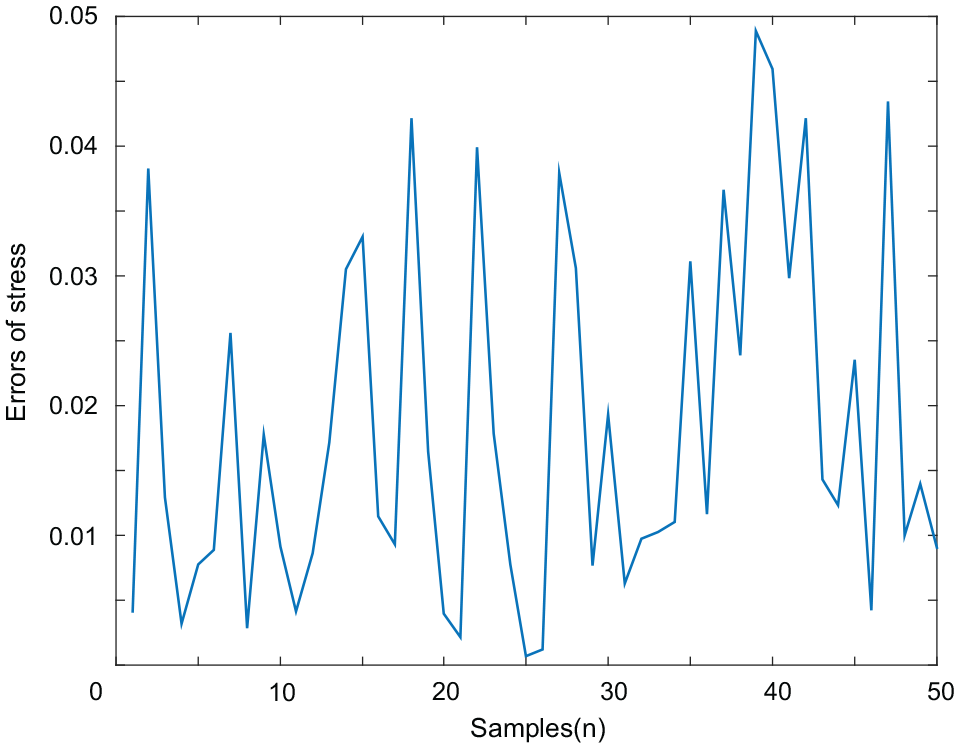
Relative error of Kriging fitting about stress.

Relative error of Kriging fitting about temperature.
The regression fitting curve of the Kriging model is generally consistent with the curve corresponding to the sample point value, as shown in Figures 10 and 11. It can be seen from the relative error graph of Kriging fitting in Figures 12 and 13 that the fitting effect is very good and the error is controlled within 5%. Therefore, the corresponding function equation of the fitted curve can be used to solve the reliability.
The relationship between the stress on the brake shoe and the variables is

The relationship between the temperature on the brake shoe and the variables is

where f is the coefficient of friction, S is the contact area between the brake shoe and the brake disk,
Reliability analysis of brake shoes
Saddlepoint approximation method
Define that the performance function is Y = g(

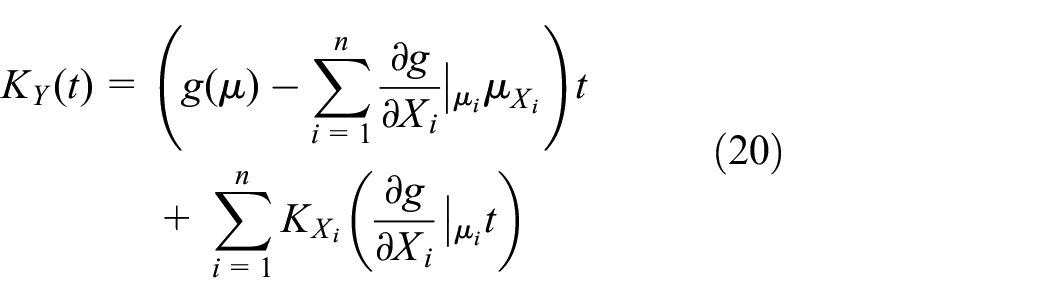
Combined with the table of cumulative generating function 19 and the properties of cumulative generating function,20,21 the cumulative generating function of equation (19) can be written as
LUGANNANI and RICE calculated the cumulative distribution function of Y = g(

where

where sgn() is the sign function

In equation (23), ts is the saddlepoint, the value is the solution of equation (24), and y is the variation range of Y = g(

Reliability calculation of each failure mode
Establish stress and temperature performance function

where
In the process of emergency braking, because of the friction effect, the friction pair will produce a lot of heat, in the local large temperature rise and the combined effect of external load, brake shoe internal will generate compressive stress, tensile stress, and shear stress. Therefore, when selecting the failure threshold, the minimum tensile strength should be selected as the failure standard. Therefore, the tensile strength is selected as
The non-asbestos brake shoe has better thermal performance under 300°C, and the material property will not change in this temperature range. However, when temperature exceeds 300°C, the non-asbestos brake shoe will enter the qualitative change period of melting, degradation, and rapid type. The working temperature of non-asbestos brake shoe shall not exceed 300°C; otherwise, the frictional property will change due to the material quality. Therefore, the value of T0 is set to be 300°C.
By applying the saddlepoint approximation theory, equation (25) are substituted into equations (20)–(24); thus, the failure probability of brake shoe under stress (Pf1) in emergency braking condition is

And the failure probability of brake shoe under heat (Pf2) in emergency braking condition is

It can be seen from the above reliability calculation results that the failure probability of brake shoe due to the influence of heat and stress is low in the emergency braking of kilometer deep well elevator, which provides theoretical basis for the research on the reliability design of brake shoe.
Reliability estimation of correlated failure modes
The dependence among different failure modes may have a great impact on the system reliability analysis. When calculating joint failure probability, it is necessary to establish the joint probability distribution model of two failure modes to estimate the system reliability. At present, copulas have been proved to be an effective tool for establishing joint failure probability model. According to Sklar’s theorem, 24 while the marginal cumulative distribution functions of two variables are given, then the joint cumulative distribution function of the two variables can be modeled as

where F1(x1) and F2(x2) are the marginal cumulative distribution function of two random variables X1 and X2;
The Frank copula is adopted to model the dependency structure between the thermal stress failure and temperature failure; the expression of the copula is

in which
The Kendall rank correlation coefficient is estimated based on the output random variables with 400 samples, which is
Since the Frank copula calculates the joint probability of failure of the two failure modes, that is,
Conclusion
The probabilistic modeling and reliability analysis of brake shoes for hoist disk with correlated failure modes are discussed. Some specific conclusions drawn from the present research are as follows:
Under the emergency braking condition of the hoist, high initial braking speed and long braking time will lead to high surface temperature of the friction pair.
When the initial braking speed is 20 m/s, only 16.38% of the heat generated by the friction pair of the brake disk–brake shoe is distributed to the brake shoe, which result in the maximum thermal stress value of the brake shoe is 3.1 MPa. Therefore, thermal stress has little effect on brake shoe failure.
When the initial braking speed is 20 m/s, the failure probability about stress of brake shoe is 3.299 × 10⁻⁵ and the failure probability about temperature of brake shoe is 1.263 × 10⁻⁷.
When considered stress and temperature with correlated failure modes, the failure probability is 3.312 × 10⁻⁵. The result shows that the joint probability of failure has little impact on the system reliability when the stress failure and temperature failure are considered.
Footnotes
Appendix 1
Parameter matrix of Latin hypercube sampling.

| Number | f | S (m2) |
|
D (kg/m3) | E (N/m2) | L (Pa) |
|
T (°C) |
|---|---|---|---|---|---|---|---|---|
| 1 | 0.42 | 0.00127 | 0.009632 | 2247.35 | 2,208,547,000 | 1,674,752 | 2,883,810 | 86 |
| 2 | 0.42015 | 0.00139 | 0.009659 | 2237.31 | 2,211,853,600 | 1,574,656 | 2,620,890 | 76 |
| 3 | 0.4203 | 0.00143 | 0.009751 | 2254.00 | 2,182,963,200 | 1,554,768 | 2,512,110 | 70 |
| 4 | 0.42045 | 0.00138 | 0.009756 | 2258.18 | 2,201,047,200 | 1,710,672 | 2,891,480 | 84 |
| 5 | 0.4206 | 0.00145 | 0.009554 | 2239.91 | 2,206,120,400 | 1,709,392 | 2,760,190 | 76 |
| ⋮ | ⋮ | ⋮ | ⋮ | ⋮ | ⋮ | ⋮ | ⋮ | ⋮ |
| 397 | 0.47955 | 0.00150 | 0.009823 | 2255.36 | 2,191,675,200 | 1,620,208 | 2,773,620 | 87 |
| 398 | 0.4797 | 0.00132 | 0.009711 | 2243.29 | 2,178,220,000 | 1,566,960 | 2,922,620 | 92 |
| 399 | 0.47985 | 0.00148 | 0.009793 | 2231.67 | 2,189,910,800 | 1,624,064 | 2,880,910 | 82 |
| 400 | 0.48 | 0.00130 | 0.01 | 2260.66 | 2,201,489,400 | 1,493,808 | 2,819,270 | 90 |
Handling Editor: James Baldwin
Declaration of conflicting interests
The author(s) declared no potential conflicts of interest with respect to the research, authorship, and/or publication of this article.
Funding
The author(s) disclosed receipt of the following financial support for the research, authorship, and/or publication of this article: This study was financially supported by the National Natural Science Foundation of China (grant no. 51875567), the Program for Changjiang Scholars and Innovative Research Team in University (grant no. IRT_16R68), and the Priority Academic Program Development of Jiangsu Higher Education Institutions (PAPD).
