The mechanical damage variable, as well as the thermal and mechanical relaxation times, plays essential roles in the thermal quality factor of the resonators, where controls energy damping through the coupling of mechanical and thermal behavior. In this article, we developed a mathematical model in which a static-pre-stress and mechanical damage variable in the context of a two-temperature viscothermoelasticity of silicon resonator has been considered. The effects of static-pre-stress, thermal relaxation time, mechanical relaxation time, mechanical damage variable, isothermal frequency, and length-scale on the quality factor have been discussed in the context of a one-temperature and two-temperature models. The model predicts that significant improvement in terms of quality factors is possible by tuning the static-pre-stress, isothermal frequency, and length-scale of the resonator. Moreover, the thermal and mechanical relaxation times and the mechanical damage variable have impacts on the thermal quality factor.
The most critical parameter of viscothermoelastic resonators is its thermal quality factor Q. Higher Q-factor indicates the less energy is dissipated during vibrations and low damping. The study of the energy dissipation mechanism is significant for the improvement of the design of micro-/nanoelectromechanical resonators.1–4
The first who introduced the Q-factor in thermoelastic dissipation is Zener,5–7 where he introduced an approximate analytical form of it and studied the thermoelastic damping in beams by treating the viscoelastic material. Many authors calculated the thermoelastic damping using the classical theory of thermoelasticity based on the Fourier heat law of heat conduction. Lifshitz and Roukes8 developed an exact expression for thermoelastic damping. Sun et al.9 discussed thermoelastic damping of a beam resonator based on a non-Fourier heat equation. Sharma and Sharma10 studied the energy dissipation in scale circular plate resonators using the Lord-Shulman theory of generalized thermoelasticity theory (L-S).
Tzou11,12 proposed a mathematical model to study heat conduction known as dual-phase lag (DPL). In this model, he established the temperature gradient and heat flux. Many authors used his model in heat transfer applications and physical systems,13–18 and thermoelastic damping vibration.19,20 Guo et al.21,22 introduced the thermoelastic damping theory of micro- and nanomechanical resonators using the DPL model.
The study of viscothermoelastic materials has become essential in mechanics. Biot23,24 discussed the theory of viscothermoelasticity in thermodynamics. A thermoviscoelasticity model of polymers at finite strains was derived by Drozdov.25 A new model of thermoviscoelasticity for isotropic media was established by Ezzat and El-Karamany.26
As the size of a flexural resonator is reduced, its natural frequency increases, and thermoelastic damping also increases in the process. The natural frequency of beams can also be changed by the application of an axial force.3,27 A compressive force decreases in the natural frequency, whereas a tensile force increases in the natural frequency. Experimental results have been utilizing the frequency change to tune resonators. Furthermore, these experiments also suggest an increase in the Q-factor with the application of tensile stress.3,28 Youssef constructed a model of thermoelasticity with two-temperature heat conduction equations. This model is based on the conductive temperature and the dynamical temperature. The difference between the values of the two types of temperatures is proportional to the heat supply.29 Youssef and many other authors solved applications in the context of the two-temperature model of thermoelasticity.30–33
Damage variables can be viewed in different ways. In a cross section of the damaged body, we thus consider an area element with unit normal vector n. The area of the defects in this element is denoted by , and the amount of damage can be represented by the area fraction34
where corresponds to the undamaged material and formally describes the totally damaged material with a complete loss of stress carrying capacity. In the real materials, at values of processes take place, which leads to total failure. If the damage is constant across a finite area, for instance, under uniaxial tension, the relation (1) reduces to
The influence of microcracks that are inclined to the cross section cannot be described correctly in the same way. Correspondingly, in case of isotropic damage D independent of n, hence, the effective stresses are given by34
where are the average stresses in the undamaged material.
Many applications and problems have been published under this definition of damage mechanics.35–39 Therefore, the present work is dealing with the mechanical damage variable, as well as the thermal and mechanical relaxation times, which plays essential roles in the thermal quality factor of the resonators. Hence, we will develop a mathematical model in which a static-pre-stress and mechanical damage variable will be applied in the context of a two-temperature viscothermoelastic model and resonator of silicon will be considered. The effects of the static-pre-stress, thermal relaxation time, mechanical relaxation time, mechanical damage variable, isothermal frequency, and length-scale on the quality factor will be discussed based on one-temperature and two-temperature models.
Basic equations and model formulation
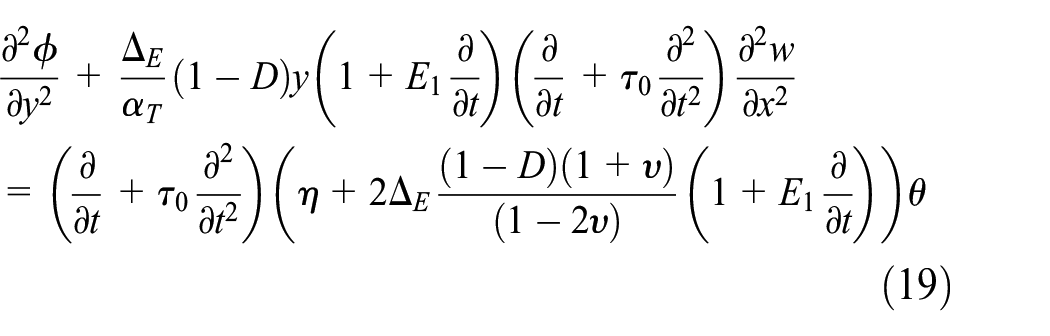
The constitutive relationship for an Euler–Bernoulli’s beam with dimensions length L, width b, and thickness h along the x, y, and z-axes, respectively, as in Figure 1. A moment of inertia I, and applied axial force F and flexural displacement can be written as9–12
where is the Young’s Modulus, and is the coefficient of thermal expansion.
The beam resonator.
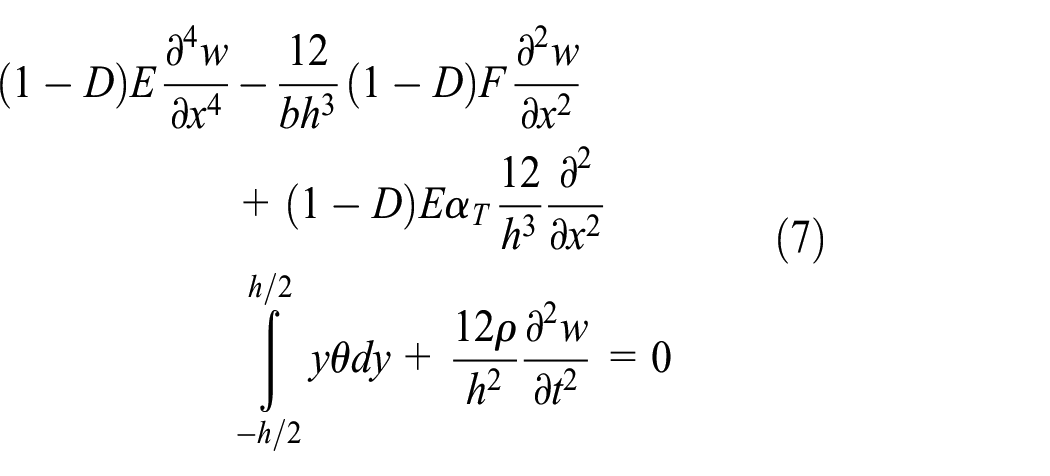
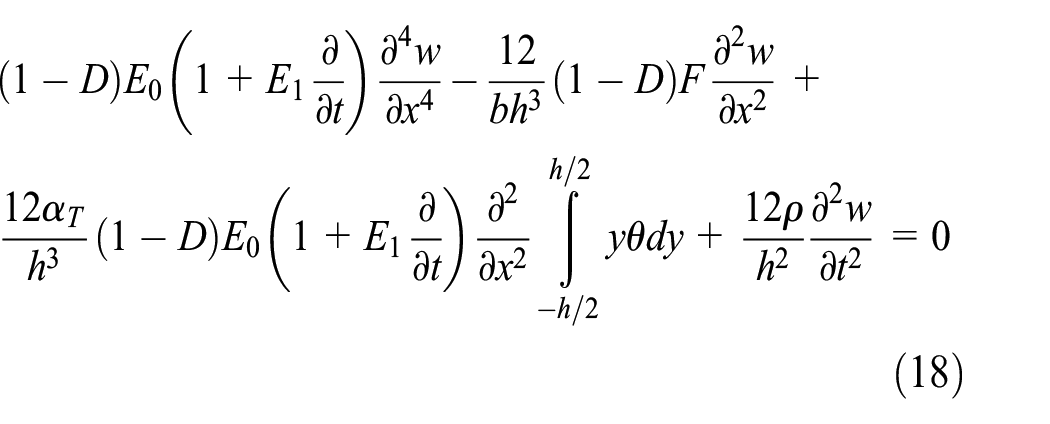
By deriving the equation of motion for lateral deflection, we obtain
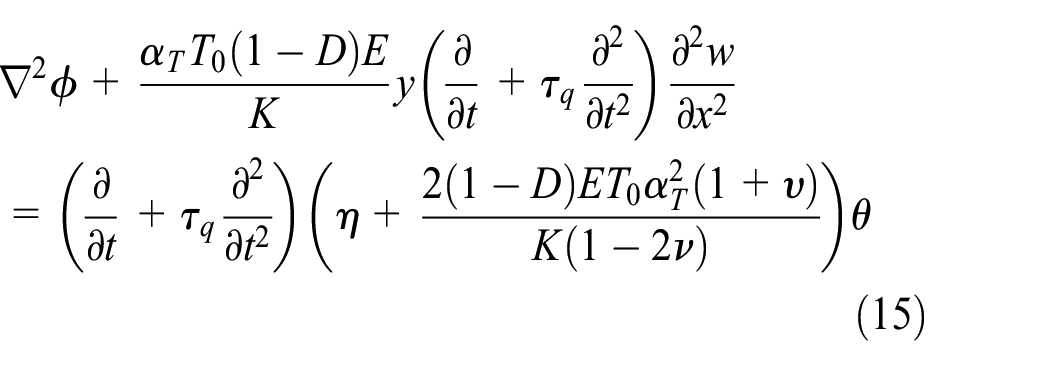
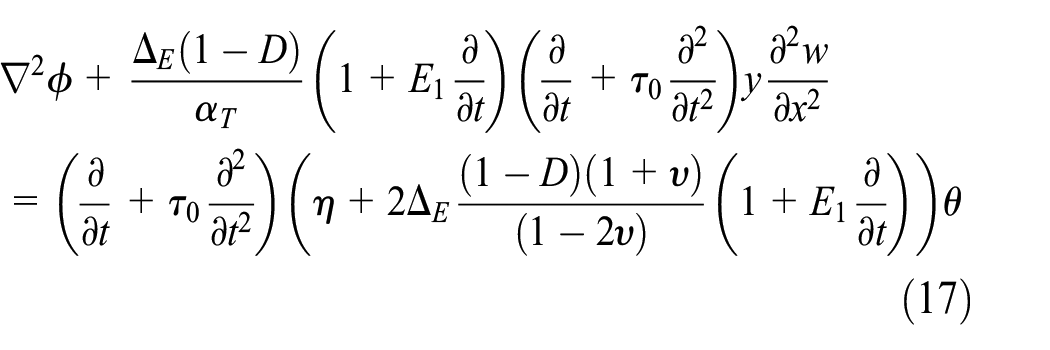
The two-temperature heat equations with one-relaxation time take the forms19,20,29
and
where is the equilibrium temperature of the beam, is the conductive temperature increment, is the dynamical temperature increment, a is non-negative constant and is called the two-temperature parameter, is the thermal conductivity, is the Poisson’s ratio, is the specific heat at constant strain, and is the thermal relaxation time.
The volumetric deformations as follows
and
where is the stress due to the applied axial force.
For a simply supported beam, the exact analytical solution for the natural frequency is given as9,10,27
where is the isothermal value of frequency given by27
In general, the frequencies are complex, the real part giving the new eigenfrequencies of the beam in the presence of thermoelastic coupling, and the imaginary part giving the attenuation of the vibration. The amount of thermoelastic damping, expressed in terms of the inverse of the quality factor, will then be given by4–7,40
Numerical results and discussions
Now, the relationships between the variation of the thermoelastic damping with the beam height h, and the beam length in different values of the applied axial force F on the microbeam resonator, which is made of silicon and clamped at two ends, will be explored. Material properties of silicon (Si) have been taken as follows9
The aspect ratios of the beam are fixed . For the scale of a microbeam, we will take the beam’s thickness .
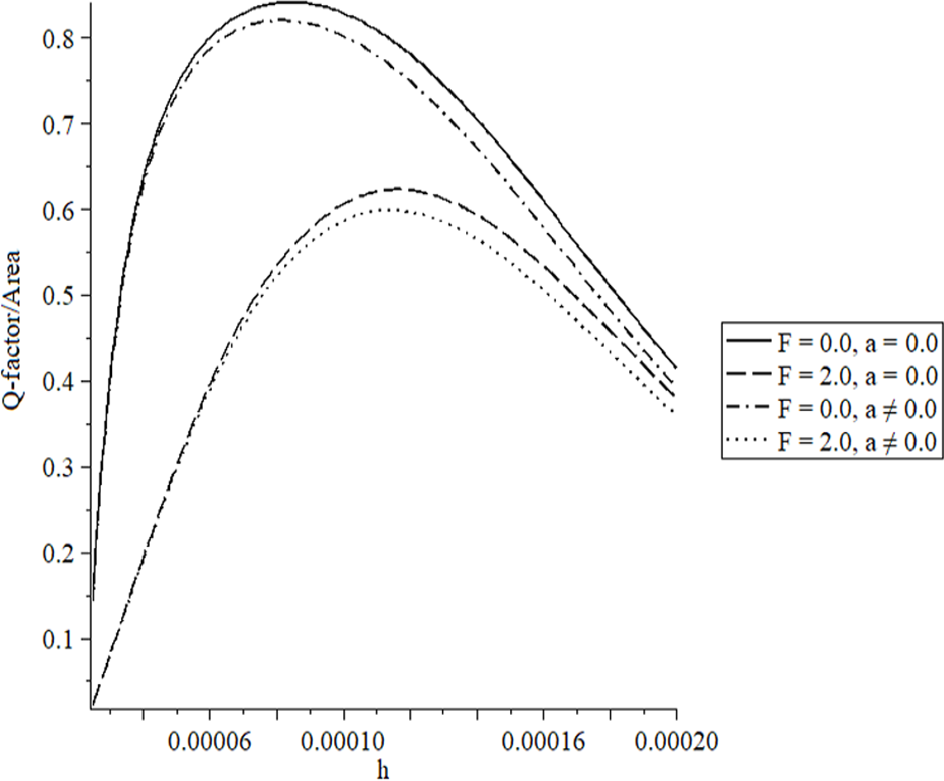
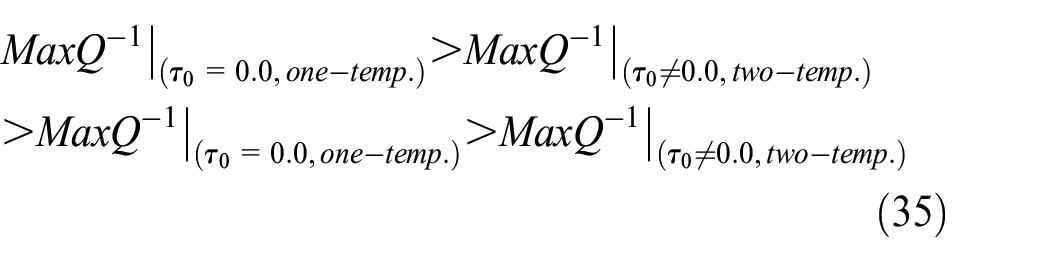
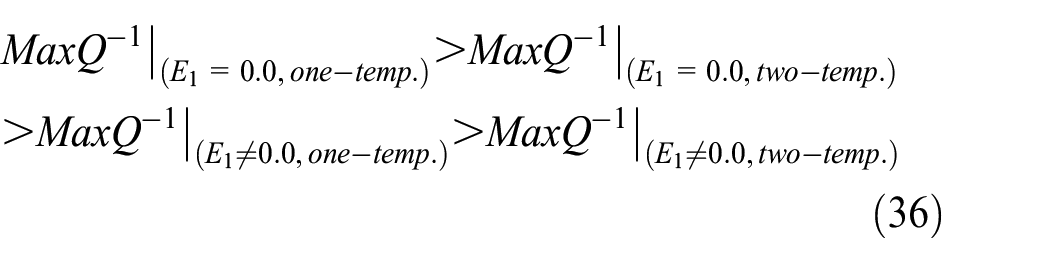
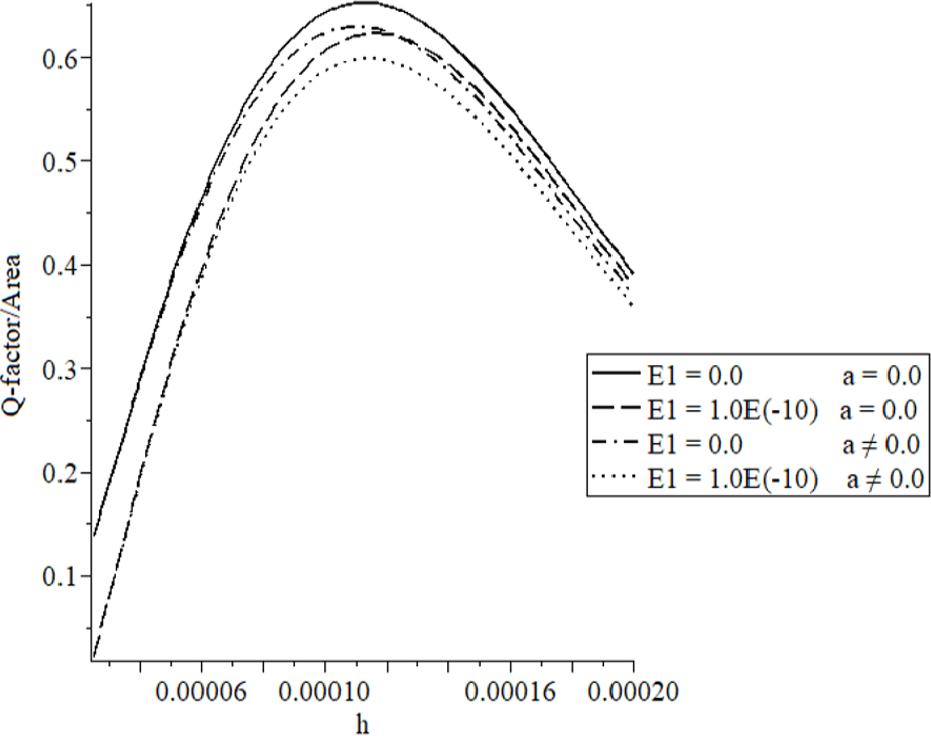
Figure 2 represents the Q-factor per unit area with various values of the two-temperature parameter and force due to static-pre-stress when , , , , . It is noted that the two-temperature parameter has a significant effect on the Q-factor for the different values of the force due to the static-pre-stress. The values of the Q-factor decrease when the value of the two-temperature parameter increases. The static-pre-stress has a significant effect on the thermal quality factor in the context of the one-temperature and two-temperature models, and increase in the value of the static-pre-stress leads to decrease in the thermal quality of the resonator. The maximum values of the thermal quality satisfy the following order
The Q-factor of the resonator per unit area with various values of the static-pre-force and the two-temperature parameter when , , , , .
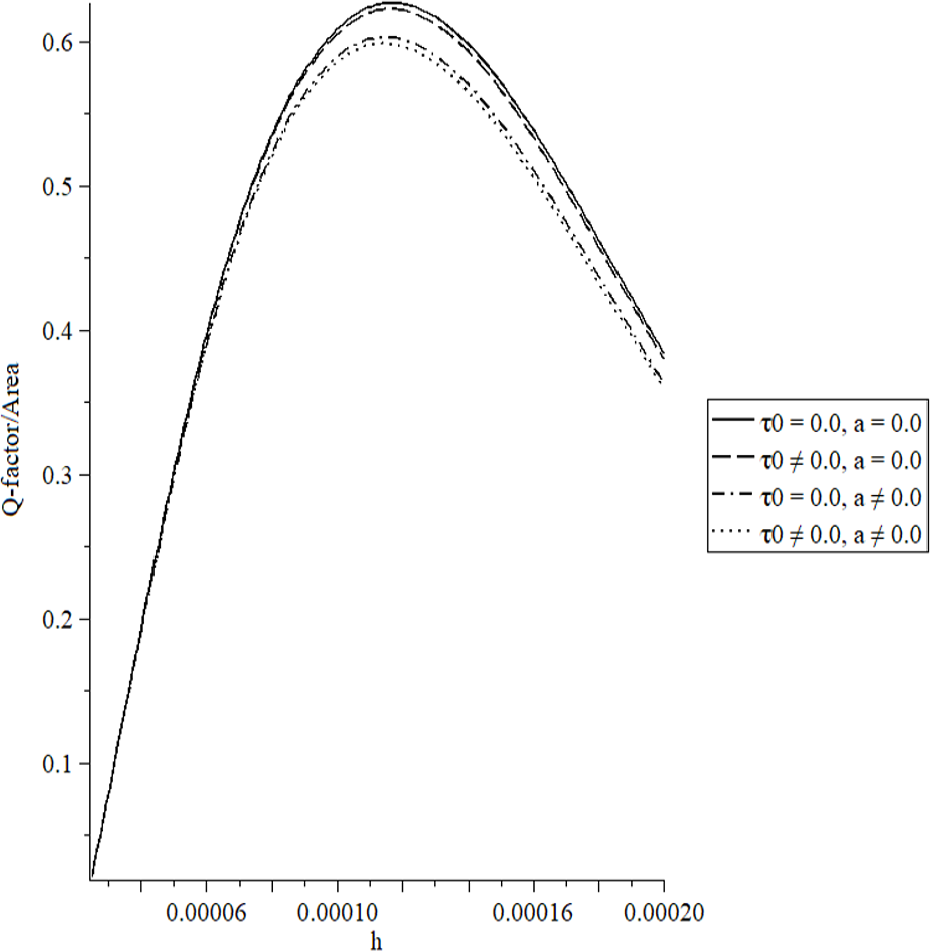
Figure 3 represents the Q-factor per unit area with various values of the two-temperature parameter and thermal relaxation time when , , , , . It is noted that the two-temperature parameter has a significant effect on the Q-factor for the different values of the thermal relaxation time. The values of the Q-factor decrease when the value of the two-temperature parameter increases. The thermal relaxation time has a significant effect on the thermal quality factor in the context of the one-temperature and two-temperature models. The increase in the value of the thermal relaxation time leads to a decrease in the thermal quality of the resonator. The maximum values of the thermal quality satisfy the following order
The Q-factor of the resonator per unit area with various values of thermal relaxation time and two-temperature parameter when , , , , .
Figure 4 represents the Q-factor per unit area with various values of the two-temperature parameter and mechanical relaxation time when , , , , . It is noted that the two-temperature parameter has a significant effect on the Q-factor for the different values of the mechanical relaxation time. The values of the Q-factor decrease when the value of the two-temperature parameter increases. The mechanical relaxation time has a significant effect on the thermal quality factor in the context of the one-temperature and two-temperature models. The increase in the value of the mechanical relaxation time leads to a decrease in the thermal quality of the resonator. The maximum values of the thermal quality satisfy the following order
The Q-factor of the resonator per unit area with various values of the mechanical relaxation time and two-temperature parameter when , , , , .
Figure 5 represents the Q-factor per unit area with various values of the two-temperature parameter and mechanical damage variable when , , , , . It is noted that the two-temperature parameter has a significant effect on the Q-factor for the different values of the mechanical damage variable. The values of the Q-factor decrease when the value of the two-temperature parameter increases. The mechanical damage variable has a significant effect on the thermal quality factor in the context of the one-temperature and two-temperature models. The values of the thermal quality factor decrease when the value of the mechanical damage variable increases. The maximum values of the thermal quality satisfy the following order
The Q-factor of the resonator per unit area with various values of the mechanical damage variable and two-temperature parameter when , , , , .
Figure 6 represents the Q-factor per unit area with various values of the two-temperature parameter and the isothermal frequency when , , , , . It is observed that the two-temperature parameter has a significant effect on the Q-factor for the different values of the isothermal frequency. The values of the Q-factor decrease when the value of the two-temperature parameter increases. The value of isothermal frequency has a significant effect on the thermal quality factor in the context of the one-temperature and two-temperature models. The values of the thermal quality factor increase when the value of isothermal frequency increases. The maximum values of the thermal quality satisfy the following order
The Q-factor of the resonator per unit area with various values of the isothermal frequency and the two-temperature parameter when , , , , .
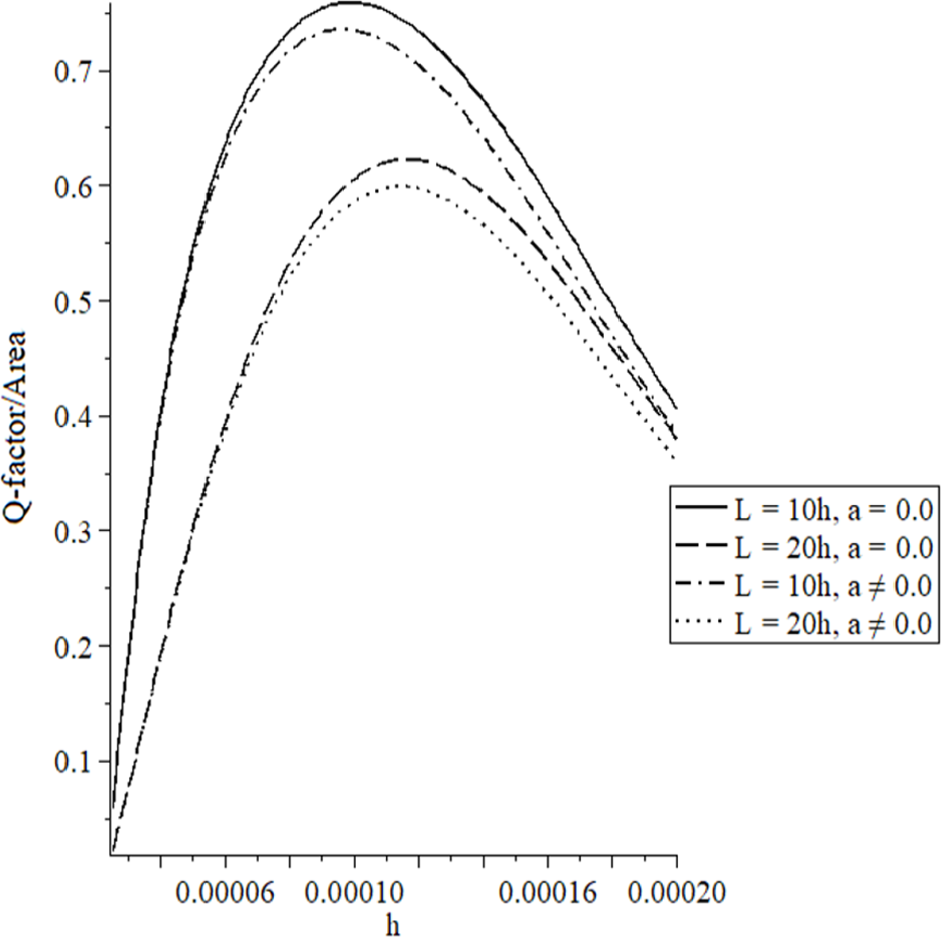
Figure 7 represents the Q-factor per unit area with various values of the two-temperature parameter and length-scale ratio of the resonator when , , , , . It is observed that the two-temperature parameter has a significant effect on the Q-factor for the different values of the length-scale ratio of the resonator. The values of the Q-factor decrease when the value of the two-temperature parameter increases. The value of the length-scale ratio of the resonator has a significant effect on the thermal quality factor in the context of the one-temperature and two-temperature models. The values of the thermal quality factor decrease when the value of the length-scale ratio of the resonator increases. The maximum values of the thermal quality satisfy the following order
The Q-factor of the resonator per unit area with various values of length-scale of the resonator and the two-temperature parameter when , , , , .
Conclusion
A mathematical model of a static-pre-stress and mechanical damage variable in the context of a two-temperature viscothermoelastic silicon resonator has been developed. The effects of static-pre-stress, thermal relaxation time, mechanical relaxation time, mechanical damage variable, isothermal frequency, and length-scale on the thermal quality factor have been discussed in the context of the one-temperature and two-temperature models.
The results conclude the following:
The thermal and mechanical relaxation times increase the thermal quality factor.
The model predicts that significant improvement in terms of quality factors is possible by tuning the static-pre-stress, isothermal frequency, and length-scale of the resonator.
The mechanical damage variable and two-temperature parameter have impacts on the thermal quality factor.
Considering two-temperature model decreasing the value of the thermal quality factor.
Footnotes
Handling Editor: Mario L Ferrari
Declaration of conflicting interests
The author(s) declared no potential conflicts of interest with respect to the research, authorship, and/or publication of this article.
Funding
The author(s) received no financial support for the research, authorship, and/or publication of this article.
ORCID iD
Hamdy M Youssef
References
1.
DuwelACandlerRNKennyTW, et al. Engineering MEMS resonators with low thermoelastic damping. J Microelectromech Syst2006; 15: 1437–1445.
2.
GuoFRogersonG. Thermoelastic coupling effect on a micro-machined beam resonator. Mech Res Commun2003; 30: 513–518.
3.
HarrisCMPiersolAG. Harris’ shock and vibration handbook. New York: McGraw-Hill, 2002.
4.
KoyamaTBindelDSHeW, et al. Simulation tools for damping in high frequency resonators. In: SENSORS, 2005 IEEE, Irvine, CA, 30 October–3 November 2005, p.4. New York: IEEE.
5.
ZenerC. Internal friction in solids. I. Theory of internal friction in reeds. Phys Rev1937; 52: 230.
6.
ZenerC. Internal friction in solids II. General theory of thermoelastic internal friction. Phys Rev1938; 53: 90.
7.
ZenerCOtisWNuckollsR. Internal friction in solids III. Experimental demonstration of thermoelastic internal friction. Phys Rev1938; 53: 100.
TzouD. On the thermal shock wave induced by a moving heat source [Database]. J Heat Transfer1989; 111: 232–238.
12.
TzouD. Macro- to microscale heat transfer: the lagging behavior. Washington, DC: Taylor & Francis, 1997.
13.
XuMGuoJWangL, et al. Thermal wave interference as the origin of the overshooting phenomenon in dual-phase-lagging heat conduction. Int J Therm Sci2011; 50: 825–830.
14.
Al-HunitiNSAl-NimrM. Thermoelastic behavior of a composite slab under a rapid dual-phase-lag heating. J Therm Stresses2004; 27: 607–623.
15.
HoJ-RKuoC-PJiaungW-S. Study of heat transfer in multilayered structure within the framework of dual-phase-lag heat conduction model using lattice Boltzmann method. Int J Heat Mass Tran2003; 46: 55–69.
16.
LeeY-MTsaiT-W. Ultra-fast pulse-laser heating on a two-layered semi-infinite material with interfacial contact conductance. Int Commun Heat Mass2007; 34: 45–51.
17.
LiuK-C. Numerical analysis of dual-phase-lag heat transfer in a layered cylinder with nonlinear interface boundary conditions. Comput Phys Commun2007; 177: 307–314.
18.
RamadanK. Semi-analytical solutions for the dual phase lag heat conduction in multilayered media. Int J Therm Sci2009; 48: 14–25.
19.
AlghamdiN. Dual-phase-lagging thermoelastic damping vibration in micro-nano scale beam resonators with voids. Int J Multidiscip Curr Res2017; 5: 71–78.
GuoFSongJWangG, et al. Analysis of thermoelastic dissipation in circular micro-plate resonators using the generalized thermoelasticity theory of dual-phase-lagging model. J Sound Vib2014; 333: 2465–2474.
22.
GuoFWangGRogersonG. Analysis of thermoelastic damping in micro-and nanomechanical resonators based on dual-phase-lagging generalized thermoelasticity theory. Int J Eng Sci2012; 60: 59–65.
23.
BiotMA. Theory of stress-strain relations in anisotropic viscoelasticity and relaxation phenomena. J Appl Phys1954; 25: 1385–1391.
24.
BiotMA. Variational principles in irreversible thermodynamics with application to viscoelasticity. Phys Rev1955; 97: 1463.
25.
DrozdovA. A constitutive model in finite thermoviscoelasticity based on the concept of transient networks. Acta Mech1999; 133: 13–37.
26.
EzzatMAEl-KaramanyAS. The relaxation effects of the volume properties of viscoelastic material in generalized thermoelasticity. Int J Eng Sci2003; 41: 2281–2298.
VerbridgeSSShapiroDFCraigheadHG, et al. Macroscopic tuning of nanomechanics: substrate bending for reversible control of frequency and quality factor of nanostring resonators. Nano Lett2007; 7: 1728–1735.
29.
YoussefH. Theory of two-temperature-generalized thermoelasticity. IMA J Appl Math2006; 71: 383–390.
30.
YoussefHMEl-BaryAAElsibaiKA. Vibration of gold nano beam in context of two-temperature generalized thermoelasticity subjected to laser pulse. Lat Am J Solids Stru2014; 11: 2460–2482.
31.
ElsibaiKAYoussefHM. State-space approach to vibration of gold nano-beam induced by ramp type heating without energy dissipation in femtoseconds scale. J Therm Stresses2011; 34: 244–263.
32.
AbbasIA. A two-temperature model for evaluation of thermoelastic damping in the vibration of a nanoscale resonators. Mech Time-Depend Mat2016; 20: 511–522.
33.
YoussefHMEl-BaryAA. The reference temperature dependence of Young’s modulus of two-temperature thermoelastic damping of gold nano-beam. Mech Time-Depend Mat2018; 22: 435–445.
34.
GrossDSeeligT. Fracture mechanics: with an introduction to micromechanics. Cham: Springer, 2017.
VoyiadjisGZ. Handbook of damage mechanics: nano to macro scale for materials and structures. New York: Springer, 2015.
37.
YaoYHeXKeerLM, et al. A continuum damage mechanics-based unified creep and plasticity model for solder materials. Acta Mater2015; 83: 160–168.
38.
VoyiadjisGZKattanPI. Introducing damage mechanics templates for the systematic and consistent formulation of holistic material damage models. Acta Mech2017; 228: 951–990.
39.
KhatirATehamiMKhatirS, et al. Multiple damage detection and localization in beam-like and complex structures using co-ordinate modal assurance criterion combined with firefly and genetic algorithms. J Vibroeng2016; 18: 5063–5073.
40.
LiPFangYHuR. Thermoelastic damping in rectangular and circular microplate resonators. J Sound Vib2012; 331: 721–733.