



Abstract
In this article, the analysis and numerical results are represented for the thermoelastic of an isotropic homogeneous, thermally conducting, Kelvin–Voigt-type circular micro-plate in the context of Kirchhoff’s Love plate theory of generalized viscothermoelasticity based on the dual-phase-lagging model. The governing equations are obtained for the generalized dual-phase-lagging model and coupled viscothermoelastic plates. The scaled viscothermoelasticity has been illustrated in the case of the circular plate and the axisymmetric circular plate for an aspect ratio for clamped boundary conditions. Laplace transform has been applied, and its inversions have been calculated numerically by using the Tzou method. The results have been carried out for the ceramic (Si3N4). It is noted that the temperature increment and lateral deflection are significantly affected by the time, the width, the thickness, and the mechanical relaxation times of the material.
Introduction
Heat conduction has been studied using mathematical models such as dual-phase lag (DPL), which was proposed by Tzou.1,2 The temperature gradient and heat flux were established by this model. Many scientists used this model in heat transfer problems, 3 physical systems,4–8 and thermoelastic damping vibration.9,10 Guo et al.11,12 used the DPL model to analyze the thermoelastic damping theory of micro- and nanomechanical resonators; then, he investigated the dissipation in the circular micro-plate resonator.
The circular plate is a common structural in many micro-and nano-electromechanical resonators. Hao
13
adopted an analytical study to analyze thermoelastic damping in vibrations of micro- and nano-electromechanical circular thin-plate resonators. Sun and Tohmyoh
14
studied thermoelastic damping on axisymmetric out-of-plane vibration of circular plate resonators. Sun and Saka
15
investigated the thermoelastic damping effects on the out-of-plane vibration of circular plate resonators. They added a factor in their formula of thermoelastic damping
The study of viscoelastic materials or relaxation properties has become essential in mechanics. The theory of viscothermoelasticity and vibrational principles in thermodynamics has been discussed by Biot.19,20 Drozdov 21 derived a constitutive model for thermoviscoelasticity behavior of polymers at finite strains. Ezzat and El-Karamany 22 used a new model of thermoviscoelasticity for isotropic media to study the relaxation effects of volume properties of viscoelastic materials in thermoelasticity. Carcione et al. 23 used a numerical algorithm for wave simulations in an elastic medium using the Kelvin–Voigt mechanical model. Grover18,24,25 studied transverse vibrations in micro-scale viscothermoelastic beam resonators.
Grover 25 studied the closed-form expressions for the transverse vibrations of a homogeneous thermoelastic thin beam with voids in micro/nano-scale. Zhou et al. 26 devolved a model based on the Kirchhoff plate theory and the continuum surface elasticity theory.
In this article, the analysis has been carried out for scaled thermoelastic damping of a homogeneous isotropic, thermally conducting, Kelvin–Voigt-type circular micro-plate based on Kirchhoff’s Love plate theory. A generalized model of the viscothermoelasticity theory of dual-phase-lagging has been used, under clamped boundary conditions for fixed aspect ratios. The analytical results have been validated for a thermoelastic circular plate as a special case, the results for which are available in the literature.
Generalized viscothermoelastic dual-phase-lagging model
We consider a homogeneous isotropic thermally conducting, Kelvin–Voigt-type thin circular plate on the basis of Kirchhoff’s Love plate theory, having origin at the center of the plate of uniform thickness “h” and radius “a” in the cylindrical coordinate system

Circular micro-plate resonator.
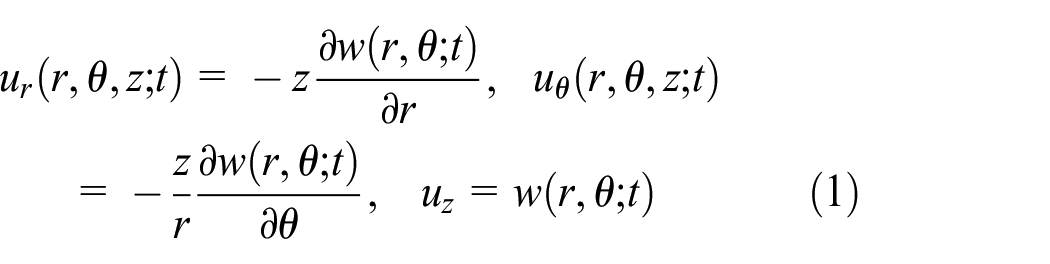
Hence, the displacement components are as follows 18
The temperature increment is as follows

The equation of motion is as follows27–29

The moments of flexure and torsion are as follows

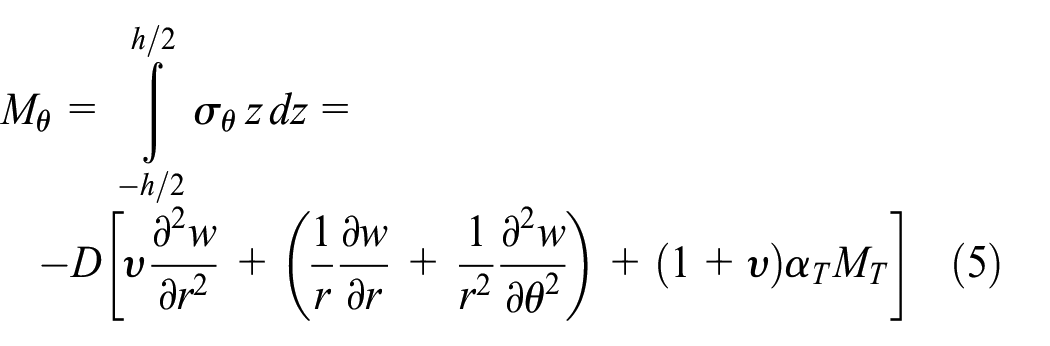
and

The thermal moment is as follows

where

and λ* and μ* are Lamè parameters, and αT is the coefficient of thermal expansion.
The stress components are as follows18,27,28,30–32



The strain components are as follows



The generalized heat conduction equation in the context of the viscothermoelastic DPL model is given by11,27

where
For the viscoelastic materials, the elastic constants

where
By substituting equation (16) in the relations on equation (8), we obtain

and

where
Formulation of the problem
In the absence of the body force, the equation of motion (equation (3)) takes the form

For the axisymmetric micro-beam, the displacement components take the forms 18

and

where there is no heat flow across the ends of the beam, so that

Thus, we can consider the temperature increment in the following form.
Because the beam is very thin and assuming the temperature varies regarding a

where
Hence, the equation of motion (equation (19)) takes the following form

After doing the integration, we obtain

By using equations (15) and (23), the heat conduction equation takes the form

In equation (26), we multiply both sides by z and integrating with respect to z from

where
Finally, we have the governing equations as follows

and

New dimensionless variables will be used as follows9,33

Hence, we obtain

and
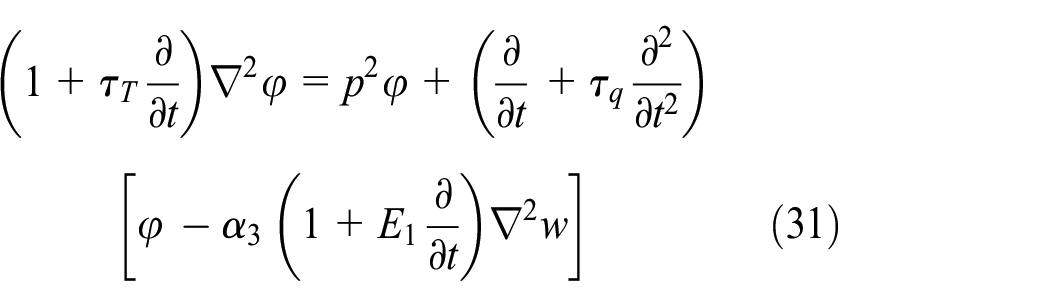
where
The primes have been dropped for simplicity.
We will apply the Laplace transform, which is defined as

Hence, we have

and

which gives

and


While applying the Laplace transform, we assumed the initial conditions as follows

Elimination between equations (35) and (36) gives the following equations

and

The bounded solutions of equations (38) and (39) take the forms

and

where

We will consider the edge of the micro-beams

and

Applying Laplace transform to the aforementioned boundary conditions, we have

and

where
Applying the boundary conditions in equations (40) and (41), we get the following system



By solving the aforementioned system, we get the solution in the Laplace transform domain as follows

Then, we have the temperature increment in the Laplace transform as follows

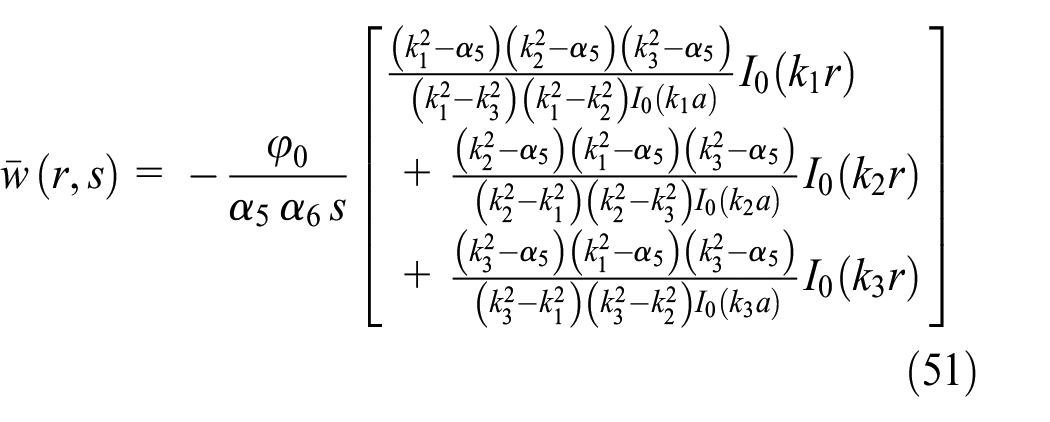
Moreover, the lateral deflection
To determine the solutions in the time domain, the Riemann-sum approximation method is used to obtain numerical results. In this method, any function in the Laplace domain can be inverted to the time domain as Tzou 2

where Re is the real part and
Mathematical software MAPLE 17 has been used to formulate the formula of Tzou (equation (52)) and we calculated the inverse Laplace transform of equations (51) and (52).
In the following numerical calculations, the circular micro-ceramic (Si3N4) plate is assumed. The thermal and mechanical properties are given by the following18,27

Figures 2 and 3 represent the temperature increment and the lateral deflection for the non-dimensional parameters
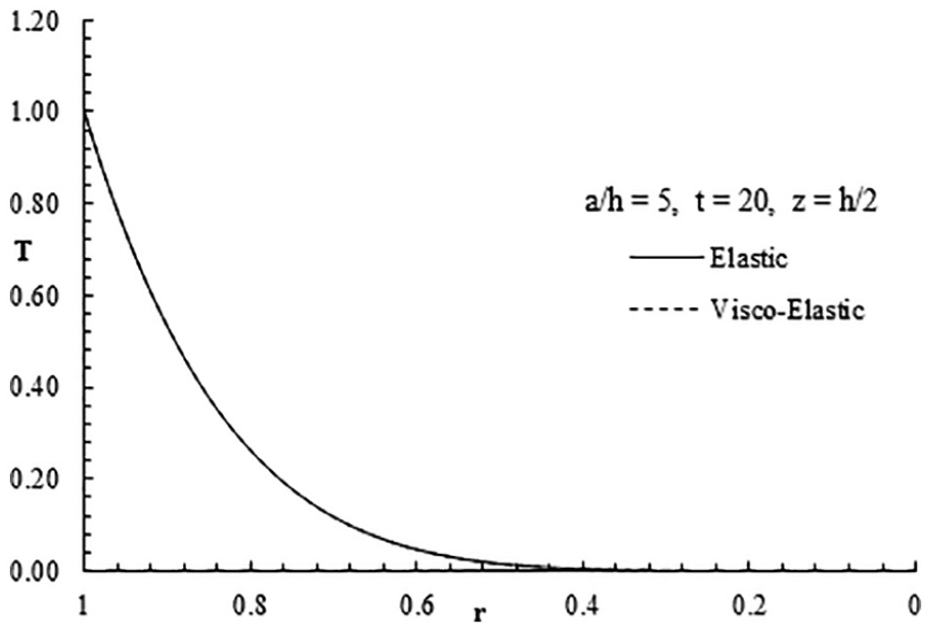
The temperature increment distribution for an elastic and viscoelastic material.

The lateral deflection distribution for an elastic and viscoelastic material.
Figures 4 and 5 represent the temperature increment and the lateral deflection for the non-dimensional parameters
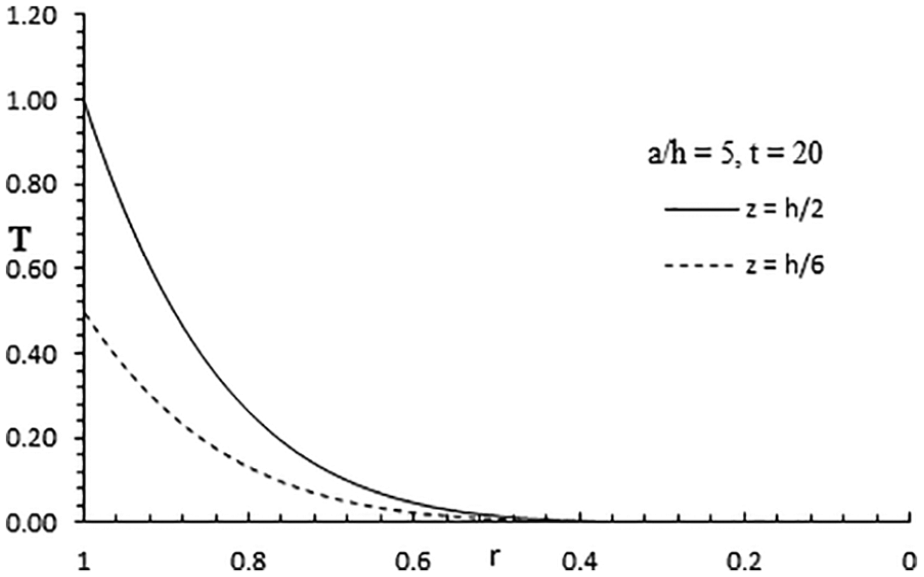
The temperature increment distribution with various values of the thickness z.

The lateral deflection distribution with various values of the thickness z.
Figures 6 and 7 represent the temperature increment and the lateral deflection for the non-dimensional parameters
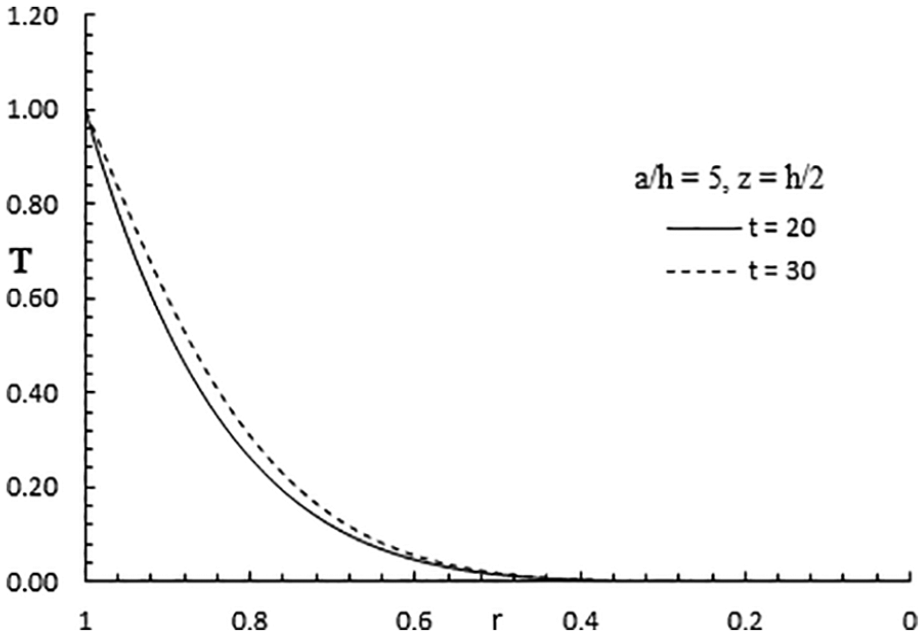
The temperature increment distribution with various values of time t.

The lateral deflection distribution with various values of time t.
Figures 8 and 9 represent the temperature increment and the lateral deflection for the non-dimensional parameters
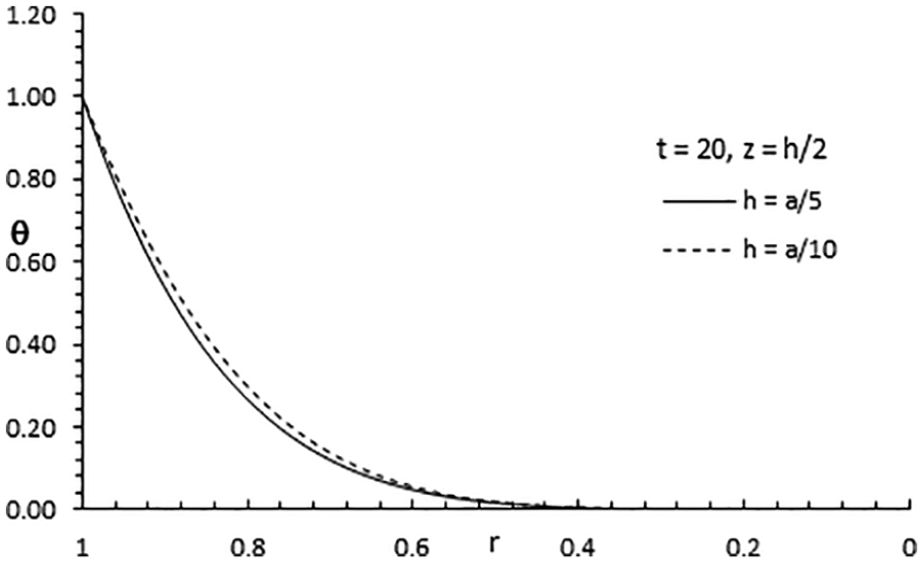
The temperature increment distribution with various values of the thickness h.

The lateral deflection distribution with various values of the thickness h.
Conclusion
A mathematical model of thermoelastic of an isotropic homogeneous, thermally conducting, Kelvin–Voigt-type circular micro-plate in the context of Kirchhoff’s Love plate theory of generalized viscothermoelasticity based on dual-phase-lagging has been constructed.
The mechanical relaxation times, the time, and the aspect ratio a/h have significant effects, while the thickness z has a limited effect on the lateral deflection distributions.
The time, the aspect ratio a/h, and the thickness z have significant effects, while the mechanical relaxation times has a limited effect on the temperature increment distributions.
Footnotes
Handling Editor: Mario L Ferrari
Declaration of conflicting interests
The author(s) declared no potential conflicts of interest with respect to the research, authorship, and/or publication of this article.
Funding
The author(s) received no financial support for the research, authorship, and/or publication of this article.
