



Abstract
A computational fluid dynamics model of the marine diesel engine was established and validated, and the simulation studies were carried out using this model. Different gravity conditions were set in the computational fluid dynamics model to investigate their effect on marine diesel emissions and performance. By comparing the simulation results under different basic grid sizes, 1.2 mm was selected as the basic grid size of the computational fluid dynamics model. The model uses the experimental data including cylinder pressure, heat release rate, and nitrogen oxides (NO x ) emissions to calibrate and validate the model. The simulation results are very close to the experimental data, and slight errors are also within the allowable range. In particular, when considering the heat transfer of the combustion chamber wall, the simulation results of the heat release rate are closer to the experimental data. The simulation results show that gravity has a slight effect on cylinder pressure and heat release rate, and has a certain degree of effect on fuel spray and atomization. The penetration length of the fuel is proportional to the gravity, and the maximum deviation of the Sauter mean diameter of the droplet is 25.74%. The spray and atomization process of fuel directly affects combustion and emissions. The maximum deviation of NO x emissions is 6.03%, which is reduced from 7.46 to 7.01 g/kW·h. Finally, the three-dimensional simulation results of temperature, equivalence ratio, and NO x emission of different crank angles under different gravity conditions are compared.
Handling Editor: James Baldwin
Introduction
As the quality of atmospheric environment continues to deteriorate, people continue to have concern about environmental issues. Pollutant emissions from marine diesel engines, especially NO x and soot, have drawn increasing attention. The International Maritime Organization (IMO) imposes limits on the NO x emissions from marine diesel engines by developing and publishing Tier-III regulations.1,2 The introduction of the Tier-III standard has caused a considerable impact on plenty of shipping countries and shipping companies. The Tier-III standard is reduced by 76% compared to the Tier-II standard, which means more stringent regulations are enforced to reduce marine diesel NO x emissions. At present, the mainstream NO x emission reduction technologies include exhaust gas recirculation (EGR), selective catalytic reduction (SCR), natural gas engines, and so on, all of which have made breakthrough in the reduction of NO x emissions. 3 – 5
Gravity condition
Ocean-bound vessels are significantly affected by marine meteorological conditions. Not only does the harsh and constant-changing marine meteorological environment affect the comfort level of personnel, it also causes disruption to the operation of the equipment. The hull caused by the waves is in a state of being overweight or weightless for a short time. People have long been aware of the effects that gravity has on the combustion process. 6 However, due to the complexity of the combustion process, the classical combustion theory described by mathematical formulas tends to overlook gravity as an influencing factor. 7 Such experimental facilities as drop towers and weightless aircraft can obtain weightlessness for a short period. Through these devices, many countries have conducted weightless combustion experiments on various combustible materials. 8 – 11 The establishment of the International Space Station has promoted the weightless combustion experiment based on which many positive results have been obtained. 12 – 16 Gravity can have effect on heat transfer, mass transfer, flame propagation, and flame stability during the process of combustion.7,17 Under normal gravity conditions, the flame shows a “droplet” shape with a center of gravity, while the flame is of “circular” shape under weightless conditions. Besides, gravity could affect chemical reaction, thus resulting in different combustion products. 18 In general, combustion exhibits the following characteristics under weightless conditions.7,19– 21 First, it is more conducive to the study of stationary and low-speed flow combustion under circumstance where natural convection almost disappears. Second, gravity sedimentation is almost non-existent, which facilitates the study of combustion under stable and free-suspension conditions. Third, the disappearance of buoyancy leads to an increase in combustion in time and space scales, which will be conducive to the observation of combustion.
A range of physical and chemical changes experienced by a droplet before burning play an important role in engine combustion. Combustion is directly associated with to emissions. 22 There is a possibility that ignition would not occur until several crank angles after the start of injection. Once ignition occurs, the fuel that has been injected and mixed with air undergoes the premixed combustion process. When the combustible mixture as prepared in advance has been consumed, mixing-controlled combustion occurs. As the name suggests, burning in this combustion process is subject to control by the fuel–air mixing process. 23 Droplet combustion is commonly found in diesel engines. Despite plenty of studies focusing on diesel spray combustion, 24 – 27 none of them takes into account the effect of gravity. The University of Tokyo, Japan, took the lead in conducting research into the combustion of n-heptane droplets under the context of microgravity. 8
Simulation software
Due to the rapid development of computer technology, it is made increasingly convenient to study engine performance and emissions by means of numerical simulation. Traditional experimental methods are faced with the difficulty in observing the effects that gravity has on the performance and emissions of combustion plants. Engine numerical simulation technology is capable to simulate a variety of different engine operating conditions, especially those that are difficult to simulate in traditional experiments. 28 As an engine computational fluid dynamics (CFD) simulation software, CONVERGE shows massive advantages that make it most commonly in practice. 29 – 38
In order to calculate the spray in a simulation, CONVERGE introduces drop parcels into the domain at the injector location at a user-specified rate. Parcels represent a group of identical drops (e.g. same radius, velocity, temperature, etc.) and are used to statistically represent the entire spray field. With the concept of drop parcels applied, CONVERGE leads to a significant reduction of the computational time required by a simulation involving spray. 39
In CONVERGE,
39
a drop’s velocity,




In summary, the velocity of the fuel droplets subject to impact from gravity. The difference in droplet velocity causes change to the statistics and distribution of parcel in CONVERGE. In this article, a validated model is applied to explore the effect of different gravity conditions on the performance and emissions of marine diesel engines.
Simulation model
Brief description of the CFD model
Main technical parameters of the engine.

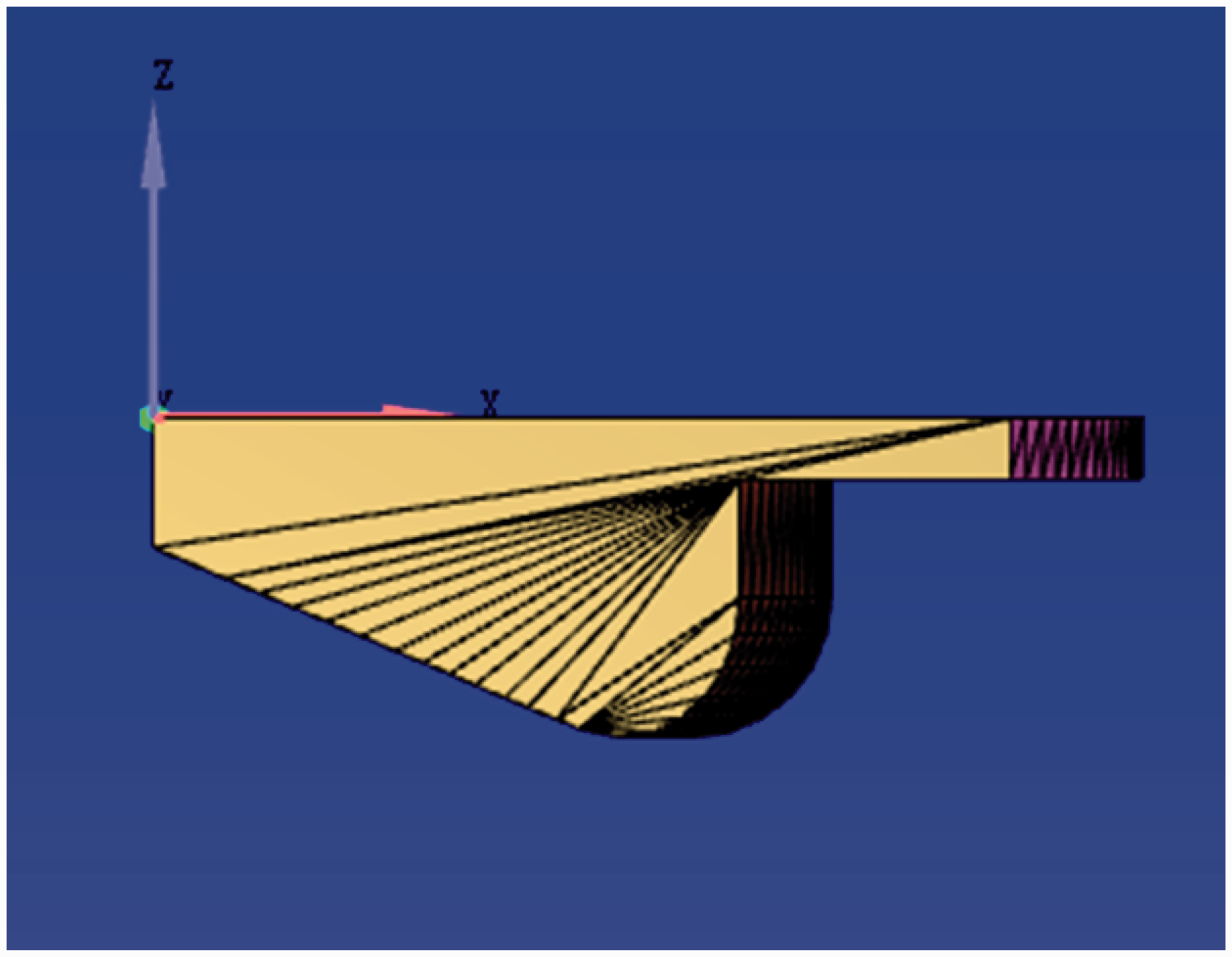
CONVERGE 2.4, commercial CFD software, is applied to facilitate simulation. The CFD model geometry is drawn according to the shape of the engine combustion chamber. Figures 1
Geometric models at BDC. Geometric models at TDC.
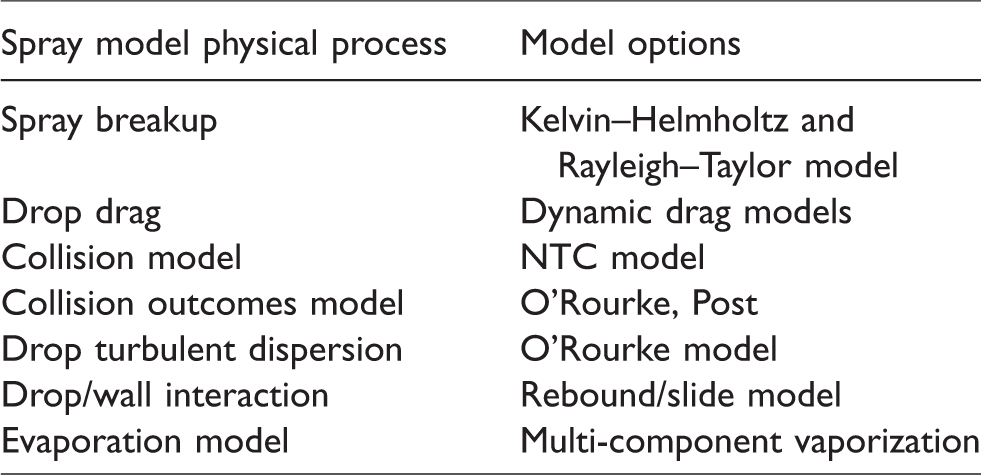
Atomization and spray model used in simulation CONVERGE. 39
Best base grid size
The governing equations used in CFD simulation are partial differential equations. The solution to the partial differential equation is to discretize the solution region into a mesh in the first place. Then, the physical parameters at the mesh node are solved. Finally, the physical parameters between the nodes are obtained by interpolation. CONVERGE is also reliant on the same method to solve partial differential equations, for which the number of meshes is closely related to the simulation results. The grid control methods in CONVERGE include base grid, adaptive mesh refinement, and fixed embedding. Both adaptive mesh refinement and fixed embedding are performed to further refine the mesh based on the base grid. Therefore, the size of the base grid determines the total number of meshes required for the CONVERGE simulation. Despite the theoretical proportionality that the number of meshes has to the accuracy of the simulation, the number of grids determines not only the computational time but also the need for computational resources. In addition, the iteration error caused in the solution process increases as the number of meshes is on the rise increases. Therefore, it is essential to determine how to choose an appropriate grid number in calculation accuracy and calculation cost for CFD simulation. Figures 3
Comparison of cylinder pressures of different base grid. Comparison of HRR of different base grid. Comparison of result under different BG: (a) pressure, (b) calculation time, (c) Pmax, and (d) NO
x
.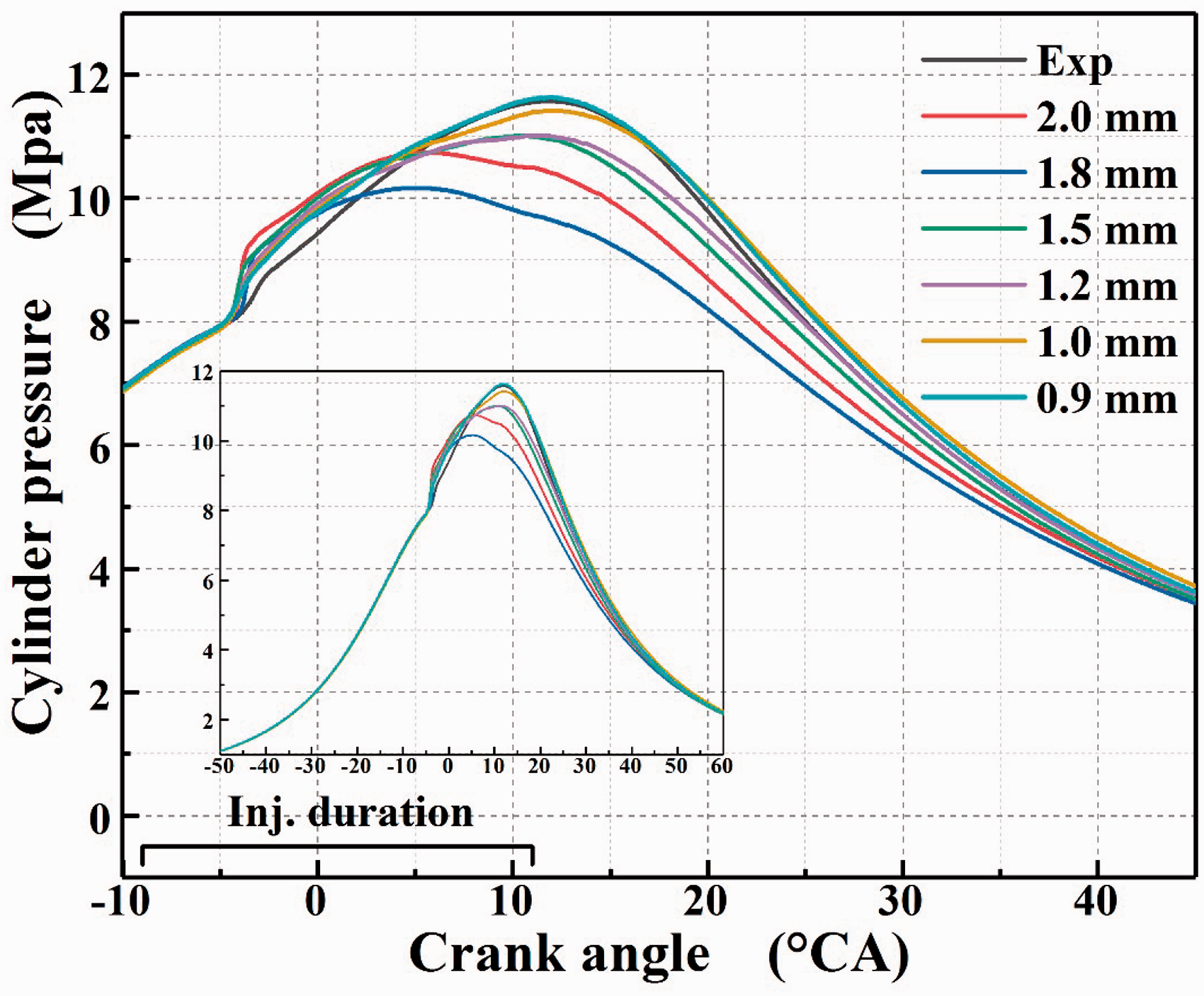
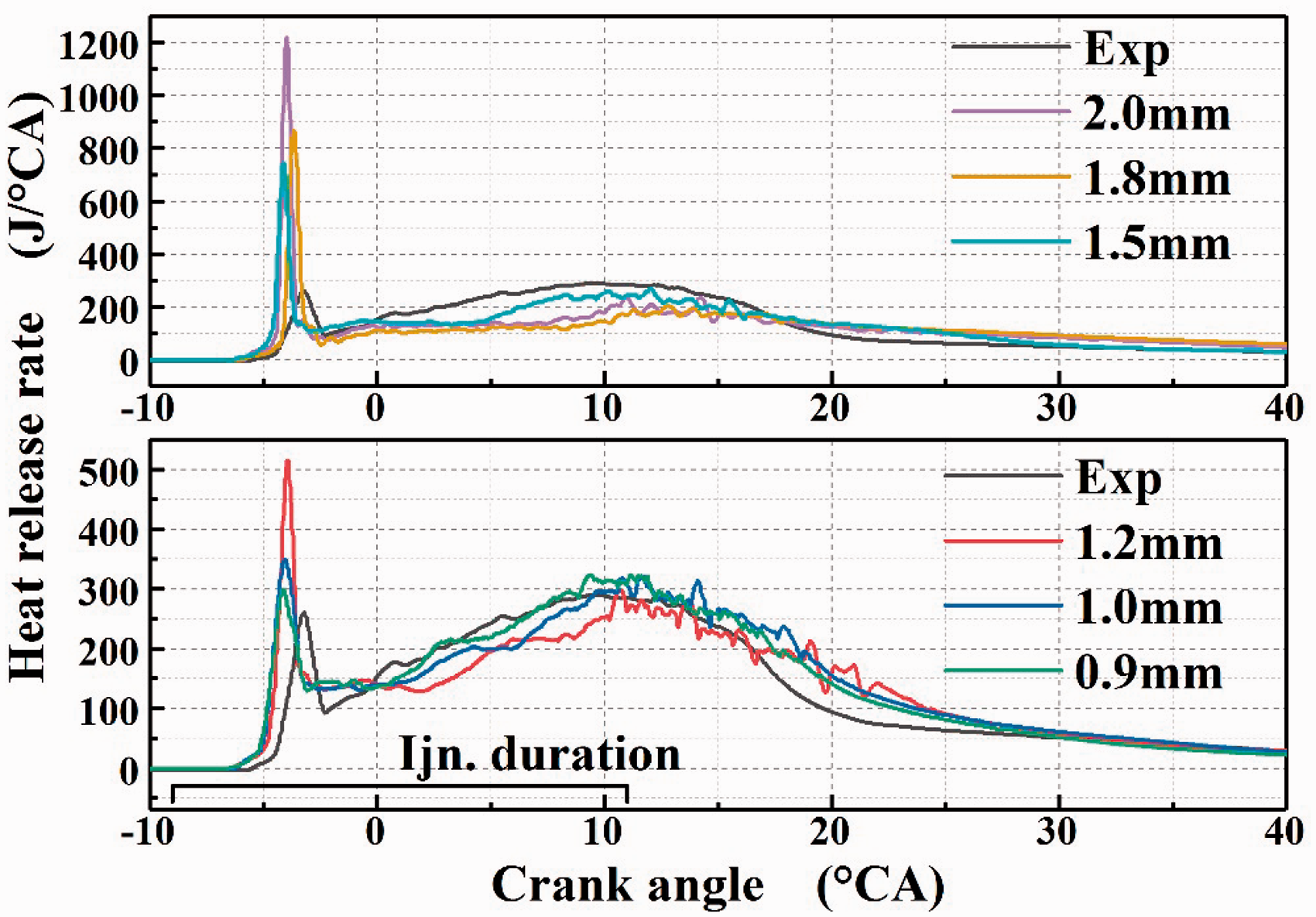

As shown in Figures 3–5, when the base grid size reaches 1 mm, the cylinder pressure, the HRR, and the NO x emission approach the experimental data. When the basic mesh size is further set to 0.9 mm, the simulation results barely change. The trend of the compression and expansion strokes shows basically no changes, which suggests that they are irrelevant to the choice over the base grid. Close to TDC, the most complex stage of physical and chemical processes, however, the result is affected significantly by base grid size. Therefore, in order to ensure accuracy of calculation and reduce the time for calculation. In this article, the base grid is set to 1.2 mm, while adaptive mesh refinement and fixed embedding are conducted to refine the grid near TDC. Throughout the calculation process, the 2-scales adaptive mesh refinement based on velocity and temperature gradient was performed in the solution region. Fixed embedding is applied to nozzle, piston, and cylinder head. Not only does such grid control approach ensure sufficient calculation accuracy and less computational time for the compression and expansion stroke, it also facilitated the capture of in-cylinder details during the spray and combustion process. With no consideration given to other factors like the combustion model, atomization model, and mechanism, such a grid strategy can achieve an excellent trade-off between simulation accuracy and calculation time.
Model calibration verification
Figures 6
The comparison of experiment and simulation pressure data. The comparison between calculation and measured HRR. The comparison of critical parameters.


Correction of HRR
There is a significant difference between the simulation results and the experimental data of HRR, especially the maximum value of the simulation results that is considerably higher compared to the experimental value, which is due to that the HRR obtained by the experimental method is affected by the heat transfer loss of the combustion chamber wall surface, and that this part of the heat transfer loss is neglected at the time of conventional CONVERGE simulation. The HRR of the combustion chamber wall as output of CONVERGE is shown in Figure 8
HRR of combustion chamber wall. Comparison of correction of HRR.

Results and discussion
A marine four-stroke diesel CFD model was applied to investigate the effect of different gravity on engine performance and emissions. When the engine worked, the state of the fluid in the cylinder showed a rapid change. It is difficult to observe the effect of gravity on engine performance and emission using the conventional experimental methods. CFD models can be applied to observe the details that are difficult to capture in traditional experiment, and to gain understanding as to the process of combustion and formation of emissions. 51
Figure 10
The comparison of cylinder pressure and HRR under different gravity. NO
x
emission under different gravity: (a and b) NO
x
emission and (c and d) soot emission. Comparison of parameters under different gravity. HRR: heat release rate.


The penetration length (PL) and Sauter mean diameter (SMD)
52
of the fuel are shown in Figures 12
The comparison of SMD under different gravity. The comparison of penetration length under different gravity.

Equivalent ratio, temperature, and NO
x
distribution cloud maps provide more support for the analysis of two-dimensional results. The equivalent ratios, temperatures, and NO
x
of contours at different crank angles (11–17°CA) are shown in Figures 14
The equivalent ratio in different crank angle under different gravity. The NO
x
in different crank angle under gravity. The temperature in different crank angle under different gravity.

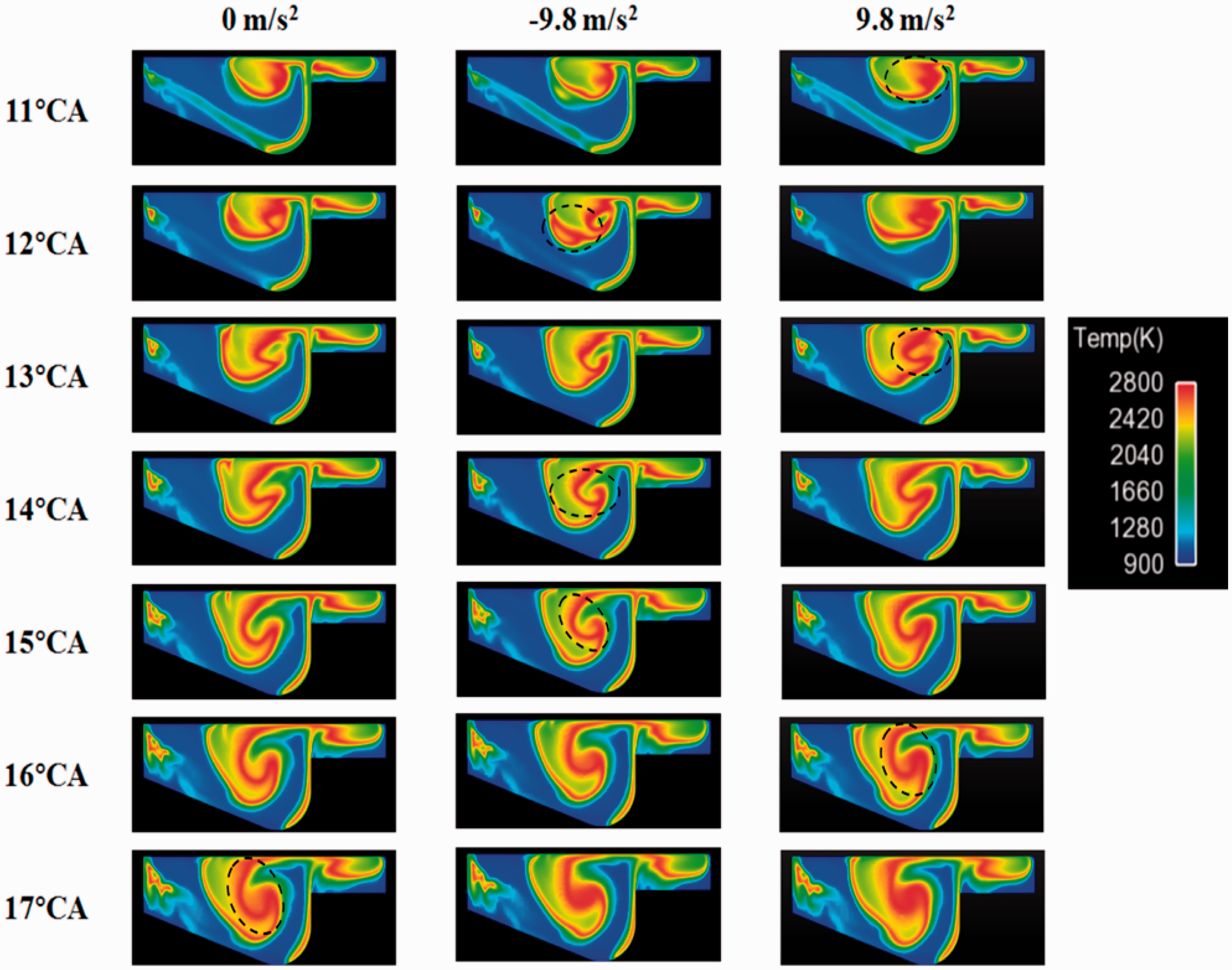
As shown in Figures 14–16, the difference in equivalence ratio, temperature, and NO x under different gravity conditions is self-evident. Figure 12 shows the effect of gravity on SMD. SMD bears an inverse proportionality to the evaporation rate of the fuel droplets. The effect of gravity on SMD is the root cause of the difference in equivalence ratio, temperature, and NO x distribution. Except for 0 m/s2, regardless of whether it is +9.8 or −9.8 m/s2, the existence of gravity causes the temperature in the core region of the cylinder to be higher, the distribution to be wider, and the NO x formation area to be expanded significantly.
Conclusion
In this article, experimental data are used to calibrate and validate the CFD model. Cylinder pressure, HRR, and NO
x
emissions are well consistent with experimental data. Based on this CFD model, the simulation results of three gravity models are analyzed. The effects of performance and emissions on four-stroke marine diesel engines are investigated, which leads to the following results:
The validity of the model has been confirmed. There is almost no error in the cylinder pressure, and the NO
x
emission error is 1.84%. The HRR in the absence of wall heat transfer is different from the experimental value by −10.58%, and the difference of HRR after consideration given to the wall heat dissipation value is 5.82% compared to the experimental value. In the process of CFD simulation, the correction of HRR is vitally important. Gravity conditions have little effect on HRR, and soot production is basically irrelevant to gravity. The effect of gravity on the NO
x
emissions of marine diesel engines can be maximized to 6.03%. The contours of temperature and NO
x
emission are different for different gravity. This can explain the different results for marine diesel engine emission characteristics under different gravity. Under three gravity models, there are differences observed in fuel atomization and spray. SMD fluctuates considerably after the process of combustion starts. This tends to be affected by the evaporation rate of the fuel droplets and in-cylinder temperature. PL is proportional to the gravity, which is because the natural convection almost disappears with the disappearance of gravity. Moreover, turbulence intensity in the cylinder will be reduced. Due to the difference in fuel spray and atomization, the equivalence ratio distribution is different which is the range of equivalence ratio distribution under non-gravity conditions is smaller. The temperature field remains distributed in line with the contour of the equivalence ratio. NO
x
is generated in high temperature and oxygen-rich regions, and the difference in temperature and equivalence ratio is also contributory to the difference in NO
x
distribution in the absence of gravity conditions.
Footnotes
Declaration of conflicting interests
The author(s) declared no potential conflicts of interest with respect to the research, authorship, and/or publication of this article.
Funding
The author(s) disclosed receipt of the following financial support for the research, authorship, and/or publication of this article: The authors thank Natural Science Foundation Committee of China (No. 51709163), China Postdoctoral Science Foundation (No. 2018T110382), Shanghai Sailing Program (No. 17YF1407500), for the financial support.
