




Abstract
Today’s society is becoming aware that a new economic model of production and consumption must take into account its environmental and social impact. Industries are under increasing pressure from stakeholders to be transparent in reporting the environmental and social impacts of their operations. In this context, sustainable manufacturing must minimize negative environmental impacts and consumption of energy and natural resources, while also being socially responsible and economically viable. That is why the sustainable manufacturing concept is gaining increasing attention both in the research community and in organizations, especially in the industrial sector. However, even today, there is a great diversity of interpretations and ideas associated with this term. Accordingly, this article first presents an overview of the main concepts related to sustainable manufacturing, and metrics to evaluate organizations’ sustainability performance, and then an outlook of current trends. Our work highlights the consistencies and inconsistencies in the research community related to the interpretations of sustainable manufacturing and Industry 4.0, as well as the lack of consensus about the true social impact of Industry 4.0. However, the positive ecological and economic impacts of sustainable manufacturing seem fairly widespread. In this way, sustainable manufacturing practices seem to be reinforced by initiatives within the fourth stage of industrialization – the so-called Industry 4.0 – which offers great opportunities for sustainable manufacturing, thanks to digital transformation.
Keywords
Introduction
Within the broad field of sustainability, the concept of sustainable manufacturing (SM) is gaining increasing attention in the research community and has moved beyond it to gain wide acceptance in business and especially in industry.
However, even today, there is a great diversity of interpretations and ideas associated with this term. The following subsections of this literature review paper explain the theoretical context of SM, the research gap identified, the aims and the approach adopted for this work.
Theoretical context
Governments, non-governmental organizations (NGOs), companies and academics have recognized since the 1970s that the unsustainability of our development model is one of the main problems faced in our society. The impacts of the relentless increase in natural resource consumption, the growth of industrialization activity and pollution, as well as the growth of human population are analysed by Robinson et al. 1 in the middle of that decade, applying several scenarios and focusing attention on global resources shortages.
The United Nations Brundtland Commission marked a significant milestone in discussions of unsustainability with the ‘Our Common Future’ report in 1987. 2 Indeed, the report postulated the first generally accepted definition of sustainable development and laid the groundwork for the drafting of principles and guidelines, such as ‘Sustainable Development Goals’ and ‘Agenda 21’, for its application.
In 2015, world leaders at the United Nations agreed to the 17 Sustainable Development Goals (SDGs) covering the three key dimensions of sustainable development: economic, environmental and social. 3 SM is related to quite a few of the 17 goals, especially SDG 9 and SDG 12. The ninth goal states that among their target indicators, industry, innovation and infrastructure need to ‘develop sustainable infrastructure and promote inclusive and sustainable industrialization’. On the other hand, the 12th goal, responsible consumption and production, has mostly sustainable targets. Among these, we can highlight a 10-year framework of programmes on sustainable consumption and production. This aims to achieve sustainable management and efficient use of natural resources by 2030, in addition to the reduction of waste generation through prevention, reduction, recycling and reuse. The SDGs apply not only to nations but also to organizations and companies. The benefits of aligning organizations with SDGs are obvious: reducing energy consumption means cost savings, decent jobs help retain staff, caring for safety and health at work reduces illness and absence, and providing continuous training increases quality and productivity. 4
In the manufacturing context, sustainability involves the transformation of resources into economically valuable goods by operating socially and environmentally responsible processes. Accordingly to Despeisse et al., 5 increasing scarcity and cost of material resources and energy, linked to waste management problems, has encouraged manufacturers to be more proactive in improving the environmental performance of their processes. In addition, consumers’ concern about the social and environmental impacts of industrial facilities has emerged as a further factor of pressure on manufacturers to change the current industrial growth model. 6
While manufacturing activities have been traditionally seen as incompatible with environmental concerns, they play a critical role in today’s socio-economic systems, creating jobs and contributing positively to the needs of the community for nutrition, healthcare, general well-being, renewable energy and green infrastructures, as Moldavska and Welo 7 state in their content-analysis-based literature review on SM. Due to the enormous diffusion of Lean Manufacturing (LM) philosophy in recent decades, we cannot forget the practices and metrics associated with this approach and their direct impact on SM. According to Womack et al., 8 LM aims to ‘use less of everything’ compared to mass production – that is, fewer materials, less labour, less investment in machines and tools, and less space, for example, to use fewer working hours to design and manufacture any specific product.
Some of the main drivers that lead companies to consider the three dimensions of sustainability (environment, economy and society) in their design, production, logistics and marketing are pressure from stakeholders, who are increasingly aware of sustainability and demand transparency; increasingly demanding legislation and standards in terms of sustainability; economic benefits derived from greater acceptance of products and cost savings due to lower resource consumption.9–11 Company managers attempt to improve sustainability performance by identifying, managing and measuring the factors and support structures that make it possible.12,13
Although the field of sustainability in business and industry, and more specifically SM, has drawn the attention of the scientific community in recent decades, there is a great diversity of interpretations and ideas associated with the concept of SM, even to the extent that many authors argue that there is not a sufficiently uniform and accepted understanding of SM and its associated sub-concepts.7,14,15 In 2010, the US Federal Trade Commission listed five concepts that would not be addressed in its ‘Green Guides’. The first one was the term ‘sustainable’, because there was no clear perception of the term among academics and professionals; the term cannot be easily measured, and there were no accepted standards with supportive assessment procedures to measure it. 16 Despite the growing interest and intensive use of concepts associated with sustainability, no uniformity has been achieved in their definition, but the number of interpretations has increased. 17 These shortcomings prevent organizations from giving rise to a clear image of SM, which is necessary to deploy the related practices and initiatives. An empirical study carried out by Ihlend and Roper 18 found as one of its more remarkable results that companies do not make any attempt to explicitly describe the idea of sustainability, so they pursue it with unclear strategies and policies.
Some authors, including Robinson, 19 argue that ‘sustainability should not be conceived as a single concept, nor even as a coherent set of concepts’. Instead, it should be seen as a ‘process of collective thinking’ that should seek to integrate eco-friendly, economic and social concerns into a long-term viewpoint for a firm. The concepts associated with sustainability are now more open to unique interpretations in the political, business and philosophical fields than in academia. Thus, sustainability, according to Robinson, is the ‘debate about the kind of world in which we want to live collectively now and in the future’.
In the last decade, Industry 4.0 has emerged as a new paradigm associated with SM, which focuses on the creation of industrial value. This new step follows the third industrial revolution that began in the early 1970s as an evolution of mass production supported by automation and control engineering, and to a lesser extent by the still-emerging information technology (IT) sector to achieve a high level of automation in manufacturing. 20 In 2001, Kagermann et al. 21 summarized the main principles of Industry 4.0 and characterized this new paradigm by the introduction of the Internet of Things (IoT) and Internet of Services into manufacturing. The Internet of Services enables smart factories with vertically and horizontally integrated production systems. Manufacturing processes have gained in flexibility, enabling individualized mass production supported by massive data exchange between intelligent manufacturing stations and cells with embedded mechatronics and sensors.22,23
Gap identification, aims and research approach
Although, in recent years, SM and Industry 4.0 have attracted the attention of the scientific community and industry, efforts are still lacking in the literature to analyse the state of the art of these two new paradigms, both in their theoretical development framework and in their implementation, as well as relationship between them.
Recent literature reviews in SM7,14,24–26 and reviews on Industry 4.022,27–31 have been taken into consideration for this study, in addition to some advances in research on opportunities of SM in Industry 4.0.20,32–37
However, new analysis approaches are in demand given the lack of consensus about what SM is and its scope, as well as the still little-explored field of research that addresses the evolution of the framework known as Industry 4.0 and its interrelation with the sustainability needed to promote advances in the field of manufacturing and production systems.
To provide new insights and a broader understanding of SM and Industry 4.0 phenomena, a qualitative and inductive content-analysis-based literature review has been conducted. Taking into account the influence that technological advances have in the evolution of this framework, this review provides a temporary perspective of evolution of the concepts and theories shaping this field of knowledge.
To compile the sample of papers, a review was carried out by keyword search in major academic databases. The first stage of the literature review identified relevant papers for inclusion in the analysis by using the combination of keywords (in title and abstracts) ‘sustainable manufacturing’ OR ‘Industry 4.0’ AND ‘review’ OR ‘framework’ in order to identify the main theoretical and literature review papers in both fields. Then, we considered ‘sustainable manufacturing’ AND ‘industry 4.0’ in order to identify the papers that address the interrelation between both approaches. Finally, in a second stage of the literature review, we narrowed the sample of papers using the combination ‘sustainable manufacturing’ AND ‘technic*’ OR ‘metrics’ OR ‘indicators’ in order to complement this mainly conceptual literature review with a practical approach.
Qualitative content analysis was concluded by grouping the papers into bundles of approaches related to the evolution of SM as a broad concept over time, beginning in the 1980s to the present. As a consequence, the structure of this article is organized as follows: ‘SM approaches over the time’ section describes the evolution of SM over time, and ‘The concept of SM: Definitions, frameworks and metrics’ section introduces the concepts, frameworks and metrics associated with SM. ‘Opportunities for manufacturing sustainability within Industry 4.0’ section outlines the opportunities and trends for SM, many of which fall within the broad concept of Industry 4.0. Finally, some conclusions are drawn in ‘Conclusion’ section.
SM approaches over the time
The first studies in SM were carried out under the environmental approach, thus beginning the research field of Environmentally Conscious Manufacturing (ECM). 38 Some of the main topics of this approach are source reduction, design for manufacturing and assembly or cradle-to-reincarnation concept. On its part, Sarkis identified product, process and technology as the main three dimensions to ECM strategies by proposing the well-known ‘Rs’ approach: reduction, remanufacturing, recycling and reuse.39,40
In this context, the aforementioned in previous section, Environmental Management System (EMS) is becoming popular among manufacturers as a tool for improving their manufacturing performance. The main benefits of these frameworks are allowing an organization to assess and control its significant impacts on the environment, reducing the risk of pollution incidents, ensuring compliance with relevant environmental legislation, and continually improving its processes and operations.41–43
Later, Gungor and Gupta 44 proposed an expanded model under the label of Environmentally Conscious Manufacturing and Product Recovery (ECMPRO). From this new approach, the environmental premise not only applies to the process of developing new products taking into account design, manufacture and distribution to the end consumer, but also covers the end-of-life management of the product after its useful life. Along the same lines, O’Brien 45 emphasizes the idea of cost-saving opportunities for companies that are proactive in improving the environmental performance of processes.
Other concepts related to SM are developed during the 1990s, such as ‘industrial ecology’,46,47 ‘ecological footprint’ 48 and cradle-to-cradle design. 49 And, in the early years of this century, the idea of extending the environmental approach to all stages of the product´s life cycle to address SM strategy leads to a new line of research at life cycle assessment (LCA) methodology. 50 As aforementioned in previous section, LCA provides a methodology for measuring environmental impacts on the resource consumption (e.g. materials, water, energy) and the waste generated (solid waste, air emissions). 51 Moreover, LCA facilitates its assessment throughout the entire Product Life Cycle (PLC), from raw materials acquisition through production ‘cradle to gate’, use, end-of-life recovery,52,53 and disposal ‘cradle to grave’.54,55
Furthermore, Jayal et al. 56 pointed out the need to consider a holistic approach in SM, addressing product, process and systems issues in an integrated framework. At the product level, Jawahir and Bradley 57 claimed that the initial ‘Rs’ approach supported by three principles, reduce, reuse and recycle, 58 must be extended to a broad vision of SM, considering three new activities that complemented the 6R strategy: reduce, reuse, recovery, redesign, remanufacture and recycle. 59 At the process level, Jawahir et al. 60 claimed the need to progress in process planning to reduce materials and energy consumption, emissions, waste, overstocks, and so on and to improve manufacturing technology. 61 Finally, at the system level, new approaches were pointed out, such as Product-Service Systems 62 and whole supply chain simultaneously with the design of products 63 and production systems.64,65 Into this last level, several authors address the supply chain management (SCM) and customer-oriented perspective in order to reduce the environmental impacts more efficiently.66–68
Thus, in the early years of this decade, SCM has established itself as a central approach to analysing SM issues. Many authors presented different visions of this approach towards the first period of this decade. Current trends in SM and the importance of considering the entire supply chain are discussed by Jayal et al. 56 in addition to highlighting the need to develop and apply predictive models capable of capturing the environmental impacts of products and processes. 69 Metta and Badurdeen 70 pointed out the importance of embedding product and processes design in supply chain design and defined hierarchical, multistage decision support models to evaluate alternative sustainable products design, taking into account the economic, environmental and social performance of associated supply chains. In a business as critical as fast fashion, leading companies 71 are mainly implementing traceability management systems, training and capacity building teams, and joint long-term planning programmes to improve SCM performance. Hutchins and Sutherland 72 proposed an approach for integrating sustainability issues into supply chain decision-making through a methodology that includes sustainability-related impacts of multiple suppliers. The basis for this approach can be found in early works about supplier selection strategies and the evaluation of impacts of improving the sustainability processes in suppliers, such as material selection, packaging or waste management, in supply chain environmental performance improvements. 73
In accordance with this new trend of promoting recycling and remanufacturing at the end of the useful life of products, it is essential to tackle the design of logistics strategies and new technological developments to recover products and reuse increasingly complex materials and components. It is clear that all of this is going to have a great impact on how the manufacturing systems and the supply chains themselves are going to evolve, both in their direct and inverse flow. This last idea was emphasized by Ilgin and Gupta, 24 pointing out that as remanufacturing and recycling levels increase, real changes will be promoted in product design, the development of inverse logistics and a re-envisioning of the entire PLC. Obviously, according to Hutchins, 74 all these proposals require significant rethinking of business models and, as a consequence, the consideration of the social dimension of sustainability, until now overlooked, in this new scenario.
As a result, the latest trends in the literature advocate addressing SM from the perspective of Triple Bottom Line (TBL). Rockström 75 proposes an integrated concept for sustainable development, outlining a framework for planetary boundaries. 76 According to this author, in this framework, planetary boundaries (e.g. climate change, biosphere integrity) are identified and quantified, preventing human activities from causing unacceptable environmental change. However, the author himself acknowledges that sustainable development can only be achieved if the balance of benefits and impacts of human activities takes into account the three dimensions of sustainability. Thus, the concept of SM according with Zhang and Haapala 77 is broadly consistent with the generally accepted one: ‘Sustainable manufacturing can be defined as the production of products in a way that minimizes environmental impacts and assumes the social responsibility of employees, the community and consumers throughout the life cycle of a product, while at the same time they achieve economic benefits’. As this concept does not quantify the objectives to be met in the three dimensions, the following concept provided by Giret et al. 25 provides a more pragmatic approach related to operational production planning: ‘The ideal sustainable manufacturing scheduling system does everything (maximum efficiency) without using anything (minimum use of means, i.e. maximum efficiency)’.
And to complete the most current vision of SM concept, Bonvoisin et al. 78 consider that such a model is only possible as a closed system with negative and positive environmental and social impacts in equilibrium: ‘sustainable manufacturing is the creation of discrete manufactured products that, by fulfilling their functionality throughout their life cycle, cause a manageable amount of impacts on the environment (nature and society) while offering economic and social value’.
Finally, a new stage of industrial development, labelled as Industry 4.0, opens a great opportunity for the creation of sustainable industrial value from the most comprehensive perspective of sustainability. 20 The creation of this sustainable industrial value is imperative given the growing global demand for consumer goods and the rate at which our planet is being subjected to degradation. For this reason, ‘Opportunities for manufacturing sustainability within Industry 4.0’ section of this article is focused on the role that Industry 4.0 – through the different enabling technologies – could play in the implementation of truly SM. Figure 1 summarizes the main SM approaches over the time.

Main sustainable manufacturing approaches over the time.
The concept of SM: definitions, frameworks and metrics
As described previously, the diversity of interpretations associated with the term of sustainability is the main cause of the difficulty in finding a standardized definition of SM that is accepted by the majority of the scientific community and organizations.
Main definitions observed in the literature
One of the most widespread definitions of sustainability is that found in the 1987 UN Brundtland Commission report: ‘Development which meets the needs of current generations without compromising the ability of future generations to meet their own needs’. This definition was subsequently used in various UN initiatives, such as the 2015 SDGs. However, despite its acceptance, this definition is not operational for the manufacturing area. A proposal with greater application to the field of manufacturing is made by Mihelcic et al.: 79 ‘design of human and industrial systems that ensure the use of natural resources and cycles by humanity without diminishing the quality of life due to losses in future economic opportunities or negative impacts on the human health, society or the environment’.
Despite the aforementioned lack of uniformity for a definition of SM, the content-analysis-based literature review conducted by Moldavska and Welo 7 points out that the definition of SM most widely adopted in the 189 articles analysed is the one provided by the US Department of Commerce in 2008: ‘the creation of products through processes that minimize both negative environmental impacts and consumption of energy and natural resources, being also safe for employees, communities, consumers and economically viable’. In addition to the concept of creating products or services, the content analysis identifies other definitions which consider various concepts such as, for example, approach, paradigm, ability, solution or technology, among others.
Environmental management system
The environmental dimension is increasingly taken into account by organizations. Accordingly, the most widely used method to enhance a firm’s environmental results in the short and medium term is the EMS. It can be defined as an agenda that enables any company to systematically monitor its main environmental impacts and to reduce the potential pollution risks according to the legislation and a goal of continuous improvement. Here, ISO14001 is the most generalized international standard defining the requirements for developing, implementing and maintaining an EMS. The standard is organizationally oriented and does not establish a set of quantitative targets for emission levels or specific methods of measuring those emissions. 14
Life cycle assessment
LCA is a method for environmental impact assessment, standardized due to the widespread use of ISO environmental standards (especially ISO 14040). An accepted definition of LCA is as follows: ‘[Life cycle assessment is] an environmental accounting and management approach that considers all aspects of resource use and environmental releases associated with an industrial system from cradle to grave’. 54 LCA can be used to systematically compare the environmental impacts of different SM alternatives and to help identify benefits and trade-offs among options. 80
In this sense, to widen the scope of PLC indicators, the LCA concept has evolved into Life Cycle Sustainability Assessment (LCSA), incorporating social and economic aspects in addition to environmental aspects when analysing the sustainability of PLCs (Kloepffer 2008). The definition of Zhang and Haapala, 77 for instance, incorporates the concept of LCSA in addition to the dimensions of TBL: ‘sustainable manufacturing can be defined as the manufacture of products in a way that minimizes environmental impacts and considers the social responsibility for employees, the community and consumers throughout the PLC of a product, while achieving economic profit’.
The PLC
The sustainability of manufactured products must be considered not only in the production or the use phase, since in many cases it is more critical to manage the product once it is no longer used, that is, ‘end of life’ management. In this way, the consideration of sustainability from a lifetime perspective leads us to the widespread concept of PLC. The main steps of the PLC are process design, production planning, manufacturing, assembly, consumer utilization, ultimate reuse, recycling and remanufacturing. As Zarte et al. 81 state, SM is only possible when organizations consider the whole PLC. Moreover, the subsequent post-uses of the product, thanks to the last steps of the PLC, lead to the concept of multiple life cycles. The 6R concept (Reduce, Reuse, Recycle, Recover, Redesign and Re-manufacture) is a key element in ensuring that the multiple life cycles lead us to the closed-loop flow. 57 In recent years, SM has often been associated with the closed-loop and the circular economy (CE) concepts. Closed-loop production systems seek efficiency in the flows of materials, components, energy and water throughout the successive life cycles of the product during multiple phases of use by encouraging reuse or, if not possible, remanufacturing. 20
Triple bottom line
Another widespread term in this field is the TBL established by Elkington. 82 The TBL broadens the dimensions (also known as pillars) with which sustainability must be considered: social, environmental, and economic. The TBL approach involves expanding the organization’s responsibilities, which in many cases are limited to the monetary questions of manufacturing, and obtaining benefits by respecting legality and complying with standards. However, the TBL approach adds those environmental and social responsibilities through additional performance indicators which complement the economic perspective. 83
The economic dimension is the simplest to understand since it is the one traditionally considered. To the purely economic perspective that contemplates the transformation of raw materials, labour and other resources into products and services at an adequate cost and time, the business management adds an organizational perspective that analyses the sequence of activities that increase the product value or service. In this way, in the SM field, it is more common to only adopt the economic perspective. 81
The social dimension seems to be more difficult to assimilate and understand, as measuring impacts and social responsibilities is a more challenging task for organizations, especially for SMEs. The concept of Corporate Social Responsibility (CSR) involves activities related to the social dimension, but can take on different meanings depending on context and interpretation. The most accepted definition is that of Carroll 26 which poses four kinds of social responsibilities of companies, seen as a pyramid: ‘Corporate social responsibility encompasses the economic, legal, ethical, and philanthropic expectations that society has of organizations at a given point in time’.
Figure 2 shows to a large extent the relationship between most of the defined concepts.

Sequence of SM process within 6R and TBL dimensions.
Frameworks and metrics
In order to properly manage companies, it is essential to assess the performance and verify the compliance with objectives in order to make appropriate strategic and operational decisions. Manufacturing is a mature business function, so companies measure economic performance systematically by accounting the costs of the resources consumed and the value added along the manufacturing process. In addition, this accounting can be extended to the entire supply chain. However, the measure of environmental and social performance is a complex task that involves assessing the impact of productive activity on sustainability, taking into account the materials, components, energy and other supplies consumed in the manufacturing processes. Furthermore, waste and emissions can also be inputs for other industrial or natural recycling systems that involve environmental, social and economic impact that must be evaluated. 14
To properly manage production systems or even the entire supply chain from a sustainability perspective, the performance must be evaluated with both qualitative and quantitative metrics 84 that facilitate the identification of connections and interactions between the three dimensions of sustainability. 60 These metrics for SM make it easier to make decisions when optimizing products, processes and systems designs.
There is general agreement on the need to use several indicators for each of the aspects of the SM. 85 The indicators will form part of the company’s reporting for internal purposes, among others: management control and decision-making, as well as to inform stakeholders. The choice of sustainability indicators and their practical application in decision-making are a challenge for the managers of the organizations. 81 Moreover, while the quantification of economic indicators is obvious, the quantification of environmental and social indicators, as aforementioned, is a challenge for managers. 86 On the contrary, the relative importance of indicators can vary greatly depending on the type of manufacturing or the phase of the PLC under consideration, and so this weighting must be carefully established and a sensitivity analysis must be used to determine how the results of sustainability reports vary according to weightings. 77
The sustainable performance evaluation can be carried out at product, process, factory or company level. Fiksel et al. 87 reviewed current practices of leading companies, and then proposed a product sustainability performance measurement framework that embodies three principles: separation of resource and value measures, explicit representation of the TBL and consideration of the LCA. Lu and Jawahir 88 proposed metrics and a calculation method to evaluate the process sustainability. Huang and Badurdeen 89 developed a framework to evaluate the sustainable performance at the company level integrating previous works on product and process sustainable performance indexes. A framework of operational sustainability indicators for industry covering the three dimensions of TBL was proposed by Labuschagne et al. 90 which has been applied for sustainability assessment in a variety of industries. 91
The work of Joung et al.92 identified 11 international frameworks of indicators for sustainable development, some of which include indicators that can be used to measure SM performance and are summarized below. The one created by the United Nations Division for Sustainable Development (UN-CSD) categorizes the metrics by the three dimensions of TBL and 14 themes with a total of 96 indicators, of which a large part are not oriented to manufacturing.
The Global Reporting Initiative (GRI) 93 is a voluntary reporting initiative for organizations and industrial companies. The GRI G4 reporting guidelines consist of 91 measure indicators which cover the three main dimensions of sustainability. The GRI reporting system makes it possible to analyse and monitor the organization’s sustainability performance. Some authors like Tiwari and Khan 94 propose SM or Industry 4.0 framework mapped with the appropriate TBL topic under the GRI.
The Dow Jones Sustainability Index (DJSI) evaluates the financial and sustainability performance of large companies of the Dow Jones Market Index. The results of the DJSI are used as criteria for investors and investment firms. The index assesses a company’s performance against 12 criteria, covering primarily the economic dimension, but also including some aspects of the environmental and social dimensions. 95
As explained in the previous section, organizations that implement an EMS following the ISO14001 standard do not find guidance in it for designing a set of environmental indicators and metrics. The guidelines for assessing environmental performance are provided by the ‘ISO 14031 Environmental Performance Evaluation (EPE)’. 96 According to this standard, ‘An EPE enables organizations to measure, evaluate and communicate their environmental performance using key performance indicators (KPIs), based on reliable and verifiable information’. ISO 14031 establishes three types of EPE indicators: (1) Management Performance Indicator (MPI) which provides information on management efforts to influence an organization’s environmental performance; (2) Operational Performance Indicator (OPI) which provides information on the environmental performance of an organization’s operations; and, finally, (3) Environmental Condition Indicator (ECI) which provides information on the condition of the local, regional, national or global environment.
The work of Despeisse et al. 5 analyses current SM practices through a review of the state-of-the-art academic literature and quality websites about SM. Among other findings of the work, the following can be highlighted: most metrics can be classified as lagging ‘a posteriori’ and only a few metrics can indicate future performance improvements. On the contrary, most of the metrics published by companies are OPIs, confirming what Starkey and Andersson 97 argue: mostly, sustainable development has been measured through processes, facilities and equipment performance.
One of the best-known indicator categorization frameworks is provided by the American National Institute of Standards and Technology (NIST). This system classifies sustainable indicators at multiple levels. The upper level is made up of five main categories: economic growth, environmental management, social welfare, technological advancement and performance management. These main categories are divided into several subcategories and sub-subcategories. On the basis of the NIST framework, Joung et al. 92 proposed a simplified classification of indicators discarding the last two categories as they are not directly related to the traditional dimensions of sustainability. The set of 17 indicators are grouped according to the three dimensions of the TBL. Table 1 shows a modified version with supplementary indicators to the set proposed by the above-mentioned author.
Modified categorization framework of sustainable indicators, adapted from Joung et al. 92

TBL: triple bottom line.
Kamble et al. 32 conducted a systematic literature review on concepts related with Industry 4.0 and human–machine interactions, machine–equipment interactions, operations and technologies. Based on this review, the cited authors propose a sustainable Industry 4.0 framework comprising three main components: technologies, process integration and sustainable outcomes (summarized in Table 2). The technologies facilitate the integration of processes, and these in turn provide sustainable outcomes.
Sustainable Industry 4.0 framework, adapted from Kamble et al. 32

The evaluation of sustainable performance at a product, process, factory or company level is not only a simple matter of selecting performance indicators; the implementation phase and subsequent monitoring are equally important. This difficulty in implementation has been identified by several authors.84,98,99
In addition to studying the theoretical frameworks, it would be of interest to determine through empirical studies the adoption of sustainability metrics by manufacturing companies, data which are otherwise scarce. Of special interest is the empirical work of small and medium manufacturing enterprises (SMEs) across Germany and Italy conducted by Trianni et al. 9 Their results show that the indicators most used by companies can be summarized in about 20 and are mostly focused on the economic dimension, while the social and environmental dimensions are often addressed in order to comply with legislation. The indicators are grouped into 12 categories according to the three dimensions of TBL. As Table 3 shows, the aforementioned importance given by companies to the economic dimension and a reasonable correspondence in social and environmental indicators with Table 1 can be appreciated:
Most-measured sustainability indicators, German and Italian SMEs, adapted from Trianni et al. 9
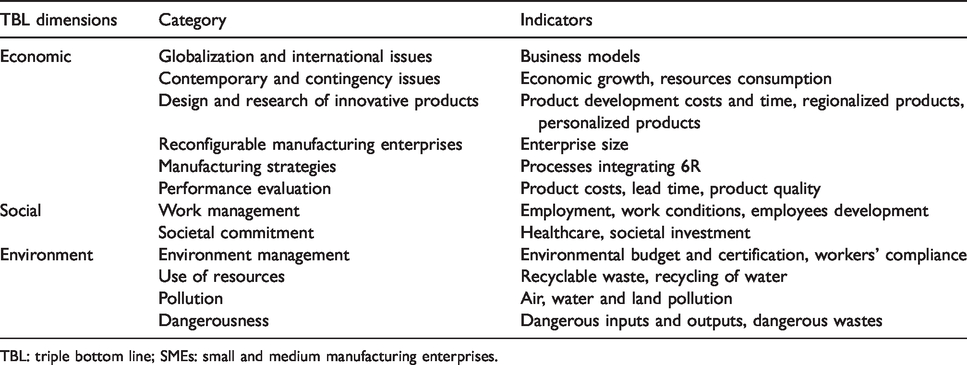
TBL: triple bottom line; SMEs: small and medium manufacturing enterprises.
Opportunities for manufacturing sustainability within Industry 4.0
Over the last few decades, we have witnessed a growing competitive pressure in world markets that has generated an obsessive concern within the manufacturing industries about ensuring higher quality, lower costs and shorter delivery times. 100 However, the increase in living standards, especially in developed countries, requires companies to go beyond the deployment of management philosophies based exclusively on efficiency. Environmental challenges and concern for sustainability are key issues that managers should consider when developing their strategy. Undoubtedly, the customer of today, concerned about his or her impact on the environment, has obliged companies to move towards new eco-efficient manufacturing models, maximizing the economic efficiency and sustainability of operations in the process, and creating an environment in which new technologies can assume an important role as catalysts for change.101,102
The industrial sector has traditionally seen an important trade-off between eco-friendly improvements and economic development. 101 As a matter of fact, it was not until 1987 – from the Brundtland Report – that the need for a more sustainable type of growth – ‘that meets the needs of the present without compromising future needs’ – began to be raised. This report and the following treaties to combat climate change aroused the environmental awareness of nations, consumers began requesting ‘environmentally friendly’ products, and companies started to perceive new business possibilities. 103 In this context, many researchers and practitioners have also posed the idea that ‘Industry 4.0’ can offer solutions to solve this eco-efficiency challenge.20,104,105
Industry 4.0 is a multi-field concept that was first introduced during the Hannover Fair event in 2011, symbolizing the start of the fourth industrial revolution.104,106 Industry 4.0 emphasizes consistent digitization and linking of all productive units in an interoperable environment. Accordingly, several technological areas underpin Industry 4.0: horizontal and vertical system integration, the Industrial Internet of Things (IoT), cybersecurity, big data analytics and additive manufacturing (AM), among others. 31 Undoubtedly, however, the key aspect from the environmental approach, is the possibility – offered by the ‘smart factory’ – of controlling and analysing in a transparent and integral way the life cycle of any product – both outside and within the manufacturing area.20,105
In fact, it is in this context that the concept of ‘circular economy’, whose primary focus is to reduce both the entry of virgin resources (e.g. water) and the production of wastes and pollution, is having a big impact, closing the ‘loops’ or economic and ecological flows of resources.107,108 Since the Industrial Revolution, the economic system that has been developing is linear, in which resources and raw materials are taken as unlimited. It is an economic model that moves on three basic principles: ‘obtain, use and discard’. However, due to the current concern for the environment, new eco-efficient manufacturing models that integrate sustainability at the centre of their activity are being promoted.102,109
It is in this context furthermore where the CE is presented as the logical alternative to the traditional linear model. It is also in this context that sustainability and ‘circularity of operations’ are clearly enhanced, thanks to the digitalization and interconnection of all production areas offered by Industry 4.0. 20 After all, the first step in transforming any current manufacturing environment into an ‘intelligent factory’ requires vertical and horizontal integration within the company, that is, integrating not only all the related production areas from different facilities, but also, in turn, the links with distributors and customers through information and communication technology (ICT) platforms and applications that integrate production and information systems, making global supply chains more transparent and helping to reduce the use of packaging, waste and energy. 101
In parallel, if all these data are transformed into useful information, it will be the key to decision-making, particularly from the environmental and sustainability perspective. Therefore, the arrival of Industry 4.0 can be understood as a key facilitator in the efficiency of industrial processes, as well as in the optimization of CE models. Thus, it seems logical to think that Industry 4.0 can help to meet targets in the manufacturing, economic and ecological fields, and face social challenges according to the TBL within sustainability. 33
First, with respect to the ecological part, there are several authors who assure us that Industry 4.0 helps to reduce the generation of waste through its recycling and energy use. 33 For example, the incorporation of different types of sensors throughout the life cycle of products not only allows for greater transparency of operations but also provides intelligence to the processes so that, in turn, they can develop specific performance criteria to mitigate the negative effects on the environment without damaging competitiveness through the possibility of simulation offered by new technologies.110,111 In parallel, this type of system also allows the losses generated throughout the entire process to be reduced (e.g. in the food industry), thanks to this greater transparency throughout the supply chain. 112 Similarly, the design of new products directly benefits from the interconnection of data, favouring intelligent programming of tasks and processes, as well as efficient management of energy consumption for example.112,113
From the economic viewpoint, the interconnection of processes permitted by technologies associated with Industry 4.0 will directly or indirectly provoke an increase of performance indicators such as, for example, efficiency and responsiveness. As stated by Kiel et al., 34 ‘In general, the digitization and interconnection of industrial processes intended by Industry 4.0 is facilitated by data analytics, machine learning, and artificial intelligence, leading to potentials in all three dimensions of Sustainability’. On the contrary, from a technological perspective, research should be focused on the development of new equipment that reduces global impact through an efficient use of energy and resources. The possible strategies are many: process hybridization, right-sizing of facilities, utilization of new and cleaner technologies, etc. In fact, the use of specific technologies such as, for example, 3D printing, can help diminish the waste generation associated with both manufacturing and maintenance activities, or even contribute directly to improving productivity.104,114 It is also worth mentioning the generation of new business models which focus on the use of intelligent data that allows both new products and sustainable services – such as joint ventures for the exchange of by-products between different sectors – to be offered for example.35,115
Finally, regarding the social dimension, there is currently no consensus in the academic and informative literature about the true impact of Industry 4.0 on the number of workers in the industrial field in general, and the area of manufacturing in particular.33,34 While it is true that, in general, the majority position defends a negative impact for those simpler tasks, other typical activities in any manufacturing environment (e.g. analysis, cooperation, creativity) will continue to be carried out by human workers. 33 Even so, what seems clear is that, even if these tasks remain, they will not survive as we know them today. New profiles of workers with specific skills for these positions are immediately required, where manual work is reduced in favour of cognitive and analytical skills, and fundamentally linked to information technologies and data analysis.34,111
Delving into these three levels, Table 4 specifically describes the opportunities offered by the some of the main Industry 4.0 technologies (AM, simulation, virtualization and cloud computing, among others) for SM on the environmental, social and economic dimensions.
Impact of Industry 4.0 technologies on SM.

SM: sustainable manufacturing.
Thus, while the main trigger for a necessary evolution to a more CE seems to be the behaviour of consumers, technological advances are what will allow the model to change. In this way, Industry 4.0 enables the adoption of circular strategies in a more efficient way, thanks to the connectivity and intelligence it provides and the emergence of digital facilitators. However, this whole process of digital transformation and the application of technologies related with Industry 4.0 in general present significant challenges related to two fundamental issues: the high investments required, and on the contrary, the uncertain profitability that still surrounds these types of projects.33,129
In view of the above, Industry 4.0 can provide important environmental, economic and social prosperity under the sustainability concept of the ‘Triple Bottom Line’. For this to be carried out correctly, however, companies must take into account that the process of digital transformation entails certain risks, particularly for SMEs, which must be explicitly considered for each project and from the beginning to maximize the chances of success and generate sustainable competitive advantages for organizations.
Conclusion
SM is a broad concept that is gaining increasing attention in the research community and has moved beyond academia to gain a wide acceptance in organizations, especially in the industrial sector. Nevertheless, there is still a great diversity of interpretations and ideas associated with the concept of SM to the extent that many authors argue that there is not a sufficiently uniform and accepted understanding of SM or its associated sub-concepts. Our work attempts to provide some light in this regard and introduces, furthermore, the analysis of a potential and important catalyst for SM processes in the medium term: Industry 4.0.
In the last decade, Industry 4.0 has emerged as a new paradigm associated with the SM that focuses on industrial value creation. This new development offers significant opportunities for the realization of SM through the use of ICT infrastructure, IIoT, big-data, new manufacturing technologies, human–machine and machine-to-machine interaction.
This article addresses SM opportunities within Industry 4.0 and aims to contribute to the clarification of these broad concepts. Attention is paid to the impacts not only on production systems, but also on management, the economy, the environment and society in a broader sense. Several theoretical and empirical frameworks of SM metrics have been identified. The empirical studies show that the indicators most used by productive companies can be summarized in about 20 and are mostly focused on the economic dimension, while the social and environmental dimensions often seem to be addressed with the sole goal of complying with legal aspects.
Our work highlights the consistencies and inconsistencies in the research community related to the interpretations of SM and Industry 4.0, and the lack of consensus about the true impact of Industry 4.0 regarding the social dimension. On the contrary, the positive impact on the ecological and economic dimensions seems to be fairly widespread. Finally, the opportunities offered by the some of the main Industry 4.0 technologies for SM on the environmental, social and economic dimensions are summarized.
The need for additional research on the effects of the emerging technological field of Industry 4.0 on the SM is evident. Future works could also extend the analysis through empirical studies or case studies, and into other frameworks beyond the industrial field. Similarly, it may be interesting to introduce the development of standards or metrics of performance for Industry 4.0, since currently the only specific metrics are aimed at evaluating the degree of implementation and performance of main technologies 4.0, but there is no consensus among researchers about comprehensive performance indicators in this area. All of these opportunities can offer supplementary comprehension into this developing field of connections among sustainability and Industry 4.0. Clearly, this field of research has plentiful space to grow in terms of study opportunities.
Footnotes
Handling Editor: James Baldwin
Declaration of conflicting interests
The author(s) declared no potential conflicts of interest with respect to the research, authorship and/or publication of this article.
Funding
The author(s) received no financial support for the research, authorship and/or publication of this article.
