



Abstract
Given that the cable harness wiring quality (CHWQ) of complex mechatronic products is affected by multiple factors and it is difficult to solve the resulting control problems, this paper proposes a quality prediction method for cable harness wiring using extension theory and a backpropagation (BP) neural network. First, a quality prediction framework is designed based on the factors influencing the composition and analysis of the CHWQ. Second, we establish a quality evaluation index system based on five aspects and design a first-level factor set and a second-level factor set. Based on the single factor index for various parameters and evaluation of data after dimensionless parameter processing, we use extension theory and the entropy weight method to determine the membership matrix and the fuzzy weight vector for the first-level evaluation. Additionally, the single factor and the synthetic fuzzy weight vector are determined using the entropy weight method and the analytic hierarchy process (AHP), respectively, and quality grade evaluation based on the fuzzy synthetic evaluation (FSE) method is completed. Finally, we use a three-layer feedforward neural network to predict the quality status of a specific phased array radar system. The results demonstrate that the proposed method can produce increased prediction accuracy.
Keywords
Introduction
A cable harness generally consists of cables, connectors and sheaths. 1 Cable harnesses are widely used in complex mechatronic products to connect different items of electronic equipment and must therefore meet specific electrical and mechanical requirements.1–3 As an energy and signal transmission medium, the cable harness is playing an increasingly important role in complex mechatronic products for applications such as airplanes, satellites, radar and shipping equipment. However, it is challenging for designers to improve cable harness quality while also accommodating the following wide range of strict constraints: 3
The wiring space for the cable harness is very small within the narrow assembly spaces of these complex mechatronic products;
The cable harness wiring must have sufficient electromagnetic compatibility to prevent production of electromagnetic interference;
The wiring path of the cable harness must be well designed to avoid self-collisions and prevent collisions between different cable harnesses;
Some of these products have to work in complex environments with conditions such as high humidity and high operating temperatures;
The feasibility of wiring the cable harness may decrease because of the complexity of these products.
The quality of cable harness wiring is an important factor in comprehensive assessment of the performance and reliability of products4–6 and is affected by multiple factors but the research on wiring quality trend analysis is comparatively inadequate. This paper proposes a quality prediction and control method for cable harness wiring that uses extension theory and a backpropagation (BP) neural network. The proposed approach involves the following steps and contributions. (1) A quality prediction framework is designed for cable harness wiring based on the factors influencing the composition and analysis of the cable harness wiring quality (CHWQ). The research in this article basically revolves around this framework. (2) Based on the introduction of extension theory, the membership matrixes for the assessment are established using extension theory and the entropy weight method. These matrixes are realized to establish quality grade assessment of the cable harness wiring based on fuzzy synthetic evaluation (FSE) in combination with the analytic hierarchy process (AHP) method. (3) To predict the wiring quality, this paper uses a BP neural network as a prediction method by using the sequence values from the FSE as the inputs to the neural network. Some specific CHWQ control measures are then given upon analysis of the prediction results.
The rest of this paper is organized as follows. Section 2 briefly reviews some of the existing work related to this research. Factors influencing the composition and analysis of the CHWQ are presented in Section 3. Section 4 illustrates the CHWQ prediction method in detail. Section 5 presents a case study based on the proposed approach and provides specific quality control measures. Finally, conclusions are drawn from the research in Section 6.
State of the art
This section provides a brief background description of the relevant work in the fields of wiring technology and quality prediction and control methods. To date, several studies have focused on routing and assembly planning for cable harnesses. Ritchie et al.7,8 studied the effectiveness of the use of immersive virtual reality in the design and routing of cable harnesses for enhancement of the expertise of the cable harness designer and also developed a new virtual cable design system for cable harness assemblies. Conru 9 described a system for automatic routing of cable harnesses in 3D environments that used a pair of genetic algorithms. The cable harness routing problem was decomposed into two problems: generation of a harness configuration (topology) and routing of the harness in the environment. Van der Velden et al. 10 discussed the development of an intelligent routing system to automate the design of electrical wiring harnesses and pipes in aircraft. Hermansson et al. 11 presented a novel method to automatically plan and determine smooth and collision-free mounting of connectors in a wiring harness installation. The research described above has provided some meaningful methods for cable harness design and assembly. However, these researchers rarely concentrated on analysis of the assembly quality trends and early wiring quality prediction and warnings for the cable harness.
Mazzuchi et al. 12 discussed the results of an actual experiment in which the paired-comparison technique for expert judgment was used to develop a relationship for the wire failure probability as a function of the influential factors in an aircraft environment. To control and evaluate the quality of the Cu wire bonding process, Tsai proposed an adaptive diagnosis system using grey relational analysis (GRA) and a neurofuzzy technique 13 . Ertuğrul and Güneş 14 used fuzzy quality control charts to evaluate product quality. Hou et al. 15 proposed a fuzzy quality control chart to monitor the product quality characteristics or the quality parameters of manufacturing processes using traditional control charts. With the aim of resolving the difficulties in the evaluation and provision of early warning of quality loss in key assembly process materials for complex electromechanical products, Yin et al. 16 proposed an evaluation and early warning method that integrated real-time field acquisition of abnormal quality information with a comprehensive evaluation and early warning of the quality loss.
From the analysis above, although some researchers have made meaningful contributions on early warning and control of quality, most of the previous research was conducted for rigid structures rather than for a flexible cable harness. The quality prediction and control processes for cable harness wiring are often more difficult to perform than those for rigid structures because of the flexible characteristics of the cable harness and the complexity of its installation. This paper is intended to provide a new quality prediction method for flexible cable harness wiring.
Composition and analysis of influencing factors
The factors that influence the quality of cable harness wiring have complex and changeable characteristics. When a particular phased array radar device (i.e. the antenna array device) is taken as an example, the factors influencing the quality mainly include:
Complex structure with narrow and small wiring space. The complete antenna array device contains a large number of electronic components, e.g., power modules, manipulation modules, display modules, cable harness plug-in cards, fixed brackets and fixed convex platforms. These internal electronic parts and components cause the available wiring space to be irregular and narrow.
Flexible features, leading to easily changed shape and location. Unlike rigid bodies, the flexible features of cable harnesses mean that their deformation and spatial positioning can change easily under the influence of the drag force that occurs during the wiring process. A deformed cable harness will present wriggling, winding, and snarling behavior, along with other complex geometries. It is thus difficult to determine the spatial attitude, direction, length, and location relationships for the cable harness.
Large quantities, wide component varieties and complex installation processes. The number of cable harnesses contained in a complete antenna array device can reach a high total value in the thousands. In addition, the different types of cable harness required (e.g. single core, multicore, flat; rigid, semi-rigid, flexible; low frequency, intermediate frequency, high frequency; large wire diameter corners, small wire diameter corners) will have different operating characteristics. The installation processes for these cable harnesses are then much more complex.
More detected contents, large quantities of information, and deviations existing in the data processing. The on-line testing and detection of the cable harness involves a number of processes, e.g. conduction testing, resistance capacitance testing, circuit breaker testing, insulation testing, and compression testing. This can lead to large quantities of information or data being acquired. The results may also show inevitable deviations from the required values when the data are processed.
Despite the analysis above, the quality of the cable harness wiring can be affected by multiple factors. In addition to the four main factors listed above, the CHWQ can also be affected by the operating proficiency of the wiring workers, the degree of wiring requirements from an overall viewpoint, and the workshop’s environmental conditions (where the temperature and humidity are extremely important for sophisticated precision equipment).
Quality prediction method
Framework of the method
To enhance the quality of cable harness wiring for complex mechatronic products, a quality prediction framework is designed for cable harness wiring that is illustrated in Figure 1.
Phase I: Preparations before cable harness wiring. This phase mainly involves preparation of the resources required to perform the wiring process. Adequate preparations of the various resources described above provide a good foundation for smooth development of the subsequent wiring works.
Phase II: Wiring by experienced workers. In this phase, the wiring workers use the resources offered in Phase I to complete the wiring task based on their accumulated experience. During the wiring process, the workers should comply with certain wiring specifications, such as cable harness selection principles, classification of the electrical components, and fixed cable harness wiring methods.
Phase III: Quality assessment after the cable harness wiring procedure. After wiring, the product cannot be used immediately. In this phase, a variety of test instruments are required to test the cable harness on-line and obtain multiple types of working state data. Using data processing techniques, the required indicators are extracted for use in the quality assessment. In addition, the FSE method is used to complete the wiring quality assessment procedure. This phase is the core content of this paper and will be explained in greater detail in the following.
Phase IV: Quality prediction. During this phase, the results acquired from the FSE method in Phase III are used as the input to the neural network training model. The trained neural network model is then used to predict the new FSE value for the phased array radar cable harness wiring. Based on the predicted FSE value, the quality grade of the cable harness wiring can then be determined. Finally, decision recommendations are made based on the quality grade.
Phase V: Corresponding corrective action program based on the decision recommendations. Other possible problems can be determined via judgment of the wiring status of the equipment as a whole (including the extension modules). The wiring requirements are met if no problems exist (meaning that the wiring quality is “Good”); otherwise, professional knowledge is used to evaluate the seriousness of any problems that do exist according to the results (meaning that the wiring quality is “Fine”, “Ordinary” or “Poor”).
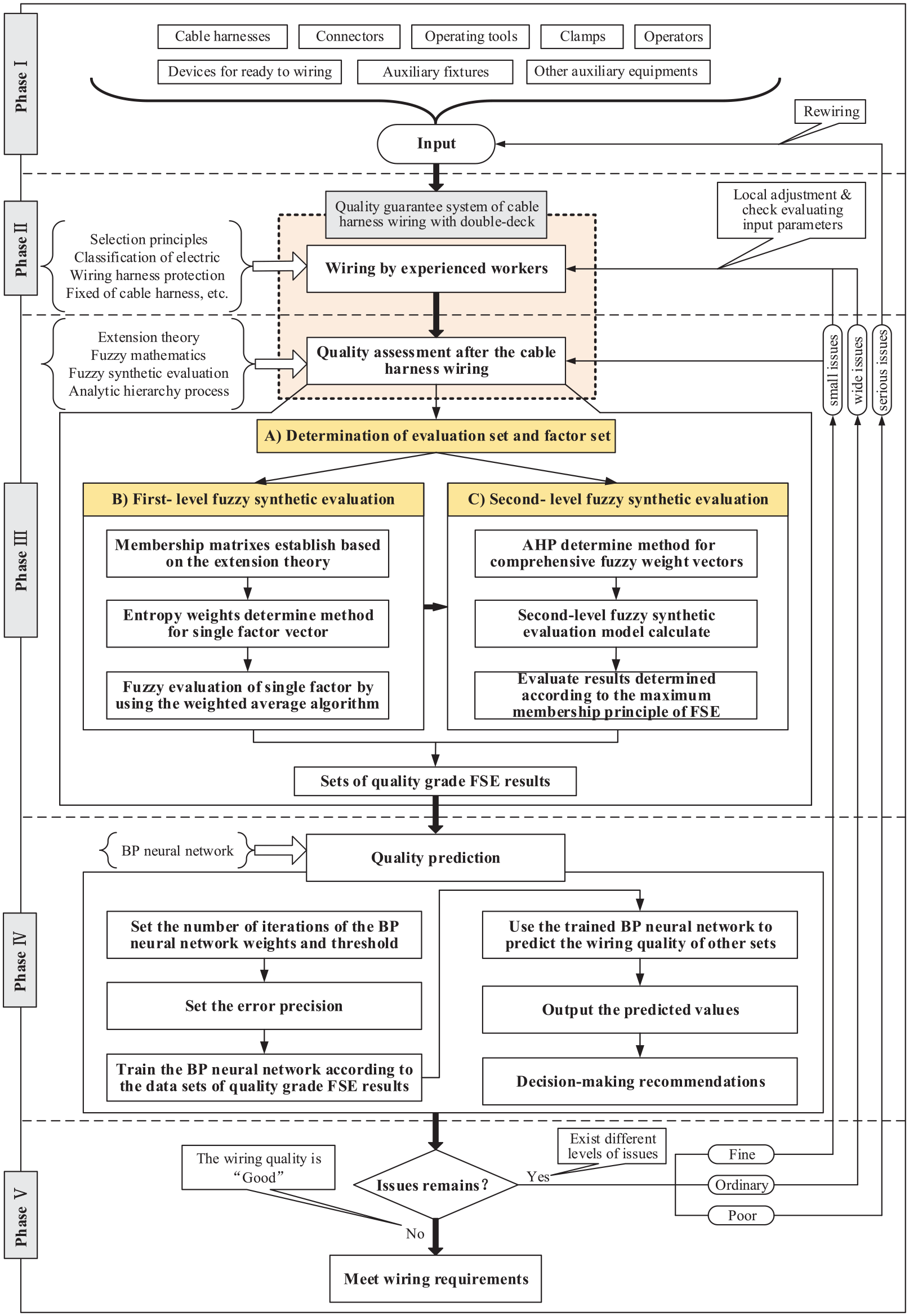
Quality prediction framework for cable harness wiring.
Quality prediction method
Extension theory
Extension theory is a new type of knowledge system based on the concepts of matter elements and extension sets and was proposed by the Chinese researcher Cai in 1983. 17 In a defined universe, the associated function value can quantitatively describe the changes in the relationships between each multi-dimensional matter element and each extension set and, on the basis of a correlation degree analysis, can distinguish different levels and allow upward range expansion to be realized.18,19 Extension theory can deal with any incompatibility issues and can express the features of the objective by building a matter element evaluation model.17,20 Extension theory has been widely used in various fields.18,20–22 In this paper, we use the extension theory method to study the wiring quality assessment.
Fuzzy synthetic evaluation model
In the FSE method, the weighted vector determines the classification via a matrix operation and the fuzzy evaluation matrix can be established after all individual membership functions of the evaluated factors have been determined. 23 Figure 2 shows the FSE model of the CHWQ.
A) Determination of the evaluation set and the factor set

FSE model of the CHWQ.
To evaluate the quality grade of the cable harness wiring for complex mechatronic products, we establish an evaluation set
Quality grade descriptions for the cable harness wiring.

In this paper, on the basis of the characteristics of the complex mechatronic products and the factors influencing the composition and the quality of the wiring, we establish a quality evaluation index system for cable harness wiring based on the following five aspects: (a) mechanical performance; (b) electrical performance; (c) wiring process; (d) spatial arrangement; and (e) environmental status. The first-level factor set is
Mechanical performance factors (
Electrical performance factors (
Wiring process factors (
Spatial arrangement factors (
Environmental status factors (
B) First-level fuzzy synthetic evaluation
a. Establishment of membership matrixes

Quality grade evaluation factor set for cable harness wiring.
Before carrying out the first-level FSE (single factor fuzzy evaluation) for the second-level factor set
Extension theory primarily contains a matter element and an extension set 22 . The matter element researches the models and their transformations and the nature of the matter can then be represented easily. In the designed correlation functions, the extension set can express the degree of correlation between two matter elements and also serves as the quantitative index of the extension theory 22 . Based on the method described above, the degree of membership of the evaluation set can be determined more comprehensively for each factor. To describe this, we use a matter element in this paper, and the ordered triad of this element can be expressed as:22,24

where
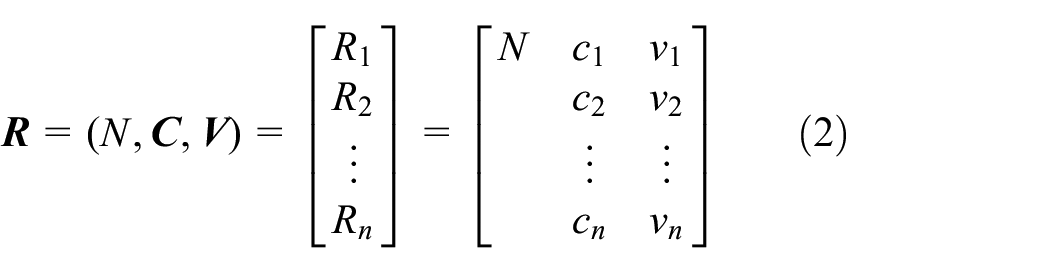
where
The steps for determination of the membership matrixes based on extension theory are detailed as follows.
Step 1: Dimensionless parameters
The dimensionality of each parameter in the factor set is different and incommensurability issues thus exist, so it is necessary to perform dimensionless processing of the various parameters and remove the dimensional effects among the indicators through a numerical transformation. The dimensionless parameters can be calculated using equation (3) as follows:

where
Step 2: Confirming the classical field
Equation (4) is used to express the classical field as follows:

where
Step 3: Confirming the joint field
Equation (5) is used to express the joint field as follows:

where
Step 4: Confirming the evaluated matter element
To evaluate the CHWQ grade, we can represent the data sets on the basis of the matter element, and the evaluated matter element
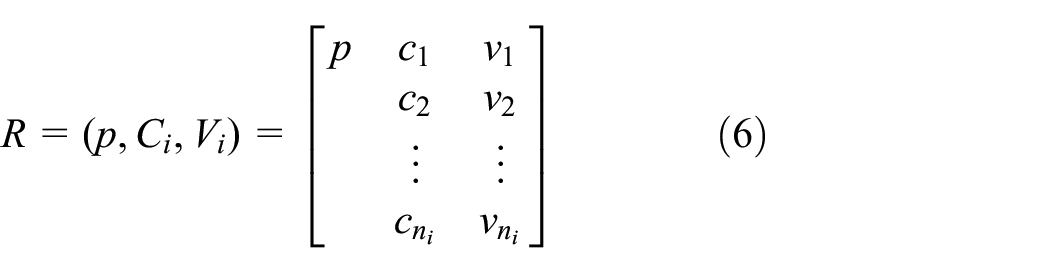
where
Step 5: Confirming the correlative degree of each factor index
The correlative degree of each factor index can be expressed as:

where


The membership matrix of the first-level FSE

b. Entropy weight determination method for single factor vector
The weight reflects the degree of importance of the various parameters on the evaluation target and is related directly to the credibility of the evaluation results. Determination of the weight is a core problem when performing a comprehensive evaluation. However, when applying the FSE method to the CHWQ assessment, the scientific features of the weight value usually have some ambiguity and some important information is lost when the method emphasizes extreme value action. 26 Additionally, the weight value often includes indicator information and there is no relationship among the assessment objects 26 . Therefore, the information entropy has been introduced to solve the problems described above. The information entropy can measure the amount of valuable information based on the adopted data. 26 For the same indicator, the entropy value is determined by whether the difference between the evaluation objects is large or small. If the difference is large, then the entropy is small, and the indicator’s weight should be set to be relatively large in this case. 27 In contrasting case where the entropy is large, the weight would be small. Therefore, use of the theory of entropy to determine the weight is reasonable. 27
The steps of the entropy weight determination method for the single factor fuzzy weight vectors are described as follows.
Step 1: Normalized processing of the judgment matrix
Assuming that there are
Step 2: Definition of the entropy
Let

in which
Step 3: Definition of the weight of entropy
The weight of entropy of the

where
Step 4: Definition of the first-level fuzzy weight vector
Using the weight of entropy

c. Fuzzy evaluation of single factor
On the basis of the preceding calculation steps, i.e. Steps 1 to 4, we use the weighted average algorithm to synthesize the arithmetic for the membership matrix

C) Second-level fuzzy synthetic evaluation
a. AHP determination method for the comprehensive fuzzy weight vectors
The AHP method is mainly used to solve multiple criteria decision issues in which the criteria are compared pair-wise based on their importance.
28
The steps by which AHP is used to determine the synthetic fuzzy weight vectors
Step 1: Construct the judgment matrixes
For the first-level factor set of the hierarchy structure model (i.e. the quality grade evaluation factor set for the cable harness wiring)

Step 2: Calculate the product of each row element for the judgment matrix

Step 3: Calculate the

Step 4: Perform normalization processing of the vector

Step 5: Calculate the maximum characteristic root

where
Step 6: Perform a consistency inspection of the judgment matrix
The value

where
Random consistency index (RI) values.

In general, the comparison matrix
b. Second-level FSE model
The first-level fuzzy evaluation results constitute the membership matrix

Quality prediction based on BP neural network
A) BP neural network model
It has been proved in theory that, when the transfer function of the hidden layer neurons is a bounded monotonically increasing continuous function, the three layers of a feedforward neural network can approximate a differentiable function with arbitrary precision, so this model is selected for the three-layer BP neural network model to forecast the CHWQ. The model consists of an input layer, a hidden layer and an output layer, and is shown in Figure 4.
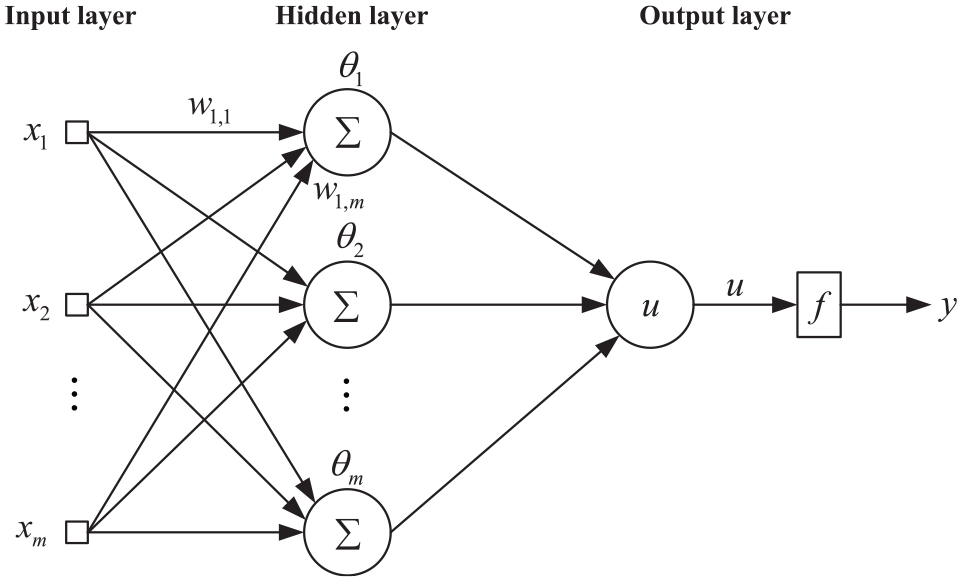
BP neural network model.
Neurons are necessary for prediction of the quality of the cable harness wiring when using the BP neural network approach. When the inputs

where
Before the BP neural network model can be applied, the input and output variables must first be determined. In this paper, the input variables are specified as the previous five evaluation values of the quality grades of the FSE. The number of hidden layer nodes determines the network complexity and the nonlinear processing ability; the node number is generally determined based on experience gained from previous designs in combination with practical problems to be solved in tests, where too many or too few nodes will affect the network performance of the model. The number of hidden layer nodes can be obtained within an approximate range using the following empirical formula: 31

where

BP neural network model for quality prediction of cable harness wiring.
Here, the continuously differentiable log-sigmoid function, which we used as the activation function, can be defined as shown in equation (24):

In practical engineering applications of the BP neural network method, the numerical optimization performances of the training algorithms used are highly important. 32 Different BP neural networks can be specified in terms of their error backpropagation algorithm; in this paper, the Levenberg–Marquardt (LM) algorithm is adopted and is used to solve for the second derivative of the error to judge the error rate of decline, to adjust the learning rate adaptively and to train the neural network to realize rapid convergence33–35.
B) Network weight and threshold
Let the input vector be


Learning is performed for the

Each weight is then adjusted and the computation formula for the weight adjustment is given as follows:


where the number of iterations is
C) Quality prediction of cable harness wiring
The trained BP neural network can now be used to predict the FSE value of the CHWQ. On the basis of the previous discussion and analysis, the process for quality prediction of the cable harness wiring using the BP neural network method can be expressed as follows. 36
Step 1. Obtain the training samples via the FSE method for the CHWQ.
Step 2. Determine the forecast samples using a specific problem.
Step 3. Determine the network structure, the training algorithm and the training objects, and then use the training samples to train the neural network.
Step 4. Use the trained neural network structure to complete the quality forecast.
Case study
Quality prediction
To introduce the FSE and perform quality prediction of the cable harness wiring, we use the cable harness wiring of a specific phased array radar system as an example. An extension module of the phased array radar is shown in Figure 6. In practical engineering, the wiring quality will affect the tactical technique index of the phased array radar directly. In phased array radar antenna design, the design of the antenna array wiring is a difficult process. If the wiring scheme is unreasonable, then the internal equipment installation and adjustment properties of the antenna array will be seriously affected and stress may appear around the cable harness junction. As a result, poor contact, short circuits, open circuits and other faults may occur if the stress is not eliminated, and the normal operation of the equipment would ultimately be affected. Figure 7 shows the topology of a cable harness structure.
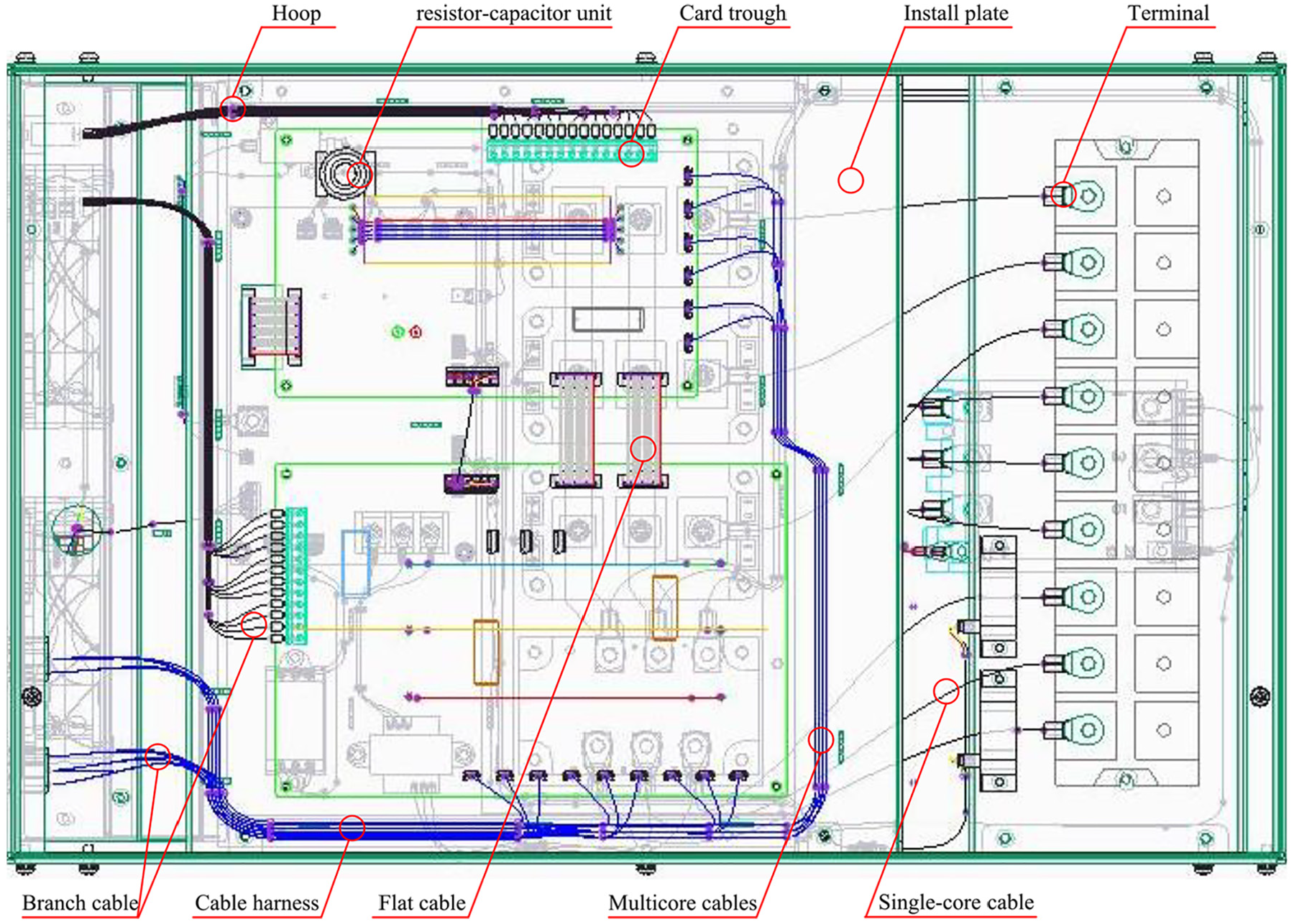
Extension module of phased array radar.

Topology of a cable harness structure.
We collected a set of wiring quality status data for phased array radar from the Nanjing Research Institute of Electronics Technology. The method proposed in this paper was then used to determine the membership degree of each factor relative to the evaluation set
Single-factor index and FSE of mechanical performance.

FSE: fuzzy synthetic evaluation.
Single-factor index and FSE of electrical performance.

FSE: fuzzy synthetic evaluation.
Single-factor index and FSE of wiring process.

FSE: fuzzy synthetic evaluation.
Single-factor index and FSE of spatial arrangement.

FSE: fuzzy synthetic evaluation.
Single-factor index and FSE of environmental status.
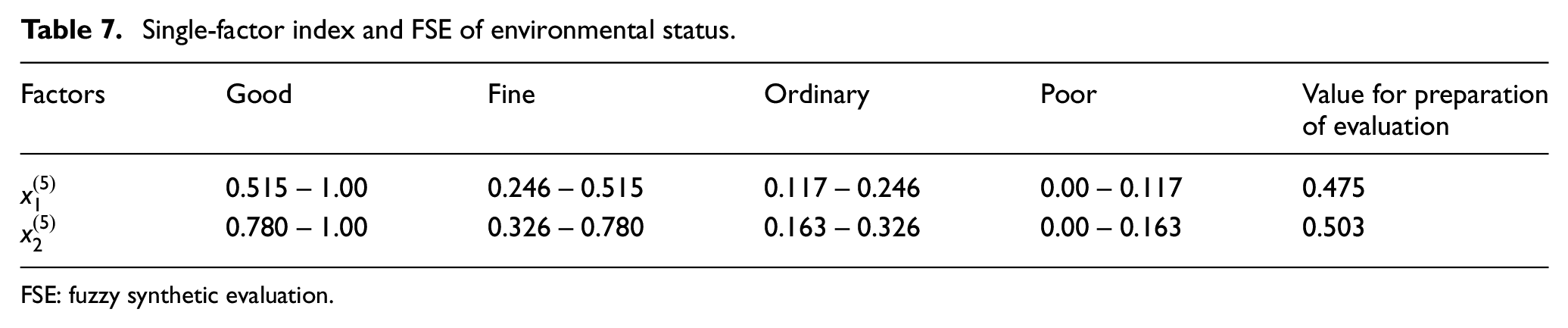
FSE: fuzzy synthetic evaluation.
Based on the single factor index values of the various parameters and the evaluation of the data after the dimensionless processing stage, we use the extension theory and the entropy weight method described in this paper to determine the membership matrix and fuzzy weight vector for the first-level evaluation. The steps for the single-factor evaluation are detailed as follows (we use Table 3 as an example to introduce the procedure here).
Step 1. Determine the classical field of the CHWQ status


Step 2. Determine the joint field of the CHWQ status

Step 3. Determine the value for preparation of evaluation

Step 4. Establish the membership matrix
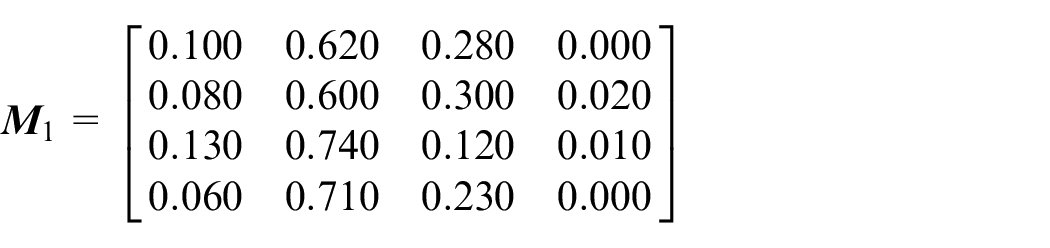
Using the same steps, we can obtain the corresponding membership matrixes for the values in Tables 4 to 7, and these matrixes are listed as follows.


Step 5. Calculate the entropy value for each parameter
Using equation (11), the entropy values of the various factors can be determined. Tables 8 to 12 show these entropy values.
Step 6. Determination of the first-level fuzzy weight vectors
Entropy values for the mechanical performances of various factors.

Entropy values for the electrical performances of various factors.

Entropy values for the wiring processes of different factors.
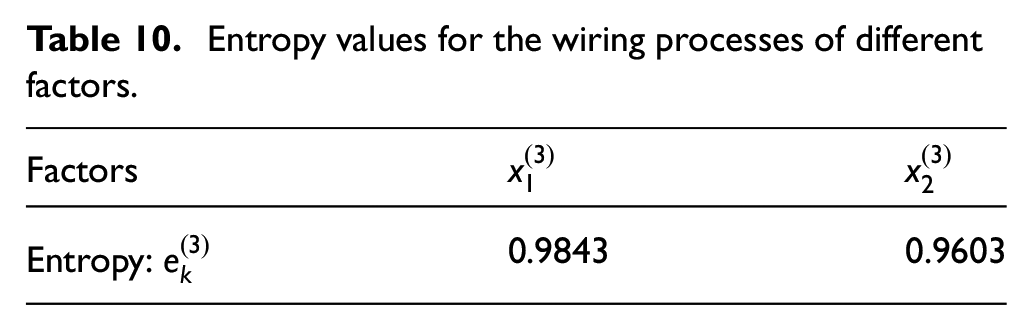
Entropy values for the spatial arrangements of different factors.

Entropy values for the environmental statuses of different factors.
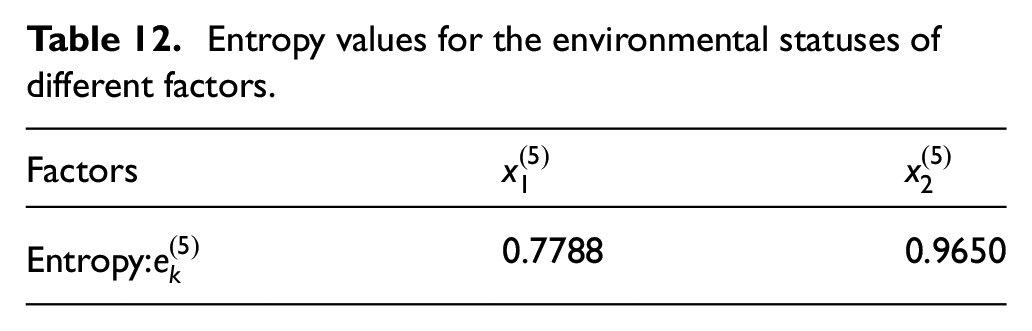
When the entropy values are determined, the first-level fuzzy weight vectors

Step 7. Calculate the first-level FSE results
Based on the first-level fuzzy weight vectors



Step 8. Calculate the second-level FSE
The first-level fuzzy evaluation results
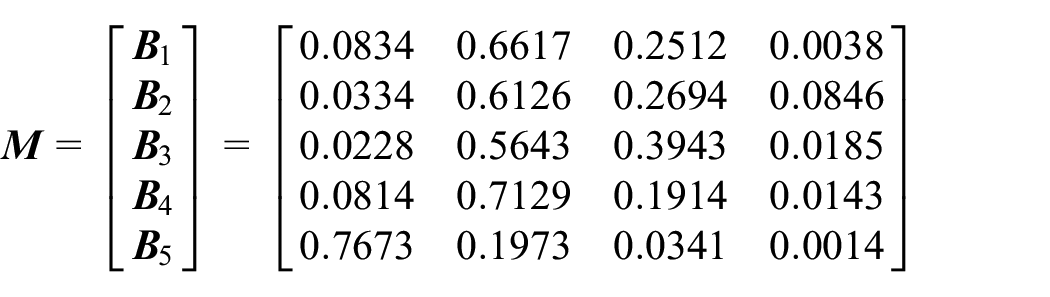
To implement the second-level FSE, the second-level fuzzy weight vector
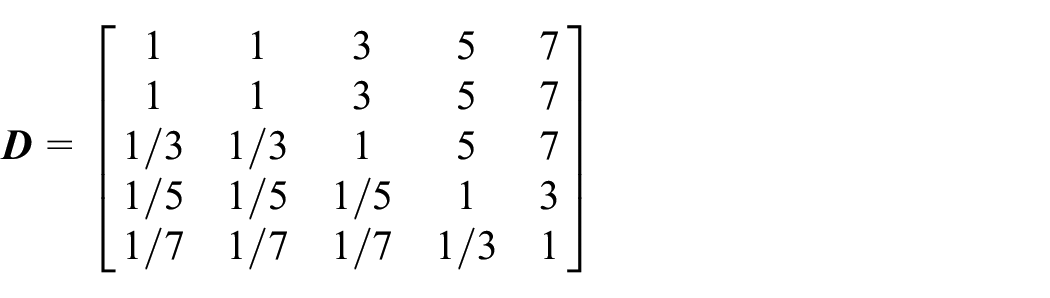
In addition, the weight vector

and

The consistency index

The consistency ratio

Obviously, the consistency ratio

and thus

Each value of the synthetic evaluation model
By applying the methods and steps described above to the remaining 49 sets of phased array radar wiring quality grade data in the FSE, we obtained 50 sets of quality grade FSE results for the phased array radar wiring (see Table 13).
Fifty sets of quality grade FSE results for the phased array radar wiring.

(Note: the above data were obtained based on the maximum membership principle).
FSE: fuzzy synthetic evaluation.
When the MATLAB neural network toolbox is used to predict the CHWQ, the number of iterations of the BP neural network weights and the threshold is set at 5000; and the error precision is set at 0.001. Then, the BP neural network is trained using the data presented in Table 13. A comparison chart of the 50 learning samples for the neural network and the neural network output values after training is presented in Figure 8. From the results shown in Figure 8, we conclude that the BP neural network’s structure and parameter settings could be fitted well to an actual engineering situation and that higher prediction accuracy for the CHWQ was achieved.

Comparison chart of neural network output values and actual values.
The trained BP neural network is then used to predict the CHWQ for sets 51 to 60 of the phased array radar equipment. The predicted results are shown in Figure 9 and the corresponding predicted values are listed in Table 14.

Quality prediction chart of the FSE values.
Values predicted by the BP neural network.

BP: back-propagation.
From Table 14, we know that the CHWQ values of the 10 sets of phased array radar equipment declined gradually. Through research and analysis, we found that the main reason for this decline in the quality of the cable harness wiring was that the enterprise hired a group of new employees and the wiring of these 10 sets of phased array radar equipment was performed by these new employees. Because the new employees had no prior experience of cable harness wiring and were not skilled in cable harness assembly operations, these factors led to the reduction in the wiring quality. To address this phenomenon and thus improve the CHWQ, this batch of new staff must be trained systematically before wiring and on-site guidance should also be provided by an engineer with many years of installation experience in the actual wiring process.
Figure 10 shows a comparison of the wiring effect before and after use of the method proposed in this paper. Figure 10(a) indicates that the wiring effect is not satisfactory before use of the proposed method; under these circumstances, the wiring requirements of the phased array radar were not met and the mechanical performance and electrical performance of the system were greatly affected. Figure 10(b) illustrates the correctness of the wiring after use of the proposed method; the layout of the cable harness is satisfactory in this case.

Wiring effect comparison before and after use of the proposed method.
Several points about the above are explained here as follows:
In the training pattern, the input is the 50 sets of values given in Table 13 (see the blue dotted line in Figure 8) and the output is the 50 sets of simulated values obtained after training (see the pink dotted line in Figure 8). This step is performed to obtain a neural network that can be used to make accurate predictions.
In the prediction pattern, the network trained above is used to predict the FSE value of the CHWQ of 10 new phased array radar sets (see the 51st to 60th phased array radar sets shown in Figure 9).
In Table 13, there are 50 sets of quality grade FSE results for phased array radar wiring. Among these sets, the value for the first set of 0.6132 is b2=0.6132, which is solved using the method from Phase III in Figure 1. The remaining 49 sets of values (numbered 2–50) were also solved using the method from Phase III.
Each FSE result corresponds to a quality grade for the cable harness wiring (Good, Fine, Ordinary, or Poor); for example, when b2=0.6132, the corresponding quality grade is “Fine”.
Quality control measures
Cable harness wiring is a complex, time-consuming and costly process. In addition to the training of the workers and provision of on-site guidance, some quality control measures should also be adopted in the cable harness wiring process to ensure that each performance indicator meets the requirements of the target equipment. These related quality control measures are described as follows:
Correct selection of the cable harness type. Different cable harness types may have different diameters and use ② different material types. When different cable harness materials and types are used, the bending radius required during the wiring process will also be different. Therefore, when different types of cable harness are selected, different stiffness factors should be set in accordance with the requirements of the wiring environment.
Classification of electrical performance. Different types of wires, including power cables, signal cables, and control cables are installed in electronic equipment. The electromagnetic fields produced by the electricity around these cables will interfere with each other, and this will then affect the electrical performance of the machine. To prevent coupling crosstalk between the cable harnesses as far as possible, the designs of the cables and wires should be classified using bandings in accordance with the conductor signal’s current, voltage, frequency and other relevant properties.
Standardization of routing of the cable harness. To reduce coupling of the capacitance and the inductance, cable harness routing should be performed in straight lines and in alignment as far as possible. At the same time, the workers should also consider factors including the vibration resistance, heat dissipation, and ease of disassembly and maintenance. If rotating parts such as a revolving door or work stations are present, the transit cable harness should then be bent into a “U” shape.
Correct sequence of installation. The workers should perform the wiring operations in the following order: ① large diameter and corner cable harnesses should be wired first, and the small diameter and corner cable harnesses should then be installed; ② rigid cable harnesses should be wired first, followed by the flexible cable harnesses; ③ high frequency harnesses should be wired first and then the low frequency harnesses should be wired; ④ high power harnesses should be wired first, followed by the low power harnesses.
Reasonable protection and fixing. Cable harnesses have flexibility characteristics and are installed in large quantities; corresponding protection measures should be taken for wires that may be easily worn out or damaged. For example, a perforated liner or an insulation sleeve with a heat shrinkable casing could be installed. Fixed clamps and banding threads can also be used to fix the cable harness.
Conclusions
The structures of radar, satellite, aircraft, ships and other complex mechatronic products are becoming increasingly complex. Based on indicators of the main factors that influence the quality of cable harnesses, a quality prediction framework for cable harness wiring has been designed. The membership matrixes are established using extension theory. In addition, by combining the single factor and the synthetic fuzzy weight vector determined using the entropy weight method and the AHP, respectively, quality grade evaluation of the cable harness wiring is completed based on the FSE method. On the basis of the study described above, we used a BP neural network to realize quality prediction of the cable harness wiring for complex mechatronic products.
After studying the case above and discussing the related results, we would like to summarize three important aspects of the study as follows:
The current cable harness wiring process is mainly reliant on the experience of the assembly workers and this makes it difficult to obtain guaranteed quality. In addition, the process still did not have an available set of perfect operations and a scientific evaluation method to address the aspects of CHWQ prediction and control. The case study results here show that one of the advantages of the method proposed in this paper is that it can provide more realistic predictions and decision-making results when compared with the traditional quality assurance methods.
Reliance on the operator’s experience to ensure the quality of the cable harness wiring indicates the lack of a theoretical basis for the process. In this paper, the proposed method combined operational experience with theoretical knowledge (e.g. extension theory, the entropy weight method) and the results were then shown to be more credible.
The factors that influence the quality of cable harness wiring have complex and changeable characteristics. These different factors have fuzzy characteristics and their importance is difficult to quantify. The application of extension theory and the FSE method in this paper solved these problems adequately. Therefore, the CHWQ prediction results are more accurate.
The next stage of this research work will be a study of cable harness fault diagnosis and performance degradation prediction of complex mechatronic products.
Footnotes
Handling Editor: James Baldwin
Declaration of Conflicting Interests
The author(s) declared no potential conflicts of interest with respect to the research, authorship, and/or publication of this article.
Funding
The author(s) disclosed receipt of the following financial support for the research, authorship, and/or publication of this article: This work is supported by a grant from the National Natural Science Foundation of China (51675258); by the National Defense Basic Research Program of China (41423010401); by the Research Project of the State Key Laboratory of Mechanical System and Vibration (MSV201914); by the Research Project of Science and Technology of Jiangxi Education Department (GJJ180539); and by the PhD Commencement Program of Nanchang Hangkong University (EA201803301).
