




Abstract
In order to study the modular design of computer numerical control machine tools oriented to customer demands, the customer demand information model was established based on rough analytic hierarchy process and information entropy by analyzing and transforming customer demands. Based on the domain mapping method of axiomatic design and quality function deployment integration, the product function model and structure model of computer numerical control machine tools are established. Based on fuzzy clustering analysis, the module division of computer numerical control machine tools is studied, and the dynamic clustering diagram of computer numerical control machine tools is formed with MATLAB as the operating environment. Based on Technique for Order Preference by Similarity to Ideal Solution method, the scheme of computer numerical control machine tools module division is evaluated. Taking the horizontal computer numerical control machine tool products of Shenyang Machine Tool Group as an example, the module division is carried out. The example design and the result analysis prove that the module division system is very effective and fast.
Keywords
Introduction
Computer numerical control (CNC) machine tools are the key basic equipment of equipment manufacturing industry. With the continuous improvement of industrialization level, people put forward higher and higher requirements on the diversification and personalization of CNC machine tool products. The cycle of replacement of CNC machine tools is also shorter and shorter. On the other hand, with the increasingly fierce market competition, enterprises are in urgent need of rapidly configuring CNC machine tools to meet the diverse needs of customers with lower cost and higher performance. 1 Modular design realizes the mass production and personalization of products with the cost of mass production through the reorganization of product structure design process, so as to find the best balance between product variety and cost performance.2,3
In the field of engineering, Simon 4 and Alexander 5 first proposed the idea of modular design, dividing the system into the least related components or modules can effectively reduce the complexity of the system. G Pahl et al. 6 proposed the modular design method to map from the functional domain of a module to the structural domain, and realized the inter-domain mapping of the module based on the performance of the module. On the basis of considering the whole product, J Lao and S Wu. 7 divided the system into modules with the same or different functions according to functions. W Hu 8 transformed the general product design tasks into modular design tasks. H Wang 9 proposed a modular product configuration method for mass customization products. Most of the existing research methods of modular design are directly mapping from functional domain to structural domain, establishing product structure model, and then completing product modular design. Therefore, this article brings forward modular design of CNC machine tools for customer demands. Modular design is to decompose products into different functional modules according to certain rules. Then, according to the special needs of each customer, select the appropriate functional modules for combination and assembly to form individual modular products, so as to achieve the goal of providing customized products to customers in a short time. Its significance has the following aspects:
Save design time and shorten supply cycle.
Improve product quality and reduce production cost.
It is convenient for product renewal and development of variant products.
It is beneficial to enhance the enterprises’ adaptability and reduce the cost of product replacement.
Easy to maintain, repair.
Therefore, it is necessary to divide modules according to the customer demands. This article puts forward modular design of CNC machine tools for customer demands. It starts from the establishment of customer demand information model. Using the mapping model of integration of axiomatic design (AD) and quality function deployment (QFD), it transforms customer demands into product function model, and finally establishes product structure model to meet customer demands, so that product module division is more reasonable and can meet customer demands.
The remainder of this article will proceed as follows:

Modular design
Customer demand information model is established to provide customer demand domain. The model of AD and QFD integration is used to solve the mapping of product from customer demand domain to function domain and function domain to structure domain. It transforms customer demands into product function model, and finally establishes product structure model that meets customer demands. The fuzzy clustering of transitive closure method is applied to classify modules, and the results of module classification are evaluated based on Technique for Order Preference by Similarity to Ideal Solution (TOPSIS) method.
Customer requirements information modeling
Customer requirements model construction
The process of customer demands acquisition mainly includes determining reasonable survey objects and survey methods to conduct market survey and sort out customer demands.10–12 According to the actual situation, adopt appropriate survey method to accurately reflect the customers’ demands.
The original customer demand information collected through investigation often has various forms, which need to be screened, summarized, and sorted out. Affinity diagram 13 (KJ method) was used to conduct hierarchical analysis of customer demand information. The main steps are as follows:
Step A. Organize the customer demands of each item and write on each card.
Step B. Divide the same meaning cards into the same group, keep only one card in each group, discard the other cards in each group, and record their repetition frequency.
Step C. Gather the cards with similar meaning to divide them into different groups.
Step D. A word is used to describe the similar item, which is a high-level customer demand item.
Step E. Gather the customer demand items obtained in Step D according to the principle of similar meaning and group them again.
Step F. Repeat Step D, use representative statements to describe each group, and get a higher level of customer requirements.
Step G. Repeat Steps C and D, and according to the actual situation, continue to merge until a reasonable hierarchical structure of customer needs is obtained.
Finally, the customer requirements tree model as shown in Figure 1 is constructed.

Hierarchy structure model of customer demands.
Calculation of the importance of customer demands based on rough analytic hierarchy process and information entropy
Analytic hierarchy process (AHP) cannot accurately reflect the ambiguity of customer demands. Rough Numbers can better reflect the true feeling of customers. Therefore, the importance of customer demands is determined based on rough analytic hierarchy process (RAHP) 14 and information entropy. The customer demand analysis is shown in Figure 2.

Customer demands significance analysis based on RAHP and information entropy.
Customer demand weight solution steps based on RAHP
Construct AHP judgment matrix and conduct consistency test.
The hierarchy model of customer demands is built as shown in Figure 1. Make appropriate AHP15,16 questionnaire, solicit and invite customers to participate in AHP questionnaire survey, and construct customer demands judgment matrix, as shown in equation (1)

where
According to the related ideas of AHP, consistency test must be carried out for the judgment matrix obtained from customer evaluation. Calculate the consistency ratio CR of the AHP judgment matrix. If CR < 0.1, the judgment matrix does not need to be modified. Otherwise, it needs to be corrected.
2. Construct rough group decision matrix

where
3. Solve the rough pair comparison matrix

where
4. Calculate the weight of customer demands at each level based on geometric average RN(qe)

where n represents the number of categories of each level customer requirements.
5. Synthesize the basic importance of customer requirements.
The basic importance degree fi of all customer demands can be obtained by multiplying the importance degree of customer requirements of each level and its corresponding sub-level.
Evaluation of market competitiveness based on information entropy
Assuming that, after market investigation and analysis, a product has m customer demands and n competing enterprises, the market competition evaluation matrix X can be formed

where

where E(Ni) is used to reflect relative competitive advantage, thus setting the priority of requirements. For normalization

According to the formula

where fi is the basic importance degree and ei is market competitiveness assessment, and the final revised customer demands significance Ii is obtained.
Inter-domain mapping
Customer demand domain is gained based on customer demand information. A domain mapping method based on AD 18 and QFD 19 integration solves product demand domain, function domain, and structure domain mapping. Finally, the product structure model is obtained, which provides the basis for the module division and modular design.
Domains of AD
Domains are proposed in AD theory. According to the different design interaction content, AD divides the whole design process into four design activities, which are composed of four domains: Customer Domain, Functional Domain, Physical Domain, and Process Domain. Each field has its own corresponding elements, which are Customer Requirements (CRs), Functional Requirements (FRs), Design Parameters (DPs), and Process Variables (PVs).20,21 As shown in Figure 3, there is a certain mapping relationship between the design elements of the adjacent domain, and a mapping matrix is established to determine the relationship between them. The design process moves from the left domain to the right domain successively, and finally produces the product required by CRs.

The mapping process among domains of AD.
Hierarchy and inter-domain mapping
Take the mapping of functional domain to physical domain as an example. The total functional requirements of the product are first determined, and then the overall design parameters are determined according to the total functional requirements. When the total functional requirements are met, the total function is decomposed according to the overall design parameters, and the corresponding sub-design parameters are determined according to the sub-functions. When the sub-functional requirements are met, the sub-functions of the next level are decomposed. And so on until all sub-functions are satisfied and no longer decomposed. After mapping, the hierarchical tree of function hierarchy and design parameters, as well as the relationship between design parameters and function requirements, is obtained. The mapping principle from functional domain to physical domain is shown in Figure 4, and the mapping process between other domains is similar.
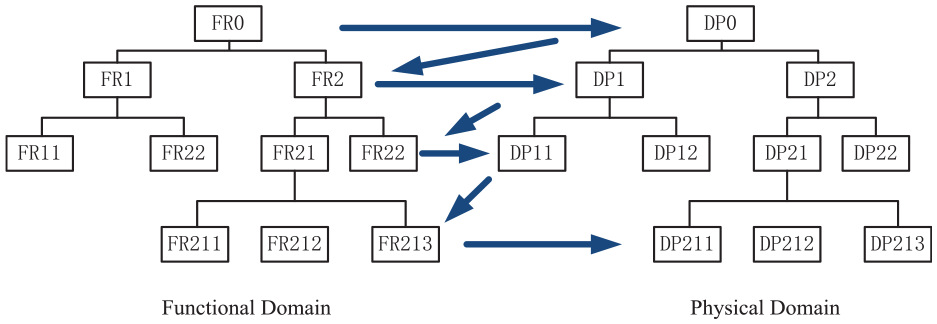
The mapping principle of the domains and hierarchical structure of AD.
Two axioms of design
There are two important axioms in AD: independence axiom and information axiom. The independent axioms in AD are used to study related problems. Independence axiom requires the independence of functional requirements, which is used to show the relationship between functional requirements and design parameters. When there are multiple functional requirements, the design results must meet each functional requirement without affecting each other.
The process of inter-domain mapping in AD can be expressed by matrix equation. For example, functional requirements in functional domain and design parameters in physical domain can be expressed as follows

where

where n is the number of functional decomposition and

When some DPs change, some FRs will also change accordingly, so independent axioms cannot be satisfied in the mapping process. In order to satisfy the independent axioms, the design matrix must be diagonal or triangular. The forms are as follows:
The design matrix
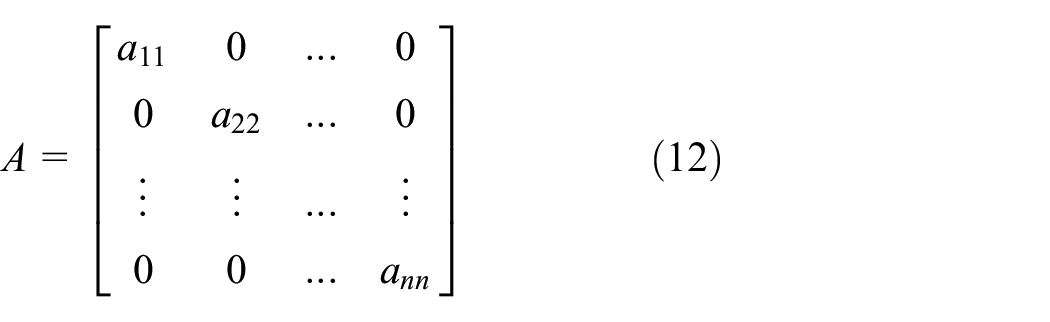
This form is called uncoupled design, which is also the ideal design form.
2. The design matrix

This form is called quasi coupled design, which also satisfies the independent axiom.
In addition, other design matrices do not satisfy the independent axioms and need to be decoupled. The mapping process relationships between other domains are similar.
The least amount of information in design is information axiom. The more complex the functional requirements are, the greater the information content is and the lower the probability of design success is. Therefore, it is necessary to make the design parameters meet the functional requirements as much as possible on the premise of satisfying the independent axioms, so that the design results will be better.
Inter-domain mapping
The AD process is shown in Figure 5. The implementation form of QFD is house of quality, as shown in Figure 6. By utilizing the complementarity of AD and QFD, based on the domain mapping method of AD and QFD integration, this article constructs the house of quality of customer demands and function demands, and the house of quality of function demands and design parameters. It establishes the mapping model, as shown in Figure 7. Product structure model is established to divide product modules.

The design process of AD.

The structure of the House of Quality.

The mapping model among domains of AD and QFD.
The calculation transformation of the house of quality adopts the independent collocation method. 22 On the premise of satisfying the independent axiom, using the house of quality, the relationship matrix between customer demands and functional demands is established. The correlation degree of them is 1, 3, 5, 7, 9. The larger the value is, the stronger the relationship between functional demands and customer demands is. If they are not related, the value is 0. According to the independent axiom, each functional demand is independent from each other, so it is not necessary to establish the autocorrelation matrix of functional demands.
Suppose

If the j functional engineering measure is closely related to multiple customer demands, and these customer demands are more important, then the weight of functional requirements is more important. Similarly, the transformation calculation from the weight of functional requirements to the importance of design parameters can also be obtained by using this equation.
Product module division
Principle of product module division
The principle of module division has the same commonality:
The functions of each module are independent from each other and the structure of each module is complete.
Each module interface is convenient for loading and unloading.
Weak coupling between modules, and strong coupling among parts in modules.
Module partition granularity is moderate.
Unit modules are typical and different product modules are universal.
Module extensibility and so on.
There is a prerequisite for product module division, that is, there should be some correlation between product components. According to the above listed module classification principles and combined with the actual situation of the product, the relevant elements that need to be considered under the classification principles are determined. The relationship model of product parts and components is established.
Construction of product parts relation model
The parts relation model is constructed, including parts correlation analysis and parts synthesis relation matrix. When analyzing the correlation of parts, it is necessary to comprehensively consider the relevant factors that have interactive effects on parts. In this article, functional, geometric, design, and information-related and physical-related elements among components are considered as the judgment basis for module division. And the component relationship model is established. Finally, the AHP is used to calculate the importance of the relevant elements, and the component synthesis matrix is established.
Component correlation analysis.
According to the strength of the correlation of parts, it is divided into four strength levels: strong, medium, weak, and none. The quantification method is shown in Table 1.
The strength of component correlation.

Starting from the principle of module division, and according to the definition of component correlation, the article analyzes and describes the five related elements of components, including functional correlation, geometric correlation, design correlation, information correlation, and physical correlation.
By analyzing the function correlation of parts, the function relation matrix of parts can be established. If the product is divided into n parts by function, a
Obtain in turn: geometric correlation matrix
2. Analysis of component comprehensive correlation matrix.
Finally, it is necessary to consider the influence of all related factors comprehensively. The AHP is applied to calculate the weight of each relevant element, and then the component comprehensive relation matrix

where wf, wg, wd, win, and wp are the relative weights among the five related elements, including functional correlation, geometric correlation, design correlation, information correlation, and physical correlation, 1 ≤ i, j ≤ n.
Product module division based on fuzzy clustering algorithm
The product module division is studied by fuzzy clustering analysis with transitive closure method.
Transitive closure.
Products-integrated relationship matrix is obtained by components correlation analysis, which only satisfy reflexivity and symmetry and does not meet the transitivity. In the transitive closure method of fuzzy clustering analysis, the product fuzzy similarity matrix (component synthesis correlation matrix) obtained by correlation analysis is constructed into a transitive fuzzy equivalence matrix, which is transitive closure
The transitive closure of fuzzy similarity matrix is obtained by the flat method. For the fuzzy similarity matrix on the field F, the reflexivity and symmetry are satisfied. When there is a minimum positive integer k, such that R2k = Rk, t(R) = Rk.
2. Fuzzy clustering based on λ intercept array.
In the transitive closure t(R) = [tij]
n×n
, where 0 ≤ tij ≤ 1,

where
Program evaluation of module division based on TOPSIS method
The product module division scheme is evaluated and decided based on TOPSIS. Module partition scheme evaluation is a typical multi-attribute decision-making process, determining the priority of multiple options through the relationship between multiple attributes and multiple options, so as to select the most required options. As far as this article is concerned, the attribute is the evaluation criterion of the module partition scheme, and the option is the multiple module partition schemes. The attributes of evaluation criteria fall into two categories:
The first category is properties that require investment. The smaller the value, the better.
The other is the output attribute, where the higher the value, the better.
Suppose the number of module division scheme is n, which constitute scheme set

The application principle of TOPSIS method in evaluating module division scheme is to make the final module division option as close as possible to the most ideal module division scheme
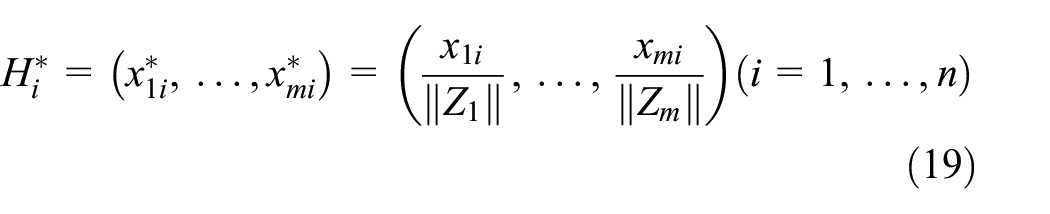
After normalization, the importance of each evaluation criterion calculated by AHP is
Normalization processing

where


3. Calculate the Euclidean distance

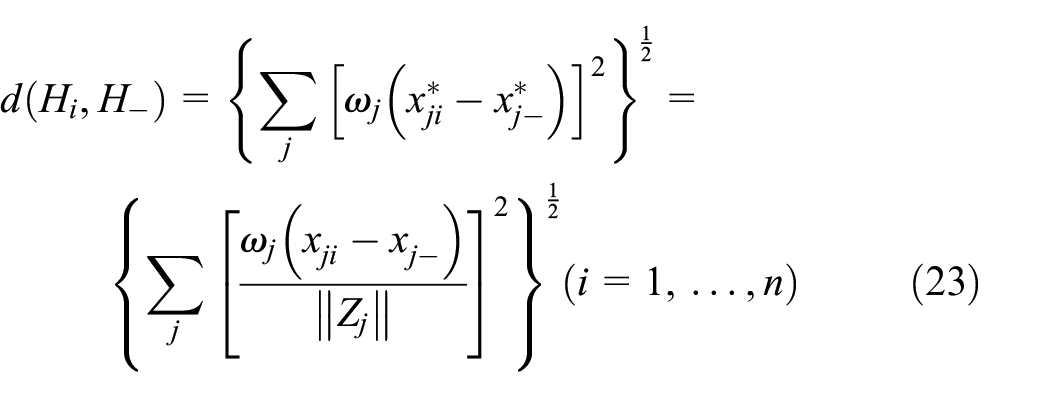
where
4. Calculate how close the alternatives are to the best

The higher the value of
Application example
Taking horizontal CNC lathe products of Shenyang Machine Tool Group (SYMG) as an example, the customer demand information collected was summarized and sorted by KJ method, and customer demands were divided into three levels. The hierarchical structure model of customer demand of this horizontal CNC lathe was established, as shown in Figure 8. With the successive development of requirements, the information is more and more specific and detailed, which can guide the functional decomposition of the next step. In this paper, the third level customer demands will be as the horizontal CNC lathe demand domain.
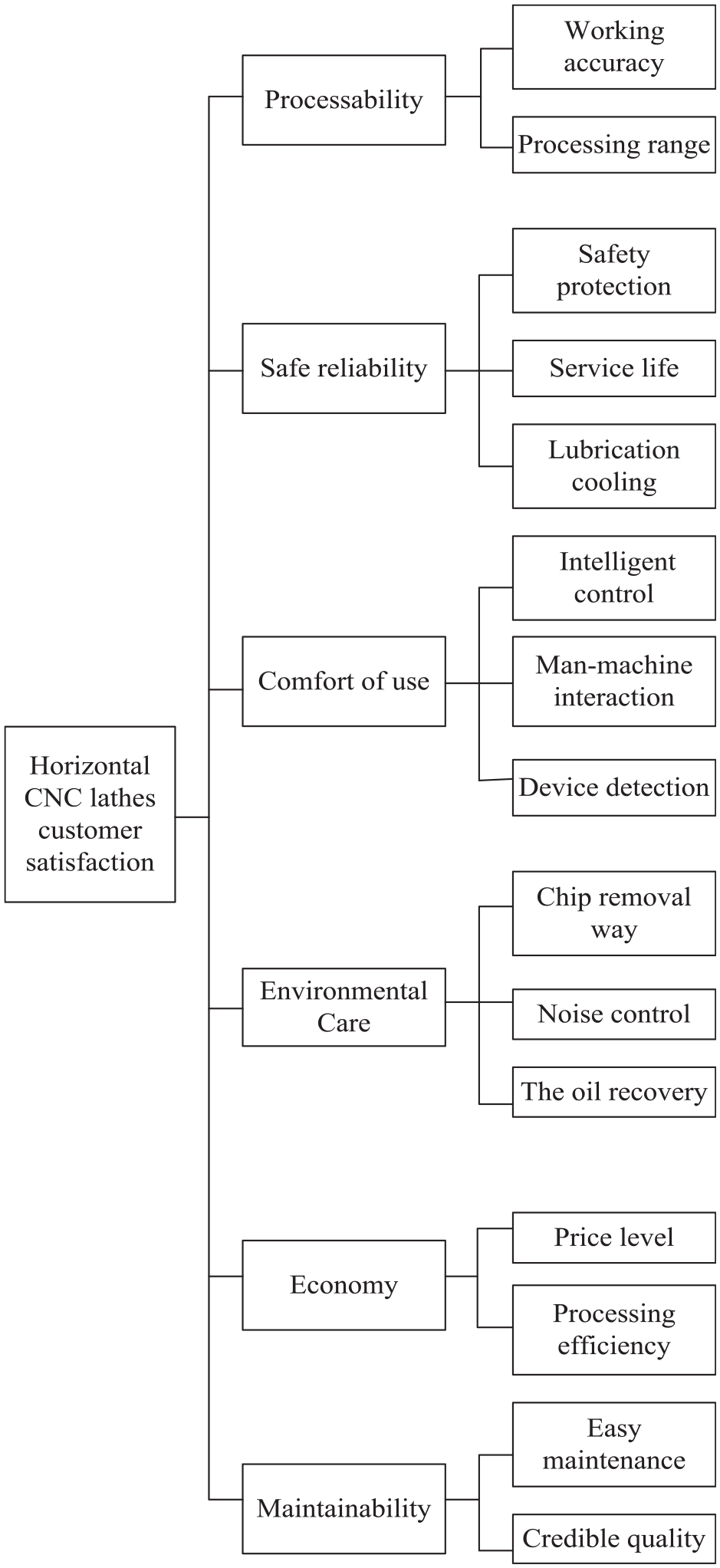
Hierarchy model of customer requirements for horizontal CNC lathes.
Calculate the importance of customer demand of CNC machine tools based on RAHP and information entropy. Take the second level of customer needs as an example and build AHP judgment matrix, and the evaluation scale and its meaning are shown in Table 2

Scale meaning.

If the value of CR for the judgment matrix is less than 0.1, the judgment matrix does not need to be modified. Otherwise, it needs to be corrected. According to the consistency test formula proposed by professor E Sundin et al., 26 CR = CI/RI, CI = (λmax– n)/n– 1. RI stands for random consistency index, and the values of which are shown in Table 3. λmax is the maximum eigenvalue of the judgment matrix. The judgment matrix passes the consistency test. By calculation, the weight of customer demand at the second level is multiplied by the weight of customer demand at the corresponding third level to obtain the basic importance of the customer demands fi. Specific results are shown in Table 5.
The value of RI.

RI: random consistency index.
A questionnaire survey was conducted on the horizontal CNC lathe and the two competing targets, and customers could score the corresponding customer needs according to 1, 2, 3, 4, and 5 respectively. The design of the questionnaire is shown in Table 4. All the survey results obtained through the market survey questionnaire were sorted out according to the corresponding customer demand to obtain the arithmetic average value of the customer demand scoring results. Finally, the evaluation matrix of market competition was constructed

Market competitiveness evaluation questionnaire of horizontal CNC lathe customer demand based on information entropy.

Based on the principle of information entropy, equations (5) and (6), MATLAB software can be used to solve the relative importance of market competition of the horizontal CNC lathe based on information entropy. Based on information entropy, ei, the relative importance of customer demand market competition for horizontal CNC lathe is obtained. The calculation results are shown in Table 5.
According to the formula Ii
Calculation of customer demand importance based on RAHP and information entropy.

QFD house of quality transforms customer requirements into functional requirements with independent axioms in AD to ensure the independence of functional requirements in horizontal CNC lathe. After analysis, the horizontal CNC lathe has eight basic functional requirements, respectively: cutting function, feeding function, support function, control function, detection function, protection function, intelligent monitoring function, and human–machine interaction function. Since the basic functional requirements satisfy the independence axiom, the autocorrelation matrix of functional requirements is omitted. By using the independent collocation method, the importance of customer demand of horizontal CNC lathe is converted to the importance of each function requirement of horizontal CNC lathe. And then the obtained weight of function requirement is normalized to gain the relative weight of function requirement. The configuration table of quality room of customer demands and function requirements of horizontal CNC lathe is shown in Table 6 to realize the mapping of customer domain to function domain.
The configuration of House of Quality for customer requirement and function requirement.

After the basic functions of horizontal CNC lathe are determined, the function decomposition and design parameter selection of horizontal CNC lathe are carried out by using the mapping in AD until the function carrier is produced. The basic functions of horizontal CNC lathe are these:
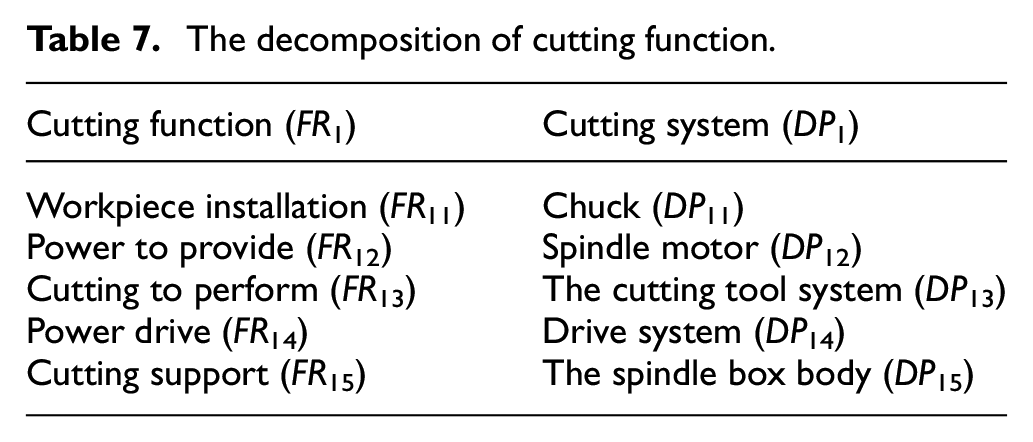
Take the decomposition of cutting function FR1 as an example.
In order to meet the functional requirements of design parameters


The decomposition of cutting function.
where X is related, 0 is unrelated. It can be seen from the design matrix that this decomposition is an uncoupled matrix. DP13 (tool system) is not a design parameter and requires further decomposition of FR13. The FR13 (cutting execution) breakdown is shown in Table 8. The design matrix equation is as equation (26). The following decomposition is carried out successively: FR2, FR3, FR4, FR5, FR6, FR7, and FR8.
The decomposition of FR13.

In conclusion, based on the customer demand model of horizontal CNC lathe and the inter-domain mapping model of AD and QFD integration, the customer demand to function mapping model and function to structure mapping model of horizontal CNC lathe are respectively established. Finally, the function tree and structure tree of horizontal CNC lathe are established, as shown in Figures 9 and 10.
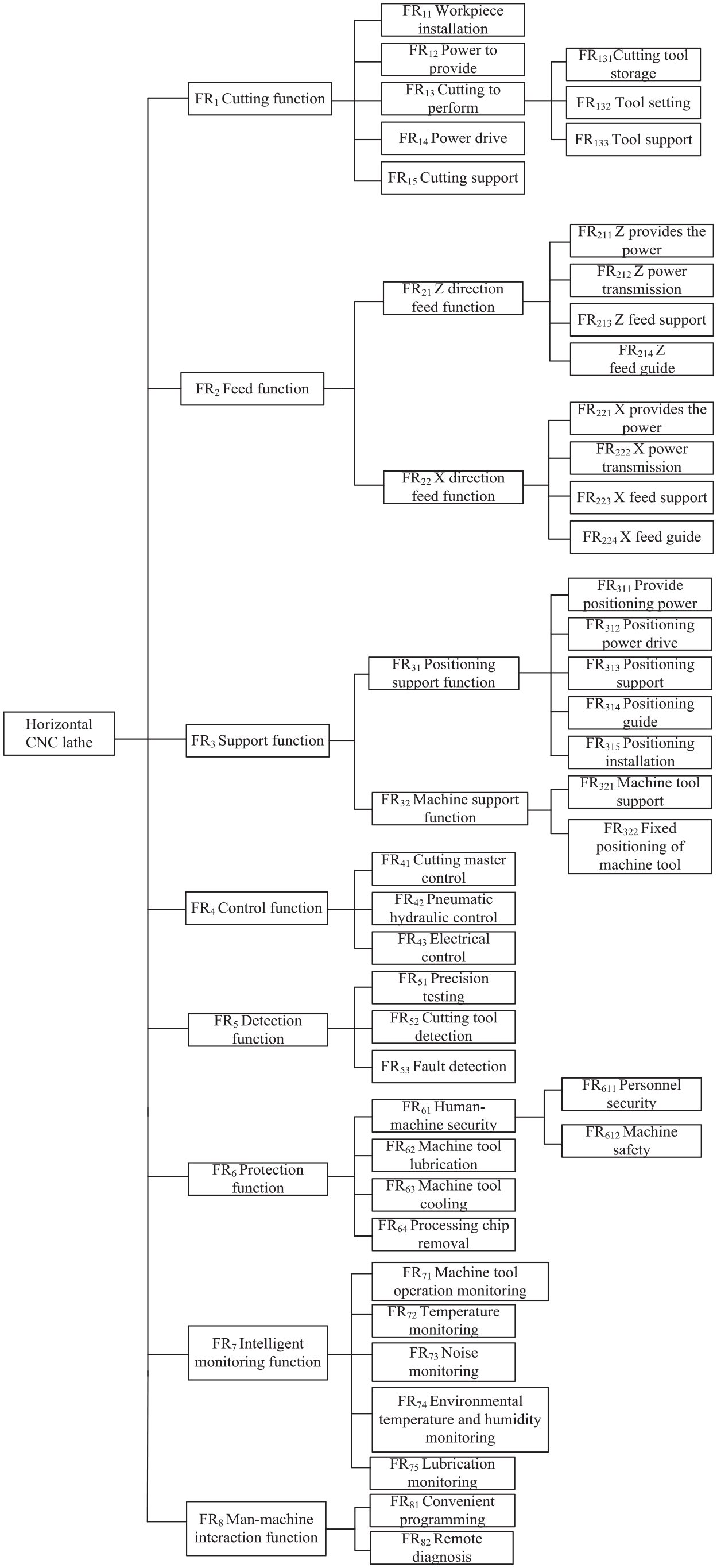
The function tree of horizontal CNC lathes.

The structure tree of horizontal CNC lathes.
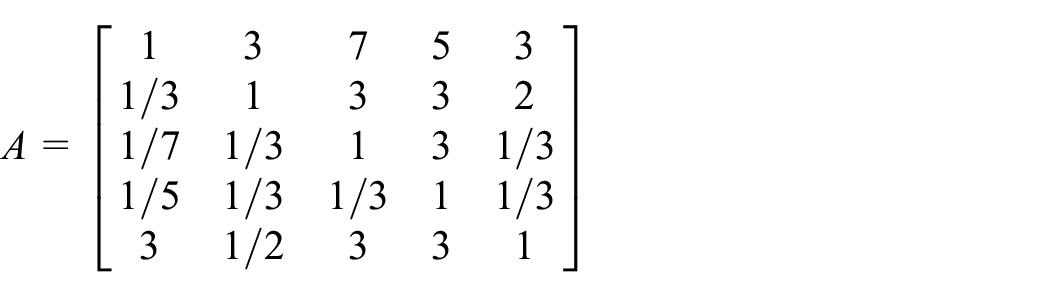
The AHP judgment matrix among related elements is established as follows. Through MATLAB calculation, the normalized importance of each relevant element is as follows: wf = 0.4758, wg = 0.2153, wd = 0.0865, win = 0.0585, and wp = 0.1693
As shown in Figure 10, 40 parts of this horizontal CNC lathes were finally decomposed. The comprehensive correlation matrix of product parts (fuzzy similar matrix) was established, as shown in Table 9.
Comprehensive correlation matrix of components.

The transitive closure of the fuzzy similarity matrix can be obtained by using the flat method and MATLAB. The result
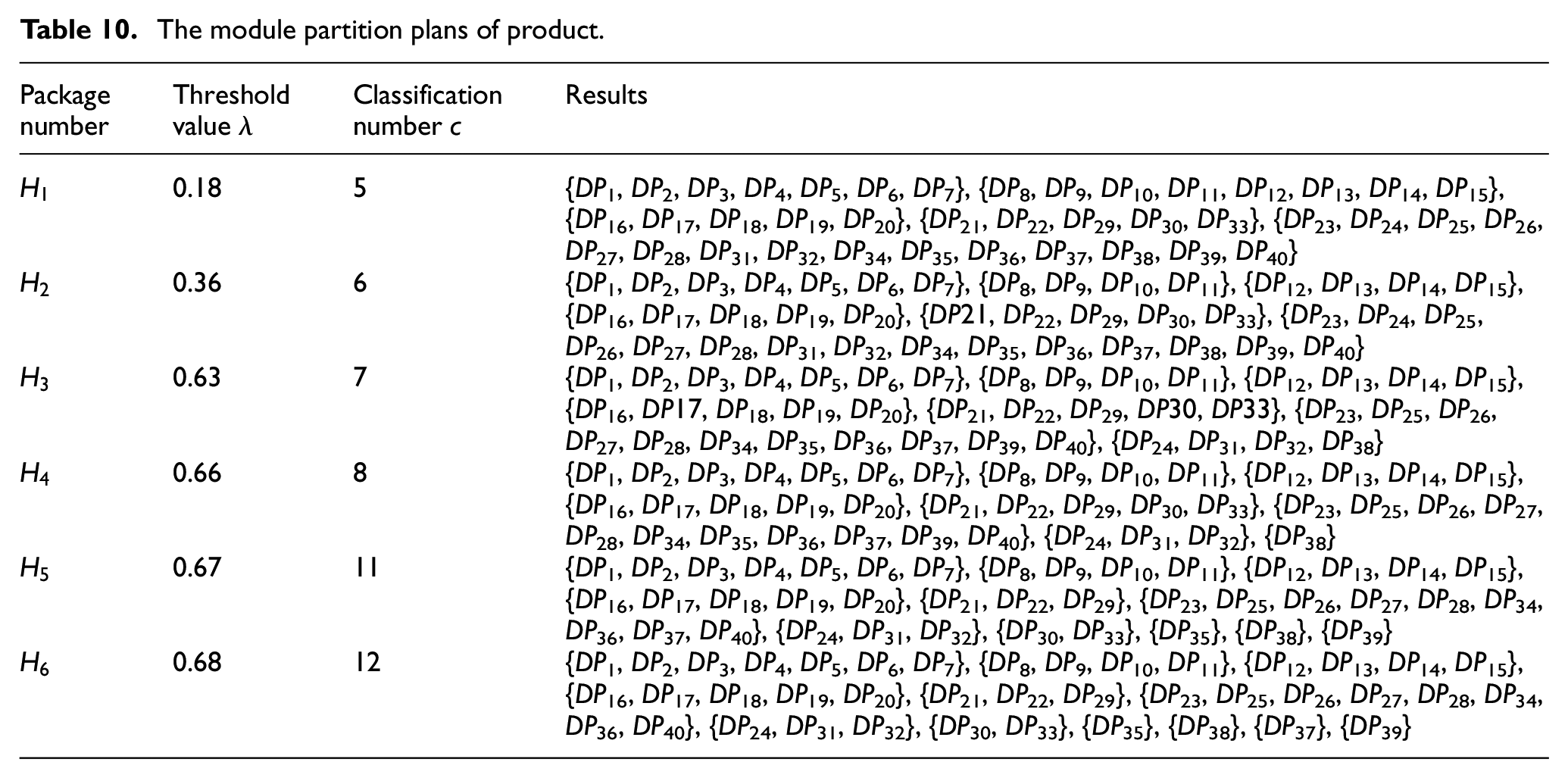
For the calculated transitive closure, λ intercept different values, and get different module partition results. According to the module division method of intercept array and the MATLAB tool, when

Dynamic cataloging chart.
According to Figure 11, 22 different modules can be divided according to different values,
The module partition plans of product.
According to the design characteristics of horizontal CNC lathe and customer demands, the evaluation criteria for the product module division of CNC lathe are as follows:
Module system cost, including design cost, manufacturing and assembly cost, management cost, and so on.
Interchangeability of modules.
Product function, accuracy, and strength.
Simplicity of module interface.
The number of module classification is reasonable.
Expansibility of module system.
In these six evaluation criteria, module system cost and module interface simplicity are input attributes, which are denoted as
According to the application principle of TOPSIS method, the relevant values of the six alternative module partition schemes under each evaluation criterion are determined, and the final constructed initial decision matrix is as follows

According to the calculation procedure of TOPSIS method, the nearness degree of the optimal scheme is calculated

Therefore, the corresponding scheme H3 is closest to the most ideal scheme and is the optimal module partition scheme among the alternatives. The final product module division result is shown in Table 11

Module partition results of horizontal CNC lathes.

CNC: computer numerical control.
Conclusion
In this article, a product customer demands information analysis model is established, and a customer demands importance calculation method based on RAHP and information entropy market competition evaluation is proposed.
Based on AD and QFD, the product structure model of horizontal CNC lathes was established, and the validity of the mapping model was verified.
The comprehensive correlation matrix of product parts is established through the relevant elements among parts. Taking the horizontal CNC lathes as an example, the division scheme under different thresholds is obtained by the method based on transfer closure, and the dynamic clustering diagram is formed. The results show that the module partition based on this method is reasonable and provides a basis for the evaluation of the optimal partition scheme. This article puts forward the general evaluation criteria of the module division scheme of horizontal CNC lathes, evaluates six alternative schemes based on TOPSIS method, and finally determines the optimal module division result. The results show that the module partition scheme evaluation based on this method is reasonable and effective.
Footnotes
Handling Editor: James Baldwin
Declaration of conflicting interests
The author(s) declared no potential conflicts of interest with respect to the research, authorship, and/or publication of this article.
Funding
The author(s) disclosed receipt of the following financial support for the research, authorship, and/or publication of this article: This topic is derived from the National Science & Technology Pillar Program during the Twelfth Five-year Plan Period: comprehensive application demonstration of manufacturing informatization supporting regional and local pillar industries; research and application of key technologies of informatization oriented to high-end equipment manufacturing (2012BAF12B08-4).
