Unsteady three-dimensional flow of an incompressible Oldroyd-B nanomaterial is reported in this article. The origin of flow is time-dependent surface spreading in lateral directions transversely taking nanoparticles with zero mass flux. The formulated partial differential system is reframed by similarity variables into ordinary differential system. The obtained system is solved by the process of homotopy analysis for dimensional temperature and concentration of nanoparticles. Physical parameter behavior on temperature and concentrations of nanoparticles is examined using graph and tabular data. The surface temperature is also measured and evaluated, and it is found that the temperature is reduced for greater unsteadiness parameter values. We found that the higher enhances the curves of nanoparticle concentration and temperature while these curves retard for the incrementing values of The increasing nature of Brownian movement and Lewis number Le corresponds to lower profiles of nanoparticles concentration.
Because of many uses in the fields of engineering, manufacturing, and biology, the study of non-Newtonian fluids has become significant in recent years. Such applications include industries such as meat, product processing, and cosmetics.1 The equations governing non-Newtonian fluids are very nonlinear because of the complex geometry. The empirical equations that determine the non-Newtonian fluid’s mathematical description give the fluid’s rheology. Due to their nature, the non-Newtonian materials are usually categorized into three forms, that is, the type of rate, the type of differential form, and the type of the integral form. The Maxwell fluid is the simplest non-Newtonian rate type material which describes the nature of relaxation time phenomenon. But it cannot predict the time effects of retardation. The Oldroyd-B liquid is a sub-category of rate type materials that defines both the retardation and relaxation stress features. For two-dimensional flows configuration under distinct non-Newtonian fluid models, studies2–7 are reported and many therein. However, sometimes the flow is three-dimensional in practical applications. The three-dimensional flow was studied by scientists of various flow geometries in view of this inspiration.7–10
For better cooling efficiency, an advanced category nanotechnology has been proposed as fluid cooling is the main issue in automated processes. Because of its huge implications in industrial, chemical, and technological processes, nanotechnology is an exciting field of research. The growth of processes for heat transfer is the primary focus of researchers working in this direction. Choi and Eastman11 and Buongiorno12 suggested the nanofluid concept for improving thermal performance by moving nanoparticles in the base fluid. Thermophoresis, nanoparticles length, volume fraction, and Brownian movement factors are the major factors for enhancing thermal conductivity. With Buongiorno’s12 introduction of a credible nanofluid model, nanofluids have become a highly interesting subject to investigators in recent years.13–18 Soret effect on mixed convection nanofluid flow with convective boundary conditions was explored by RamReddy et al.19 Rashad et al.20 considered mixed convection of non-Newtonian nanofluid flow in vertical porous surface. The non-similar solution of mixed convection along a wedge of a non-Newtonian nanofluid flow in a porous medium was studied by Chamkha et al.21 Ghalambaz et al.22 executed the analysis of nanofluid flow under different impacts of nanoparticles shapes and sizes. Some recent studies can be found in the literature.23–28
Multiple efforts have been presented and demonstrated to identify the behaviors of distinct Newtonian and non-Newtonian materials under various assumptions and geometries. For example, Wang29 first considered the three-dimensional flow due to stretching sheet. Heat transfer analysis due to bidirectional stretching sheet with variable thermal conditions was carried out by Liu and Andersson.30 Xu et al.31 performed the first analysis of time-dependent three-dimensional flows due to movement of surface. Hayat et al.32 reported the time-dependent nature of viscoelastic material flow induced by the movement of sheet. Awais et al.33 addressed the steady-state three-dimensional Maxwell fluid flow behavior. Magnetized time-dependent viscous fluid flow through porosity medium is executed by Ahmad et al.34 Ahmad et al.35,36 used the same principle to describe the nature of Maxwell and Oldroyd-B non-Newtonian fluids model. Due to bidirectional moving boundaries, there are limited works reported for nanofluid in literature. The effects of different thermal conditions on bidirectional stretching boundaries to analyze heat transport with nanoparticles are studied by Ahmad et al.37 for both Newtonian and non-Newtonian fluid steady and unstable boundary layer flows.
Such structure for time-dependent Oldroyd-B nanofluid’s flow has not been previously been published to our knowledge in the literature. Although some studies are available in the literature dealing with the flow of different fluids over a stretching surface, the Oldroyd-B fluid’s unsteady three-dimensional flow phenomenon and other interesting features are not yet published. Therefore, present scientific calculations are conducted to fill this gap, and the reported results may be useful in improving thermal extrusion processes, solar energy system, and biofuels. We preferred to use the boundary conditions of nanoparticles with no mass flux to model the equations. The homotopy analysis method (HAM)38–42 is used to achieve nonlinear differential governance solutions. Convergence analysis has been performed through graphs and tabular data for developed series solutions. The impact of physical parameters appears numerically and graphically in the governing equations.
Modeling
Because of the unsteady lateral stretch of the surface where y and x axes are taken along surface and is adopted along vertical to the surface of incompressible Oldroyd-B nanofluid along thermophoresis and Brownian effects, the problem is based on a three-dimensional approach. The material velocities are and in the y and x directions, respectively, and . Geometric description of the problem is shown in Figure 1. The equations developed for this case are using the boundary layer approach. Schlichting43
Physical adjustment of the problem.
The conditions at boundaries for present phenomenon are
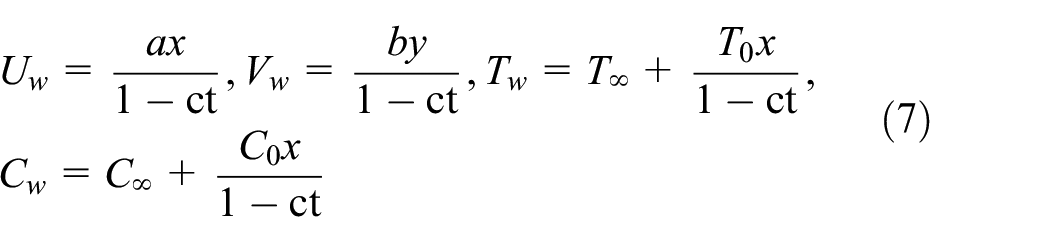
Here, , and are the velocities components along the x, y, and z axes, respectively, , are the dynamic viscosity, fluid density, kinematic viscosity, relaxation time, retardation time, temperature, density of base fluid, thermal diffusivity of base fluid, capacity of heat in a fluid, capacity of heat in nanomaterial, concentration of nanoparticles, Brownian, thermophoretic diffusion coefficients, wall temperature, ambient temperature, and nanomaterial concentration at infinity, respectively. The wall conditions are represented by subscript w. The wall stretching velocities, temperature, and concentration can be demonstrated as
where a, b, , and represent the constants. Introducing the dimensionless quantities as
The non-dimensionalized boundary conditions have the form
Here, , and are the unsteadiness parameter, relaxation parameter, retardation parameter, Brownian coefficient, Prandtl number, thermophoresis coefficient, Lewis number, and stretching variable, respectively. The prime symbolization indicated the derivative w.r.t. and the above parameters are defined in dimensionless form as
The heat transport rate at the wall is the physical quantity and can be described as
The dimensionless pattern off the above relationship is
where is the Reynolds number.
Homotopy analysis approach
The HAM38–42 is used to solve the differential nonlinear equations (9)–(12) based on the limits (13). Using the HAM method, we select the initial assumptions , and for the functions and meeting the limiting conditions (13)
and the auxiliary linear operator are
Satisfying
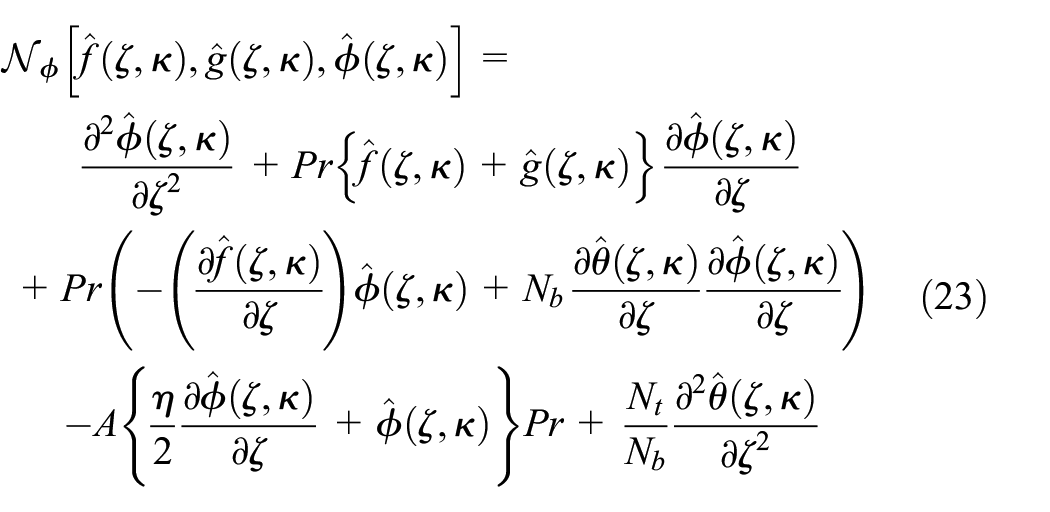
where are arbitrary constants. From equations (9)–(12), the expressions for nonlinear operatives are
If is the embedding factor and the non-zero auxiliary constraints are , then the deformation problems are taken at zeroth-order is
This equation implies the following solutions for
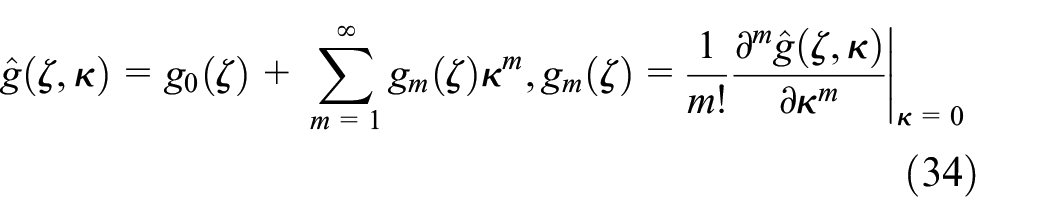
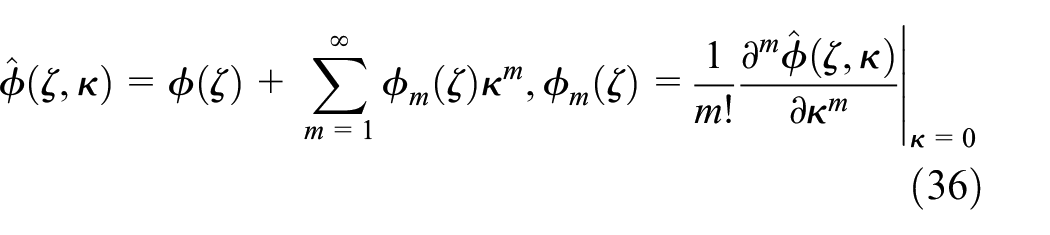
, , , and varies from , , , and to the solutions , , , and as varies from to . The Taylor series at this stage provides information as
The auxiliary parameters from equations (33)–(36) give the information of convergence of series solutions. Assuming that are selected such that the series in equations (33)–(36) is convergent at . Thus
HAM’s developed equations (solutions) include auxiliary parameters such as , and . Such parameters play a significant role in convergence and approximation rate. The right values for convergent solutions are the performed at approximations of the 25th order. The acceptable values ranges are as you can see in Figure 2. Table 1 shows the solution convergence approximation order, and it can be noted that the approach is compatible at approximations of the 25th order for the distributions of concentration and temperature while it converges at the 17th order for the flow analysis.
The for , , and .
Convergence test of various approximation ranges uses HAM solutions if and .
Approximate order
1
−0.8248028
−0.361215
−1.189583
1.18958
5
−0.8443760
−0.360637
−1.314035
1.31404
10
−0.8443823
−0.360497
−1.312236
1.31224
15
−0.8443835
−0.360493
−1.312291
1.31229
17
−0.8443836
−0.360491
−1.312292
1.31229
20
−0.8443836
−0.360491
−1.312294
1.31229
25
−0.8443836
−0.360491
−1.312273
1.31227
30
−0.8443836
−0.360491
−1.312273
1.31227
35
−0.8443836
−0.360491
−1.312273
1.31227
40
−0.8443836
−0.360491
−1.312273
1.31227
Discussion
The consequences of parameters arising such as unsteady parameter A, ratio parameter , Deborah numbers and , thermophoresis , Brownian motion , and Prandtl number Pr on nanoparticle concentration and temperature fields are elaborated in this part. The nature of these constraints on the temperature profile is sketched in Figures 3–9. The impact of unsteadiness constraint A is executed in Figure 3. This figure portrays a decrease in the temperature and thermal layer of thickness by the improvement in the unsteadiness constraint. It relies on the thermal diffusivity due to the unsteady parameter. As we raise the unsteady parameter, the thermal diffusivity decreases and therefore temperature decreases. The influence of the stretching parameter on the temperature profile is examined via Figure 4. Here, temperature decay and thickness of thermal layer are considered for larger stretching parameter values. Clearly, the layer thickness reduces due to the cooler-to-ambient liquid for greater values of stretching parameter. Figure 5 demonstrates the Deborah number impacts on the temperature distribution. This figure elucidates that the larger Deborah number values correspond to temperature rises. The higher relaxation time factor is responsible for augmentation in temperature . The nature of Deborah number on temperature is reported in Figure 6. Temperature is a decreasing function of higher Deborah number values. This is because if we augment the Deborah number values, the factor of retardation time is larger, which produces a decrease in the temperature . It is important to illustrate here that corresponds to the case of viscous fluid and represents the state of Maxwell fluid flow.
Variations of A on .
Variations of on .
Variations of on .
Variations of on .
Variations of on .
Variations of on .
Variations of Pr on .
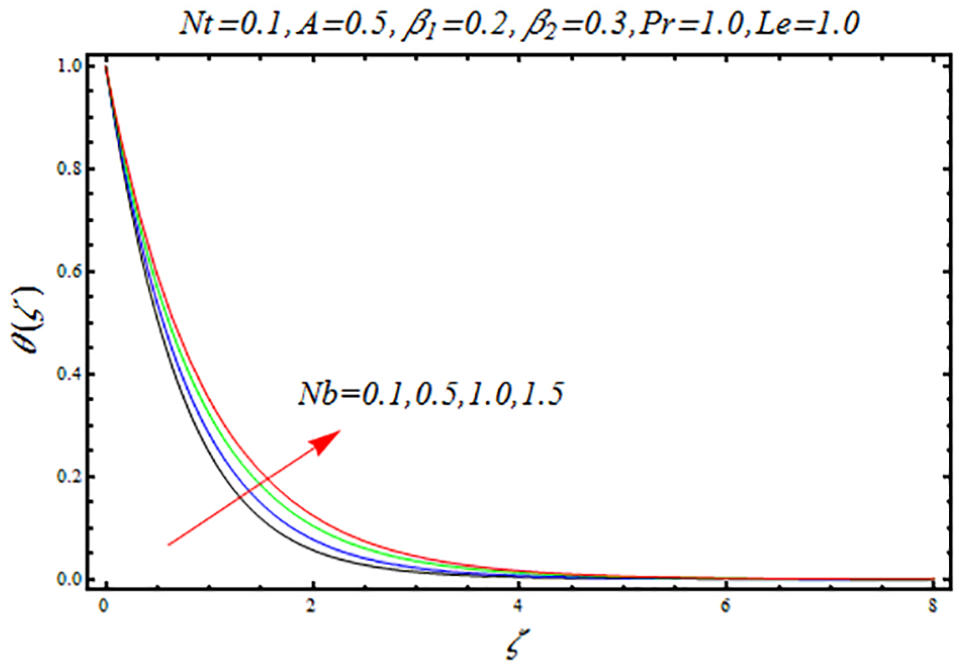
The behavior of temperature for distinct Brownian movement and thermophoresis values is designated in Figures 7 and 8. For greater Brownian movement constraint values, an augmentation is reported in the temperature . The viscous forces decrease for higher values of Brownian movement and the Brownian diffusion factor improves due to which the boundary layer thickness and temperature increase. Figure 8 discloses that the temperature profile and thickness layer increase for higher thermophoresis values. Thermophoresis factor plays an important role in the temperature distribution. When we augment the thermophoresis, the thermophoretic forces enhance and the nanoparticles move from warm areas to cold areas because of these forces. The temperature and thickness of thermal layer decay due to enhancing values of Prandtl number Pr (see Figure 9). In addition, the Prandtl number increases or decreases as a result of increase or decrease in the fluid’s thermal diffusivity. For greater values of Prandtl number, the thermal diffusivity of the fluid increases, and it leads to decrease in the temperature .
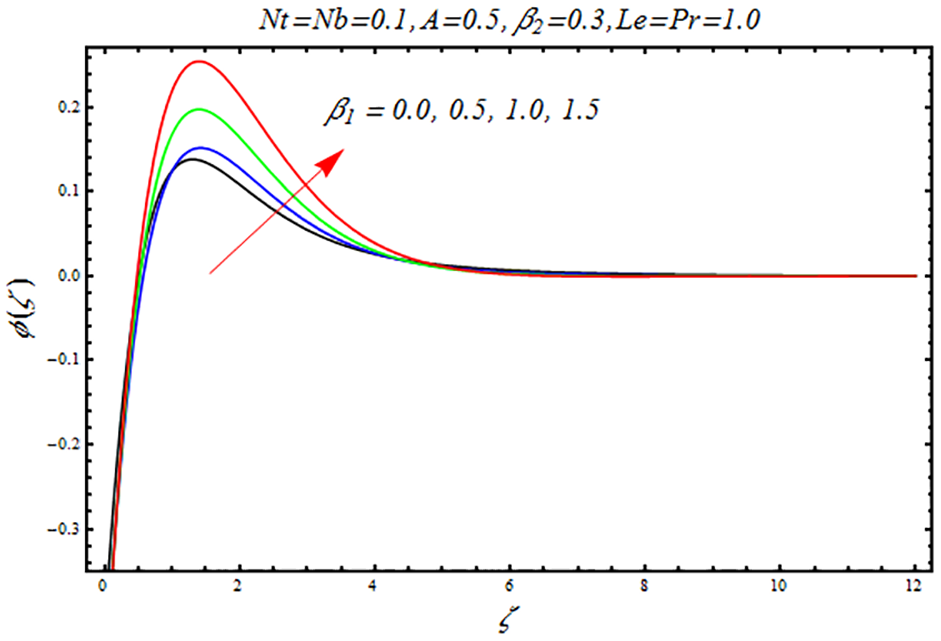
To observe the parametric behavior of unsteady constraint A, ratio parameter , Deborah numbers and , Brownian movement , thermophoresis , Prandtl number Pr, and Lewis number Le on nanoparticle concentration fields, we present Figures 10–17. The role of unsteady constraint A is seen in Figure 10. As a consequence of higher values of unsteady constraint, the profile of concentration and thickness of concentration layer are decreased. Figure 11 shows the nature of stretching constraint on . The nanoparticles concentration decreases due to improved stretching constraint. The activity of Deborah number is addressed in Figure 12. Improvement in the concentration profile and boundary thickness is observed for higher Deborah number values. Figure 13 shows the effect of Deborah number on the concentration profile. With higher values of the concentration of nanoparticles retards. Figure 14 elucidates that the higher factor of Brownian movement leads to decaying trend of concentration profile . In the case of the thermophoresis constraint , the reverse behavior of is noted (see Figure 15). It is investigated that the parameter of thermophoresis influences the nanomaterial more compared to the parameter of Brownian motion. The influence of Prandtl number on the nanoparticles concentration is sketched in Figure 16. It is worth mentioning that the concentration profile of nanoparticles is decreasing due to the higher Prandtl number values. It is due to the increased concentration of nanoparticles near the surface for higher values of Prandtl number decreases the adjunct thickness of the boundary layer. Lewis number Le impact on is displayed in Figure 17. A decrease in is achieved for higher Lewis values. This happens because the diffusion factor is inversely related to Lewis number. Hence, weaker diffusion factor is occurred due to Larger Lewis number due to which nanoparticles concentration profile is decreased.
Variations of A on .
Variations of on .
Variations of on .
Variations of on .
Variations of on .
Variations of on .
Variations of Pr on .
Variations of Le on .
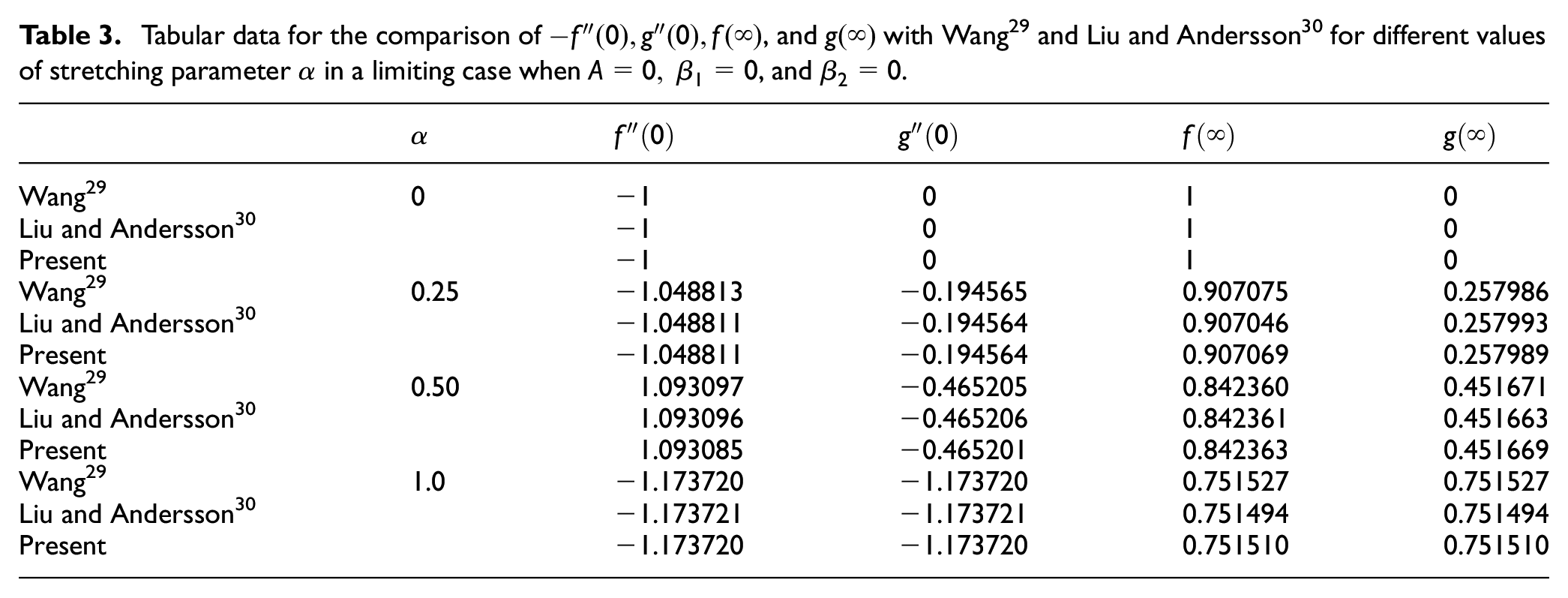
Table 2 shows that the heat transport rate (Nusselt number) for distinct . From tabular data, it can be seen that increases for greater values of A, and decreases for the enlargement of the values of . Table 2 clearly shows that the values of in case of Oldroyd-B fluid are higher as compared to Maxwell fluid. In order to check the accuracy of our method, the values of , and for different values of stretching parameter are compared with Wang29 and Liu and Andersson30 for Newtonian fluids (Table 3). We observed that the solutions have excellent agreement with the previously published data in a limiting approach.
Heat transport rate (Nusselt number) for multiple values .
A
Le
Pr
0.0
0.5
0.2
0.3
1.0
0.1
0.1
1.0
0.825084
0.5
0.919319
1.0
1.151284
1.5
1.232875
0.5
0.0
1.21124
0.5
1.29571
1.0
1.69026
1.5
1.79571
0.5
0.5
0.0
1.36879
0.5
1.26071
1.0
1.17786
1.5
1.11739
0.5
0.0
1.26071
0.5
1.37215
1.0
1.49512
1.5
1.57675
0.5
0.1
1.38586
0.5
0.938207
1.0
0.87859
1.5
0.77637
0.5
0.1
1.47228
0.5
1.44559
1.0
1.38295
1.5
1.38176
0.5
0.1
1.28195
0.5
1.28193
1.0
1.28184
1.5
1.28171
0.5
0.1
0.99462
0.5
0.92444
1.0
1.87295
1.5
1.86627
Tabular data for the comparison of , and with Wang29 and Liu and Andersson30 for different values of stretching parameter in a limiting case when , and .
This work introduces the time-dependent phenomenon in three-dimensional Oldroyd-B nanomaterial flow generated by the unsteady bilateral moving sheet. Series solutions are obtained for the developed transformed differential expressions. The important points of this investigation are summarized as follows:
The decay in temperature and concentration distributions is significant for improving values of time-dependent constraint A.
The larger Deborah number values strengthened the profiles of nanoparticle concentration and temperature , while these curves are reducing for improving Deborah number
An enhancement in Brownian movement and thermophoresis boost up the temperature and its thermal thickness layer.
Higher Brownian movement and Lewis number Le correspond to weaker nanoparticle concentration profile.
The situation of steady flow is retrieved for .
Rate of heat transportation at the wall is increased for greater values of , but remain constant for .
Footnotes
Appendix 1
Handling Editor: James Baldwin
Declaration of conflicting interests
The author(s) declared no potential conflicts of interest with respect to the research, authorship, and/or publication of this article.
Funding
The author(s) received no financial support for the research, authorship, and/or publication of this article.
ORCID iDs
Manzoor Ahmad
Sabir Ali Shehzad
References
1.
LarsonRG. The structure and rheology of complex fluids. New York: Oxford University Press, 1999.
2.
BhatnagarRKGuptaGRajagopalKR. Flow of an Oldroyd-B fluid due to a stretching sheet in the presence of a free stream velocity. Int J Nonlin Mech1995; 30: 391–405.
3.
HayatTImtiazMAlsaediA. Boundary layer flow of Oldroyd-B fluid by exponentially stretching sheet. Appl Math Mech2016; 37: 573–582.
4.
NiuJShiZ-HTanW-C. The viscoelastic effects on thermal convection of an Oldroyd-B fluid in open-top porous media. J Hydrodyn2013; 25: 639–642.
5.
HayatTHussainTShehzadSA, et al. Flow of Oldroyd-B fluid with nanoparticles and thermal radiation. Appl Math Mech2015; 36: 69–80.
6.
KhanSUAliN. Unsteady hydromagnetic flow of Oldroyd-B fluid over an oscillatory stretching surface: a mathematical model. Tech Sci2017; 20: 87–100.
7.
MustafaMHayatTAlsaediA. Rotating flow of Oldroyd-B fluid over stretchable surface with Cattaneo–Christov heat flux: analytic solutions. Int J Numer Method H2017; 27: 2207–2222.
8.
GuptaSGuptaS. MHD three dimensional flow of Oldroyd-B nanofluid over a bidirectional stretching sheet: DTM-Padé Solution. Nonlinear Eng2019; 8: 744–754.
9.
ShehzadSAAlsaediAHayatT, et al. Three-dimensional flow of an Oldroyd-B fluid with variable thermal conductivity and heat generation/absorption. PLoS ONE2013; 8: e78240.
10.
SulaimanMAliAIslamS. Heat and mass transfer in three-dimensional flow of an Oldroyd-B nanofluid with gyrotactic micro-organisms. Math Probl Eng2018; 2018: 6790420.
11.
ChoiSUSEastmanJA. Enhancing thermal conductivity of fluids with nanoparticles. In: Proceedings of the 1995 ASME international mechanical engineering congress and exposition, San Francisco, CA, 12–17 November 1995, paper no. FED 231/MD, vol. 66, pp.99–105. New York: ASME.
12.
BuongiornoJ. Convective transport in nanofluid. J Heat Trans: T ASME2006; 128: 240–250.
13.
TurkyilmazogluM. Mixed convection flow of magnetohydrodynamic micropolar fluid due to a porous heated/cooled deformable plate: exact solutions. Int J Heat Mass Tran2017; 106: 127–134.
14.
TurkyilmazogluM. Buongiorno model in a nanofluid filled asymmetric channel fulfilling zero net particle flux at the walls. Int J Heat Mass Tran2018; 126: 974–979.
15.
AbbasiFMGulMShehzadSA. Hall effects on peristalsis of boron nitride-ethylene glycol nanofluid with temperature dependent thermal conductivity. Physica E2018; 99: 275–284.
16.
IzadiMMehryanSAMSheremetMA. Natural convection of CuO-water micropolar nanofluids inside a porous enclosure using local thermal non-equilibrium condition. J Taiwan Inst Chem E2018; 88: 89–103.
17.
AbbasiFMShanakhatIShehzadSA. Entropy generation analysis for peristalsis of nanofluid with temperature dependent viscosity and Hall effects. J Magn Magn Mater2019; 474: 434–441.
18.
WaqasMShehzadSAHayatT, et al. Simulation of magnetohydrodynamics and radiative heat transport in convectively heated stratified flow of Jeffrey nanofluid. J Phys Chem Solids2019; 133: 45–51.
19.
RamReddyCMurthyPVSNChamkhaAJ, et al. Soret effect on mixed convection flow in a nanofluid under convective boundary condition. Int J Heat Mass Tran2013; 64: 384–392.
20.
RashadAMChamkhaAJAbdouMMM. Mixed convection flow of non-Newtonian fluid from vertical surface saturated in a porous medium filled with a nanofluid. J Appl Fluid Mech2013; 6: 301–309.
21.
ChamkhaAJRashadMGorlaRSR. Non-similar solutions for mixed convection along a wedge embedded in a porous medium saturated by a non-Newtonian nanofluid: natural convection dominated regime. Int J Numer Method H2014; 24: 1471–1786.
22.
GhalambazMBehsereshtABehsereshtJ, et al. Effects of nanoparticles diameter and concentration on natural convection of the Al2O3–water nanofluids considering variable thermal conductivity around a vertical cone in porous media. Adv Powder Technol2015; 26: 224–235.
23.
TliliIRashadAMKhanWA, et al. Unsteady slip flow of a micropolarnanofluid over an impulsively stretched vertical surface. Indian J Pure Ap Phy2019; 57: 773–782.
24.
KumarKGRameshGKGireeshaBJ, et al. On stretched magnetic flow of Carreau nanofluid with slip effects and nonlinear thermal radiation. Nonlinear Eng2019; 8: 340–349.
25.
ChamkhaAAbbasbandySRashadAM. Non-Darcy natural convection flow for non-Newtonian nanofluid over cone saturated in porous medium with uniform heat and volume fraction fluxes. Int J Numer Method H2015; 25: 422–437.
26.
ReddyPSChamkhaAJ. Soret and Dufour effects on MHD convective flow of Al2O3–water and TiO2–water nanofluids past a stretching sheet in porous media with heat generation/absorption. Adv Powder Technol2016; 27: 1207–1218.
27.
ReddyPSSreedeviPChamkhaAJ. MHD boundary layer flow, heat and mass transfer analysis over a rotating disk through porous medium saturated by Cu-water and Ag-water nanofluid with chemical reaction. Powder Technol2017; 307: 46–55.
28.
RashadAMKhanWAEL-KabeirSM, et al. Mixed convective flow of micropolar nanofluid across a horizontal cylinder in saturated porous medium. Appl Sci2019; 9: 5241.
29.
WangCY. The three-dimensional flow due to a stretching flat surface. Phys Fluids1989; 27: 1915–1917.
30.
LiuICAnderssonI. Heat transfer over a bidirectional stretching sheet with variable thermal conditions. Int J Heat Mass Tran2008; 51: 4018–4024.
31.
XuHLiaoSJPopI. Series solutions of unsteady three-dimensional MHD flow and heat transfer in the boundary layer over an impulsively stretching plate. Eur J Mech B: Fluid2007; 26: 15–27.
32.
HayatTMustafaMHendiAA. Time-dependent three-dimensional flow and mass transfer of elastico-viscous fluid over unsteady stretching sheet. Appl Math Mech2011; 32: 167–178.
33.
AwaisMHayatTAlsaediA, et al. Time-dependent three-dimensional boundary layer flow of a Maxwell fluid. Comput Fluids2014; 91: 21–27.
34.
AhmadIAhmadMSajidM. Heat transfer analysis of MHD flow due to unsteady bidirectional stretching sheet through porous space. Therm Sci2016; 20: 1913–1925.
35.
AhmadMAhmadISajidM. Magnetohydrodynamic time-dependent three-dimensional flow of Maxwell fluid over a stretching surface through porous space with variable thermal conditions. J Braz Soc Mech Sci2016; 38: 1767–1778.
36.
AhmadMAhmadISajidM, et al. Flow of an Oldroyd-B fluid past an unsteady bidirectional stretching sheet with constant temperature and constant heat flux. J Appl Fluid Mech2016; 9: 1329–1337.
37.
AhmadMTajMAbbasiA, et al. Time-dependent 3D flow of Maxwell nanofluid due to an unsteady stretching surface through porous space. J Braz Soc Mech Sci2019; 41: 452.
38.
LiaoSJ. The proposed homotopy analysis method for the solution of nonlinear problems. PhD Thesis, Shanghai Jiao Tong University, Shanghai, China, 1992.
39.
TurkyilmazogluM. Solution of the Thomas-Fermi equation with a convergent approach. Commun Nonlinear Sci2012; 17: 4097–4103.
40.
AbbasbandySHashemiMSHashimI. On convergence of homotopy analysis method and its application to fractional integro-differential equations. Quaest Math2013; 36: 93–105.
41.
HayatTKiyaniMZAhmadI, et al. On analysis of magneto Maxwell nano-material by surface with variable thickness. Int J Mech Sci2017; 131: 1016–1025.
42.
ShehzadSA. Magnetohydrodynamic Jeffrey nanoliquid flow with thermally radiative Newtonian heat and mass species. Rev Mex Fis2018; 64: 628–633.
43.
SchlichtingH. Boundary-layer theory. New York: McGraw-Hill, 1964.