



Abstract
The compressive densification strain of honeycomb paperboard is one of the important parameters which affect the energy absorption property of honeycomb paperboard. The in-plane bearing mechanism of honeycomb paperboard in plastic zone was analyzed based on compression tests of the single row and multi-rows of honeycomb paperboard. The result indicates that the core layer plays a supporting role in resisting the buckling of the face layer. The double inner folds are formed in machine direction and the symmetrical inner folds are formed in cross direction in a honeycomb core. The core single wall and the face layer play a critical role in the load bearing in machine direction, and the core double walls, core single wall, and face layer all play critical roles in the load bearing in cross direction. On this basis, the evaluation equation of the compressive densification strain was obtained based on the energy absorption efficiency method and geometric scale effect, which are verified so that the experiment and test results are in good agreement.
Keywords
Porous honeycomb materials have been widely applied in the field of aviation, construction, and packaging due to their superior properties such as lightweight, high strength, and strong energy absorption ability. Bearing and cushioning performance of honeycomb paperboard was the hotspot not only in the domestic but also in the international research field over the years.
For a long time, research on metal honeycomb materials has achieved preliminary results on bearing capacities and cushioning performance. Focused on bearing mechanism, Gibson and Ashby 1 established mathematical models on the basis of one honeycomb core, which lays the foundation for the search of deformation mechanism and property characterization. Zhu and colleagues2,3 had investigated the characterization of in-plane elastic and plastic properties of metal honeycombs with different core wall thickness. Wang et al. 4 studied the instability and collapse of aluminum honeycombs under in-plane unidirectional compression.
Cricrì et al. 5 studied the in-plane impact behavior, tensile behavior, and shear behavior of honeycomb core. Khan et al. 6 studied the crushing properties of aluminum honeycomb from out-of-plane and two directions of in-plane. Jin et al. 7 studied the effects of specimen dimension on stiffness and determined the minimum specimen. Stefan Sorohan et al. 8 used the in-plane bearing model and analyzed the properties of honeycombs using numerical simulated calculation by homogenization method. Galehdari et al. 9 studied the in-plane bearing property of metal honeycomb with quasi-static and low-velocity impact. On these foundations, many researchers studied the in-plane properties of face layer, 10 assisted layer, 11 and face layer curing pressure. 12 Jian et al. 13 derived the failure mechanism maps by investigating different configuration cores under in-plane compression. Peng et al. 14 studied the in-plane compression deformation mode of brazing aluminum honeycomb panel. Yuming Li et al. 15 focused on the effects of in-plane elasticity modulus of honeycomb sandwich with different face layers and different sandwich thickness.
Honeycomb paperboard is a new kind of environment-friendly material after corrugated paperboard and is widely applied in the field of packaging, construction, and so on. Research focused on the out-of-plane load performances and cushioning properties, and established out-of-plane critical load16,17 and the out-of-plane platform stress model.18,19 Meanwhile, the out-of-plane cushioning properties of honeycomb paperboard were studied based on the energy absorption diagram,20–22 and the compressive densification strain of paper honeycombs was evaluated.1,23,24 The out-of-plane densification strain was obtained due to the relationship between limit strain and relative density.
Xu and Li 25 studied the in-plane bearing property of honeycomb paperboard with different face layers. According to the in-plane bearing deformation test in machine direction (M.D.), Wang and Lu 26 characterized the in-plane platform stress of honeycomb paperboard which was affected by relative humidity (RH). Mou and colleagues27,28 characterized the in-plane platform stress with energy conservation theorem.
In-plane compressive densification strain is a key parameter which affects in-plane load performance and energy absorption properties, but there are only few reports on the mechanism and characterization of densification strain. This article studied the in-plane bearing mechanism of honeycomb paperboard based on geometric scale effect and then carried out evaluation of in-plane densification strain. It provided a further technical basis for researching the in-plane bearing performance and cushioning property of honeycomb paperboard.
Analysis of face and core layer plastic progressive folding mechanism of honeycomb paperboard
The honeycomb paperboard structure is shown in Figure 1. In the in-plane loading, the honeycomb face layer and the core layer are jointly stressed and are divided into two directions. The tensile direction of the honeycomb core is set in the M.D., and the vertical direction is set in the cross direction (C.D.).

Honeycomb paperboard: (a) honeycomb paperboard structure and (b) core structure diagram.
Based on practical application, the honeycomb paperboard mainly bears the in-plane loads from M.D. and C.D., regardless of other angular deformations. The plastic deformation of the core wall is different when the paperboard is formed from two directions, and the buckling forms of the face layer are different when densification occurs.
As shown in Figure 2, the in-plane bend behavior of honeycomb paperboard in both M.D. and C.D. contains three zones: elastic zone (Figure 2(c), 1 and 4), plastic zone (Figure 2(c), 2 and 5), and densification zone (Figure 2(c), 3 and 6).

In-plane bearing diagram of single-row honeycomb paperboard: (a) bearing in M.D., (b) bearing in C.D., and (c) bearing curves.
In the case of loading from M.D., the loading and buckling properties of single wall have little effect on the in-plane plastic bearing strength for the whole paper honeycomb, and the stress difference is small; therefore, it is stable for plastic stress (Figure 2(c), 2).
In the case of loading from C.D., the stress of double-wall bearing is the peak value in plastic zone (Figure 2(c), 7), and the stress of single-wall bearing is the trough value in plastic zone (Figure 2(c), 8). A honeycomb core consists of two single walls in the same direction, so double-trough is formed (Figure 2(c), 8 and 10) and larger fluctuation in plastic zone is observed.
In the case of loading of multi-row honeycomb paperboard, initial densification strain from C.D. is lower than that from M.D. (Figure 3). The stress is stable for plastic stress in M.D. The difference in stress between peak and trough decreases gradually with an increase in strain in C.D., which is affected by stress transferring, and the densification zone in M.D. is less than that in C.D.; this can consequently affect the load and energy absorption properties of the material.

In-plane bearing diagram of multi-row honeycomb paperboard: (a) bearing in M.D., (b) bearing in C.D., and (c) bearing curves.
When bearing in M.D., the core single-wall buckles form an inner-concave wrinkling in yield behavior of the face layer (Figure 4(a) and (b)). A honeycomb core consists of two single walls (upper and lower), and double adhesive walls are close to each other layer by layer, so double-concave folds are formed as “W” on the face layer in a complete honeycomb core. The phenomenon of fold is not obvious, and single wrinkling is found in the case of deficient bending stress in face layer and incomplete deformation in core layer (Figure 4(c) and (d)).

In-plane bearing of honeycomb paperboard (M.D.): (a) static compression process, (b) stress–strain curve, and (c–e) deformation.
When bearing in C.D., core single-wall buckling drives two-layer bonded panels close to each other vertically, which results in the face layer subsiding toward unit core. When densification strain commences, the double walls are mostly in vertical or inclined state. With the increase in densification strain, the double adhesive wall begins to bend, and consequently the inner concave refolds and tends to densify at last (Figure 5(a) and (c))

In-plane bearing of honeycomb paperboard (C.D.): (a) static compression process, (b) stress–strain curve,(c) cross direction (face removed), and (d) deformation;
Based on the division of double wall, the face layer is formed as “X” to be a left-right symmetrical inner-concave structure (Figure 5(d)).
As can be seen from Figures 4(e) and 5(d), the face layer with firm bonding form even folds, and the face layer with weak bonding breaks away from the core layer and bulges out, which both affect the value of the strain.
Evaluation of in-plane compressive densification strain of honeycomb paperboard based on energy absorption efficiency
The compressive densification strain of honeycomb paperboard is an important parameter which affects the energy absorption of honeycomb paperboard.
Energy absorption efficiency

The corresponding strain becomes the densification strain when the curve of energy absorption efficiency reaches the climax, the equation of which is given by 28

In-plane energy absorption efficiency–strain curve of honeycomb is drawn by MATLAB, and the corresponding stress–strain curves are shown in Figure 6.

In-plane stress–strain curve and energy absorption efficiency–strain curve of honeycomb paperboard: (a) machine direction and (b) cross direction.
The stress–strain curve increases linearly and holds a stable stage, and enters the ascent stage rapidly as the strain increases. Meanwhile, the energy absorption efficiency increases up to a peak and then drops rapidly as the strain increases, and the corresponding peak strain is the densification strain.
Evaluation of in-plane compressive densification strain of honeycomb paperboard based on geometric scale effect
The wrinkle of core and face layers is compact, and the slope of stress–strain curve is close to the elasticity modulus of paper when the honeycomb paperboard enters the compaction zone. The bigger the elasticity modulus of paper, the smaller the energy absorption. Therefore, the strain when the face layer completely contacts the wrinkling of core layer is considered as densification strain. Based on the difference in material and structural parameters, the corresponding densification strain of honeycomb is fluctuant. The densification strain is constrained by environmental conditions and technological conditions, and the bearing strength and densification strain are influenced by factors such as cracking of adhesive layer and instability in the process of loading.
Evaluation of in-plane compressive densification strain of honeycomb paperboard in M.D.
Compressive densification strain of face layer and core layer in close bonding
The deformation mechanism of honeycomb paperboard in M.D., is shown in Figure 2(a) and (b), and the simplified model is shown in Figure 2(c). There is double wrinkling in one core unit when the face layer and core layer are closely bonded. Therefore, the equation of the compressive densification strain in M.D. can be obtained as

where
In the regular hexagonal honeycomb structure,

Compressive densification strain between the face layer and the core layer in separating state
When the bonding force between the face layer and the core layer is insufficient, it is easy to separate the face layer from the core layer during the loading process.
Considering the limit condition, that is, the face layer and the core layer are separated completely, and the strain of complete compression of double layer core is the compressive densification strain. The equation of the compressive densification strain of the regular hexagonal core structure of honeycomb paperboard in M.D. can be obtained as

In the regular hexagonal honeycomb structure,

The real densification strain of honeycomb paperboard
Due to the influence of production bonding technology, there is a partial separation between honeycomb paperboard face layer and core layer in practical application. Then, the range of in-plane densification strain in M.D. should be as follows

Evaluation of in-plane compressive densification strain of honeycomb paperboard in C.D.
Compressive densification strain of the face layer and core layer in close bonding
The deformation mechanism of honeycomb paperboard in C.D. is shown in Figure 2(d) and (e). The upper and lower double wallboards approach vertically until buckling, and the equation of the compressive densification strain in C.D. can be obtained as

where
In the regular hexagonal honeycomb structure,

Compressive densification strain of the face layer and core layer in separating state
When the bonding force between the face layer and the core layer is insufficient, it is easy to separate the face layer from the core layer during the loading process. In the extreme case, the face layer is completely separated from the core layer, and the densification strain should be the strain when the erect double walls incline until they are compacted.
The equation of the compressive densification strain in C.D. can be obtained as

In the regular hexagonal honeycomb structure,

The densification strain of honeycomb paperboard in practical application
Affected by the bonding process, the partial separation phenomenon is observed in the face layer and core layer of honeycomb paperboard during bearing. Then, the range of in-plane densification strain in C.D. should be as follows

Experiment verification
Experimental materials
The classification of the honeycomb paperboards used for testing is presented in Table 1. The different parameters used for representing the honeycomb paperboards are in the following order: weight of the face layer, weight of the core layer, honeycomb side length, and board thickness. For example, label “607-117A-20” represents a honeycomb paperboard with the weight of the face layer corresponding to 607 g/m2, weight of the core layer corresponding to 117 g/m2, honeycomb side length corresponding to A, and board thickness corresponding to 20 mm.
Key parameters of honeycomb paperboard.

Experimental method
Testing the physical performance of base paper
The standard samples were cut based on the testing methods of national standards GB/T451.2-2002: PAPER AND BOARD—DETERMINATION OF GRAMMAGE. A temperature humidity chamber (Rong Xinli, model: RTH-408ST) was used to maintain the standard sample at a constant temperature and humidity (temperature: 23°C, RH: 50%) for at least 24 h. The thickness was determined via a thickness meter (type: Changchun paper test factory ZH-4).
Testing static load of the in-plane honeycomb paperboard
Based on GB/T 1454-2005: TEST METHOD FOR EDGEWISE COMPRESSIVE PROPERTIES OF SANDWICH CONSTRUCTION, samples of different types of honeycomb paperboards were cut with sizes corresponding to 100 mm × 100 mm. Subsequently, the samples were placed in a temperature humidity chamber (temperature: 23°C, RH: 50%) for at least 48 h, and the time required for the temperature and humidity to achieve the regulations was recorded, and the corresponding values were maintained for 1 h. After removing each sample from the temperature humidity chamber, it was tested by the universal material tester (type: instron3369, Figure 7) within 10 min, and the average of platform stresses was calculated. In the testing condition, the static compression rate was 12 mm/min, and the test was repeated five times.

In-plane bearing test of honeycomb paperboard: (a) the universal material tester, (b) machine direction, and (c) cross direction.
Results and discussion
Effect of cellular side lengths and thickness of core paper on densification strain
Based on the weight of the face paper, densification strains in M.D. and C.D. fall within acceptable ranges (Table 2). It causes the value of densification strains to be at a higher level and approaches the theoretical upper limitations.
Theoretical value and experimental value of in-plane densification strain of honeycomb paperboard (

M.D.: machine direction; C.D.: cross direction.
Effect of cellular side lengths and thickness of overlay paper on densification strain
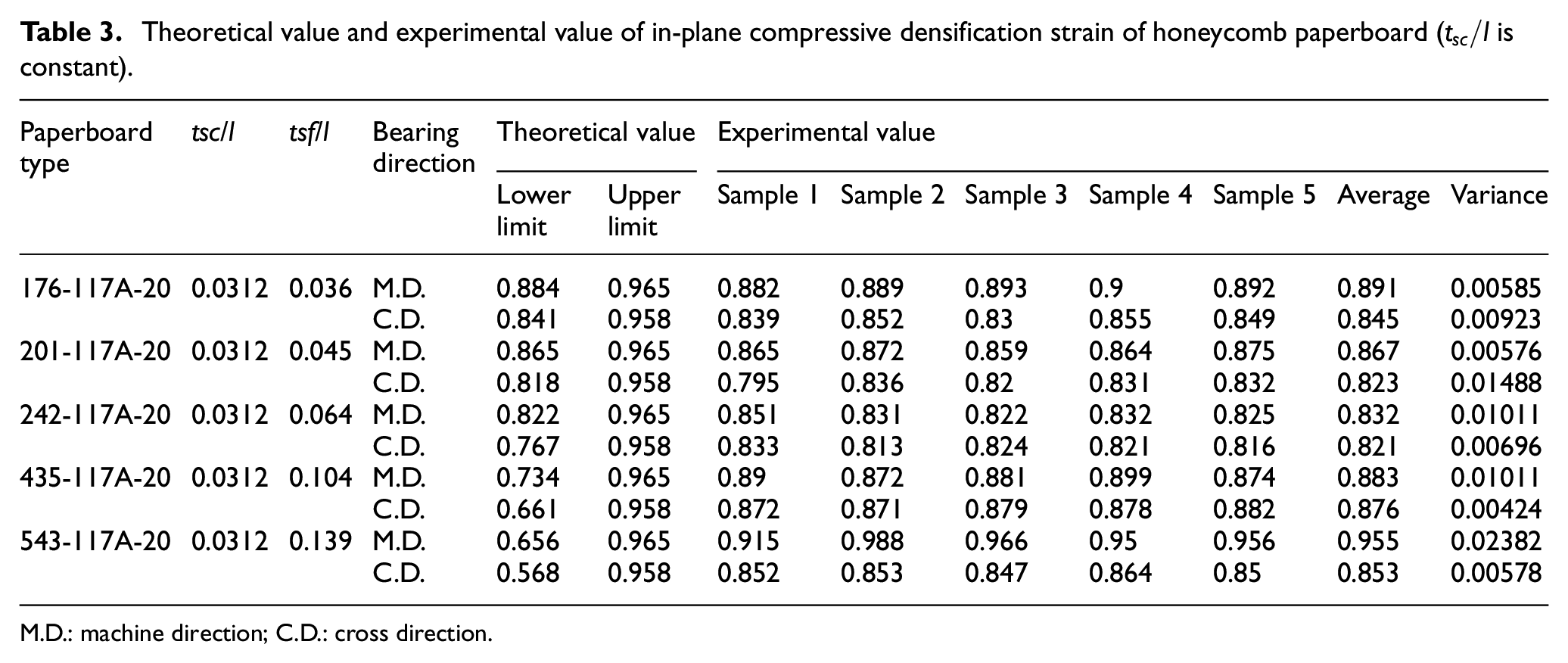
Densification strains in M.D. and C.D. fall within acceptable ranges (Table 3), which agree with theoretical calculation. Honeycomb easily forms the regular inner-concave wrinkling when the weight of the face paper is low; therefore, the densification strains approach the theoretical lower limitations. With the weight of face paper increasing, face layers incline to separate from core layers and densification strains increase on the condition of in-plane yield status; the experimental results are close to theoretical upper limitations.
Theoretical value and experimental value of in-plane compressive densification strain of honeycomb paperboard (
M.D.: machine direction; C.D.: cross direction.
Conclusion
The deformation mechanism of honeycomb paperboard under in-plane M.D. and C.D. is different. When bearing from M.D., the face layer buckles form an inner-concave wrinkling in the yield behavior of core single wall, and the face layer forms double inner folds as “W” in each honeycomb core correspondingly. When bearing from C.D., the face layer is sunk due to the buckling of core single wall, and the face layer forms concave folds as “X” in each honeycomb core.
The bearing mechanism of honeycomb paperboard under in-plane M.D. and C.D. is different. The core single wall and the face layer play a critical role in bearing in M.D., and the curves of stress in plastic zone are stable. The core double walls, core single wall, and face layer play a critical role in bearing in C.D.. There is a huge difference in stresses between the double-wall bearing and single-wall bearing. The troughs appear during single-wall bearing, the peaks appear during double-wall bearing, and the stress fluctuation is higher in plastic zone.
The evaluation methods and zone evaluation equations of the in-plane compression densification strain of honeycomb paperboard in M.D. and C.D. are obtained based on the energy absorption efficiency method and geometric scale effect, and also by combining the deformation mechanism of core layers and face layers, which provides the theoretical basis for energy absorption characterization of honeycomb paperboard.
Footnotes
Handling Editor: Mohammad Arefi
Declaration of conflicting interests
The author(s) declared no potential conflicts of interest with respect to the research, authorship, and/or publication of this article.
Funding
The author(s) disclosed receipt of the following financial support for the research, authorship, and/or publication of this article: This study was supported by the Scientific Research Plan Project of Tianjin Municipal Education Commission (2019KJ159) and the Science Research Foundation Project of Tianjin Vocational Institute (20151102).
