



Abstract
The analysis of the quantity discount of the decentralized supply chain has been studied only for single-period planning models. This article presents the design of an optimal quantity discounts for multi-period bilevel production planning for two-echelon supply chains under demand uncertainty. In order to derive an optimal contract for multi-period production planning, the cumulative order quantity and production quantity are introduced. From our proposed model, a Stackelberg equilibrium is analytically derived for the supply chain when the supplier is the leader and the retailer is the follower. An optimal discount contract is analytically designed through the optimal solution of the centralized problem. Computational results show the effectiveness of the proposed discount contract under demand uncertainty.
Keywords
Introduction
The multi-period production planning under demand uncertainty over time periods is one of the important challenges in various business organizations. A variety of production planning models and theoretical developments have been developed for multi-period production planning under demand uncertainty.1,2 Among these studies, the coordination of multi-period newsvendor problem has received much attention from researchers. The classical newsvendor problem is the one in which the decision-maker is faced with the situation of placing an order of a perishable item to meet the uncertain demand for a single-period such that the expected profit is maximized. The optimal solution of the problem is the trade-off between the expected cost of overstocking and understocking of the product.
Several types of contracts such as quantity discounts, revenue sharing, and buyback have been employed to realize the entire optimization under uncertain demands. However, due to its complexity, the analysis of optimal contracts for multi-period production planning models has been one of the significant issues under uncertain demands, which has not been addressed before. This article presents an analytical model for the equilibrium analysis of multi-period planning for two-echelon supply chains under demand uncertainty.
The goal of the analysis is to design the optimal contract between the entities that allow the decentralized supply chains to perform as well as a centralized one in which all decisions are made by a single entity. The coordination of production planning problems for suppliers and retailers in decentralized supply chains can be treated as supply chain games. 3 There are two types of games in supply chains. One is a cooperative game, and the other is a noncooperative game. One of the noncooperative games is a Stackelberg game which is conducted by the leader and the follower. In this case, supply chain contracts are introduced into a leader–follower relationship in order to maximize the total profit. Hohn 4 studied some types of supply chain contracts in a Stackelberg game. Supply chain contracts include only wholesale price discount contracts, buyback contract and quantity discount contracts. Chen 5 studied a buyback contract in a single-period newsvendor problem. Moreover, Tsai 6 studied the optimization of the supply chain by introducing the quantity discount contract. Tsai’s model was developed only for manufacturer’s standpoint.
However, multi-period production planning problems have inventory balancing constraints, which makes it difficult to derive an optimal solution analytically. The multi-period supply chain models with some complex constraints are studied in Kogan and Tapiero. 3 However, it is also difficult to analyze the solution of the multi-period bilevel production planning under demand uncertainty for the supplier and the retailer due to its complexity. Therefore, a multi-period production planning model is required when uncertain demands are considered. The customer’s demands have been regarded as uncertain in most studies related to supply chain planning models. Zhang et al. 7 studied a multi-period production planning with quantity discounts. In their model, the retailer’s decision variable is defined as the total amount of order quantity, which makes it easier to solve the problem analytically. However, Zhang et al.’s model only considers the production planning problem from the retailer’s standpoint.
The problem that we study is motivated by the online retailer and manufacturing industries such as parts supplier and assembly manufacturer.
These companies require the analysis of the business environment for a period of time considering collaboration and cooperation between the supplier and manufacturer under demand uncertainty. To analyze the multi-period bilevel supply chain under demand uncertainty is one of the key challenges in real companies.
We address the following a general analytical model: there is a leader–follower relationship between a single supplier and a single retailer. The supplier determines wholesales price to the retailer and the order quantity to the supplier where the retailer faces a random demand according to stochastic demand functions. The bilevel programs and their solution methods have been studied in many years. The coordination in supply chains is achieved by introducing contracts in the Stackelberg game. Buyback contracts can be introduced in a newsvendor problem. In this contract, supplier has the promise to buy all unnecessary inventories if they are unsold to customers. However, quantity discounts have also been often used in the multi-period bilevel production planning models in supply chains. Under the contract, the supplier can reduce the wholesale price to induce the retailer to take more under risks under demand uncertainty.
In the conventional works, the multi-period supply chain planning problems under demand uncertainty have been addressed. However, the analysis of quantity discounts on the multi-period bilevel production planning under demand uncertainty has not been explored. To the best of our knowledge, this is the first investigation in the literature that addresses the theoretical analysis of optimal quantity discount on the multi-period bilevel supply chains under demand uncertainty. The novelty of this article is summarized as follows:
A new multi-period bilevel supply chain model is proposed with the decision variable of the cumulative total order quantity. The model is developed for the supplier and the retailer. By considering the retailer’s decision variable as the total amount of order quantity, the model can be easily analyzed.
A Stackelberg game is conducted by the supplier (leader) and the retailer (follower). By the assumption, the equilibrium solution between the supplier and the retailer is obtained in the multi-period production planning model.
An optimal quantity discount contract is analyzed in order to maximize the total profit for the multi-period bilevel supply chain under demand uncertainty. By introducing the analytical solution of the optimal contract into the multi-period bilevel supply chain model, we show that the optimal profit is achieved in the decentralized model.
We introduce a novel formulation of the equilibrium analysis of the multi-period bilevel production planning in two cases. The first case is the coordination of a single supplier with a single-period model and a single retailer with a multi-period model under demand uncertainty. The second case is the coordination of a single supplier and a single retailer with multi-period models. The supplier and the retailer determine their own decision-making for production planning, respectively, in a Stackelberg game. An optimal quantity discount contract is introduced into the decentralized supply chain. The optimal contract model which can maximize the total profit is studied. The solution of the decentralized problem is compared with that of the centralized problem from some computational examples.
The rest of the article is organized by the following sections. We introduce literature reviews on game theoretical approach for production planning problems, Stackelberg game, bilevel programming, and contract decision in supply chains. Then, the multi-period bilevel planning model for a single supplier and a single retailer is defined. A novel reformulation of the problem is formulated. The Stackelberg equilibrium of the multi-period bilevel program is analyzed to obtain the optimal quantity discounts. Numerical examples are provided to show the effectiveness of introducing the optimal contract and their managerial insights. Finally, conclusion and future works are mentioned.
Literature review
Coordination of supply chains has been analyzed for the global marketplaces where there are multiple decision-makers in the supply chains. In the global production, the coordination of the different organizations is required to optimize the total supply chain. Nishi et al. 8 introduced the coordination of supply chain planning for multiple companies. They proposed an augmented Lagrangian approach in order to optimize the distributed supply chain.
In the case where multiple decision-makers are involved in supply chains, there are some game theoretical situations for the decision-makers. Nagarajan and Sosic 9 studied some types of game theoretical approaches. There are two types of supply chain games. One is the cooperative situations, the other is the noncooperative situations. One of the noncooperative situations is a Stackelberg game. The game is conducted by the leader and the follower in which the leader can know complete information about the follower’s decision-making in the future. Therefore, the Stackelberg game is advantageous for the leader because the leader can make the decision by considering the follower’s decision-making.
In the Stackelberg game, some types of contracts are required in order to increase the profit of the total supply chain. A supply chain contract was studied by Chen. 5 In the model, buyback contract was introduced in a newsvendor problem. Hohn 4 addressed the coordination of decision-makers in the supply chain. Some contracts such as buyback, revenue sharing, and quantity discount contracts were introduced in the Stackelberg game. Viswanathan and Wang 10 addressed the discount pricing decision in a distribution channel. One of the supply chain contracts is a quantity discount contract which has also been studied. Tsai 6 addressed an optimization approach to the supply chain coordination with quantity discounts. Yin et al. 11 considered the optimal quantity discount contract for multiple suppliers and a single manufacturer. It can maximize the total profit in the supply chain. Yin and Nishi 12 also addressed a solution approach for the supply chain which was formulated as the mixed integer nonlinear programming problem under demand uncertainty. Trejo et al. 13 reported on the real-world attacker–defender security games where the solution was the Stackelberg equilibrium. They used an extra proximal method in order to compute the Stackelberg equilibrium experimentally. Chaudhary and Narahari 14 analyzed the secure and efficient surveillance in the Stackelberg game, especially focusing on the defenders’ strategies. The model was analyzed under some scenarios and the model was reformulated as a linear programing problem. Ghotbi et al. 15 proposed a sensitivity-based approach to finding Nash and Stackelberg solutions among some decision-makers. By applying their proposed method to the single-period model, their method was proven to be effective. Serin 16 solved the newsvendor problems in a Nash game and in a Stackelberg game with an analytical method in the single-period model. Kim 17 examined the radio spectrum sharing scheme in the Stackelberg game which was conducted by multi-leader and multi-follower in a single-period model. Choi et al. 18 analyzed a supply chain between a single-supplier and retailer under the return policy. They analyzed the centralized model and the decentralized model both of which were single-period models using mean-variance analysis. Wan and Boyce 19 examined the two-period Stackelberg model. They solved the equilibrium solution by the theoretical approach only in a two-period model. Julien 20 addressed a Stackelberg game where there were some leaders and followers, respectively. They solved the Stackelberg equilibrium by a theoretical approach to the single-period model. Xiao et al. 21 studied the dual-channel distribution structure in Stackelberg games where the retailer was the pricing leader and the manufacturer was the pricing follower under the fixed demand.
Stackelberg game is formulated as the bilevel programming problem. Yue and You 22 proposed an optimization approach for a multi-echelon supply chain in a Stackelberg game using a piecewise linear approximation to the nonconvex functions. Alizadeh and Nishi 23 addressed a dynamic p + q maximal hub location problem and an efficient decomposition method using the duality-based reformulation. Liu et al. 24 studied a solution approach to a problem in the Stackelberg game. They solved a bilevel programming problem that has too many solutions by integrating the gradient-based search with a genetic algorithm. Yeh et al. 25 investigated an established timberlands system in terms of a new bio-refinery facility which was formulated as a bilevel programming problem. By formulation and analysis of the model, they compared a single-level and a bilevel programming problem representation.
However, the bilevel programming problem has also been studied in order to formulate a Stackelberg game. Bard 26 introduced some optimization algorithms and applications for bilevel programming. Kalashnikov et al. 27 reported a multi-period bilevel stochastic optimization in natural gas cash-out problem. They solved the problem in some scenarios. Therefore, the model was formulated as a linear programming problem. Wee et al. 28 formulated a vendor–buyer Stackelberg game as the bilevel programming problem. The model was a time-dependent model, and the model was analyzed by a genetic algorithm. Du et al. 29 studied the price-only contracts in supply chains in the Stackelberg game where one of the suppliers was as a leader and his manufacturer was as a follower. The model was a single-period model and was analyzed by an analytical method. Alizadeh et al. 30 studied a two-stage stochastic bilevel pricing problem by reformulating as a single-stage problem. They especially studied theoretical analysis with a general model in a single-period model. Øksendal et al. 31 analyzed the time-dependent newsvendor models in a Stackelberg game. They offered an analytical method for the multi-period model in the Stackelberg game. However, this approach was defined only in terms of a coupled system of stochastic differential equations. Therefore, it is difficult to solve in terms of explicit expressions using the method. Zou et al. 32 studied the two-period supply chain management with the contract in the decentralized assembly system. Zhang et al. 7 addressed multi-period production planning with demand uncertainty. In the model, they proposed the theoretical method for the optimization of the production planning which includes the only one decision-maker with a quantity discount contract. The main difference between this article and the previous works is that we formulate the nonlinear bilevel programming model for the production planning which includes the single supplier and the single retailer under demand uncertainty.
Yoshida et al. 33 addressed an analysis of the multi-period bilevel supply chain under demand uncertainty. The coordination between the supplier and the retailer is conducted by the cumulative order quantity only at the end of the time period. Nishi and Yoshida 34 developed an algorithmic optimization approach for multi-period bilevel supply chains where an optimal response function cannot be derived analytically. The effects of the replacement of the leader and follower relationship are examined to maximize the total profit. 35
Yue and You 36 proposed an improved reformulation and decomposition method for supply chain design and operation. Chua et al. 37 addressed a multi-period Stackelberg game formulation of production planning of make-to-order production system in supply chains. However, the optimal contract design between supplier and manufacturer is not considered in their study. The main similarities and differences between the previous works and this article are summarized in Table 1.
Similarities and differences between the previous works and this article.

In this article, we propose a new analytical model for the general multi-period bilevel supply chain under demand uncertainty. The main feature of the proposed model is that the coordination is conducted for all time periods. We can derive an optimal quantity discount contract analytically from our proposed model. The proposed model is general in the sense that the cumulative order quantity and production quantity are introduced to analyze the model.
Analytical model for multi-period planning problem
Problem definition
We consider a two-echelon supply chain consisting of a single supplier and a single retailer over multiple time periods. In the model, each supplier and each retailer makes an individual decision, respectively, in the decentralized supply chains. The relationship between the supplier and the retailer is shown in Figure 1. In the problem definition, we assume that the supplier is the leader and the retailer is the follower. We obtain the Stackelberg equilibrium when the supplier and the retailer make an individual decision regarding production planning.

Two-echelon supply chain model under uncertain demands.
The supplier has ample capacity. The length of a period is sufficiently longer than the supplier’s lead time, which implies that the supplier can deliver on time any quantity ordered by the retailer. The supplier sets a unit wholesale price and the retailer orders a quantity at the start of each period to the supplier during periods
We consider two cases when the supplier sets a constant wholesale price during the planning horizon, and the supplier sets a wholesale price for each period. The supplier determines the wholesale price per unit products for the total time horizon in order to maximize the supplier’s profit. The supplier incurs a unit production cost and sells the product at a unit wholesale price. The supplier’s profit function is the total wholesale profit minus total production cost over the time horizon. All parameters are constant over the periods and uncertain demands of each product at each period are assumed to be independent. The demands follow a probability distribution according to historical data. The density and cumulative probability function, mean and variance are known in advance. The remaining inventories from one period are stored for use in subsequent periods. Sales of products from the retailer to the customer are not lost if the demand exceeds the stock and the stock shortage is backlogged in subsequent periods. The retailer determines the order quantity to the supplier under uncertain demands incurring unit inventory holding cost and unit penalty of shortage cost. The retailer’s profit function is the expected value of the total sales minus the sum of the inventory holding costs, penalty costs of the stock shortage, and wholesale costs. To make the discussion easier, the number of product items is assumed to be one. We consider a noncooperative game situation between the single supplier and the single retailer in the supply chain. The sequence of the game is explained as follows. The supplier decides the wholesale price which is announced to the retailer following the supplier. The retailer decides the order quantity
Mathematical model of multi-period bilevel planning
The production planning problems for the supplier and the retailer are formulated as the optimization problem. An algorithm to obtain the Stackelberg equilibrium solution is also provided. In this case, a general model of the profit maximization problem between the supplier and the retailer is explained as follows.
Parameters
Decision variables
The supplier’s decision problem
The supplier’s decision problem is to determine an optimal wholesale price over the time periods such that the total profit is maximized.
The objective function

The constraints on upper and lower values of the wholesale price are given by

where
The retailer’s decision problem
The retailer faces uncertain demand from customers. Therefore, we formulate the retailer’s decision problem as a stochastic model. A stochastic model under demand uncertainty is constructed for the formulation. The retailer’s decision problem is to determine an optimal order quantity over the time periods such that the total profit is maximized.
In order to explain the model easier, the model for a deterministic case is explained. Let

The inventory balancing constraints for the retailer are represented by

The nonnegative constraints of the order quantity are

Due to the inventory balancing constraints (4), it is difficult to analyze the optimal solution of the retailer’s problem. In that case, by considering the retailer’s inventory balancing constraints (4) in

By adding the equations

Then, the following equation is obtained

From equation (7), the inventory quantity in period

Let
Under demand uncertainty case, we formulate the expected value of the retailer’s objective function (equation (9)) as follows

The objective is to maximize the expected profit over the time horizon. The first and second terms of the objective function are the total expected revenue and cost for the overstocking situation, whereas the third and the fourth terms are the total expected revenue and cost for the understocking situation. The fifth term represents the procurement cost from the supplier.
Constraints
The constraints for the retailer’s problem are as follows.


The constraints (equation (11)) guarantee that there is no negative ordering quantity in all periods. Constraints (equation (12)) are the nonnegativity requirements.
Formulation of multi-period bilevel supply chain with a constant wholesale price
If the supplier sets a constant wholesale price during period

where the constant wholesale price is expressed by
Using the formulation, inventory balancing constraints of equation (4) can be eliminated in the retailer’s decision problem in equation (15). Then, the Stackelberg game of the multi-period model between the supplier and the retailer can be analyzed.
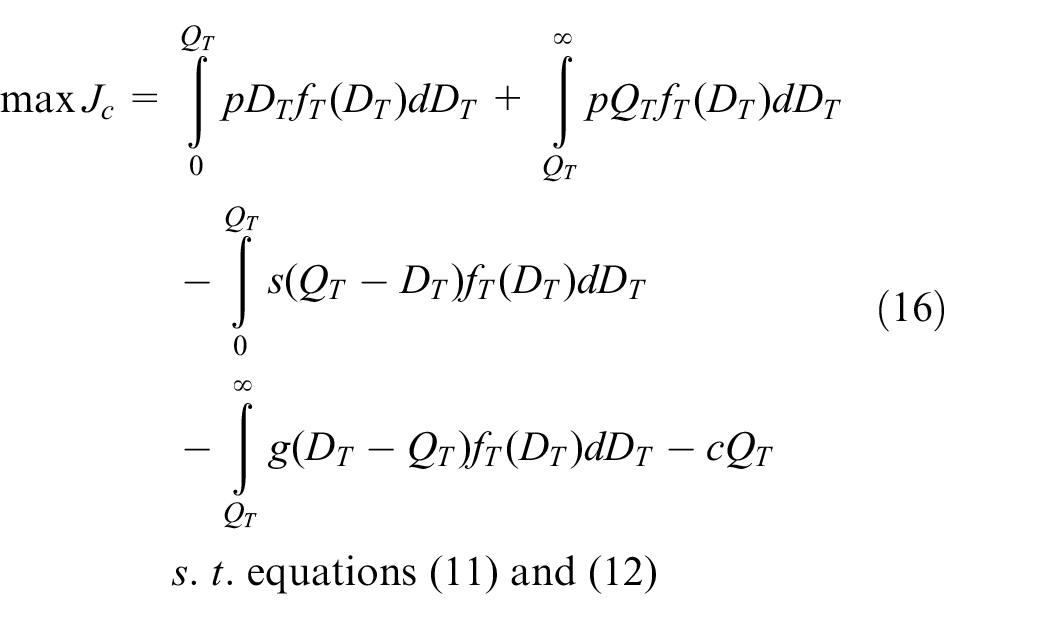
The Stackelberg model with a single supplier as the leader, and a single retailer as the follower, is formulated as follows


Formulation of centralized problem
If the multi-period planning for the supplier and the retailer can be optimized simultaneously, the centralized production planning can be formulated as the following equations
The multi-period bilevel supply chain planning model
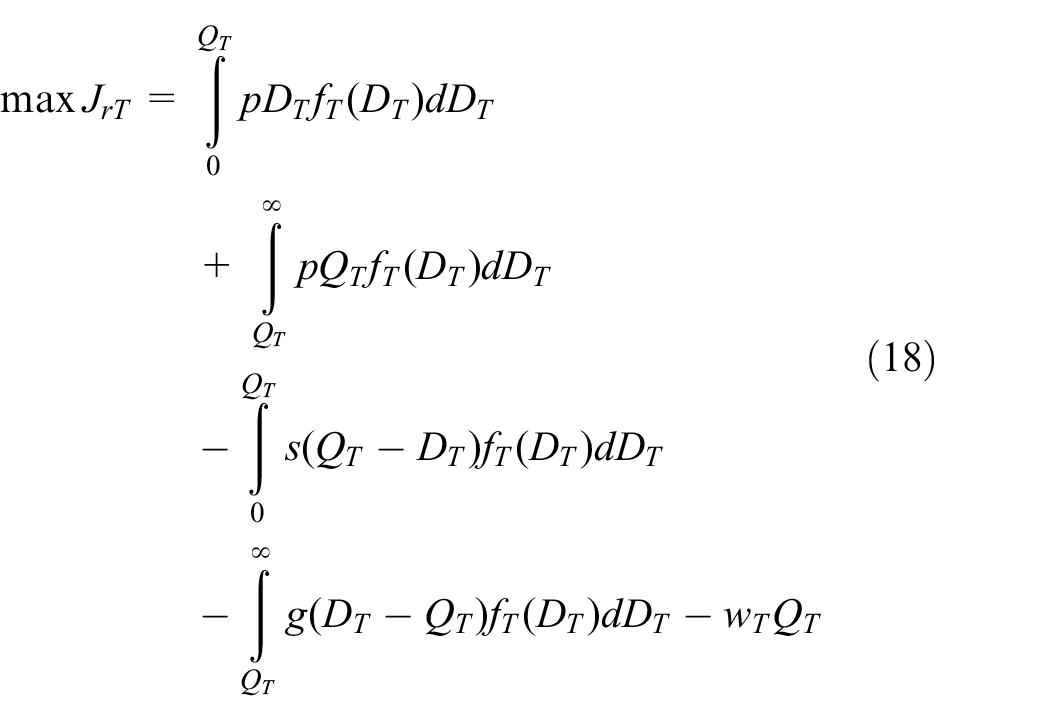
Analysis of retailer’s objective function
The retailer’s problem is analyzed as follows. By omitting the constraints (11) in the retailer’s problem, the retailer’s objective function (10) can be separated into the following two objective functions,

where

The properties of
Proposition 1
The retailer’s objective function
Proof
By the second differential of

Therefore, the objective function
According to Proposition 1, the objective function

We can show Proposition 2 for
Proposition 2
The retailer’s objective function
Proof
From the second differential of

Therefore, the objective function
From Proposition 2, the objective function

Feasibility algorithm for retailer’s decision problem
From the analysis above, the optimal
Proof
The validity of the algorithm is shown in the following. Proposition 2 shows that the retailer’s objective function

From equation (22), the cumulative order quantity which minimizes

Analysis of equilibrium for supplier and retailer
We derive the equilibrium between the supplier and the retailer for the multi-period bilevel production planning. The supplier and the retailer follow the Stackelberg game. In the Stackelberg game, the supplier can determine an optimal wholesale price
Let

However, by the first-order differential of

We can readily verify that the supplier’s profit function is strictly concave because

By substituting equation (25) into equation (24), the Stackelberg equilibrium can be derived

Then, the unique equilibrium solution is obtained by
Optimal quantity discount contract
The optimal quantity discount contract is analyzed in the setting of decentralized decision-making. The supplier can reduce the wholesale price if the retailer increases the cumulative order quantity by introducing quantity discounts into the decentralized production planning.
Therefore, the supplier’s wholesale price
Analysis of equilibrium with quantity discounts
With the quantity discounts into the bilevel production planning, the supplier’s profit function is written by

Using equation (23), an equilibrium solution under the quantity discounts satisfies the following equation

Then, the quantity discount, type 1, is assumed that the wholesale revenue is linearly dependent on


where

Relationship between
Analysis of optimal quantity discounts
The quantity discounts to maximize the total profit in the decentralized problem are analyzed when the optimal solution
When the quantity discounts are introduced into the decentralized problem, the optimal

From equations (28) and (31), if

Then, the function

If
Proof
(a) Case 1: the retailer’s optimal solution
In this case,
(b) Case 2: the retailer’s optimal solution
In this case,
According to (a) and (b), the retailer’s optimal solution
The quantity discount type 2 which satisfies equations (32) and (33) is shown with the wholesale price having the following function

where
Figure 3 shows the linear relationship between the supplier’s wholesale revenue

Relationship between
If the supplier announces the wholesale price with equation (34), the retailer determines the cumulative order quantity, which is equal to the optimal solution
Analysis of multi-period supply chain with a different wholesale price for each period
The new supplier’s problem is formulated in order to obtain a Stackelberg equilibrium in the multi-period model. However, the formulation of the supplier’s decision problems of equations (2) and (13) is considered in the optimization only at the end of period


Then, the retailer’s decision problem of equations (10)–(12) is reformulated into

The Stackelberg equilibrium is obtained using the response function of the multi-period planning of the supplier of equations (11), (12), and (35)–(37) and the retailer of equations (11), (12), and (37). For example, if



Then, the retailer’s objective function is rewritten by


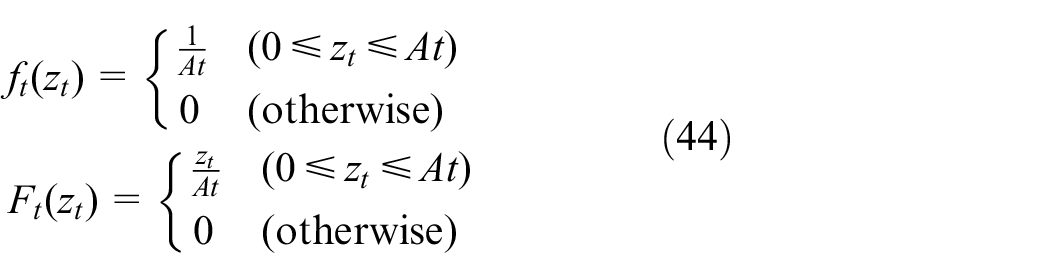
The demand function of customers follows the uniform function distribution where
where


The following conditions are obtained by substituting equations (45) and (46) into equations (39) and (40)


The equilibrium wholesale prices


Then, by substituting


From the above equations, the Stackelberg equilibrium is shown as

The Stackelberg equilibrium can be represented by some parameters in the multi-period problem using equations (49)–(52).
However, it is obtained without the conditions in the decision problems of the supplier and the retailer. Therefore, the derived solution is adjusted to obtain the optimal solution which satisfies the conditions.
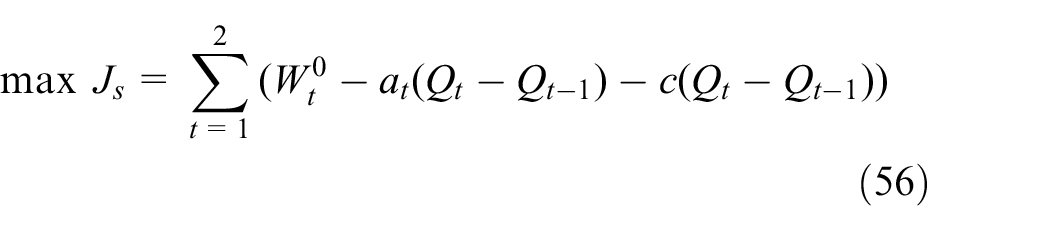
Then, we consider the supply chain contract in the Stackelberg game where the wholesale revenues


For example, for the quantity discount, type 1, depends on the wholesale price which is indicated by a linear function of


where
Numerical examples
The Stackelberg equilibrium is compared with the optimal solution derived from the centralized problem. The decentralized problem is the equilibrium solution of the production planning between the single supplier and the single retailer. The test cases are randomly generated instances that are studied in Zhang et al. 7
Description of test instances
Since the benchmark instances are not available for the new model, the test instances are generated from the real-world problems which were studied in Zhang et al.
7
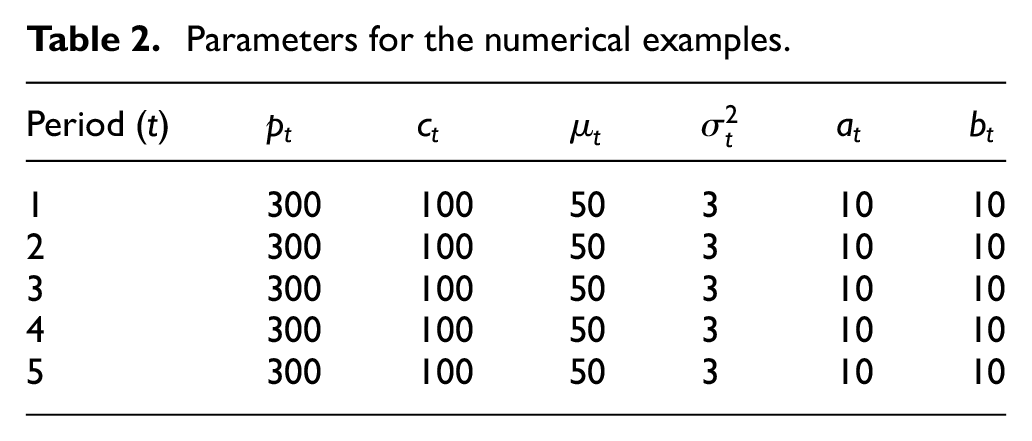
The parameters for the test instances are randomly generated. The size of each instance is mainly defined by the length of the planning horizon. Table 2 shows the parameters for the test instances which were provided in Zhang et al.
7
The total planning horizon was set to 5. The cumulative quantity of the customer’s demand until each period
Parameters for the numerical examples.
Effectiveness of supply chain contracts
The effectiveness of supply chain contracts is investigated by some numerical experiments. The supplier’s decision problem is represented by equations (2) and (13). The retailer’s decision problem is formulated as equations (10)–(12). Figure 4 shows how to make decisions in order to derive the Stackelberg equilibrium between the supplier and the retailer. The equilibrium solution is obtained by differentiating

Decision-making of the supplier and the retailer.
The total profit of the decentralized problem is the sum of the supplier’s profit and the retailer’s profit. The cumulative quantity of the customer’s demand until each period
Parameters in each case.

Tables 4–6 show the comparison of the optimal solution and the total profits of the centralized problem, the decentralized problem without contract, the decentralized problem with contract
Comparison of the total profit

Comparing the total profit

Comparison of the total profit

The decentralized problem without a contract can obtain 94.41% of the total profit of the optimal solution. It is caused by the fact that the supplier and the manufacturer have their preferences trying to maximize their profits in the decentralized problem without a contract.
However, the decentralized problem with a contract can gain 99.56% of the total profit of the optimal solution. The total profit in the decentralized problem can be improved by introducing a contract
The total profit in the decentralized problem becomes close to the one in the centralized problem by introducing the contract
The total profit in the decentralized problem is improved by introducing contract
We also discuss the effects of cost parameters on the solution of centralized and decentralized problems. The profit and the cumulative order quantity are decreased both in the centralized and decentralized problems when the retailer’s penalty cost for the stock shortage
Tables 5 and 6 show the results in cases
Figures 5 and 6 show the effect of the contract type in case

Comparison of the order quantity

Comparison of the total profit
Numerical results for the multi-period supply chain with a different wholesale price for each period
The validity of the multi-period supply chain with a different wholesale price for each period is examined from numerical experiments in this section. Figure 7 shows how to make decisions in order to derive a Stackelberg equilibrium between the supplier and the retailer in the model with a different wholesale price for each period. In Figure 7, the supplier and the retailer decide a Stackelberg equilibrium in each period

Decision-making in the multi-period planning with a different wholesale price for each period.
Table 7 shows the result of the numerical experiments for the model of equations (49)–(52). According to the results of Table 7, the equilibrium is valid because their optimal values are larger than the optimal values obtained by each period, respectively. The effectiveness is confirmed for the proposed model.
Comparison of the supplier’s profit in the multi-period planning with a different wholesale price for each period.

Figures 8 and 9 show the comparison between the proposed model and the single-period model. Figure 8 shows that the comparison of the order quantity between the proposed model and the single-period model. The order quantity in period 2 is larger than that in period 1 because the supplier determines a higher wholesale price in period 2 than that in period 1 in both models. Figure 9 shows the result of the supplier’s total profits for the extended model and the single-period model. From the figure, the profit which is obtained by the multi-period optimization is larger than the profit obtained by each period optimization. Therefore, the proposed model is effective.

Comparison of the order quantity in the multi-period planning with a different wholesale price for each period.
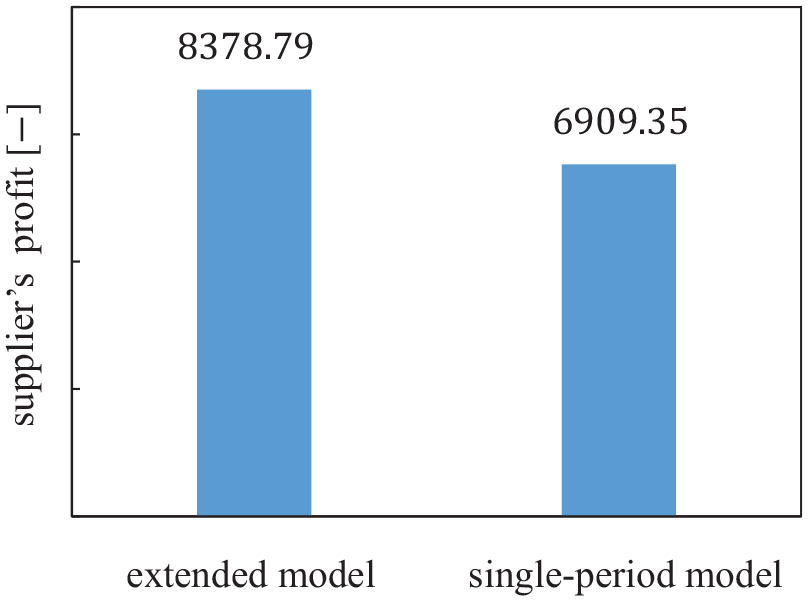
Comparison of the supplier’s profit for the extended model and that for the single-period model.
Managerial insights
In Table 8, the multi-period planning with a different wholesale price with the contract
Comparison of the total profit with the proposed model.

Figure 10 shows the effectiveness of the contract

Comparison of the total profit in the proposed model with no contract and with contract type 1.
From the experimental results, the equilibrium solution between the supplier and the retailer has an advantage to the supplier and the retailer’s objective value can be negative in a Stackelberg game where the leader is the supplier. Moreover, the supply chain contract can make the total profit larger in a Stackelberg game both in the single-period model and in the multi-period model. The supply chain contract can also relax unfairness in a leader–follower game. Therefore, the supply chain contract is valid to be introduced in a Stackelberg game in order to maximize the total profit. We have also confirmed that the same results are obtained when the length of the planning horizon is sufficiently large when the time horizon is greater than 5 and less than 10.
From the experimental results, the equilibrium solution between the supplier and the retailer has a disadvantage when the supplier and the retailer’s objective value can be negative in a Stackelberg game where the leader is the supplier. The supply chain contract can increase the total profit larger in a Stackelberg game both in the single-period model and in the multi-period model. The supply chain contract can also relax the unfairness in a leader–follower game. Therefore, the supply chain contract is valid to be introduced in a Stackelberg game in order to maximize the total profit. Utilizing the analytical model proposed in this article, we have obtained the following insights:
The optimal contract
The contract derived from the multi-period model has more profit than that derived from the single-period model.
The contract
Conclusion
In this article, we have developed a new multi-period bilevel supply chain planning model for a single supplier and a single retailer under demand uncertainty. Utilizing the cumulative demand and the cumulative order quantity, the Stackelberg equilibrium between the supplier and the retailer is analytically derived in the decentralized problem. The analysis of the optimal quantity discounts is also conducted. The proposed model enhances the coordination between the single supplier and the single retailer for all time periods. Computational experiments are conducted to show the effectiveness of the multi-period planning model under demand uncertainty. The Stackelberg equilibrium with the derived quantity discount contract is compared with the profit in the centralized problem. The effectiveness of the quantity discounts is confirmed in all cases. In the future works, we will extend our analytical model to consider multiple product items and the multi-period bilevel supply chain problems are analyzed to obtain the optimal contracts for more general cases. The proposed multi-period model can be used to develop the decision-making model for optimal supply chain configuration and design problems, optimal pricing problems, optimal contract decision-making and optimal business decision-making linking to the tactical and strategic level of the supply chain optimization. The analytical approach will be enlarged for the dynamic supply chain planning problems under several uncertainties.
Footnotes
Acknowledgements
The authors thank editors and anonymous reviewers for their valuable suggestions and comments to improve the paper.
Handling Editor: James Baldwin
Declaration of conflicting interests
The author(s) declared no potential conflicts of interest with respect to the research, authorship, and/or publication of this article.
Funding
The author(s) disclosed receipt of the following financial support for the research, authorship, and/or publication of this article: The work was supported, in part, by JSPS KIBAN B (No. 15H02971), JSPS KIBAN A (No. 18H03826), Beijing Social Science Foundation (17GLB014), National Natural Science Foundation of China (71372195), The Ministry of Education of Humanities and Social Science Project (16YJC790026), and Funds for First-Class Discipline Construction (XK1802-5).
