




Abstract
In the current work, an experimental investigation of γ-Al2O3/water characteristics nanofluid was performed for convective cooling of engine cylinder head for fully developed turbulent regime. Nanoparticles of different sizes were mixed in distilled water with constant volume fraction of 1% through the experiments. The cylinder head was simulated as a rectangular duct, of an aspect ratio of 0.8, with a cast iron test specimen from actual cylinder head of diesel engine. The effect of different nanoparticle sizes (30, 100, and 150 nm), bulk temperature (60°C, 70°C, and 80°C), and flow velocity (1, 1.5 and 2 m/s) were investigated at variable heat fluxes. The experimental results revealed that the obtained enhancement of convective heat transfer coefficient is inversely proportional to both nanoparticle diameter and bulk temperature and directly proportional to the coolant flow velocity. Also, the highest achieved enhancement over the pure base fluid in heat transfer coefficient is 88.74% at 30 nm particle size. The γ-Al2O3/water nanofluid showed promising results for intensive study with different operating conditions.
Introduction
Keeping internal combustion engines functional right requires smart cooling system to withstand thermal stresses facing engine parts at different operating conditions. No doubts, the internal combustion engine output has risen remarkably through the past few decades. The demand of higher output forms of load, speed, and breathing (level of charging “boosting”) increases rapidly. The heat flux magnitude generated from combustion process for diesel engines much higher than those from spark ignition engines. 1
For reciprocating engines, under part to zero loads, the wall heat loss reaches a value higher than 30% of the heat supplied by the fuel; while, under full load conditions, 10%–25% only is heat lost through the walls. Thus, the walls are undergone to thermal and mechanical stresses as well. The ratio of thermal to mechanical stresses is 12.8:1 to 39.4:1 on cylinder head wall surface of diesel engines, 2 which means that thermal stresses are more forceful than the mechanical one. Manipulating thermophysical properties of working fluid or passive conventional fluid flow geometry changing can enhance the cooling cycle. 3 Choi and Eastman 4 suggested what is named later as “nanofluids,” which is adding micron particles to coolant fluid, and that can effectively increase thermal conductivity of conventional coolants. 5
Nallusamy 6 carried out an experimental investigation on convective heat transfer and flow characteristics of Al2O3/water nanofluid with Al2O3 nanoparticles of about 50 nm diameter and 1% volume concentration. Such investigation proved that Al2O3/water nanofluid has a higher overall heat transfer coefficient compared to that of the base liquid. Coolant additives have been investigated in many researches intensively, especially before nanofluid trend appearance; the aim of coolant additives was mainly improving the heat transfer characteristics and preventing coolant freezing and inhabit rust and corrosion. Abou-Ziyan and Helali, 7 moreover Selim and Helali, 8 investigated heat transfer characteristics for various commercial engine coolants under sub-cooled conditions and nucleate boiling conditions as well, at a given heat flux. Undoubtedly, for achieving a clear universal result, scientific thinking method is a must, starting from the first step which is identifying each variable that accounts for the research problem and the relationship between those variables. Many investigators have studied various types of nanofluids, mainly consists of nanoparticles submersed into base fluid, in various applications. Table 1 listed the most frequently used base fluid and nanoparticles in literature.9–11
Various nanoparticles and base fluids used in literature.

Despite of all the obstacles in engine cooling enhancement road, the new generation of heat transfer fluids “Nanofluids” shows promising results in many different aspects that overcome the disadvantages of the idea of microsized particles suspended in fluids. For that, many researchers said that nanofluids offer higher thermal conductivity compared to classical coolants. The effect of different volume concentrations of the suspended Al2O3 nanoparticles on the heat transfer enhancement has been investigated by Sahin et al. 12 and Ali et al. 13 They studied it experimentally and illustrated that 1% per volume for turbulent flow regime shows the highest enhancement value.
Moghaieb et al. 14 investigated experimentally the characteristics of γ-Al2O3/water nanofluid as an engine coolant using a cast iron specimen with aspect ratio of 0.8. Different nanoparticle volume concentrations (0%–2%) were used throughout the study. Their results revealed that the convective heat transfer coefficient was enhanced for all nanoparticle volume concentrations compared to water at the same operating conditions. However, maximum heat transfer enhancement of 78.67% was achieved with 1% concentration of γ-Al2O3 nanoparticles of nanoparticle diameters range of 21–37 nm. However, other investigators 15 mentioned that for nanoparticle volume fraction more than 0.054%, no enhancement effect was observed on heat transfers in turbulent regime.
Heris et al. 16 studied (Al2O3 and Cu) nanoparticles submersed in water as a base fluid in circular tube with constant surface temperature, and the results state that the enhancement of Al2O3/water nanofluids is greater than Cu/water nanofluids at the same conditions. Moreover, Farajollahi et al. 17 and Shedid 18 showed that Al2O3/water is higher than that of TiO2/water nanofluids at the same conditions. Elsebay et al. 19 investigated numerically four different concentrations (1%, 3%, 5%, and 7%) of Al2O3/water and CuO/water nanofluids. A flat tube of a radiator was used and the results showed a significant reduction in the radiator size due to the remarkable enhancement in case of using nanofluids but there was a noticeable rise in pumping power.
While other investigators have studied the particle diameter effect numerically and experimentally, Kalteh et al. 20 studied numerically the nanoparticle size effect of a Cu/water nanofluid flow inside an isothermally heated microchannel using the two-phase approach. The effect of the nanoparticle size on the enhancement of heat transfer is greater for higher volume concentrations and increases with a decrease in the nanoparticle diameter. Besides, Dawood el al. 21 investigated numerically the convective heat transfer in elliptic annulus with constant heat flux for ethylene glycol (EG)-based nanofluids. Different particle size and identity were used; 20, 40, 60, and 80 nm for Al2O3, CuO, SiO2, and ZnO, respectively. SiO2 shows the highest enhancement; despite that it is not the lowest particle size which means that for each particle identity there is an optimum size.
However, Arani et al. 22 studied experimentally convective fully developed turbulent flow for TiO2/water nanofluid. Low volume fraction from 0.01% to 0.02% and 10, 20, 30, and 50 nm particle diameters was investigated. Nusselt number (Nu) enhancement values did not changed by decreasing the particle size but 20 nm showed the highest thermal performance factor. Esfe and Saedodin 23 studied forced convective turbulent flow through circular pipe experimentally. Coolant-submersed particle sizes were 60, 50, 40, and 20 nm for MgO/water nanofluid. The findings showed that with decreasing particle size, Nu enhanced more. In addition, Timofeeva et al. 24 experimentally studied forced convective heat transfer of SiC in EG and water mixture 50/50 volume ratio for turbulent flow at four different particle sizes 16, 29, 66, and 90 nm. Results demonstrated that the heat transfer efficiency is a function of both the average particle size and the system temperature with a directly proportional relation while Anoop et al. 25 studied Al2O3-based water for convective heat transfer in the laminar developing region, and the enhancement in heat transfer coefficient for 45 and 150 nm particle sizes was around 25% and 11%, respectively.
From the previous studies, it can be shown that a little interest was given to the particle diameter size effect for (γ-Al2O3/water) nanofluid as well as cast iron cylinder heads. Besides, many theoretical and experimental studies were implemented on the radiator part of engine using nanofluids as a new trend of coolants. Therefore, the objective of this study is to present a comprehensive experimental investigation of using nanoparticle/water (γ-Al2O3/water) as a coolant on a stimulated cast iron cylinder head region with a specimen machined for diesel engine. Also, particle size was considered as a factor for optimized cooling system enchantment. The heat transfer characteristics were evaluated for constant volume fraction (φ = 1%), different nanoparticle sizes (30, 100, and 150 nm), different bulk temperatures (60°C, 70°C, and 80°C) and different flow velocities (1, 1.5, and 2 m/s).
Experimental set up
Figure 1, as shown, describes the test rig in details; the expansion tank was connected to the main cylindrical tank with a copper coil and an electric heater of 3 kW, submersed in the main tank. A centrifugal pump was used to circulate the fluid flow through a 3/4-inch circular pipe and controlled by two valves—one main and the other is a bypass. A turbine flow meter screwed for flow rate determination was used. The specimen was connected to a copper plate that is heated by a surrounded electric heater fitted to the rectangular test section with “0.8 aspect ratio” which flanged to a rig circular piping. Before and after test specimen, calibrated thermocouples of K-type were used for measuring the flow average temperature. For controlling the heat flux supplied to specimen, a voltage regulator was used. Test section fluid returns back to the main tank for achieving a closed circulated system. Therefore, 2-in thick fiber-glass insulation was used for insulating the test rig (pipes, test duct, and tanks).
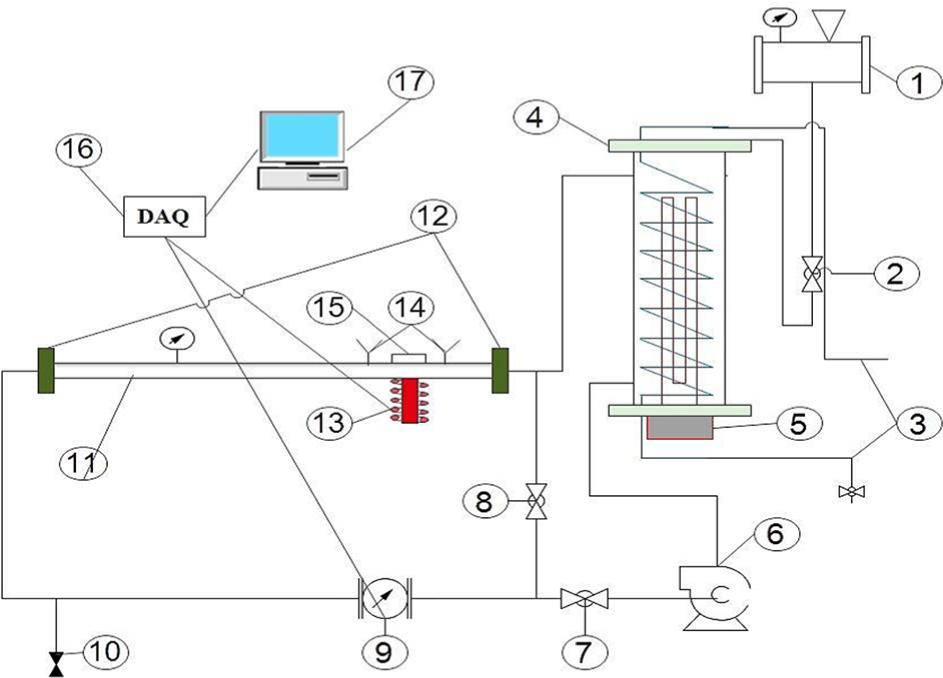
Schematic diagram of the test rig.
Figure 2 shows the test section and its fixation. The rectangular duct was manufactured from stainless steel sheet giving an aspect ratio (height of the channel normal to the heating surface to the duct breadth ratio) of 0.8 (20 × 25 mm). For minimizing the heat loss, asbestos and glass wool were wrapped around the heater. The test specimen conditions and geometry are extracted from actual working cylinder head of a diesel engine. A copper bar is welded to the specimen and perfectly fitted in test section duct bottom side. On the top side of the test duct in alignment with the test specimen, a perspex window is fitted in the machined hole in test duct for flow visualization. Figure 3 shows the test specimen in details with dimension of 40 mm length, 20 mm height, and 8 mm thickness. Heat flux and temperature differences across the specimen were measured. Two horizontal rows of thermocouples were fitted with three drilled equal distance holes in each row named x1 (5 mm) and x2 (4 mm). Six thermocouples of 0.5 mm wire diameters are installed and connected to a data acquisition card (DAQ).

A schematic diagram of the test section with test specimen details.
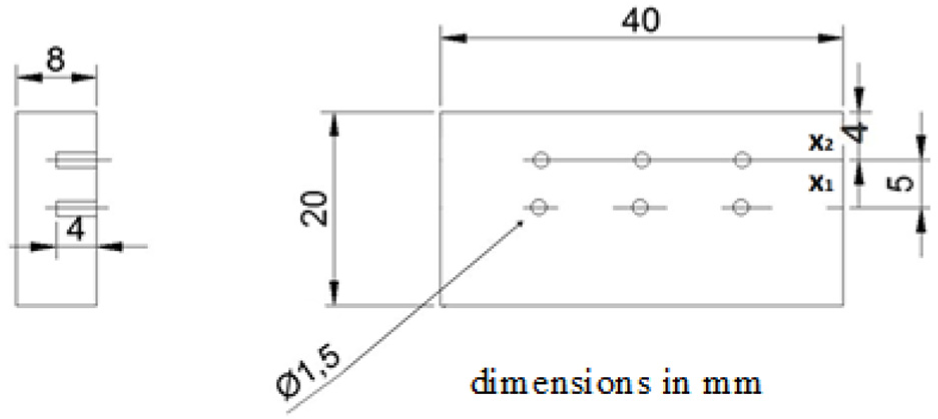
Test specimen dimension with thermocouple’s holes details.
The DAQ was used for acquiring the measured data for the different parameters and for displaying, saving, calculating, and manipulating those data; a main program was created using LabVIEW. To prevent liquid leakage at the mounted specimen, Teflon coats were used. The specimen top surface must be at same horizontal level as the inner bottom surface of the duct to prevent any disturbance. The close readings of the thermocouples (around 1°C difference) in each plane indicate the heat flux uniformity through the test specimen. The average reading in each plane is used in the heat flux calculations.
Nanofluid preparation and properties evaluation
The used γ-Al2O3 nanopowder in this investigation was purchased from Luoyang Tongrun Info Technology Co., Ltd. The thermophysical properties of the used nanoparticles and pure water are listed in Table 2. In this investigation, three different particle sizes in distilled water were used (30, 100, and 150 nm), each size is prepared using electromechanical agitator, as shown in Figure 4 that rotates at 2800 r/min for 3 h to establish uniform stable dispersion with the required mass to achieve 1% volume fraction. For stability check, the resultant nanofluid is observed for 2 weeks for each particle size dispersed. As particle size increases, the stability of the mixture decreases. Ali et al. 13 and Moghaieb et al. 14 mentioned that during the nanofluid pumping operation, which characterizes this experiment, there is no observed settlement for γ-Al2O3/water nanofluid. The thermophysical properties were calculated using equations from (1) to (5) as reported in Maıäga et al. 26 and Roy et al. 27





Thermophysical properties of different γ-Al2O3 nanoparticle sizes and distilled water (base fluid) at 300 K).

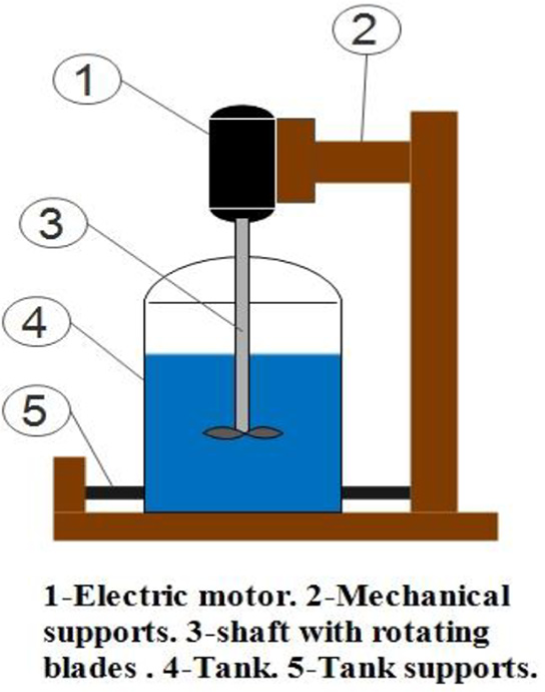
Schematic diagrams for nanofluid mixing device.
Experimental procedures, data reduction, and error analysis
Flushing the test rig with hot water is the first step in the experiment for cycle degasing and to remove any contaminants. The test rig was filled with the homogeneous fluid coolant with a specific particle size. The circulating pump was started; the heater submersed in the main tank was switched on. The specimen electric heater was adjusted to supply the required heat flux to the specimen using a voltage regulator. The flow velocity was monitored on computer. For adjusting the circulated fluid temperature to achieve the research program values, both submersed heater and cooling coil were used. By means of voltage regulator, the heat flux varied in steps. The heat flux supplied is calculated by Fourier’s equation of heat-conduction equation (6), where ksp is the thermal conductivity of the test specimen; it was calculated using equation (7) as reported in Helali. 28 The average temperature of the lower plane thermocouples of the test specimen is T1 and T2 is for the upper one. Tavg, the average temperature of T1 and T2, was calculated from equation (8). The specimen–coolant interface temperature (Tw) is obtained by mathematical extrapolation of the temperature gradient line. Consequently, (Tw−Tb) was evaluated. The heat transfer coefficient is evaluated from equation (9). Nu is calculated from equation (10). The error analysis indicates the error of the measured parameters and the uncertainty of the results. The detailed error analysis for each parameter is listed in Table 3. The differential method14,29 is used for detailed error analysis of the various parameters



Detailed error analysis for each parameter.

Results and discussion
Validation of the test rig
To assure the validity of the obtained results from the test rig, the verification of Nu is performed using distilled water as the working fluid at 60°C bulk temperature and 1 m/s flow velocity, the obtained results were compared with those calculated from equation (11) 30 Figure 5 shows that the results with an average percentage error of 9.8% which agrees in a satisfied way. The experimental data at the different operating conditions are reported next for convective heat transfer

where

Validation of this experimental study.
The convective heat transfer coefficient values (h, W/m2·K) versus the temperature difference (Tw−Tb, °C) at different nanoparticle size (Ps, nm), bulk temperatures (Tb, °C) and flow velocities (v, m/s) are shown in Figures 6–9.

Effect of particle size on heat transfer coefficient at v = 2 m/s and bulk temperature of 80°C.

Effect of flow velocity on heat transfer coefficient at Ps = 30 nm and bulk temperature of 80°C.

Effect of bulk temperature on heat transfer coefficient at Ps = 30 nm and flow velocity of 1.5 m/s.

Effect of nanoparticle size on the heat flux at constant (Tw−Tb = 20°C) and flow velocity of 1 m/s.
Effect of nanoparticles particle size
Figure 6 shows the convective heat transfer coefficient (h) versus the temperature difference (Tw−Tb) with the effect of nanoparticle size (Ps) at 2 m/s flow velocity and 80°C bulk temperature. The results showed that the heat transfer coefficient values of the nanofluids are enhanced compared to those for pure base fluid (distillated water) at the same conditions. The heat transfer enhancement was observed for all particle sizes and reached its maximum value at 30 nm. As at constant (Tw−Tb) = 17.15°C, for Ps = 30 nm, Tb = 80°C, and v = 2 m/s, the heat transfer records a maximum enhancement value of 88.74%. The obtained enhancement values for all performed experiments are listed in Table 4 for each particle size compared to distillated water values at the same operating conditions.
Heat transfer coefficient enhancement values at various nanoparticles size, bulk temperature, and flow velocity.

All experimented (γ-Al2O3/water) nanofluids state that Ps = 30 nm is the best studied size for engine cooling at all operating conditions for the cylinder head region. This particle size achieves maximum enhancement of 88.74% in convective heat transfer coefficient leads to decrease the temperature of the engine metal cylinder head, thus improving overall cooling effectiveness.
Effect of coolant flow velocity
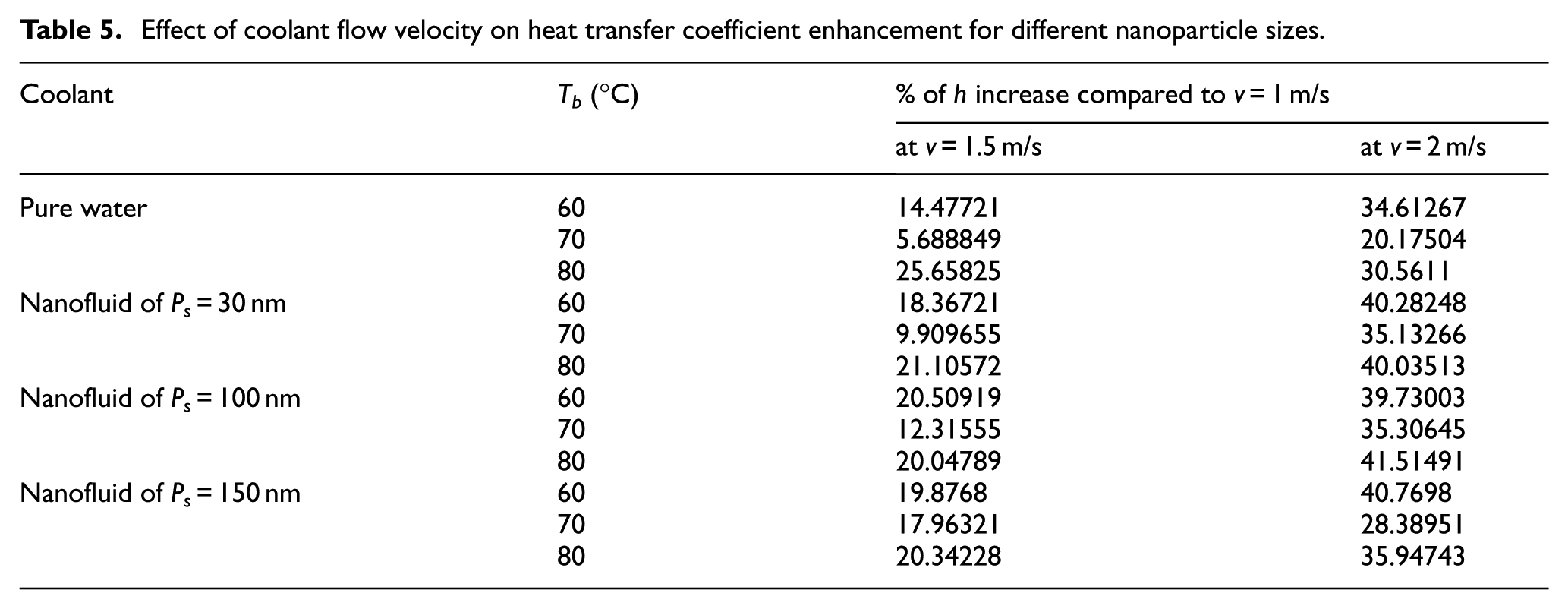
The convective heat transfer coefficient (h) versus the temperature difference (Tw−Tb) at various flow velocities (v) and constant particle size of 30 and constant bulk temperature (Tb) of 80°C is shown at Figure 7. The results demonstrated that convective coefficient significantly increased with increasing flow rate due to the resultant turbulence. All experiments were recorded and listed in Table 5 to indicate the effect of coolant flow velocity on heat transfer enhancement for different nanoparticle sizes. Among all experimented flow velocities, the best studied velocity is v = 2 m/s for engine cooling at all operating conditions for the cylinder head region. At larger particle size the velocity effect for enhancing the heat transfer coefficient is higher. These results reveal that the higher flow velocity of the engine coolant leads to higher heat transfer enhancement for lower metal temperature of the engine and consequently achieving high engine performance.
Effect of coolant flow velocity on heat transfer coefficient enhancement for different nanoparticle sizes.
Effect of coolant bulk temperature
The convective heat transfer coefficient (h) versus the temperature difference (Tw−Tb) at various bulk temperature (Tb) and constant particle size of 30 nm and constant flow velocities (v) of 1.5 m/s is shown at Figure 8. As the thermal conductivity and viscosity of Al2O3/water nanofluid changed considerably compared to pure distilled water, 31 the results demonstrated that convective coefficient decreases with flow bulk temperature as any noticeable change in temperature changes the coolant thermophysical properties.
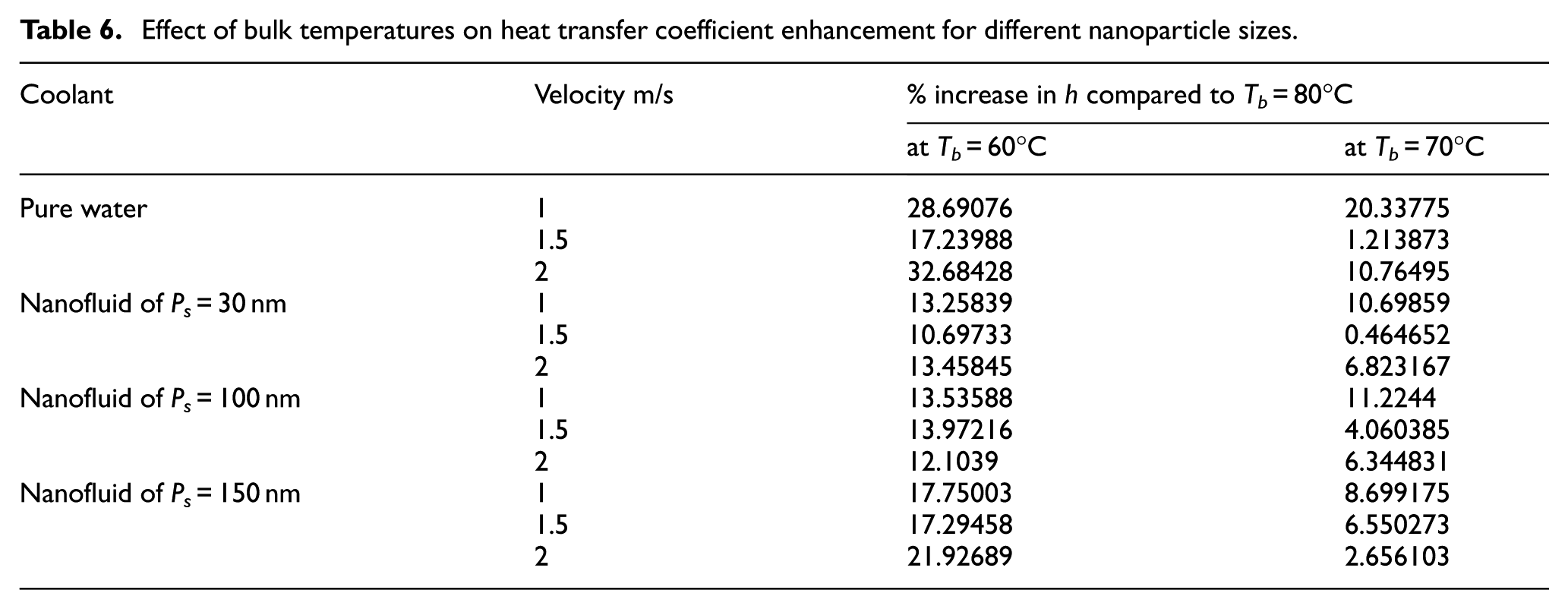
All experiments were recorded and listed in Table 6 to indicate the effect of coolant bulk temperature on heat transfer enhancement for different nanoparticle sizes. The best flow bulk temperature among the tested ones is Tb = 60°C, the enhancement range is listed in Table 6 for different bulk temperatures compared to Tb = 80°C values at the same operating conditions. These results reveal that the lower bulk temperature of the engine coolant leads to lower metal temperature due to the enhancement in the convective heat transfer coefficient.
Effect of bulk temperatures on heat transfer coefficient enhancement for different nanoparticle sizes.
Also, as shown in Figure 9, at bulk temperatures 60°C, 70°C, and 80°C, the heat flux increased by 52.22%, 48.797%, and 73.33% from pure base fluid for Ps = 30 nm, followed by slight reductions of 1.03%, 6.49%, and 12.334% for Ps = 100 nm. Ps = 150 nm showed slight reductions of 13.29%, 12.92%, and 9.299%, respectively.
From all experimental results, the optimum operating conditions for the diesel engine are at 30 nm particle size, 1% nanoparticles volume concentration, 2 m/s flow velocity, and 60°C bulk temperature which achieve maximum convective heat transfer coefficient of 15450 W/m2·K. The ultimate value of heat flux at Ps = 30 nm particle size, Tb = 60°C bulk temperature, and v = 2 m/s flow velocity at (Tw−Tb) = 34°C is 450 kW/m2. While the minimum value at pure base fluid for 1 m/s, 80°C, and (Tw−Tb) = 7.5°C is 32 kW/m2.
Conclusion
Nanoparticles of γ-Al2O3 identity dispersed in distillated water as a base fluid were investigated as engine coolant in stimulated cylinder head. Based on this experimental investigation, the following findings can be concluded as follows:
By using nanofluid, convective coefficient was enhanced for all different nanoparticle sizes (30, 100, and 150 nm) compared to pure water at the same operating conditions.
The enhanced heat transfer coefficient leads to lower temperature of the engine cylinder head wall and consequently prevent the thermal loading on the engine.
The maximum enhancement achieved is 88.74% at nanoparticle diameter of Ps = 30 nm, bulk temperature of 80°C, and flow velocity of 2 m/s compared to pure water at the same conducted conditions.
The maximum recorded heat transfer coefficient value is 15422.4 W/m2·K that could be achieved at Ps = 30 nm, Tb = 60°C, and 2 m/s flow velocity which has enhancement value of 60.82% compared to pure base fluid at the same conditions.
For smaller particle diameter, the velocity and bulk temperature effects on heat transfer effect are lower compared to those for pure distillated water.
Footnotes
Appendix 1
Handling Editor: James Baldwin
Declaration of conflicting interests
The author(s) declared no potential conflicts of interest with respect to the research, authorship, and/or publication of this article.
Funding
The author(s) received no financial support for the research, authorship, and/or publication of this article.
