



Abstract
The water-based single- and multiple-wall carbon nanotubes nanofluid over the surface of an unsteady stretched cylinder has been studied. The thin film of the carbon-nanotube nanofluid has been focused for the heat transfer enhancement applications. The well-known thermal conductivity model for the revolving tube materials like single- and multiple-walled carbon nanotubes defined by Xue were used. The modeled problem has been solved through the optimal homotopy analysis method using the BVPh 2.0 package. The distribution of the thin layer has been regulated through the pressure term using the variable thickness of the nanoliquid. The entropy generation has mainly focused during the motion of the thin layer for the both sorts of carbon nanotubes. The important features of the entropy generation and Bejan number under the influence of the physical constraints have been compared for the both types of single-wall carbon nanotubes and multiple-wall carbon nanotubes and discussed. The well-known BVPh 2.0 package of the optimal homotopy analysis method has been used to find the outcomes.
Keywords
Introduction
The suspension of micro large size solid particle in the base fluids gives a remarkable change in their thermal, mechanical, optical, and electronic properties because the thermal efficiency of the solids is much more than that of fluids. The family of carbon plays an imperative role to growth the thermal conductivity of the base fluids. One of the well-known families of carbon called carbon nanotubes (CNTs) have been utilized in most of the recent research fields for the thermal and cooling applications. The CNTs are further divided into two classes, known as single-wall carbon nanotubes (SWCNTs) and multiple-wall carbon nanotubes (MWCNTs). SWCNTs are fashioned by a packaging layer of carbon with one atom thick layer, whereas the MWCNTs contain multiple rolled layers of carbon. The SWCNTs need catalysts for their fusion, whereas the MWCNTs are complex structured and can be fashioned without any catalyst.
Most of the work has done on the nanofluids as the large size nanoparticles do not give satisfactory results because of their stability problems. Most of the researches in early 1990 reported that CNT nanofluids have lot of importance in both academic and in industrial community and its applications in numerous fields like aerospace, electronics, optical, and energy conservation.1,2 The CNTs have ultra-high thermal conductivity, that is, 2000–6000 W/mK—which is of a higher magnitude compared with copper and aluminum oxide nanofluid—that is why CNT is getting a great interest in the research area. The high thermal efficiency of CNTs reveals advanced thermal conductivity and heat flux as compared to pure fluid and other types of nanoparticles as discussed by Murshed and colleagues.3,4 They examined that the carbon nanoparticles have great desperation behavior with most of the base fluids, which lead them to long-term stability. As mentioned before, the high thermal properties of CNT nanofluid employed many techniques for different types of CNT nanofluids. Furthermore, Kamali and Binesh 5 investigated the enhancement of heat transmission using CNT suspension. Most of the work is done on MWCNT.
Various mathematical models are used by the researchers to study the nanofluids, and these models are mostly dependent on the different initial and boundary conditions. Domairry and Aziz 6 have studied the viscous incompressible fluid flow between parallel disks. Heat transforms of motor oil within the sight of both sorts of CNTs between two concentric chambers is given in Haq et al. 7 It is depicted that the consideration of nanoparticles maximized the heat conductivity of liquid essentially for both turbulent and laminar flows. The results of the above problem were reviewed for SWCNT-motor oil and MWCNT-motor oil. Boundary layer stream of CNTs over an extended disk is examined by Gohar et al. 8 The homogeneous responses happening in the liquid are executed by first-order kinetics. The four types of nanofluids, for example, MWCNTs-H2O, CuO-H2O, SiO2-H2O, and CuO-C2H6O2, are considered in Hwang et al. 9 Their thermal conductivity was estimated by a transient hot wire technique. The thermal conductivity improvement of water-based MWCNT nanofluid is expanded up to 11.3% at a volume fraction of 0.01. The efforts made by the researchers to define a comparative model for the improvement of the thermal conductivities of CNTs are given in Maxwell, 10 Jeffery, 11 Davis, 12 Lu and Lin, 13 and Hamilton and Crosser. 14
The above five models have been used for the augmentation of the thermal conductivity for spherical elements and not authenticate the CNTs space dispersal’ and therefore, the appropriate thermal conductivity model is required to fulfil this deficiency. Xue 15 suggested a model having a large axial ratio and repaying the CNTs space dispersal. The proposed thermal conductivity of the Xue model has been utilized for the CNT nanofluid. The study of the thin film flow over an extending surface has varieties of applications regarding the mechanical engineering and our daily life usages. The running of the thin drop on the widow of a car in a rainy weather, slipping on a wet bathroom, spraying, and painting are the common examples of the thin nanoliquid. The heat and mass transmission of the thin nanoliquid flow past an extending surface have been investigated by Khan et al. 16
Aziz et al.
17
described the unsteady flow of the liquid film past a stretching surface with internal heating. Qasim et al.
18
conferred the time-dependent flow of a nanoliquid using Buongiorno’s model. Wang
19
has the innovator to describe the streaming of a thin layer over the surface of an extending cylinder. The nanoliquid spray over an extending tube for the thermal and cooling applications has been studied by Khan et al.
20
Alshomrani and Gul
21
have extended the spray of a nanoliquid film over the slippery surface of an extending tube. Gul et al.
22
have examined
Entropy generation in slip rotating flow is scrutinized by Rashidi et al. 27 The numerical study of entropy generation on the magnetohydrodynamics slip flow past an extending cylinder under the effect of heat generation is comprehensively discussed by Jain and Bohra. 28
The effect of the entropy on a Casson nanoliquid flow past a shrinking surface is nicely discussed by Qing et al. 29 The study of entropy comprising nanoliquid flow through a porous plate is discussed by Bhatti et al. 30 They observed that by increasing the thermophoresis parameters, the entropy generation enhances. Gul et al. 31 have inspected the entropy regime in the thin film streaming over an enlarging surface. The impact of the various entrenched constraints on entropy regime and Bejan number has been shown in their study.
The homotopy analysis method (HAM) is one of the analytic approximation methods for obtaining the solution of highly nonlinear differential equations. Liao 32 has introduced this technique for the first time in his PhD dissertation. Liao 33 further modified this technique by introducing additional assisting parameters for the better convergence. These parameters are executed to overcome the convergence of the series solution. Recently, Liao 34 has further improved this method for the fast convergence of the nonlinear problems by introducing the BVPh 2.0 package. This package is utilized for the range of the embedded parameters and square residual errors. Gul and Ferdous 35 have used the OHAM-BVPh 2.0 package for the solution of the high nonlinear problems. This method is frequently used for the solution of nonlinear problems.36,37
The objective of this work is to study the thin CNT nanoliquid flow past an extending cylinder. The modeling and simulation play a vigorous role in the field of Material Sciences and Engineering. It balances experimental testing and sometimes is very useful to detect those physical spectacles that cannot be specified experimentally. The mathematical tools enhance and support the spray materials through optimization. The main features of the current coating tactic and its computational outputs with uncertainty and optimization will play an imperative role in the field of coating for heat transmission. Also, from the existing literature, the spray over the stretching cylinder is steady while the recent study is unsteady and also the entropy generation and Bejan number are included.
Mathematical formulation
The CNT–water-based nanofluid spray over an unstable stretching cylinder with radius
The basic equations for the flow field and thermal boundary layer are


The velocity mechanisms


where
The dimensionless liquid film thickness is defined as

The thermophysical constraints of the CNTs are

where
Introducing the similarity transformations to alter the basic governing equations into the dimensionless form and satisfying20–22 for

The similarity variables defined in equation (15) have been used in equations (7)–(12). The continuity equation satisfied automatically and the rest of the equations are altered as
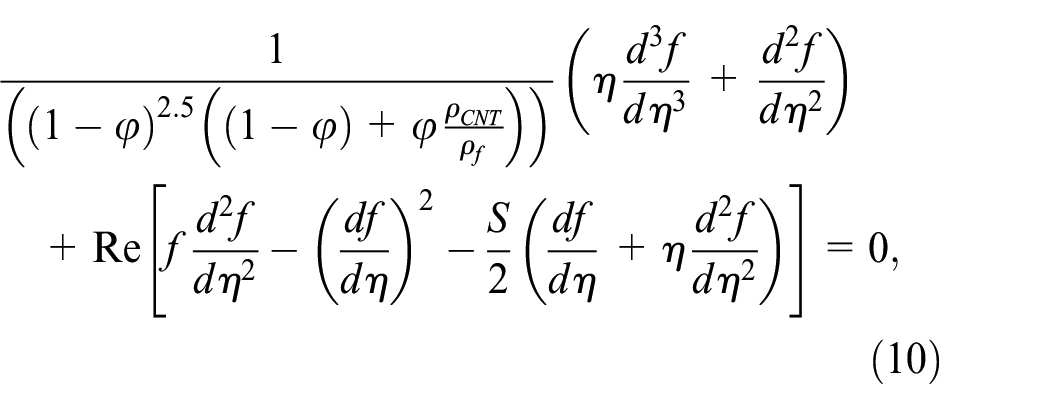

The nanofluid constraint


The Reynolds number, Prandtl number, and unsteady parameter are defined as follows

The pressure distribution term is evaluated from equation (2) as following

The shear stress at the outer surface is zero and defined as

The shear stress at the surface of the cylinder is taken as

The deposit velocity V is a function of the nanofluid thickness

The mass flux

The normalized mass flux

The significant physical constraint of the drag force and rate of the heat transfer are as
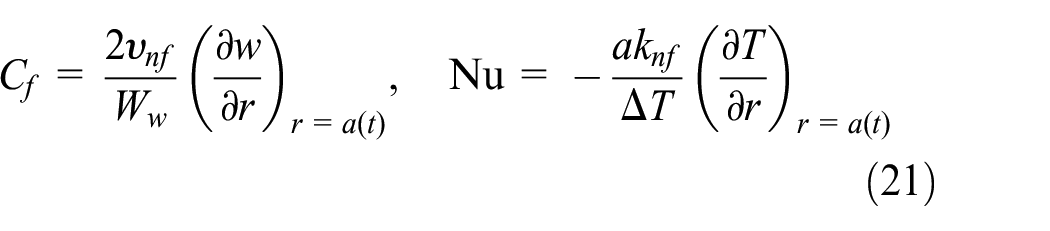
The non-dimensional form of the above constraints are

Entropy analysis

according to Jain and Bohra. 28
After the nondimensionalization, the above equation becomes

according to Jain and Bohra.
28
Here,

where

The total and heat transfer entropy generation has many applications in optimization and engineering design problem. The Bejan number

OHAM solution
In this section, the nonlinear flow modeled in equations (10)–(13) has been attempted analytically through OHAM. For this purpose, the BVPh 2.0 package as mentioned in previous studies33–38 is utilized to obtain the tenth-order approximations for which the residual error is minimized. The initial trials play an important role in the OHAM solution and are calculated as

The linear operators

Consequently, the general outputs of

Equations (10)–(13) are confirmed as


The sum of the total and square residual error is defined as33–38

The total residual error
Results and discussion
The spray analysis of the CNT nanofluids over an unstable and stretching cylinder has been investigated. The velocity, temperature, and pressure profiles for both SWCNTs and MWCNTs suspended in water as a base fluid are investigated. The modeled nonlinear differential equations have been solved through OHAM. The BVPh 2.0 package of the OHAM technique is applied for the solution of equations (15)–(18) and (20). The solution for velocity pitch, temperature field, and pressure profile are accomplished using the thermal conductivity model. 15
The stepwise detail discussion of the OHAM method convergence, velocity field, temperature profile, pressure distribution and spray rate are as follows:
Residual error sketches
In OHAM technique, the optimal values of the auxiliary parameters

The geometry of the proposed problem.
The numerical values of the optimal convergence controlling constraints
Velocity profile
The striking features in the sprayed pattern on the exterior surface of an extending cylinder are the thickness of the nanoliquid film

Impact of
The nanoparticle volume fraction

Impact of
According to the thermal conductivity model as given in equation (8), it is very clear that the values of
The significances of the Reynolds number Re and unsteady parameter S are shown in Figures 4 and 5, respectively. The inertial forces (resistive forces) are in the direct contact with the Reynolds number Re and the increasing value of Re, enhancing the inertial forces which cause the fluid motion. Therefore, stronger Reynolds number Re declines the velocity of the both sorts of CNTs. The thickness of the momentum boundary layer upsurges for greater values of S (unsteadiness parameter), which indicates the decline in the velocity field, and this effect is almost much closed for both sorts of CNTs. In fact, the rising value of the unsteadiness parameter S enhances the thickness of the momentum boundary layer, and as a result, the velocity field declines.
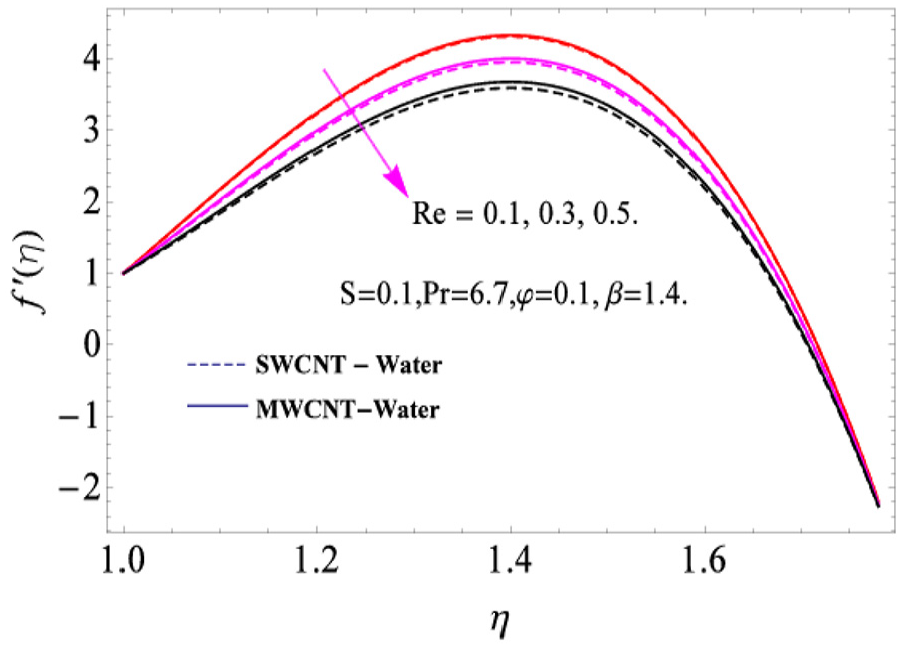
Impact of Re on the velocity field.
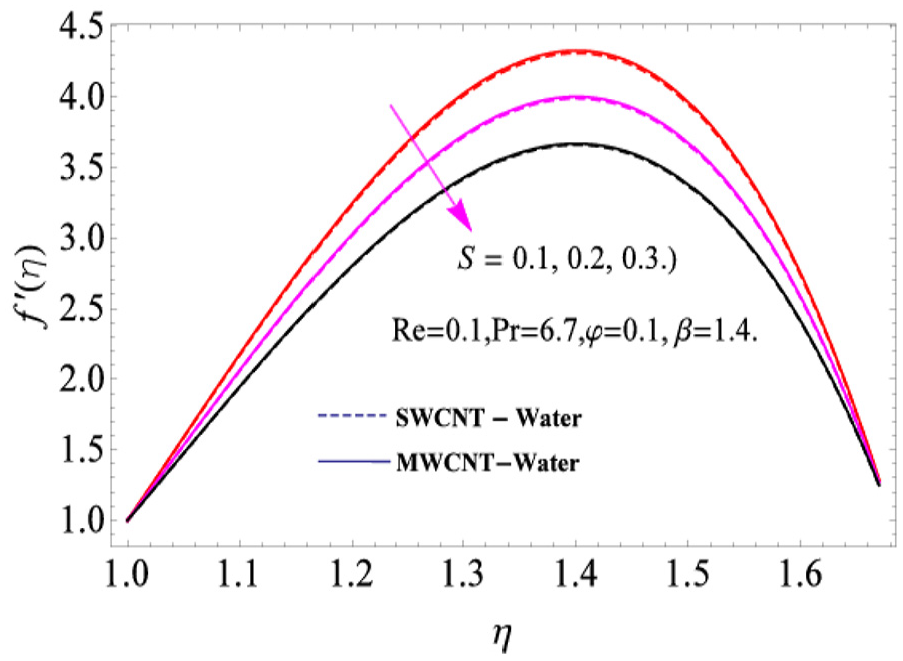
Impact of S on the velocity field.
Temperature profile
The CNTs play a vital role due to its imperative thermophysical properties to enhance the thermal efficiencies of the nanofluid during spray phenomenon. The impact of the embedded constraints on the temperature field has been compared for the SWCNTs and MWCNTs. The temperature distribution decelerates for greater values of

Impact of
The thermal conductivity model as described by Xue
15
has been used for the CNT nanofluid, and the impact of the nanoparticle volume fraction has been calculated and revealed in Figure 7. According to Xue model, the greater particle volume fraction
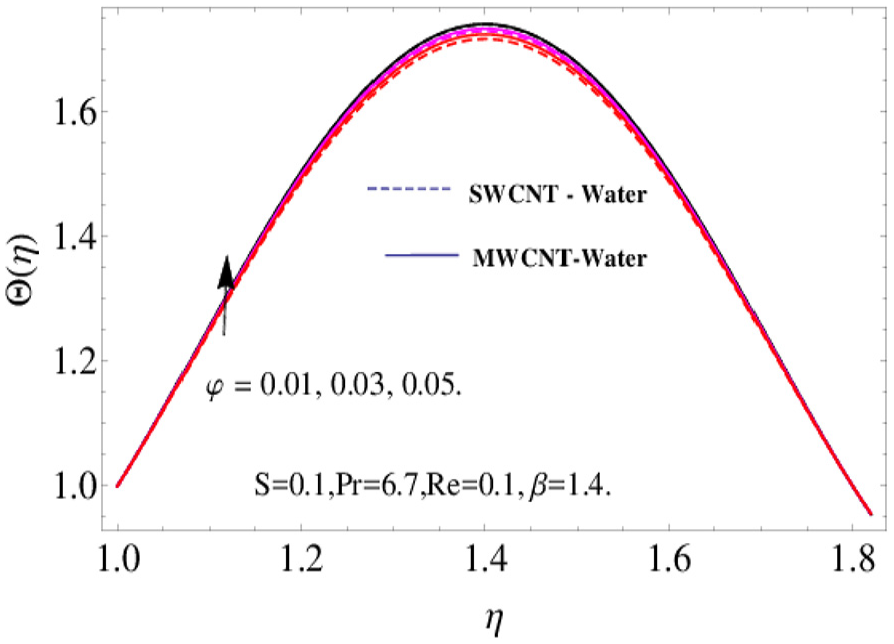
Impact of
Figure 8 indicates the effects of the Prandtl number Pr on temperature field

Impact of Pr on the temperature field.
Figure 9 shows the effect of the Reynolds number and implies that the inertial forces (resistive forces) in the Reynolds number alter the viscous forces. Due to the strong inertial forces, the molecules and atoms of the nanoliquid are tightly bound and too much energy is required to collapse them. The decline effect due to the larger Reynolds number is comparatively rapid in the SWCNTs.

Impact of Re on the temperature field.
Pressure distribution
Figure 10 specifies that pressure distribution is enhanced for the larger values of the thickness constraint

Impact of the
Figure 11 depicted that greater Reynolds number values decline the pressure term. Due to the inertial forces, the pressure inevitably goes to the lowest rate in the broad way of motion. The particles of the nanoliquid are tightly packed and more pressure is required for the fluid motion.

Impact of the Re on the pressure distribution.
Entropy and Bejan number
Figure 12 illustrates the influence of the Reynolds number Re on Bejan number Be. The larger Re enhances the Bejan number. The rate of Be cuts to the surface of the tube, and after the critical point, it starts retardation. The cumulative values of

Impact of the Re on Bejan number.

Graph of
The impact of the effect of Re and S on the entropy regime has been displayed in Figures 14 and 15, respectively. The larger values of the Reynolds number decline the entropy regime, and this effect changes after the critical point. Physically, the heat source is responsible to reduce the entropy generation for the cumulative values of Re. The effect of the unsteadiness S on entropy regime has been depicted in Figure 15. The rising values of S decline the entropy generation near the cylinder surface, and this effect changes after the point of inflection.

Impact of the Re on the entropy generation.

Impact of the S (unsteady parameter) on the entropy generation.
Skin friction and Nusselt number
Table 1 indicates the physical possessions of the base solvent water and of the two sorts of CNTs. The sum of the squared residual errors for the SWCNTs and MWCNTs is presented in Table 2. The influence of the unsteadiness parameter S and Reynolds number Re on the local skin friction is scrutinized in Table 3. The larger quantities of the unsteady parameter S and Reynolds number Re rises the skin friction coefficient
The thermophysical properties of CNTs and the base fluid water.
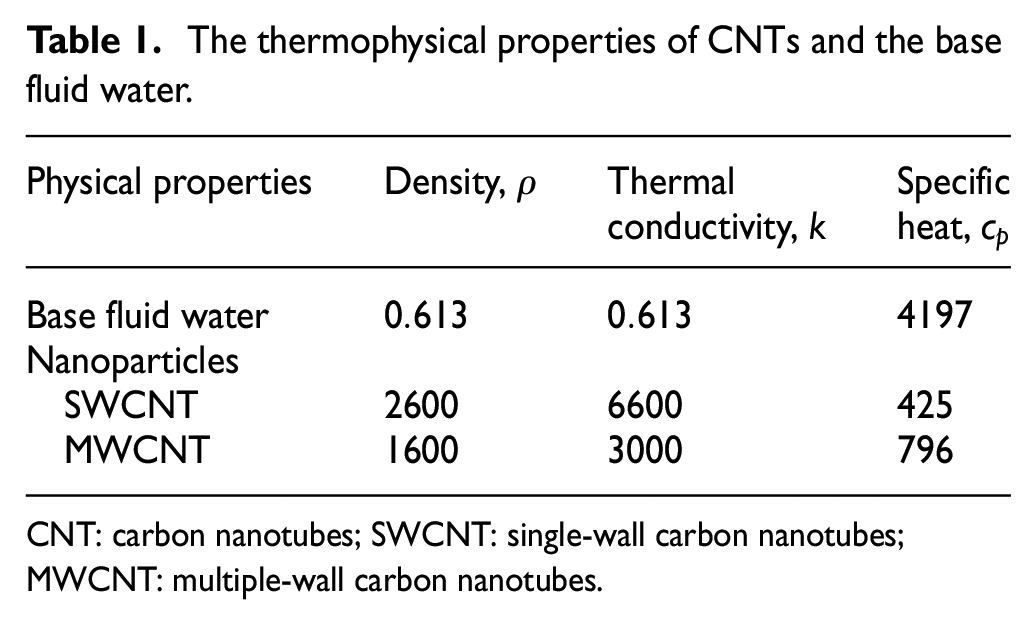
CNT: carbon nanotubes; SWCNT: single-wall carbon nanotubes; MWCNT: multiple-wall carbon nanotubes.
Individual averaged squared residual errors for SWCNTs/MWCNTs–water when

SWCNT: single-wall carbon nanotubes; MWCNT: multiple-wall carbon nanotubes.
Exhibits the numerical values for skin friction coefficient for different physical parameters when

SWCNT: single-wall carbon nanotubes; MWCNT: multiple-wall carbon nanotubes.
Exhibits the numerical values of local Nusselt number for different physical parameters when

SWCNT: single-wall carbon nanotubes; MWCNT: multiple-wall carbon nanotubes.
The larger parameters S and Re enhance the heat transfer rate or cooling effect. The motive is obvious that the thermal boundary layer enhances with larger values of these parameters as mentioned previously, and as a result, the cooling effect upsurges. The effects of these parameters are more effective in the case of SWCNTs.
Conclusion
Water has been used as a base solvent for the diffusion of the CNTs to perform nanofluid. The two sorts—SWCNTs and MWCNTs—of the CNTs have been used for the spray pattern over the stretching surface of the cylinder. The thermal efficiency outcomes have been observed operating the Xue model. Xue 15 inspected that the previous proposed models of nanofluid are operational only for the sphere-shaped or elliptic-shaped revolving nature materials through the smaller axial part. These ideas do not describe the space scattering features of the thermal conductivities of the CNTs. To overcome this problem, Xue 15 have prolonged Maxwell’s concept in view of revolving elliptic-shaped nanotubes with very huge axial part and rewarding the impacts of space scattering on CNTs.
The solution of the modeled nonlinear differential equations has been obtained through OHAM. The absolute total residual error has been calculated for the velocity and temperature profiles, respectively. The range of the embedded parameters has also been obtained for the stable convergence of the OHAM method. The parallel and normalized spray rates have also been calculated for the uniformity of spray phenomenon. The pressure distribution is also necessary for the uniform spray coating and has been observed in this research.
The obtained outputs are deliberated as follow:
It is observed that the increasing thickness parameter
It is observed that the larger quantity of the nanofluid volume fraction
The greater values of the Reynolds number decay the entropy regime, and this effect varies after the point of inflection.
The Bejan number declines with the increasing values of
The impact of the different parameters against the skin friction and Nusselt number in the case of SWCNTs and MWCNTs have been calculated numerically.
Footnotes
Handling Editor: James Baldwin
Author contributions
T.G. contributed to conceptualization, methodology, and validation; M.W. and W.N. contributed to software; Z.Z., T.G., and I.S.A. contributed to writing-review and editing.
Declaration of conflicting interests
The author(s) declared no potential conflicts of interest with respect to the research, authorship, and/or publication of this article.
Funding
The author(s) received no financial support for the research, authorship, and/or publication of this article.
