




Abstract
The low thermal efficiency of the base liquids is the main issue among the researchers and to resolve this issue, scientists use the small-sized (1–100 nm) metal solid particles in the base liquids to increase the thermal efficiency of the base solvents. In the recent article, a theoretical study has been carried out for the thermal application functioning of graphene-oxide-water-based and graphene-oxide-ethylene-glycol-based nanofluids under the impact of the Marangoni convection. The nanofluid flow is also subjected to thermal radiation and magnetic field. The problem has been solved through optimal homotopy analysis method. The impacts of the embedded parameters over the velocity and temperature pitches have been analysed. Due to strong thermophysical properties of graphene-oxide-ethylene-glycol-based nanofluid, it is observed that the heat transfer rate of this sort of nanofluid is more efficient as compared to the graphene-oxide-water-based nanofluids. All the obtained outputs have been presented graphically and numerically.
Keywords
Introduction
The huge interest in energy assets is the toughest issue for the recent researchers to meet the growing energy demand in advanced scientific processes. The scientists are trying to develop new sources which are simply accessed and economical for the thermal and cooling applications. The easily accessible resource of the renewable energy is the solar energy in the universe. The researchers discovered the solar collector to store the solar energy radiation effectively at large scale, and they utilized the convectional fluid flow as a heat conduction medium. However, the common liquids such as water, vegetable oil, mineral oil and ethylene glycol (EG) are the convective heat transfer fluids and play a vital role in numerous technological and industrial approach such as air-conditioning, heat generation, microelectronics and transportation of chemical production. Heat transfer fluids are primarily suffering from less thermal conductivity, and it is a serious restriction for a device achievement. To overcome this demerit, nanofluids are introduced by Choi 1 to improve the heat transfer rate and thermal conductivity of nanofluids through nanoparticles. Nanofluids are colloidal solutions incorporating nanoparticles of size (10–50 nm) in the base fluids. The important properties of nanofluid are thermal properties, accessibility, compatibility with the base fluid, chemical stability, toxicity and cost. Common nanomaterials are metal oxides, metal and carbon materials. Hummers and Offeman 2 developed a speedy and comparatively safe technique for the production of graphite oxide.
Graphene is structured as a single layer of carbon which makes it a striking material with exceptional physical and chemical properties. Graphene is discussed for the first time by Novoselov et al. 3 The rich chemical and electrical properties of graphene oxide (GO) and good cycling stability, large capacitance values and exceptional surface area make it interesting for the researcher. These effective properties of GO play an important role in electronic and electrical equipment such as sensor, transistor and fuel cell. Poor solubility of water is its main disadvantage. GO is well soluble in water because it contains more oxygen and belongs to a functional group such as carboxyl and hydroxyl; therefore, we used GO instead of graphene. Vinayan et al. 4 has experimentally examined the thermal conductivity and thermal properties of a special type of graphene called hydrogen exfoliated graphene (HEG) mixed with deionized (DI) water. Water and EG were used as the base solvents for the preparation of nanofluids in their study. Li et al. 5 have organized the polyaniline (PANI)/GO mixtures of GO with a ratio of 6:1 to exhibit the uppermost capacitance of 422 F/g at a present density of 1 A/g. Paredes et al. 6 have examined numerous organic diluents (DMF, THF, NMP and Eg) in which they organized graphite oxide diffusions with maximum stability. Shen et al. 7 have elaborated the preparation of GO from the chemical reaction of graphite with benzoyl peroxide (BPO), comprehensive alteration of GO to GO-sheets.
The high thermal conductivity and characteristic lubricity of graphene make it a perfect applicant for the alteration of functional fluids. The solid particles having efficient thermal conductivity are assorted to the base liquid to enhance the overall thermal efficiency of the fluid as depicted in Maxwell. 8 Balandin et al. 9 have examined the thermal efficiency of single-layer graphene in different solvents. Wei et al. 10 were the pioneers to express the use of GO in C2H6O2 to enhance the thermal efficiency of the nanoliquid. The GO nanosheets were set and isolated in EG and water at 5% capacity concentration to enhance the thermal conductivity up to 60% compared to the base liquid EG.
Recently, Gul and Firdous 11 examined experimentally and numerically the full solubility of GO in water and they also examined the numerical study. Sheikholeslami and colleagues12–15 have examined the nanofluid flow utilizing various mathematical models. The temperature-dependent convection situation is called Marangoni. This phenomenon was first discussed by Thomson 16 in 1855, and later in 1865, Marangoni 17 fruitfully discussed this phenomenon. This phenomenon is applicable in soluble, insoluble, and partially soluble materials. The effects of Marangoni have many uses in welding purposes, drying, soap film, silicon wafer crystal development, equilibrium and electron beam melting of metals. Arifin et al. 18 investigated the radiation properties of the flow of nanofluids with Marangoni convection. Golia and Viviani 19 have studied the Marangoni convection effect in the non-isobaric boundary layers. Chamkha et al. 20 have studied the idea of the mixed convection using the Marangoni convection in a boundary layer flow. Pop et al. 21 have examined the forced convection idea utilizing the Marangoni convection. Christopher and Wang 22 have observed the effect of the Prandtl number model over an inclined plate under the influence of Marangoni convection. Hamid et al. 23 completely discussed the Marangoni convection and radiation effects over a plane surface. The effect of Marangoni convection and thermos gradient situation in a penetrable medium is discussed by Al-Mudhaf and Chamkha. 24 Ellahi et al. 25 scrutinized the influence of EG base aqueous solution of nanofluids. The magnetic effect of the carbon nanotube (CNT) nanofluids on the Marangoni convection flow has been examined by Tiwari et al. 26 Magnetohydrodynamic nanofluid in a stretching sheet is discussed by Hamad. 27 Bataller 28 discussed the effect of viscoelastic fluid under the influence of heat source and thermal emission phenomenon over an extending surface.
Keeping in mind the above fruitful discussion, the current study examines the graphene-oxide-water-based (GO-W) and graphene-oxide-ethylene-glycol-based (GO-EG) nanofluids for the thermal applications under the Marangoni convection. The experimental results of Gul and Ferdous 11 have been utilized for the GO-W and GO-EG nanofluids under the influence of Marangoni convection.
The basic governing equations for the fluid flow pattern are converted into a set of nonlinear equations. The optimal homotopy analysis method (OHAM)11,29–34 has been used for the solution of the problems. The BVPh 2.0 package has been utilized in the error analysis. Many researchers have published many articles using the Marangoni convection, but the present work explained fruitfully the effect of GO-W and GO-EG nanofluid flow and thermal radiation under the influence of magnetic field. The comparison of the two sorts of nanofluids has also been investigated. The BVPh 2.0 package up to the 15th-order approximation has been used and the sum of the total square residual error has been calculated numerically. The numerical study of GO-W and GO-EG nanofluids under the influence of Marangoni convection is new and there is no literature that exists.
Mathematical formulation
Consider the incompressible and the two-dimensional nanofluid flow under the influence of Marangoni convection. The nanofluids consist of GO where water and EG are used as the base fluids. The constant magnetic field




Graphical representation of the problem.
Exposed boundary conditions are

The Marangoni boundary conditions are shown in equation (4), the surface tension is

Here,
Electrical conductivity model
Mathematically, we can write the relative heat flux
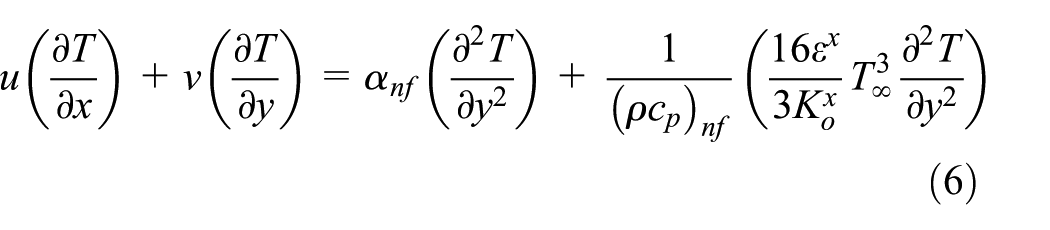
The transformations are suggested as defined in Tiwari et al. 26

where

Similarly, the constants

Keeping in mind all the above assumptions, equation (1) is satisfied successfully, while equations (2)–(5) are transformed into the following forms

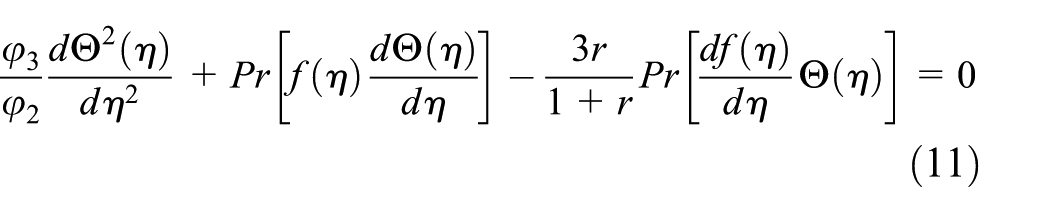

where

The local Nusselt number (

The dimensional form of the Nusselt number is

OHAM solution
Equations (10) and (11) with the physical conditions in equation (12) have been tackled through the BVPh 2.0 package of OHAM.29–31 The residual errors have been minimized using the 15th-order approximation for the stable convergence of the attained results. The auxiliary constraint

The linear terms are represented by

The general results of

Here,
The OHAM-BVPh 2.0 package29–31 has been applied and equations (10) and (11) are validated as


Liao29,30 defined the total squared residual error as

The auxiliary parameters have been used, and the total residual error
Result and discussion
The OHAM-BVPh 2.0 package as mentioned in Liao29,30 has been utilized to attain the results of the proposed problem for the 15th-order approximation. The desired accuracy of the modelled problem with the possible range of the embedding parameters for the GO-W and GO-EG nanofluids has also been obtained for the temperature and velocity pitch.
The residual error has been depicted in Figures 2 and 3 for velocity and temperature fields. The approximate values obtained from optimal convergence control parameters
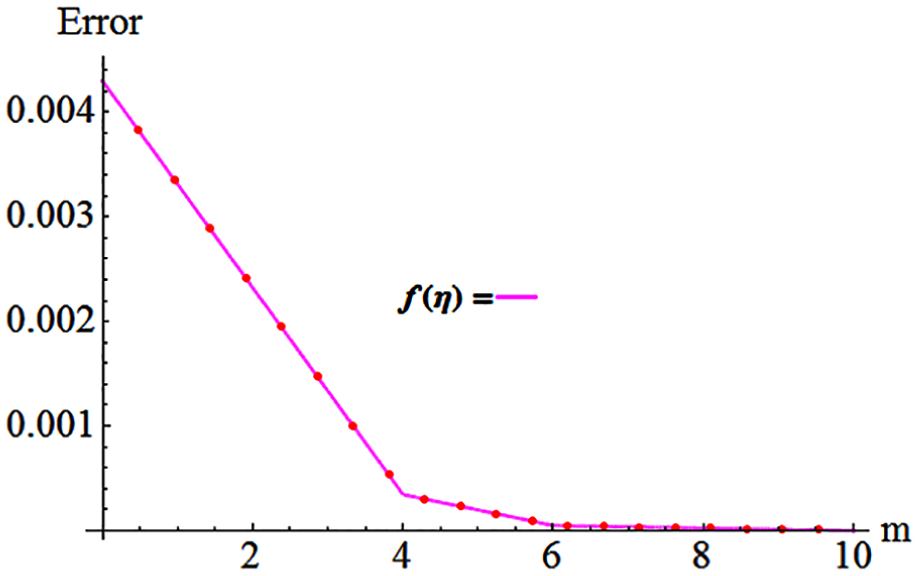
Residual error of
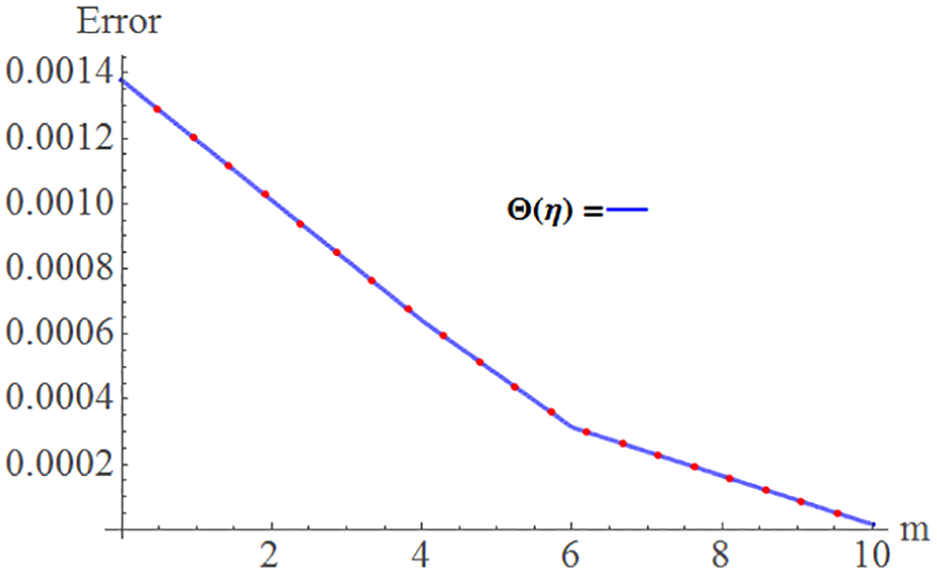
Residual error of
The impact of magnetic parameter

Influence of M on
The increasing values of

Influence of nanoparticle

Influence of nanoparticle

Influence of Rd on

Influence of
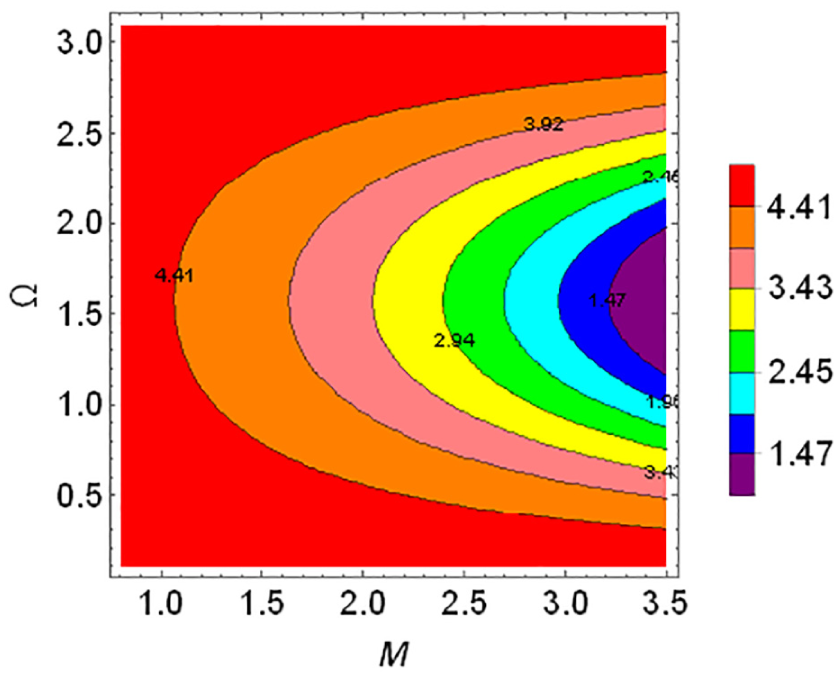
Influence of

Influence of

Influence of
The contour figures show the best seen of the physical parameters for the both sorts of nanofluids. Since these parameters are interlinked in the momentum boundary layer, the contour figures have been obtained from the velocity profile.
The thermophysical properties of the base solvents and solid particles are displayed in Table 1. The residual errors obtained for the temperature and velocity fields up to the 15th-order OHAM approximation for the two sorts of nanofluids are analysed in Table 2. The increasing order of the approximation reduces the residual error to authenticate the convergence of the problem. The higher values of the nanoparticle volume fraction (
Thermophysical properties of GO-W/GO-EG nanofluids from the experiment.

Residual error for both sorts of nanofluids at the 15th-order OHAM approximation.

Numerical values for local Nusselt number for different physical parameters.

Conclusion
Graphene is a fascinating material of carbon and comprises exceptional mechanical and organic properties. The present research is related by means of the theoretical approach to the heat transfer applications of the GO-W/GO-EG nanofluids. The numerical and theoretical analyses have been carried out under the effect of Marangoni convection. The results have been calculated from the minimum residual error analysis using the OHAM-BVPh 2.0 package. The effects of the imperative parameters, such as magnetic parameter (M), radiation parameter (Rd) and Prandtl number (Pr), are pointed out as follows:
The increasing value of the Marangoni convection parameter creates hurdles in the fluid motion and declines the velocity field;
The greater values of
The impact of the local Nusselt number versus embedded parameters has been observed;
It has been concluded that the GO-EG nanofluids have higher thermal efficiency as compared to the GO-W nanofluids.
Footnotes
Appendix 1
Handling Editor: Ahmed Abdel Gawad
Declaration of conflicting interests
The author(s) declared no potential conflicts of interest with respect to the research, authorship and/or publication of this article.
Funding
The author(s) received no financial support for the research, authorship and/or publication of this article.
