




Abstract
The two-dimensional magnetohydrodynamic unsteady movement and transmission of energy confined to finite domain layer of the second-grade nanofluid embedded with graphene nanoparticles on an expanding space are studied. Graphene nanoparticles have continuous electrical conductivity because the charge carrier movement in graphene bears extremely peak points compared to the available nanomaterials. The well-known system of equations for movement and energy of the second-grade nanofluid film accompanying the additional information have been transformed into the fourth-order coupled differential systems accompanying the auxiliary facts on behalf of simplifying substitutions. The simplified systems are evaluated via an efficient approach through homotopy analysis method which provides very clear relations for the motion and energy representatives. All the potential factors of the output are debated and portrayed pictorially. The results are useful in the analysis, design of coating, and cooling/heating processes.
Keywords
Introduction
Recently, the world confronts major challenges such as consistent energy provision, capacitance, and utilization. The main aim is not only to propose innovative and consistent work ability means but also, probably even more significantly, to save energy sufficiently and provide it on need, always for moving utilization such as systems of transportation and portable electronic devices. Carbon is the most suitable and of small weight element employed for energy saving which is essentially made into diverse shapes to deliver big surface capacity and rate of doing work capability. There exists a rich concentration on the application of carbon nanotubes (CNTs) for the rate of doing work capability saving tool fabrication. Apart from keeping low weight, CNTs have several good applications. They keep a sufficient enhanced surface area up to 1315 m2 g−1 for single-walled CNTs, in contrast to other elements, for example, graphite which has a typical surface area of 10–20 m2 g−1. But it should be noted that CNTs show disadvantages such as the existence of hazardous remaining metallic impure things that are highly difficult to make clean and a vast production price.
Graphene at present appeared as another energy-saving substance keeping remarkable aspects, such as light weight, inertness due to chemical aspects, and minimum cost. Graphene, keeping two-dimensional sp2 carbon atoms packed in a honeycomb lattice, having great attraction throughout the world application after its finding. Intrinsically, graphene has a step-by-step layer shape, extreme stiffness, and exceptionally very tight and popular. The basic physical aspects of graphene particularly mechanical stiffness, tensile bearing capability, heat conduction, and ratio of aspect are remarkably very great. These popular aspects of graphene enable it a high advantage of delivering entity for diverse utilizations such as graphene polymer composites having conduction aspect, pressurizing sensor, rate of doing work-reliant usages, and the biofield. The surface area of graphene is 2630 m2 g−1 that is significantly suitable for the rate of doing work capacity utilizations. Based on extensive applications of graphene, Zuhra et al. 1 made a research in the time-reliant movement and transmission of energy characteristics having electronic capability water-reliant non-Newtonian thin liquid film (of different structures) nanoliquid dispersion of graphene tiny size particles surpassing an expanding material in the existence of magnet acting at the right angle and the provision of dissimilar energy production/accumulation. They proved that heat transfer in non-Newtonian dispersion provides a leading activity in technical fields and in nature because of its tangential force looseness, tangential force weakening, and strength aspects. Khan et al. 2 analytically studied the hydromagnetic CuO–H2O thin nanoliquid finite domain confined layer coated on an expanding material in the hydrothermal environment, manifesting that the thermal conductivity enhances by introducing tiny/small-sized particle materials in dispersion and coating rate rises with amplifying the film size. Pumera 3 discussed the development that is fulfilled with the involvement of chemical relation, electrochemical and electricity rate of doing work-saving environments through graphene. Eswaraiah et al. 4 performed the experimental work using the graphene. They have been prepared a small layer of graphene through the oxide of some element through a nanodispersion procedure on the mentioned process emitted from the sun; in addition, graphene-reliant engine oil nanodispersion is created and their aspects due to friction, antiwear, and maximum force per unit features are computed. Khan et al. 5 provided the discoveries on the joint flow equation of a two-dimensional steady laminar gravity employed non-Newtonian Casson and Williamson nanofluid films accompanying a type of heat conducting on solid non-horizontal wall accompany involvement of Cu tiny particles and small organisms using actively boundary conditions and the Buongiorno model. They have obtained interesting results regarding fluids flow, Cu nanoparticles, gyrotactic microorganisms, and heat transfer in analyzing the comparison of Casson and Williamson nanoliquid. Meharali et al. 6 prepared nitrogen-doped graphene (NDG) nanodispersion by adopting the special step procedure in a water dispersion of 0.025 wt% Triton X-100 as an impurity at some saturations (0.01, 0.02, 0.04, 0.06 wt%). They experimentally proved that due to electrical conduction of the water-dependent NDG tiny particles, dispersion exhibits a straight forward reliance on the saturation and developed up to 1814.96% for taking the amount of 0.06 wt% NDG tiny particles. Khan 7 presented the study about thermal conductivity using transmission due to heat in a non-Newtonian rat-type tiny particle dispersion movement retaining Cu tiny particles and small organisms. His work is related to energy sources such as biomass and biogas. Akhavan 8 investigated the preparation of graphene confined to finite domain layer on the Si3N4/Si material through minimization of exfoliation due to chemical reactions in graphene oxide tiny particle spaces in a minimizing situation, keeping several temperatures values, and following few distinct energy utilization techniques.
The movement and transmission of energy confined to finite domain non-Newtonian fluids past expanding space keep attraction and enough attention because of its vast utilizations in various departments of scientific and technological nature. Some applications are wire and fiber spraying, in thrusting out the conducting material and carbon substances, nourishments processing, nonstop provision of materials having high iron content, generation of plastic substances, exchanging of substances, making low temperature through the act of passing through pores, reactor, chemically making instrument, and so on. Nearly, all painting/spraying techniques need smoothness on the surface to fulfill the needs for existence, minimum roughness, transparency, and strength. In the view of these applications, Khan et al. 9 described the parametric study of diverse phenomenon accompanying energy and quantity of matter transmission flow of an external deriving expertness of an agent on the finite domain–confined layer second-grade dispersion of temperature-dependent features on expanding space. They added the homotopy procedure to solve the challenging issue and illustrated graphically the important contributions of all parameters, the dispersion changeable aspects such as heating conduction and viscousness in the platform of finite domain originated due to temperature. Lin et al. 10 analyzed the movement and transposition of energy of pseudo-plastic tiny particle dispersion in a finite domain on a time-reliant expanding space with the dispersion changeable aspects such as heating conduction and viscousness in the platform of finite domain originated due to temperature by investigating four several kinds of tiny particles such as Cu, CuO, Al2O3, and TiO2 accompanying sodium carboxymethyl cellulose (CMC)-H2O added like a classic dispersion. Khan et al. 11 solved the problem using similarity solutions for the non-Newtonian second-order dispersion immersed in a permeable space on an expanding space providing that motion and heat transmission become lower, even though the high values to all of the parameters are assigned. They authenticated the computation by finding numerical comparisons, residual errors and showing the correlation with the published work. Abbas et al. 12 employed a homotopy analysis method (HAM) to investigate the movement of confined finite domain rat-type dispersion fluid on a time-dependent expanding sheet in which the sequential computation attached to the complicated fourth-order differential issue is obtained and the potentialities of diverse representatives on movement and skin friction are illustrated. Zuhra et al. 13 investigated the magnetohydrodynamic (MHD) second-order nanodispersion of finite domain layer movement retaining copper tiny particles and small organisms accompanying the type of convection heating. They showed that skin friction quantity amplifies with a huge amount under the existence of amplifying positive quantities of the second-grade nanofluid representative. Khan et al. 14 considered Buongiorno model of nanofluid by investigating the tiny particle movement and dragging of particles control of MHD-mixed convection finite domain–confined layer second-grade nanodispersion movement accompanying intense external impact and transmission of energy past an expanding space by delivering the output that the system resumes axial and transverse velocities, thereby making three-dimensional motion on account of strong applied magnetic field. They obtained the interesting MHD results in which one result implies that the transverse velocity is due to the Hall effect and it vanishes as soon as the Hall effect is removed. Palwasha et al. 15 reported the creation of a tiny particle system environment, microorganisms in the activism of magnet prevailing, considered as a relevant class for usages in diverse fields including energy and medicine. Their study decided that magnetotactic microorganisms are the backbone of the interpreted system.
To get insight into the research, a study is to discuss the time-reliant special type of motion and transposition of energy in the second-grade confined to finite domain layer nanoliquid embedded with graphene tiny particles on an expanding space. The governing system is shifted into dimensionless form by the application of appropriate transformations and then treated with an efficient and well-known procedure, 16 which does not miss any parameter in different expressions of different profiles. The potentialities of each and every pertinent representative on motion and energy fields are portrayed in figures and elucidated.
Methods
Basic equations
A time-reliant, electrical capability dispersion finite domain–confined movement of an external force–controlled non-Newtonian second-grade nanofluid on an expanding space is treated. A flexible sheet begins working at a slit of small width determining its position on the place (0, 0) under the measuring dimensions (x, y). Note that x-axis is adopted accompanying the expanding space keeping the expanded displacement rate Uw(x, t) = cx(1 – αt)−1 being c and α manifest constants in a style that c > 0 (expanding rate) also αt < 1. y-axis rests at the right angle to expanding space. Note that T0 and Tref are the initial and temperature at the reference position, and Tw(x, t) = T0 + Tref (cx2/2vf) (1 – αt)−1/2 manifests the wall energy of the dispersion, in which
The potential of the induced magnet environment is very low under the considered system.
The Cauchy stress tensor in the second-grade dispersion as in the study by Abbas et al. 12 is

where P manifests the pressure,


in which

Invoking the fact that for


Note that in the coordinate system, x-and y-directions have u and v velocities components, respectively.
The auxiliary information are


in which H(t) manifests the size of the dispersion.
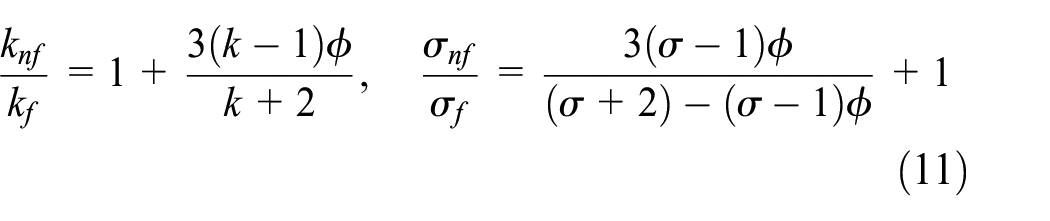
Considering the experimental utilization, the graphene tiny particle saturation is very low. By taking advantage of Taylor’s series, the nanodispersion items are simplified as follows

here
Heat-reliant aspects of H2O as well as graphene tiny particles.

The following substitutions simplify the functions f,

note that ψ(x, y, t) manifests the stream function which provides
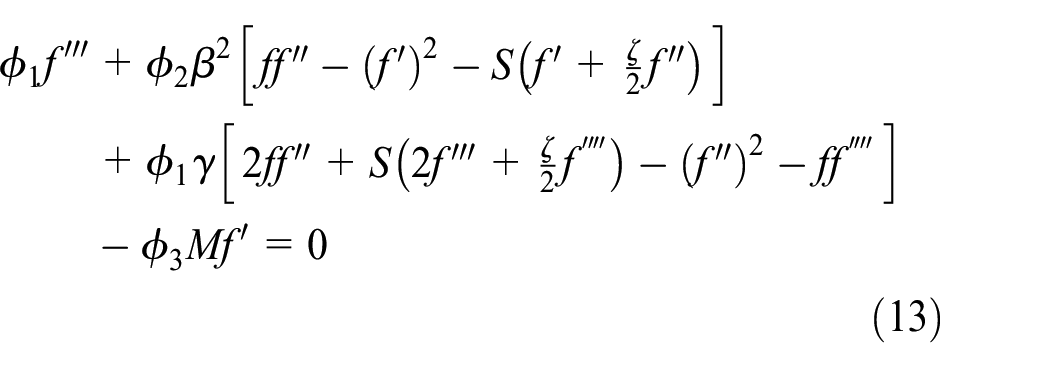



here the prime (′) manifests the differentiation concept in terms of
Transformed equations solution through HAM
The scheme (HAM) is utilized to evaluate the transformed equations. The initial guesses of evaluation and auxiliary linear operators are furnished as


The following aspects are satisfied with the linear operators

where
Deformation equations of zeroth order
Inserting the nonlinear operator


where p shows an embedding representative in a manner p ∈ [0, 1].
Considering equations of the zeroth-order deformation, the following is obtained


where
Equation (22) holds the auxiliary information

Equation (23) holds the auxiliary information

For p = 0 and p = 1, the following is obtained


The coincidence for the series in equations (28) and (29) is strongly dependent on


Problems of deformation keeping mth order
Lines of deformations of mth order
Employing differentiation up to m times regarding p of equations (22) and (24), performing division through m!, and putting p = 0 develop the furnished lines



Employing differentiation up to m times with respect to p of equations (23) and (25), performing division through m! and putting p = 0 develop the furnished lines


If


Results and discussion
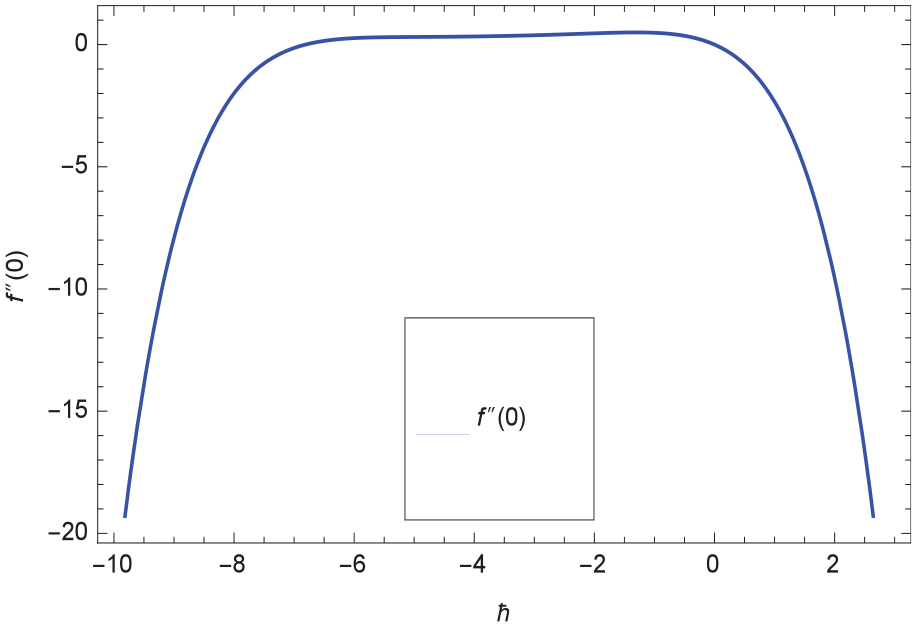
The simplified equations (13)–(16) due to similarity transformations are treated through symbolic evaluating software MATHEMATICA following HAM code. The activities of different profiles such as velocity

Geometry of the physical model.

Velocity profile
Movement

Movement curves for

Movement curves for

Movement curves for
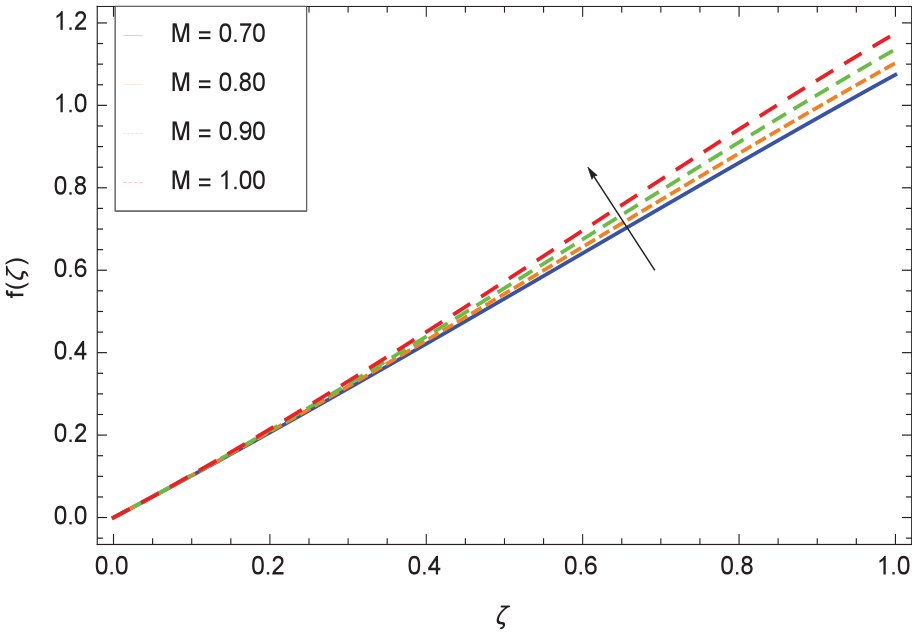
Magnet environment regulates the graphene tiny particle flow. During the present study, the graphene nanoparticles flow is enhanced on the magnet environment amplification from 0.70 to 1.00, as shown in Figure 7. At low magnetic field strength, there is a formation of small dipolar chains. For the peak magnitude of magnet environment, the continuity extent is high, forming in evenly distanced one tiny particle continuity throughout the tiny particle dispersion volume. When the magnet environment is intensified, there observed the zipping of the two-pole continuities in microscopic pictures.
Movement curves for
The addition of graphene nanoparticles brings change in flow, as shown in Figure 8. It is evident that with the graphene tiny particle saturation

Movement curves for

Movement curves for
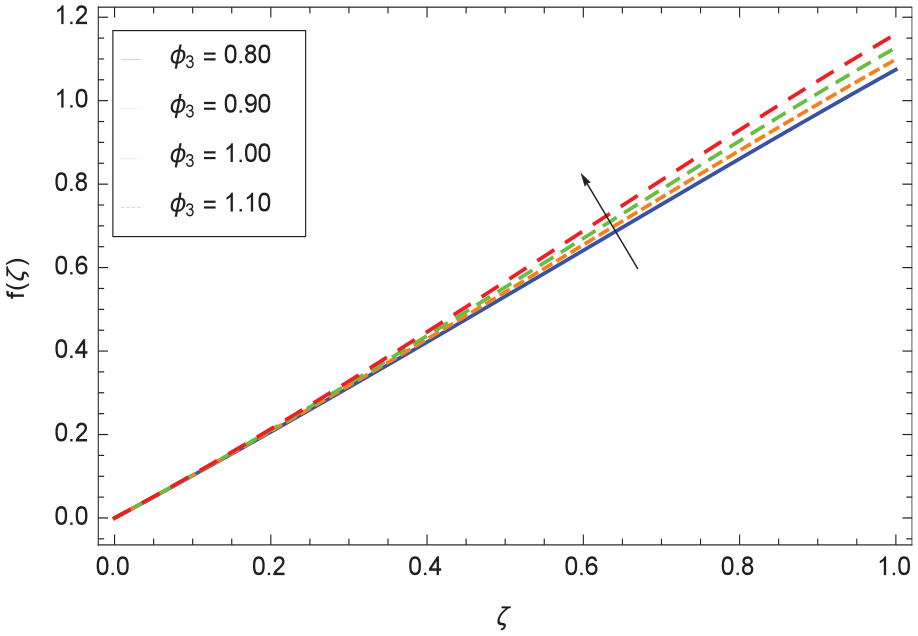
Movement curves for
Temperature profile
Due to crystal form of matter, energy is taken through the expansion of lattice movements, that is, phonons, which are irregularly generated, expanded in irregular sides, and dispersed from one another. The potentiality of a finite-confined domain representative

Energy curves for
Figure 12 visualizes that heat energy

Energy curves for
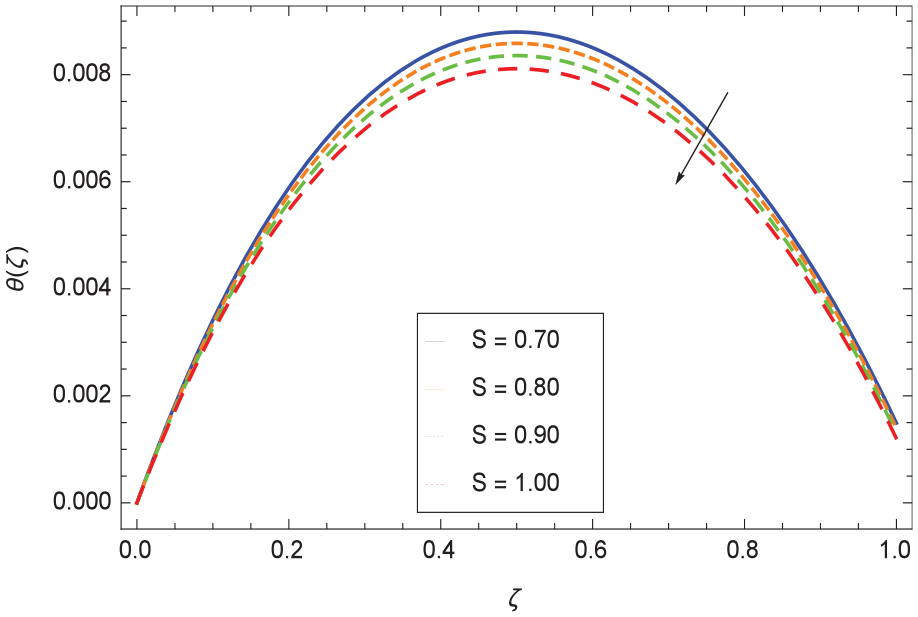
Energy curves for

Energy curves for
In Figure 15, the energy
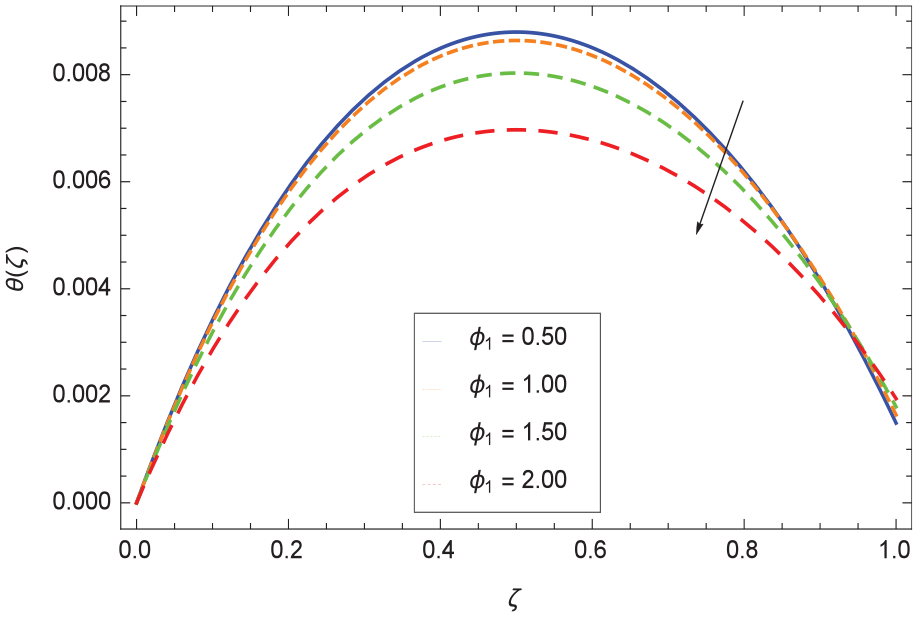
Energy curves for

Energy curves for

Energy curves for
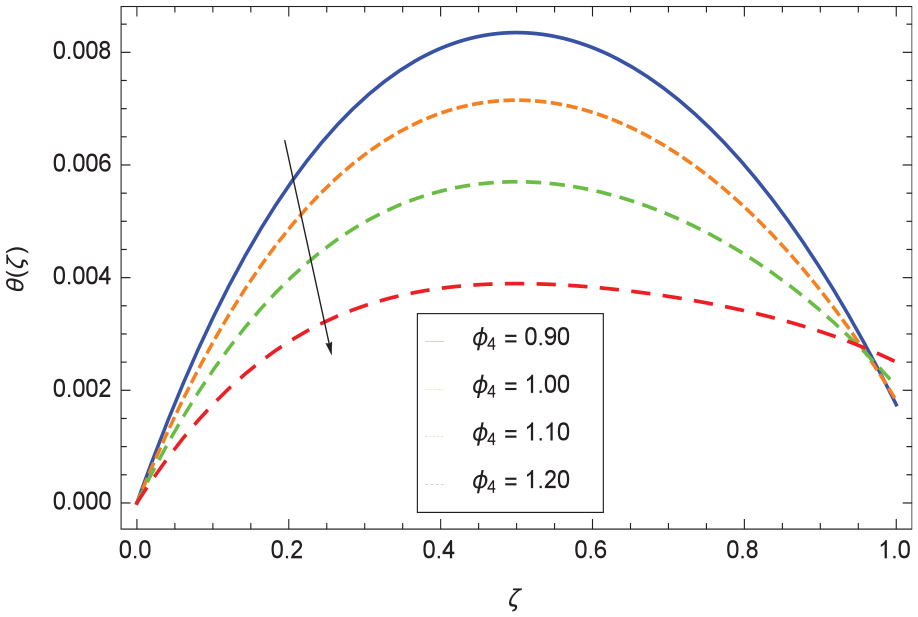
Energy curves for

Energy curves for
Figure 20 focuses on the space-reliant energy yield representative A3. Perceiving that the energy
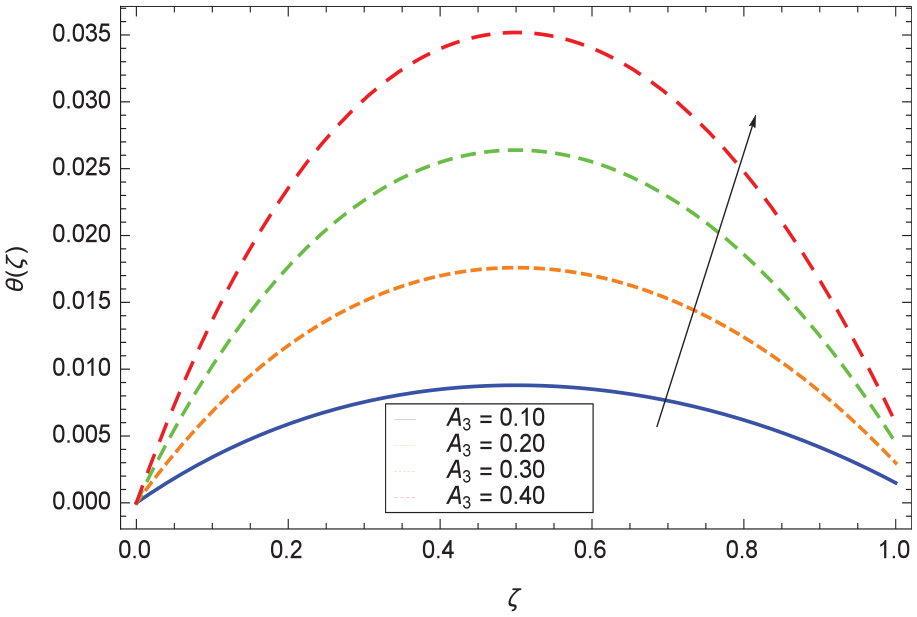
Energy curves for

Energy curves for

Energy curves for
Conclusion
The aforementioned lines attribute to series evaluation of time-reliant movement and energy transmission aspects of electrical conduction nature H2O residing the non-Newtonian second-grade nanofluid dispersion film mixed with graphene tiny particles on an expanding space in the occurrence of magnet exerted at the right angle and dissimilar energy yield/consumption. The evaluation of the issue performed through an efficient procedure (HAM) for the movement and energy profiles. The potentialities of each and every representative for movement and energy furnish quite real output to the movements of the second-grade nanofluid.
Supplemental Material
Scientific_Justification – Supplemental material for Boundary layer flow and heat transfer in a thin-film second-grade nanoliquid embedded with graphene nanoparticles
Supplemental material, Scientific_Justification for Boundary layer flow and heat transfer in a thin-film second-grade nanoliquid embedded with graphene nanoparticles by Noor Saeed Khan and Samina Zuhra in Advances in Mechanical Engineering
Footnotes
Handling Editor: James Baldwin
Declaration of conflicting interests
The author(s) declared no potential conflicts of interest with respect to the research, authorship, and/or publication of this article.
Funding
The author(s) received no financial support for the research, authorship, and/or publication of this article.

Supplemental material
Supplemental material for this article is available online.
References
Supplementary Material
Please find the following supplemental material available below.
For Open Access articles published under a Creative Commons License, all supplemental material carries the same license as the article it is associated with.
For non-Open Access articles published, all supplemental material carries a non-exclusive license, and permission requests for re-use of supplemental material or any part of supplemental material shall be sent directly to the copyright owner as specified in the copyright notice associated with the article.
