




Abstract
The non-recurrent traffic congestion triggered by crashes is one of the most important factors that undermine the traffic efficiency of urban road networks. In this article, an improved cellular automaton model was proposed to simulate the non-recurrent congestion triggered by crashes in grid networks with signalized intersections. Four rules were adopted to represent vehicle movements on road sections and intersections. The network speed is adopted to capture the propagation and dissipation of the non-recurrent congestion. The effect of main influencing factors of crashes on the road network was evaluated through the simulation. Simulation results showed the incident duration and areas affected by the distance between the crash point and the upstream intersection, the number of closed lanes, and the crash duration. In addition, the stop-start wave was observed in the simulation. The realistic findings from the simulations validated the model to have the potential for practical applications in the analysis of the non-recurrent congestion triggered by crashes.
Keywords
Introduction
Nowadays, the congestion problem has become a major and costly problem in many countries due to the rapid increase in the automobile ownership. Crashes are a major cause of the non-recurrent congestion that may diminish the available capacity of the road during a certain period of time. 1 Existing research has studied non-recurrent traffic congestion detection,2,3 evolution,4,5 and control.6,7 Developing a dynamic traffic simulation model of urban road networks to reveal the evolution mechanism of a non-recurrent congestion can promote the development of effective traffic control strategies, such as the ramp metering of freeways, 8 vehicle movement ban, and diversion for road networks.9,10
For the one-dimensional system such as freeways, the fundamental diagram (FD) is utilized to identify the congestion with the mean speed, flow, and density. For a road network, the macroscopic fundamental diagram (MFD) can describe the relationship between the network-aggregated demand and performance. 11 MFDs have been extensively studied for being calibrated based on real world data, 12 characterizing the network traffic behavior,13,14 evaluating the effect of adaptive traffic signal systems, 15 and implementing traffic control strategies.16,17 MFDs can determine relationships between macroscopic network metrics and microscopic characteristics such as the flow, density, speed, and travel time. 18 The existence of MFDs has been observed under a variety of conditions.19,20 Some crash analysis have been researched using realistic data.21,22 However, for the non-recurrent congestion, the speed change over time in the network is a more useful indicator of the traffic state. Thus, there is a need of the method that can model the detailed vehicles’ movements so as to capture the speed change triggered by the crash.
A stochastic cellular automaton (CA) model is the one that has often been utilized to simulate the evolution of traffic flows in road networks. The CA model is an effective tool to simulate the non-recurrent congestion due to its strengths in terms of simplicity, flexibility, and immediacy. The initial one-dimensional CA traffic model (Nagel–Schreckenberg) 23 and the two-dimensional CA traffic model (Biham–Middleton–Levine) 24 were proposed in 1992. Various factors have been incorporated into CA models to enhance their ability to simulate the detailed traffic moving phenomena. Jiang et al. 25 utilized the Nagel–Schreckenberg CA model to simulate the traffic flow in a Manhattan-like urban network to depict the traffic breakdown. Zhang et al. 26 studied and compared MFDs on the arterial road network governed by different types of adaptive traffic signal systems using the CA model.
In this article, the CA model is improved to simulate the effect of the network traffic density, the crash’s position on the road section, and the crash duration, on the network traffic mobility.
Improved model
The effect of a crash on the non-recurrent congestion is studied in a hypothetical urban road network in which all intersections use stop sign controls where vehicles approaching the intersection from all directions are required to stop before proceeding through the intersection. As shown in Figure 1, the network consists of
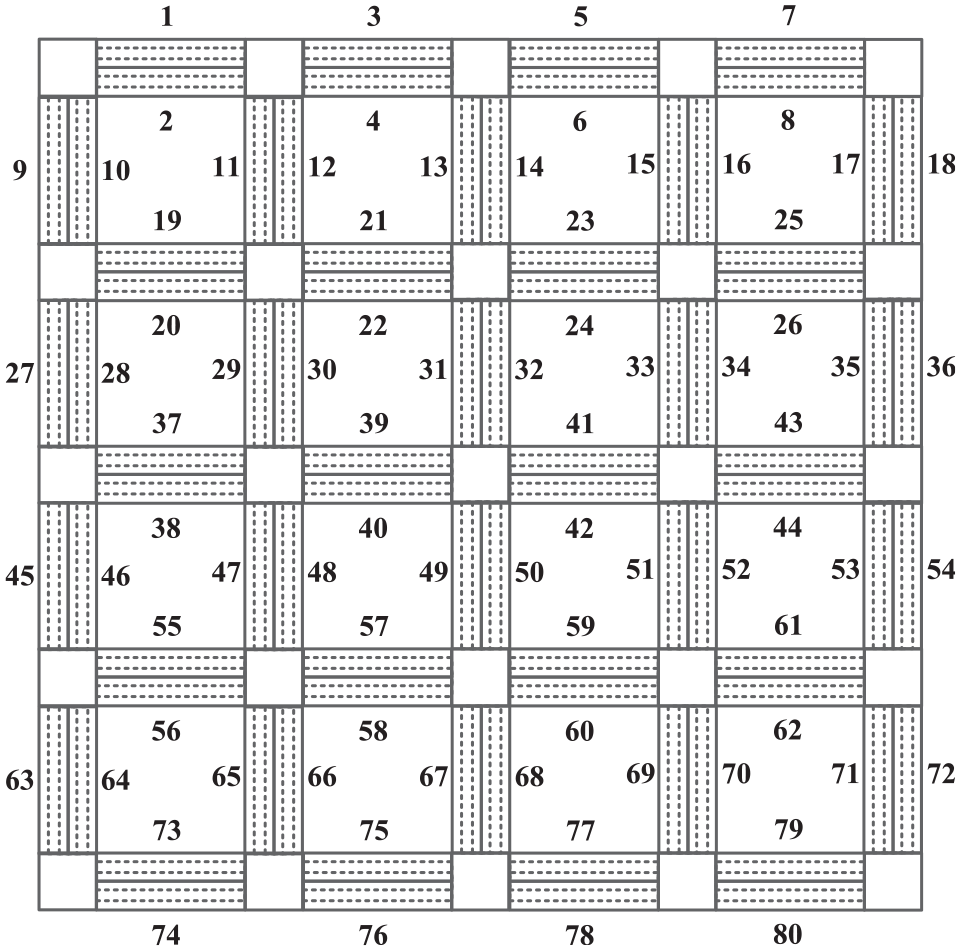
The sketch of the network and road section numbers:
In the beginning, each car is randomly assigned an origin and a destination in the network and travel along the shortest path in terms of distance to their destinations. When a vehicle arrives at its destination, it will randomly select a new destination to continue its travel. 9
During the unit time r, at time step t, let

The movement behavior of a vehicle traveling through an intersection is quite different from that on a road. Hence, update rules of vehicles on roads and in intersection areas are proposed below.
As shown in Figure 2, let

The sketch of the road section and the intersection.
Lane changing according to its turn in the downstream intersection
When
When
When
When
If the above four conditions are met, the
Lane changing according to the distance to the leading vehicle
When
When
When
If the above three conditions are met, the
Update rules for turning vehicles in the intersection
If the front cell is empty, then the vehicle moves to the front cell at the end of the step; otherwise, the vehicle will hold still. This rule will be adopted for all turning vehicles in cells 1–36.
Update rules for through vehicles in the intersection and vehicles in the lane
Step 1. Acceleration:
Step 2. Deceleration: when green light
Step 3. Randomization:
Step 4. Vehicle movement:
Simulation and analysis of crashes
This section presents and discusses the effect of crashes on road traffic flows and the congestion propagation in a hypothetical simulation study. In the simulation, as shown in Figure 1, the system size is set as
Effect of the number of vehicles
The crash is assumed to happen in the middle of road section 31 from
Figure 3(a) and (b) shows the effect of the number of vehicles
When
When

The effect of the number of vehicles
During morning and evening rush hours, there are more vehicles in the urban road network. Therefore, the crash happening during morning and evening rush hours has a greater effect than the one that happens during other times on traffic flows.
Effect of the crash’s position on the road section
We assume that the crash happens in the cell away from the upstream intersection
Figure 4 shows the effect of the distance between the crash point and the upstream intersection on the road section speed
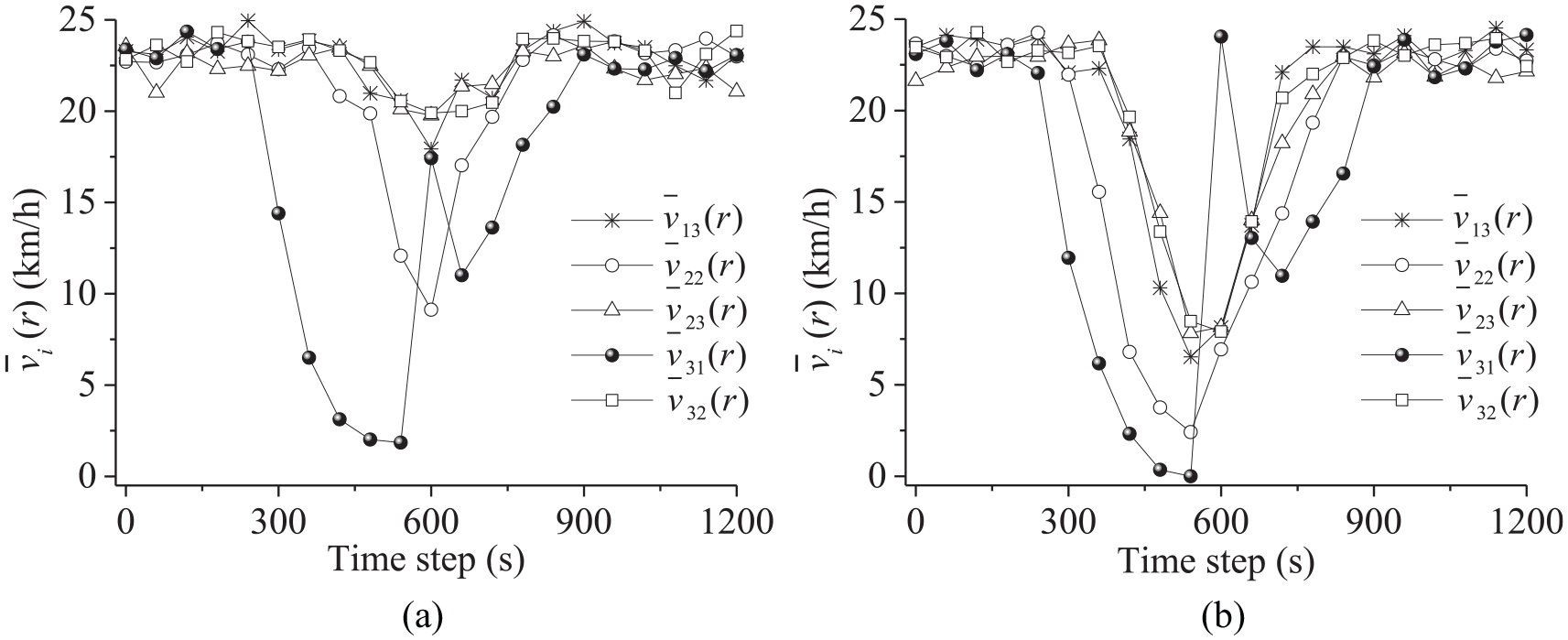
The effect of distance
In addition, the congestion always occurs in the crash section and then spreads to other roads, and after the removal of the crash, the road section speed affected by the crash may continue to decline for some time. For example, as shown in Figure 4(b), when the crash happens in road section 31,
Moreover, there is a speed rebound on the crash section after the removal of the crash. It is because the crash makes all lanes of the crash section closed to form an empty space in front of the crash point. Once the crash is removed, vehicles move on quickly to form a starting wave; therefore, the speed rebounds quickly first, then declines, and finally increases slowly to return to normal. When the distance is 20 cells, the maximal rebound of the crash section speed
Effect of the crash duration
We assume that the crash happens in the middle of road section 31 from
Figure 5(a) shows the effect of the traffic duration on the speed of road sections 31, 22, 32, 13, and 23 when the traffic duration is 300 time steps. One can see that
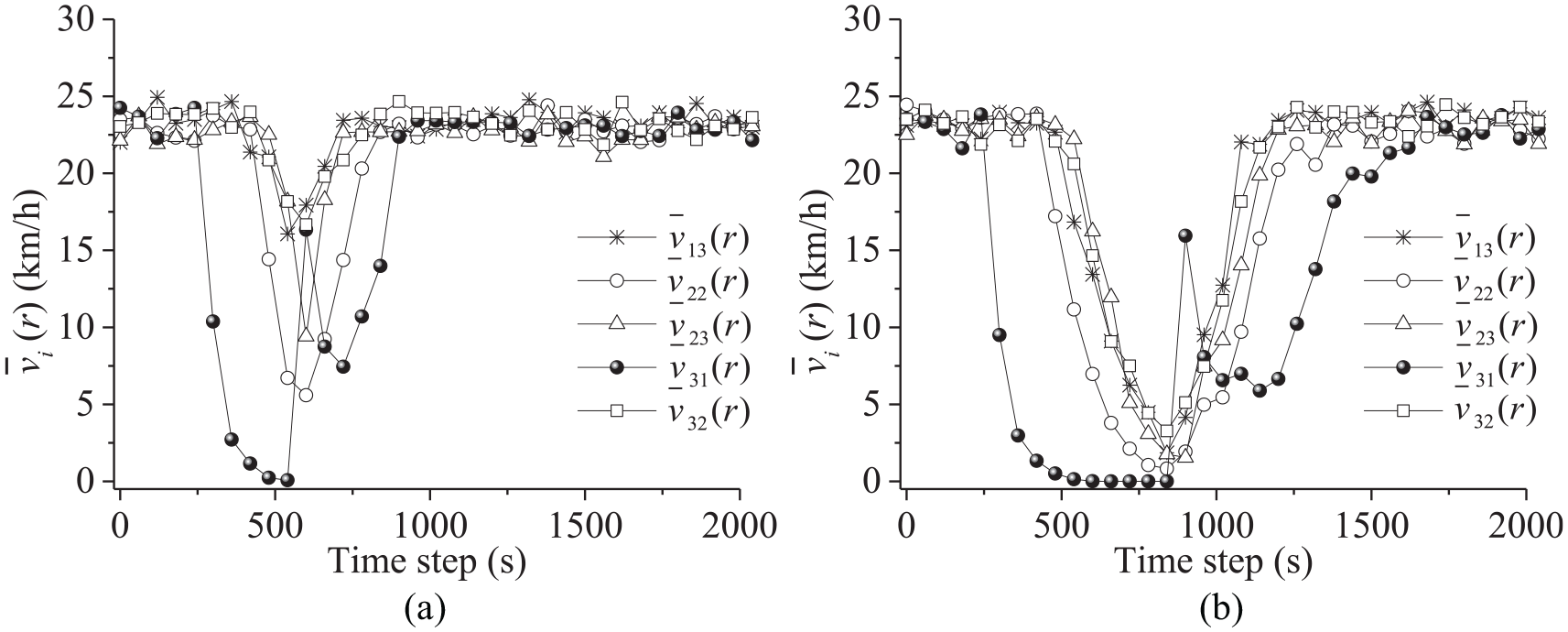
The effect of traffic duration on the speed: (a)
These mean that the increase of the traffic duration leads to the expansion of the influence scope, which is because with the increase of the traffic duration, the congestion will propagate much longer and affect more roads.
Conclusion
This article established an improved CA model for the simulation of the non-recurrent congestion triggered by crashes in road networks with signalized intersections. The proposed model can be used to investigate the effects of the number of vehicles, the distance between the crash point and the upstream intersection, the severity of the crash, and the traffic duration on the non-recurrent congestion.
Simulation results showed that the incident duration and affected area increased with the increase of vehicles, the decrease of the distance between the crash point and the upstream intersection, the increase of closed lanes, and the increase of the crash duration. In addition, the stop-start wave was observed in the simulation. The findings drawn from the simulations validated that the proposed model could represent the real traffic flow phenomenon and thus had the potential for practical applications.
Although the model is rather simple, it has captured the most important parameters in non-recurrent traffic congestions in road networks, that is, the formation, propagation, and dissipation of the traffic congestion affected by crashes and effects of the crash on the network traffic. In the future, more realistic road networks including various types of roads and intersections need to be considered, and more realistic origin-destination data need to be applied with a consideration of time-varying traffic demands. In addition, studies should be conducted to model the real route choice behavior of drivers with a consideration of the heterogeneity of travelers, the dynamic control methods, and strategies for managing traffic congestions, such as the dynamic route guidance, temporary vehicle ban, and adaptive traffic lights.
Footnotes
Handling Editor: Hai Xiang Lin
Declaration of conflicting interests
The author(s) declared no potential conflicts of interest with respect to the research, authorship, and/or publication of this article.
Funding
The author(s) disclosed receipt of the following financial support for the research, authorship, and/or publication of this article: This work was jointly supported by the Zhejiang Provincial Natural Science Foundation of China (LY18E080021) and the Project of Science and Technology of the Department of Transportation of Hubei Province, China (2017-538-4-9, 2014-721-3-13).
