




Abstract
This investigation is concerned with the study of thin film flow of a generalized Maxwell fluid along with slip conditions, confronting withdrawal and drainage on non-isothermal cylindrical surfaces. The governing equations have been formulated from the continuity equation, momentum equation, and energy equation. Analytical solutions for the velocity field, volume flow rate, average film velocity, tangential stress, and temperature are obtained in series form through the Binomial expansion technique in both withdrawal and drainage cases. The well-known solutions for a Newtonian fluid are regained as a particular case of our acquired general solutions in all flow cases. In addition, solutions for the power-law fluid model, executing alike motion, can be recovered as a limiting case of our acquired general solutions. The influence of different dimensionless parameters on all physical quantities (i.e. velocity, volume flow rate, average film velocity, tangential stress, and temperature profile) is examined and discussed graphically for both generalized Maxwell and Newtonian fluids.
Keywords
Introduction
In recent time, the non-Newtonian fluids have gained astonishing interest by researchers and engineers in various branches of science and technology. Such interest is initiated by practical applications of these fluids in bioengineering, chemical industries, and material processing such as slurry fuels, colloidal and suspension solutions, exotic lubricants, extrusion of polymer fluids, and many more. Fluids belonging to this group including drilling mud, cement, shampoo, grease, ketchup, sludge, granular suspension, paints, aqueous foams, food products, plastics, paper pulp, and several others illustrate the characteristics of non-Newtonian fluids which are pretty different when equated with the linearly viscous fluids. These fluids are elucidated by a non-linear association between stress and the rate of deformation tensors, and hence, there is not a solo constitutive model which can forecast all the prominent features of non-Newtonian fluids because of their assorted physical structures. Generally, non-Newtonian fluid models are classified as (a) the rate type, (b) the differential type, and (c) the integral type. But the most prominent among them is the first one which has gained stunning importance in the field of research, especially in applied mathematics, engineering, and industry-related research problems. An imperative class of the rate type model of non-Newtonian fluids, that have the properties of both viscosity and elasticity, is viscoelastic fluids.1,2 The study of viscoelastic fluids has many applications to industrial processes, including the cooling of metallic plates in a bath and food stuff. 3 The first rate type model of viscoelastic fluids which is still extensively used to approximate the response of some dilute polymeric solutions is Maxwell fluids. 4 This is a simplest subclass of rate type viscoelastic fluids which can designate the physical characteristics of relaxation time. Due to its important applications in industrial technology, it has gained considerable interest in the technical fields.5,6 These applications comprise power generators, cooling of nuclear reactors, liquid metal flow control, micro pumps, high-temperature plasmas, biological transportation, drying processes, solidification of binary alloy, and so on.3,7,8 Rajagopal and Srinivasa 9 established a methodical thermodynamic structure for several viscoelastic fluids of rate type which is based on the influential work of Maxwell for different flow problems.
Thin liquid films are quite omnipresent in nature and technology, so an understanding of their mechanics, the amount of fluid withdrawn, and knowledge of their thickness is of great importance in numerous practical applications, such as coating of photographic films, enameling, hot tinning, lubrication of moving machine parts as in lubricating gears and bearings, chemical and nuclear reactor design, manufacturing of CDs and plastic sheets, painting, rinsing, dip coating, spreading of sauce on food, and pickling. A typical thin film flow comprises a span of fluid partly bounded by a solid surface, whereas the other surface is freely interrelated to another fluid, generally a gas and, most frequently, air in applications. For the formulation of these films, three basic conditions such as gravitational force, surface tension, and centrifugal force are required. A simple and clear example is the flow of a thin raindrop down a windowpane under the action of gravity. With the research advancement, thin film flow of non-Newtonian fluids has received significant approach by many intellectual workers and researchers10–14 due to their fruitful applications in the vicinities of physical and biological sciences, particularly with the progress of polymer, petroleum, and other kinds of pulp industries.15–19 Landau and Lifshitz 20 studied the drainage thin film flow phenomena of Newtonian fluids. Over the past few decades, significant attempts have been made by scientists21–24 for the establishment of numerical solutions and analytical algorithms of thin film flows.25–28 Hayat and colleagues29–31 analyzed the thin film flow by considering differential type fluids in varieties of articles. They studied the influence of numerous physical parameters on flow fields. Siddiqui et al.32–34 investigated the flow of thin films of third- and fourth-grade fluids down an inclined plane and vertical cylinder by means of the homotopy perturbation method. They also studied the flow behavior of non-Newtonian fluid films over a vertical moving belt. At present, the study of non-Newtonian fluid flow along with slip boundary conditions has become spirited due to the extensive usage of such fluids in polymer melt, power engineering, petroleum production, and food engineering.35–37 Farooq et al.38,39 explored the withdrawal and drainage on a vertical cylinder for generalized second-grade fluid with slip conditions. Gul and colleagues40–42 probed the lifting and drainage for magnetohydrodynamic (MHD) thin film flow of third-grade fluid using constant and variable viscosities.
The purpose of this article is to venture further into the establishment of a generalized Maxwell fluid. More precisely, this article claims to examine the impact of slip condition on thin film flow of a generalized Maxwell fluid over a vertical upward moving cylinder and down a stationary vertical cylinder. Series solutions in both cases are acquired by using efficient methodical techniques, namely, binomial series method. Analytical solutions for velocity field, volume flow rate, average film velocity, tangential stress, and temperature are obtained in both withdrawal and drainage cases. The equivalent solutions for Newtonian fluid are also achieved as a particular case of our general solutions by taking the flow behavior index is equal to zero. Moreover, the influence of various physical parameters on velocity field, volume flow rate, average film velocity, tangential stress, and temperature is discussed and presented graphically in both cases under the state of generalized Maxwell and Newtonian fluids.
Governing equations
The main equations governing the motion of an incompressible generalized Maxwell fluid on non-isothermal cylindrical surfaces are35,38


where
The Cauchy stress tensor

where

where
Problem formulation for withdrawal case
Consider a container filled with an incompressible generalized Maxwell fluid. An infinite vertical cylinder of radius


Geometry of withdrawal case.
By making use of equation (6), equation (1) is satisfied identically and equation (2) is written as35,37



Suppose that the atmospheric pressure

Using equations (4) and (6), equation (3) becomes35,37
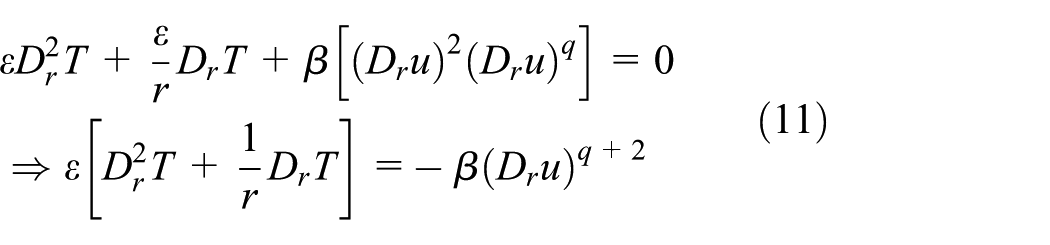
Boundary conditions related with equations (10) and (11) are35,39


By integration of equation (10) with respect to “

In series form, using binomial expansion, equation (15) becomes
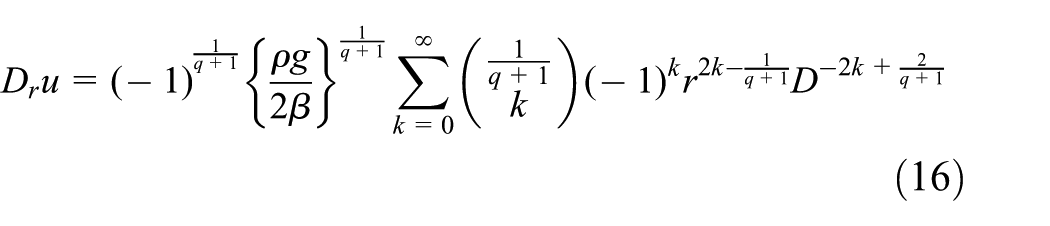
Equation (11) in view of equation (16) becomes

Solutions for withdrawal case
Solutions for the generalized Maxwell fluid and for Newtonian fluid are presented here in this section.
Solutions for generalized Maxwell fluid
For
Velocity field
Integrating equation (16) with respect to “

Volume flow rate
Volume flow rate

Using equation (18), we acquire

Average film velocity
Average film velocity

Inserting equation (20) into equation (21), the average film velocity is

Tangential stress
The tangential stress on cylindrical surface is given in equation (14). Using equation (4), we have

Consuming the slip boundary conditions given in equation (13), the tangential stress employed by the fluid on cylindrical surface in withdrawal case is

Temperature profile
Solution of equation (17) for temperature profile by using boundary conditions defined in equations (12) and (13) is

Solutions for Newtonian fluid
When
Velocity field
Putting

Volume flow rate
Volume flow rate

Average film velocity
By using equation (27) into equation (21), the average film velocity

Tangential stress
Tangential stress for Newtonian fluid is the same as it is for generalized Maxwell fluid, which is given by equation (24).
Temperature profile
Putting

Solutions for withdrawal case in dimensionless form
Introducing the following dimensionless parameters22,35,39

in differential equations (10) and (11) and in the boundary conditions given by equations (12) and (13). The new transformed differential equations along with boundary conditions in dimensionless form after dropping the “hats” for simplicity are 35



where
By integration of equation (31) with respect to “r” and consuming boundary conditions defined in equation (33), we have

In the above expression, signs of

Equation (32) in view of equation (36) yields

Inserting equation (35) into equation (34), we have

Solutions for generalized Maxwell fluid
For
Velocity field
Integrating equation (36) with respect to “

Volume flow rate
Volume flow rate

Inserting equation (39) into equation (40), the volume flow rate is obtained as 35

Average film velocity
Average film velocity

Inserting equation (41) into equation (42), the average film velocity

Tangential stress
Tangential stress employed by the fluid over the cylindrical surface is

Using equation (35) into equation (44), tangential stress is

Temperature profile
Solving equation (37) using boundary conditions given in equations (33) and (34), expression for temperature profile is

Solutions for Newtonian fluid
When
Velocity field
Putting

Volume flow rate
Volume flow rate

Average film velocity
By using equation (48) into equation (42), the average film velocity

Tangential stress
Using equation (35) into equation (44) and then solving for
Temperature profile
Putting

Problem formulation for drainage case
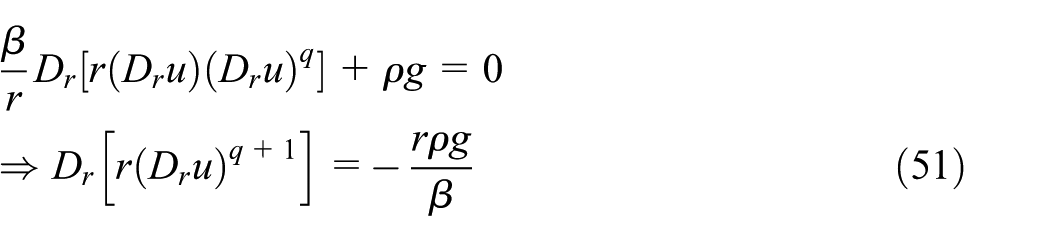
Consider a steady, uniform thin film of generalized Maxwell fluid draining down over a stationary vertical cylinder. In drainage case, z-axis is in the downward direction and the motion of fluid is due to the gravity as shown in Figure 221,22,37 The geometry and assumptions for drainage case are alike as in the preceding case, but the boundary conditions of velocity are changed. Therefore, equations (10) and (11) turn into the following form23,35,39


Geometry of drainage case.
Boundary conditions connected with equations (51) and (52) are35,37,39


where

In series form, using binomial expansion, equation (55) becomes

Equation (52) in view of equation (56) yields
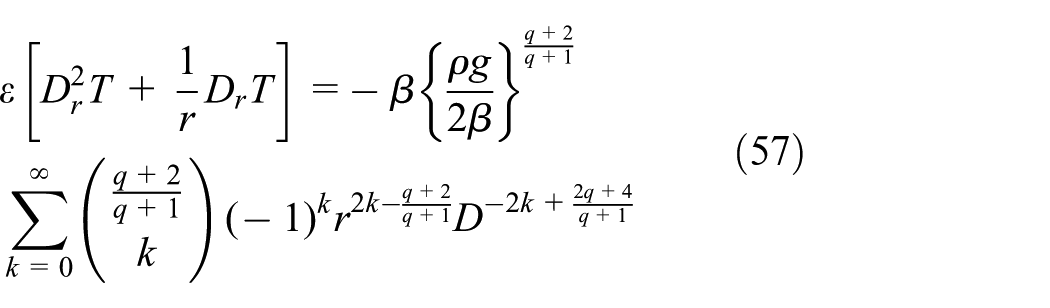
Solutions for drainage case
Solutions for generalized Maxwell fluid and also for Newtonian fluid are presented here in this section.
Solutions for generalized Maxwell fluid
For
Velocity field
Solving equation (56) using the given boundary conditions, the expression for velocity field in drainage case is acquired as

Volume flow rate
Volume flow rate

Average film velocity
Expression for average film velocity

Tangential stress
Tangential stress exerted on cylindrical surface in this case is

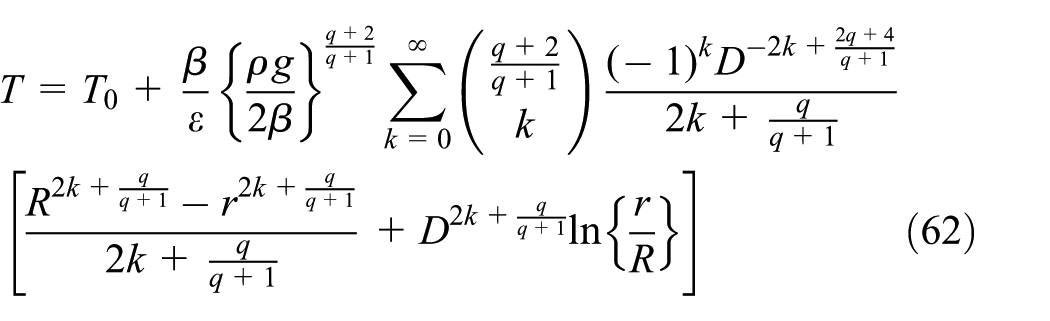
Temperature profile
Solution of equation (57) for temperature profile, when the boundary conditions defined by equations (53) and (54) are used, is
Solutions for Newtonian fluid
When
Velocity field
Putting

Volume flow rate
The volume flow rate

Average film velocity
By utilizing equation (64) in equation (21), the average film velocity

Tangential stress
Tangential stress for Newtonian fluid is the same as it is for generalized Maxwell fluid, which is given by equation (61).
Temperature profile
Putting

Solutions for drainage case in dimensionless form
Inserting the non-dimensional parameters defined in equation (30) into equations (51), (52), (53) and (54). After dropping “hats” for simplicity, the new converted dimensionless equations together with boundary conditions are 35



By integration of equation (67) with respect to “r” and using the given boundary conditions, we acquire

In series form, using binomial expansion, equation (71) is written as 35

Using equation (72), equation (68) yields

Equation (70) in view of equation (71) gives

Solutions for generalized Maxwell fluid
For
Velocity field
Solving equation (72) using boundary conditions defined in equation (74), the expression for velocity field is

Volume flow rate
Using equation (75) into equation (40), the volume flow rate
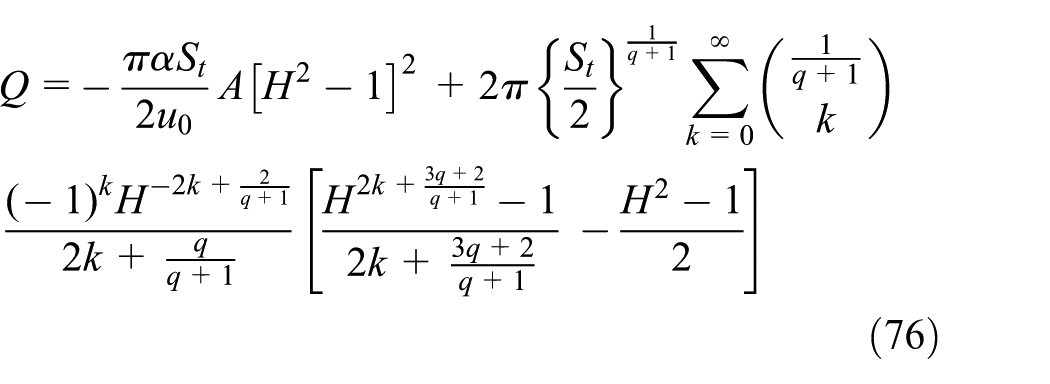
Average film velocity
Profile for average film velocity

Tangential stress
Tangential stress exerted on cylindrical surface in the drainage case is

Temperature profile
Solution of equation (73) for temperature profile, when the boundary conditions specified in equations (69) and (74) are used, is

Solutions for Newtonian fluid
When
Velocity field
Putting

Volume flow rate
Volume flow rate

Average film velocity
By utilizing equation (81) into equation (42), the average film velocity

Tangential stress
Tangential stress for Newtonian fluid is same as it is for generalized Maxwell fluid given by equation (78).
Temperature profile
Putting

Results and discussion
In this article, we analyzed the thin film flow of generalized Maxwell fluid over a vertical cylinder under the impact of slip and free space boundary conditions. The problem has been modeled for withdrawal and drainage of velocity field and temperature profile. Furthermore, series solutions for volume flow rate, average film velocity, and tangential stress have been predicted by using the binomial series technique. The geometry of problem has been shown in Figures 1 and 2 for withdrawal and drainage, respectively. The influences of dimensionless model parameters, for instance, flow behavior index

Impact of
Effect of

Impact of
Impact of

Effect of
Impact of

Impact of
Impact of

Impact of

Impact of

Impact of

Effect of

Effect of

Influence of

Effect of

Effect of

Effect of

Effect of

Impacts of (a) St and (b) Br, on temperature when 0 < q < 1.
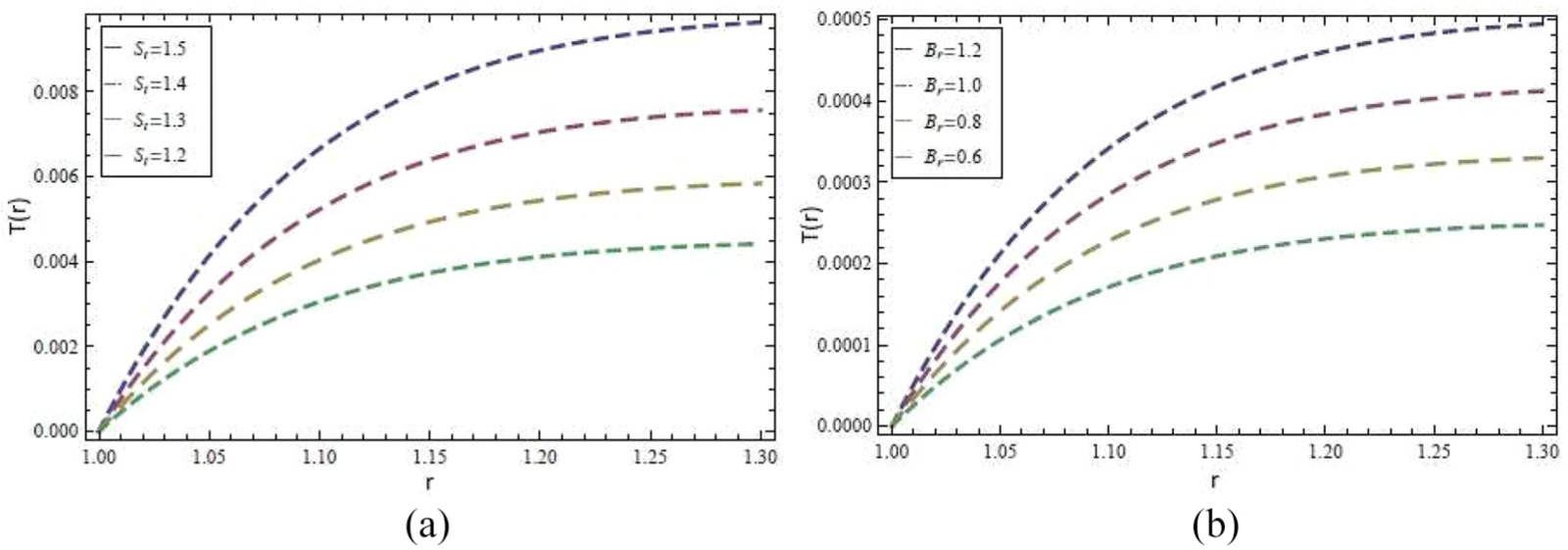
Impacts of (a) St and (b) Br, on temperature when −1 < q < 0.
Effect of

Impact of
It has been investigated that, when
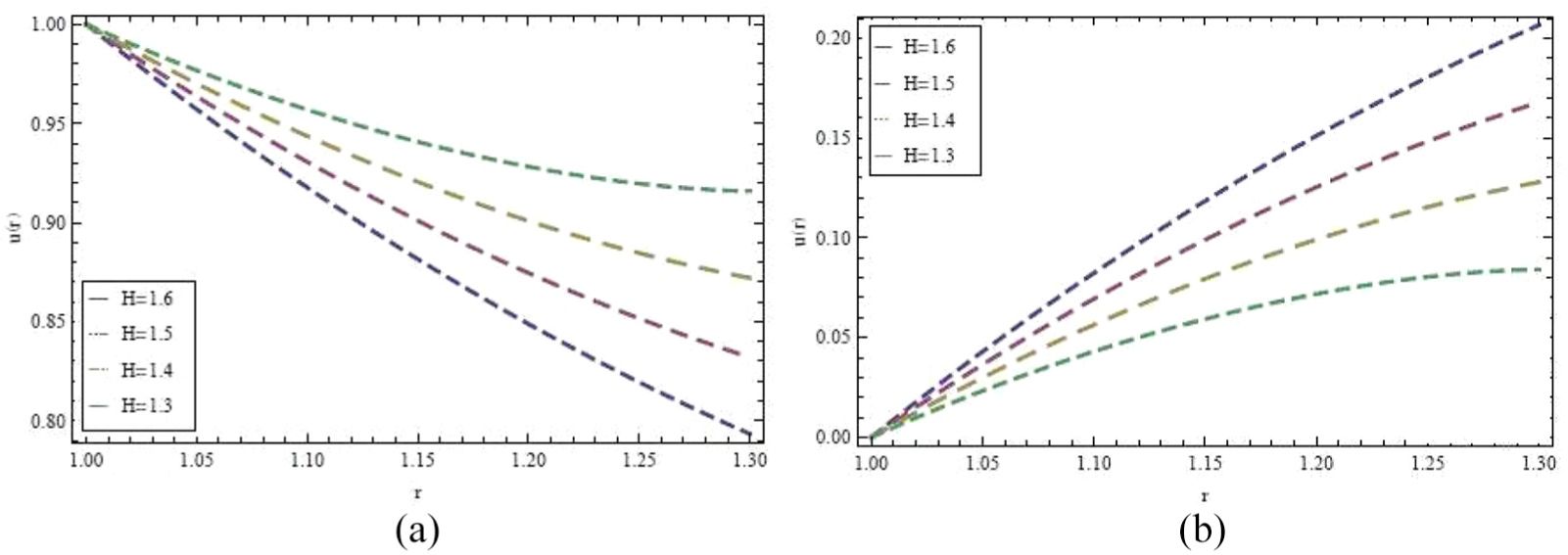
Figures 6–8 show the effect of
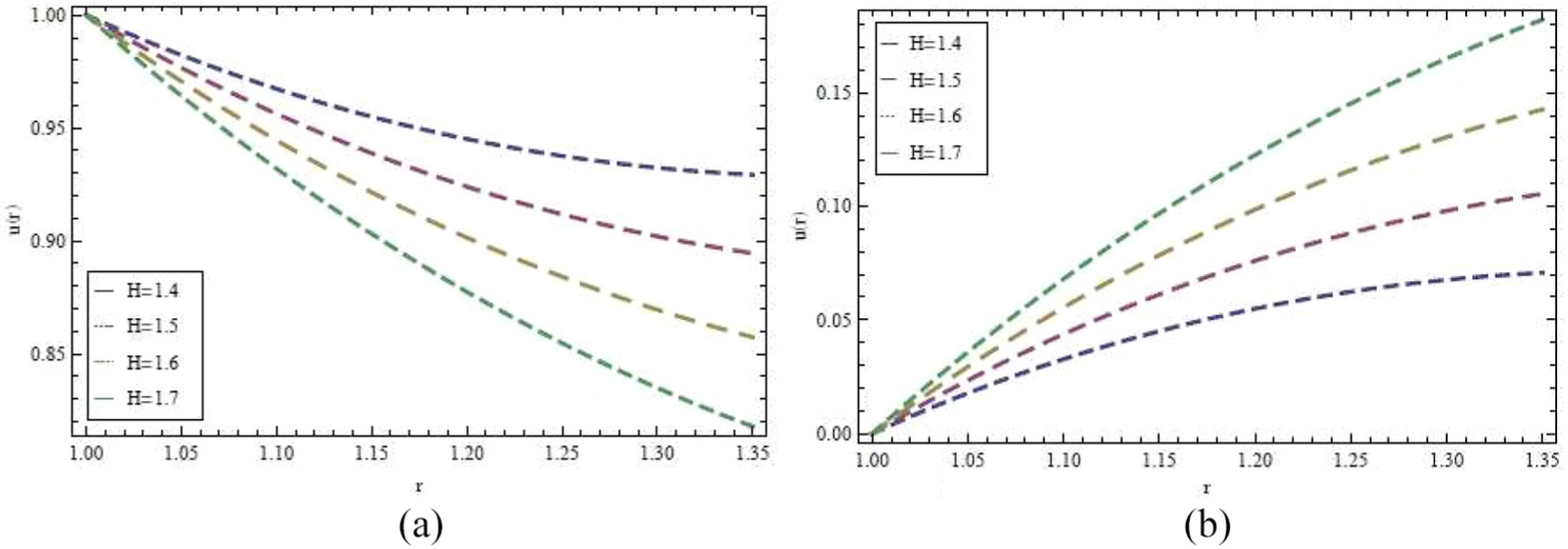
Figure 9(a) shows that velocity declines as the fluid is becoming thicker in withdrawal case, and it rises in the drainage case, as shown by Figure 9(b).
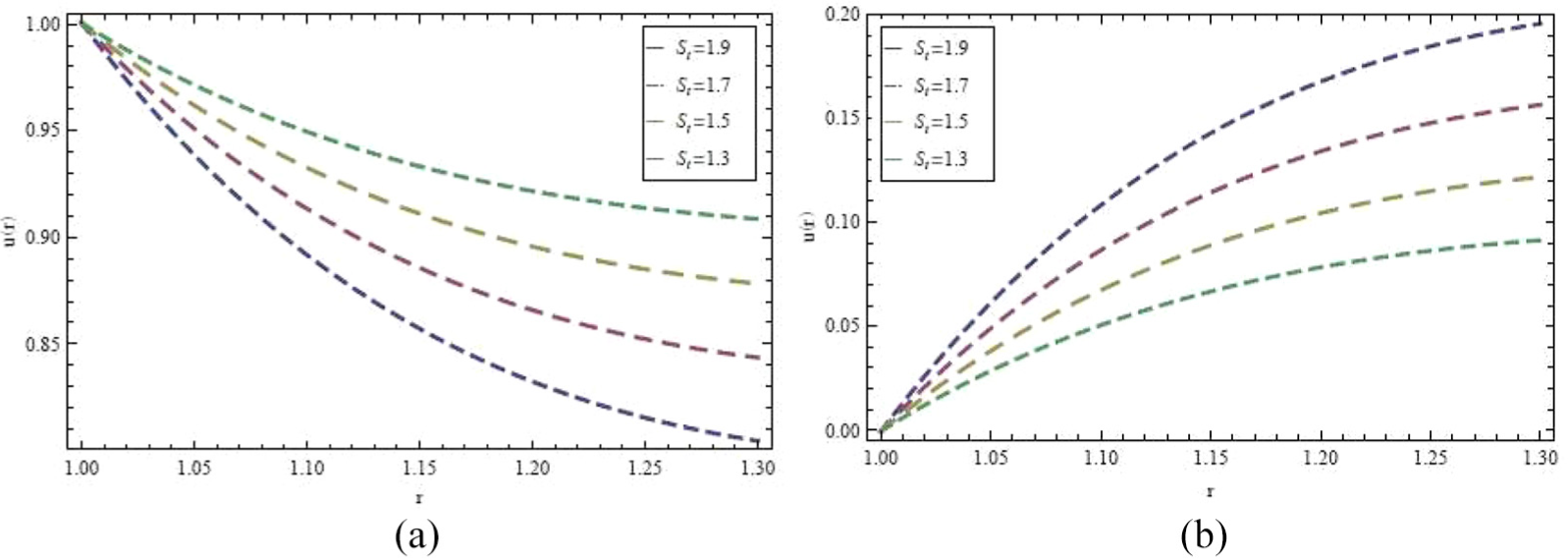
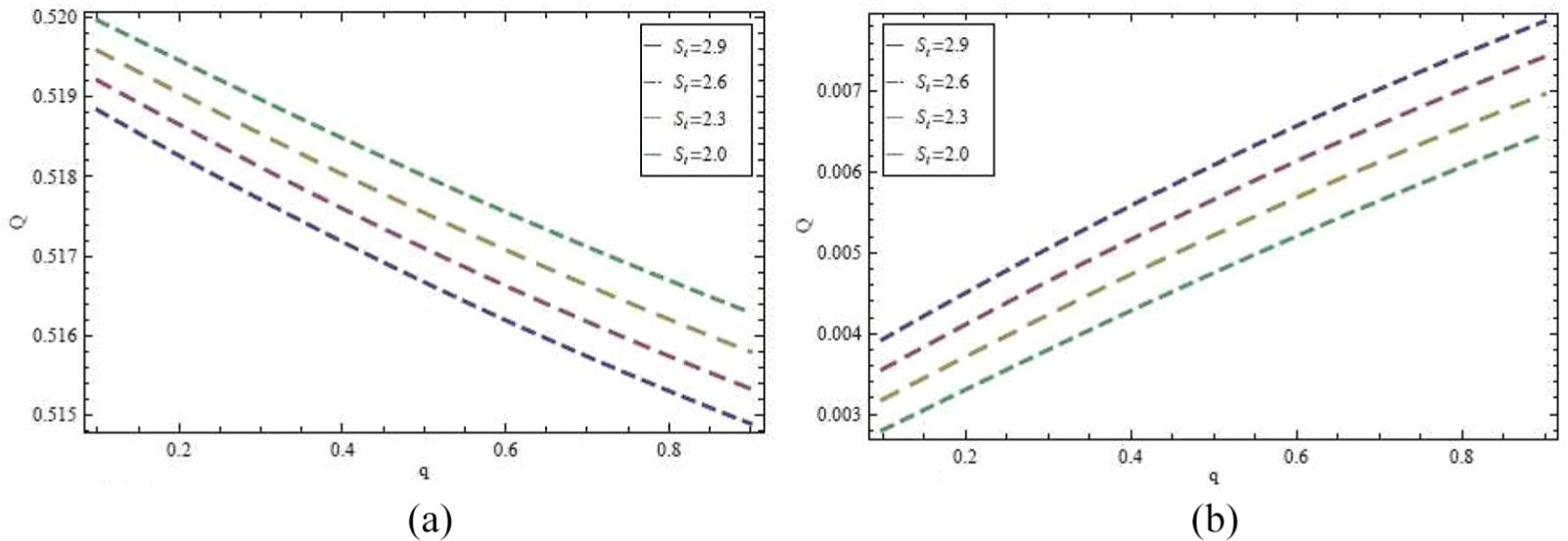
Figures 10–12 display the influence of Stock’s number
Figure 13(a) shows that the volume flow rate rises as the fluid is becoming thicker in withdrawal case and it declines in the drainage case, as shown by Figure 13(b).
Figures 14–16 display the influence of Stock’s number on average film velocity. Figures 14(a), 15(a), and 16(a) indicate that with the increase of Stock’s number, average film velocity decreases in withdrawal case and it increases in the drainage case as shown by Figures 14(b), 15(b), and 16(b).
Figures 17 and 18 present the effects of
Figures 19 and 20 show the impacts of parameters
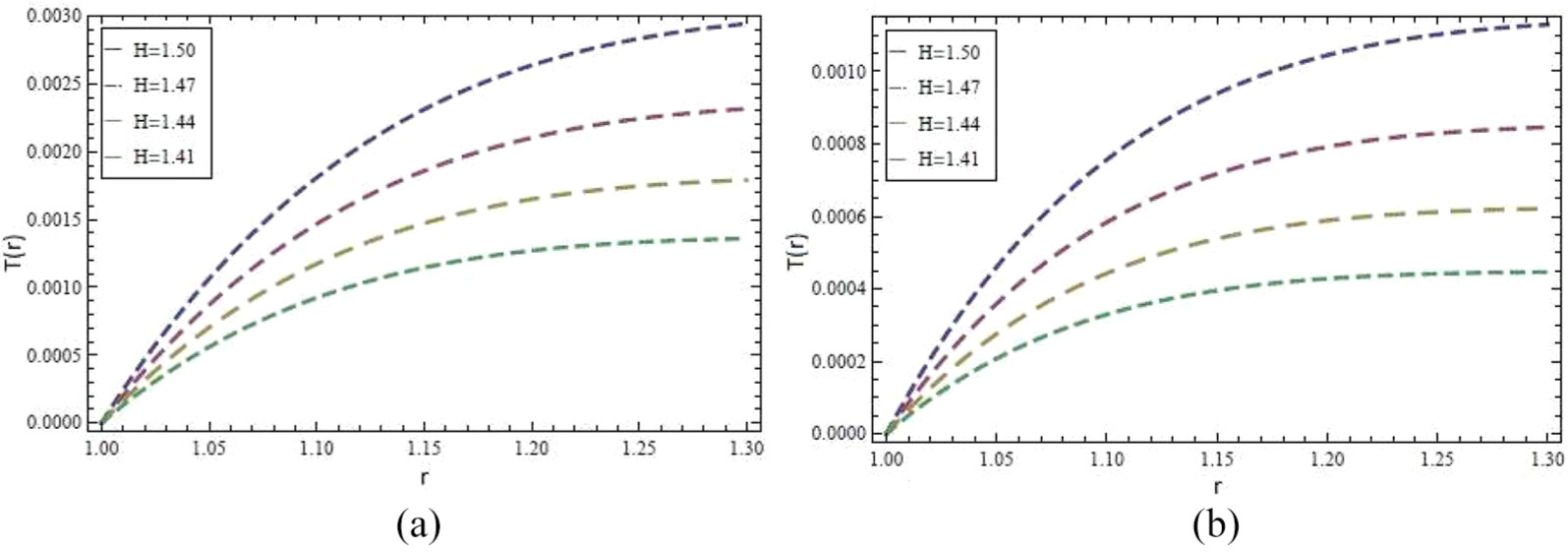
Figures 21–23 indicate that temperature increases by rising the values of
Conclusion
The important findings of this article are listed below.
The theoretical study of steady uniform thin film flow of incompressible generalized Maxwell fluid over vertical cylinder under the influence of non-isothermal effects for withdrawal and drainage cases is presented.
The problem is formulated in terms of differential equations along with appropriate initial and boundary conditions.
Exact methodical solutions are reported for velocity, volume flow rate, average film velocity, tangential stress, and temperature for both cases by applying binomial series technique which is the most efficient, effective, and reliable technique for the solutions of such problems.
Solutions for the Newtonian fluid are recovered as a particular case of our obtained solutions for generalized Maxwell fluid.
Tangential stress on cylindrical surface is similar for Maxwell and Newtonian fluids in withdrawal case. Moreover, the effect of tangential stress also remains invariable in drainage case for either type of the fluid.
Solutions for temperature profile in both cases remain the same for either type of the fluid.
The impacts of different dimensionless parameters on velocity field, volume flow rate, average film velocity, tangential stress, and temperature profile are examined and discussed graphically for both generalized Maxwell and Newtonian fluids.
The temperature of the fluid rises with a rise in the values of pertinent parameters used in the planed problem. This effect shows that there is a direct relation between these parameters and temperature profile. On the other hand, the magnitude of velocity decreases by rising the values of parameters in withdrawal case, while it increases in drainage case.
Footnotes
Acknowledgements
The authors express their heartfelt gratitude to the editor and reviewers for their precious comments, which have led to the improvement in clarity and quality of this paper.
Handling Editor: James Baldwin
Declaration of conflicting interests
The author(s) declared no potential conflicts of interest with respect to the research, authorship, and/or publication of this article.
Funding
The author(s) received no financial support for the research, authorship, and/or publication of this article.
