




Abstract
Analysis of three-temperature heating system has revealed the apparent advantages and disadvantages that the combination of thermodynamic systems has in future development with respect to environmental and economic issues. Three-temperature heating systems consist of a heat engine and a heat pump, thus enabling maximum use of the primary thermal source for heating buildings. It seems that the combination of a Stirling engine, or a similar heat drive, with a heat pump is suitable. In order to analyse the effectiveness of such a system, a comprehensive calculation procedure is used as follows: its basis lies in accounting for all types of energy and their relationship to the original natural resource. The present study aims to point out that the combination of a Stirling engine and a heat pump is a useful solution due to the fact that it has the most favourable resultant economic impact in comparison to the use of a diesel, four-stroke gas or the most commonly used electric drive.
Introduction
In the search for an ecologically favourable solution to energy usage, the main criterion is maximizing efficiency and/or usefulness of such solutions. This approach is important especially in heating buildings, where energy resources are burned, thus producing the necessary heat. The authors argue that the efficiency of energy usage can be increased by applying a three-temperature heat pump system. A relatively significant potential for improvement remains in this area that has hardly been tackled. The authors delve into the issue of the efficiency of an overall heating system, in view of the fact that maximum heat acquisition from the energy source is insufficiently explored.
The three-temperature system is a heating system that converts part of the heat generated by combustion into mechanical work. At the same time, the mechanical work ensures the running of the heat pump, which adds additional ambient heat to the system. For example, a four-stroke engine burns gasoline and simultaneously carries out the mechanical work that drives the heat pump. As a result, more heat is released into the heated system than if only the gasoline itself was combusted without the heat pump.
Effective use of energy sources for heating requires that two conditions be met. The first necessary condition is the efficient transfer of energy to the heated object; the second one is the effective retention of heat by the object, that is, the appropriate thermal insulation of the heated building.
In connection with the first condition, one of the most important parts of the heating system is the pump itself. The topic of pump as turbine (PAT) as an effective alternative for power generation for small hydropower system is dealt with by authors in the study ‘Theoretical model of energy performance prediction and BEP determination for centrifugal pump as turbine.’ 1 Another related theme dealing with transient cavitating flows of a mixed flow PAT at pump mode is investigated experimentally and numerically. This is covered in the article ‘Symmetrical and unsymmetrical tip clearances on cavitation performance and radial force of a mixed flow pump as turbine at pump mode’ 2 The article ‘Tip clearance on pressure fluctuation intensity and vortex characteristic of a mixed flow pump as turbine at pump mode’ 3 also deals with the issue of the pressure fluctuation intensity and vortex characteristic of a mixed flow PAT at pump mode with a tip clearance.
Various building technologies based on the use of thermal insulation materials 4 have been elaborated. The present study does not deal with this topic; however, due to its importance, a reference thereto is due.
We focus on the efficient transfer of energy to the heated object. For a three-temperature heating system, the energy sources generated by the combustion process are important. As to its efficiency, this process involves efficient combustion of the material in the boiler and efficient preparation of the material to be combusted. The preparation of, for example, wood-based material for combustion has been studied by Krizan et al. 5 The implementation of the decision-making criteria in the use of sustainable technologies based on renewable energy is discussed in detail in Mardani et al. 6
In the debates on fuel efficiency, with respect to the view on different energy sources, it is also necessary not to forget in what form and/or in which quality the fuel is supplied. Not every material – fuel – exhibits the same calorific value. For example, organic bio-briquettes produced from wood sawdust through a uniaxial pressing process 7 exhibit various values of density and calorific value. This issue has a significant impact on the diagnostic procedures since the thermal balance considerably influences machine systems. Status monitoring and evaluation of indicators during machine operation are reported in previous research studies.8–10 The simulation of heat transfer in the form of mathematical simplification is also dealt with in previous studies.11,12
When introducing progressive innovation, such as the use of renewed heat, technical considerations need to be taken into account as well, 6 as these are among key factors in decisions on introducing such innovation. The issues concerning small- and medium-sized businesses have been addressed by the authors of the previous study. 13 For buildings, the starting points have been defined and developed in a study. 14
These calculations of economic impact are merely of an informative nature. The calculations have not taken into account such important circumstances as system reliability, investment and operational costs. The study makes use of a nonstandard computational method that can be used in general for other machine systems with regard to machine condition assessment.
A significant limitation in the direction of development in heating systems also arises due to the necessity of compliance with the legislature, which also affects the price. Legislature exercises such an influence that it can fully affect the usage of certain technical devices regardless of the technical solution. For example, as of September 2015, the performance requirements set out in the ErP Directive have been effective with regard to all residential and commercial heating products throughout Europe, including electric power products, boilers and water heaters, as well as renewable technologies, such as solar thermal products and heat pumps. In practice, this means that only condensing boilers may be produced under this directive. It is therefore important to separate the operating economy only in terms of energy consumption, operating economy in terms of founding costs, operating economy in terms of planned and unplanned maintenance costs, while complying with legislation. The present study focuses on the economic impact with regard to energy consumption without taking into account operational and investment costs. This issue will be the subject of another interesting study.
The benefit of the three-temperature system increases the overall thermal efficiency by a minimum of 26% for any heat source. However, in terms of environmental load, only more environmentally friendly and sustainable resources ought to be preferred.
Effective energy transfer to an object depends on the primary type of energy source and on the method of its further processing. When heat is produced with a higher difference in thermodynamic temperature, it can be used to operate the heat engine. In conventional carbohydrate combustion, the difference in thermodynamic temperatures is around 500°C. Naturally, heat can also be generated at low thermodynamic temperatures, for example, heat sourced from solar collectors, obtained by decomposition. Unfortunately, small differences in thermodynamic temperatures are not suitable for generating efficient mechanical work (e.g. for Stirling engine); therefore, these sources are difficult to use in the three-temperature heat pump system.
The efficiency of the use of a heat source can be increased by the three-temperature heat pump system only when the system’s thermodynamic temperatures are sufficiently different. Conversion of heat into mechanical work is theoretically limited by the Carnot cycle. If the higher thermodynamic temperature is 850°C and the lower is about 77°C, then the thermal efficiency of the Carnot cycle is 69%. Today, under laboratory conditions, half-efficiency of the Carnot cycle heat engine can be achieved (34%); commercially produced Stirling-drive engines achieve about a quarter-efficiency of the Carnot cycle heat engine (around 17%).15–18 This is to say that, with a conventional source like combustion, it is now possible to convert only about 17% of the total heat output into mechanical work. This mechanical work can be used to drive the heat pump, which is the basic principle of the three-temperature system.
Convenient properties of the Stirling engine in conjunction with the heat pump are as follows:
A large range of system sizes;
Low operating costs;
Independence from the type of heat source;
Relatively few mechanical components in comparison to conventional gasoline-, gas- or diesel-powered heat engines;
Relatively quiet running.
Inconvenient properties are as follows:
Relatively many mechanical components in comparison to a solar panel;
Relatively low efficiency if long-term reliability is required;
Close interconnection between efficiency and the difference in thermodynamic temperatures and the outside temperatures;
Relatively high initial investment.
A conventional fuel source allows for generation of as much heat supply

The difference between (a) conventional and (b) three-temperature heating system.
The three-temperature system allows the heat
Energy transformations take place between three temperatures. Heater temperature
If the focus is on the development of a particular product, it must be technically feasible and efficient. This condition is relatively unchanging over time, contrary to economic conditions. If the system guarantees the highest technical efficiency, it does not necessarily mean that it is applicable to practice or that it can be used commercially. Therefore, the present study addresses feasible three-temperature systems with a potential for later commercial application. The study also looks at the economic impact of using certain fuel sources.
Thermodynamics equations applied to heat pumps
The necessary equations are based on the principle of the First Law of Thermodynamics. The heat delivered to the system is not lost; in some parts, it may well be converted to some form of energy. Thermal balance analysis is based on the assumption that all energy sources originate from a natural source. Therefore, the evaluation of the efficiency of any device must begin with incoming natural energy. Generally, this energy has the form of heat. The whole system is then a combination of heat equipment that includes a heat pump and a heat engine.
The purpose of the heating system is to get the maximum amount of heat into the heated space. As already mentioned, in theory, we are not concerned with keeping the heat in the heated space. Heat retention is not the subject of economic analysis, as totally different technical means are used to achieve that purpose, for example, house insulation, types of ventilation and the like. When comparing different heating systems, we assume that the same conditions of heat retention apply.
The efficiency of the system is also determined by thermodynamic temperatures. In order to compare different systems, the thermodynamic temperature of the condenser and system temperature are in all cases the same. As for the temperature of the heater, it may vary depending on the type of fuel and equipment. Therefore, approximate efficiencies, listed in the following section, are selected for evaluation. This is an important argument, since the conditions for assessing effectiveness are not always properly explained.
The efficiency of the heat pump is given by the coefficient of performance (COP) expressed by equation (1). The value of this parameter is greater than one

The efficiency of the heat engine is expressed by equation (2)

If we assume

using the First Law of Thermodynamics, the following applies for the heat engine and heat pump


Of the total heat supplied from a natural source, only part of the energy is converted to mechanical work (equation (3)) that is used to drive the heat pump

In the heating system, the equation for efficiency calculation is modified depending on whether the primary heat source
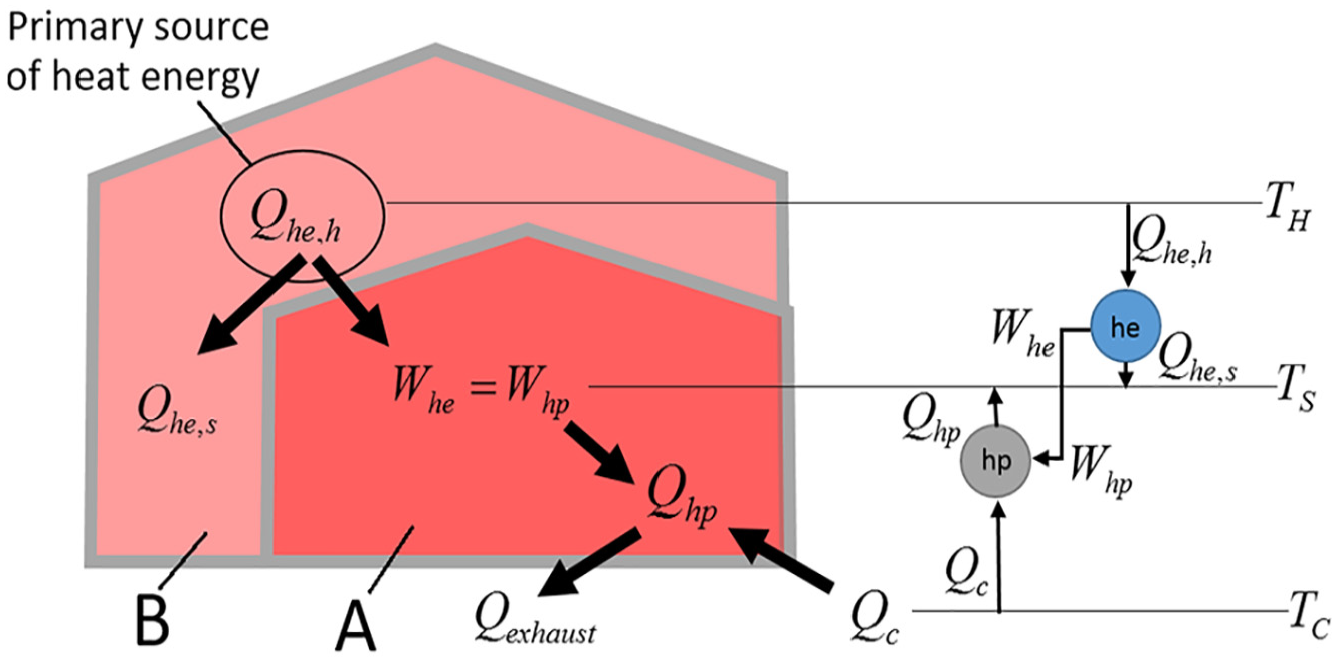
Energy flows during heating a building.
The amount of system heat supplied for object A is given by the equation

The amount of system heat supplied for object B + A is given by the equation

The total energy efficiency for object A is the total heat supplied to the system relative to the total heat from the original natural resource

Similarly, the energy efficiency for object A + B can be calculated, which applies to the three-temperature system

The above equations are used to analyse the efficiency of different combinations of heating systems.
Declaring general efficiency of enginesand equipment
The aim of the efficiency declaration is to find a suitable source of energy that can be used to drive the heat pump through transformation to mechanical work. Thermal power accounts for a significant proportion of energy sources. These are either thermal power plants where coal is most commonly used or thermal machines where gas, petrol or diesel is used as fuel. Typically, these most widespread energy sources are sources with a high temperature combustion. Low-temperature sources are not suitable for converting mechanical work because they have very low efficiency. Even at temperature combustion sources, the thermal machine’s efficiency is at best about 40% (Figure 3).

If a heat source is used to heat a building and is also used to drive a heat pump, then the overall heating efficiency will be higher than without a heat pump. However, an assessment of the efficiency of the heat source is not sufficient. Advantage of use is highly dependent on the economic valuation of the system, even without additional operating costs. Therefore, the next chapter is devoted to the declaration of general energy prices of the most used heat energy sources.
A heat pump can be powered by different types of engines. The heat efficiency graph, as in Figure 3(a), 15 is used to select the efficiency of the combustion engines and that of the thermal power plant.
The thermal power plant is an additional source of electric power. The data in Table 1 should only be taken as indicators that approximate reality. For example, the efficiency of a thermal power plant is 40%; many power plants, however, are operating with a lower efficiency of about 35%. From Table 1, it can be deduced that the asynchronous electric motor has high electrical efficiency. In case, it is necessary to control its speed with a frequency converter, its efficiency can decrease by 8%. 19 Figure 3(b) shows the high efficiency of condensing boilers. In fact, DIN EN 303-5 norm allows for a calculation with efficiency higher than 100%. This is so, however, for historical reasons. At the time when condensing boilers did not exist, the heat loss with water content in the fuel was not counted in the efficiency calculation. To be objective, only 95% is shown in Table 1. Boiler efficiency also depends on many additional circumstances, such as fuel quality, air inlet, chimney type and the like. It is therefore advisable to make an estimate and to use the worse efficiency, represented by a conventional boiler in the calculations. For the purposes of calculating the energy efficiency of the system (formula (10)), we consider the lower efficiency limit restricted to the electrical efficiency of 15% (Table 1). This effect is ensured by a commercially available product. 5 At the same time, it is only appropriate to consider the efficiency of a conventional boiler. This is because only part of the total heat produced can be used to drive the Stirling engine. The condensation process takes place at relatively lower temperatures, and is therefore not suitable for driving the Stirling engine.

Efficiency estimated under the energy conservation.
The COP of heat pumps is also an important factor in the efficiency of the entire heating system. If there is an advantageous source of mechanical energy for driving the heat pump, the efficiency of the system is also determined by the type of pump used. In heat pumps of air–water type, the COP varies depending on the outside temperature. In heat pumps of water–water and ground–water types, the COPs are steady (Figure 4), yet dependent on the source temperature. The COP also depends on the reached output temperature ranging from 35°C to 55°C. For winter heating periods, heat pumps with stable COP are more suitable. These have more expensive set-up costs. On the other hand, an air–water pump is more suitable for efficient heating of hot water, for example, in summer period. In the present study, the COP values are not given, but they are available in many heat pump manufacturers’ catalogues.22,23,25,26

The change of COP depending on the type of heat pump. 24
To help you take some of the mysterious outcomes of these fluctuating COPs and give you a sense of the heat pump effective temperature range and efficiency at freezing outdoor temperatures, we have mapped how our heat pumps perform at different temperatures.
The data above were taken from an ATW-65 type from Nordic® brand of heat pumps, Maritime Geothermal Ltd. and the equivalent geothermal heat pump (W-65) on both an open and closed geothermal ground loops. 24
Declaring general energy prices
Energy prices can greatly influence the economic advantage of certain technical solutions for heating. However, they are highly variable in character; therefore, the price ratios of the individual sources in Table 2 are determined by an estimate of the price development graphs. 27 The United States has been chosen as the standard price-factor, as it is a large and economically advanced country. It must be emphasized that the ratios are estimated, and different countries have different values in different periods. Without this estimate, however, future economic efficiency cannot be predicted. The European Union (EU) countries have a huge range of energy prices and presenting the calculation only for some countries would not be fair. However, it is possible to perform a conversion for any country, based on examples.

TCF: Thousand Cubic Feet.
Prices are estimated from Figure 5.
Figure 5(a)–(d) illustrates price dependencies of individual energy sources. The estimates of average values for the same period (2009–2016) are converted to USD/GJ.

The blue line shows the changing energy prices for the period 2009–2016. TCF (thousand cubic feet), US t (short tons). 27
The overall summary of the energy source calculations is clearly outlined in Table 2.
For the sake of clear comparison, it appears to be appropriate to convert the proportional relationships between individual energy sources into a dimensionless proportional indicator – the effective ratio of energy prices.
Definition of effective price ratio (p)
Of all energy sources, the average prices over a given period of 8 years are converted to the price of 1 GJ of energy that is obtained by burning the raw material or by producing it in the case of electricity. The lowest value of all prices shall be chosen as the reference value against which the prices of other commodities shall be expressed as a ratio. We called this ratio the effective price ratio (p), formula (11).
The effective price ratio expresses the ratio between the lowest energy price and other energy prices (formula (11)). This dimensionless variable allows for the conversion of energy efficiency into the economic impact. The formulation of effective ‘p’ ratio is listed in Table 3, and if ‘p’ = 1, it indicates the lowest energy source; the more the ‘p’ value approximates ‘0’, the relatively more expensive the source is. The energy price does not include the operating costs related to the equipment burning a given energy source
Price ratios of energy sources.


where
Results
In all cases, except for the one with the electric drive, it is assumed that the heat source is located in the house and the heat from the source is used for heating. For the sake of comparison, COP 3 has been chosen uniformly. As a matter of fact, this is the worst COP value; thus, in reality, it is possible to achieve better results, however with higher investment costs.
Total thermal efficiency of different heating systems





Energy ratios when heating with a condensing boiler.

Diagram illustrating the thermal efficiency of the system using an electrically driven heat pump.

Diagram illustrating the thermal efficiency of system when using a Stirling engine-driven heat pump.

Diagram illustrating the thermal efficiency of the system using a four-stroke gas-powered combustion engine-driven heat pump.

Diagram illustrating the thermal efficiency of the system using a diesel-powered electric heat pump.
Relative contribution of energy efficiency of three-temperature system
A three-temperature heating system allows for an increase in the heat supply compared to a two-temperature heat pump system or to a conventional heating system. In order to illustrate the three-temperature energy efficiency, it is appropriate to express the average increase in energy efficiency in percentage compared to the conventional heating method.
Definition of the relative energy efficiency contribution of a three-temperature system (
)
The relative contribution of energy efficiency is expressed by how much percent the efficiency of the heating system will be increased if a three-temperature system is used in comparison to heating in another way, referred to as a conventional heating device (Table 4)
Asset in three-temperature system energy efficiency compared to other heating systems.
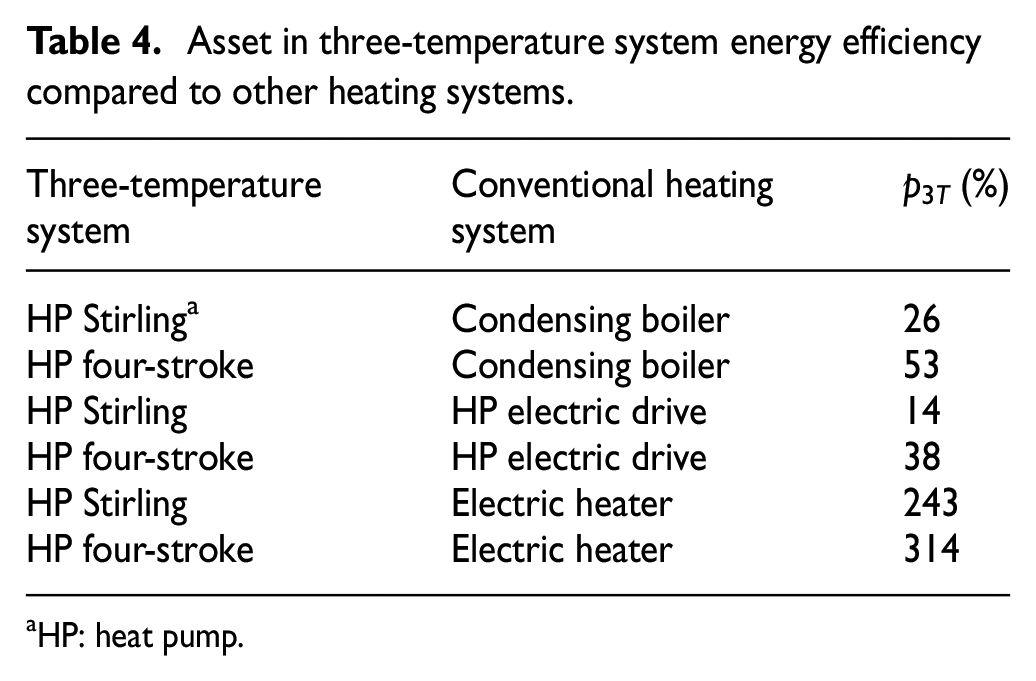
HP: heat pump.

where
Table 4 points to the significant increase in the energy efficiency of the three-temperature system when compared with other heating systems and, in particular, with the electric heater. In reality, however, only a combination of the Stirling engine and the condensing boiler may be actually used. It does not make sense to electrically heat a medium in order to drive the Stirling engine in such a manner. In view of the overall environmental impact of the heating system, it is necessary to consider and reconsider the combination of the four-stroke engine and the condensing boiler. It may be heated by a heat pump, the propel aggregate of which is a gas-powered engine. It is a relatively clean operation. The maintenance costs compared to a gas-heated boiler are likely to be higher as the system contains a considerable number of moveable mechanical components. Moreover, these systems cannot be combined, as is the case of the first combination, because they work independently.
The overall economic impact of individual heating systems
Definition of economic impact
The economic impact

Economic and energy advantage of heating systems.

In Figure 12, the economic relationships between various systems are shown. The higher the value, the more economical the system is.
Providing the economic impact is only relevant for systems that have the potential for real usage. This applies to the combination of the Stirling engine with a heat pump and a high heat source (such as a boiler). The second possible combination is a four-stroke gas-powered engine and a heat pump. The diesel engine can manifest high efficiency; however, it is unsuitable from an environmental point of view. Based on Table 3, the prices of individual sources of energy are used.
The following charts (Figures 11 and 12) show the results of energy and economic benefits of selected heating systems.

Energy efficiencies of different heating systems (n.e.s. – natural energy source).
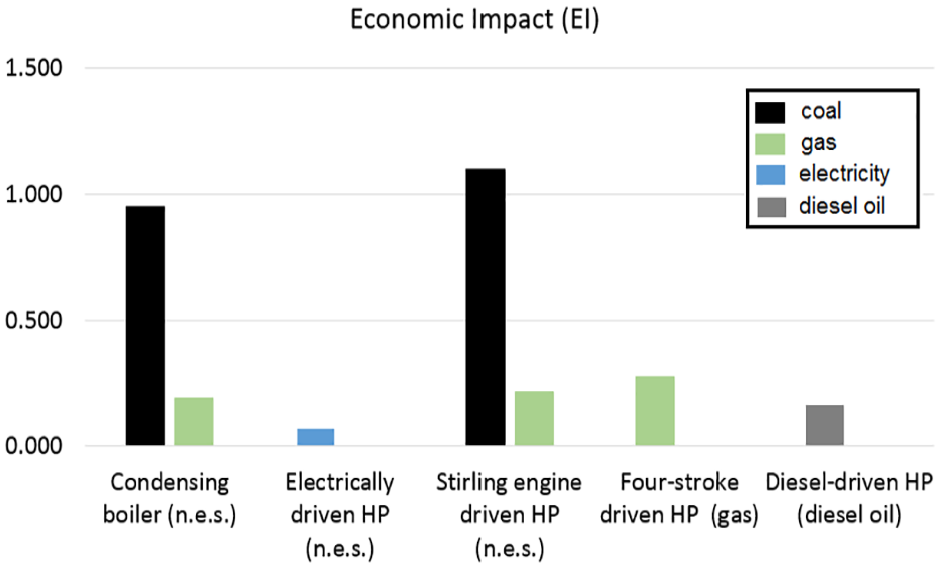
Economic impact of different heating systems (n.e.s. – natural energy source).
Discussion
The present study mainly points to the methods of calculating the efficiency of individual heating systems. Heat pumps represent a clear benefit in terms of thermal efficiency. However, the large variability of input conditions and the variability of energy prices are considered to be major issues. Nowadays, the most widely used heat pumps are electrically powered. Their cleaner operation is particularly advantageous in comparison with conventional heating. Unfortunately, fluctuations in electricity prices and expensive production may seriously affect their economic efficiency. The efficiency of electricity generation in thermal power plants is approximately 30%. If the production costs are not considered, the electricity should be approximately three times more expensive than the heat obtained by burning the original source. In that case, even the electrically driven heat pumps would be more advantageous than direct boiler heating. In fact, electricity prices compared with those of the primary energy sources tend to substantially increase, see Table 2. In this respect, there are significant differences among various countries.
Three-temperature heat pump systems can advantageously be used to reduce the total direct cost of heating. If the mechanical work obtained is not used to drive the heat pump, the system has further advantages. Mechanical work can be used to drive household machinery and equipment, or to generate additional household electricity. The setting-up and maintenance costs of a three-temperature system remain an open question. Essentially, all system components are already commercially manufactured separately. It is a question of technical development that these components are suitably linked into a three-temperature system and used commercially.
Analysis of a three-temperature system with Stirling engine
At the first glance of Figure 12, the condensing boiler and, in particular, the Stirling engine-driven and coal-powered heat pump appear to be the most advantageous devices. However, it should be noted that the overall economic impact will deteriorate after including the costs of necessary filtering equipment for the elimination of emissions, transport logistics and storage of coal. After following the policy of gradually reducing the coal economy, we do not consider this path promising.
The thermal efficiency of the three-temperature four-stroke gas-powered engine system is significantly higher than that of the three-temperature Stirling-driven system. The Stirling engine, however, is not dependent on the type of heat source, which makes it more economical if a cheaper primary source is used for heating and for driving (Figure 12).
From the overall analysis, it follows that the usage of the Stirling engine or of a similar heat pump drive combined with any high-temperature heat source seems to be the most progressive solution, and it increases the efficiency by at least 26% (Table 4). Nevertheless, relatively few publications29–31 tend to address this issue. However, it can be assumed that future research may follow this direction.
Since the Stirling engine can be produced in various power ranges, the real usage of the three-temperature system is feasible in heating plants and cogeneration power plants. Naturally, with regard to the heat pump COP, the most preferred heat pump is a geothermal heat pump, open loop type, Figure 4. However, with regard to the initial investment and local options, it is not always beneficial or possible. The usage of a three-temperature system for the production of hot service water is of particular importance. Especially during the summer period, the efficiency of the system may be increased if an air–water heat pump type is used, since its COP increases along with an increase in the outside temperature (Figure 4).
Conclusion
The study points to the significant potential for increasing the overall efficiency of the heating systems currently in use. Take a typical example from a global perspective: a modern way of heating a home with a ground source heat pump. This is a highly efficient way to use a heat pump. It is driven by electric power. This electricity is produced with high efficiency in a CNG gas plant. At first glance, this seems like a good solution. However, the user may cut more than 50% of the operating costs using a Stirling engine-driven three-temperature heat pump system that is directly driven by CNG. The explanation lies in the lower price of CNG compared to electricity and also the higher thermal efficiency of the entire heating system by no less than 26%.
Footnotes
Appendix
Handling Editor: James Baldwin
Declaration of conflicting interests
The author(s) declared no potential conflicts of interest with respect to the research, authorship, and/or publication of this article.
Funding
The author(s) disclosed receipt of the following financial support for the research, authorship, and/or publication of this article: This work was supported by the Slovak Research and Development Agency under the Contract no. APVV-18-0413, APVV-17-0258 and VEGA 1/0437/17. The financial support was granted to cover expenses pertaining to open-access publishing. T. Stejskal and J. Svetlík addressed the theoretical issues of heat pumps. T. Stejskal proposed the equations and the theoretical verification of the Second Law of Thermodynamics. T. Stejskal and J. Svetlík drafted the research study. P. Demeč ensured the declaration of general energy prices. A. Žilinský and J. Kováč participated in drafting the discussion.
