The classical models of viscous flows and heat transfer are reformulated in this article. The physical problem describes flow and heat transfer over a stretching (shrinking) and porous cylinder of non-uniform radius. The mathematical model is presented in the form of new equations and dimensionless parameters by means of reframing techniques. A porous and heated cylinder of a non-uniform diameter is stretched (shrunk) with variable stretching (shrinking) velocities. The governing equations and their physical geometrical perspectives are summarized into simplest boundary value ordinary differential equations. A set of unseen, generalized, and convenient transformations are used to solve the complex problem. The current formulation accumulates all the previous models of axisymmetric flow and heat transfer toward stretching (shrinking) and porous cylinder presented in the literature and prevails over all such models. The current model can be easily transformed into classical simulations for particular values of the parameters. The problem is solved numerically and the results were compared with the benchmark solutions. Velocity, temperature, skin friction coefficient, and Nusselt number profiles are plotted and analyzed for different values of the parameters. Moreover, coupling effects of all parameters are seen on flow and heat transfer characteristics and new results are explored and discussed.
There are many physical and practical phenomena that are directly related to fluid motion and heat transfer produced by stretching (shrinking) of a porous cylinder. These days human society and the world population are enlarged and increased. Their survival is impossible without the suitable and reasonable resources of energy. Moreover, the use of energy increases day by day in order to make the life easier. Scientists and researchers have performed simulations in this area to improve advanced energy resources and technologies and produced new means of energy and handwork. Meanwhile, solar energy is utilized in a more easy and efficient way. In this regards, the group of scientists is experienced in searching the best options for incorporating the design and construction of principles into heat exchangers. Heat transfer in various natural engineering and industrial processes depends upon the mechanism and mode of heat transfer from the wall to the ambient fluid. The uses and applications of such mechanism are involved in industrial and engineering simulations of fluid transport due to stretching (shrinking) of solid bodies. Such flow models are widely discussed, examined, and summarized by Altan et al.1 Fluid flow over a moving cylinder is analyzed in many research papers and interesting features of flow models are discussed. New research problems of fluid flows over a stretching (shrinking) cylinder have been explored and solved. In such models, varieties of physical boundary conditions are considered for the governing equations and new problems are analyzed. A problem of fluid motion over a stretching cylinder is modeled and studied by Wang.2 The problem is modified and furnished by adding supplementary heat transfer effects into it, see Ishak et al.3 These assumptions are made for uniformly porous and stretched cylinders. More precisely, the sequential work of Ishak and Nazar4 are included here and they claimed the fluid motion along a stretching cylinder. Also Wang and Ng5 analyzed the flow over a stretching cylinder with the addition of slip conditions at the solid–fluid interface. Flow and heat transfer were studied by Bhattacharyya and Gorla.6 In this study, fluid flow is maintained over a permeable and shrinking cylinder and the effects of shrinking are observed on flow properties. Magnetohydrodynamic (MHD) effects on flow over a stretching cylinder are analyzed by Mukhopadhyay.7 Flow and heat transfer over a stretching cylinder (assuming the partial slip and prescribed heat flux conditions) are studied by Majeed et al.8 who solved the problem numerically using Chebyshev spectral Newton iterative scheme. The literature regarding flows due to stretching (shrinking) cylinders and their numerical solutions is rich enough. However, varieties of good research studies have been conducted to determine the effects of stretched/shrunk and porous surfaces on the flow behavior considering industrial and engineering applications. Chamkha9 analyzed the natural convection flow of an absorbing fluid in a uniform porous medium supported by a semi-infinite, ideally transparent, vertical flat plate due to solar radiation. The important applications of boundary layer flow are further enhanced by Chamkha and colleagues10–12 who discussed the unsteady flow and heat transfer, unsteady mixed convection with magnetic effect, and unsteady natural convection flow with MHD effects for micro-polar fluids. The study of MHD thermosolutal Marangoni boundary layer flow with and without convection over a flat surface in the presence of heat generation or absorption effects is also performed by Chamkha and colleagues.13,14 Moreover, other dimensions of flow and heat transfer due to porous stretching sheet are explained by considering different types of flows such as Hiemenz flow and other types of flow of micropolar fluids and nanofluids. All these interesting models have been analyzed and summarized by Chamkha and colleagues.15–26 Most of the problems of boundary layer flow in porous media with force/natural convection for different types of fluids (such as nanofluids and micropolar fluids) were discussed by many other researchers.27–31 The classical models of viscous flows and heat transfer are examined here for a stretching (shrinking) and porous cylinder. The new problem is discussed with the modified approach. The latest version is furnished and equipped with the new entities. More precisely, we have considered the variable stretching (shrinking) and porous velocities simultaneously in the current modeled problem. The stretching (shrinking) velocity, porous velocity, and radius of the cylinder are changed with the axial coordinate. A set of unusual and generalized similarity transformations are formed and new parameters come into being. The boundary layer equations are transformed into a simplest boundary value ODE. As a result, new boundary value ODEs are formed and their elaborated solution is provided in the next section. Later on, the current model is exactly transformed into the published simulations of linear, uniform, variable, and power law stretching (shrinking) and linear (variable) porous velocity. The new model can easily accommodate the classical models associated with uniform or variable stretching (shrinking) of a uniform/non-uniform cylinder. On the contrary, the final boundary value ODE has a new set of parameters, that is, , , , , , , , , , , and . The classical models of uniform or variable stretching (shrinking) velocities with or without injection (suction) can be recovered easily for fixed values of these parameters. The classical models and their solutions are directly retrieved from the current model and its solutions. The final problem includes different cases of uniform and variable (linear and power law) stretching (shrinking) and suction (injection). No such model exists in the literature that contained the simultaneous effects of all these physical mechanisms considered in this model. The problem is solved numerically using the method introduced by the Cebeci and Keller32 scheme, and the effects of different parameters are observed on velocity and temperature profiles. Solutions of the current model are compared with the classical results. Comparison ensures the validity and correctness of current simulation and transformations. The similarities and differences are essentially noted among the current model and the classical problems and results are replicated with amazing details.
Formulation and solution of the problem
A viscous fluid flow is maintained over a heated, porous, and stretching (shrinking) tube. The long and thin longitudinal tube has a non-uniform radius which is expanded (contracted) in the axial direction in a stagnant fluid. The x-direction is located along the cylinder and r-axis is orthogonal to it. Moreover, the flow is axi-symmetric and field variables are not depending upon azimuthal axis. Note that the surface of the tube is heated and has temperature , whereas the temperature of the ambient fluid is . It is also assumed that and the aspect ratio of the boundary layer’s thickness and the radius of the tube is very small. In view of these considerations and assumptions, the velocity is decomposed such that , where and represent the velocities in the radial and axial directions, respectively. The temperature of the fluid is denoted by . The laminar flow within the boundary layer is governed by the following equations in cylindrical coordinates:
The boundary conditions are as follows
where , , , and .
Here and represent the stretching (shrinking) and suction (injection) velocities, respectively, and is the variable radius of the cylinder. Notice that and are used for an impermeable and fixed sheet. Moreover, and are the stretching (shrinking) and suction (injection) parameters, respectively. On the contrary, , , , and are the parameters and is the kinematic viscosity which is defined in terms of dynamic viscosity and fluid density and the thermal diffusivity is defined as with thermal conductivity and specific heat . Note that the dissipation term in energy (equation (3)) is neglected. A set of unusual and generalized variables are defined and constructed for the stream function , temperature variable , and similarity variable as follows
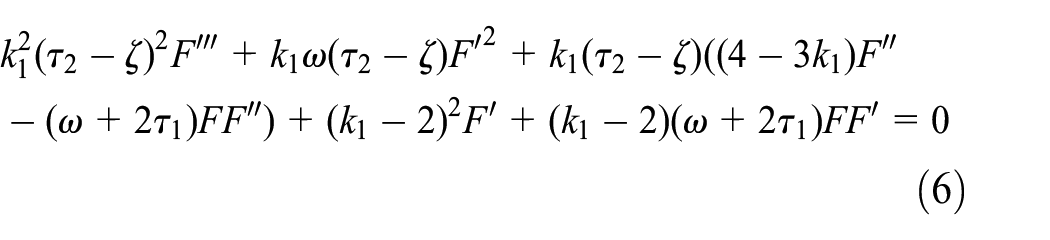
where , is the similarity index, and and are the translation and scaling parameters for the similarity variable, respectively. The unknown similarity function can be determined. The velocity vector is replaced by a stream function such that and . The continuity (equation (1)) is satisfied exactly by the velocity components when expressed in view of the stream function. The transformations defined in equation (5) are substituted into equations (2)–(4) and we obtained the following exact ODEs and exact boundary conditions
where , , , , and .
Comparison with the literature
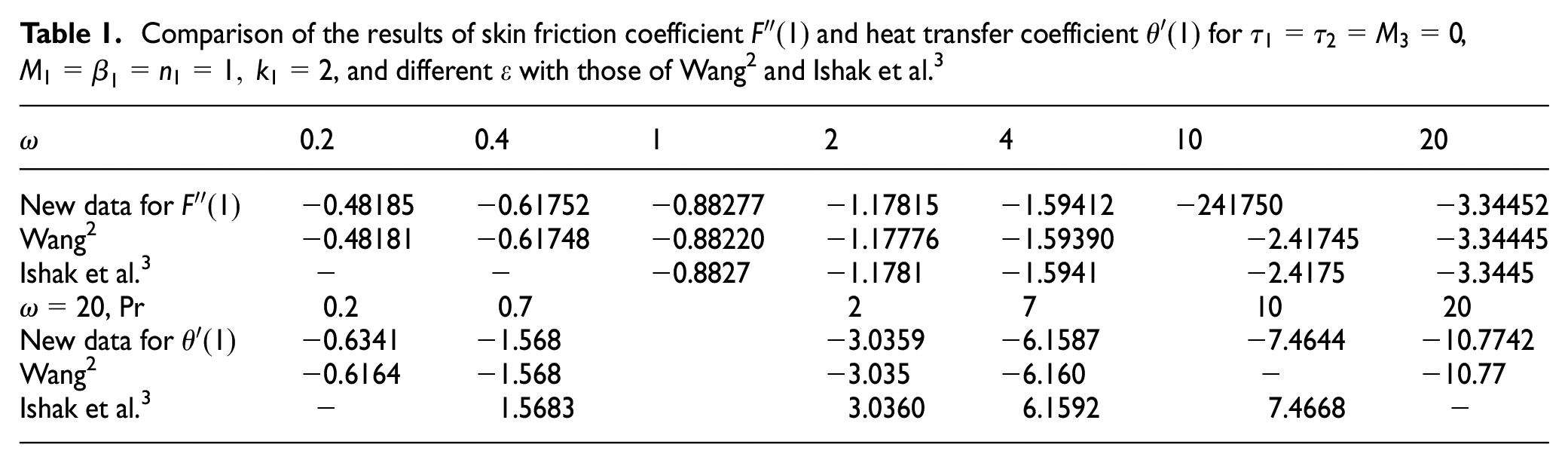
The final problem is composed of equations (6)–(8) and obtained after using the new set of transformations. Solutions of the last boundary value ODEs are compared and matched with the classical solutions for specific values of the parameters involved in the problem. The modeled problem of Bhattacharyya and Gorla6 is retrieved as a special case for fixed values of the parameters (i.e. , , and , where , , , , and ). The notations (curvature parameter) and (suction parameter) were used in Bhattacharyya and Gorla,6 and the new solution corresponds to this set of parameters which is shown in Figure 1(a). On the contrary, results of Ishak et al.3 are also found for the parameter values of , , , , , and , where . Note that (Reynolds) and (suction) and (injection) were considered in Ishak et al.3 Moreover, a comparative study of the numerical solution of the modeled problem with the benchmark solutions is carried out. Naturally, these solutions describe the behavior of the fluid flow over a stretching (shrinking) and permeable (injection/suction may take place) cylinder. The numerical solution that presents such special characters is plotted in Figure 1(b) and (c). The presented solutions for and are matched with the established results of Wang2 and Ishak et al.3 in Table 1, and an excellent agreement between these solutions is found to the best accuracy level. It is observed from the table that the values of are all negative which means that the stretching tube exerts a dragging force on the fluid and the positive sign implies the opposite. The absolute values of are larger for suction compared to injection. This implies that the heat transfer rate is increased with the increases of and .
Profiles of the function (a) matched with Bhattacharyya and Gorla,6 (b) matched with Ishak et al.,3 (c) matched with Ishak et al.,3 and (d) under different .
Comparison of the results of skin friction coefficient and heat transfer coefficient for , , and different with those of Wang2 and Ishak et al.3
The final problem in equations (6)–(8) is solved numerically using the well-known Cebeci and Keller32 scheme and the effects of different parameters on , , , and are observed in different graphs and a table. We have retrieved the equations and numerical solution of Bhattacharyya and Gorla6 in Figure 1(a) for . It is confirmed that the two solutions are exactly similar. The validity of the current model is ensured by providing the comparisons between the solution of the current model and those of classical problems. Therefore, it is the most suitable formulation for the situation of viscous fluid motion over such a stretching (shrinking) and porous (injection/suction) cylinder. More precisely, the physical mechanism of stretching (shrinking) is controlled by a sole parameter in the present formulation and there is no need of multiple scalars for these boundary inputs. The effects of governing parameters , , and on the velocity component are observed as shown in Figure 1(a) for different values of these parameters. It is noticed that the profiles of decrease with the increase of (and the decrease of and ). In Figure 1(b), the effects of on the velocity profiles are observed. It is seen that the velocity profiles and their gradients at the surface increase with the decrease of . In Figure 1(c), the velocity curves are plotted for and , and it is confirmed that the velocity gradient is decreased in the vicinity of the cylinder with the increase of and . Figures 1(d) and 2(a) present the behavior of on when the fluid is flown over a stretching cylinder. In Figure 1(d), both velocity and boundary layer thickness decrease with the increase of . For large negative values of , different profiles of the same boundary layers are graphed. On the contrary, for small negative values of and large , the opposite behavior of velocity curves is observed as shown in Figure 2(a). The essential learning outcomes based on the model and general transformation because they give great advantages. It is noteworthy that such a model did not exist in the literature and enhanced the collective behavior of stretching, shrinking, injection, and suction simultaneously. The current model provides accurate and acceptable solutions for all finite and reasonable values of and ; therefore, it is a more comprehensive and compatible formulation. The ample scope of the formulation is expanded and has the capacity to provide accurate solutions for the combination of all parameters involved in the problem. However, the effects of different positive and negative values of all parameters on the flow properties are noted. Similarly, the effects of the shrinking parameter on are shown in Figure 2(b) for large . From this figure, it is observed that the velocity and boundary layer thickness decrease with the increase of . The velocity is graphed (for the same set of parameters values as in Figure 2(b)) in Figure 2(c) for different positive and negative values of . For the increase of (injection), the fluid velocity and boundary layer thickness increase. On the contrary, for (suction), velocity exhibits different behaviors and the boundary layer thickness shows similar behavior with the decreasing values of as compared to the previous case. A variation in the fluid velocity is observed for both positive and negative values of and a thin boundary layer is seen for the shrunk cylinder case. Figure 2(d) demonstrates the effects of on the velocity profiles . The velocity profiles and boundary layer thickness increase with the decrease of .
Profiles of the function under (a) different , (b) different M1 < 0, (c) different (+ve and –ve) under , and (d) different under .
Temperature profiles, wall shear stress, and Nusselt number
The important quantities of main physical interest are the heat flux and skin friction coefficient which are evaluated at the surface of the cylinder and defined by the following relations. The wall shear stress and the wall heat flux at the surface of the cylinder are given by
where and are thermal conductivity and dynamic viscosity of the fluid, respectively. The dimensionless form of is known as skin friction coefficient , whereas the dimensionless form of is called the Nusselt number . Note that the total amount of heat transfer from the surface of the cylinder is an important entity. For a fixed value of the similarity index , that is, , and after proper scaling and normalization, the Nusselt number and the skin friction coefficient at the surface of the cylinder may be evaluated by and , respectively.
In Figure 3, different physical quantities are graphed and the effects of different parameters on the behavior of transpiration, skin friction, and heat transfer coefficient behavior are analyzed. In Figure 3(a) and (b), profiles of the function under are presented for fixed values of the other parameters involved in the problem. For both cases of and , the temperature profiles decrease with the increase of , respectively. One possible reason is that the distance from the surface increases and finally approaches zero at some large distance of the cylinder from the surface. The thickness of thermal boundary layer decreases with the increase of , which shows rapid increase in the heat flow and heat transfer rate at the surface. Hence, the Nusselt number increases as increases and these observations are noticed from Figure 3(c). The data in Figure 3(a)–(c) give a valid conclusion that the effects of suction/injection are found to be more pronounced for fluids with smaller since fluids with smaller Pr have larger thermal diffusivity values. In Figure 3(a) and (b), the temperature profiles show different behaviors for injection compared to suction. It is clear from Figure 3(b) that, for large values of , the temperature gradient at the surface is zero, which means that there is no heat transfer at the surface if the injection is strong enough. Therefore, injection is a valid, sufficient, and physical condition to reduce or minimize the heat flux at the surface, as well as wall shear stress. The result in Figure 3(b) shows the best accuracy compared with the results of Ishak et al.3 and we get these results from the established relations and where . Note that (Reynolds) and (suction) and (injection) were considered in Ishak et al.3 The heat transfer rate at the surface of the cylinder as a function of and , in terms of Nusselt number , is shown in Figure 3(c) and compared with the results of Ishak et al.3 This comparative study also shows the best agreement from the relations and where . This observation is clearly consistent with the values given in Table 1. It may be concluded from Figure 3(a)–(c) that water is a better cooling agent compared to air, provided that there is no strong injection. Figure 3(d) presents the behavior of skin friction coefficients with the injection/suction parameter for the three values of . The magnitude of the skin friction coefficient increases with the increase of and also the parameter . This feature also supports the calculated values of skin friction coefficients in Table 1 for and , so that the results in Figure 3(d) and Table 1 are consistent. It is very clear from this figure that the values of skin friction coefficients are negative. Physically, the negative sign of implies that the surface exerts a dragging force on the fluid and the positive sign implies the opposite.
Profiles of functions: (a) under different ; (b) under different (+ve and –ve); (c) against under different ; and (d) against under different (+ve and –ve).
Conclusion
The highlighting key features of this study are remarked here. The final ODEs are equipped with 11 parameters and each parameter has an effective role and causes variation in the field quantities. Simultaneous changes in velocity and temperature field are observed as shown in Figures 1–3 against each parameter. The simulation is flourished with accurate formulation for stretching (shrinking) cylindrical duct of a porous surface. Intuitively, the model problem is equally valid for a cylinder of non-uniform (uniform) radius, and its geometry is defined and given in equation (4). The classical models of fluid motion are either associated with a stretching (shrinking) cylinder of uniform or variable (both linear and power law variation) radius. All such models recovered by focusing and adjusting the parameters of the current model accordingly. The final problem is formed using a set of generalized transformations and the results of Wang,2 Ishak et al.,3 and Bhattacharyya and Gorla6 are recovered for specific values of parameters. The solution of equations (6)–(8) is obtained with the help of a numerical scheme and the effects of all parameters on field quantities are observed. The numerical solutions of the current model matched exactly with the results of Wang,2 Ishak et al.,3 and Bhattacharyya and Gorla6 for fixed and appropriate values of parameters. The parameters of the problem are representative of stretching, shrinking, injection, suction, translation, and scaling. Therefore, the effects of all these parameters on velocity, temperature, heat transfer coefficient, and skin friction coefficient profiles are observed. We hope that such a comprehensive model did not exist in the literature and the model described the combined and simultaneous effects of stretching/shrinking and injection/suction on fluid motion over a cylinder of variable (uniform) radius. The model problem is equally valid for all the boundary effects discussed above. The transformed equations also provide accurate results for variable (linear, power law) and uniform stretching (shrinking) and injection (suction) velocities.
Footnotes
Appendix 1
Handling Editor: Ali J Chamkha
Declaration of conflicting interests
The author(s) declared no potential conflicts of interest with respect to the research, authorship, and/or publication of this article.
Funding
The author(s) received no financial support for the research, authorship, and/or publication of this article.
ORCID iD
Azhar Ali
References
1.
AltanTOhSGegelH.Metal forming fundamentals and applications. Metals Park, OH: American Society of Metals, 1979.
2.
WangCY.Fluid flow due to a stretching cylinder. Phys Fluids1988; 31: 466–468.
3.
IshakANazarRPopI.Uniform suction/blowing effect on flow and heat transfer due to a stretching cylinder. Appl Math Model2008; 32: 2059–2066.
4.
IshakANazarR.Laminar boundary layer flow along a stretching cylinder. Eur J Sci Res2009; 36: 22–29.
5.
WangCYNgCO.Slip flow due to a stretching cylinder. Int J Nonlin Mech2011; 46: 1191–1194.
6.
BhattacharyyaKGorlaRS.Boundary layer flow and heat transfer over a permeable shrinking cylinder with surface mass transfer. Int J Appl Mech Eng2013; 18: 1003–1012.
7.
MukhopadhyayS.MHD boundary layer slip flow along a stretching cylinder. Ain Shams Eng J2013; 4: 317–324.
8.
MajeedAJavedTGhaffariA, et al. Analysis of heat transfer due to stretching cylinder with partial slip and prescribed heat flux: a Chebyshev spectral Newton iterative scheme. Alex Eng J2015; 54: 1029–1036.
9.
ChamkhaAJ.Solar radiation assisted natural convection in uniform porous medium supported by a vertical flat plate. J Heat Transf1997; 119: 89–96.
10.
TakharHSChamkhaAJNathG.Unsteady flow and heat transfer on a semi-infinite flat plate with an aligned magnetic field. Int J Eng Sci1999; 37: 1723–1736.
11.
TakharHSChamkhaAJNathG.Unsteady mixed convection flow from a rotating vertical cone with a magnetic field. Heat Mass Transfer2003; 39: 297–304.
12.
ChamkhaAJMohamedRAAhmedSE.Unsteady MHD natural convection from a heated vertical porous plate in a micropolar fluid with Joule heating, chemical reaction and radiation effects. Meccanica2011; 46: 399–411.
13.
Al-MudhafAChamkhaAJ.Similarity solutions for MHD thermosolutal Marangoni convection over a flat surface in the presence of heat generation or absorption effects. Heat Mass Transfer2005; 42: 112–121.
14.
MagyariEChamkhaAJ.Exact analytical results for the thermosolutal MHD Marangoni boundary layers. Int J Therm Sci2008; 47: 848–857.
15.
ChamkhaAJKhaledAR.Similarity solutions for hydromagnetic mixed convection heat and mass transfer for Hiemenz flow through porous media. Int J Numer Method H2000; 10: 94–115.
16.
ChamkhaAJKhaledAR.Hydromagnetic combined heat and mass transfer by natural convection from a permeable surface embedded in a fluid-saturated porous medium. Int J Numer Method H2000; 10: 455–477.
17.
ChamkhaAJIssaCKhanaferK.Natural convection from an inclined plate embedded in a variable porosity porous medium due to solar radiation. Int J Therm Sci2002; 41: 73–81.
18.
TakharHSChamkhaAJNathG.MHD flow over a moving plate in a rotating fluid with magnetic field, Hall currents and free stream velocity. Int J Eng Sci2002; 40: 1511–1527.
19.
KhedrMEChamkhaAJBayomiM.MHD flow of a micropolar fluid past a stretched permeable surface with heat generation or absorption. Nonlinear Anal: Model2009; 14: 27–40.
20.
MagyariEChamkhaAJ.Combined effect of heat generation or absorption and first-order chemical reaction on micropolar fluid flows over a uniformly stretched permeable surface: the full analytical solution. Int J Therm Sci2010; 49: 1821–1828.
21.
ChamkhaAJ.Coupled heat and mass transfer by natural convection about a truncated cone in the presence of magnetic field and radiation effects. Numer Heat Tr A: Appl2001; 39: 511–530.
22.
GorlaRSChamkhaA.Natural convective boundary layer flow over a nonisothermal vertical plate embedded in a porous medium saturated with a nanofluid. Nanosc Microsc Therm2011; 15: 81–94.
23.
ChamkhaAJAbbasbandySRashadAM, et al. Radiation effects on mixed convection about a cone embedded in a porous medium filled with a nanofluid. Meccanica2013; 48: 275–285.
24.
RamReddyCMurthyPVChamkhaAJ, et al. Soret effect on mixed convection flow in a nanofluid under convective boundary condition. Int J Heat Mass Tran2013; 64: 384–392.
25.
ReddyPSChamkhaAJ.Soret and Dufour effects on MHD convective flow of Al2O3–water and TiO2–water nanofluids past a stretching sheet in porous media with heat generation/absorption. Adv Powder Technol2016; 27: 1207–1218.
26.
ReddyPSSreedeviPChamkhaAJ.MHD boundary layer flow, heat and mass transfer analysis over a rotating disk through porous medium saturated by Cu-water and Ag-water nanofluid with chemical reaction. Powder Technol2017; 307: 46–55.
27.
RashadAMBakierAY.MHD effects on non-Darcy forced convection boundary layer flow past a permeable wedge in a porous medium with uniform heat flux. Nonlinear Anal: Model2009; 14: 249–261.
28.
ModatherMChamkhaA.An analytical study of MHD heat and mass transfer oscillatory flow of a micropolar fluid over a vertical permeable plate in a porous medium. Turk J Eng Environ Sci2010; 33: 245–258.
29.
Reddy GorlaRSEl-KabeirSMMRashadAM.Boundary-layer heat transfer from a stretching circular cylinder in a nanofluid. J Thermophys Heat Tr2011; 25: 183–186.
30.
RashadAMEl-HakiemMAAbdouMM.Natural convection boundary layer of a non-Newtonian fluid about a permeable vertical cone embedded in a porous medium saturated with a nanofluid. Comput Math Appl2011; 62: 3140–3151.
31.
ChamkhaAJRashadAMReddyCR, et al. Effect of suction/injection on free convection along a vertical plate in a Nano fluid saturated non-Darcy porous medium with internal heat generation. Indian J Pure Ap Mat2014; 45: 321–342.
32.
CebeciTKellerHB.Shooting and parallel shooting methods for solving the Falkner-Skan boundary-layer equation. J Comput Phys1971; 7: 289–300.