



Abstract
The current pagination is devoted to offering the untapped features of non-Newtonian rotatory magnetized fluid flow over the solid disk. The said non-Newtonian fluid model is a Powell–Eyring fluid model. The flow field is further carried with suspended nanoparticles with velocity slip effects. The strength of the article is a complex mathematical modeling subject to physical effects mentioned before, and the computational results are provided through the self-coded algorithm rather than to move on with the usual built-in scheme. To make the implementation possible, the obtained flow-narrating system is converted into a system having fewer independents. The key involved parameters are Powell–Eyring fluid, magnetic field, velocity slip, thermophoresis, and Brownian motion parameters. The dependent quantities namely axial, tangential velocities, temperature, and concentration are examined against flow-controlling parameters. The obtained outcomes in this direction are offered by means of graphical trends. It is noticed that both axial and radial velocities possess direct relation with Power–Eyring parameter (M). The Powell–Eyring fluid temperature is an increasing function of the thermophoresis parameter. Furthermore, the Powell–Eyring concentration enhances significantly toward the higher values of the Brownian motion parameter.
Introduction
Fluid flow realization due to the rotation of disk persuades theoretical and practical significance of engineering and applied sciences. Some important practical fields are the rotor–stator system, gas turbine engineering, air rotational cleaners, medical equipment, chemical engineering, and thermal power–generating systems. Von Karman 1 admitted the fluid flow achieved by a rotating disk and introduced the transformation to transform the partial differential equations (PDEs) into ordinary differential equations (ODEs). Many researchers have investigated his work under different aspects. Shateyi and Makinde 2 analyzed the hydromagnetic stagnation-point flow over a stretching convectively heated disk. Rashidi et al. 3 analyzed the magnetohydrodynamic (MHD) flow of viscous liquid over a rotating disk under entropy-generation effects. Turkyilmazoglu 4 discussed the rotating disk flow with nanoparticle’s effects. Mustafa 5 elaborated MHD partial slip nanofluid flow over a disk with MHD. Hatami et al. 6 used the least square method and examined the incompressible laminar nanoliquid flow generated by contracting and rotating disks. Kumar and Kavitha 7 examined the three-dimensional (3D) Jeffrey fluid flow between stationary and rotating disks. They noticed that the radial velocity of a fluid increases with the increasing Jeffery fluid parameter, while the axial velocity decreases with the increasing value of Jeffrey fluid parameter. Rehman and colleagues8–10 investigated the flow over a rotating disk with the impact of MHD and nanoparticles.
The confined flow of non-Newtonian fluids has attracted the research community in the past decades because of its applications such as polymer extrusion, glass-fiber production, and aerodynamic extrusion of plastic sheets, paints, and lubricants. In literature, there is not a single constitutive formula to designate the characteristics of non-Newtonian materials. Various models of non-Newtonian fluids have been proposed regarding the nature of the materials. The Powell–Eyring (PE) fluid model is one model that is quite capable of being used in a chemical engineering system. This model has numerous advantages as compared to other non-Newtonian formulas such as simplicity and physical robustness. In the past, many attempts have been made to characterize the physical attributes of a PE fluid, for instance, Malik et al. 11 reveal the variable viscosity shear-thinning fluid flow over a stretchable cylinder. They witnessed that the temperature of the fluid decreases with intensifications in Prandtl number and Reynolds number. Jalil et al. 12 appraised the significances of self-similar solutions for the PE fluid flow in a parallel free stream. Akbar et al. 13 scrutinized the MHD PE fluid flow over a stretchable sheet. They studied that the opposition of flow increases for the large magnetic field as well as the parameter of PE fluid. Malik et al. 14 considered the MHD flow of PE fluid over a stretchable sheet. They detected that the flow velocity has a reverse relation with Hartmann number and mixed convection parameters. The physical and thermal features of an MHD PE fluid that flows through a stretched surface along with heterogeneous and homogeneous reactions and chemically reactive species is discussed by Khan and colleagues.15,16 Rehman and colleagues17,18 consider the stagnation point in the flow of PE fluid through the cylinder with effects of magneto-nanofluid. In addition, they discussed the comparative flow study of the inclined surface with chemical reactions. Khan et al. 19 discussed the flow effects of heterogeneous–homogeneous reactions and MHD. Makinde and colleagues20,21 analyzed the effect of MHD on stretching convective surface with stagnation point flow and radiative heat.
The nanoliquids have valuable uses such as engine cooling, biomedicine, electronic cooling devices and many more. Choi and colleagues22,23 first used nanoparticles in the base fluid to improve the thermo-physical properties of a nanofluid with base the fluids. They observed that using the nanoparticles thermal conductivity of fluid is more effectual than base fluids. The thermal conductivity of a nanofluid is experimentally examined and found out that the energy transfer of a nanofluid is larger than that of base fluids.24,25 Ibrahim 26 deliberate the convective viscous nanofluid in the presence of the stagnation point in the flow field. Khan et al. 27 deliberated the Williamson MHD nanofluid flow over a plate and cone with chemically reactive species. Salahuddin et al. 28 consider the stretching cylinder and resolved numerically the flow problem of MHD tangent hyperbolic nanofluid. Rashad et al. 29 examined the Joule heating phenomenon inflow of convective viscous nanofluid through the circular cylinder. They found that the thermal energy increases significantly via the Joule heating phenomenon. Hussain et al. 30 observed the flow of nanofluid with combined effects of viscous dissipation and Joule heating over a stretching cylinder. They analyzed that in the case of both viscous dissipation and Joule heating, the fluid temperature significantly increases. Rehman et al. 31 scrutinized the influences of Joule heating on a MHD PE fluid that flows over a cylindrical surface. Mahanthesh et al. 32 designed a 3D flow of a PE nanofluid flow through a stretchable sheet under the impact of Joule heating, applied magnetic field, and thermal radiation.
They examined that the thermal energy of the fluid increases with increasing viscous dissipation. Extensive studies for the nanofluid over different geometries are described in literature.33–39
The current investigation deals with the flow of a PE nanofluid over a rotating disk with additional effects of MHD and slip condition. The governing nonlinear analysis has been carried out for velocity, temperature, and nanoparticle concentration profiles using Runge–Kutta (RK-5) method. The obtained results are offered with the aid of graphs.
Problem formulation
The non-Newtonian fluid model named Powell–Eyring is considered. The flow is achieved due to the rotation of the solid disk. The flow field has an interaction with the externally applied magnetic field. The nanoparticles are suspended in the PE fluid. The velocity slip assumption is also taken into account. The geometric illustration is shown in Figure 1.
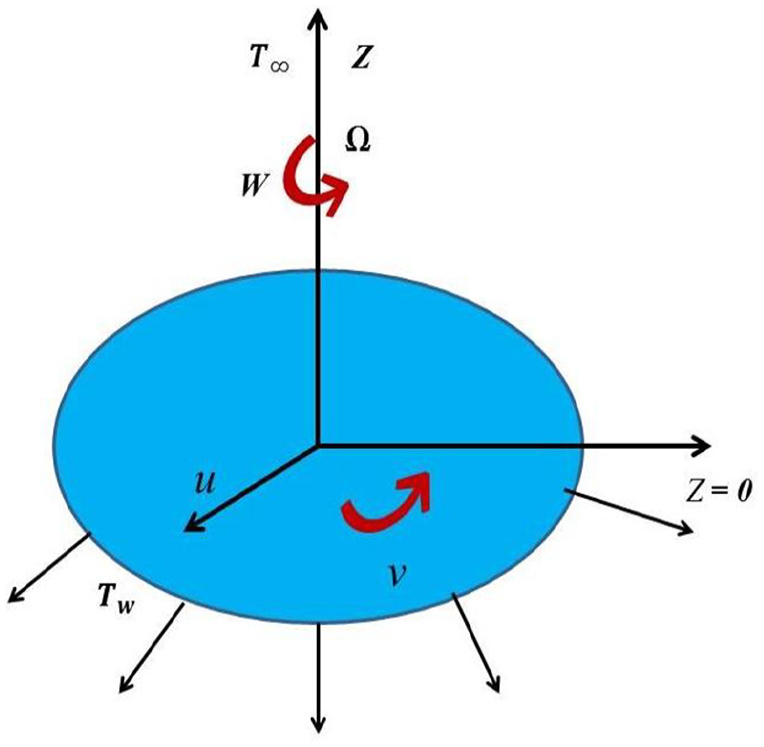
Geometry of the problem.
The fundamental laws involved in the field of fluid science yields a system of PDEs, that is

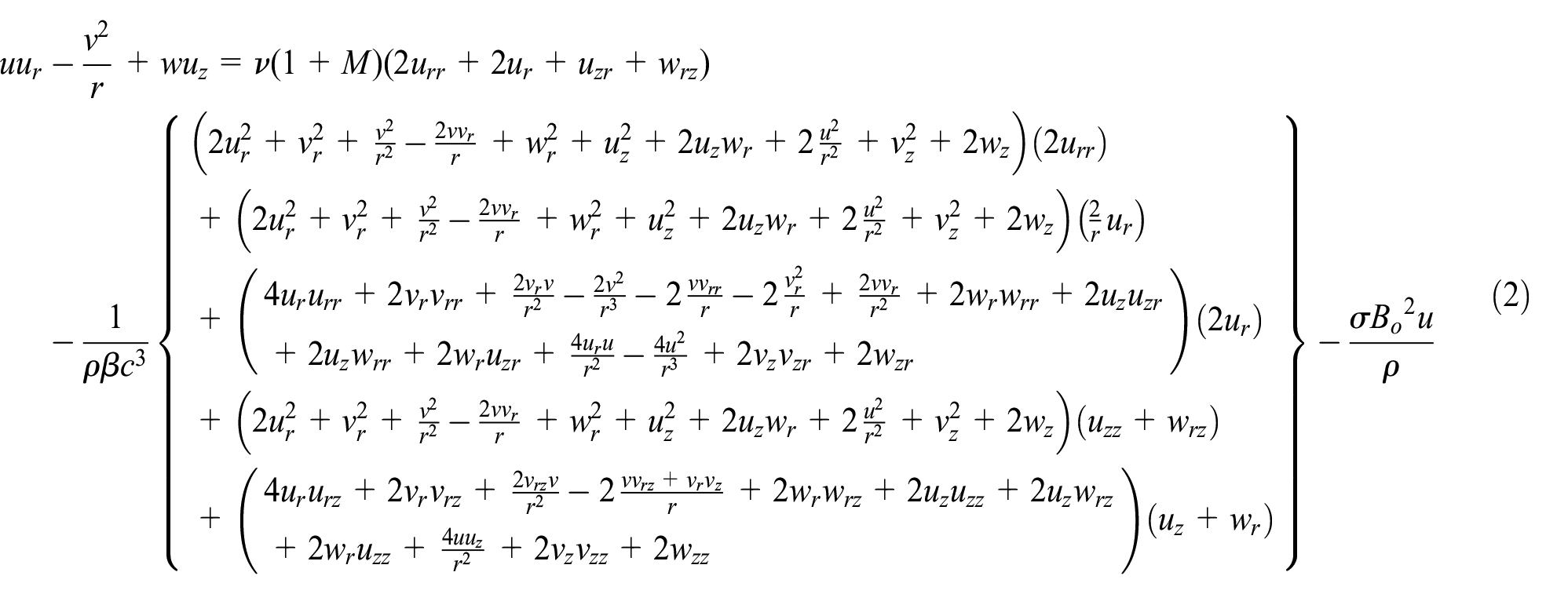



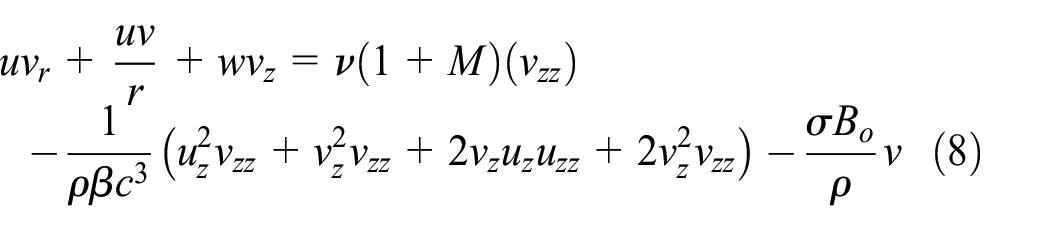
After applying the boundary layer approximation, equations (1)–(6) can further be rectified as



The corresponding conditions are
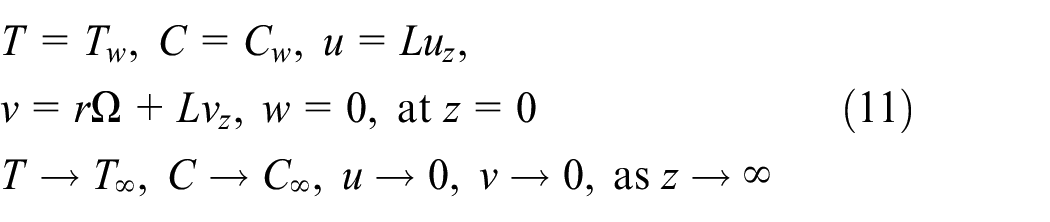
Since we have considered the non-Newtonian fluid model and the destruction toward fluctuation velocity gradients by the action of viscous stresses is assumed to be very small, the viscous dissipation individualities are neglected. Some works in this direction are assessed by Rehman et al. 40 Furthermore, the involved differential equations (equations (7)–(11)) are highly nonlinear coupled PDEs; therefore, it always remains difficult to solve such a system. So an equivalent system having a less number of independent variables can be attained using the following set of transformations

By operating equation (12) one can achieve
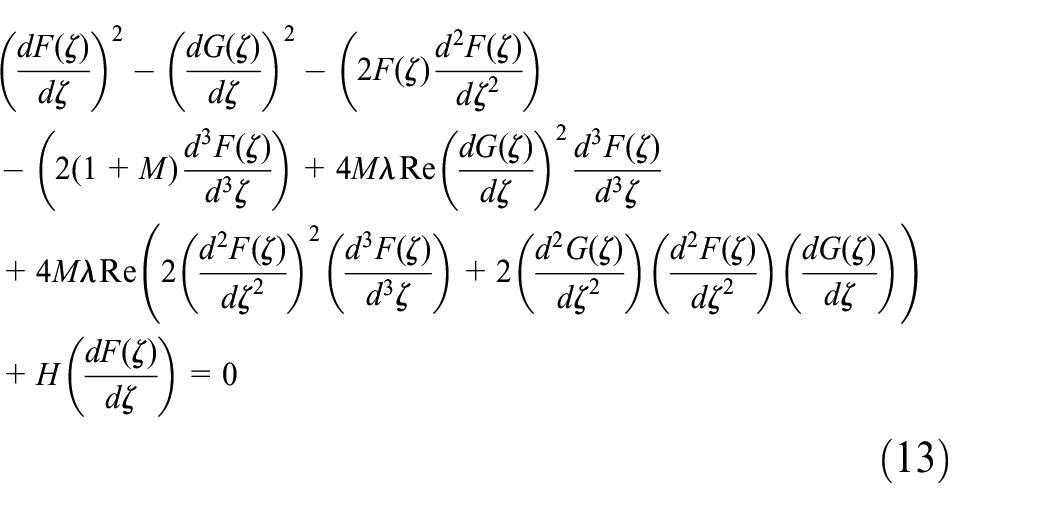



while the reduced endpoint conditions are as follows

The relations for surface quantities namely, skin-friction coefficient, local Nusselt number, and Sherwood number are defined as
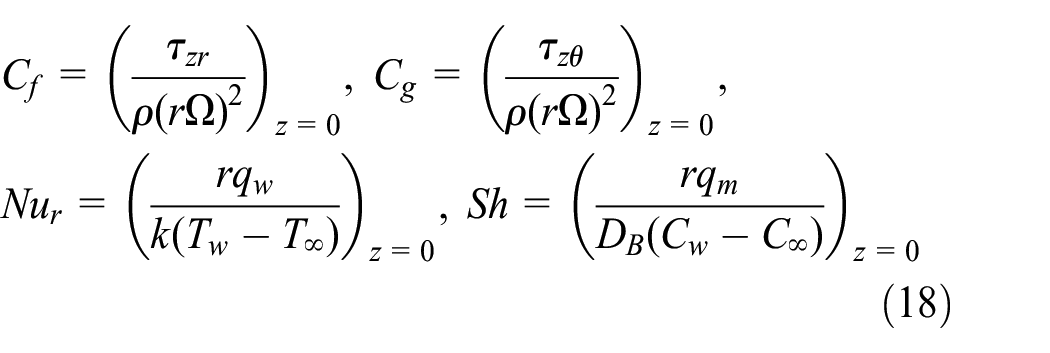

The dimensionless form of surface quantities can be written as

One can assess some mathematical analysis on PE fluid model in literature.11,15,17,32
Computational algorithm
To convert the third- and second-order differential equations to first-order differential equations, we suppose the following assumptions

Using equation (21), equations (13)–(16) along with boundary conditions equation (17) has been adapted to a system of nine first-order simultaneous equations


The system given by equations (7)–(11) represents PDEs against PE rotatory fluid flow over a disk. These equations are highly nonlinear; therefore, to seek an exact solution seems impossible. So we reduced the system in terms of ODEs, see equations (13)–(17). To implement shooting scheme along with RK-5 algorithm, we obtained a system of first-order ODEs, see equations (21)–(23). The detail in direction was assessed by Rehman et al. 40
Graphical results and discussion
The PE fluid flow is mathematically modeled in terms of high-order differential equations. The obtained differential system is further reduced into an ordinary differential system by reducing the number of independent variables using suitable transformation methods. The ultimate flow-narrating equations are solved by shooting methods along with RK-5 algorithm. The involved pertinent flow controlling parameters

Impact of
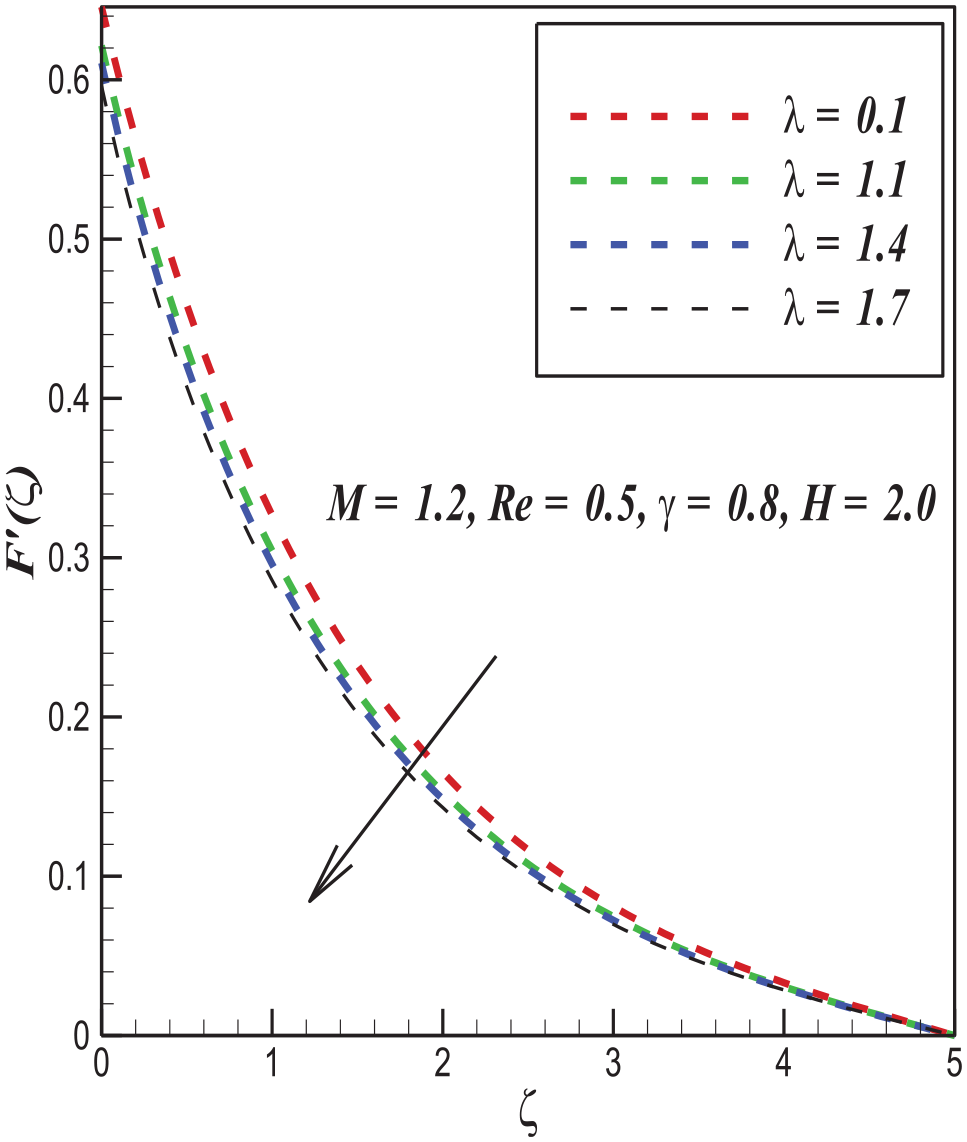
Impact of

Impact of

Impact of
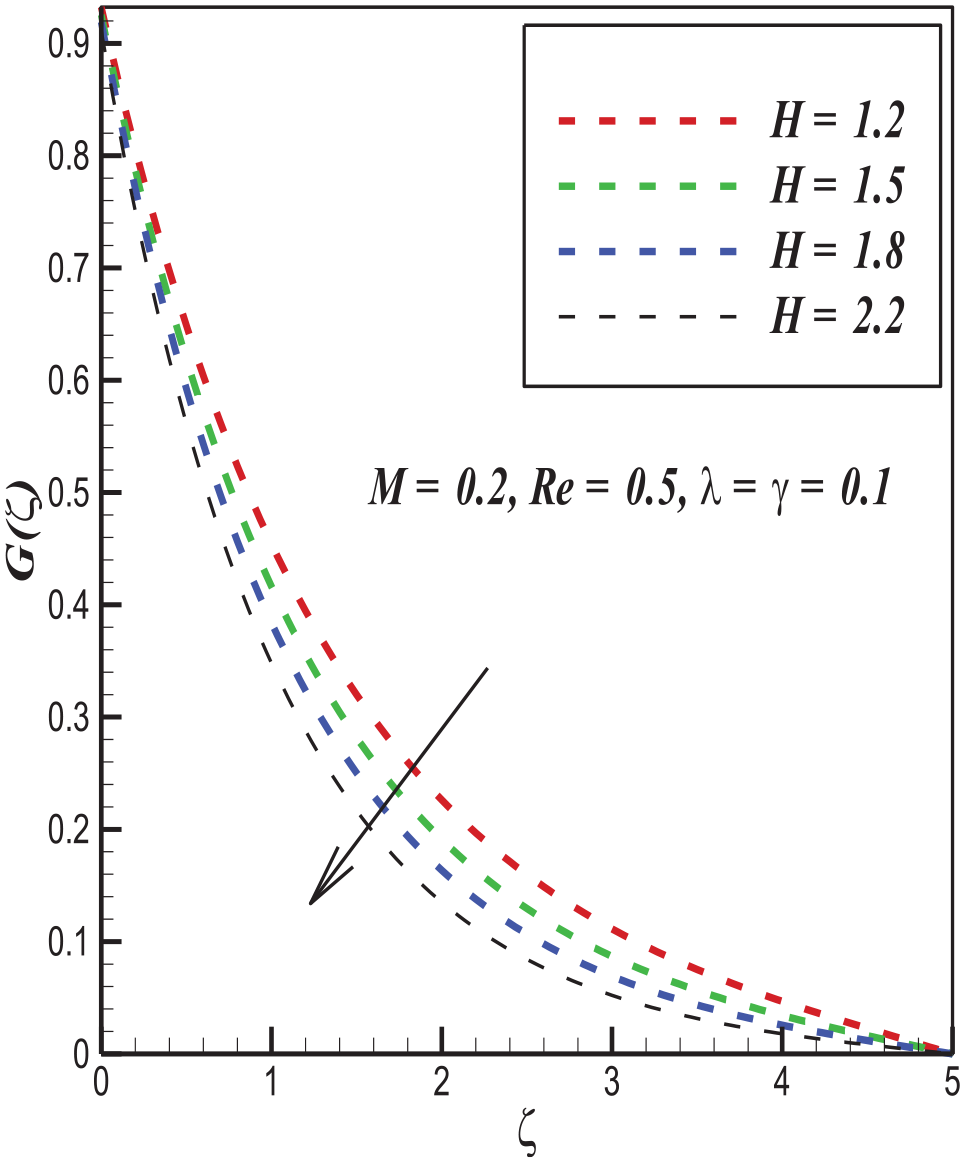
Impact of

Impact of

Impact of

Impact of

Impact of

Impact of
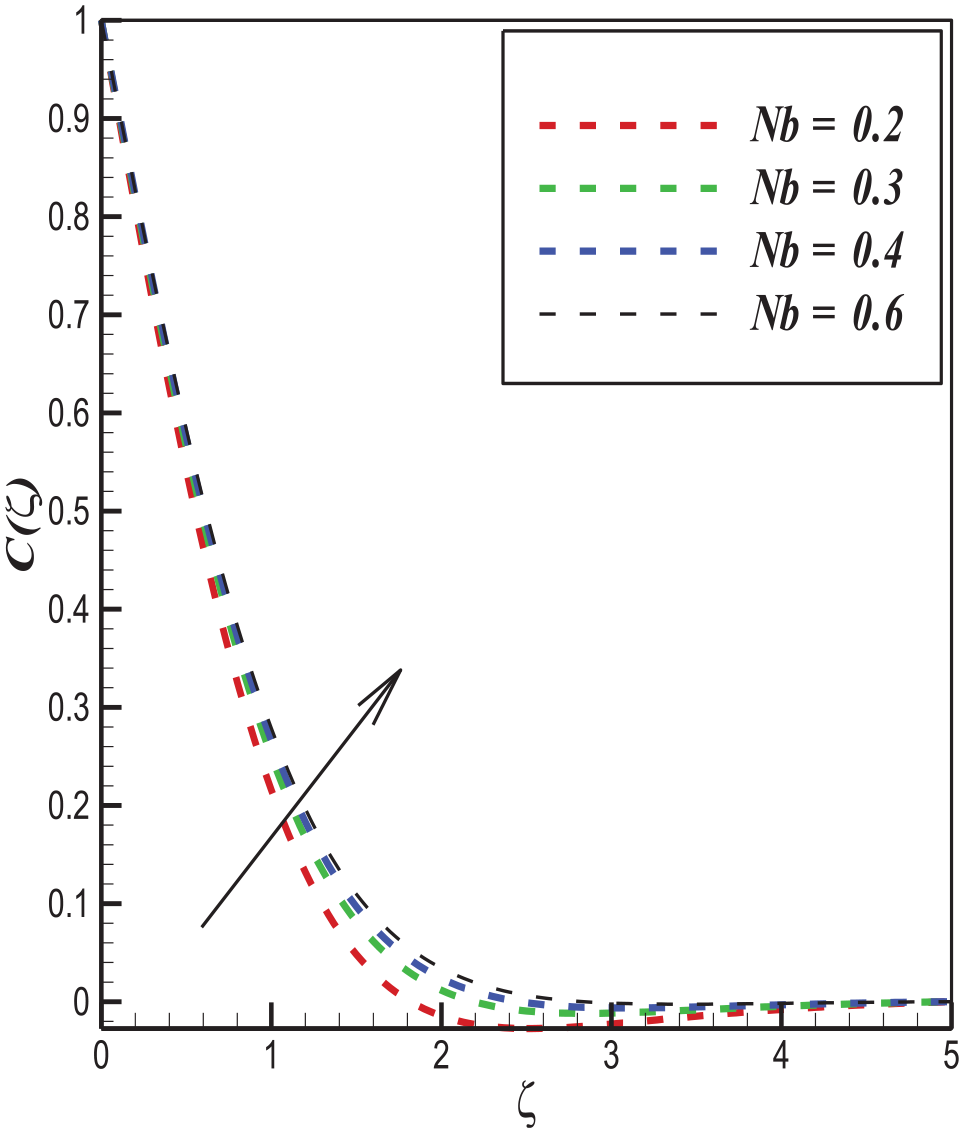
Impact of

Impact of

Impact of

Impact of

Impact of

Impact of
Conclusion
The current pagination provides analysis on magnetized rotatory flow field subject to non-Newtonian fluid model named PE fluid. The flow-narrating equations are nonlinear; therefore, the exact solution seems impossible. To overcome such difficulty, a computational algorithm is developed, and an approximate solution is presented through graphical trends. The key observations are itemized as follows:
Both axial and tangential velocities
Tangential velocity of the PE fluid shows decline values toward
Axial velocity varies positively toward higher values of
PE fluid temperature increases significantly toward
PE nanoparticle concentration shows higher values for the case of
Footnotes
Appendix 1
Acknowledgements
The authors would like to express their gratitude to King Khalid University, Abha 61413, Saudi Arabia for providing administrative and technical support.
Handling Editor: James Baldwin
Declaration of conflicting interests
The author(s) declared no potential conflicts of interest with respect to the research, authorship, and/or publication of this article.
Funding
The author(s) received no financial support for the research, authorship, and/or publication of this article.
