




Abstract
Effect of surface undulation on convective flow in a porous enclosure is investigated in this present article. The porous enclosure is filled with a water-base nanoliquid containing Cu solid nanoparticles, and the porous layer is modeled using the Darcy law. The governing equations are solved numerically using the built-in finite element method of COMSOL. The investigation was carried out for several parameters: the nanoparticle concentration,
Introduction
Free convection in enclosures has been extensively studied both experimentally and theoretically, being of considerable interest in industrial and science applications, such as solar collector, multi-pane windows, crystal growth in liquids, building insulation, electronic cooling, and geothermal energy systems. In free or natural convection, the thermal flow or buoyancy is induced by temperature variation between the horizontal or vertical walls.
Natural convection in enclosures filled with porous medium has been studied extensively in recent years, which involves moving ground water system, heat exchangers, food processing, energy harvesting, to name of a few. Walker and Homsy 1 studied the convective flow through the porous material using a number of different techniques. Other solution methods were also presented by Manole and Lage 2 and Saeid and Pop. 3 Bilgen and Mbaye 4 studied heating from below. Two convective solutions branches were found and bifurcate from the zero solution in the direction of increasing Rayleigh number.
Natural convection by heating from the vertical walls for the empty enclosure filled with the new fluids or called as nanoliquid has been analyzed by many authors. Dispersing solid nanoparticles in base liquid would substantially improved the liquid properties. Free convection in enclosures filled with copper nanoparticles in water was conducted by Khanafer et al., 5 Jou and Tzeng, 6 and Das and Ohal. 7 Öğüt 8 considered dispersed argentum in water, while Rashmi et al. 9 engineered the alumina–water nanoliquid.
The porous enclosures filled with nanoliquid having different configurations from above were studied by Chamkha and Ismael. 10 They found that the thermal performance advanced with the enhancement of the solid concentration at weak convective intensity. Chamkha and Ismael 11 studied a differentially heated partially porous layered cavities filled with a nanofluid, and Ghalambaz et al. 12 extended to the viscous dissipation and radiation effects. Mehryan et al. 13 applied the hybrid Al2O3-Cu water nanoliquid in a differentially heated porous cavity. Sheikholeslami and Shehzad 14 applied finite element method to solve nanoliquid migration in a porous medium for Darcy model. Sheikholeslami and Shehzad 15 and Chamkha et al. 16 simulated the convective nanoliquid flow in a square porous enclosure via non-equilibrium model.
All of the authors considered that the hot and cold surfaces are flat and straight. The thermal performance of the nanoliquid for the case of surface undulations has not been previously considered. The surface undulations were found to decrease the heat transfer 17 for the porous enclosure filled with pure liquid. Kumar 18 reported that the high frequency improves the natural convection from the undulated wall with uniform heat flux. Kumar and Shalini 19 concluded that partial heat flux has a complex periodical pattern in the non-Darcy model case equivalent to the side undulated surface. Misirlioglu et al. 20 examined their results with those reported in the open literature for a square enclosure with straight walls. Misirlioglu et al. 21 concluded that the convective flow is sensitive to the surface waviness for the enclosure orientation lower than 45° at high convective intensity. Khanafer et al. 22 found that the amplitude and the number of undulations surface modified the thermal performance. Cheong et al. 23 included the combustion with non-uniform wall heating. Sheremet et al. 24 considered a porous wavy enclosure filled with a nanoliquid using Buongiorno’s formulation with thermal dispersion effect. Very recently, Hoghoughi et al. 25 included the effect of enclosure configurations on free convection in a porous wavy enclosure filled with a nanoliquid using Buongiorno’s mathematical model. This work focuses on studying the effect of surface waviness on the flow structure and thermal performance for various solid nanoparticles concentration using Tiwari and Das 26 nanoliquid mathematical model. Previously, the effect of surface waviness on the flow structure and thermal performance was investigated by Alkhalidi et al. 27 They concluded that the wavy cavities could be used as thermal insulation bodies.
Mathematical formulation
A schematic diagram under consideration is presented in Figure 1. It is considered in this study that the right wall has a low temperature

where

Schematic representation of the physical domain.
Temperature variation between the left and right walls lead to a natural convection problem. In the porous medium, Darcy’s law is considered valid and the Oberbeck–Boussinesq approximation is applied. Following on these considerations, the continuity, the momentum, Darcy flow, and the energy equations with adopting Tiwari and Das 26 nanoliquid mathematical model are


The boundary conditions are



where subscript

where

where the heat capacitance of the nanoliquid given is

and

Thermophysical properties of pure water with Cu are tabulated in Table 1.
Thermophysical properties of pure water with Cu.

Source: Khanafer et al. 5
Equations (2)–(5) can be transformed into the stream function

Then, the final equations are obtained


Together with the boundary conditions



The physical quantity of interest in this problem is the thermal performance across the enclosure. This quantity is evaluated by employing Fourier’s law at the hot wall, that is

The resulting non-dimensional heat transfer rate is

The surface-averaged heat transfer rate,

where
Computational methodology
The governing equations along with the boundary condition are modeled and solved numerically by the COMSOL. COMSOL is a general-purpose solver of interlinked partial differential equation (PDE) based on the Galerkin finite element method (GFEM). This program contains state-of-the-art numerical algorithms and visualization tools bundled together with an easy-to-use interface. We consider Poisson’s equation (poeq) for equations (14) and (15). In this study, mesh generation on an enclosure is made using triangles. The triangular mesh distribution calibrates for fluid dynamics condition.
Several grid sensitivity tests were conducted to determine the sufficiency of the mesh scheme and to ensure that the results are grid independent. We use the COMSOL default mesh settings, type physics-controlled mesh sizes, that is, extremely coarse, extra coarse, coarser, coarse, normal, fine, finer, extra fine and extremely fine. In the tests, we consider the parameters
Grid sensitivity check at

CPU: central processing unit.
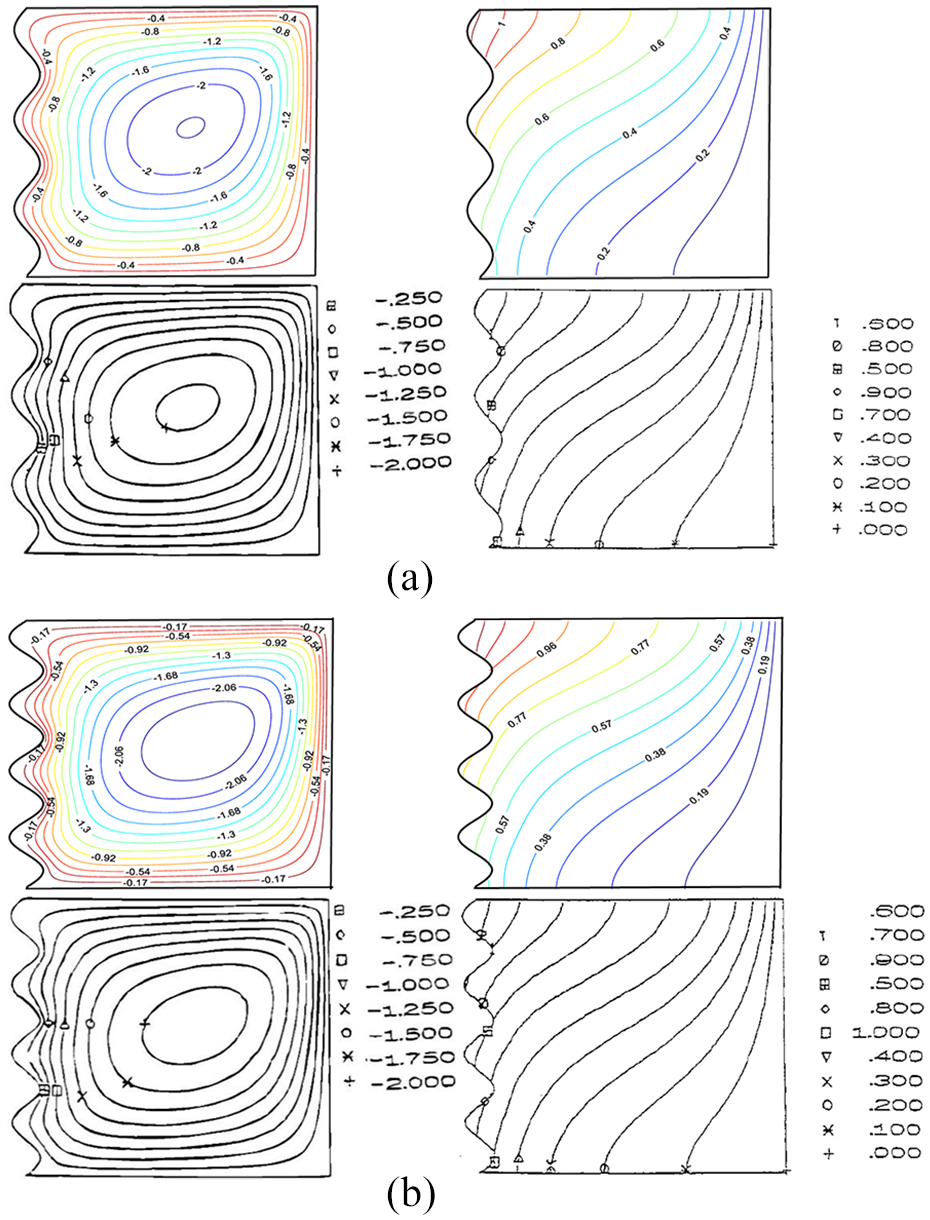
Verification of computed streamlines and isotherms with literature results for
Results and discussion
The analysis in this studies is conducted in the following domain of the associated dimensionless groups: the solid volume fraction of Cu nanoparticles,
Figure 3 shows the evolutions of the streamlines and isotherms in the porous enclosure filled with nanoliquid
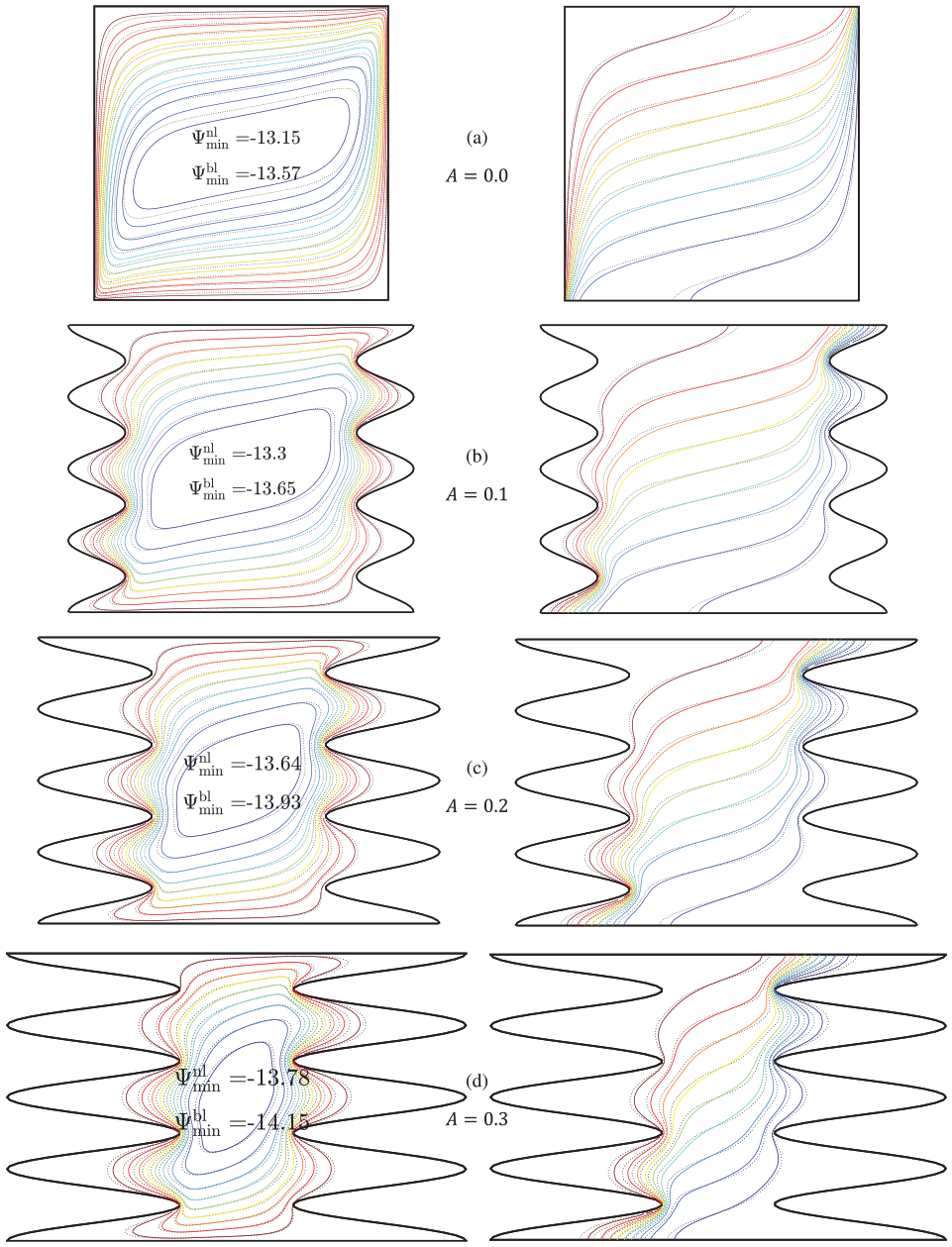
Fluid flow and temperature distributions (nanoliquid (solid lines) and pure water (dashed lines)) for different amplitudes,
Figure 4 shows the evolutions of the streamlines and temperature distribution in the porous enclosure filled with 5% Cu nanoparticles or pure water for different number of undulations
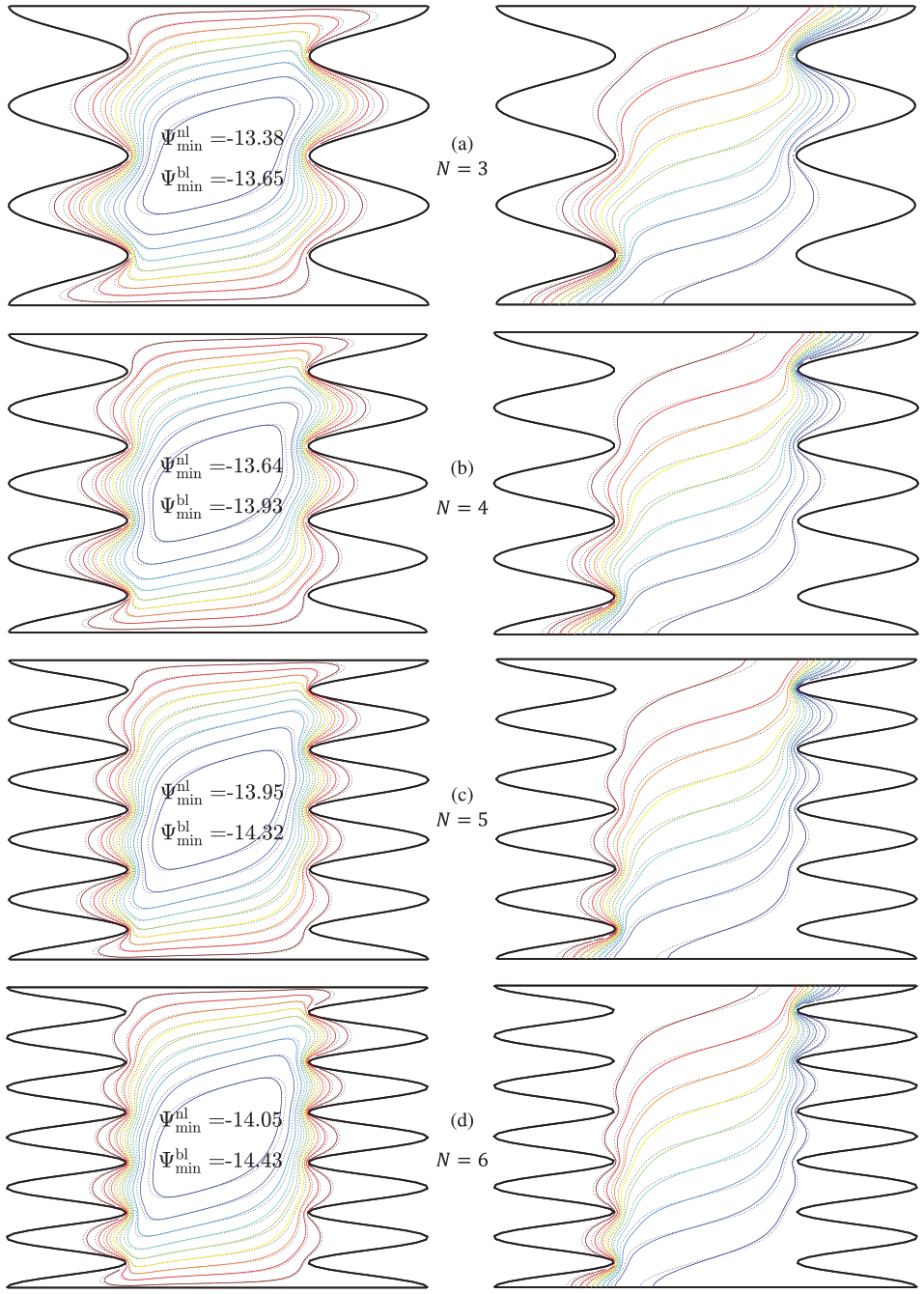
Fluid flow and temperature distributions (nanoliquid (solid lines) and pure water (dashed lines)) for different number of undulations,
Figure 5 shows the evolutions of the streamlines in the porous enclosure filled the pure water or dispersing 5% Cu nanoparticles for different Rayleigh numbers with

Streamlines (nanoliquid (solid lines) and base liquid (dashed lines)) for different Rayleigh numbers with
Figure 6 displays the evolutions of the isotherms in the porous enclosure filled the pure water or dispersing 5% Cu nanoparticles for different Rayleigh numbers with

Isotherms (nanoliquid (solid lines) and pure water (dashed lines)) for different Rayleigh numbers with
Figure 7 shows the increasing absolute values of maximum clockwise flow circulation by increasing the Rayleigh number or the heating intensity. The flow strength was suppressed by increasing Cu nanoparticles volume fraction at moderate and strong Rayleigh numbers. It indicates that the water flow is stronger than nanoliquid flow. This result contradicts the previous result for the non-porous enclosure as given by Khanafer et al. 5 and Fattahi et al. 29 They found an increase in flow circulation with increasing solid volume fraction, in particular at moderate and strong Rayleigh numbers. At moderate and strong Rayleigh numbers, the suppression of the flow strength due to the increase in the viscosity (which is the result of increasing Cu concentration) is greater than the heat transfer improvement due to the presence of nanoparticles. Moreover, the suppression of the flow strength by the presence of nanoparticles is more considerable for the case of a porous matrix with low permeability or a porous medium with high thermal conductivity.

The
The effects of the nanoparticles volume fraction and the Rayleigh number on the average Nusselt number at

Effect of the nanoparticles concentration and the Rayleigh number on the average Nusselt number at
The effects of the nanoparticles volume fraction and the amplitude undulation on the average Nusselt number at

Effects of the nanoparticles volume fraction and the amplitude undulation on the average Nusselt number at
The effects of the number of undulation and the amplitude undulation on the average Nusselt number at

Effects of the number of undulation and the amplitude undulation on the average Nusselt number at
Conclusion
In this numerical simulation, we studied the natural convection induced by a temperature difference between a hot left wall and a cold right wall. The governing equations are solved numerically using the built-in finite element method of COMSOL. Detailed numerical results for liquid flow and temperature distributions and the heat transfer rate have been illustrated and tabulated. The amplitude of the undulated wall, solid concentration and Rayleigh number influenced the geometrical of cells circulation, temperature distribution and heat transfer performance. The main findings of this invest are as follows:
The strength of the nanoliquid flow circulation increases with increasing the amplitude or number corrugations. The change of amplitude and number of undulations provide a visual alteration of the core vortex.
Higher solid concentration gives higher heat transfer for sufficiently weak Rayleigh number and higher solid concentration gives lower heat transfer for sufficiently strong Rayleigh number.
The maximum heat transfer suppression happened in the heat transfer occurs at strong Rayleigh number and high concentration. The reduction is more significant for moderate undulation number and about
For the configuration with three and four undulations, a growth of
Footnotes
Handling Editor: James Baldwin
Declaration of conflicting interests
The author(s) declared no potential conflicts of interest with respect to the research, authorship, and/or publication of this article.
Funding
The author(s) received no financial support for the research, authorship, and/or publication of this article.
