




Abstract
This study investigates the natural convection induced by a temperature difference between cold outer polygonal enclosure and hot inner circular cylinder. The governing equations are solved numerically using built-in finite element method of COMSOL. The governing parameters considered are the number of polygonal sides, aspect ratio, radiation parameter, and Rayleigh number. We found that the number of contra-rotative cells depended on polygonal shapes. The convection heat transfer becomes constant at
Introduction
Fluid flow and natural convection heat transfer from a heated body inside enclosures have long been studied and have received more attention due to its direct relevance to many engineering and technological applications such as flood protection for buried pipes, solidification processes, heat exchange, electronic packaging, and chemical reactors. Natural convection in enclosures containing a heated circular cylinder is studied rigorously in the literature. Different cylinder configurations are studied theoretically or experimentally in the literature.
Yang and Tao 1 investigated the natural convection heat transfer in a cylindrical envelope with an internal concentric slotted hollow cylinder. Yoo et al. 2 have found multicellular natural convection of a low Prandtl number fluid between horizontal concentric cylinders. Guj and Stella 3 numerically considered the natural convection in horizontal eccentric annuli. SW Baek and CY Han 4 investigated the effects on natural convection phenomena by radiation in concentric and eccentric horizontal cylindrical annuli. An efficient approach to simulate natural convection in arbitrarily eccentric annuli by vorticity-stream function formation has been proposed by Shu et al. 5 Waheed 6 discussed the problem of natural convection between two concentric horizontal cylindrical annuli. Abu-Nada et al. 7 studied the heat transfer enhancement in horizontal concentric annuli using nanofluids. The nanofluids in a lid-driven cavity with a rotating circular cylinder were investigated by Chatterjee et al. 8
Ghaddar 9 studied a heated horizontal cylinder placed inside a rectangular enclosure. He found that the maximum air velocity was at a distance of about nine cylinder diameters along the vertical centerline above the heated cylinder. Moukalled and Acharya 10 have analyzed the effect of the radius of the inner circular cylinder and the aspect ratio of the fluid flow and heat transfer rate. Cesini et al. 11 performed a numerical and experimental analysis of the cylinder and reported that in general, the numerical and experimental results were in good accordance. Shu et al. 12 used the differential quadrature method and showed that the global circulation, flow separation, and the top space between the square outer enclosure and the cylinder have an important influence on the flow and thermal fields. Shu and Zhu 13 analyzed the effect of the radius of the inner circular cylinder and the aspect ratio of the fluid flow and heat transfer rate. Kim et al. 14 and Lee et al. 15 showed that the cylinder position could affect the heat transfer quantities. The changes in heat transfer quantities at Rayleigh number of 107 have been presented by Yoon et al. 16 and Yu et al. 17 The different thermal boundary conditions are presented by Roychowdhury et al. 18 Angeli et al. 19 developed a correlation for the average Nusselt number as a function of Rayleigh number and the diameter. The heat transfer enhancement by increasing the cylinder size and/or surface emissivity has been achieved by Mezrhab et al. 20 Hussain and Hussein 21 studied a uniform heat flux which enters through the cylinder instead of being kept at a constant high temperature. They obtained two cellular flow fields and the total average of Nusselt number behaves nonlinearly as a function of locations. The existence of local peaks of the Nusselt number has been investigated by Lee et al. 15 Chatterjee and Halder 22 numerically considered two rotating cylinders in a square enclosure filled with an electrically conducting fluid. Recently, Gupta et al. 23 investigated a ventilated cavity in the presence of the heat conducting cylinder.
Xu et al. 24 studied the cylinder inside a triangular enclosure. The cross-section geometry was found to have insignificant effects on the overall heat transfer. However, the above studies of heat transfer characteristics were developed for specific enclosures, such as cylindrical, rectangular, and triangular. Hence, this work aims to investigate various polygonal enclosures with inner hot cylinder. The enclosure can be triangular, rectangular, pentagonal, hexagonal, heptagonal, octagonal, nonagonal, or cylindrical. These arbitrarily geometries are expected to be of importance for some engineering applications, for example, thermal management of electronic devices. This work will present the fluid dynamics and thermal performance in the space between hot inner cylinder and cold outer polygonal. The radiative heat flux is taken into consideration.
Mathematical formulation
A schematic diagram of a cold regular polygonal enclosure having an inner hot circular cylinder is shown in Figure 1. The cylinder is located in the center of the enclosure with radius

where Pr is Prandtl number and Ra Rayleigh number. The dimensionless form of the governing equations is expressed as follows:



where


(a) Schematic representation of the model for pentagonal enclosure and (b) mesh distribution.
Heat transfer rate is very important in thermal engineering applications. Therefore, the rate of heat transfer is computed at inner wall expressed in terms of the local surface Nusselt number

where

Computational methodology
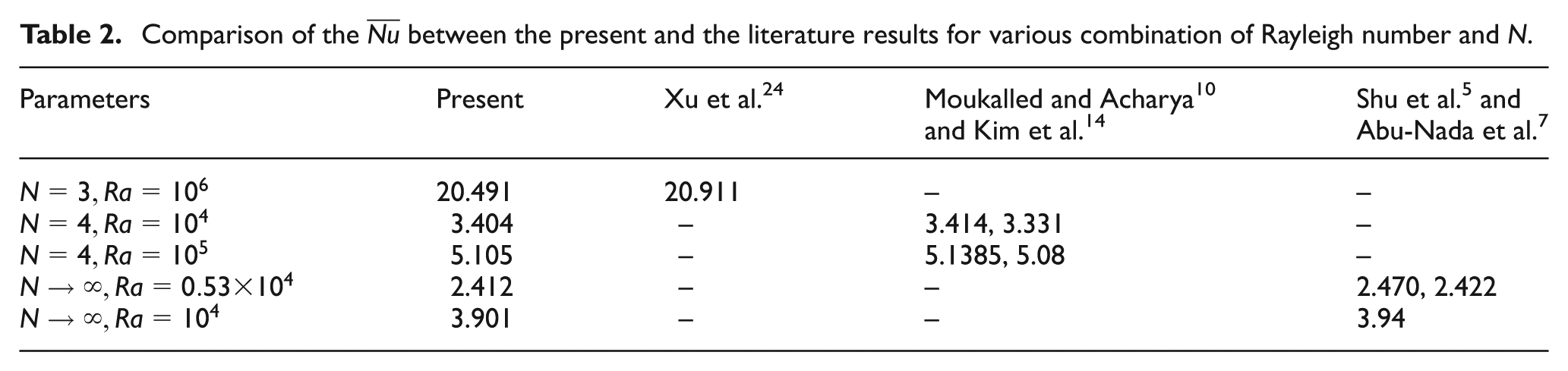
The governing equations along with the boundary conditions are solved numerically by the computational fluid dynamics (CFD) software package COMSOL Multiphysics. COMSOL Multiphysics (formerly FEMLAB) is a finite element analysis, solver, and simulation software package for various physics and engineering applications. We consider the following application modes in COMSOL Multiphysics. The incompressible, laminar flow (spf) for equations (2)–(4) and the heat transfer in fluids (ht) for equation (5). P2-P1 Lagrange elements and the Galerkin least-squares method are used to assure stability. In this study, mesh generation on square enclosure having an inner circular cylinder is made using triangles. The triangular mesh distribution is shown in Figure 1(b), and it calibrates for fluid dynamic condition. Several grid sensitivity tests were conducted to determine the sufficiency of the mesh scheme and to ensure that the results are grid independent as shown in Table 1. We use the finer mesh sizes for all the computations done in this article by considering both accuracy and time computation. To validate the computation code, the previously published problems on natural convection in triangular, rectangular, and circular enclosures were solved (see Figure 2). The comparison was made between the resulting figures and the figures provided by Xu et al.,
24
Kim et al.,
14
and Abu-Nada et al.
7
These results provide confidence to measure the accuracy of the current numerical method. In addition, the
Grid sensitivity check at


Comparison of the
Results and discussion
The analysis in the undergoing numerical investigation is performed in the following domain of the associated dimensionless groups: the
Figure 3 shows the effects of various values of radiation parameters and N at

Streamlines for different radiation parameter, Rd = 0 (left), Rd = 0.5 (middle), Rd = 1 (right) and values of N at L/D = 0.63, Ra = 105 and (a) N = 3, (b) N = 4, (c) N = 5, (d)
The effects of radiation parameter and N on isotherms for

Isotherms for different radiation parameter, Rd = 0 (left), Rd = 0.5 (middle), Rd = 1 (right) and values of N at L/D = 0.63, Ra = 105 and (a) N = 3, (b) N = 4, (c) N = 5, (d)
Figure 5 presents surface-averaged Nusselt number
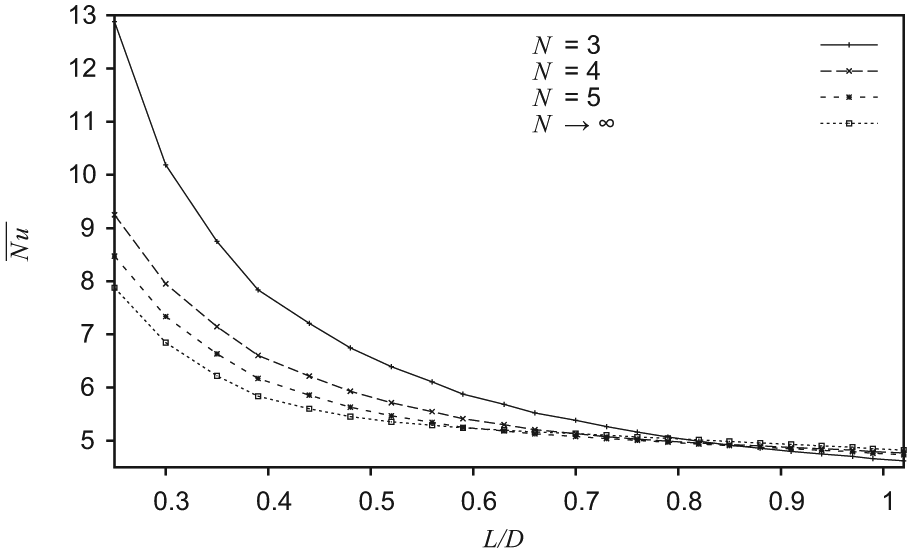
Surface-averaged Nusselt number
Figure 6 summarizes the variations in surface-averaged Nusselt number versus the aspect ratio for various value of Rayleigh number at (a)

Surface-averaged Nusselt number
Figure 7 depicts the effect of various radiation on the average Nusselt number with

Surface-averaged Nusselt number
The effects of various Rayleigh number on surface-averaged Nusselt number
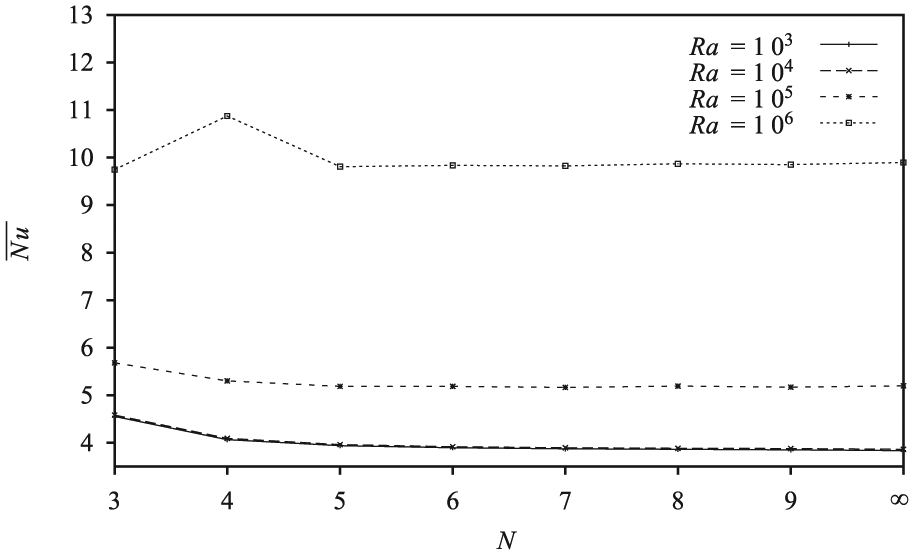
Surface-averaged Nusselt number
Figure 9 presents the

Surface-averaged Nusselt number
Conclusion
This numerical study investigated the natural convection induced by a temperature difference between the cold outer polygonal enclosure and hot inner cylinder. The dimensionless forms of the governing equations are modeled and solved using the built-in finite element method of COMSOL Multiphysics software. Detailed computational results for flow and temperature fields and the heat transfer are presented in graphical forms. The main conclusions of the present analysis are as follows:
The number of contra-rotative cells depends on polygonal shapes. The flow fields are symmetric for each polygonal shape.
The Nusselt number decreases by increasing the cylinder diameter and enclosure length ratio for each polygonal shape, convection, and radiation parameter. The convection heat transfer becomes constant at
Generally, the Nusselt number decreases by adding the number of polygonal sides.
The results presented here provide an alternative approach to optimize the convective flows and heat transfer rate by a proper choice of the cross-section geometry.
Footnotes
Appendix 1
Academic Editor: Bo Yu
Declaration of conflicting interests
The author(s) declared no potential conflicts of interest with respect to the research, authorship, and/or publication of this article.
Funding
The author(s) disclosed receipt of the following financial support for the research, authorship, and/or publication of this article: This work was supported partially by the Malaysian Ministry of Education through the Fundamental Research grant scheme no. FRGS/1/2014/SG04/UKM/01/1.