In the present study, the three-dimensional Darcy–Forchheimer magnetohydrodynamic thin-film nanofluid containing flow over an inclined steady rotating plane is observed. Nanofluid thin-film flows are taken thermally radiated and suction/injection effect is also considered. By similarity variables, the partial differential equations are transformed into a set of first-ordinary differential equations (ODES). By Homotopy Analysis Method, the required ODES is solved. The boundary layer over an inclined steady rotating plane is plotted and observed in detail for the velocity, , and profiles. The influence of various embedded parameters such as variable thickness, Pr, and thermophoretic parameter on velocity, , and profile. The influence of many parameters is explained by graphs for the velocity, , and . The crucial terms of Nusselt number and Sherwood number have also been observed numerically and physically for and . Radiation phenomena is the cause of energy to the liquid system. For more rotation parameters, the thermal boundary-layer thickness is reduced.
In chemical and mechanical engineering progressions, the elimination from cooling of a fluid condensate, saturated vapor, is significant. Numerous scientists demonstrated this problem at dissimilar conditions. The deferrals of nanoparticles in fluids display vital enrichment of their possessions at modest nanoparticle concentrations. Numerous researchers’ work on nanofluids appreciate their behaviors so that they can be applied where straight heat transfer enrichment is vital as in numerous industrialized uses, transportation, and nuclear reactors. Nanofluid as a smart fluid, where heat transfer can be decreased or increased at will, has also been described. This research work aims at deliberating the wide-ranging present and future uses of nanofluids, emphasizing their enriched heat transfer possessions that are governable and the definite features that these nanofluids preserve that make them suitable for such uses. Moreover, a nanofluid is a new kind of energy transference fluid, which is the suspension of a base fluid and nanoparticles. For cooling rate requirements, usual heat transfer liquids cannot be used, due to their lesser thermal conductivity. By implanting nanoparticles into normal fluids, their thermal enactment can be enriched considerably. Bhatti et al.1 have explored simultaneous impacts of varying magnetic field of Jeffrey nanofluid. Ellahi2 has deliberated the magnetohydrodynamic (MHD) non-Newtonian nanofluid with temperature-dependent viscosity flow through a pipe. The flow exploration cooled by Cu water nanofluid of microchannel heat sink applying least square method and porous media approach observed by Hatami et al.3,4 have explored nanofluid laminar flow between rotating disks with heat transfer. Shamshuddin et al.5 have deliberated numerical study of non-Fourier heat flux model in a rotating disk in the presence of viscosity and heat transfer. Khan and Pop6 have deliberated boundary-layer nanofluid flow through a stretching surface. Khanafer et al.7 have described two-dimensional buoyancy driven with enhancement heat transfer enclosure utilizing nanofluids. Bég et al.8 have studied solar magnetic nanopolymer fabrication simulation, by applying the modeling of magnetic nanopolymer flow with induction. Rashidi et al.9 have explored flow of nanofluid on a steady porous rotating disk with entropy generation and MHD. Rashidi and Dinarvand10 have investigated three-dimensional (3-D) film condensation on steady inclined rotating disk. Saleh et al.11 have studied carbon-nanotubes suspended nanofluids flow with convective condition using Laplace transform. Sheikholeslami et al.12 have studied flow of nanofluid in a semi-annulus enclosure with heat transfer and MHD effects. Sheikholeslami et al.13 have deliberated flow of MHD nanofluid in a semi-porous channel. Later investigators14 have deliberated unsteady nanofluid flow through a stretched sheet. Hayat et al.15 have explored boundary-layer flow of nanofluid. Malik et al.16 have examined MHD flow through a stretching of Erying–Powell nanofluid. Nadeem et al.17 have examined flow of Maxwell liquid with nanoparticle through a vertical stretching sheet. Raju et al.18 have examined flow with free convective heat transfer through a cone of MHD nano liquid. Rokni et al.19 have explored flow through the plates of nanofluid with heat transfer. Nadeem et al.20 have deliberated flow on stretching sheet of nano non-Newtonian liquid. Shehzad et al.21 have investigated convective boundary conditions of Jeffrey nano liquid flow. Sheikholeslami et al.22 have explored flow with magnetic field and heat transfer of nano liquid. Mahmoodi and Kandelousi23 have examined flow for cooling application of nanonfluid with heat transfer. Shah et al.24–27 have deliberated nanofluid flow through a rotating system with Hall current and thermal radiation effects. The further present theoretical and investigational examine of Sheikholeslami using different phenomena for nanofluids, with present usages and possessions with applications of numerous methods can be deliberate in previous studies.28–32
The thin-film flow exploration have achieved substantial presentation due to its frequent usages in the field of industries and technology, and engineering in certain years. Investigation of thin liquid flow has practical uses such as cable, fibber undercoat. Several well-known uses of thin film are fluidization of the devices, elastic sheets drawing, and constant forming. Sandeep and Malvandi33 have studied non-Newtonian nano liquids thin-film fluid flow. Wang34 has detected unsteady flow of thin-film fluid through stretching sheet. Usha and Sridharan35 have deliberated unsteady finite thin liquid past through a stretching surface. Liu and Andersson36 have deliberated film flow with heat transfer on a stretching surface. Aziz et al.37 have perceived flow of thin fluid film on a stretching sheet for the production of inner heat. Tawade et al.38 have examined fluid flow with thermal radiation and heat transmission of thin film. Fluid film flow on stretching sheet with heat transfer have deliberated by Anderssona et al.39 Also investigators40–43 have deliberated unsteady flow of liquid film on stretching surface for further dissimilar cases. Hatami et al.44 have examined 3-D nanofluid flow on a steady rotating disk. Jawad et al.45 have examined Darcy–Forchheimer nanofluid thin-film flow with MHD effect. Jawad et al.46 have studied 3-D Single-Wall Carbon Nanotubes rotating flow with impact of non-linear thermal radiation and the viscous dissipation. Bég et al.47 have studied flow on an inclined surface in the presence of heat generation effects and Soret diffusion with heat and mass transfer. Kadir et al.48 have deliberated flow of von Karman swirling bioconvection in a deformable rotating disk. Bég et al.49 have discussed improved rheology and lubricity of drilling fluid enhanced with nanoparticles. Bég et al.47 have investigated steady state flow along an inclined surface with MHD heat and mass transfer.
Problem formulation
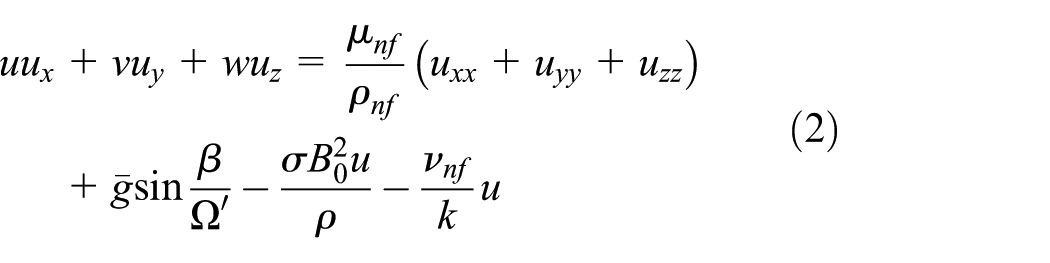
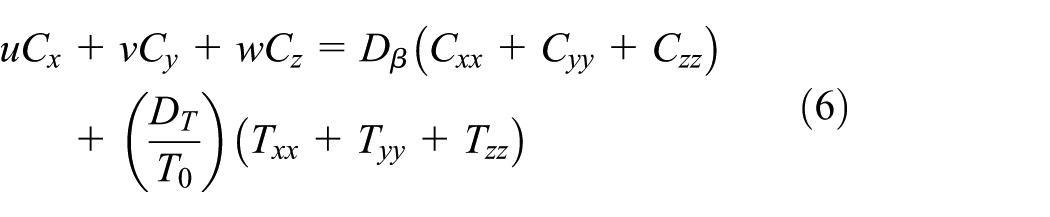
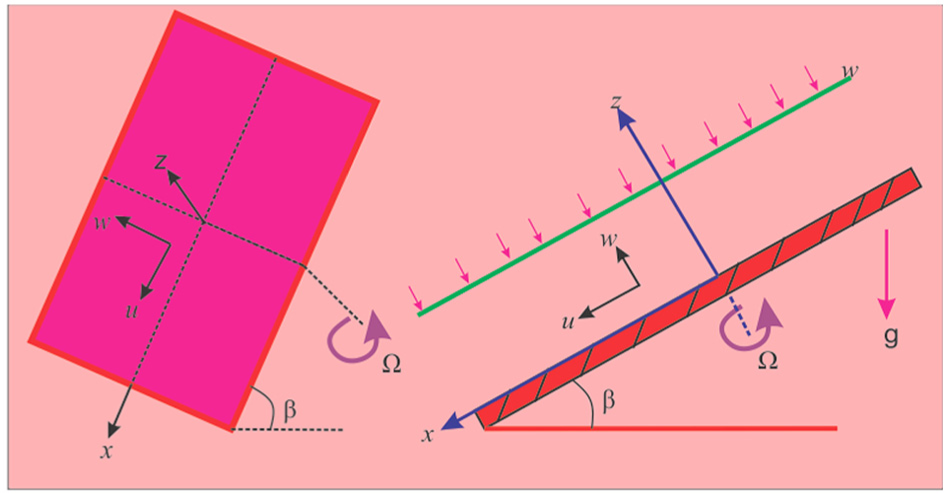
Suppose flow over rotating disk of a steady 3-D nanofluid thin film. The rotation of the disk is due to the angular velocity in its own plane as displayed in Figure 1. An angle is observed by the inclined disk with horizontal axis; denotes the film thickness of nanofluid, and represents the spraying velocity. The radius of the disk is very large as matched to the liquid film thickness and hence the termination influence is unnoticed. The is gravitational acceleration, the temperature at the film surface is represented by , while denotes the surface temperature of the disk. Likewise , is the concentration at the film and on the disk surfaces, respectively. Pressure is a function of z-axis only and the ambient pressure at sheet of the film is kept constant. The equations for steady state of continuity, momentum, concentration, and energy are shown in equations (1)–(6)
Geometry of the problem.
In the above equations, the velocity components in the , and -axes are represented by , and individually, where BCs are as follows
If and are a function of only, equations (5) and (6) become
Now , , , are identified as
The normalized thickness constant is presented as
The condensation velocity is defined as
The pressure can be attained by integration equation (4).
For , by using , the exact solution is
An asymptotic limit for small is defined in equation (17). The reduction of for rising is not monotonic, so is denoted as
The Sherwood number is denoted as
Solution by HAM
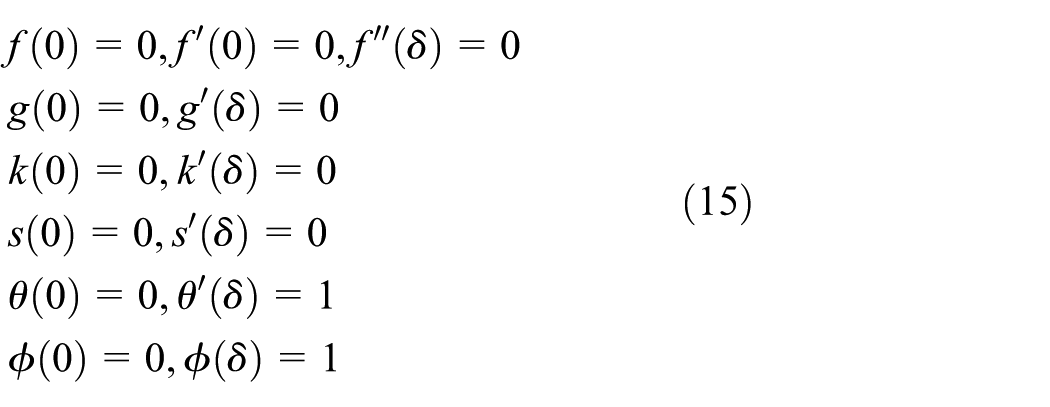
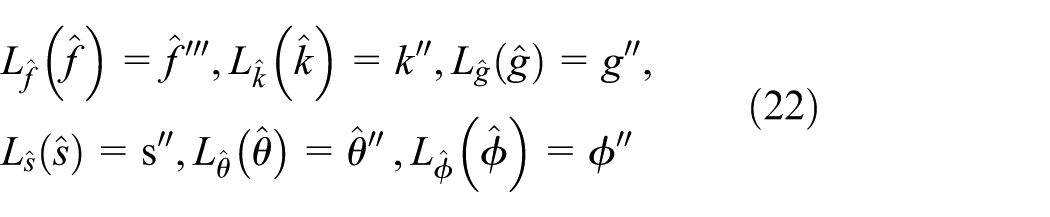
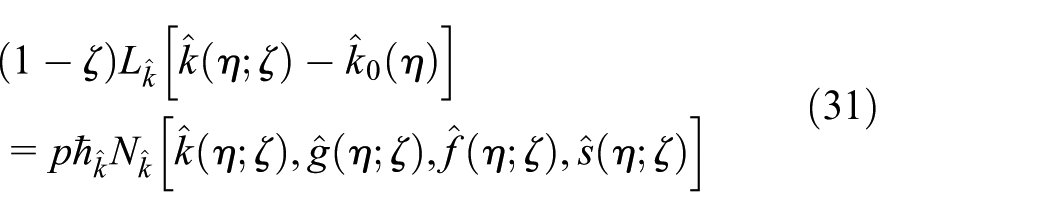
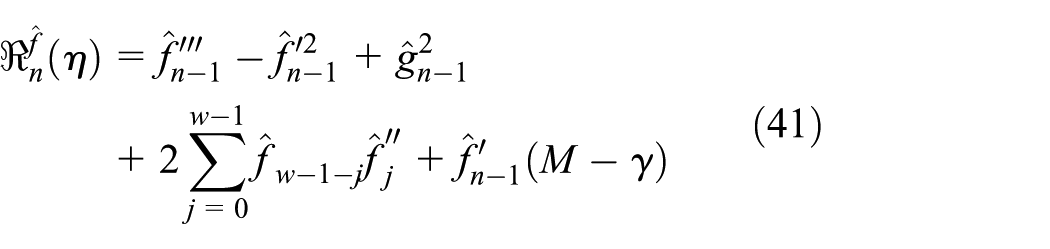
Optimal approach is used for solution process. Equations (9)–(14) with boundary conditions (15) are solved by Homotopy Analysis Method (HAM). Mathematica software is used for this aim. Basic derivation of the model equation through HAM is given in detail below.
Linear operators are denoted as , and , and represented as
which is shown as
where the representation of coefficients is included in the general solution by .
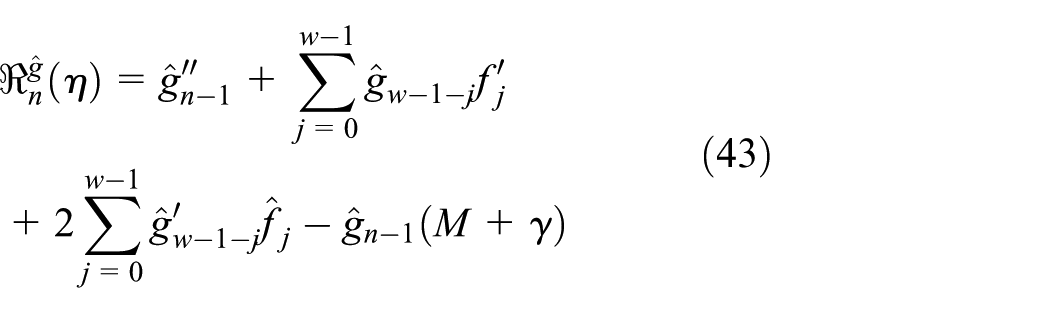
The corresponding non-linear operators are sensibly chosen as , and identified in the form
where the embedding restriction is , to normalize for the solution convergence , , and are used. When , we get
Expand the , and through Taylor’s series for
The boundary constrains are
Here
where
Result and discussion
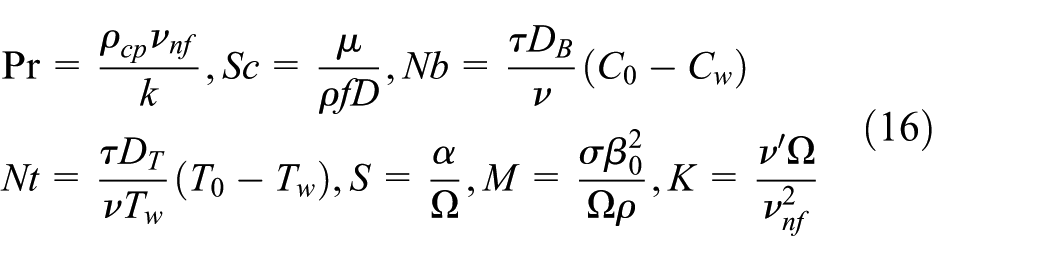
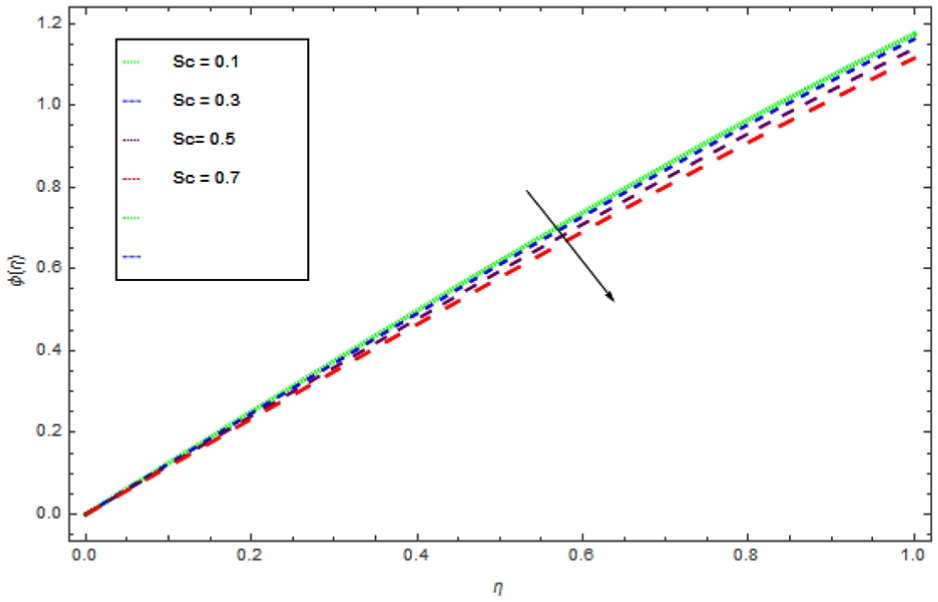
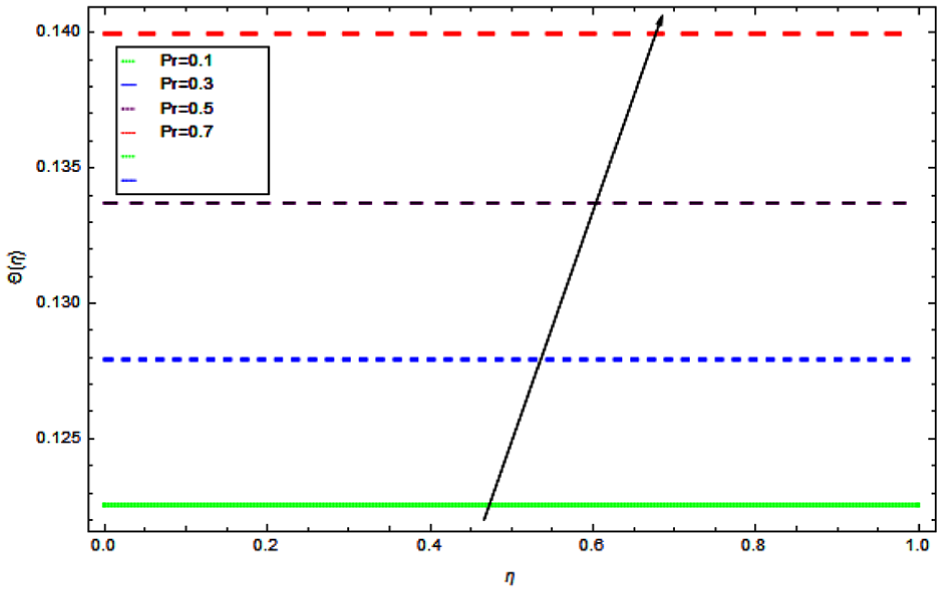
The flow of 3-D thin-film nanofluid through a steady rotating inclined surface with mass and heat transmission has been examined. The influence of the embedded parameters , and has been investigated for axial velocity , radial velocity , drainage flow , and induced flow , and profile, respectively. The effect of on , , , and are shown in Figures 2–5. Figures 2 and 5 display the impact of on and . With increases in axial velocity, the induced flow of fluid film increases. It is also detected that rise in results inside liquid velocity of nanofluid and layer thickness to decrease suggestively. The purpose behind such influence of is the stimulation Lorentz force. To both fields, the action of this force is vertical. Figures 3 and 4 displays that, the decreased values of increases radial velocity and drainage flow. As recommends the ratio of viscous and hydromagnetic body forces, larger value of specifies a more hydromagnetic body force due to which the fluid flow is reduced. Lorentz force theory states that has an inverse effect on velocity function. Figures 6–9 display the influence of on , , , and . Figures 6 and 7 display that rising rises the porous space which generates resistance in the flow path and decreases the flow motion of nanoparticles. It is observed that an increase in porosity variable leads to decrease in the and . Physically, it is due to this fact that the porous surface effect on the boundary layers progress is significant owing to increase in the viscosity of the thermal boundary layers. Also Figures 8 and 9 display that rising values of reduce and . So it is expected that, an increase in the porosity leads to decrease in the motion of the liquid on it. Basically, when the dumps of the permeable surface come to be large, the opposition of the porous surface may be ignored. The opposite is found in case of z-direction, that is, the enormous value of decreases the and . The influence of on is displayed in Figure 10. It is expected that regressions with huge value of increases for smaller values. Thermal diffusivity of nanofluids is greater by reducing and this significance is inconsistent for larger . Hence, the greater value of drops in thermal boundary layer. The influence of on is presented in Figure 11. It is observed if we rise , then in the boundary-layer area augment. The effect of on is displayed in Figure 12. The converse influence has been created for as for , which is augmenting as decreases. The boundary-layer thickness is decreased due to the rises of as a result to reduce the . The features of on is presented in Figure 13. Enhancing rises . Due to that depends on the temperature gradient of the nanofluids. Kinetic energy of the nanofluids rises with rise of , and as a result rises the . The influence of the on the is shown in Figure 14. It is seen that directly varies with . Enhancing rises the temperature, which in consequence rises kinetic energy of the liquid, so the fluid film speed rises. Figure 15 identifies the influence of The dimensionless number is stated as the ratio of momentum and mass diffusivity. It is obvious that amassed reduces the and as a result decreases the boundary-layer thickness.
The effect of on when .
The effect of on when .
The influence of on when .
The effect of on when .
The effect of on when .
The influence of on when .
The influence of on when .
The influence of on when .
The effect of on when .
The effect of on when .
The effect of on when .
The influence of on when .
The influence of unsteadiness parameter on when .
The effect of Schmidt number on when .
Table 1 observes the influence of , and on . Figures 16 and 17 label the effect of . It is seeming that has positive impact on . It is also realized that the rising values of and increase the . Figures 18 and 19 identify that the reduces for the amassed values of and . Table 2 observes the effect of , and on . The increases for increased value of and . For increasing values of , reduces. Variation in heat flux and mass flux are shown in Tables 1 and 2 numerically.
Nusselt number for various values of embedded parameters.
0.1
0.1
0.4
1.6
0.3
0.5
0.7
0.1
0.3
0.5
0.7
0.4
0.5
0.6
0.7
1.6
1.1
0.6
0.1
Sherwood number for various values of embedded parameters.
0.5
0.6
0.7
1.6
0.6
0.7
0.8
0.6
0.7
0.8
0.9
0.7
0.6
0.5
0.4
1.6
1.1
0.6
0.1
The influence of Prandtl number on Nusselt number when .
The influence of radiation parameter on Nusselt number when .
The influence of on Nusselt number when .
The influence of on Nusselt number when .
Conclusion
In this article, the 3-D Darcy–Forchheimer MHD thin-film nanofluid containing flow over a steady inclined rotating plane is observed. Nanofluid thin-film flow is taken thermally radiated and suction/injection effect is also considered. By similarity variables, the partial differential equations are transformed into a set of first-ordinary differential equations (ODES). The required ODES is solved by HAM with association of mathematica program. In this exploration, flow through a steady inclined rotating disk of nanofluid 3-D condensation film is solved by HAM.
A higher e value of the S parameter delivers to cool the boundary layer and the rises.
A greater value of the Sc decreases the Sh as a result to enhancement in the concentration and kinematic viscosity of the fluids.
For a larger amount of Pr, the decreases.
Rising nanofluid volume fraction leads to rise in and the maximum temperature was achieved in this situation for Al2O3-water.
Footnotes
Handling Editor: James Baldwin
Declaration of conflicting interests
The author(s) declared no potential conflicts of interest with respect to the research, authorship, and/or publication of this article.
Funding
The author(s) received no financial support for the research, authorship, and/or publication of this article.
ORCID iDs
Zahir Shah
Hakeem Ullah
References
1.
BhattiMMZeeshanAEllahiR.Simultaneous effects of coagulation and variable magnetic field on peristaltically induced motion of Jeffrey nanofluid containing gyrotactic microorganism. Microvasc Res2017; 110: 32–42.
2.
EllahiR.The effects of MHD and temperature dependent viscosity on the flow of non-Newtonian nanofluid in a pipe: analytical solutions. Appl Math Model2013; 37: 1451–1467.
3.
HatamiMGanjiDD.Thermal and flow analysis of microchannel heat sink (MCHS) cooled by Cu-water nanofluid using porous media approach and least square method. Energ Convers Manage2014; 78: 347–358.
4.
HatamiMSheikholeslamiMGanjiDD.Laminar flow and heat transfer of nanofluid between contracting and rotating disks by least square method. Powder Technol2014; 253: 769–779.
5.
ShamshuddinMMishraSRBégOAet al. Numerical study of heat transfer and viscous flow in a dual rotating extendable disk system with a non-Fourier heat flux model. Heat Transf Asian Res2019; 48: 435–459.
6.
KhanWPopI.Boundary-layer flow of a nanofluid past a stretching sheet. Int J Heat Mass Tran2010; 53: 2477–2483.
7.
KhanaferKVafaiKLightstoneM.Buoyancy driven heat transfer enhancement in a two-dimensional enclosure utilizing nanofluids. Int J Heat Mass Tran2003; 46: 3639–3653.
8.
BégOAKuharatSFerdowsMet al. Modeling magnetic nanopolymer flow with induction and nano-particle solid volume fraction effects: solar magnetic nano-polymer fabrication simulation. P I Mech Eng N-J Nanomater2019; 233: 27–45.
9.
RashidiMMAbelmanSMehrNF.Entropy generation in steady MHD flow due to a rotating porous disk in a nanofluid. Int J Heat Mass Tran2013; 62: 515–525.
10.
RashidiMMDinarvandS.Purely analytic approximate solutions for steady three-dimensional problem of condensation film on inclined rotating disk by homotopy analysis method. Nonlinear Anal-Real2009; 10: 2346–2356.
11.
SalehHAlaliEEbaidA.Medical applications for the flow of carbon-nanotubes suspended nanofluids in the presence of convective condition using Laplace transform. J Assoc Arab Univ Basic Appl Sci2017; 24: 206–212.
12.
SheikholeslamiMGorji-BandpyMGanjiDD.Numerical investigation of MHD effects on Al2O3-water nanofluid flow and heat transfer in a semi-annulus enclosure using LBM. Energy2013; 60: 501–510.
13.
SheikholeslamiMHatamiMGanjiDD.Analytical investigation of MHD nanofluid flow in a semi-porous channel. Powder Technol2013; 246: 327–336.
14.
AbolbashariMHFreidoonimehrNRashidiMM.Analytical modeling of entropy generation for Casson nano-fluid flow induced by a stretching surface. Adv Powder Technol2015; 6: 542–552.
15.
HayatTMuhammadTShehzadSAet al. Three-dimensional boundary layer flow of Maxwell nanofluid. Appl Math Mech-Engl2015; 36: 747–762.
16.
MalikMYKhanIHussainAet al. Mixed convection flow of MHD Eyring-Powell nanofluid over a stretching sheet: a numerical study. AIP Adv2015; 5: 117–118.
17.
NadeemSHaqRUKhanZH.Numerical study of MHD boundary layer flow of a Maxwell fluid past a stretching sheet in the presence of nanoparticles. J Taiwan Inst Chem E2014; 45: 121–126.
18.
RajuCSKSandeepNMalvandiA.Free convective heat and mass transfer of MHD non-Newtonian nanofluids over a cone in the presence of non-uniform heat source/sink. J Mol Liq2016; 221: 101–115.
19.
RokniHBAlsaadDMValipourP.Electrohydrodynamic nanofluid flow and heat transfer between two plates. J Mol Liq2016; 216: 583–589.
20.
NadeemSRizwanUHKhanZH.Numerical solution of non-Newtonian nanofluid flow over a stretching sheet. Appl Nanosci2014; 4: 625–631.
21.
ShehzadSAHayatAAlsaediA.MHD flow of Jeffrey nanofluid with convective boundary conditions. Braz Soc Mech Sci Eng2014; 37: 873–883.
22.
SheikholeslamiMHatamiHMGanjiDD.Nanofluid flow and heat transfer in a rotating system in the presence of a magnetic field. J Mol Liq2014; 190: 112–120.
23.
MahmoodiMKandelousiSH.Kerosene−alumina nanofluid flow and heat transfer for cooling application. J Cent South Univ2016; 23: 983–990.
24.
ShahZIslamSAyazHet al. Radiative heat and mass transfer analysis of micropolar nanofluid flow of Casson fluid between two rotating parallel plates with effects of Hall current. ASME J Heat Transf2018; 141: 022401.
25.
ShahZIslamSGulTet al. Three-dimensional third grade nanofluid flow in a rotating system between parallel plates with Brownian motion and thermophoresis effects. Results Phys2018; 10: 36–45.
26.
ShahZIslamSGulTet al. The electrical MHD and Hall current impact on micropolar nanofluid flow between rotating parallel plates. Results Phys2018; 9: 1201–1214.
27.
ShahZGulTKhanAMet al. Effects of Hall current on steady three dimensional non-Newtonian nanofluid in a rotating frame with Brownian motion and thermophoresis effects. J Eng Technol2017; 6: 280–296.
28.
SheikholeslamiM.CuO-water nanofluid flow due to magnetic field inside a porous media considering Brownian motion. J Mol Liq2018; 249: 429–437.
29.
SheikholeslamiM.Numerical investigation of nanofluid free convection under the influence of electric field in a porous enclosure. J Mol Liq2018; 249: 1212–1221.
30.
SheikholeslamiMRokniHB.Numerical simulation for impact of Coulomb force on nanofluid heat transfer in a porous enclosure in presence of thermal radiation. Int J Heat Mass Tran2018; 118: 823–831.
31.
SheikholeslamiM.Fe3O4-ethylene glycol nanofluid forced convection inside a porous enclosure in existence of Coulomb force. Mol Liq2018; 249: 429–437.
32.
NasirSIslamSGulTet al. Three-dimensional rotating flow of MHD single wall carbon nanotubes over a stretching sheet in presence of thermal radiation. Appl Nanosci2018; 8: 1361–1378.
33.
SandeepNMalvandiA.Enhanced heat transfer in liquid thin film flow of non-Newtonian nanofluids embedded with graphene nanoparticles. Adv Powder Technol2016; 27: 2448–2456.
34.
WangCY.Liquid film on an unsteady stretching surface. Q Appl Math1990; 84: 601–610.
35.
UshaRSridharanR.On the motion of a liquid film on an unsteady stretching surface. ASME Fluids Eng1993; 150: 43–48.
36.
LiuICAnderssonIH.Heat transfer in a liquid film on an unsteady stretching sheet. Int J Therm Sci2008; 47: 766–772.
37.
AzizRCHashimIAlomariAK.Thin film flow and heat transfer on an unsteady stretching sheet with internal heating. Meccanica2011; 46: 349–357.
38.
TawadeLAbelMMetriPGet al. Thin film flow and heat transfer over an unsteady stretching sheet with thermal radiation internal heating in presence of external magnetic field. Int J Adv Appl Math Mech2016; 3: 29–40.
39.
AnderssonaHIAarsethJBDandapatbBS.Heat transfer in a liquid film on an unsteady stretching. Int J Heat Mass Tran2000; 43: 69–74.
40.
ChenCH.Heat transfer in a power-law liquid film over an unsteady stretching sheet. Heat Mass Transf2003; 39: 791–796.
41.
ChenCH.Effect of viscous dissipation on heat transfer in a non-Newtonian liquid film over an unsteady stretching sheet. J Non-Newton Fluid2006; 135: 128–135.
42.
WangCPopL.Analysis of the flow of a power-law liquid film on an unsteady stretching surface by means of homotopy analysis method. J Non-Newton Fluid2006; 138: 161–172.
43.
MahmoudMAA. On flow and heat transfer in a thin liquid film over an unsteady stretching sheet with variable fluid properties and radiation. Open Sci J Math Appl2015; 3: 14–18.
44.
HatamiMJingDMajeedAY.Three-dimensional analysis of condensation nanofluid film on an inclined rotating disk by efficient analytical methods. Arab J Basic Appl Sci2018; 25: 28–37.
45.
JawadMShahZIslamSet al. Darcy-Forchheimer flow of MHD nanofluid thin film flow with Joule dissipation and Navier’s partial slip. J Phys Commun2018; 2: 115014.
46.
JawadMShahZIslamSet al. Impact of nonlinear thermal radiation and the viscous dissipation effect on the unsteady three-dimensional rotating flow of single-wall carbon nanotubes with aqueous suspensions. Symmetry2019; 11: 207.
47.
BégOABégTAKarimIet al. Numerical study of magneto-convective heat and mass transfer from inclined surface with Soret diffusion and heat generation effects: a model for ocean magnetic energy generator fluid dynamics. Chinese J Phys2019; 60: 167–179.
48.
KadirAMishraSRShamshuddinMet al. Numerical simulation of von Karman swirling bioconvection nanofluid flow from a deformable rotating disk. In: ICHTFM 2018: international conference on heat transfer and fluid mechanics, Istanbul, 16–17 August 2018. Paris: World Academy of Science, Engineering and Technology.
49.
BégOAEspinozaDESKadirAet al. Experimental study of improved rheology and lubricity of drilling fluid enhanced with nano-particles. Appl Nanosci2018; 8: 1069–1090.