




Abstract
Hsu recently conducted a shear test on nine reinforced concrete panel elements subjected to applying pure shear using a shear testing device. Modern truss models (i.e. modified compression field theory and a rotating angle softened truss model) are used to perform a complex nonlinear analysis through a trial and error method based on a double loop. This analysis is conducted by employing equilibrium conditions, compatibility conditions, and a ductile stress–strain relationship of a reinforced concrete membrane panel in a biaxial state. In this study, an effective algorithm that uses a revised Mohr compatibility method based on the failure criteria of struts and ties is proposed. This algorithm is used to improve the convergence rate in the analysis of shear history, which was performed in the experiment of Hsu. The result of the analysis indicates that the shear strain energy in a state of extended shear strain is influenced by the relationship between principal compressive stress and strain (crushing failure).
Keywords
Introduction
Modified compression field theory (MCFT) proposed by Collins and the rotating angle softened truss model (RA-STM) proposed by Hsu and Zhang 1 show the evolution of empirical, statistical methods toward modern truss models that can perform a nonlinear stress–strain analysis, by employing equilibrium conditions, constitutive conditions of materials (i.e. concrete and rebar), and strain compatibility conditions. 2 Since the concept of a truss with various angles was proposed in 1960s, many researchers, including Schlaich, Thürlimann, Marti, and Nielsen, particularly in Europe, have been conducting studies on truss models by combining plastic theory and the strut–tie model to expand the applications of these models and improve their accuracy.3–5 The background of various truss models is described in Figure 1. Moreover, Mohr compatibility truss models, which are represented by the MCFT and softened truss model (STM), have been developed mainly in North America. The shear design criteria of AASHTO LRFD 6 are based on the compression field theory (CFT) proposed by Mitchell and Collins 7 and MCFT by Vecchio and Collins 8 and Vecchio et al. 9 and study details of “A General Shear Design Method” published by Micheal et al. 10

Background of various truss models.
As shown in Figure 2, a nonlinear analysis of thin reinforced concrete membrane panels is performed to obtain 14 solutions: the crack angle

Unknown variable relationship of shear membrane panel: (a) shear panel, (b) constitutive law relationship, (c) stress equilibrium, and (d) compatibility.
To perform this nonlinear analysis or determine solutions, unknown values are calculated by applying the first invariant principle of the Mohr compatibility equation and geometric properties of the Mohr circle (i.e. circles of stress and strain) under the condition of strain. In addition, the solutions of 13 unknown values can be obtained using only 3 variables and can be determined more quickly by using a conditional equation proposed by Wagner, which was established based on the following conditions. The first condition is that the central point of strain in the horizontal and vertical directions is the same as that of strain in the direction of principal stress. The second condition is that the angle formed by the upper and lower triangles in the Mohr circle is half the angle passing through the central line. The final condition is that the angles of the Mohr circles of stress and strain are consistent. Wagner proposed tension field theory by employing the aforementioned method. 1
However, the history of failure criteria should be calculated by gradually increasing the shear stress 10 or the principal compressive strain. 11 Such methods require several analytical processes as well as a double loop process where two or more variables should be consistent, thereby complicating the process of obtaining solutions in the entire history stages.
An approach to the computer-aided design of distributed regions of concrete structures was introduced. 12 The approach was used to define the topology of the equivalent truss structure (location and amount of reinforcement, and position of compressive struts) needed to provide a specified load capacity while requiring an absolute minimum volume of reinforcement. In addition, it is difficult to transfer shear from concrete slab to concrete in the complex space truss structure. To overcome this difficulty, an experimental study was carried out on the space truss with concrete slab by introducing steel plates and bolts as shear connector. 13 LA Qureshi and U Muhammad 14 investigated the effect of steel and fiberglass addition on the structural behavior of concrete and column beam joints compared to conventional concrete. Recently, in order to predict the shear strength of reinforced concrete wall, a truss model based on the theory of softening truss model and CFT was proposed. 15 However, these studies relied on experimental methods or simple numerical methods.
Thus, an enhanced algorithm employing a single loop trial and error method by substituting the maximum effective stress during strut crushing is proposed in this study. This method is based on the condition that a rebar having a lower steel ratio among the rebar in horizontal and vertical directions yields first, and the rebar that did not yield also yields. This enhanced algorithm can maintain accuracy, increase the solution convergence rate, and estimate a history envelope of shear stress and strain more easily compared to the existing algorithm.
In the study of A Kezmane et al., a three-dimensional nonlinear finite element model was developed to understand the local and global behaviors of reinforced concrete slabs under impact load. Through this study, it has been found that it is not explicitly dependent on all parameter values included in the microstructure model of concrete. 16
In addition, the study of B Chiaia et al. presented the experimental and theoretical results of an investigation carried out on reinforced concrete plates placed on yielding supports along their perimeter under short-term dynamic loading. Through this study, it has been verified that application of yielding supports provides the reduction of the stress–strain state parameters with different dynamic loadings. 17
Nonlinear analysis of reinforced concrete membrane panel
Shear behavior
A thin reinforced concrete membrane panel subjected to pure shear, which is shown in Figure 3(a), is primarily dependent on the boundary conditions in the horizontal and vertical directions. Internally, principal shear behaviors are determined using the steel ratio in the horizontal and vertical directions, and they become nonlinear after cracks occur owing to an increase in the shear stress. After the occurrence of crack, nonlinear shear behaviors are observed depending on the priority of yield of the anisotropic rebar and crushing behaviors of the strut. To analyze these nonlinear behaviors, equilibrium conditions, constitutive conditions, and compatibility conditions are used. Accordingly, the process of evaluating the history of mean stress and strain of discretized continuum elements requires a great amount of time to examine several trial and error methods and convergence relations. For this reason, a method of implementing conditions corresponding to failure criteria should be developed to achieve convergence more quickly and increase the convergence rate. This enhanced method can be effectively applied to members that have complex loads or boundary conditions.
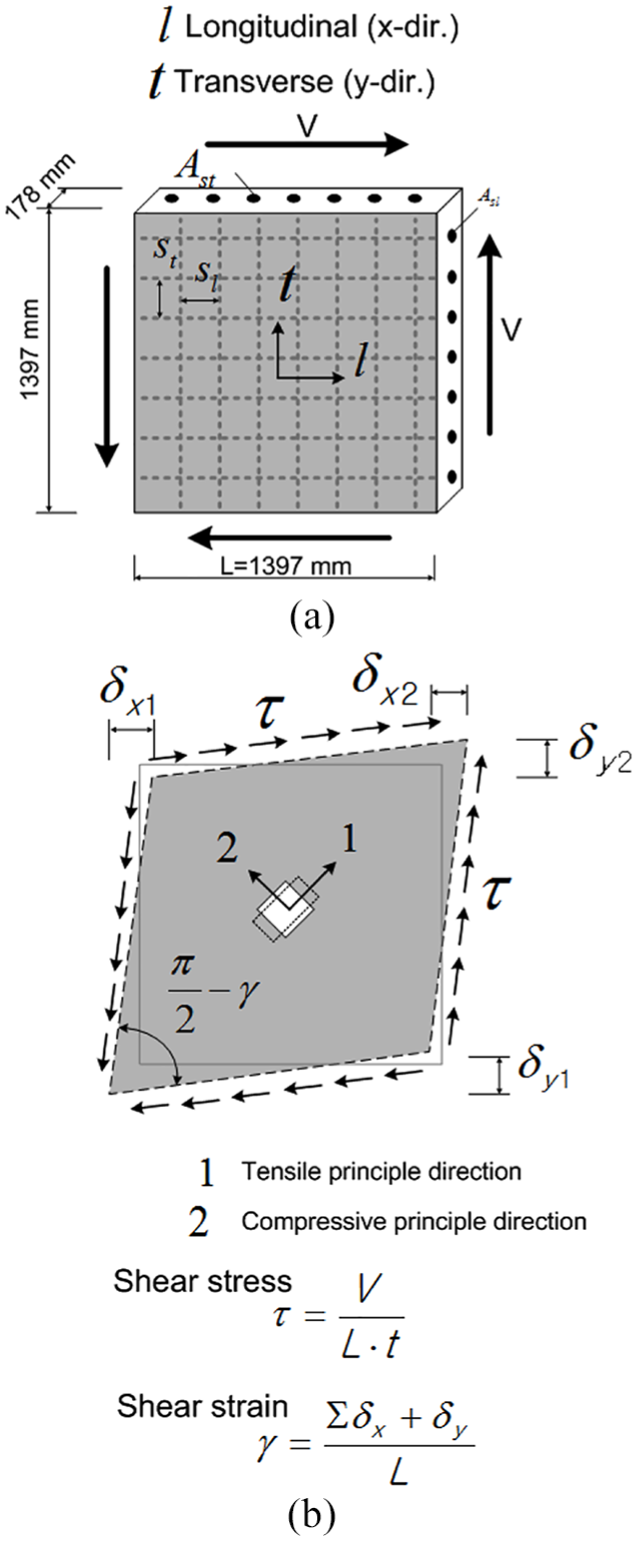
Dimension of Hsu panel and shear deformation: (a) Hsu panel size and (b) shear deformation.
Nonlinear analysis
The nonlinear analysis of a reinforced concrete panel subjected to pure shear is done based on three behaviors in terms of mechanical properties. These behaviors are classified into an equilibrium relation that describes force or stress conversion, a constitutive relation, indicating the relation between stress and strain in a biaxial tension–compression field, and a compatibility relation between strain and crack angle. Each relation is identified by using 13 fundamental analytical factors. Complex conditional equations and convergence processes are employed to determine the solutions of these analytical factors. For this reason, an efficient conditional equation should be formed and failure criteria should be used, which ensure the accuracy of solutions derived and simplify the calculation process.
The internal part of a thin reinforced concrete panel is a single continuum and exhibits mean stress–strain behavior, as shown in Figure 4. As concrete cannot transfer stress on the surface cracked, a state of equilibrium between the stress of the rebar in Figure 4(c) and the mean stress of the continuum in Figure 4(b) occurs. The Mohr circle of stress uses the invariant and geometrical conditions in the direction of principal stress and horizontal and vertical directions as equilibrium conditions. In other words, the conditional equation on stress proposed by Wagner is identified more easily through the condition




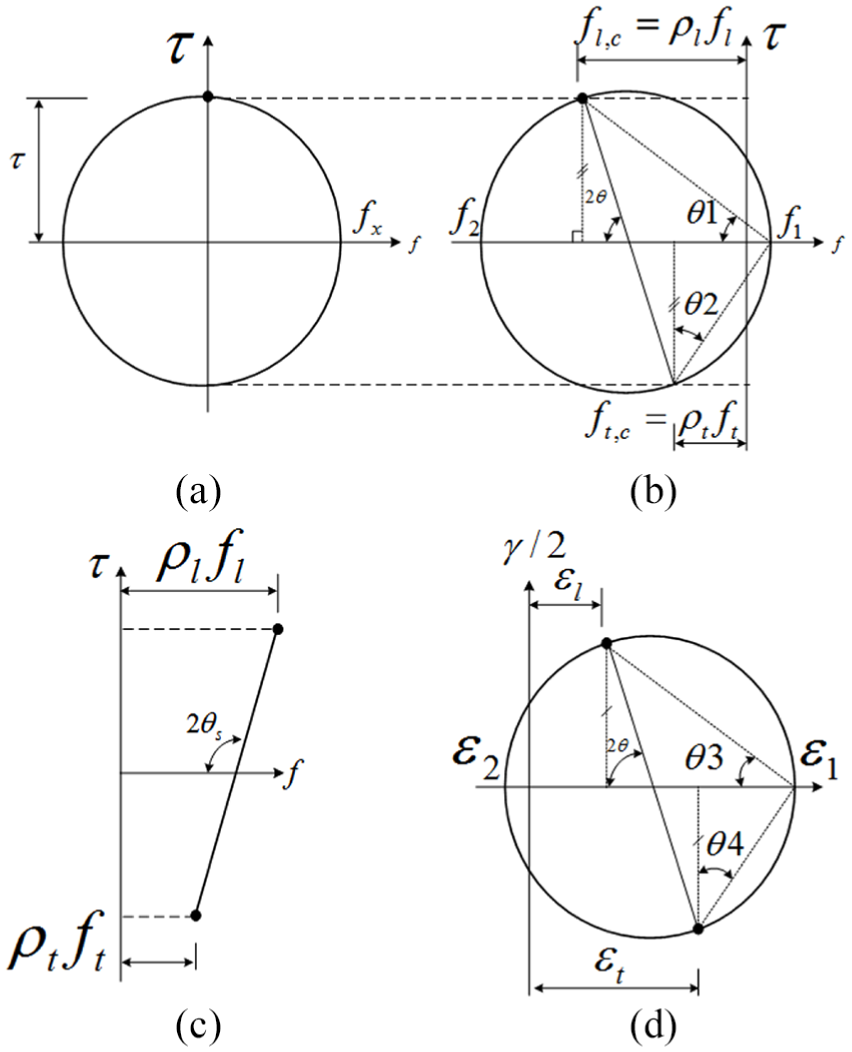
Nonlinear analysis of reinforced concrete panel: (a) applied shear, (b) stresses in concrete, (c) stresses in steel, and (d) average strain.
Hsu analyzed the existing research data and proposed a constitutive equation (1) on the principal tensile stress
To develop a quicker algorithm, this study derives equation (4) for the strain
In this study, the state of yield of the rebar in an orthogonal direction is easily estimated by substituting the yield stress of the rebar in each direction into equations (4) and (5). Similarly, the history of crushing failure of concrete can be calculated by substituting the maximum compressive strength

Flow of nonlinear analysis of reinforced concrete panel with an efficient algorithm.
The yield strains of the strut and rebar in each direction, which serve as failure criteria, are employed through these analytical processes to establish a limit state. This study increased the convergence rate by substituting the yield strain of the rebar in each direction to reduce trial and errors during calculation.
Density of shear strain energy
The truss model has a structure where the nodal points of the strut and tie are connected as a link and only the axial force is transferred, as shown in Figure 6.

Shear strain energy density of the truss model.
Moreover, the external energy is absorbed as axial strain energy for the internal truss elements because the shear behaviors are converted into the axial force (i.e. tensile force and compressive force) of the truss mechanism. That is, for the unit truss elements of the thin membrane panel where a crack occurred, external energy (W) is the same as the internal strain energy (U) of the four elements (i.e. concrete strut, tie, and rebar in horizontal and vertical directions) of the truss model owing to the law of conservation of energy. As such, the density

Result of nonlinear analysis
The experimental data of nine panels tested by Hsu and Zhang 1 are comparatively analyzed to verify the result of this study.
Shear stress and shear strain
Figure 7 shows the curve of the history of shear stress and shear strain, which is obtained by substituting the yield strength of the rebar in each direction for the failure criteria of the tie (tensile member of the rebar) and the effective strength for the failure criteria of the concrete strut according to the analytical flow chart presented in Figure 5.
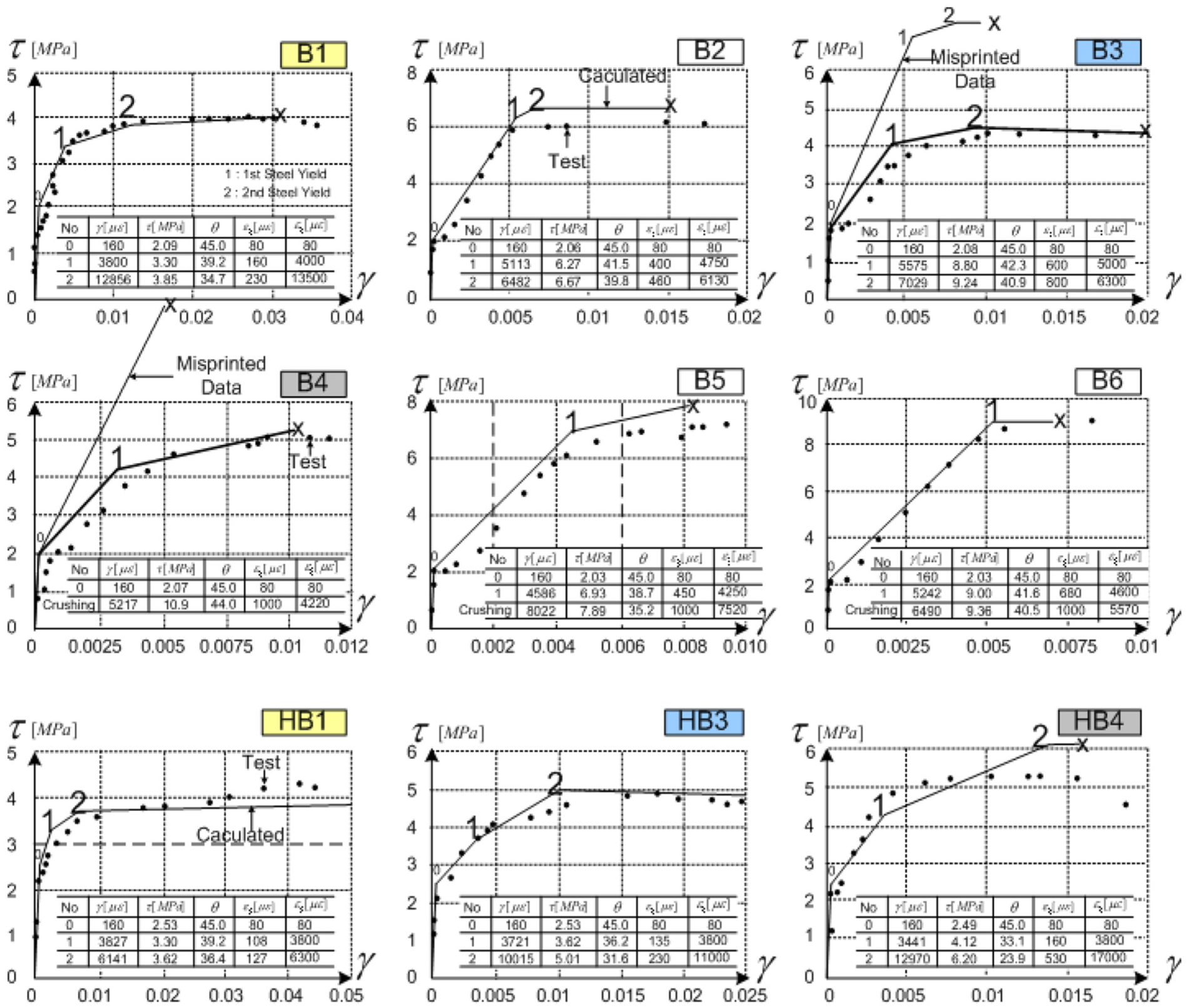
Shear stress versus shear strain curve.
The result of correcting an error (refer to Table 1) on the specifications of the rebar of panels B3 and B4, which was proposed by American Concrete Institute (ACI), 18 and using the enhanced algorithm for analysis indicates that the curve of shear stress and shear strain derived through this analytical result is very consistent with that measured in an experiment. Furthermore, the shear strength during the yield of the rebar of the reinforced concrete panel subjected to pure shear and the failure point during the crushing of concrete were accurately estimated in the analytical result compared to those in the experimental result. In addition, the calculation process employed in the analysis is simpler and shorter than that in the experiment.
Mechanical properties and principal variables of Hsu test panels.
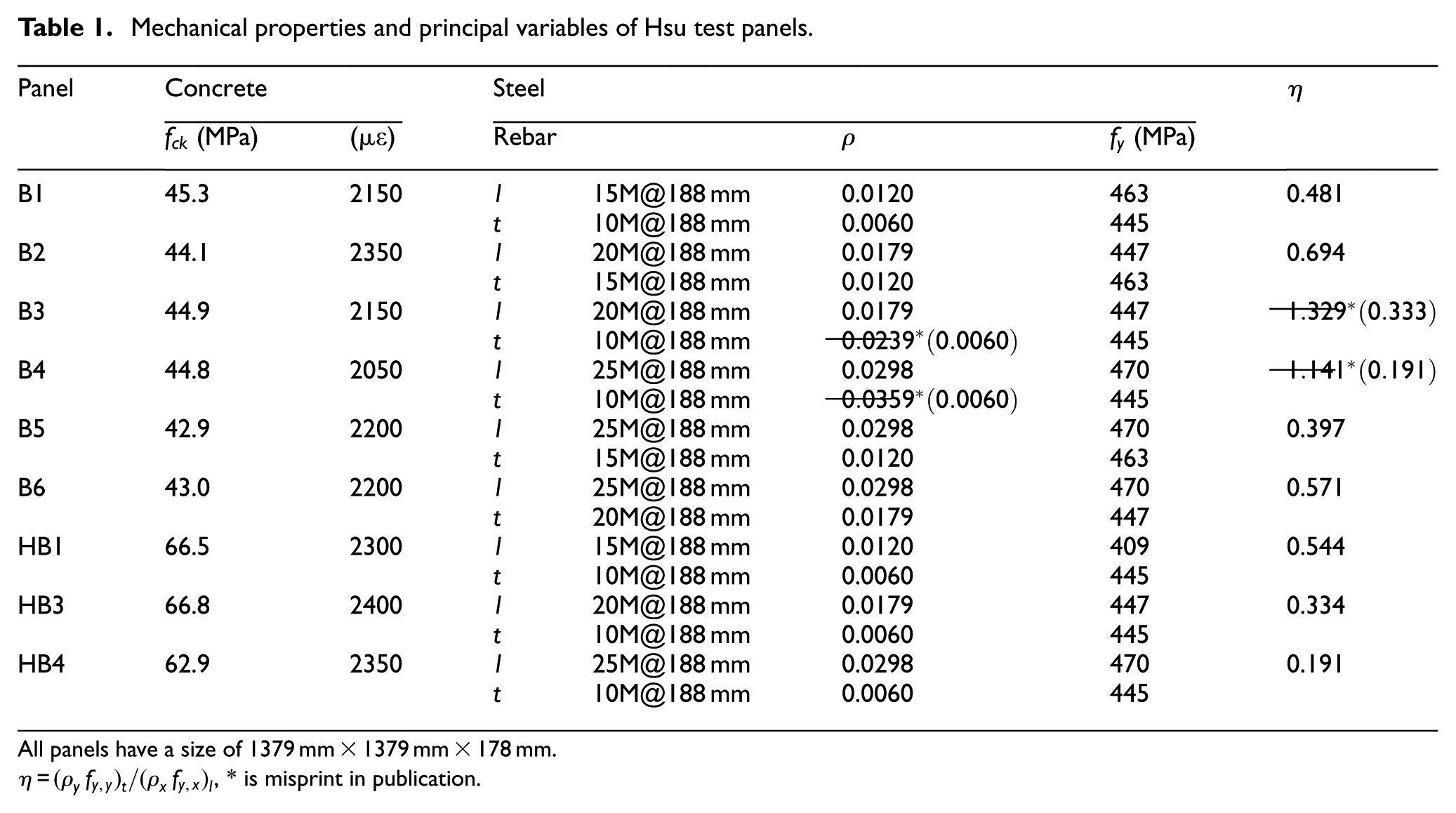
All panels have a size of 1379 mm × 1379 mm × 178 mm.
Mohr circle of stress
Plastic theory states that the properties of stress depend on the equilibrium conditions in the limit state, whereas they are practically determined by a complementary relation between the compatibility conditions and constitutive conditions. In this sense, it can be said that principal stress depends on the equilibrium conditions, compatibility conditions, and constitutive conditions in the nonlinear analysis of the reinforced concrete panel. The analytical result can be identified more easily in the form of a Mohr circle than in terms of complex numerical values, as illustrated in Figure 8.

Shear stress history by Mohr circle.
Figure 8 indicates that the principal tensile stress
Mohr circle of strain
Figure 9 shows the Mohr circle of strain on the reinforced concrete panel after the occurrence of a crack, which is easily calculated based on the relation between constitutive equations (1) and (2).

Shear strain history by Mohr circle.
As opposed to the Mohr circle of principal stress, the Mohr circle of strain shows a considerable change in its diameter according to the steel ratio. Accordingly, the strain increases much more than the stress from the state of load history because the crushing of the concrete strut is considerably delayed after rebar yield.
Energy density of truss elements
The energy density on the entire load history of the three panels that exhibit considerable shear strain energy is calculated from equation (10) based on the law of conservation of energy, as shown in Figure 10. The result of comparatively analyzing the cumulative amount of internal strain energy of truss elements indicates that the maximum error of energy density is between 3.9% and 7.4%, thus verifying that the result estimated from equation (10) is highly accurate. Thus, it seems that a new conditional equation based on the law of conservation of energy can be employed. Furthermore, the resistance mechanism has been determined by considering the change in the amount of energy density of the truss elements according to the load history. In terms of final failure, as most panels are subjected to the maximum effective stress, energy density is not accumulated anymore and the strut collapses.

Energy density of truss element: (a) panel B2, (b) HB1, and (c) HB4.
Extended shear strain
If the first rebar that has a relatively low steel ratio shows a higher second steel ratio after yielding, the crushing failure of the concrete strut occurs first.
In contrast, if the second steel ratio of the rebar is lower than the first steel ratio, the strain of the rebar reaches ultimate strain and the truss mechanism is destroyed owing to rebar fracture. When the second strain of the rebar reaches ultimate strain, the shear strain increases considerably up to 100,000 με beyond 70,000 με, as shown in Figure 11.

Maximum shear strain of the reinforced concrete panel subjected to shear.
As this high value has not been found by other researchers, the term on extended shear strain is specifically used for it in this study (refer to Figure 12).
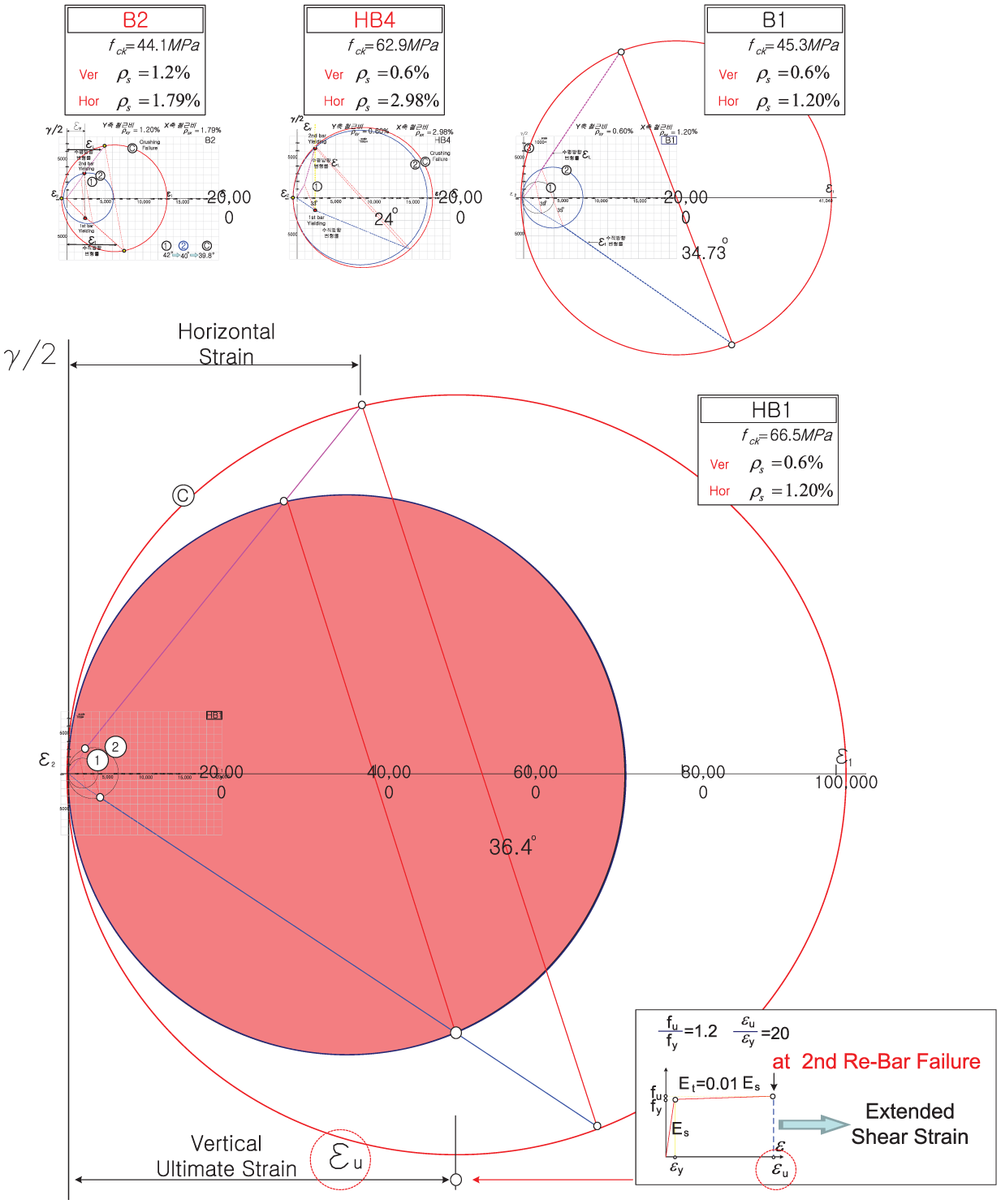
Extended shear strain at the second rebar failure.
Conclusion
This study has enhanced the process of nonlinear stress–strain analysis of a reinforced concrete panel subjected to pure shear. This study substituted the conditions of rebar yield and crushing failure of the strut into the Mohr compatibility conditions to simplify the complex process of nonlinear analysis based on the double loop trial and error method, which has been used in the existing truss models. We replace this method with the single loop trial and error method. The nonlinear analysis of reinforced concrete panels was carried out using the improved algorithm; through a comparison between the analysis result and the experimental data obtained by Hsu, it was found that the shear history was accurately estimated in the analysis result. The energy density of each truss element was also calculated by applying the law of conservation of energy to them, and the energy conservation relation derived in the calculation result was verified to be highly precise. Moreover, the phenomenon where shear strain increases considerably when the second strain of the rebar reaches ultimate strain (fracture) has been defined as extended shear strain in this study. Further studies should be performed to apply the algorithm proposed in this study to members such as reinforced concrete beams and prestressed concrete (PSC) beams, which show a change in the surrounding constraint conditions or have various load conditions.
Footnotes
Handling Editor: Michal Kuciej
Declaration of conflicting interests
The author(s) declared no potential conflicts of interest with respect to the research, authorship, and/or publication of this article.
Funding
The author(s) received no financial support for the research, authorship, and/or publication of this article.
