




Abstract
Based on the correction factor of accuracy applied in ISO standard 3408-4:2006, this article proposed a modified method to calculate the effective ball number and basic static load rating of ball screws. Meanwhile, the basic static load rating of ball screws was obtained through a new measurement method presented in this article. The experimental results, agreeing well with the theoretical values calculated by the modified method, showed that there is a large discrepancy between the basic static load rating calculated by the traditional method and the measured result, which proves that the new modified method is valid. This study provides a more accurate method to obtain the basic static load of ball screws, which is significant for predicting the performance and service life of ball screws.
Introduction
As a key part of computer numerical control (CNC) machine tools, ball screws are widely used to convert rotary motion to linear motion or thrust to torque, and the reverse is the same. 1 The positioning accuracy of ball screws directly determines the machining accuracy of CNC machine tools. In recent years, there is an ever-increasing demand for high precision and high durability performance of CNC machine tools. 2 Because the basic static load rating of ball screws would directly affect the carrying capacity and positioning accuracy, it is worth paying more attention to research in the basic static load rating of ball screws.
In the literature, ball screws are usually simplified as thrust radial ball bearings under axial load,
3
which means that the theoretical analysis of thrust radial ball bearings can be directly applied to ball screws. For ball bearings, if the permanent deformation exceeds
Based on the formula for calculating the basic static load rating of ball bearings, the basic static load rating of ball screws was directly proposed in ISO standard 3408-5:2006,
7
which is defined as the maximum static load that produces a plastic deformation no more than
Therefore, in this work, a more exact calculation method of the effective ball number and basic static load rating of ball screws is proposed. What is more, a new measurement method is proposed to validate the modified calculation method. The theoretical results are consistent with the experimental results, which proves that the modified formula of the basic static load rating is valid. This study contributes to the study of the service life of ball screws.
Theoretical analysis
Effective ball number in ball screws
Figure 1 shows the ball screw raceway without manufacturing error. In such a kind of condition, all balls are in good contact with the raceway and the load distribution is quite uniform. In fact, the load distribution of ball screws is not as uniform as we think due to the manufacturing error, as shown in Figure 2. This would lead to a lower effective ball number and then a lower basic static load rating and a lower axial stiffness than the designed values. For the estimation of the actual axial stiffness of ball screws, the correction factor of accuracy was applied in ISO standard 3408-4:2006
12
to eliminate the influence of manufacturing error. And the overall axial stiffness (R
bs
) is obtained based on the static axial stiffness of screw shaft

where

where

where

where
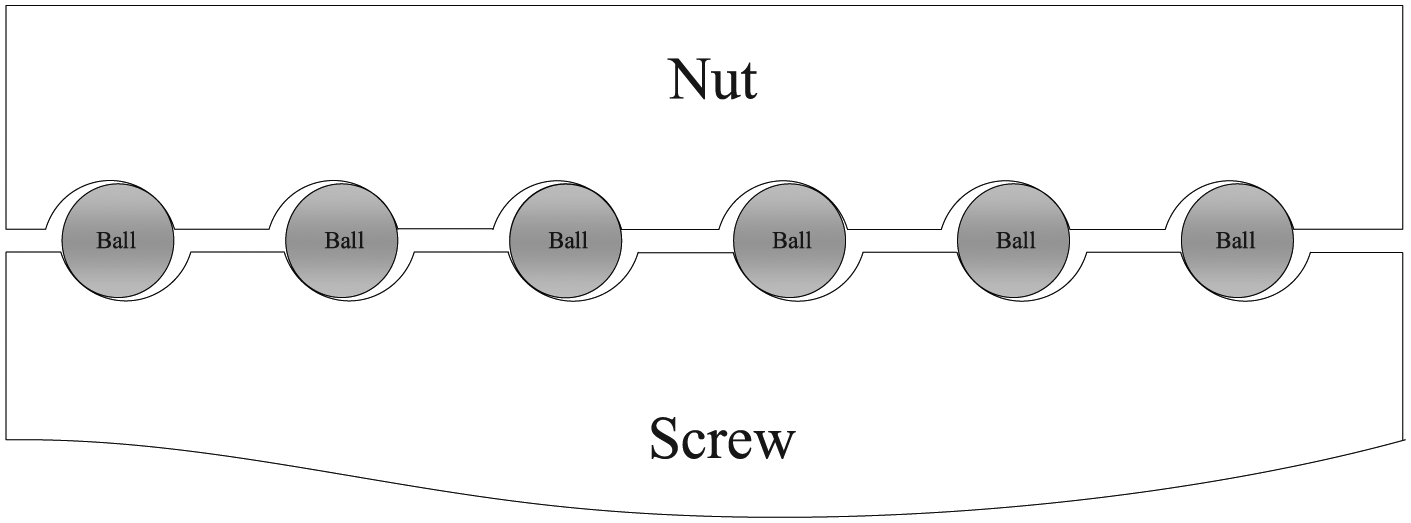
Ball screw raceway without manufacturing error.

Ball screw raceway with manufacturing error.
According to ISO standard 3408-4:2006,
12

where
The static axial stiffness of the ball/raceway area

where z is the number of loaded balls,
In ISO standard 3408-4:2006, 12 the correction factor of accuracy values between 0.5 and 0.6 on the basis of the standard tolerance grade, which means that the actual axial stiffness is far lower than the theoretical value. This indicates that the actual deformation (as well as the normal contact force) of the ball track is far higher than the theoretical value, which means that the effective ball number in a ball screw is far lower than the theoretical value.
According to ISO 3408-5:2006, 7 the basic static load rating of ball screws can be written as

where


where
It can be seen from equation (7) that the basic static load rating is proportional to the number of loaded balls. This means that if the effective ball number varies significantly due to manufacturing error, a large discrepancy between the actual basic load rating and the theoretical value would be caused.
Replacing the static axial stiffness of the ball nut unit

The effective ball number can be obtained by combining equations (2), (3), (6), and (12), which can be written as
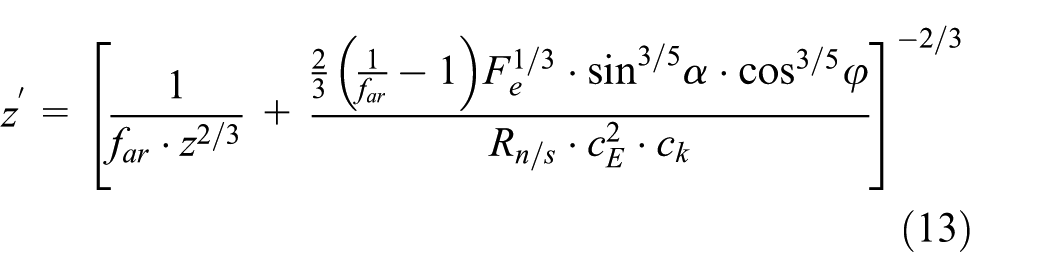
Modified basic static load rating of ball screws
On the basis of the effective ball number obtained above, a modified calculation method of the basic static load rating of ball screws is proposed, which is in proportion to the effective ball number.
Replacing the number of loaded balls z in equation (7) with the effective ball number

Experimental verification
Based on the definition of the basic static load rating of ball screws, a new measurement method of the static load rating based on a stiffness test bench is proposed. As shown in Figure 3, the stiffness test bench is composed of the load beam (1), the load cell (2), the anti-rotation unit (3), the stiffness measurement unit (4), and the fixing unit (5). When the load beam moves down to compress the ball screws, the axial load can be obtained through the load cell. Simultaneously, the axial deformation under axial load can be obtained through the displacement sensors in the stiffness measurement unit. It is worth mentioning that both loading and unloading processes are measured in the experiment. The parameters used in the test are shown in Table 1.

The stiffness test bench.
Parameters used in the experiment.

The experimental process is shown in Figure 4. According to the theoretical results calculated through the modified method, the ratio of the modified basic static load rating to the theoretical value varies between 0.3 and 0.5. As permanent deformations of the ball screw would be produced during the experiment, the initial axial force applied on the ball screw is usually set less than 30%Coa. However, to obtain more accurate experimental results, both the initial axial force and the loading interval are set at 10%Coa. The experimental process is as follows:
1. The axial force is applied on the stiffness test bench. Based on the obtained axial stiffness curve of ball screws, the difference between the initial value

The cumulative difference between the initial and final values is the plastic deformation of ball screws, which can be written as

2. Comparing the cumulative difference
3. Repeat the above two steps until the cumulative difference


The experimental process.
Results and discussion
The measured axial stiffness curves are shown in Figures 5–9. It can be seen from these figures that the unloading axial stiffness curve (the red solid line) is over the loading axial stiffness curve (the black solid line). The permanent difference

The axial stiffness curves under the axial load of
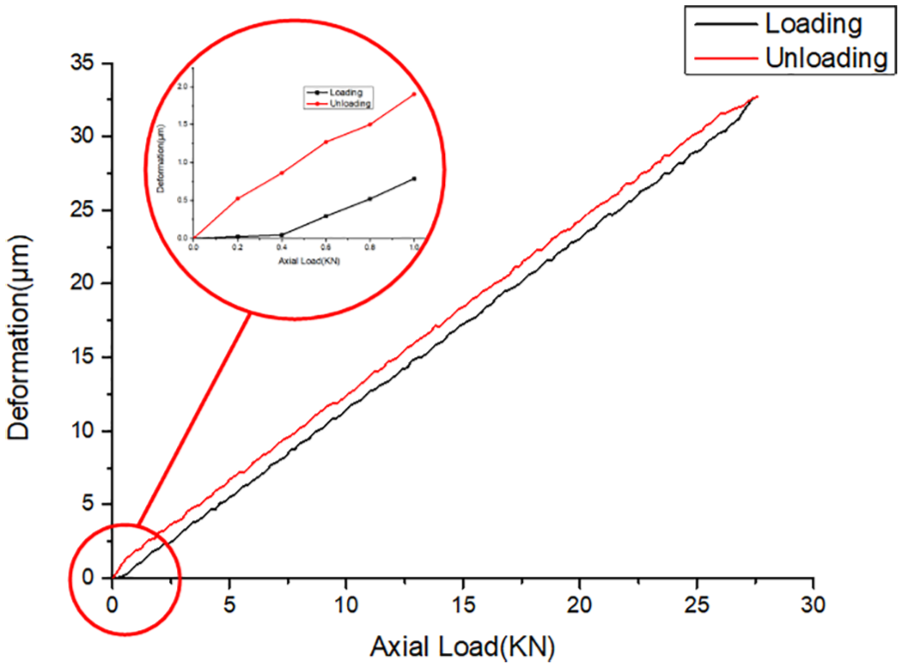
The axial stiffness curves under the axial load of

The axial stiffness curves under the axial load of

The axial stiffness curves under the axial load of

The axial stiffness curves under the axial load of
The permanent difference obtained through the experiments.

As shown in Figures 5 and 6, the unloading curve can always return to the original point under the axial forces of
As shown in Table 2, when the axial load applied on the stiffness test bench reaches 40%Coa, the cumulative difference is

The static axial load calculated through the modified calculation method in this article is 51.8625 kN. The relative error of the modified calculation method is 7.14%, while the error of the traditional method (138.3 kN) is as high as 185.71%, which verifies the theoretical analysis in this work.
Conclusion
In this work, a new modified method to calculate the effective ball number and the basic static load rating of ball screws is proposed. The theoretical results show that the basic static load rating calculated through the modified method is less than half of the value calculated through the traditional method. With a new measurement method proposed in this article, the basic static load rating of ball screws was measured for the first time in the literature. The experimental results show that the relative error of the modified calculation method is 7.14%, while the error of the traditional method is 185.71%, which proves that the modified calculation method is valid. More importantly, the actual basic static load rating is only 35% of the theoretical value reported in ISO 3408-5:2006, 6 which means that manufacturing error has a great influence on both the basic static load rating and stiffness of ball screws.
It is worth mentioning that, although the experimental results agree well with the theoretical values, the experiment is just based on a single ball screw. Therefore, in order to make the modified calculation method of basic static load rating more convincing, more number of experiments should be conducted in future research.
Footnotes
Acknowledgements
The authors are indebted to the Key Laboratory of Performance Test and Reliability Technology for CNC Machine Tool Components of Chinese Machinery Industry for providing the experiment materials.
Handling Editor: James Baldwin
Declaration of conflicting interests
The author(s) declared no potential conflicts of interest with respect to the research, authorship, and/or publication of this article.
Funding
The author(s) disclosed receipt of the following financial support for the research, authorship, and/or publication of this article: This study has been supported by the National Science and Technology Major Project of China (grant no.2017ZX04011001).
