



Abstract
Entropy is originally introduced to explain the inclination of intensity of heat, pressure, and density to gradually disappear over time. Based on the concept of entropy, the Second Law of Thermodynamics, which states that the entropy of an isolated system is likely to increase until it attains its equilibrium state, is developed. More recently, the implication of entropy has been extended beyond the field of thermodynamics, and entropy has been applied in many subjects with probabilistic nature. The concept of entropy is applicable and useful in characterizing the behavior of stochastic processes since it represents the uncertainty, ambiguity, and disorder of the processes without being restricted to the forms of the theoretical probability distributions. In order to measure and quantify the entropy, the existing probability of every event in the stochastic process must be determined. Different entropy measures have been studied and presented including Shannon entropy, Renyi entropy, Tsallis entropy, Sample entropy, Permutation entropy, Approximate entropy, and Transfer entropy. This review surveys the general formulations of the uncertainty quantification based on entropy as well as their various applications. The results of the existing studies show that entropy measures are powerful predictors for stochastic processes with uncertainties. In addition, we examine the stochastic process of lithium-ion battery capacity data and attempt to determine the relation between the changes in battery capacity over different cycles and two entropy measures: Sample entropy and Approximate entropy.
Introduction
A stochastic process can be simply defined as a collection of random variables indexed by time. The continuous and discrete time cases can be separated to define stochastic processes more precisely. A discrete time stochastic process
Real-world applications of most scientific subjects including stochastic processes are fraught with numerous uncertainties. Hence, it is believed, by many, that the stochastic processes, which consist of complicated uncertainties, are not predictable.1–3 The applications of concepts of physics and thermodynamics to explain scientific phenomena have been studied in the recent decade. The concept of entropy, which stems from thermodynamics, has advanced our understanding of the world.3–5 Entropy is one of the concepts in physics that can be useful in rejecting the null hypothesis of unpredictability of stochastic processes.6–8 In this regard, various metrics including Shannon entropy, Renyi entropy, Tsallis entropy, Approximate entropy, Sample entropy, Transfer entropy, and Permutation entropy have been presented. The concept of entropy is applicable and useful in characterizing the behavior of stochastic processes since it represents the uncertainty, ambiguity, and disorder of the process without causing any restrictions on the theoretical probability distribution. In order to quantify the entropy, an associated probability distribution is needed. 9
The conditional heteroscedastic models such as Generalized Autoregressive Conditional Heteroskedasticity (GARCH) models have traditionally been studied for measuring the variabilities in the stochastic processes due to the inherent uncertainties. In this article, first, we present traditional models as well as their assumptions and limitations. Next, we review the literature on the relationship between entropy measures and uncertainty inherent in stochastic processes. This research area is characterized by numerous studies reflecting different entropy measures, uncertainties, methodologies, and applications. We discuss nearly 140 scholarly works on the subject and draw general conclusions from previous studies. We attempt to provide a cogent approach to the issue, identify the key findings from the literature, and present the concluding remarks as well as the future research directions. In addition, we present case study of the lithium-ion battery capacity data, which is an example of stochastic process. We examine the relation between battery capacities over different cycles and two entropy measures: Sample entropy (SampEn) and Approximate entropy (ApEn).
Conditional heteroscedastic models
Before the idea of utilizing entropy measures for uncertainty modeling and quantification was introduced, long memory and volatility clustering10,11 were traditionally studied for predictive modeling and uncertainty quantification based on conditional heteroscedastic models. Conditional heteroscedastic models are statistical models, which are usually used to model time series. These models explain the variance of the current error term, known as innovation, as a function of the previous periods’ error terms. 12 Examples of conditional heteroscedastic models are Autoregressive Conditional Heteroskedasticity (ARCH) model, Generalized ARCH (GARCH) model, GARCH in-Mean (GARCH-M) model, and Exponential GARCH (EGARCH) model. Conditional heteroscedastic models are mostly used to model the stochastic behavior of a time series, which is a special case of stochastic process with discrete time data. This section reviews and summarizes these models focusing on the main assumptions and modeling principles. Conditional heteroscedastic models for variances are based on Autoregressive (AR) and Moving Averages (MA) as follows.
The general form of the GARCH variance model, GARCH

where

It should be noted that large values of
In the GARCH-M model,
14
the conditional variance,


In addition, the error terms,

where
In the EGARCH model, 15 the logarithm of the conditional variance follows an AR as shown below



where
In summary, GARCH family models can be used for modeling the stochastic processes with complicated endogenous and exogenous uncertainties such as the financial time series. In order to build the appropriate GARCH model that fits the data set, the GARCH parameters must be estimated based on the historical data. It is noted that the model order parameters
Entropy measures for uncertainty quantification
Shannon entropy
Entropy was first discussed by Clausius in 1865 to explore the inclination of intensity of heat, pressure, and density to gradually disappear over time. Based on this concept, Clausius established the Second Law of Thermodynamics stating that the entropy of an isolated system is likely to increase until it attains its equilibrium state. Schwill 28 and Shannon29,30 extended the concept of entropy and claimed that entropy is not limited to thermodynamics and can be applied in any subject with probabilistic nature.31,32 Bentes et al. 33 argued that physical concept of entropy is actually a special case of the Shannon entropy as it quantifies probabilities in the full state space.
Schwill
28
stated that entropy is a measure of uncertainty in random variables. For a random variable


where

As it is shown in equation (13), the expected value of
Maasoumi and Racine 42 studied the predictability of the time series by utilizing a new measure of dependence, which performs similar to the Shannon entropy as follows

where
The interesting properties of this measure of dependence are as follows:
It is applicable in both discrete and continuous cases.
It lies within the range from 0 to unity. It is normalized to 0 in the case of independency and the modulus of the measure is 1 in the case of measurable exact relationship between the random variables.
In the case of a bivariate normal distribution, this measure of dependence has a simple relationship with the correlation coefficient.
It measures not only the distance but also the divergence.
Moreover, they compare their numerical results with those of a set of traditional measures. They show that their entropy measure43–45 is capable of uncovering non-linear dependence in the time series. To the best of our knowledge, the work by Maasoumi and Racine is one of the first studies related to the entropy measures, uncertainty, and predictability of time series, at least, in the finance area.
Renyi and Tsallis entropies
Shannon entropy performs well only if the storage capacity of a transmitting channel is finite. Renyi presents a new entropy measure known as Renyi entropy of order

where
Tsallis entropy24–27 for any non-negative real number

Tsallis entropy yields power-law distribution, whereas Shannon entropy yields exponential equilibrium distribution. It is noted that

where
Sample entropy
Sample entropy is useful in quantifying the fluctuation degree of a time series.49–56 The sample entropy SampEn
The process of sample entropy measurement can be summarized as follows.
For a data sequence
Step 1
Form m-vectors,


Step 2
Define the distance

The relation matrix is shown in Figure 1.

Relation matrix used for defining distance
Step 3
Define for each


Similarly



where
Step 4
Sample entropy for a finite data length of

Mutual information and transfer entropy
Entropy measures, including the measures discussed in the previous section, are useful in explaining the variability in univariate time series.57–60 The concept of entropy is extended to the Transfer entropy 61 and Mutual information,62,63 which are discussed in the following section. The concept of Transfer entropy is applicable to uncovering the information flows between the systems, bivariate analysis of time series under uncertainties such as financial time series, 28 and multivariate analysis of time series in various disciplines such as physiology, 64 neuroscience, 65 ecology, bionomics, and neurology. 28
Mutual information and Transfer entropy measure the information flow between two time series and determine whether the variability in one random variable is helpful in explaining the variability in a second variable, whereas Shannon entropy is utilized for quantifying the variability in an individual random variable. Mutual information and Transfer entropy can be determined based on the conditional probability distributions between the two random variables and are discussed in this section.
The joint entropy


Moreover, the relationship between conditional and joined entropies is as follows

Mutual information of two random variables

Figure 2 demonstrates the relationship between (1) different entropy measures as well as the joint entropy between the two random variables

The entropies
Mutual information is symmetric and therefore cannot be used for determining the direction of an information flow35,72

Mutual information can be modified in order to include lead-lag relationships 73 as follows

where

The mutual information
Measuring the interactions between the time series is critical in most disciplines. Correlation and cross-correlation can be utilized to detect the linear dependence between time series. However, these measures are not appropriate for modeling the dependence between the time series due to the following two reasons: time is not equally spaced and there is a non-linear mechanism in the time series. Hence, Transfer entropy, which performs according to transition probabilities, can be utilized to quantify the dependence between the time series.
74
Let

where

The Transfer entropy
The main difference between the Transfer entropy and Mutual information is that Transfer entropy takes into consideration the transition probabilities. Transfer entropy can be defined as the difference in the gain of information regarding
Marschinski and Kantz 79 examined the well-known physical concepts such as Spin systems, 80 Turbulence, 81 Universality, 82 Self-organized criticality,83,84 Complexity, 85 and entropy and concluded that among these physical concepts entropy may be useful in capturing the uncertainties inherent in stochastic processes. They define the Transfer entropy as follows

Kwon and Yang
86
argued that the first step in the study of Transfer entropy is to discretize the time series87,88 by some coarse graining. They partition the variables


It is crucial to determine an appropriate constant
Effective transfer entropy
Using the longer history of the time series in the calculation of Transfer entropy may cause noises rather than providing more information.89–92 The limitation of the Transfer entropy is that it does not account for the effect of noises. 67 In order to take into consideration the noises, Effective Transfer entropy 93 is introduced as

where
Relative explanation added (REA) can be utilized as a secondary measure 28 to study the uncertainty based on the concept of entropy as follows

REA quantifies the extra information obtained from the history of the random variables
Entropy rate
Entropy rate measures the average information required in order to predict a future observation given the previous 28 observations as follows

where

The conditional entropy
Normalized permutation entropy and number of forbidden patterns
Zunino et al.
94
stated that the Random Walk model is based on the assumption that the dynamic changes in the data are uncorrelated and therefore entropy measures can be used to capture the uncertainties inherent in the time series.
95
The authors discussed the Second Law of Thermodynamics, which states that entropy expands monotonically over time. In addition, they examined Renyi,96,97 Tsallis,
98
Approximate,99–101 and Transfer entropies, as well as a local approach to study Shannon entropy.
102
Zunino et al.
103
presented two new quantifiers for predictive models: the number of Forbidden patterns and the normalized Permutation entropy. Both of these metrics are model independent and therefore have wider applicability. The number of Forbidden patterns is positively correlated with the inefficiency degree, and the normalized Permutation entropy is negatively correlated with the inefficiency degree. Forbidden patterns represent the patterns that cannot be uncovered because of the underlying deterministic structure of the time series. It is noted that Permutation entropy is the normalized form of Shannon entropy over the probability distribution

where
Entropy measures based on singular value decomposition
Gu et al. 104 investigated the predictive ability of the Singular Value Decomposition entropy. The multifractality of time series is due to local fluctuations of the index, long-term memory of the volatility,105,106 heavy-tailed distributions, herding behavior, outside information, the intrinsic properties, non-linear incremental changes in the data, and so on. According to their study, the tendency of the entropy series is ahead of the component index, which indicates that the Singular Value Decomposition entropy has predictive power for the variable.
Caraiani 107 studied the entropy measures based on the Singular Value Decomposition of the correlation matrix for the components of the time series and defined the correlation matrix of data as follows

where

where


Residual sum of squares for the initial series,


The appropriate statistic,

F
0-statistic has
Approximate entropy
In this section, other measures of dependencies of random variables are presented. Different methods for quantifying the uncertainties of stochastic processes have been introduced including the methods based on Fourier analysis,111,112 Symbolic analysis, 113 Amplitude statistics,113–117 and Wavelet transform.118,119 Huang et al. 120 reported that real-world complex dynamics reflect anomalous, chaotic, irregular, and non-stationary characterizations due to various factors, including internal drive and external disturbances. In particular, the methods of analyzing the stochastic process of financial times series include wavelet analysis,121,122 detrended fluctuation analysis,123,124 and diffusion entropy analysis (DEA).125–127 Shi and Shang 128 studied two entropy-related metrics, Cross-sample entropy and Transfer entropy, as well as a Cross-correlation analysis to examine the relationship between time series among different data sets. Cross-sample entropy, Transfer entropy, and Cross-correlation measures are utilized to obtain the asynchrony, information flow, and cross-correlation between the time series, respectively. Other statistical tools, which have been introduced to examine the stochastic processes, are Correlation function, Multi-fractal, Spin-glass models, and Complex networks.129–137 The Kolmogorov–Sinai entropy for real-world time series cannot be precisely estimated. Therefore, the analysis of the finite and noisy time series can be performed by using Approximate entropy. 137 In addition, Cross-sample entropy is based on Approximate entropy,138–141 which captures changes in a system complexity. Approximate entropy can be utilized to measure patterns in time series and uncover the regularities by extracting the noises from the original data. Kristoufek and Vosvrda 135 studied various variables including the Efficiency indices, Long-term memory, Fractal dimension, 142 and Approximate entropy. According to their study, the efficiency index can be defined as a distance from the unpredictable process specification based on various measures including Long-term memory, Fractal dimension, and Approximate entropy.
Consider a series of numbers of length

where

and

Case study
Battery health monitoring is important since the failure of the battery may result in the failure of the system. The proper and efficient battery health management can prevent the disastrous hazards and premature failures. This section aims at determining the correspondence between the loss in the capacity of the battery and the Sample entropy (SampEn) and Approximate entropy (ApEn) of voltages. Many approaches for estimating the battery capacity are based on a direct analysis of battery capacity with respect to aging cycle. Approximate entropy is capable of quantifying the regularity of time series and therefore can be used as estimators of degradation of the battery capacities.
In this section, we use the definitions of Sample entropy and Approximate entropy and determine these two entropy measures for the changes in the battery voltages over time. We examine five lithium-ion batteries as follows: PL19, PL17, PL11, PL10, and PL09. The battery voltages over time are illustrated in Figure 6. Figure 7 displays the changes in the battery capacities over cycle. The Sample entropy (SampEn) and Approximate entropy (ApEn) are calculated and shown in Figures 8 and 9, respectively.

Battery voltages versus cycles.

Battery capacities versus cycles.
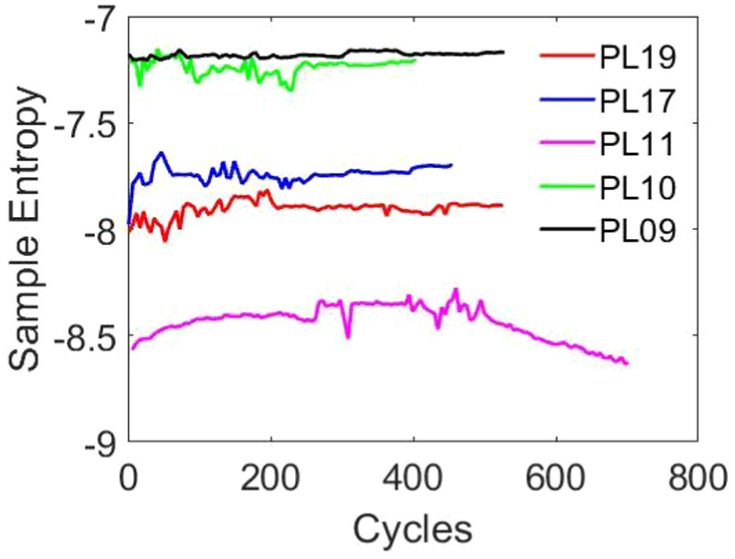
Sample entropy (SampEn) versus cycles.
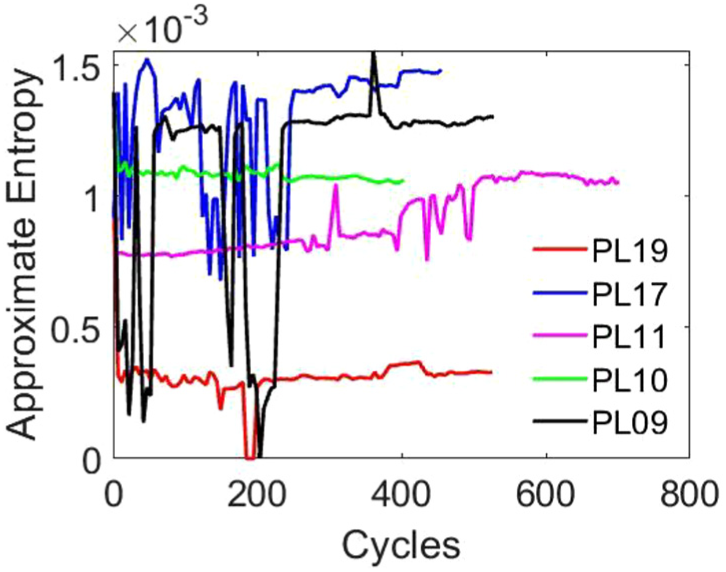
Approximate entropy (ApEn) versus cycles.
It is noted that the degradation of batteries may be due to the internal shorts, opening of the short, or cell undergoing reversal. Thus, detecting these causes of degradation is very significant for battery diagnosis in real-world applications.
Discussion and conclusion
Entropy was originally defined as the average number of bits needed to store or communicate one symbol in a message. It can also quantify the uncertainty involved in predicting the value of a random variable. In this article, we review various entropy measures to examine the uncertainties inherent in stochastic processes. It is shown that different predictive models have been built by using various entropy measures. The concept of entropy has not been limited to physics and thermodynamics. The entropy measures have been used for developing predictive models in various disciplines including mechanics, finance, physiology, neuroscience, ecology, bionomics, and neurology. Moreover, various entropy measures have been introduced depending on the process and time series studied. These metrics include, but are not limited to Shannon entropy, Approximate entropy, Sample entropy, Transfer entropy, and Permutation entropy. The concept of entropy is helpful in characterizing stochastic processes since it represents the uncertainty and disorder of the process, without causing any restrictions on the theoretical probability distribution. The contribution of this article lies in its description of information, uncertainty, entropy, and ignorance in stochastic processes. More precisely, information is the decline in disorder and ambiguity, uncertainty is referred to the unlikelihood of logical reasoning, entropy is the expected information, and ignorance is the lack of knowledge regarding the uncertainty. The key findings of this review and the future research directions are as follows:
Entropy is useful in explaining the uncertainties inherent in stochastic processes.
Entropy measures have predictive power, and the type of time series studied may have an impact on the predictive ability of the entropy measures.
Entropy measures play an important role in various branches of science and disciplines.
Entropy is an indicator representing the complexity of the signals. The greater the entropy measures are, the more complexity the signals accumulate, and the more information the signals contain.
The results of the existing studies in this research area show that the predictive ability of the entropy measures is related to the complex degree of the available information.
Future work should examine the predictive power of the entropy after taking into account the effect of other variables such as periodicity. Variables such as periodicity may make some of the uncertainties inherent in stochastic processes more explicit.
The entropy-based proposed method can be applied to battery monitoring and prognostics, and it is found that Sample entropy and Approximate entropy are useful in quantifying the fluctuation degree of a stochastic process. These two entropy measures can quantify the regularity of time series and assess the predictability of a data sequence. Thus, they can be applied to battery capacity data as an indicator for battery health.
Footnotes
Handling Editor: James Baldwin
Declaration of conflicting interests
The author(s) declared no potential conflicts of interest with respect to the research, authorship, and/or publication of this article.
Funding
The author(s) received no financial support for the research, authorship, and/or publication of this article.
