



Abstract
The capacity and capability of flexible manufacturing system varies with different market demands. To satisfy the requirements of performance expressions, avoid the problem of combinatorial explosion and consider the influence of intermediate buffer stations, a new reliability modelling and evaluating methodology for repairable non-series hybrid flexible manufacturing systems with finite buffers is proposed using an extended vector universal generating function technique. For repairable modular machines, the Markov models of modular machines are established using stochastic process analysis and the corresponding theoretical steady-state probability in various states is obtained. Furthermore, the original system in combination with multi-state reliability measures of buffer stations is equivalent to a system with independent machines which can be expressed by vector u-functions. Based on the probability distributions of the states of subsystems, the composition operators for series connections and parallel connections are defined. Consequently, the entire system is simplified to one component represented by the polynomial universal generating function. In particular, reliability indicators and measurement models are given to assess the system’s reliability through promoting the basic ones. Finally, a practical case of engine head machining line is utilized to verify the effectiveness of the method. The results demonstrate that the use of vector universal generating functions can describe the system structure and states more appropriately while providing efficient assessment.
Keywords
Introduction
A non-series multi-stage manufacturing system refers to a system that involves multiple stages to complete a final product, where several machines or workstations are utilized at the same stage to meet the productivity and line-balance requirements. 1 Reliability is one of their extremely important performance indicators. If the system is not reliable, it will not meet all the manufacturing tasks and achieve the intended production goals. The complexity of reliability research lies in the extremely intricate relationship between the events of all machines and devices that occurs asynchronously in discrete time. In addition to machine failures, the phenomenon of machine obstruction, lack of materials and decreased operation should also be considered. 2 As the scales of manufacturing systems continue to expand and their structure become more complex, reliability becomes increasingly important.
In recent years, reliability has been a hot topic 3 and more and more researchers are working on figuring out a better way to estimate and predict it of machines and manufacturing systems more precisely. Wu 4 proposed a novel model to describe the availability of repairable system across their operating time, at the level of their components, on the assumption that the failed components are immediately replaced. Xie et al. 5 used the Petri net to model the deterioration and maintenance process of equipment and proposed the calculation method of the availability and other indicators. Li et al. 6 developed a reliability model of products with multiple degradation processes via the copula function. Taking into account the degradation mechanism of mechanical components in the failure mode of fatigue, Gao and Yan 7 proposed fuzzy dynamic reliability models of mechanical systems in terms of stress and strength. Zhang et al. 8 introduced a new reliability evaluation method based on cascading failure analysis and the failure influenced degree assessment. Yang et al. 9 proposed a reliability modelling and assessment solution aimed at small-sample data of numerical control machine tools on the basis of Bayes theories. Yang et al. 10 proposed a comprehensive reliability allocation method based on cubic transformed functions of failure modes and effects analysis to solve the problem of computer numerical control (CNC) lathes reliability allocating. Das et al., 11 Xia et al. 12 and Lu and Zhou 13 studied the opportunistic preventive maintenance problem for the performance improvement of cellular manufacturing systems, reconfigurable manufacturing systems and serial–parallel multistage manufacturing systems, respectively. Li and Ni 14 used the maximum likelihood estimation method to establish a reliability evaluation model under incomplete maintenance based on Weibull distribution and operational data. Sarhan and Mustafa15,16 used reduction method, increasing method and redundancy method to improve the availability of repairable series–parallel and parallel–series systems, respectively. Zhang et al. 17 developed a modular model for multistage series manufacturing system with consideration of rework and products polymorphism based on extended stochastic Petri nets. He et al. 18 proposed an integrated predictive maintenance strategy considering product quality level and mission reliability state regarding the intelligent manufacturing philosophy of prediction and manufacturing.
The polymorphism of machine, system structure and buffers makes the manufacturing system flexible, so the system may not completely fail after a specific machine failure. In addition, for a flexible manufacturing system, its machining object is a family of parts, which mainly focuses on the diversity of production capability and the size of production capacity. Any failure will cause the system performance to drop or lose, so system reliability indicators proposed must reflect the influence of these factors on product diversity and productivity. However, the traditional two-state reliability theory and analysis method have certain deficiencies in the reliability modelling, analysis and optimization design of multi-state serial–parallel repairable systems. The multi-state system19,20 shows that the system or components often goes through several intermediate states from normal operation to complete failure. The multi-state system reliability analysis theory provides a new research idea for the study of multi-state reliability of manufacturing systems.21,22 Youssef et al.23,24 established a model for evaluating multi-state manufacturing system availability and expected production rates with unreliable modular machines. Azadeh et al. 25 used universal generating function (UGF) and genetic algorithm to investigate a multi-objective optimization problem for multi-state series–parallel systems. Duan et al. 26 proposed a multi-state reliability model of reconfigurable manufacturing system. Chen et al. 27 presented a mission reliability evaluation method based on operational quality data for multi-state manufacturing systems. In view of the inherent polymorphism of manufacturing systems and with the objective of maximizing benefits, He et al. 28 proposed a novel cost-oriented predictive maintenance based on mission reliability state for manufacturing systems. For the solution of cloud service supplier selection problem under the background of cloud computing emergence, Li et al. 29 proposed an integrated group decision method based on support vector machine (SVM), triangular fuzzy number-rough sets-analytic hierarchy process (TFN-RS-AHP), and improved TOPSIS replacing Euclidean distance with connection distance (TOPSIS-CD), which can also provide some train of thoughts for the reliability modeling and evaluation of manufacturing system.
Although some aforementioned studies have been done, there are very few studies which consider the influence of buffer stations’ states on production capability and capacity of series–parallel hybrid manufacturing systems simultaneously. In this article, the multi-state reliability model of repairable series–parallel flexible manufacturing system with finite buffers is established, and some reliability indicators such as steady-state availability, theoretical production rates, utilization rates, efficient production rates and production loss are given. The remainder of this article is structured as follows. In section ‘Problem statement’, we describe the multi-state reliability modelling issue and propose six hypotheses as the basis for follow-up work. And then, theoretical steady-state probability and actual steady-state probability of each machine are calculated in sections ‘Markov model of multi-state machine’ and ‘Machine reliability modelling’, respectively. Consequently, multi-state reliability of repairable series–parallel hybrid system considering finite buffers is derived in section ‘System reliability modelling’. Finally, section ‘Case study’ discusses an actual case, and the conclusion is presented in section ‘Conclusion’.
Problem statement
It is assumed that there is a repairable non-series multi-state flexible manufacturing system with m machining stages for part family
In order to evaluate the performance distribution of the entire system, all possible performance values of the system and their corresponding state probabilities are required. Aiming to describe more clearly the multi-state reliability modelling problem of repairable non-serial multi-state manufacturing systems with finite buffers, six hypotheses are proposed as the basis for follow-up work.
Markov model of multi-state machine
The machine has various states from perfect performance, decreased performance to complete failures, and there are transitions between non-adjacent states. A machine state transition diagram with non-adjacent state transitions is shown in Figure 1.

Non-adjacent state transition diagram of machines.
State transitions are caused by machine failures and repairs, and state transition densities λ and μ are represented by failover density (failure rates) and repair transfer density (repair rates), respectively. Multi-state machine with state repair and state failure between non-adjacent states can be expressed by equation (1)

where k = 2, …, mij– 1,
Suppose that machines are always in perfect state mij and its corresponding performance value is
For a manufacturing system, only a steady-state solution is required, that is, the left side of the equation (1) is all zeros, and equation (1) is simplified to equation (2)

When calculating the steady-state probability of each state of machine with equation (2), the amount of calculation is greatly reduced. Figure 2 shows an example of machine state transition diagram with four states.
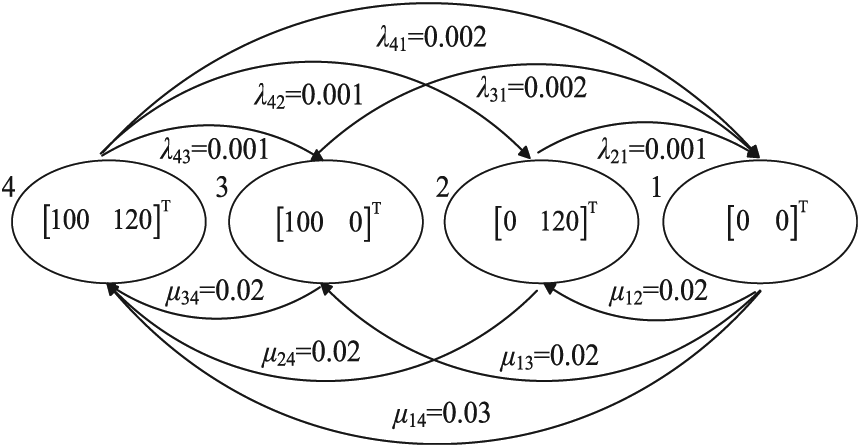
Machine state transition diagram with four states.
In the steady state, the state transition probability equations and theoretical steady-state probability are

Ordinary machine generally only has two states of normal operation and complete failure, which are represented by 2 and 1. The state transition occurs between state 2 and 1, and the state transition diagram of the ordinary machine is shown in Figure 3.

State transition diagram of ordinary machines.
According to equation (1), the state transition probability equations of ordinary machines can be obtained as equation (3)

where

Machine reliability modelling
Figure 4 shows a part of the manufacturing system consisting of three stages and two buffer stations. Stage Si–1, Stage Si and Stage Si+1 have d, e and f machines individually. Mi1 and Mie denote the first and eth machines of stage Si, respectively.

Manufacturing system with buffer stations.
It is supposed that the volume of buffer station Bi is bi, the production rate of the upstream stage is ωi and the downstream is ωi+1. The steady-state solution can be obtained by establishing the state transition equations of Bi. The probability of k (k = 0, 1, …, bi) workpieces remained in Bi can be obtained by equation (5)

where
During operation, Bi has different states which are full, partially full, partially empty and empty. Their corresponding probabilities can be obtained as follows:
State 1: Bi is full

State 2: Bi is partially empty

State 3: Bi is empty

State 4: Bi is partially full

When Bi is full, all the machines of stage Si will be stopped due to overloading; when Bi is empty, all the machines in stage Si+1 will be stopped due to lack of material. Therefore, all the machines of stage Si can only work normally when Bi–1is partially full while Bi is partially empty. The availability of Bi for the machines of stage Si is
If

If

If Mij’s input is normal while output is blocked, the probability can be obtained by

If

Thus, the actual steady-state probability of machine

The probability of the machine not being able to maintain in state k due to being blocked, lack of material or machine failures can be obtained by

Assuming that all the machines in the first stage have enough workpieces, the actual steady-state probability and non-steady-state probability of machine

Assuming all the machines in the last stage has enough stock space to ensure smooth output, the actual steady-state probability and non-steady-state probability of machine

Disregarding the influence of buffer states, the failure probability of machine

Taking buffer states into consideration, the failure probability equivalence of machine

Based on the above analysis,
System reliability modelling
When there are a large number of machines, auxiliary devices, buffer stations and logistic equipment, the state space of whole system will increase exponentially which is difficult and even impossible to solve. UGF method can be used as an efficient tool to solve above problems. The UGF of machines considering the influence of buffer states can be given by

where
The machines have different steady-state probabilities when machining different workpieces which can be expressed with vectors, so equation (20) evolves to

where
The probability and performance in each state have been expressed with vectors which have the same dimensions as types of workpieces. Consequently, the equivalent non-series system can be divided into independent parallel subsystems and series subsystems. The UGF of the system can be derived through recursive decomposition and the final results are evaluated by the equivalent modules and operators, both parallel and series. The composition operator ⊗ is defined by

where
Let σ and π be the composition operator corresponding to series connections and parallel connections of the subsystems, respectively. They are the special cases of ⊗ and defined as follows
Series composition operator

Parallel composition operator

For the series–parallel manufacturing system, the UGF calculating procedures are as follows:
Decompose the structure of the equivalent system with consideration to buffer states;
Calculate UGFs of all the parallel equivalent subsystems using equation (21) and parallel composition operator;
Simplify the non-series system into series one;
Calculate
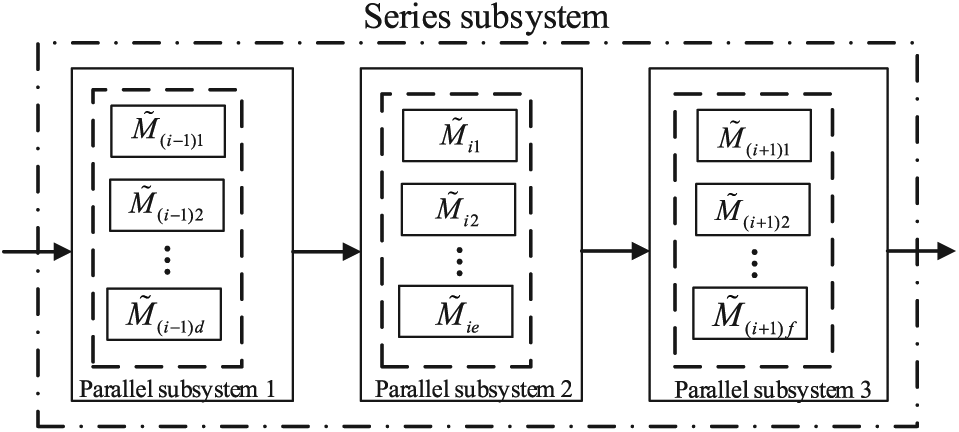
Decomposition of systems.
In order to describe the behaviours of multi-state manufacturing system in terms of reliability, parameters needs to be defined, which could be obtained by expanding from classical reliability indicators. Reliability is the performance measurement of the system satisfying the requirements of certain level, the evaluating indicators of which include the following:
Steady-state availability

where
Given
Theoretical production rate

Utilization rate US: it is defined as the ratio of actual production rate to theoretical production rate, which is used as econ-technical norms to reflect the system’s working conditions and manufacturing efficiency

where
Efficient production rate

Production loss Ds: it is used to describe the shortage against the assigned demand

Case study
This section reviews a practical case of a production line located in south China for machining two distinct engine heads as shown in Figure 6.

Flexible engine head production line.
This production line consists of 10 stages (S1–S10) and 9 internal buffer stations (B1–B9). Stage S1 has only one machine M1. S3, S8 and S9 each consists of two identical machines paralleled (M31, M32), (M81, M82) and (M91, M92); S2 and S4 include three identical machines (M21, M22, M23) and (M41, M42, M43), respectively. b1–b9 represent the volumes of the nine buffer stations. S5, S6, S7 and S10 are auxiliary stages; M5 and M10 are cleaning machines; M6 is a press-fit machine; and M7 denotes a leak detector.
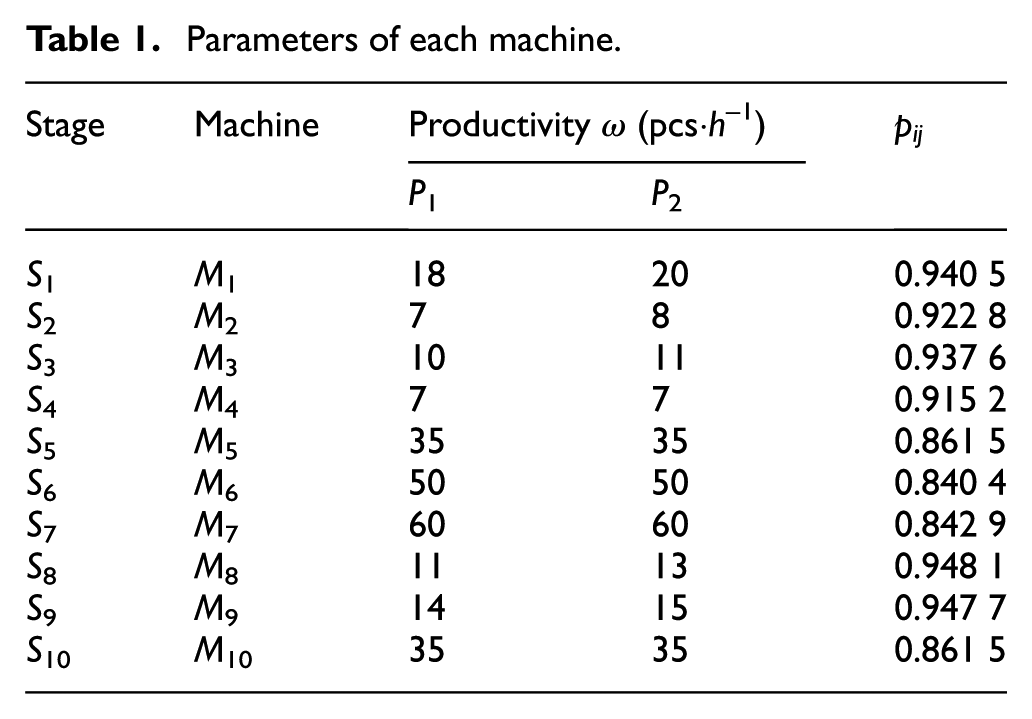
It is assumed that the sojourn times of all the machines and auxiliary equipment follow exponential distribution. The steady-state availability of each machine can be obtained using equation (2) in accordance with the failure rates, repair rates and state transition diagram. The parameters of each machine are given in Table 1.
Parameters of each machine.
Machine availability analysis
According to Table 1, the productivity ratios

Influence of buffer volume on the machine’s steady-state availability are shown in Figure 7.

Influence of buffer volume on machines’ steady-state availability: (a) influence of b1 on p1; (b) influence of b1, b2 on p21-p23; (c) influence of b2, b3 on p31-p32; (d) influence of b3, b4 on p41-p43; (e) influence of b7, b8 on p81-p82; and (f) influence of b8, b9 on p91-p92.
Figure 7(a) shows that steady-state availability p1 of machine M1 at the first stage is only affected by the volume of buffer station B1. When b1 < 20, p1 increases quickly with the increasing b1 and the curve becomes less steep after that. For distinct engine heads, steady-state availability of M1 is different but it will infinitely approximate the same value which is M1’s steady probability 0.9405. Figure 7(b)–(f) shows the steady-state availability results with respect to the downstream and upstream buffer volumes for the rest machines in stages S2, S3, S4, S8 and S9. From Figure 7(b), (c) and (f), we know that the upstream and downstream buffer stations have almost the same influence on the steady-state availability of machine. Figure 7(d) shows that the downstream buffer station B4 has more significant influence on p4 than the upstream buffer station B3, while Figure 7(e) presents that influence of the upstream buffer station B7 on p8 is more obvious than that of the downstream buffer station B8. When the volume of upstream and downstream stations are infinite, steady-state availability of machine reaches constant value, which is the steady probability of each machine.
All of the machines’ actual steady-state availability increases with the increase in the buffer volumes. When the buffer volume exceeds a certain value, the change in the actual steady-state availability becomes mild. With further increasing of the buffer volume, the machine’s actual steady-state availability and production capacity tend to reach a limit. It means that when the buffer volume is infinite, it has no influence on the machine’s steady-state availability. However, when the buffer volume is finite, the states of buffer station will inevitably affect the machines’ states and reduce its reliability hence to cut down the production capacity and increase the system complexity.
System state space
In this section, we use the data in Table 2 as an example to analyse and verify the multi-state reliability modelling method proposed in this article.
Buffer volume allocation.

According to equations (14)–(19), actual steady-state availability and unavailability caused by failures, lack of material and jam can be obtained as shown in Table 3.
Machine states and probability distributions.

The UGF of each machine is derived from Table 3. First, decompose the production line into five parallel subsystems, M21-M22-M23, M31-M32, M41-M42-M43, M81-M82 and M91-M92, and carry out compositional calculation by applying parallel composition operator

The original system has 21× 23× 22× 23× 21× 21× 21× 22× 22× 21 = 217 = 131,072 states and only 9 remained after applying UGF technique. We can see that vector UGF technique is very efficient in reducing the quantity of state space and solving the problem.
System reliability analysis
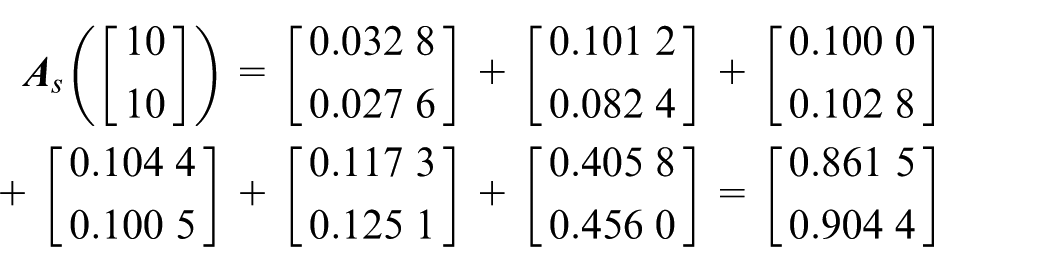
When the performance vector equals [10 10]T, the reliability indicators can be obtained by equations (25)–(29) based on the system UGF US(z) as follows:
Steady-state availability
Theoretical production rate

Utilization rate

Efficient production rate
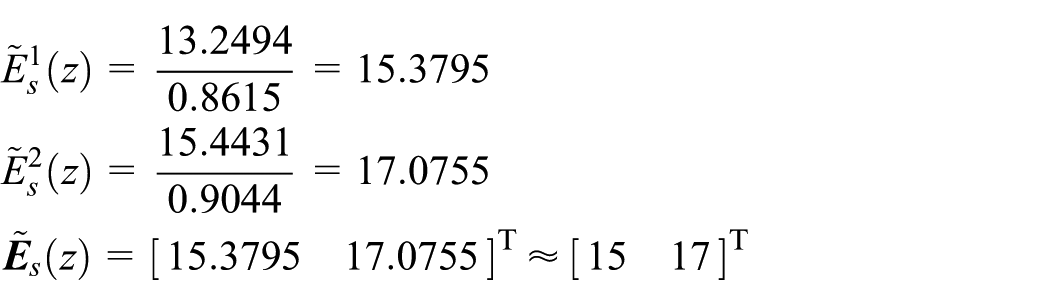
Production loss

Conclusion
According to production capacity and capability of a flexible manufacturing system, a reliability modelling method for repairable non-series multi-state manufacturing system with finite buffers was put forward using improved vector universal generation function. Through analysing buffer states’ influence on steady-state availability of each machine, a vector UGF was constructed. UGF of the entire system was obtained by parallel and series composition operators combining system structure and states, and reliability indicators in vector were proposed. The upstream and downstream buffer volumes have significant influence on the machine states. Machines’ actual steady-state availability increases with the increase in the buffer volume in certain range. With the further increase in the buffer volume, the machine’s actual steady-state availability has little change. The accurate equivalence and efficient separation of machine states were realized based on state equivalence, which is the key preposition of UGF calculation. This article analysed a two-part family engine-head production line from the aspects of system steady-state availability, theoretical production rate, system utilization ratio, efficient production rate and production loss. The result shows that buffer volume has critical influence on machine states. The use of vector UGF evidently reduces the computing complexity while describing the system states more accurately and providing more precise measurement than composition operation.
The buffer allocation issues aim to solve the problems of configuring reasonable sizes of intermediate buffers for manufacturing systems and it is of great importance in the design of manufacturing systems in terms of increasing the system average throughput and limiting the propagation of material flow disruptions. Therefore, our future work is to apply the same methodology and intelligent optimization algorithm to investigate optimal workload and buffer allocation of flexible manufacturing systems.
Footnotes
Handling Editor: Jixiang Yang
Authors’ contributions
J.D. and N.X. contributed to conceptualization and investigation; J.D. contributed to methodology, validation and formal analysis; J.D., N.X. and L.L. contributed to writing and original draft preparation.
Declaration of conflicting interests
The author(s) declared no potential conflicts of interest with respect to the research, authorship and/or publication of this article.
Funding
The author(s) disclosed receipt of the following financial support for the research, authorship and/or publication of this article: This research was funded by the MITT Intelligent Manufacturing Project of China ‘The study of interconnection standard and experimental verification in the intelligent manufacturing plant for naval architecture and marine engineering’ and the National Natural Science Foundation of China (grant no. 71471139).
