




Abstract
For the reliability analysis of complex equipment system, one of the key objectives is that the equipment can complete the specified mission as expected. First of all, this article presents the analysis method of mission success importance for a multi-state k-out-of-n repairable system based on multi-state multi-valued decision diagram as well as the implementation procedure. Second, the engineering significance of mission success importance for a multi-state repairable 2-out-of-3 system is discussed by comparing the component order of mission success importance with multi-state Birnbaum importance, multi-state Fussell–Vesely importance, performance achievement worth, and performance reduction worth. Finally, the change rule of mission success importance is presented for a multi-state 2-out-of-3 repairable system when the reliability of a component is changed. The analysis results show that the engineering significance and change rule of mission success importance could provide effective support for mission success optimization of a repairable system.
Keywords
Introduction
Recently, practical engineering systems become more and more complex with the development of modern science and technologies. In the binary systems, the components have only two states, working state and failure state. There are also many applications for multi-state systems (MSSs) in practical engineering, where the components in the systems have more than two states.
Lisnianski and Levitin 1 presented concerned theories and basic analysis method of MSS. To analyze the complex repairable systems, Liu et al. 2 proposed a new method with excellent performance especially for large-scale models, which established the Monte Carlo simulation based on Spark parallel algorithm. Cui 3 presented a unified formula with the product of matrices for evaluating the system state distribution for generalized multi-state k-out-of-n:F systems, which is based on the finite Markov chain imbedding approach. Liu and Huang 4 introduced a modified fuzzy MSS availability assessment approach to compute system availability under the fuzzy user demand. Liu and Huang 5 investigated a selective maintenance policy for MSSs consisting of binary state elements. Natvig 6 described different types of MSSs in detail and presented a probabilistic model of system operation and maintenance. Mi et al. 7 proposed a method for reliability modeling and assessment of an MSS with common cause failure based on Bayesian network. For MSSs, Liu et al. 8 presented an approach of joint redundancy and imperfect maintenance strategy optimization. Liu et al. 9 developed a method based on the Bayesian framework to assess the reliability and performance of MSSs. Phase-type modeling was proposed for the dynamic assessment of non-repairable MSSs when the system degrades according to a Markov process. 10 Wu and Wu 11 presented an object-oriented Petri net model for the mission reliability simulation of multi-stage mission common cause failure systems. Mo et al. 12 proposed a multi-valued decision diagram (MDD)-based approach to model and evaluate the performance of a multi-state linear consecutive k-out-of-n:F system. Li et al. 13 constructed a new Markov chain to depict the evolution process of the dynamic system, which focuses on the development of reliability measures for a repairable MSS.
Decision diagram analysis (DDA) is a method to analyze the reliability and performance of complex systems. 14 Akers 15 introduced the binary decision diagram (BDD) by representing Boolean functions as decision graphs. BDD was extended to multiple-valued logic called an MDD, 16 and Miller and Drechsler 17 described a matrix method for level interchange in MDDs. For the multiple mission stage systems, Zang et al. 18 presented an arithmetic based on BDD to deal with the interplay among the mission stages. Xing and Levitin 19 analyzed the reliability of phased mission systems based on common cause failure theory through the BDD method. Kammoun et al. 20 used time-reduced ordered BDDs to establish the discrete-time Petri net model. In recent years, Xing and Dai 21 presented multi-state multi-valued decision diagram (MMDD) for an MSS with multi-state components concerned. Shrestha et al. 22 presented an analytical method based on MMDD to analyze the multi-state component importance, and the advantages of the proposed method were compared with the method based on Monte Carlo simulation. The application of DDA for k-out-of-n systems has been considered in many references based on the methods of algebraic logic. Dutuit and Rauzy 23 studied the performance of BDDs on k-out-of-n systems. Zaitseva and Levashenko 24 proposed a method for the analysis of the MSS structure function of high dimension, which interrupts the MSS structure function as a multiple-valued logic function. Li et al. 25 summarized and proved the patterns of BDD/MMDD for binary/multi-state k-out-of-n:G system and proposed a two-step algorithmic process for modeling the BDD/MMDD. Mo et al. 26 proposed a new analytical method based on MDDs for the reliability analysis of such multi-state k-out-of-n systems. Kvassay et al. 27 developed a method that can be used for the creation of a good model for k-out-of-n MSSs.
As an important part of reliability theory, importance measure analysis provides a theoretical basis for system reliability optimization and maintenance decision. The importance measure describes the impact of component failure or changes of states on system reliability. For the binary systems, there are some classical importance measures, such as Birnbaum importance 28 and Fussell–Vesely importance.29,30 The reliabilities of critical components must be guaranteed, otherwise a series of serious problems and disastrous consequences will be caused. 31 If the weak components can be identified during the development of new equipment, the system performance can be increased through improving these unsubstantial components’ performance.
Various importance measures for an MSS in different circumstances had also been studied. Levitin et al. 32 considered some commonly used importance measures in a generalized version proposed by some of the authors for application to MSSs constituted by multi-state elements. Zio and Podofillini 33 evaluated the components’ importance measure in prescribed performance level by applying the general type of traditional importance measures to an MSS with multi-state components. Ramirez-Marquez and Coit 34 presented and evaluated composite importance measures for MSSs with multi-state components. Shrestha et al. 35 presented an MMDD-based analytical method for multi-state component importance analysis and illustrated the advantages of the proposed method through comparison. Si et al. 36 presented the evaluation method of integrated importance measure for MSSs. Dui et al. 37 proposed the semi-Markov process-based integrated importance measure for MSSs. Liu et al. 38 elaborated a generalized Griffith importance measure for components with multiple state transitions. There are also various researches of importance measures for an MSS under different circumstances.39,40
Mission success is an index of measuring the capacity of a system to complete the specified task with specified service conditions, which is mainly related to reliability and maintainability parameters. In this article, first the calculation method is introduced for repairable k-out-of-n systems. Then, the engineering significance and change rule of mission success importance for the repairable 2-out-of-3 system are also discussed, which can provide support for mission success optimization of repairable systems.
Concept of mission success importance for multi-state repairable systems
MMDD method for multi-state repairable systems
The assumptions of a multi-state repairable system are as follows.
For multi-state repairable systems, there are n repairable components, which are noted as
The reliability and maintainability parameters are independent of each other.
The states of each component
The probability of the system in working state is
For the component
The time that the system fulfills one task is regarded as one cycle
To calculate expediently, some matrices are defined as follows.
MMDD can be regarded as the nodes in the decision diagrams which are extended from binary to multiple states based on BDD. 35 MMDD is applied very extensively, which can avoid the complex computation of the analytical algorithm. There are root nodes, sink nodes, and non-sink nodes in MMDD which are similar to those in BDD. The terminal node is denoted as 0 or 1, which means that the system is not being or being in the system state with mission success.
The typical MMDD structure for the system state with mission success is shown in Figure 1.

The typical MMDD structure for a system with mission success.
In Figure 1, the node A is the root node which has
These three transition probability matrices

The element
At the beginning of the current task, the initial state probability of the component

Similarly, the working state transition probability of the component

The failure state transition probability of the component

MDD is the extension of the traditional BDD and MMDD is another extension of BDD. There are some researches on the evaluation of MSS based on MDD. In Zaitseva and Levashenko 24 and Kvassay et al., 27 the number of system states equal to the number of component states is considered in the MSS. Zaitseva and Levashenko 24 proposed an MDD method to represent the MSS structure function. In order to analyze the importance of MSS, the MDD is divided into some sub-diagrams based on each system state to calculate the non-zero values of direct partial logic derivatives. In fact, this method can obtain the paths from the root nodes to the terminal nodes through the sub-diagram, but the MDD should be constructed first to obtain the sub-diagrams for each system state. Kvassay et al. 27 proposed a method based on MDD to create a good model for k-out-of-n three-state systems (TSSs). MDDs can be constructed easily for TSS when we know the exact number of components in state 1, and the model for TSS can be obtained by integrating all the MDDs for different exact numbers. However, we cannot find all the paths clearly for each system state after the integration.
In this article, success paths for a specific system state are critical to analyze the system mission success probability and the change rules of mission success importance. Actually, all methods that can get the success paths are able to be applied in this article, such as MDD and MMDD. However, there are some reasons for choosing MMDD to get the success paths for each system state instead of MDD mentioned in Zaitseva and Levashenko 24 and Kvassay et al. 27 First, in this article, the number of system states may not be equal to the number of component states and every component may also have a different number of states. Second, MMDD only needs to analyze the specific system states with mission success rather than all the system states. In fact, MMDD can reduce the system complexity when the system state is determined, which can make the problem easy, especially for large systems. In order to get the success paths for a system with mission success easily, we choose MMDD to solve the problem.
Traditional importance measures of multi-state repairable systems
Based on Fussell 30 and Levitin et al., 32 the traditional multi-state importance measures are studied in this section. This section mainly focuses on the multi-state Birnbaum importance (MBI), multi-state Fussell–Vesely importance (MFV), performance achievement worth (PAW), and performance reduction worth (PRW).
MBI is a partial derivative of system performance for the component reliability. The calculation of MBI used in this article is shown as follows

where
MFV quantifies the maximum decrement in system performance caused by a particular component. In this article, the Fussell–Vesely importance for an MSS is described as follows

PAW measures the contribution of the component state

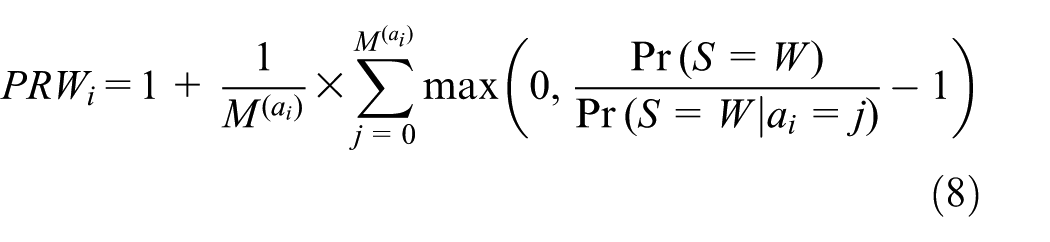
PRW measures the potential damage to the system performance caused by total unavailability of the state
Mission success analysis of a system
Each mission success path
The mission success probability of the system is the summation of all the success paths of the system. Therefore, the calculation method of the system mission success probability is shown in equation (9)

where
Mission success importance of the multi-state repairable system
The mission success importance means the influence of the states of components on the system mission success probability. Because of the impact of reliability parameter and maintainability parameter on the mission success, the calculation of mission success importance is proposed based on these two parameters, which can be expressed using equation (10) as follows

where
Mission success importance for multi-state k-out-of-n repairable systems
Calculation process of mission success importance
For component
Based on the research of Li et al., 24 determine the MMDD model of the k-out-of-n MSS.
All the success paths in the MMDD can be obtained through the depth-first search method.
Based on the state transition diagram of Markov process, obtain the availability model-generated matrix
Calculate the probability of each success path based on the matrices mentioned in Step 3 and calculate the mission success probability by equation (9). The probabilities
For the k-out-of-n MSSs, calculate the mission success importance based on equation (10). The probability of
Based on this method, MMDD can also be used to evaluate the k-out-of-n MSS with more than two performance levels. For the k-out-of-n MSS, the specific system state which can guarantee that the system is working should be determined first; then MMDD for the system state should be constructed, and at the same time the success path can be obtained; finally, the probability of the system state can be calculated easily. In this paper, we just need to analyze the ability of the system to fulfill the mission when the system can only be in working (mission fulfilled) and failure (mission unfulfilled) states. Therefore, there is no need to analyze the system with more than two performance levels.
Analysis of computational complexity
In order to analyze the computational complexity of mission success importance based on MMDD, the values of
The pseudocode for the calculation of

The pseudocode for the calculation of

From the calculation process of mission success importance,
Mission success importance for a multi-state 2-out-of-3 system
For the common voting system which is a k-out-of-n MSS,
21
there are three components

The structure of the 2-out-of-3 system.
The calculation process of the multi-state 2-out-of-3 system based on MMDD is shown as follows.
1. Based on the structure of the 2-out-of-3 system, the MMDD model of this system is shown in Figure 3 based on the research of Zaitseva and Levashenko. 24
2. Based on the MMDD model, there are three mission success paths

where

The MMDD of the 2-out-of-3 system for a system with mission success.
The system mission success probability can be expressed as follows

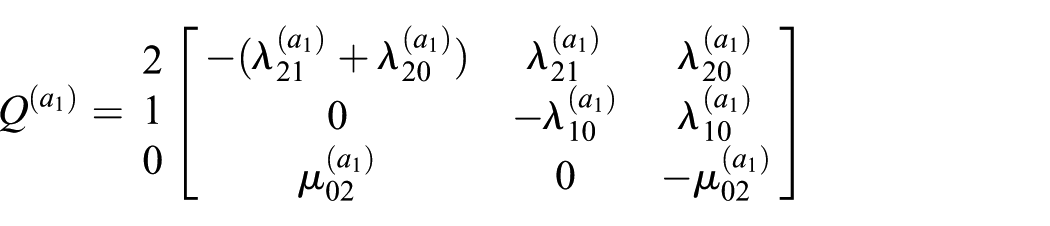
3. According to the state transition of Markov process, which is shown in Figure 4, the availability model-generated matrix and the reliability model-generated matrix of the three components are shown as follows


The state transition process of components.
The reliability parameter
The list of the reliability parameter

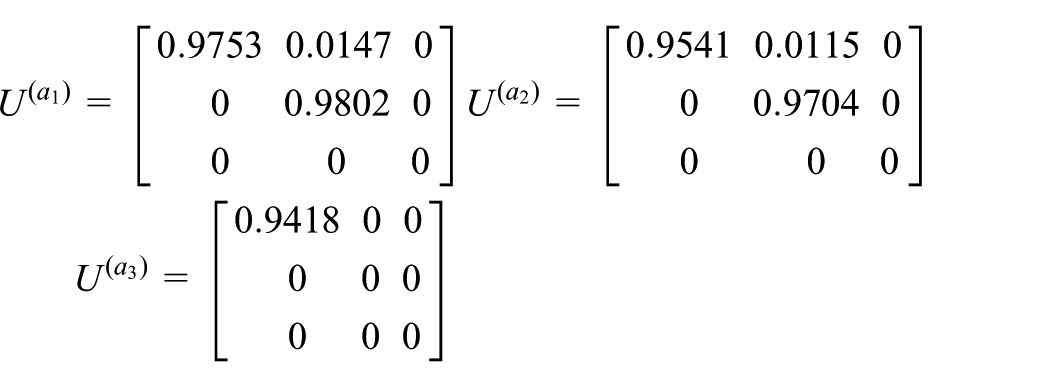
So, for the components

The one mission cycle
For the components

For the components
For the components

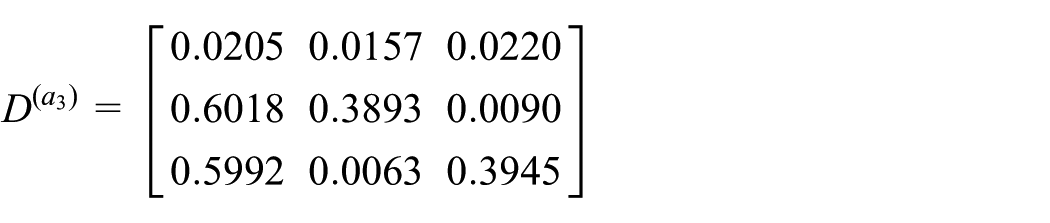
The initial probability matrix of each component is
4. Calculate the system mission success probability based on equation (9), which is shown as follows

5. Calculate the mission success importance of each component based on equation (10), which is shown as follows.
The mission success importance of the component

The mission success importance of the component

The mission success importance of the component
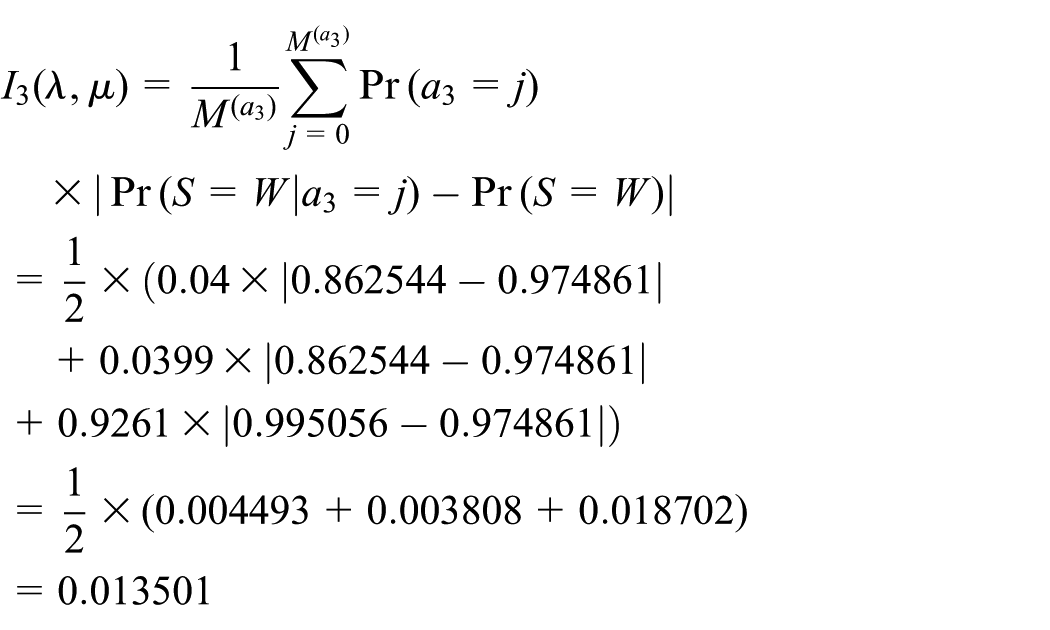
In the system, the reliability parameter
Engineering significance of mission success importance for the multi-state 2-out-of-3 repairable system
For the 2-out-of-3 system described above, the order of mission success importance is
Calculation of traditional measures
1. Calculation of MBI
For the component

For the component
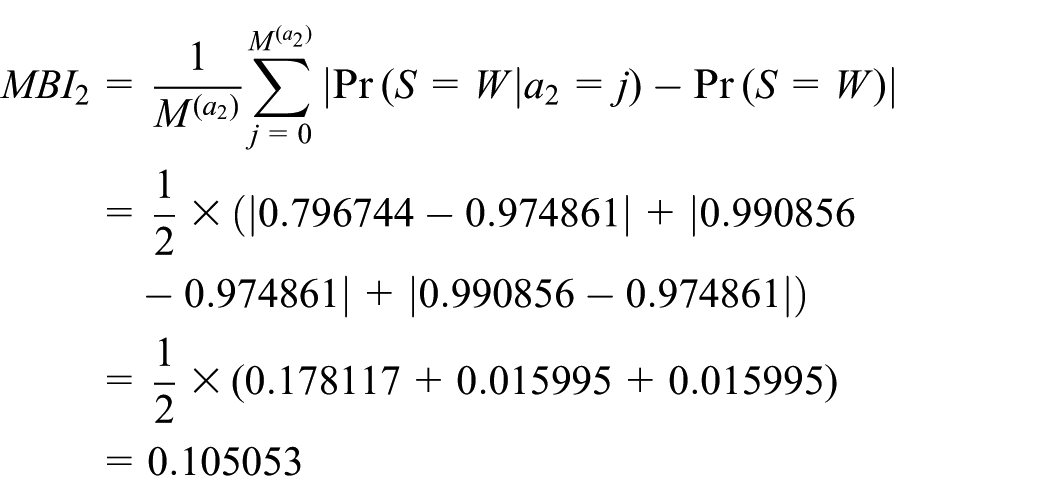
For the component

The order of MBI is
2. Calculation of MFV
For the component

For the component

For the component

The order of MFV is
3. Calculation of PAW
For the component

For the component

For the component

The order of PAW is
4. Calculation of PRW
For the component

For component

For the component

The order of PRW is
Engineering significance of mission success importance
The orders of mission success importance, MBI, MFV, PAW, and PRW are shown in Table 2.
The importance orders of mission success importance and traditional importance.

From the comparison result shown in Table 2, the order of mission success importance is different from the order of traditional importance measures. This is because the reliability and maintainability parameters have been considered in the mission success importance. The mission success importance can be used to find the vulnerable components. The reliability and maintainability of vulnerable components can be improved to increase the system mission success probability.
The reliability and maintainability of the components will influence the system mission success probability primarily at this moment. There are many factors that will cause system failure. For example, the reliability of the components will decrease because of the loss of components and the aging of equipment while the system is running. Then, the reliability and maintainability of the components should be improved by technological methods. The system mission success probability can be improved by changing the reliability and maintainability parameters of the relative critical component based on analyzing the mission success importance of each component.
Change rule of mission success importance for the multi-state 2-out-of-3 repairable system
For the k-out-of-n system described above, in order to obtain the change rule of mission success importance, the changes of the system mission success probability and the components’ mission success importance will be analyzed when the reliability and maintainability parameters of the components are changed in turn, respectively.
Change of mission success importance based on reliability parameter
Based on the calculation of the system mission success probability, the probability of each state for the component
Changes of the probability of each state for the component
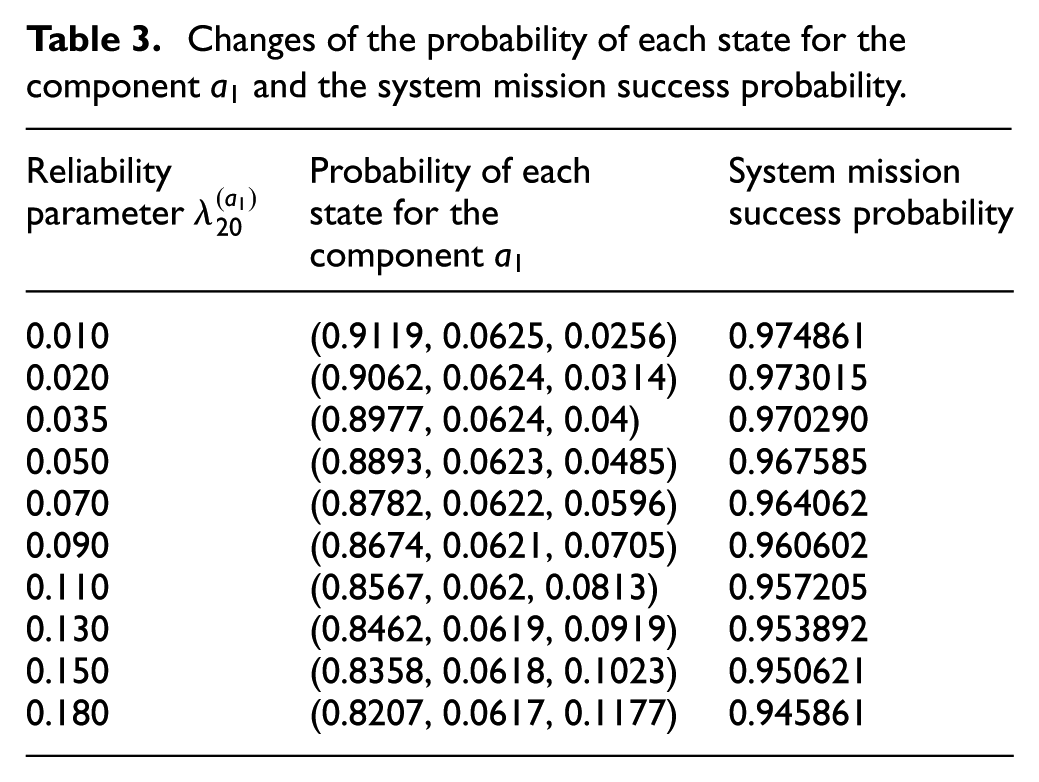
From the results in Table 3, the probabilities of states 1 and 2 for the component
The calculation of mission success importance of each component using the method described above when the reliability parameter
If

If

If

If

If

If

If

If

If

If

Mission success importance of each component with changes in the reliability parameter
Changes of mission success importance with changes of the reliability parameter.
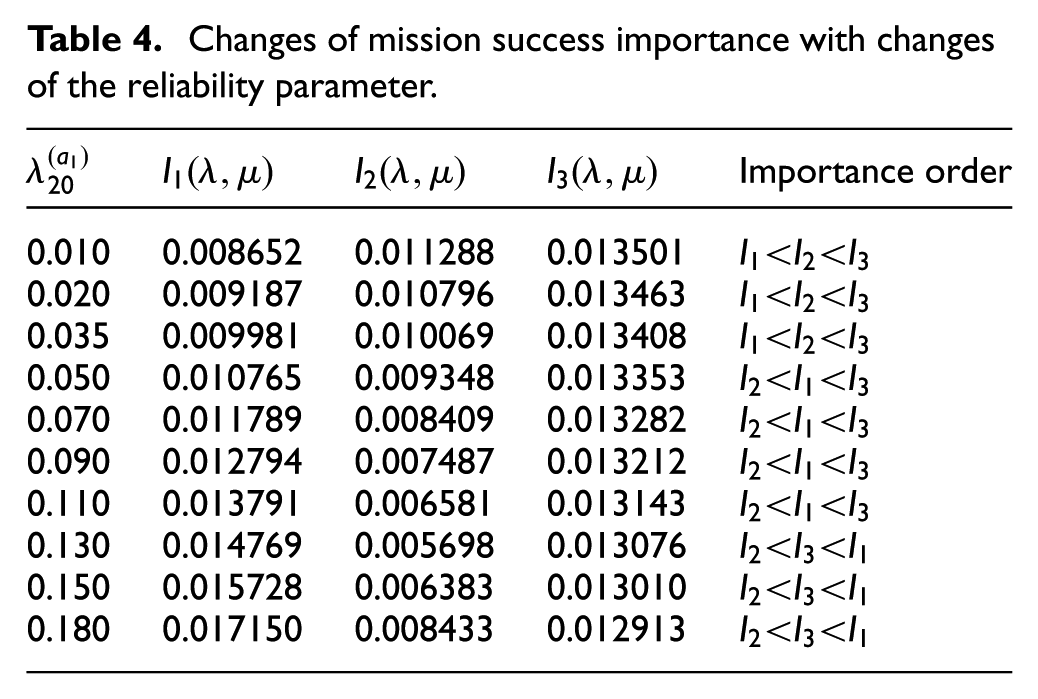
From the results in Table 4, mission success importance of the component
Change of mission success importance based on maintainability parameter
Based on the calculation of the system mission success probability, the probability of each state for the component
Changes of the probability of each state for the component

From the results in Table 5, the probability of state 1 for the component
Mission success importance of each component calculated using the method described above when the maintainability parameter
If

If

If

If

If

If

If

If

If

If

Mission success importance of each component is shown in Table 6 based on changes of the maintainability parameter.
Changes of mission success importance with changes of the maintenance parameter.

From the results in Table 6, the mission success importance of the components
Conclusion
This article proposes the mission success importance analysis method for the multi-state k-out-of-n repairable systems based on MMDD. First, according to the MMDD model and Markov process transfer matrices of each component, the mission success probability of the multi-state repairable system is obtained. Then, the mission success importance of the components in the multi-state k-out-of-n repairable systems is calculated. The engineering significance of mission success importance for multi-state 2-out-of-3 repairable systems is analyzed based on the order of mission success importance, MBI, MFV, PAW, and PRW. Finally, the change trend of mission success importance in the typical repairable systems is researched when the reliability and maintainability parameters of one component were changed, respectively.
Footnotes
Appendix 1
Handling Editor: Davood Younesian
Declaration of conflicting interests
The author(s) declared no potential conflicts of interest with respect to the research, authorship, and/or publication of this article.
Funding
The author(s) disclosed receipt of the following financial support for the research, authorship, and/or publication of this article: This research was financially supported by the National Natural Science Foundation of China (71471147, 71631001) and the 111 Project (No. B13044).
