



Abstract
Based on the linear displacement motion similarity and angular displacement motion similarity, the similarity law for free flight test of light store separation from aircraft is deduced. The problem that the ideal test model is too light to be processed and the free flight separation test in wind tunnel is harder to achieve due to the model scaling is solved. The new similarity law was simplified reasonably, and the relationship equation between separation velocity and model mass was obtained. The wind-loaded state is simulated by computational fluid dynamics, and the real separation data of aircraft, the separation data of previous test methods, and the simulation data of different mass and different separation velocity trajectories of this similarity law are obtained. The improved effect of the new similarity law is verified by data comparison. The results show that by properly increasing the mass of wind tunnel test model, the difficulty of wind tunnel test can be greatly reduced while the separation trajectory is similar, and the angular displacement error can be guaranteed to be within acceptable range. In order to ensure better consistency between flight and free flight wind tunnel test, it solves the problem that similarity law can only be designed but cannot be realized.
Keywords
Introduction
In the process of store separation, due to the high flight speed, there is complex flow interference between the store and the carrier, which easily leads to the separation failure and even the collision between the store and the carrier, threatening flight safety.1,2 In this regard, domestic and research institutions have also made a lot of explorations. In 1983, Robert L. Stallings 3 of National Aeronautics and Space Administration (NASA) Langley Research Center and others used wind tunnel tests to study the effect of different sizes of embedded capsules on missile separation under the condition of M = 2.36. In 2004, William B. Baker et al. 4 carried out numerical simulation on the launch of F-22’s inner and outer stores and compared them with flight test data. In 2009, Lockheed’s Monique L. Purdon et al. 5 carried out numerical simulation of F-35 buried weapon delivery and carried out load test and flight test for different loads. In 2012, Mark F. Reeder of the US Air Force Institute of Technology and others built a test platform to simulate the embedded ballistic chamber and carried out the free supersonic release test with zero initial release velocity of suspended objects under the condition of M = 2.94. The influence of zigzag flow control device on the motion trajectory of wall shear layer and falling object was studied, and the numerical simulation was carried out to verify the experiment. 6 Ryan Carter and others carried out the validation research of captive trajectory system (CTS) combined with flight test.7–10 Mahmood et al., 11 Berglind and Tysell, 12 Sickles et al., 13 and Hallberg et al. 14 carried out the research work of computational fluid dynamics (CFD) and flight test phase validation. When the mass of the store is lighter or the separation dynamic pressure is larger, the aerodynamic force of the separator is larger, and the interference of complex flow field will easily cause the collision between the store and the carrier aircraft, which needs to be studied in detail.
Free flight separation test in wind tunnel is an unsteady test method. Because the test model has no support interference, it can simulate the actual separation characteristics more truly. The main purpose of wind tunnel free real dropping is to check the influence of real dropping factors on separation safety.15–18 The real dropping factors include the M, flying height, mass characteristics, initial position of real dropping objects, initial separation line velocity of real dropping objects, and initial angular velocity of real dropping objects.19–21 Wind tunnel test is to use high-speed photography to take pictures of the separation process, identify the separation trajectory, assess the safety boundaries of the influencing factors, and provide a reference for the real aircraft and weapons delivery.22,23
In order to satisfy the similarity of angular displacement between wind tunnel test and real flight, equation (1) needs to be established. However, in practical application, the mass of separated material is relatively light after scaling. At this time, the mass of the designed model is too low to be processed. In ejection separation, in order to ensure that the model has a certain kinetic energy, the very low mass of the model will inevitably lead to a higher separation speed. The initial separation speed of the model is too high to be realized by the ejector. The lightness of the wind tunnel model designed according to the existing similarity law generally comes from three reasons: first, when the real flight altitude is low and the ambient air density is high, the mass of the wind tunnel model is inevitably low according to equation (1), for example, the separation of high-speed flight at low altitude. Second, the actual density of the real store itself is low, the interior of the store is empty, the volume is large, and the mass is low, such as the sub-tank; third, the size of the real aircraft and store is large. The size of the carrier aircraft is much larger than that of the conventional aircrafts. In addition, the model scaling is extremely low, limited by the size of the wind tunnel, so the density of the wind tunnel test model is very low, for example, the separation of air-launched rockets and other large aircraft. These three situations often occur in practice, but they make wind tunnel tests more difficult. The lighter mass of the wind tunnel model results in the lighter processing of the model interior, which makes the model processing more difficult. At the same time, when configuring the mass characteristics of the model, the lighter mass of the model also leads to the reduction of the rigidity of the internal parts of the model, which reduces the durability of the model. The initial velocity of the model is larger, and the model ejector needs to have higher ejection efficiency and stability, which increases the design difficulty of the model ejector.
Therefore, in order to increase the realizability of wind tunnel test, within the range of error acceptance, it will be very meaningful to simplify the restriction equation appropriately and obtain the design method of similarity law for ejection free flight test in high-speed wind tunnel with wider application. The main work of this article is to solve the problem that the mass of separated substances is relatively light in practice. Based on the reasonable assumption of the restriction equation of similarity law, the continuous variation equation of initial separation velocity and initial separation angular velocity with the mass of the model is obtained, so that the new similarity law can be adapted to the separation test of lightweight separated substances. It overcomes the shortcomings of the complete limitation of the model mass and initial separation speed. The similarity law of lightweight separators relaxes the constraints among the model mass, initial separation speed, and initial separation angular velocity. It solves the shortcomings of the previous lightweight and heavyweight model methods that completely limit the model mass and increase the realizability of wind tunnel tests. Similarly, numerical simulation is used to simulate the typical separation state with wind to verify the accuracy of the similarity law of light separation. The numerical simulation shows that the accuracy of the separation trajectory obtained by the simplified model is still high, but the linear displacement and angular displacement curves will have some errors. The closer the model mass is to the ideal mass, the smaller the error of the linear displacement and angular displacement curves of the test data.
Definition of light store
It would be very meaningful to simplify the separation problem of light stores and obtain a more widely used similarity law design method for ejection free flight test in high-speed wind tunnel. If we want to satisfy the similarity of angular displacement, we need to satisfy equation (1). We define the lightweight objects first

On further simplification of equation (1), we obtain

It can be found that

And the following relation is formed

ρm denotes the material density of the wind tunnel test model, ρs denotes the material density of the real aircraft, ρgas denotes the gas density, Ss denotes the surface area of the real aircraft, ms denotes the mass of the real aircraft, and p indicates the thickness of the skin of the wind tunnel test model. If the test model is workable, it should meet p≥ 2 mm. Aluminum is now the most commonly used and lightest dense cheap processing material in engineering. Its density is about 2.7 g/cm3. According to practical experience, when the calculated value of ρm is less than 2.7, the model is too light and difficult to process. These models are collectively called light stores. The model designed according to the new similarity law is difficult to process. The new similarity law needs to be simplified appropriately for the separation of light stores.
Derivation of similarity law
Similar trajectories are as follows

The time period of the wind tunnel test is very short, so the quadratic term of time is negligible relative to the primary term

During the real flight, let

According to the above equation, we find the n at this time. n is the trajectory correction factor, and equation (5) can be reduced to

Also because of

Therefore, the initial separation velocity can be obtained

In addition, most of the projectiles of the aircraft are spinning bodies, with smaller rudder area and smaller separation angle of attack. When the initial separation angular velocity of the projectile is larger, the effect of angular acceleration on the angle will be smaller. Therefore, it is assumed that the angular acceleration caused by the pitching moment of the projectile is negligible within the initial separation distance of 0.8*l0. The angle of delivery is as follows


Thus, the following relation is formed

Therefore, the initial separation angular velocity relation can be obtained

It can be concluded that the conversion methods of separation speed and mass are different according to the different separation speeds of real aircraft separators. The initial separation velocity required for the model of free flight test in wind tunnel is obtained according to equation (10). The mass of the model is not limited. However, in order to reduce the angular displacement error, the mass of the model should be as close as possible to that determined by the light model method, that is, the mass value determined by equation (1). The similarity rule of light stores is verified below.
Verification of similarity law
After theoretical deduction, considering the difference of wind load, in order to check the accuracy of the application of the new similarity law in the free flight separation test of high-speed wind tunnel, the motion trajectory of the real aircraft separator is calculated by numerical simulation. Then, using the similarity law of this design, according to the wind tunnel test flow, it is combined with the parameters of the real aircraft. The parameters include inertia of model mass, flight height, M, flight angle of attack, separation speed, and so on. The test parameters needed for wind tunnel test are converted, and then, the parameters of the wind tunnel test model are numerically simulated by CFD. The separation trajectory of the wind tunnel test will be simulated. By comparing the simulation curve with the real flight curve, the accuracy of the application of the new similarity law in the free flight separation test of high-speed wind tunnel is verified. At the same time, by comparing the difference between the real flight state curve, the former test method, and the new design similarity law curve, the improvement effect of the new similarity law on the test accuracy is obtained.
Validation of the models used
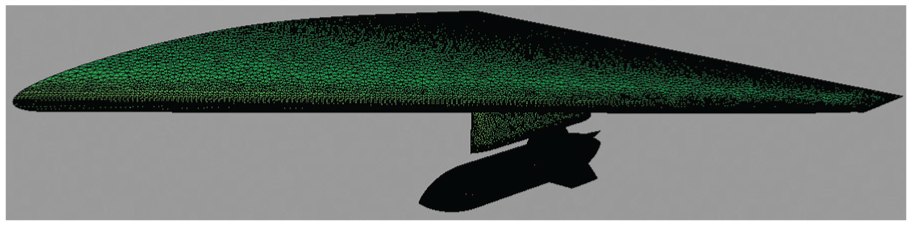
Figure 1 is a coordinate system. In order to increase the generality of the numerical simulation results, the validation numerical simulation uses the international common standard model, as shown in Figure 2.
Coordinate system description.

Validation of the models used.
In the solver, the unsteady compressible Reynolds-averaged Navier–Stokes (RANS) equations are solved using the unstructured grid finite volume method in spatial discretization and the implicit lower–upper symmetric Gauss-Seidel (LU-SGS)-based dual time-stepping scheme in temporal discretization. To realize the motion of the multiple bodies in relatively moving, the dynamic overset unstructured grid method is used. For separation problems, the trajectories of bodies can be obtained by coupling the six degrees of freedom motion equations.
The verification method of the similarity law of light stores is to use numerical simulation to find the separation trajectory of real aircraft, the separation trajectory of wind tunnel test by the similarity law of light stores, and the separation trajectory of previous wind tunnel test methods. The consistency between the separation trajectory of wind tunnel test and that of real aircraft is verified, and the feasibility of the similarity law of light stores is proved. At the same time, the errors of previous test methods are compared. The difference from the previous verification methods of similarity law is that the similarity law of lightweight objects relaxes the constraints among model mass, initial separation velocity, and initial separation angular velocity. Therefore, the method of variable model mass is used to obtain the simulation results of different models for the same real flight parameters and to verify the influence of different mass models on separation. The angle reference value is α0 = 26°. The remaining parameters are same as those of the similarity law. The model parameters are shown in Table 1. The real separation velocity is v0 =2.5 m/s. The model designed by the new similarity law is Model 1, and the models designed by the light object similarity law are Models 2–5. The mass of Models 1–5 increases exponentially, and the speed of model separation is calculated according to equation (10).
Validation of model parameters by similarity law of light stores.

Data analysis
Figure 3 is a line displacement separation trajectory curve. From the figure, it can be seen that the trajectory of the real separated centroid motion is more vertical, but the error of previous test methods is larger. Although the mass and separation speed of Models 1–5 are different, the trajectory curve of centroid separation in five states is very close to the true separation curve, with an error of less than 2%.

Separation trajectory diagram.
According to the similarity of Fr number, in order to simulate the separation trajectory of real flight, especially when the vertical displacement trajectory of the store corresponds to the horizontal separation trajectory, the vertical displacement trajectory, and the angular displacement trajectory, the vertical acceleration of the wind tunnel test model needs to be increased by an order of magnitude. However, the free flight test in wind tunnel is a test method without supporting interference, so the vertical acceleration of the separator can only be equal to the gravitational acceleration, which leads to the insufficient vertical displacement compared to the previous test methods, resulting in the vertical displacement of the store not corresponding to the horizontal displacement and the angular displacement. The test results are distorted, like the Sfor data curve in Figure 3. Although the mass of Models 1–5 is different, according to equation (10), by adjusting the initial velocity of different models, the initial separation kinetic energy of the separators are the same, thus ensuring that the vertical linear displacement of Models 1–5 corresponds to the horizontal displacement and the angular displacement, so as to ensure the consistency between the separation trajectory and the real vehicle’s separation trajectory.
Figure 4 is a trajectory diagram corresponding to linear displacement and angular displacement. It can be seen from the figure that the error between the trajectory of the former test method and the trajectory of the real separated mass center is large. Although the mass and separation velocity of Models 1–5 are different, the angular displacement and linear displacement curves of the five states are close to each other. In the past, the angular displacement and linear displacement curves of the test method were distorted. Unlike the vertical linear displacement of the store, the angular displacement of the separator is mainly affected by the mass of the model. The closer the model mass is to the ideal value, the more true the angular displacement is, which is consistent with the result derived from the similitude law.

Curves of displacement and angular displacement.
Figure 5 is the experimental error curve caused by different test models designed according to the similarity law of light stores. m0 = 0.5959 kg is selected. As can be seen from the figure, for the same separation problem, the separation trajectories obtained by different mass models are not very different, and the displacement errors of the separation trajectories are smaller than those of the real ones. With the increase of the mass of the model, the angular displacement errors increase gradually and the increase range is larger.
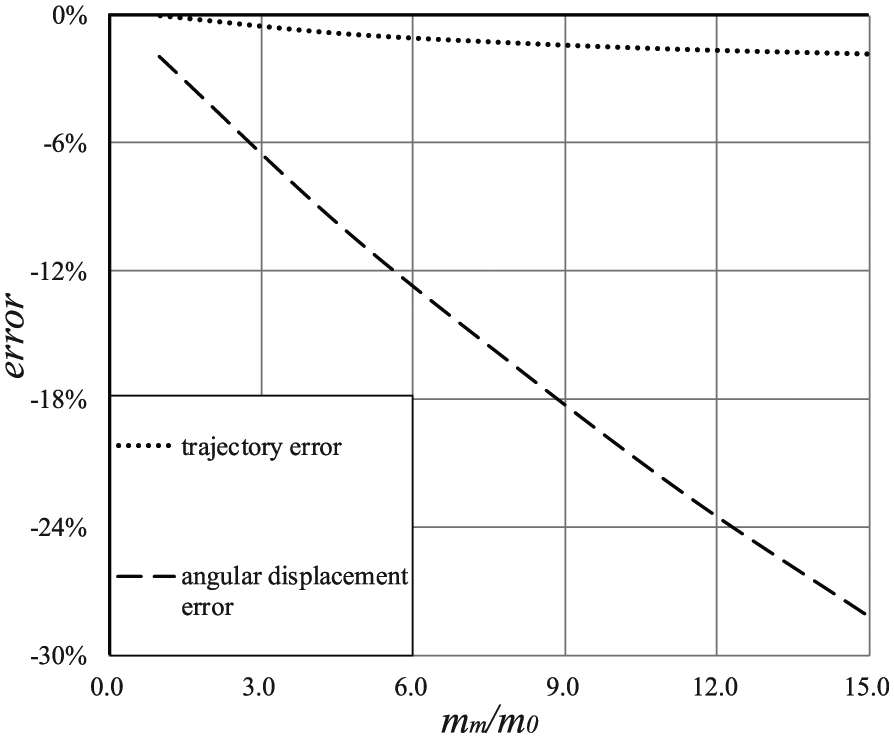
Relationship between test error and model mass change.
Table 2 shows the displacement error and angular displacement error of different models. It can be seen from the table that the linear displacement errors of the previous test methods are large, and the angular displacement errors are very large, resulting in distortion. The linear displacement errors of different mass models designed by the similarity law of light stores are smaller. The heaviest model is 15 times of the lightest model mass, and the linear displacement trajectory error is less than 2%. The effect is remarkable. The angular displacement error increases with the increase of model mass.
Linear displacement error and angular displacement error of different models.

In the actual test, when ρm≥ 2.7, by introducing the trajectory correction factor n into the equation, the defect of insufficient vertical displacement of store caused by insufficient acceleration in previous test methods can be compensated. Thus, the vertical displacement of the store in the wind tunnel test can be matched with the horizontal displacement and the angular displacement to simulate the separation trajectory. When ρm < 2.7, it indicates that the model is too light to be processed. Under the condition that a certain angular displacement error is brought, the mass of the model can be appropriately increased, such as mm/m0 = 1.3 or 1.5, which will bring some angular displacement errors, but it solves the difficult problem that cannot be achieved in wind tunnel test, and the linear displacement error is small.
Conclusion
The main work of this article focuses on the problem of large errors in previous test methods. In addition, there are a few cases of light separation in practice. Based on the reasonable assumption of the similarity law restriction equation, the continuous variation equation of the initial separation velocity and the initial separation angular velocity of the wind tunnel test model with the mass of the model is obtained, which makes the similarity law suitable for the separation test of light stores. It overcomes the shortcomings that the mass and initial separation velocity of the wind tunnel model are completely limited. The similarity law of light stores relaxes the constraints among the mass of the model, the initial separation velocity, and the initial separation angular velocity and increases the realizability of the wind tunnel test. At the same time, the numerical simulation shows that the separation trajectory obtained by the simplified model is still accurate, but the angular displacement curve will have some errors. The closer the mass of the model is to the ideal mass of the new similarity law design, the smaller the error between the line displacement and the angular displacement curve of the test data.
Footnotes
Appendix 1
Handling Editor: Ahmed Abdel Gawad
Declaration of conflicting interests
The author(s) declared no potential conflicts of interest with respect to the research, authorship, and/or publication of this article.
Funding
The author(s) received no financial support for the research, authorship, and/or publication of this article.
