




Abstract
The purpose of this article is to examine the relationship of sustainable manufacturing process and sustainability performance, which considers the environmental, economic, and social aspects. Sustainable manufacturing considering ecological system and corrosion properties has attracted interest in gaining deep insights into the application of daily business operations. Currently, there is an internal pressure in the firms to reduce the costs of production, increase the product quantity with quality, minimize the defects and reliability as well as facilitate faster and flexible delivery. In addition, these firms attempt to seek to satisfy end users and improve operational efficiency. Market pressure, society’s demand for environmental-friendly process, and regulatory compliance are mostly discussed as additional pressure to the green operations initiative in the automotive firms. In this article, an existing model was designed using the computer-aided design software and the results were analyzed to fill research gaps in the effects of the eco-system on environmental and operational performance. This study provides new research opportunities for developing models in building simulation-based design of eco-efficient systems. Finally, the article suggests that the operations should apply parsimony principles of ecosystem measurements to foresee the imminent organizational outcome to enlighten industry counterparts with guidance to enhance further robust statistical modeling and construct development.
Introduction
Design modification has become imperative, especially in the automotive sector, for producing sustainable components. Efficient utilization of resources plays a major role in sustainable development. 1 Conventional design process 2 has to be replaced by eco-design principles to improve environmental regulations.3–5 Eco-design tools need to be developed to upgrade product sustainability integrating environmental aspects into the design stage itself. 6 The use of such tools enables to understand the mediating effects of environmental and operational performance. 7 The tools entail in reducing cycle time and money 8 and help conduct sustainability assessments. When manufacturers become more environmental-friendly and socially responsible, products of high operational efficiency with competitive advantage can be produced. 9 In this context, this article reports the study of ensuring sustainable design of the alternator holding plate in the machine used for soldering of automotive components using computer-aided design (CAD) and sustainable manufacturing with environmental impact analysis of ecological parameters using AutoCAD Ecoinventor 99 and SimaPro 8.0 software. This case study begins with CAD modeling of a pneumatic motor holding plate followed by sustainability analysis to determine the environmental impact in terms of carbon footprint and energy consumption on the existing and proposed models for materials of mild steel (low carbon) and aluminum alloy.
Literature review
Sustainability in products, process, and materials is of pure significance, of which process sustainability is more important as it is concerned with impacting both energy and environment. The concepts of sustainable manufacturing system are described 10 and highlight the methodology toward efficient utilization of resources. The challenges confronted to the sustainability issues are discussed. 11 Sustainability assessments have to be made in order to facilitate decisions that affect sustainability in various aspects such as industrial, regional, natural, and global factors. 12 Manufacturing processes toward the machine component material are the key factor for the design of a product. The combined material and manufacturing system selection is the primary stage of the design process. 13 An automated evaluation tool of environmental input of the manufacturing process was presented by W Faulkner et al. 14 emphasizing three main factors, namely, emission, waste production, and material hazard for evaluation. An overall sustainability performance of operational parameters in the process industry was addressed by a framework. HA Verfaillie and Bidwell 15 and Kaebernick et al. 10 developed an assessment tool that initiates environmental and energy metrics for evaluation wherein the tool predicts energy consumption for process but not transportation. Life cycle assessment (LCA) is used in the earlier stage which helps identify the critical phase of the product’s environmental performance that can be improved. 16 An approach of LCA deals with ISO 14040/44 standards. 17 Besides, this demonstrates the real troubles associated with the manufacturingsystems. 18 The powerful tool of LCA has been used to analyze the environment impact. 19 Life cycle thinking has been the primary assessment of overall improvement of the organization. The advantages of light weight, reduction of energy utilization, and minimal CO2 emissions in aluminum are also used in the development of the manufacturing industry. 20 For selecting technical materials and manufacturing processes, the integration of management methodologies21,22 in LCA helps identify critical areas in which the product’s environmental performance can be improved.10,13 The LCA is one of the powerful tools that have been used for analyzing an environmental impact. Consideration of manufacturing process and product life cycle is essential for overall improvement of the organization. The advantages of aluminum is light weight, low energy utilization and less emission of carbon dioxide for the development of manufacturing industry.23,24 The integrated manufacturing methodologies applied for selection of materials and manufacturing processes25,26 with product environmental performance can be enhanced.
Research gap
The literature review demonstrates that amalgamations of sustainable creativity and innovation techniques to the sustainable production process system with design criteria are highly restricted. As sustainable practices were not adapted by manufacturing sectors, the issues of environmental impact have considerably increased. This research enables to reduce the gap by providing a methodology to produce components that are eco-friendly and environmental prone.
Research methodology
The methodology adopted provides a creative design to develop a new servo motor seating plate design of the motor in this research. Based on the application and concept of vision, the pneumatic motor was replaced by the servo motor to apply sustainable concept.
Case study
Existing background details
The case study has been carried out in an automotive component manufacturing organization located in Gangaikondan, Tamil Nadu, India. The organization aspires to enhance environmental friendliness in their product design and manufacturing process development practices. Since the industry shows great interest in measuring the existing sustainability level, this study has adapted a new system encompassing and enhancing the sustainability. The organization has put into practice world-class approaches such as ISO 14000-2000 environmental management systems. The firm manufactures around 5000 various automotive components every month.
A speed sensor is an electronic device used in an internal combustion engine, both petrol and diesel, to monitor the position or rotational speed of the crankshaft.
It produces three variants and each variant needs fluxing, drying, and soldering in order to provide connectivity between the bus bar and the coil wounded. The manufacturing line manufactures only the selected automotive component and has all dedicated resources needed for its manufacture. The processes involved in manufacturing the automotive component are shown in Figure 1. The machines are scheduled and sequenced and the operators are committed to predefined tasks with proper process plans and manufacturing processes. As per the design specifications, in crankshaft speed sensor assembly line, the real existing process involved in manufacturing the automotive component is shown in Figure 2.

Flowchart for manufacturing assembly unit.

Manufacturing process unit.
A flux is a chemical cleaning agent and also a flowing agent for the operation. Fluxes may have more than one function at a time. They are used in both extractive metallurgy and metal joining. Drying is a mass transfer process consisting of the removal of water or another solvent by evaporation from a solid, semi-solid, or a liquid. As the motor needs to be rotated for the fluxing, drying, and soldering operations, the machines are scheduled and sequenced and the operators are committed to predefined tasks with proper process plans and manufacturing processes. According to the design specifications in the crankshaft speed sensor assembly line, three variants were manufactured: 214 cable type, 305 without cable and O-ring type, and 315 without cable and with O-ring type. For 214 variants, it has the bus bar on the top and at the bottom of the bobbin. So, the motor needs to support the process of fluxing, drying, and soldering operations. The machines are scheduled in order and sequenced and the operators are committed to undertake predefined tasks with proper process plans and manufacturing methods. The existing CAD model diagram involved in the manufacturing process is shown in Figure 3.

CAD model for the existing plate.
Drawbacks of the existing system and scope for improvements
In crank speed sensor assembly line, three part variants were manufactured. The fixture needs to rotate with the motor for the fluxing, drying, and soldering operations. In some instances, the fixture may stop in the taper position instead of half rotation. So the soldering is not completely filled in the bus bar hole connected with the coil winding. The fixture that rotates with the motor may be stopped in the taper position instead of half rotation. So, the soldering is not completely filled in the bus bar hole which is connected with the coil winding. Owing to these problems breakdowns occur. Moreover, the coil winding was cut from the bus bar. Hence, particular groups of the part are to be scrapped. This will lead to a reduction in the machine efficiency. To overcome this disadvantage, the plate must be able to increase the width and advised to alternate the eco-material by performing experimental tests of chemical composition, wear, and corrosion. To improve the process toward eco-efficiency rate, the motor designs shown in Figure 4 are proposed.

CAD model for the proposed plate.
The proposed design
The modeling software Pro/E 5.0 was utilized for modeling the existing designs. For the proposed study, the basic models of a motor and plate assembly with the assigning material were modeled by the same software as the computer-aided design (CAD) software. The proposed motor plate unit design as orientation has been modeled with the material and analyzed by LCA with SimaPro 8.0.27–29 The subsequent software uses the Eco-indicator 99(I) impact evaluation technique according to the ISO series 14044 standards and is the base for the life cycle impact assessment. Finally, the simulation software ANSYS Workbench was utilized to simulate the material for better result requirement.
Material selection
In the last century, environmental problems were often seen as local problems due to the impact from a certain product. However, today, it has become more obvious that the problems are much more complex and related to all the phases in a product’s life cycle from extraction of material to waste or deposition of the used product. In the earlier days, environmental problems were just considered as local issues due to the impact from a specific product. 30 The eco-material selection is performed on a set of quantifiable measures. However, in the modern society, it has become more evident that the issues are much more critical and related to all the stages in a product life cycle from its production using raw material to disposal or expulsion of the used product. All the materials extracted out of nature for any product are confined to a level and it should be maintained for environmental sustainability. However, the exploration of resources for energy will definitely be more critical in the near future which could obviously increase the gap between the material availability and the energy requirement. 31 A rational thinking person should be aware of these facts and be able to continuously look for viable products where new materials and production methods can be used together with a sustainable design. After studying the above situation, cast carbon steel material could be consumed for manufacturing products with more flexible design. Designers have the largest design choice on the shape and dimension of cast carbon steel material. Particularly, poly-dimensional shape and hollow section parts could be manufactured with cast carbon steel materials with special core technology. Furthermore, the manufacturing flexibility and variability of cast carbon steel materials are the strongest among its kind. The various chemical compositions are mentioned in detail in the forthcoming chapters for different engineering requirements.
Experimental work and procedures
Low-carbon steel (mild steel)
The chemical composition of AISI 27 (cast carbon steel) is shown below.

In the metal forming process, the cross-sectional area of a billet is reduced and changed to a desired shape by forcing it through a die using a high-temperature short-time technology. At the maximum, hot plates are produced owing to a large amount of forces required in the die. 32 Friction in the die has no relative movement at the container wall which requires roughly constant pressure. Incorporating a specific material and developing a product design, adequate manufacturing methods and achieving overall sustainability related to energy consumption, emissions, and other environmental impact are considered. 33 In this study, we are aiming to develop a static model that describes the environmental pressures caused by a process. We, therefore, regard the information about the process activity rate as an input to the object. This rate can be expressed in different ways: it could be related to one of the inputs in the system or the required outputs. The choice will depend on the type of the process modeled.
Aluminum alloy (Al 8011)
The chemical composition of Al 8011 alloy is shown below.

Most of the aluminum automotive components are made using this die casting process. Pressure die casting is a rapid, consistent, and low-cost manufacturing process for producing a large number of quantities, which have an accurate shape with close tolerances. 34 Fundamentally, this die casting process deals with the injection of molten raw metal alloy at an elevated pressure into a mold cavity. This molten metal is solidifying quickly and then forms a required shape component. In this experimental work, the specimen component was extracted from pressure die casting for analyzing various properties.35,36
Results and discussion
This article presents an analysis of the system using SimaPro 8.0 software as a tool supporting both the existing and proposed plates with the design decision-making process based on the eco-impact.
The LCA performed using SimaPro 8.0 gives useful information on the importance of material life cycle options for plates of both low-carbon steel (mild steel) and aluminum alloy as shown in Figures 5 and 6, respectively. To meet the requirements of production process effectively, the design options considering the plate materials of mild steel and aluminum alloy was considered as all the aspects of material properties and ecological effects.

Single-score life cycle analysis of mild steel (low-carbon) plate.

Single-score Life cycle analysis of aluminum plate.
When aluminum alloy is used as the material instead of mild steel (low carbon), the plate width is very minimum to hold the pneumatic motor which will lead to reduction of physical lifetime and weight of the component, thereby reducing material resources. Minimization of parts also reduces resource utilization and emission reduction. If the proposed design is implemented, the defects would be reduced as much as possible and the component weight will be reduced considerably, resulting in an improved flow rate. Moreover, various ecological parameters such as carcinogens, climate change, ozone layer, end use, and fossil fuel are compared for both materials as shown in Tables 1 and 2, respectively. The graph of the analysis of LCA of the aluminum fabricated plate as shown in Figure 7 indicates the percentage of various ecological parameters while using a single-score methodology.
Life cycle analysis of mild steel plate.


Life cycle analysis of aluminum plate.


Analysis of various ecological parameters for aluminum plate.
In sustainable manufacturing, the three important aspects are to assess socio-economic and environmental factors. The energy consumption, carbon footprint, and cost analysis are the major parameters to be computed.
Tables 3 and 4 and Figures 8 and 9 clearly indicate that aluminum is the better material in terms of human health, ecotoxicity, and resources. Hence, this motor with the holding plate could be processed using aluminum alloy as an alternative material with the proposed design.
Damage categories for mild steel (low-carbon steel).


Damage categories for aluminum plate.


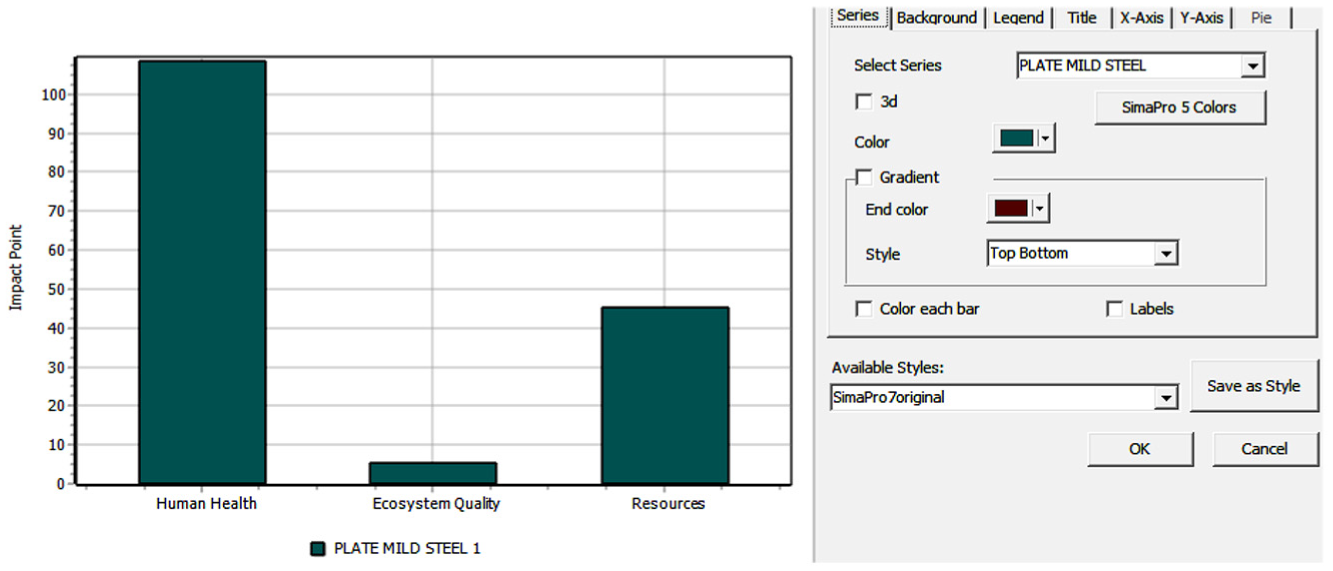
Sustainability analyses for mild steel (low-carbon steel) plate.

Sustainability analyses for aluminum plate.
Simulation analysis of the existing and proposed designs
In the production process, simulation is a novel concept to help format an appropriate sustainable manufacturing structure organizing various simulations with models. 37
The goal of simulation and modeling of the manufacturing process is to assess production efficiency 38 for analyzing suitable materials. The evaluation of the simulation analysis offers clarity in the selection of materials and manufacturing methods. A simulation is implemented before considering the manufacturing process and inventory control. This article adopts the simulation process for stress analysis and concludes that the latter is a better plate material39,40 as shown in Figures 10 and 11.

Simulation analyses for the existing material.

Simulation analyses for the proposed material.
Corrosion test and its evidence with scanning electron microscopy images
Corrosion is a naturally occurring process and, just like all acceptable processes, corrosion of resources is an impulsive one. It exposes the materials to their least possible force conditions. Corrosion is a degradation process for changing material properties in order to convert with their environment. The natural tendency of materials combined with alloys in the presence of oxygen and water will leads to the corrosion property and environmental effects to its most steady state.
The corrosion performance of mild steel, the Al8011 aluminum alloy, in a variety of environments is identified. Aluminum has greater advantages than steel, namely, less weight and poor affinity to corrosion in the presence of environment.
The material selection for the most part of the regular and significant technique of reducing corrosion is the exact and suitable materials for corrosive environments. Corrosion performance of every metal and alloy is exclusive and essential which has a powerful relation with the environment as shown in Figure 12. In this context, the experimental test of distinct aluminum alloy was performed in comparison with low-carbon steel using Tafel polarization techniques. 41 In test specimens in special circumstances compared with those in air, evident corrosion behavior with 3.5% NaCl solution, which is equivalent to sea water, was observed. These corrosion variants are considerably unusual, and the conclusions are shown in the scanning electron microscopy (SEM) images in Figure 13. The irregular corrosive surfaces can be viewed as consistent corrosion attributes. Various corrosion pits were observed in 3.5% NaCl solution.

Corrosion analyses for low-carbon steel (mild steel) with aluminum plate.

Microstructure of low-carbon steel (mild steel) and aluminum plate.
Conclusion
This article deals with the selection of material toward eco-design and presenting a structure to analyze the proposed materials in a life cycle point of view. Usually, most of the designers considering minimum available data have to choose suitable eco-friendly materials for the proposed design. The definite economic, environmental, and social impact of material identification is evidently inadequate to make knowledgeable resolutions. It is suggested to use a process model and a product process to include cost-effectiveness and ecological impact constraints of the maximum in the production process stage. The analysis of the proposed design is very simple compared with the others. In this study, focused in details of the materials and its properties are adapting simulation analysis, corrosion effects, ecological impact and cost effectiveness. The major aim of the organization is to reduce weight of the holding plate material and focus on minimizing the environmental impact even though the cost is slightly elevated. The new approach was included for motor holding plate materials for enhancement of sustainability manufacturing process. The proposed servo motor holding plate material has to be applied to the existing pneumatic motor holding plate design to reduce the impact of ecological parameters. A novel approach to study the ecological parameters has been experimented and can be utilized in manufacturing processes to reduce environmental degradation effects and improve sustainable product manufacturing.
Footnotes
Acknowledgements
The authors express their special thanks to Bosch Ltd, Gangaikondan, Tamil Nadu, India for their valuable input sources, data for the development of this work, and support extended toward the execution of the assignment titled “Up gradation of fixture indexing mechanism in crank speed sensor assembly line.”
Handling Editor: James Baldwin
Declaration of conflicting interests
The author(s) declared no potential conflicts of interest with respect to the research, authorship, and/or publication of this article.
Funding
The author(s) received no financial support for the research, authorship, and/or publication of this article.
