




Abstract
This article establishes a charging model for a tradable credit scheme based on the system optimum theory. The credit price and the distribution of the amount of tradable credit are determined with the model. The method of formulating the real-time tradable credit scheme in the circumstance of big data is also discussed. This article will enact the specific tradable credit scheme by adapting the charging model and then examine implementation effects after the scheme. The results indicate that the enacted tradable credit scheme by using the proposed charging model is helpful in reducing the total cost of the system and promoting the balance between traffic supply and demand. This suggests the effectiveness of the proposed tradable credit scheme and the feasibility of the charging model. A comparison between the tradable credit scheme and the congesting pricing strategy suggests the superior effect of the former strategy. The findings can be applied to formulating the tradable credit scheme, with which we can adjust travelers’ path selection behaviors and promote the traffic flow to a balanced distribution status. This is benefit to the urban transportation system by alleviating the problem of traffic congestion, fuel consumption, and pollution emissions.
Introduction
The problem of traffic congestion has been quite noticeable with the population and economic development in urban area. Drivers have to waste more travel time on the road due to traffic congestion. It also triggers the problems of energy consumption and environment protection.1–3 Congestion pricing has been recognized as an efficient measure for traffic demand management and control, which is implemented by defining a closed charging area and guiding the road users to change their behaviors in terms of path selection.4,5 However, one of the major problems with congestion pricing is that it is perceived as unfair. 6 That’s why congestion pricing is difficult to be implemented.7–9 To explore more reasonable charging strategies, many researchers focus on the tradable credit scheme in recent years. The strategy was originated by Dales 10 for the purpose of attaining water quality targets in a cost-effective manner. Grant-Muller and Xu 11 analyzed the roles of tradable credit strategy in traffic congestion management. Yu et al. 3 and Yang and Wang 12 introduced the tradable credit scheme to alleviate traffic congestion. Previous studies suggested that, different from the congestion charging strategy, tradable credit scheme does not involve financial transfer from travelers to government, and it is fairer and more acceptable to the public.
Compared to congestion pricing, government can initially distribute credits freely to all travelers, and tradable credit can be freely traded in the market. Travelers can buy or sell credits according to their individual travel needs in a free market for credit trading. Thus, trading travelers can get a tangible reward from the credit trading. In addition, the charge of tradable credit for each link is predetermined. Travelers can change their path selection based on the amount of the credits which need to be charged. 13 In this way, the higher operational efficiency of the network can be created.14–16 Tradable credit scheme assigns fixed credits equally to all travelers so that fairness is explicitly demonstrated. Moreover, in contrast with congestion pricing that credits can then be traded freely in market and travelers can benefit from trading. This indicates that the tradable credit scheme is more applicable than the congestion pricing.
Previous studies mainly focused on examining the effects of tradable credit scheme on adjusting the distribution of traffic flow and resolving the congestion problem. For example, Xiao et al. 17 proposed the effectiveness of a tradable credit scheme in managing traffic congestion during rush period. Nie and Yin 18 analyzed the effect of tradable credit scheme in managing commuters’ travel choices. Few researchers proposed a feasible method for the formulation of the tradable credit scheme, that is, how to calculate the credit price and the amount of tradable credit distributed in the road network. Therefore, this study will propose a charging model for tradable credit, with which a detailed scheme can be determined.
The remainder of this article is organized as follows. In section “Existing literature,” a general overview of tradable credit studies is presented. A charging model for the tradable credit scheme is formulated by considering the system optimum theory in Section “Model formulations.” Section “Case study” presents the case study and the discussions. The article is concluded with section “Conclusion,” in which we summarize our findings and discuss our study limitations and directions for future research.
Existing literature
Most of the studies emphasis on examining the effectiveness of the tradable scheme by simulating the distribution of traffic flow. The system optimum theory was one of the major theories utilized in investigating the effects of the scheme. For example, Nie 19 analyzed the efficiency of a tradable credit scheme in resolving congestion problem for the morning commute. They proved that the scheme is able to satisfy the system optimum and certain forms of fairness. Song et al. 20 checked the whole road network to verify if it could achieve an optimized state of traffic flow distribution after the path selection adjustment of the traveler. Tian et al. 21 proved that the charging scheme is unique in the system, and the scheme is always Pareto improvement when the system optimum is achieved. He et al. 22 found that there was a tradable credit scheme that can achieve system optimum status when the transaction cost was not considered. Aziz and Ukkusuri 23 proposed the tradable credit scheme that can reach Pareto optimal solutions. Ye and Yang 24 proposed that the tradable credit scheme was always Pareto improvement when the system achieves the optimal status. Besides, Dogterom et al. 25 investigated the efficiency and effectiveness of a tradable credit scheme when the system reaches optimum status. Gao and Hu 26 examined the availability of tradable credit scheme by using the system optimum theory. The previous studies indicated that the system optimum theory can be applied to simulating the path selection after implementation of tradable credit and examining the effectiveness of the scheme.
The existence and uniqueness of the tradable credit scheme have been proved in the previous studies, though a charging model, with which we can determine the unit price of each tradable credit and the amount of tradable credit in the road network, has not been proposed in these studies. Therefore, a charging model for the formulation of a tradable credit scheme will be developed in this study.
Model formulations
Definition of travel path and travel cost
The article first defines a general network
Let

The travel demand for each O–D pair u is denoted by Du, which is expressed as

For each link


Let C represent the total travel cost of system. The total travel cost of the system before implementation of the tradable credit scheme is denoted by Cbefore, which is expressed as

The total travel cost of system after implementation of the tradable credit scheme is denoted by Cafter, which is expressed as

Construction of the charging model
Some studies27,28 investigated that the charging model can be established based on the system optimum theory by considering the minimum total cost of the overall system. The mathematical programming model of system optimum is as follows


According to equation (8), the formula can be expressed as




Sheffi
29
proposed that, when the traveler chooses a link, the travel cost of the link includes the travel cost of the traveler and the external marginal cost generated by the travelers. In the article, the external marginal cost will be obtained by charging the traveler with the credit cost and that is also the implementation principle of the tradable credit scheme.30,31 Based on equation (13),


According to equation (15), the amount of tradable credit charged on the link can be expressed as

The Frank–Wolf (F–W) algorithm32,33 is utilized to solve the system optimum model. Based on F–W algorithm, we first linearize the objective function, then the linear programming problem is solved, and the feasible direction of the decline is found during the iterations. At last, a one-dimensional search in the feasible domain in the direction is used to obtain a new iteration point.34,35
In addition, the traffic flow (Fi on link i) in the road network can be obtained in real time on the background of big data. Thus, we can conduct the formulation of the tradable credit scheme and achieve the system optimization dynamically.
Case study
The network used in the case study has 16 nodes and 24 links, in which node 1 is the origin node and node 16 is the destination node. “u = 1–16” is the O–D pair in the network (Figure 1). The standard US Highway Bureau impedance function is employed as the link impedance function,18,36 namely

Traffic network diagram.
The values of parameters in cost function.

After implementation of the tradable credit scheme, the cost of tradable credit
The cost and the amount of tradable credit for each link after implementation of the scheme.
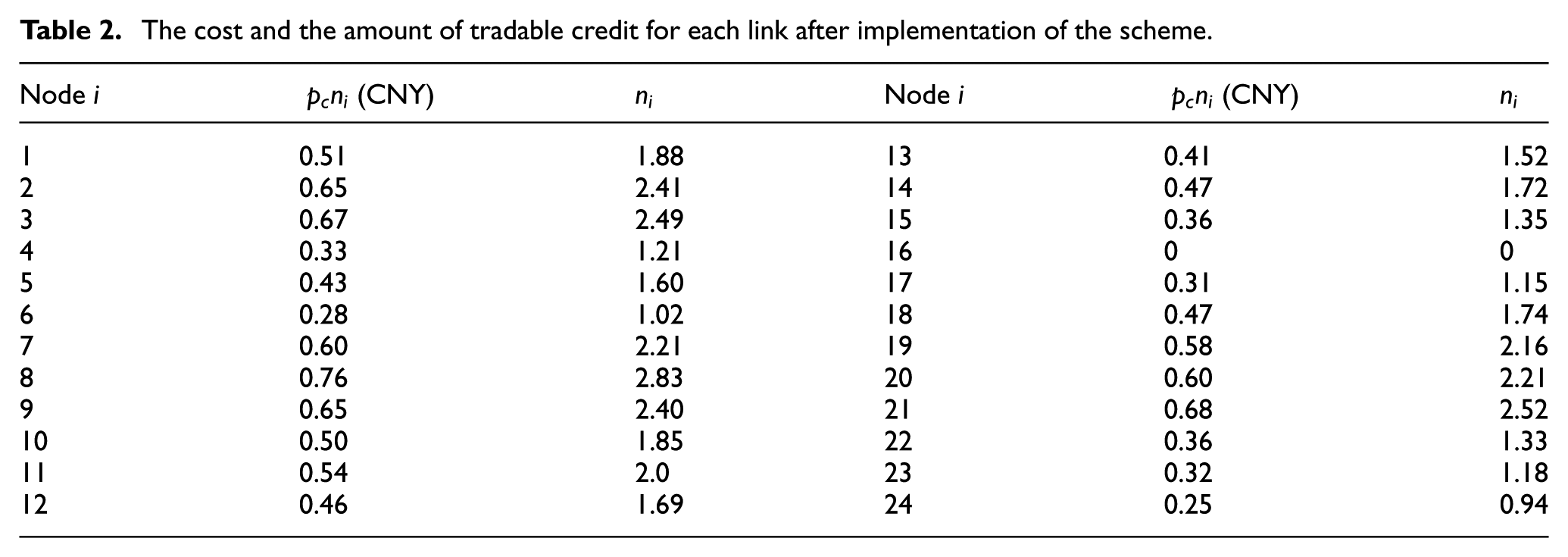
Travelers adjust their path selection decision based on the scheme, and a new traffic flow distribution is then obtained as shown in Table 3. The total travel cost of the system is calculated to be 5608.57 CNY.
Traffic flow before and after the implementation of the tradable credit scheme.

Fi-before represents the traffic flow before implementation of the scheme; Fi-after represents the traffic flow after implementation of the scheme.
In addition, the traffic flows of all the links before implementation of the tradable credit scheme are calculated, which are shown in Table 3. The total travel cost of the system is 5794.70 CNY.
The result indicates that the total cost of the system after the implementation of the tradable credit scheme (5608.57 CNY) is lower than that before the implementation of the scheme (5794.70 CNY). The results of traffic flow shown in Table 3 indicate that the traffic volumes in the congested links (i.e. links 3, 7, and 13) before the implementation of the scheme decrease while those in the uncongested links (i.e. links 8, 11, and 15) increase. This suggests that the traveler adjusts the path according to the tradable credit scheme. As a result, the distribution of the traffic flow tends to reach a balanced status. The decrease in total cost of the system and the balanced distribution of traffic flow in the network proves the effectiveness of the proposed tradable credit scheme and the feasibility of the charging model.
In addition, to compare the effect of tradable credit to congestion pricing, a congestion pricing strategy is formulated for the road network in the case. We assume that the toll for the congestion link, that is links 9, 12, 13, and 16, is, respectively, 2 CNY, 2.2 CNY, 2.5 CNY, and 2.7 CNY. The distribution of traffic flow is then calculated by employing the F–W algorithm. The results are shown in Table 4. The total travel cost of the system is 5714.13 CNY.
Traffic flow after the implementation of congestion pricing strategy.

Fi-congestion represents the traffic flow after implementation of congestion pricing strategy.
The results show that the travel cost of the system after implementation of the tradable credit scheme (5608.57 CNY) is lower than that under the congestion pricing strategy (5714.13 CNY). This indicates that the distribution of traffic flows in the network is more balanced under the implementation of tradable credit than congestion pricing, which suggests the effectiveness of the tradable credit.
Conclusion
This article establishes a charging model for the tradable credit scheme based on the system optimum theory. The credit price and the distribution of the amount of tradable credit in the road network can be determined with the model. The method of formulating the real-time tradable credit scheme in the circumstance of big data is also discussed. The results indicate that the enacted tradable credit scheme by using the charging model help for reducing the total cost of the system and promoting the balance between traffic supply and demand. This suggests the effectiveness of the proposed tradable credit scheme and the feasibility of the charging model. In addition, the total travel cost of the system after implementing the tradable credit scheme is lower than that under the congestion pricing strategy. This suggests that the tradable credit scheme is more effective than the congestion pricing strategy in promoting the balance of traffic flow distribution and reducing the total travel cost of the road network.
The results of this article can be applied to calculate the amount of tradable credit and the credit price, which contribute to the formulation of the tradable credit scheme. An effective scheme can then help to promote the equilibrium distribution of traffic flow in road network and contribute to the balance of supply and demand in the transportation system, which is benefit for the alleviation of the problem of traffic congestion. Besides, under the condition of different demand/capacity scenarios, the optimal result of the amount of credit and credit price can be obtained by setting different values for Fi in equation (15). In this way, the tradable credit scheme under different demand/capacity levels can be formulated. Furthermore, if the real-time data of traffic flow can be acquired in the big data environment, the amount of credit and the credit price can be dynamically calculated with the charging model. However, the recalculating and updating cycle of the credit price and the distribution of credits in road network need to be discussed in future research.
In this article, we take all the travelers to be homogeneous in order to simplify the charging model. However, different travelers have different characteristics, which may affect their path selection behaviors. For example, they may have distinct perceptions about the value of time. Therefore, future study will consider travelers’ heterogeneous characteristics in modeling the path choice decision as well as establishing the charging model. In addition, research concerning the dynamic calculation of the tradable credit scheme in the big data environment will be focused on in the follow-up study.
Footnotes
Handling Editor: Tao Feng
Declaration of conflicting interests
The author(s) declared no potential conflicts of interest with respect to the research, authorship, and/or publication of this article.
Funding
The author(s) disclosed receipt of the following financial support for the research, authorship, and/or publication of this article: The research was funded by the Humanity and Social Science Foundation of the Ministry of Education (18YJA 630157), the National Natural Science Foundation of China (61873109), and the Talent Development Funding Project of Jilin Province in 2019.
