




Abstract
This article proposes a tradable credit scheme for managing commuters’ travel choices. The scheme considers bottleneck congestion and modal split in a competitive highway–transit network with heterogeneous commuters who are distinguished by their valuation of travel time. The scheme charges all auto travelers who pass the bottleneck during a peak-time window in the form of mobility credits. Those who avoid the peak-time window, by either traveling outside the peak-time window or switching to the transit mode, may be rewarded credits. An artificial market is created so that the travelers may trade these credits with each other. We formulate the credit price and the rewarded and charged credits under tradable credit scheme. Our analyses indicate that the optimal tradable credit scheme can achieve nearly 40% efficiency gains depending on the level of commuters’ heterogeneity. In addition, this scheme distributes the benefits among all the commuters directly through the credit trading. Our results suggest that in assessing the efficiency of tradable credit scheme, it is important to take into account the commuters’ heterogeneity. Numerical experiments are conducted to examine the sensitivity of tradable credit scheme designs to various system parameters.
Keywords
Introduction
Congestion in morning commuter traffic has traditionally been modeled as a bottleneck problem. The classic bottleneck model was developed by Vickrey 1 who studied the commuting congestion in a highway between a residential area and a workplace. It shows that there exists an equilibrium departure-time pattern, whereby all commuters incur the same travel cost no matter when they start their trips. Traffic congestion taking the form of queuing behind a bottleneck is a deadweight loss to system efficiency. The bottleneck model offers a flexible framework for investigating the effects of congestion pricing schemes to alleviate the queue behind the bottleneck.2–4 In this context, congestion pricing is found to be efficient in internalizing the external costs of the traffic by inducing the change in departure pattern.
Since the idea was first put forward by Pigou 5 and Knight, 6 congestion pricing has become a widely known mechanism to regulate traffic congestion. However, it is also known to induce inequity among commuters if the differences in their values of time are not properly taken into account. This issue has been addressed in the literature. The effect of congestion pricing on different commuter groups is demonstrated theoretically with a static network analysis method7–9 and with the bottleneck modeling method.10–14 There have been recent interests in the design of more equitable and practical congestion management schemes. An example of such alternative is the “tradable permit system” by which the eligible residents will receive a certain amount of “rights” for the scarce good. Verhoef et al. 15 discussed the possibilities of using tradable permits in the regulation of road transport externalities. Akamatsu et al. 16 proposed a “tradable bottleneck permits” (TBPs) scheme for resolving the morning commute problem. In their model, the road manager issues the “bottleneck permits” to road users, and the permits are tradable in auction markets.
Recently, the cap-and-trade scheme, which involves issuing mobility credits and allowing travelers to trade in a market, seeks to couple quantity restriction with a trading mechanism. It is also known as tradable credit scheme (TCS) 17 and has been extensively studied.18–20 Xiao et al. 21 analyzed the TCSs in the context of the morning commute problem. Their model replaces Vickrey’s toll with a corresponding time-varying credit charge and an initial allocation of credits. Their results indicate that the credit market can achieve the system optimum even when travelers differ in their values of time. Nie 22 adopts tradable credit to replace single step-coarse toll with homogeneous commuters in bottleneck model with respect to three different behavior assumptions.2,23–26
Recently, Tian et al. 27 proposed the time-dependent credit charge scheme to manage bottleneck congestion and modal split with heterogeneous users. However, such a complex credit structure is not very well accepted by travelers as they cannot predict the amount of charging they would have to pay in advance. This impels us to develop more practical TCS, which delineates an off-peak credit-rewarding and a peak-time credit-charging systems. In addition, we consider mode choice (between auto and transit modes) in the morning commuting problem as well as heterogeneity in commuters’ Value-Of-Time (VOT). We assume that the travelers’ VOT is continuously distributed across the population and propose a new tradable credit based on different travelers’ behavior assumptions. Compared with the traditional step-coarse tolls, this scheme is revenue neutral and hence less likely to be perceived as another taxation instrument.
Introducing the TCS proposed by Yang and Wang 17 into a mode-choice problem has the potential to lead to revenue-neutral transport pricing and subsidy policy. Inspired by this consideration, this article aims at developing efficient TCS that makes everyone better off and that reduces social cost in a competitive two-mode network. Without loss of generality, we deal with the two-mode morning commuting problem with road bottleneck congestion and incorporate user heterogeneity by assuming that travelers’ VOT is continuously distributed across the population. Under the credit scheme, travelers will divide themselves among two modes and choose different departure time for going through the bottleneck according to their own preferences and sell and buy additional credits according to their individual travel needs. The resulting equilibrium price of credits in the trading market and the competitive two-mode traffic equilibrium will thus be ascertained.
The next section presents a bottleneck model of morning commute problem considering the heterogeneity of commuters and discusses the equilibrium without tolling. Section “TCS for a single bottleneck with heterogeneity” proposes a TCS for morning commute problem and looks into the changes in individual travel cost before and after the optimal credit scheme. The two-mode equilibrium with the TCSs is derived in section “Departure time and mode choice in the presence of optimal TCS.” In section “Numerical examples,” a numerical example is presented to illustrate the effect of commuter heterogeneity on equilibrium solutions with credit scheme. Finally, section “Summary and concluding remarks” draws the conclusions.
No-toll scheme for a single bottleneck with heterogeneity
User heterogeneity can be resulted from income differences between otherwise identical commuters. Following the literature, we represent user heterogeneity in terms of different unit costs of travel time (
We assume here that everyone has the same work flexibility, and the ratio between the unit penalties for the queuing delay and schedule delay is the same for all commuters, that is,

where
Suppose there are two competing modes of a highway and transit line connecting a single pair of origin and destination. It is assumed that a fixed number of
The highway exhibits bottleneck congestion, which is characterized by the standard bottleneck model developed initially by Vickrey.
1
In no-toll scheme, the trip cost of the

where
In order to derive the equilibrium based on no-toll scheme, we define the function of generalized queuing time as follows

where
Under user equilibrium without toll,

Since the first and last departures confront no queue at bottleneck, the cumulative departure flow at the last time

where

The system trip cost calculated in monetary unit is obtained by integrating the individual costs throughout the whole population

For homogeneous travelers, the system total cost becomes
TCS for a single bottleneck with heterogeneity
Here, we focus on step-coarse toll under proportional heterogeneity. And let us first explain how a step-coarse toll works in a single bottleneck. A key question in analyzing a step-coarse toll is how to deal with discontinuously taking place at the boundary of the peak-time window. Such discontinuity forces users arriving at the boundary to have different travel delays, depending on whether or not they pay the toll. Arnott et al.
2
argued that because the first person who pays the toll must have a lower travel delay compared to his or her immediate predecessor who escape the toll, he or she must arrive at the bottleneck later by
Mass departure (MD),
2
which assumes that a MD at the bottleneck occurs immediately after the toll is lifted (see Figure 1(a), at time
Separated waiting (SW),23,24 in which commuters who choose to pass the bottleneck after a tolling period can wait on a set of secondary lanes (the dotted blue curve in Figure 1(b)) without impeding other drivers who do pass the bottleneck in that tolling period.
Braking-induced idling (BI), 25 which assumes that commuters would slow down or stop just before reaching a tolling point and wait until the toll is lowered from one step to the next step before proceeding. The equilibrium departure-time patterns as derived by the above authors, under homogeneous conditions, are reproduced in Figure 1(c). Some of the key characteristics of these assumptions are further described in this section.

Equilibrium with a coarse toll based on three different behavioral assumptions: (a) MD, (b) SW, and (c) BI.
Under heterogeneous preferences, the optimal coarse tolling of congestion corresponding to the above assumptions is analyzed (see Van den Berg,
28
for details). Based on the proportional heterogeneity, total cost will be minimized with respect to the number of un-tolled users (


where
Parameters used in the analytical solutions for step-coarse toll models.

MD: mass departure; SW: separated waiting; BI: braking-induced idling.
The number of commuters who pay the toll is

Also, the system travel cost excluding toll is

and

By taking

Equation (12) implicitly determines the amount of commuters

Substituting the parameters of Table 1 into equation (13), it is clear that
In the TCS, authority delineates a peak-time window

or

which represents the ratio between the unit of reward for travel in the off-peak to the unit of pay in peak travel. It is also easy to see that
The trading between the off-peak and peak users can be translated into a peak-time step-coarse toll

where
Adopting the same uniform VOT distribution
For heterogeneous users with the special case
Departure time and mode choice in the presence of optimal TCS
A TCS was first proposed by Yang and Wang, 17 and may be used to replace Vickrey’s time-varying toll, as shown in Xiao et al. 29 (for homogeneous commuters) and Tian et al. 27 (with heterogeneous commuters). While social optimum (SO) TCS is capable of eliminating queuing delays completely, it requires a continuously adjusting credit charges which can be difficult to implement in practice. Recognizing the importance of simplicity, Nie 22 proposed a TCS that aims at replicating the effect of a step-coarse toll with homogeneous commuters. Therefore, it is straightforward to start the analysis with user heterogeneity in the context of TCS and in particular its welfare and distributional effects.
The toll scheme formulated in section “TCS for a single bottleneck with heterogeneity” keeps the toll rate constant in a time window to reallocate the peak demand on the congested highway. Such a pricing structure is not very well accepted by travelers as it may lead to issues of fairness and the lack of alternative mode of travel. Redistributing the toll revenue to the auto travelers can deal with some of these issues, so can provide attractive policies and services for rewarding travel by public transport. Here, we consider a policy based on the TCS for reducing congestion costs in a two-mode network. We examine the two subsystems of TCS: a credit charging and a credit distribution schemes.
Analysis of mode choice with TCS
Unlike the auto mode, we assume that (1) the capacity of transit mode is sufficiently large, (2) the transit pattern ignore that schedule late or early cost, and (3) the cost of commuting by transit depends only on the in-vehicle travel time cost. Since we assume the free-flow travel time for highway is zero, then

Under no-toll scheme,

and naturally,

The total system cost can be rewritten as follows

and

Substituting equations (7) and (8) into equation (20), and using equation (18), the optimal flow distribution (

where


In equation (23),
The number of peak-time highway users

Note that if
The above analysis also provides a framework to evaluate the efficiency of a given TCS defined by
Changes in individual travel cost
Once the TCS is implemented, the whole traveling population can then be divided into four groups, as follows:
1. The group with high VOT who remains on transit service. Their travel costs will never increase because the transit mode is free of congestion, and these commuters benefit most from selling their earned credits to other commuters. The cost change is

2. The group of commuters who are forced to shift from auto to transit. Those commuters have relatively low VOTs, and by shifting modes, they experience a longer travel time, although the credit charge is avoided. In addition, they receive a subsidy to cover the additional travel time cost. The cost change is

3. The group of commuters who remain on highway during peak-time window. These travelers pay the credits and enjoy a travel time reduction because the highway is less congested with less demand. The travel costs can be higher or lower depending on whether the reduction of delay cost covers the credit charge. Comparing the two costs before and after the scheme, the cost change is

where
4. The group of commuters who remain on highway during non-peak-time window. As will be seen later, in some cases, this group of commuters can benefit from the scheme, whereas in other cases, some of them will not

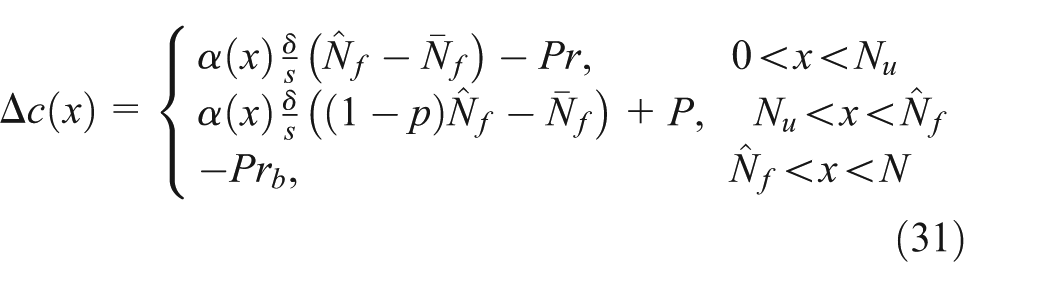
The changes in the travel costs of commuters after implementing the TCS are summarized by the following piecewise function
where
In the following section, we only consider the SW assumption and a uniform VOT distribution for better analytical tractability. Finding the analytical solutions for the other assumptions is tedious but relatively straightforward following the procedure used in SW. Hence, we shall examine the impact of different behavior assumptions in numerical experiment.
Special case: heterogeneous commuters
Finding an analytical solution to the above problem is tedious, and we shall examine the impacts of different behavior assumptions and congestion effects in numerical experiment. Below, we show how such an analysis can be conducted when VOT follows a uniform distribution,
Substituting

Using equation (17), then the above equation can be rewritten as follows

Now, from equation (8), we can obtain the equilibrium credit price as follows

The credits reward to the transit riders should be set such that the income from selling them would be able to offset the cost difference between the two modes, that is

Finally, the credit conservation condition dictates that

Combining equations (33), (35), and (36), we can find

where

Proposition 1
Under the system optimal tradable credit scheme (SO-TCS), (1) if
Proof
Condition 3 is trivial: if

If only the highway is used, then the minimum system cost is obtained when

We prove condition 1 by contradiction now. Suppose when

Combining this inequality with equation (33) yields

The last inequality holds because
The proof of Proposition 1 shows clearly that both the highway and the transit service should be used when
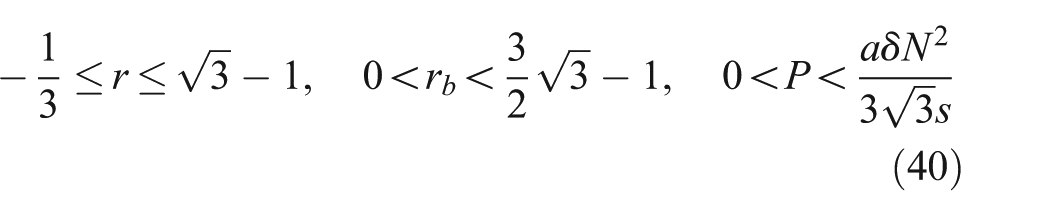
Proposition 1 assures that at the system optimum,

when
Note that the nonpeak users on highway may receive negative credits, that is,
Hereafter, we examine the welfare effects of the system travel cost with TCS and compare it to the system trip cost under no-toll equilibrium. Equation (17) indicates that the number of highway users
For SO-TCS, the analysis in Proposition 1 shows that when

where

It is clear that the efficiency gains first increases from 0% to 20.5% as
Numerical examples
In this section, we provide numerical examples to illustrate the differences under the TCS discussed in the previous sections between homogeneous and heterogeneous traveling populations. We assume the demand
Figure 2 shows how the SO credit costs under SW assumption changes with parameter

SO-TCS solutions with SW assumption.
We further investigate the difference in equilibrium trip cost between the TCS and the no-toll scheme with SW assumption, as denoted by

Change in travel cost with TCS.
Figure 4 shows the percentage reduction in system travel cost (excluding credit) generated by TCS based on homogeneous commuters and a special case of heterogeneity, as a function of

Percentage reduction in system travel cost due to TCS as a function of
Figure 5 shows how the design variable of SO-TCS as well as the corresponding equilibrium flow pattern changed with

SO-TSC solutions changed with
Figure 5(b) shows the credit price (i.e. P) is a concave function of
Figure 5(c) shows that the percentage of the non-peak-time users (i.e.
Figure 5(e) reveals that the off-peak-time users ought to be rewarded more credits (i.e. r) when the travel time
Figure 6 repeats the above sensitivity analysis for when the demand
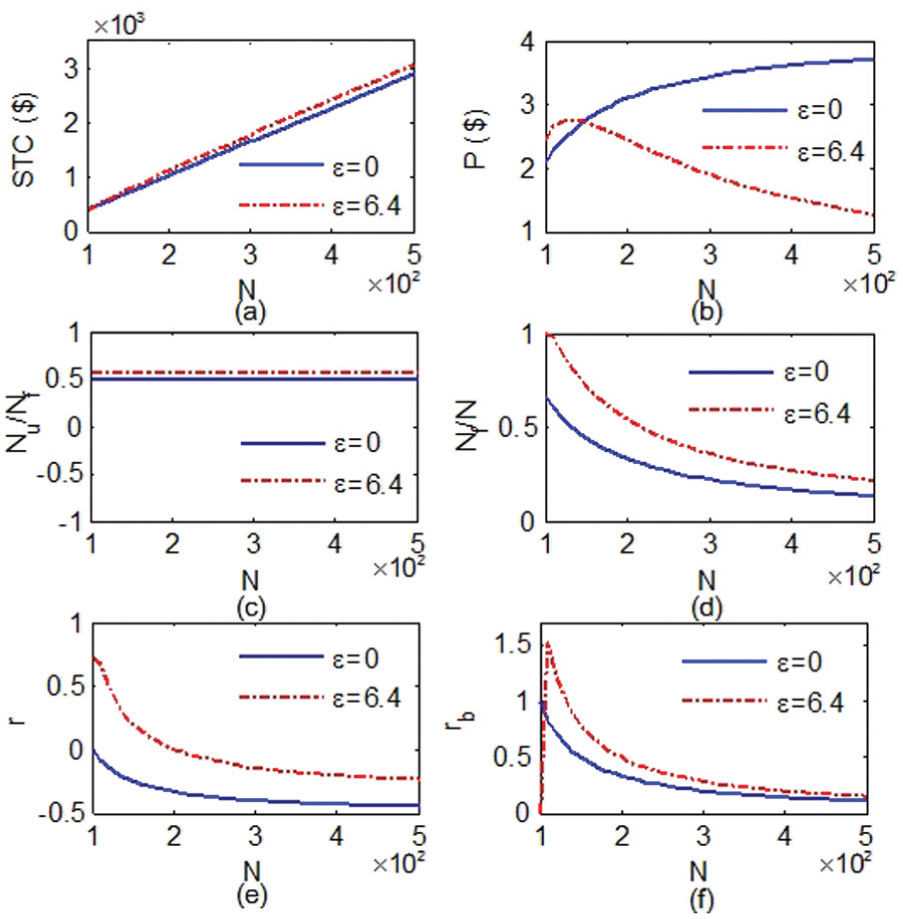
SO-TCS solutions changed with
Figure 7 shows the sensitivity analysis results when capacity
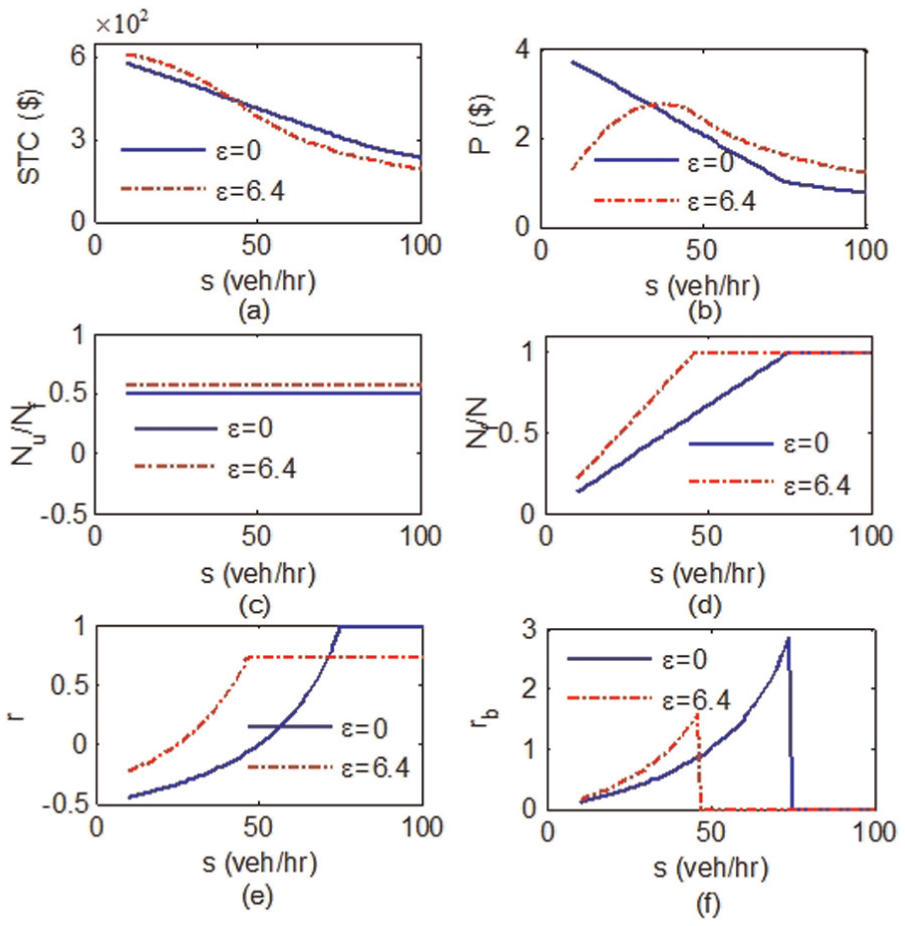
SO-TCS solutions changed with
Figure 8 compares the results for the three behavior assumptions when

SO-TCS solutions under different behavior assumptions (
Summary and concluding remarks
In this article, the economics of a morning commute problem on a single bottleneck is investigated for a heterogeneous commuter population and with a choice of auto and transit mode of travel. First, we derived the equilibrium departure-time profiles for the heterogeneous commuters, under no-toll condition. The corresponding individual trip cost and the total system trip cost are presented. For heterogeneous commuters, queuing delay is a pure loss, and it remains that congestion toll is effective for reducing the queues behind the bottleneck. We proposed a TCS as an alternative demand management strategy to replace the step-coarse toll. TCS works like a single-coarse toll, except that the price of the credit is determined by the competitive market. It is a combination of two subschemes: a credit charging and a credit distribution schemes. We analyzed TCS under three different behavior assumptions, namely, MD, SW, and BI. With each behavior assumption, we presented the optimum ratio of the unit of reward and charge credits. For TCS with a coarse toll alternative, the departure pattern of commuters with heterogeneous commuters is similar to the homogeneous case. Still, a difference that arises for the ratio of the unit of reward and charge credits, which is due to the pattern of distribution effect, is different with respect to VOT.
The main focus of this article is the two-mode problem under a tradable travel credit scheme, with a variety of assumptions about commuter’ behavior in response to the discontinuous credit charge introduced at the boundary of the peak-time window. In the simple case (when VOT follows a linear function for the SW assumption), the design of SO-TCS, including the choice of the peak-time windows as well as the number of credit rewarded to or charged on different groups of commuters, can be described using simple formulas. These analytical results indicate that the equilibrium solutions are only affected by the relative generalized travel time of the two routes (
With a general VOT distribution of heterogeneous users, the characteristics of the SO-TCS under the above three different behavioral assumptions are compared with those with homogeneous commuters. It showed that the characteristics of traffic patterns for homogeneous and heterogeneous commuters are markedly different. Without considering commuter heterogeneity, the number of peak-time highway commuters, the credit reward-to-charge ratio and the transit users are all overestimated. The
Overall, our findings suggest that it is important to take into account the heterogeneity of commuters in assessing the impacts of tradable credit under two-mode system. The analyses presented in this article still leave out a few important real-world features, of which the most critical is perhaps corridor network with multiple bottlenecks. In our future work, we plan to further extend the application of the credit scheme to solve a multi-route and multi-mode problem and to manage traffic demands, parking spots, and emissions.
Footnotes
Academic Editor: Yongjun Shen
Declaration of Conflicting Interests
The author(s) declared no potential conflicts of interest with respect to the research, authorship, and/or publication of this article.
Funding
The author(s) disclosed receipt of the following financial support for the research, authorship, and/or publication of this article: This work was financially supported by the National Basic Research Program of China (2012CB 725401) and the Talent Fund of Beijing Jiaotong University (2014RC021).