




Abstract
Nowadays phone distraction has started to become an increasingly recognized phenomenon. This article aims to examine the influences of phone use on pedestrian crossing behavior at signalized intersections in China. Using video recording and manual counting, pedestrian crossing behavior, age, gender, phone use, and waiting time are obtained at four signalized intersections. Totally, 4196 pedestrians are observed in four peak hours. Among them, 328 pedestrians (7.82%) are using their mobile phones, including 162 male pedestrians and 166 female pedestrians. The average phone use rate in different age groups are presented as follows: children (4.49%), youth (10.69%), middle-aged (6.87%), and elderly (1.15%). In terms of the phone using behavior on the crosswalk, age is a significant factor, while gender is not. For the type of violation behavior, the results show that pedestrians who use mobile phones are most likely to be late starters. In addition, some other important results are found: mobile phone use can raise the violation of pedestrian crossing behavior; pedestrians using their phones are more likely to cross on red; and pedestrians using their phones while crossing walk more slowly. Finally, the application significance of this study and some recommendations are provided to improve pedestrian safety.
Introduction
Pedestrian represents the largest group of road users. Among all the road users, pedestrian is one of the most vulnerable groups.1,2 They account for a large proportion of road traffic casualties. Traffic crashes involving pedestrians are most likely to occur when pedestrians are crossing the street. 3 The complex characteristics of pedestrian crossing behavior are embodied in the field of transportation, urban ecology, sociology, and other fields. In the last 20 years, the use of mobile devices has grown fast worldwide. For example, China has more than 668 million Internet users in 2015. What’s more, 594 million are mobile users, accounting for more than 88.9% of all the Internet users. 4
Although mobile phone offers benefit, convenience, and entertainment to the phone users, the injury prevention community has expressed concern about their distractions (e.g. listening to the music and talking on the phone) to pedestrians from safe engagement in potentially hazardous traffic environments. For example, Ferguson et al. 5 and Nasar and Troyer 6 found that the proportion of mobile phone-related injuries is higher for people under the age of 31 years. Therefore, pedestrian safety while using the phone on the crosswalks should be the subject of many studies.
In the past few years, the impact of phone use on driving safety has received considerable scholarly attention. Specifically, some researchers found that mobile phone use while driving can increase drivers’ reaction time to change traffic conditions. 7 Recently, researchers have shown a growing interest in extending work on the role of distraction from drivers to pedestrians. Findings from the observational studies showed that pedestrians who were distracted by phone conversations, listening to music or other activities (e.g. eating), take great risks while crossing the road. The distraction was found to be negatively but slightly associated with the displaying cautious pedestrian behaviors. 8 A relatively recent research, by observing 1102 pedestrians at 20 intersections of high accident rate, Thompson 9 found that distraction extends the time of the pedestrian crossing and increases the risk of crossing. Using field observation data, the logistic regression models were built to analyze the impact of phone use on pedestrian’s crossing behavior at uncontrolled intersections. 10 Hatfield and Murphy 11 found that pedestrians walk slower and pay less attention to the surrounding traffic when crossing the street with using phones.
Shigeru and Ayaka 12 made an experiment to examine the effects of “smart-phoning” (using a smart phone) while walking in a laboratory. David et al. 13 analyzed the crossing behavior characteristics of different personality people through questionnaire and traffic survey. These studies suggested that pedestrians who were using a mobile phone while crossing may amble across the street without checking for the surrounding traffic. Besides, Tang et al.14,15 proposed a two-layer stacking framework to predict the crash injury severity where three basic classification methods are used in first layer and crash injury severity are classified in second layer. Zou et al. 16 gave a copula regression model linking wildlife–vehicle collisions (WVCs) and the underreporting outcome to consider the underreporting in WVC data. Zou et al. 17 developed generalized finite mixture of NB models with K mixture components (GFMNB-K) models with varying weight parameters to analyze crash data from Indiana and Texas.
Consequently, a large sample investigation should be conducted to do a more extensive and deeper study. And, some new factors including pedestrian volume and waiting behavior should be examined in detail. This study is designed to expand on prior research by studying distraction behaviors in a large group of pedestrians during the action of crossing the street. And, we further explore not only the types of phone use but also many different factors associated with the phone use and different types of crossing behaviors.
Data collection
Study sites and investigation design
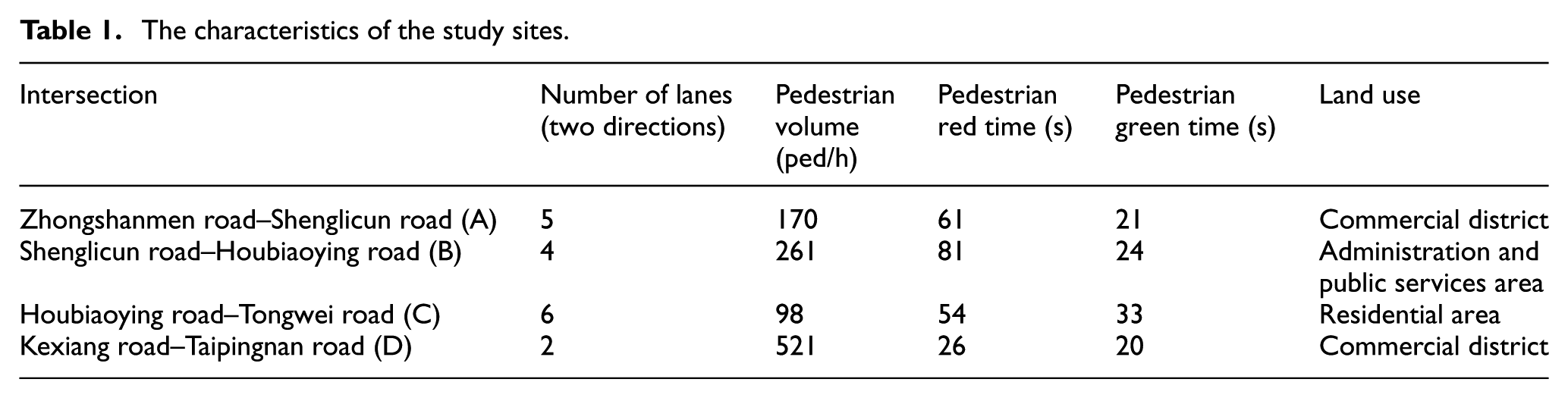
This study is mainly based on the results of a series of observations of pedestrian behavior. Research method used in this article is a combination of video recording and manual counting. Field observations are conducted at north approaches of four signalized intersections in the city of Nanjing, China. Study sites locate in different land-use areas, including commercial district, residential area, administration, and public services area. Some basic attributes of the intersections are presented in Table 1. The investigation time covers four peak hours in two periods (from 8 a.m. to 10 a.m. and from 4 p.m. to 6 p.m.) on 21 June 2016. The situation and traffic environment of four intersections are presented in Figures 1 and 2, respectively.
The characteristics of the study sites.
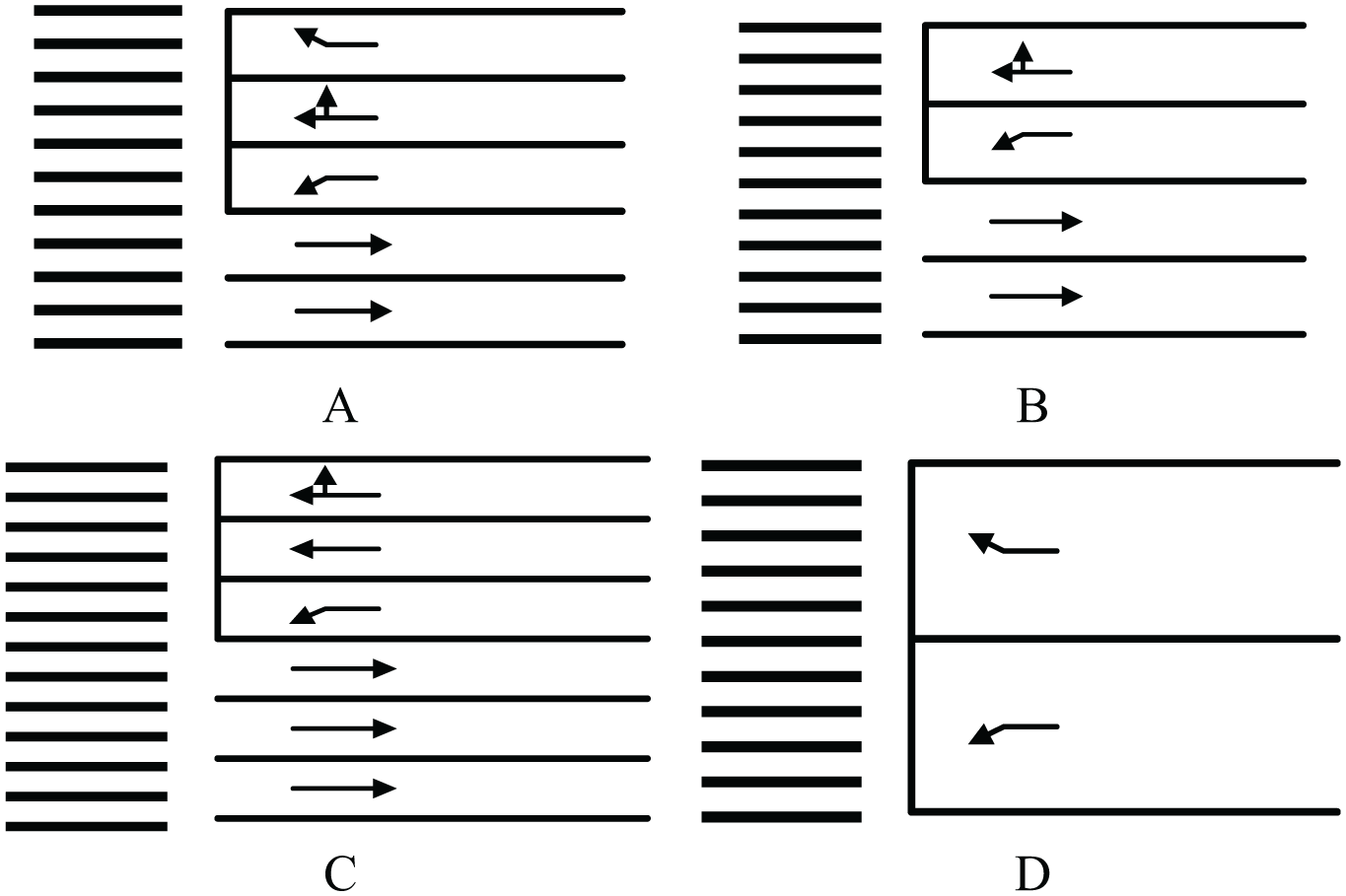
Crosswalks and lanes at four intersections.

Photos of traffic environment at the study sites.
Participants and data descriptive analysis
Using video recording and manual counting, a total of 4196 pedestrians are observed, where 328 observations are found using phone. Participants are divided into four groups by age: child (0–14 years old), youth (15–35 years old), middle-aged (36–60 years old), and elderly (over 60 years old). 18
According to the use of traffic signal, pedestrians can be classified into four categories: pedestrians who cross the street during the green signal (regular users); pedestrians who begin to cross when the signal is green, but do not finish on green (late starters); pedestrians who cross during the red signal (sneakers); and pedestrians who cross part of the crosswalk during the red signal and then continue crossing during the green signal (partial sneakers). 18 In China, the first behavior is legal behavior, while the other three behaviors are violations.
In order to examine the impact of mobile phone use, this study records the phone use time (before crossing the street, waiting, and during the crossing). In addition, the use of mobile phones is divided into three categories (making a call, playing games or texting, and listening to music). Furthermore, the car–pedestrian conflict numbers are applied to analyze the pedestrian safety in different situations. Demographic characteristics of the observed pedestrians are shown in Table 2. The behavioral characteristics of the pedestrians are shown in Table 3.
Demographic characteristics of the observed pedestrians.

Crossing behaviors of the observed pedestrians.

Methodology
Chi-square test
A chi-square test (

Odds ratio analysis
In this article, odds ratio (OR) is used to explain the relationship between the different factors and pedestrian behavior. For further analysis, each factor is analyzed by a single-factor model using the OR statistics. OR is the ratio of the odds of an event occurring in one group to that of another group. For instance, if the possibility of phone use in Group 1 and Group 2 are a and b, respectively, then the OR is calculated as

where if OR > 1, then Group 2 are more likely to use phone when they cross the street; otherwise, Group 1 may show greater tendency to phone use. As the OR is a way of comparing whether the probability of a certain event is the same for two groups, we use it to examine the effect of gender, age, and location on phone use behaviors.
Results
Different types of phone use distractions
Among all the 4196 observed pedestrians, 328 pedestrians are using the mobile phone while crossing the street. The chi-square test result (p = 0.045, which is <0.05) of location and phone use pedestrians shows that location has significant influence on mobile phone use. Table 4 presents the number of different types of phone use while pedestrians are crossing the street. It can be seen that the ratios of phone use at intersections A, B, C, and D are 7.82%, 9.58%, 16.15%, and 5.37%, respectively.
Different phone use types when pedestrians are crossing the street.

In addition, the study finds that the main use types of mobile phones are different at these four intersections. The main usage of mobile phones at the intersection located in commercial district is talking on the phone, while text messaging or playing games is the most common use type at intersections located at the school and residential area.
Age differences
According to the survey data, the average phone use rates of children, youth, middle-aged, and elderly are 4.35%, 10.05%, 6.43%, and 1.13%, respectively. The results are shown in Figure 3. Among these four different age groups, young pedestrians have the highest percentage of mobile phone use, while elderly pedestrians have the lowest. Young pedestrians have a strong need to learn new things and are skillful at mobile phone, so they are more easily too addicted into interacting with the mobile phone. In addition, young pedestrians tend to be more confident with their reactivity ability. As a result, these pedestrians think that they can response rapidly when crossing the street, even though using mobile phones.

The phone use ratios of different ages.
On the contrary, the phone use proportion of older pedestrians is lower, as most of the pedestrians in this age group will be very careful to constantly pay attention to whether there are some surrounding vehicles when crossing the street.
Children are more likely to cross the street in groups. Younger children often keep company with their parents. The rest of children often cross the street with a partner. These companion behavior performances are because children talk to each other when crossing the street, which can reduce mobile phone usage. As middle-aged people tend to work busily in China, they are always in a hurry, even though crossing the street. The usual phone use type of middle-aged pedestrians when they are crossing the street is talking on the phone.
The software of SPSS is applied to calculate chi-square value between age and phone use. The results of chi-square test (p < 0.001) shows that the age factor has a significant effect on mobile phone use.
Gender differences
As shown in Table 5, in total, male pedestrians have higher phone use rate than female pedestrians at the intersections A, B, and C. The average phone use of male is 8.12%, while the average phone use of female is 7.55%.
Phone use rate of male and female pedestrians.

After the observation study, we ask some questions about the reason for phone use while crossing the street. The following conclusions can be drawn through the further analysis of pedestrian crossing psychological factors. First, male pedestrians, especially middle-aged male pedestrians, are easily in a blundering mood and lack of patience. Many male pedestrians are bold and walk fast, so they think they can interact with phone when crossing the street without conflicted by oncoming vehicles. What’s more, it can be found in the video that female pedestrians walking with children do not use mobile phone when crossing the street. They will take care of their children and look around carefully to keep safe when crossing the street.
Chi-square test between gender and phone use is calculated. Results show that the significance value is greater than 0.05, so accept the null hypothesis. It is indicated that gender has no significant influence on phone use.
Impacts of phone use on pedestrian violation behavior
Pedestrian crossing behavior is divided into two groups of compliance behavior and violation behavior. Analysis of variance (ANOVA) is used to analyze the effect of phone use on violation rates at sites A, B, C, and D. The result (p = 0.029, which is <0.05) shows that mobile phone use significantly correlates with the violation rate.
Among all the 328 phone use pedestrians, 213 are law-abiding pedestrians, while the rest pedestrians are the violated pedestrians. In terms of the violation rate, the average violation rate of pedestrians who use phone while crossing is 35.06%, while the average compliance rate in pedestrians who do not use phone is 17.61%. The OR statistic result (0.396, which is <1) shows that pedestrians who use phone while crossing are more likely to commit violation.
Table 6 shows the number of crossing behaviors of pedestrians who use phone while crossing the street. The average rate of phone use on law-abiding pedestrians, sneakers, early starters, and late starters are 64.94%, 7.92%, 6.71%, and 20.43%, respectively.
Crossing behaviors of pedestrians who use phone while crossing the street.

In terms of the types of violation behaviors, pedestrians are divided into three types as mentioned above: late starters, sneakers, and early starters. Using the OR statistics, the OR values of different behaviors are obtained. The OR values of sneakers, early starters, and late starters are 1, 0.844, and 2.985, respectively. Compared with the other two violation behaviors, people who use mobile phones are most likely to be late starters. The main reason is that if pedestrians use mobile phones when crossing the street, they will pay less attention to the road traffic and the time displayed in the signal light.
Impacts of phone use on waiting behavior
When the traffic light for pedestrians is red, pedestrians who want to cross the street should wait at the curb and cross the street when the light turns green. The characteristic of this waiting behavior can be described by the index of waiting time, which is defined as the time interval between pedestrians arrives at the intersection and leaves the intersection.
We observed and recorded the waiting time of pedestrians who used or not used mobile phone while crossing the street. After that, we can calculate the probability of pedestrians who use mobile phones at different waiting time periods. According to the survey data, Pearson’s r between the probability of phone use and waiting time is calculated to be 0.873, which can show that these two variables are positively related. Figure 4 draws the fitting curve of phone use probability in different waiting time periods. As waiting time increases, more pedestrians are likely to take out their mobile phones to pass the time. Also, according to the data, 12.1% of the phone use pedestrians miss the best time to cross the street on green and need to wait for the next signal cycle. So, these results should be considered for signal design in the intersection to decrease the phone use behavior during the waiting time.

The relationship between the probability of phone use and waiting time.
Observing the traffic or not
Observing the surrounding traffic characteristics before crossing is an important motion for pedestrians to improve safety. Some data analysis is performed to examine the relationship between the use of mobile phones and pedestrian’s observing behavior.
Among all the pedestrians who do not use the phone, the ratio of pedestrians who observe the traffic is 68.71%, while 31.29% of them do not observe the traffic. And, for the pedestrians who use the phone, the ratio of those who observing the traffic is 39.02%, while 60.98% of them do not observe the traffic. The results are shown in Table 7. Most pedestrians who use phone do not observe the traffic, which is easy to cause traffic conflict and increase the risk of crossing the street.
Characteristics of pedestrian observing behavior when crossing the street.

Conclusion
This study analyzes the characteristics of mobile phone usage at four signalized intersections. Data are collected by a combination of video recording and manual counting. The main factors discussed in the study include pedestrian crossing behavior, pedestrian volume, waiting time, risk, and so on. OR analysis and other statistical methods are applied to deal with the observed data. Some important conclusions are drawn as follows:
Gender and age differences: young people tend to use mobile phones more often, while the probability of the elderly to use mobile phone is low. Children are more likely to cross the street in groups. The usual phone usage of middle-aged pedestrians on crossing the street is talking on the phone. Male pedestrians have slight higher rate of using mobile phones than female pedestrians when crossing the street.
Behavior characteristics: pedestrians using mobile phone while crossing the street have higher violation rate, and they are most likely to be late starters. Pedestrians using their mobile phones cross the street more slowly. This exposed them to far greater risk of an accident.
Additional findings: no obvious relationship or trend has been observed between phone use and pedestrian volume. More pedestrians would take out the mobile phone for killing time at signalized intersections when they are waiting longer.
Taken together, these conclusions show that distraction has some meaningful impacts on the pedestrians’ crossing behavior at signalized intersections. It is important to be aware that using mobile phone while crossing the street will increase the risk of pedestrians. Based on the findings in this article, several methods can be proposed to reduce the mobile phone usage. The first method is to improve the safety awareness of youth and encourage them to get rid of the dependence on mobile phone. The government should try to issue a traffic regulation to prohibit pedestrians from using their mobile phones while crossing the street. Some educational campaigns should be conducted to make pedestrians (especially youth) aware of the risks of using mobile phones while crossing the street. Second, to reduce phone use behavior caused long waiting time, it is necessary to design a reasonable pedestrian signal time avoid the long waiting time. Finally, the traffic management should also be enhanced in order to sanction the pedestrians who use phones while crossing the street. Technology can also provide a solution. Mobile phones might have functions which can warn pedestrians when they are approaching a signalized intersection or when a car is approaching. This method can reduce both phone usage and the risk of pedestrian crossing significantly. Future studies on the new functions of mobile phones can help us acquire the effective knowledge to improve pedestrian safety.
Like all research, this article has some limitations. First, it relies on observation data in China, which may not the same or similar in other countries. A second limitation is that the results are based on pedestrians at signalized intersections during the peak hour. So, more pedestrians at other sites and other time periods should be investigated in the future. Finally, in addition to the observation method, other study methods such as questionnaire should be induced to analyze the psychological characteristics of pedestrians who are walking across the street while talking on the phone.
Footnotes
Handling Editor: Martin Baumann
Declaration of conflicting interests
The author(s) declared no potential conflicts of interest with respect to the research, authorship, and/or publication of this article.
Funding
The author(s) disclosed receipt of the following financial support for the research, authorship, and/or publication of this article: This research was supported by the National Key Research and Development Program: Key Projects of International Scientific and Technological Innovation Cooperation between Governments (2016YFE0108000), the Natural Science Foundation of Jiangsu Province, China (BK20171426), the Natural Science Foundation of Zhejiang Province, China (LY17E080013), the Project of the Jiangsu Association of Higher Education (16ZD010), and the Opening Fund of Key Laboratory of Urban ITS Technology Optimization and Integration Ministry of Public Security, China (2017KFKT03).
