




Abstract
Night-time vehicle accidents under low illumination conditions are frequent and serious, and they have attracted widespread attention. The objective of this study was to explore how various factors affect night-time vehicle accidents using data collected from a city in China. Combined with logistic model theory, the occurrence or absence of a night-time fatal accident was set as the dependent variable. A total of 10 variables, including the accident site, road type and road surface conditions, were selected as independent factors. Based on 2106 valid night-time vehicle accidents, a binomial logistic model was established to evaluate the impact of contributing factors on the severity of these accidents. The results show that the accident site, accident type and presence of a median divider are important factors that affect the severity of night-time vehicle accidents under low illumination conditions. The probability of fatal night-time accidents on road segments is 2.387 times that at intersections. The probabilities of fatal single-vehicle and vehicle–pedestrian night-time accidents are also greater than that of fatal vehicle–vehicle night-time accidents, by factors of 7.591 and 1.749, respectively. The probability of fatal night-time accidents on roads with median dividers is 3.273 times greater than that on roads without median dividers.
Introduction
The driving task is subject to strict requirements in terms of visual conditions, and low illumination conditions at night cause frequent and serious traffic accidents.1,2 Although dim street lighting is often provided on roads at night, the driver’s line of sight is shortened because of the limited brightness and range of this illumination. Low illumination conditions at night also severely impair drivers’ judgement of road conditions, the traffic situation and the direction of travel. Especially in cases in which one vehicle is facing another vehicle, the glare from the vehicles’ lights directly impairs the driver’s visibility of the external environment, in some cases, even causing ‘blindness’.3,4 However, most drivers do not adequately adjust their speed to compensate for these visual hindrances, thus increasing the risks associated with driving at night. 5 In addition, traffic violations such as those related to alcohol, excessive speed and fatigue, all of which increase the risk of a crash, occur more frequently during night-time driving, especially for young drivers.6,7 Studies show that the probability of night-time accidents is 1–1.5 times the accident probability during the day, and the night-time traffic fatality rate per kilometre is approximately three times the daytime rate.8,9 Therefore, in pursuit of more accurate control measures to ensure drivers’ safety at night, an in-depth analysis of the causes of fatal night-time traffic accidents under low illumination conditions is imperative.
Traffic research is concerned not only with the prevention of traffic accidents but also with reducing the severity of traffic accidents. The severity of traffic accidents is currently a major concern and has been widely addressed in traffic accident research. Many models have been proposed for predicting the severity of traffic accidents, such as structural equation models, logit/probit models, logistic regression models and Bayesian networks.10–16
Many studies have explored multiple aspects of the causes of night-time vehicle accidents under low illumination conditions, and most of these studies have been conducted from the perspective of drivers. Sullivan and Flannagan 17 used the ratio of night-time to daytime accidents to evaluate the association between night-time accidents and driver characteristics and found that young drivers had a significantly greater risk of fatal accidents at night than older drivers. This difference may be related to young drivers’ lack of night driving experience and high-risk driving style. 18 Admas 19 found that probationary drivers were more likely than non-probationary drivers to suffer fatal crashes at night and that male probationary drivers had a higher proportion of fatalities or hospitalizations following crashes at night than female probationary drivers. Probationary drivers tend to be more nervous than non-probationary drivers during night-time driving, which may make it difficult for them to focus on the road and perceive relevant traffic information, such as traffic signs and vehicle information ahead of and behind them. 20
Some scholars have also performed in-depth studies of the relationship between the period during which one is driving at night and driving safety. Haworth and Rechnitzer 21 found that the risk of a traffic accident is significantly greater from midnight to 6 am than at other times, while Horne 22 found that the probability of having a traffic accident between 4 pm and 6 pm is approximately 10 times that during twilight and early morning.
Some existing studies have also explored the relationship between road conditions and safe night-time driving, mainly investigating the correlation between street lighting and night-time traffic safety. The installation of lighting equipment on the road can increase the visual range provided by a vehicle’s headlights, thus reducing the frequency of accidents and improving safety.23,24 The lighting effect is especially obvious on high-speed roads or roads with many lanes. 25 Wanvik 26 found that road lighting can reduce night-time injuries by 50% based on an interactive database of 763,000 injuries and 3.3 million property loss incidents from 1987 to 2006. The probability of night-time vehicle accidents also differs among different types of roads. For instance, night-time traffic accidents are less likely to occur on urban road than rural roads. 27 Another interesting study showed that the placement of reflective road indicators on the centreline of a curved section can effectively reduce night-time vehicle accidents, especially single-vehicle accidents. 28
In summary, this research has investigated various aspects of the causes of vehicle accidents at night, but a systematic analysis is lacking. Moreover, the existing research has seldom considered the influence of accident characteristics and road conditions. These studies are still mainly based on qualitative analyses; however, quantitative analysis is needed to explore the topic in greater depth. Therefore, this study explores how road environment–related factors affect the severity of night-time vehicle accidents in an attempt to address the deficiencies of existing studies. Based on 2106 valid night-time vehicle accidents, a binomial logistic model was established to evaluate the impact of factors that contribute to the severity of night-time vehicle accidents under low illumination conditions. The findings of this study can provide a theoretical basis for enhancing night-time traffic safety and decreasing the incidence of night-time vehicle accidents.
Data
The current data were obtained from a traffic accident data set collected in a Chinese city from 2014 to 2016. A total of 237,000 traffic accidents occurred during that period, of which, complete records are available for 2106 night-time vehicle accidents. A total of 197 fatal traffic accidents at night account for 9.4% of these night-time vehicle accidents. These accidents resulted in 661 deaths and 1639 injuries. The present analysis is based solely on these 2106 traffic accidents.
The descriptive statistics of the night-time vehicle accidents are summarized in Table 1. Table 1 shows that the number of vehicle accidents, fatal vehicle accidents and deaths under low illumination conditions that occurred on road segments were 1433, 166 and 570, respectively, significantly higher than the corresponding numbers of accidents at intersections. In addition, the number of traffic accidents under low illumination conditions on urban roads was significantly higher than the number of such accidents on highways. However, although there were only 15 fatal vehicle accidents under low illumination conditions on highways, these accidents resulted in a total of 81 deaths. This means that the number of deaths per accident on highways was significantly higher than the number of deaths per accident on urban road. Consistent with previous studies, these data suggest that the consequences of night-time vehicle accidents on highways are more serious than those on urban roads. 15
Sample characteristics.
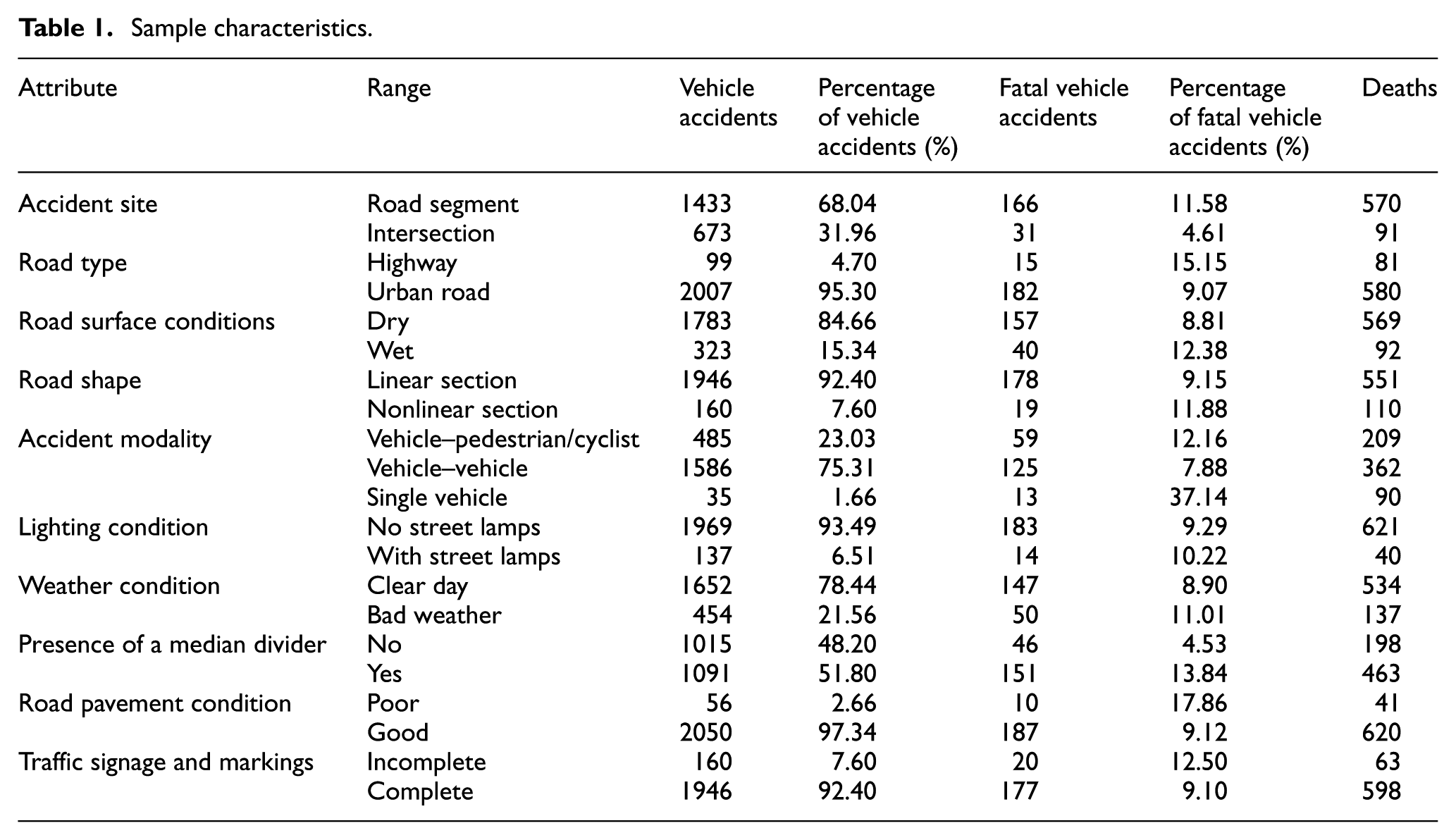
Regarding the characteristics of road traffic accidents, accidents can be classified into three categories in terms of the type of collision: vehicle–vehicle, vehicle–pedestrian and single-vehicle accidents. A collision between vehicles is the most common type of night-time vehicle accident, corresponding to 125 fatal and 1461 non-fatal accidents, significantly higher than the number of vehicle–pedestrian and single-vehicle accidents. The number of single-vehicle accidents (including fatal and injury-causing accidents) is fewer than 50, accounting for only 1.66% of the total number of night-time vehicle accidents.
The number of traffic accidents, fatal vehicle accidents and deaths under low illumination conditions on roads without street lamps were 1969, 183 and 621, respectively, significantly higher than those on roads with street lamps. Although the variable for the presence of a median divider had no significant effect on the total number of traffic accidents under low illumination conditions, the number of fatal traffic accidents and deaths was significantly higher on roads with median dividers than on roads without median dividers.
In addition, the numbers of vehicle accidents and deaths under low illumination conditions with good driving conditions (dry road surface, linear road section, good weather conditions, pavement in good condition and complete traffic signage and markings) were significantly higher than those under poor driving conditions. However, the proportion of fatal night-time vehicle accidents was greater under poor driving conditions than under good driving conditions, indicating that the consequences of these accidents were more serious when they occurred.
The characteristics of the night-time vehicle accidents as described above reflect the external representation of the data. To explore the factors contributing to the severity of night-time traffic accidents, we used logistic regression theory to develop relevant models to quantify the impact factors and the degree of severity.
Methodology
In the quantitative analysis of practical problems, linear regression models are the most commonly used statistical method of analysis. However, in many cases, the use of linear regression is limited. For example, many practical problems involve dependent variables that are categorical rather than continuous in nature. Linear regression is not suitable to predict whether a road traffic accident will occur or whether a pedestrian will cross a street against a red light. Therefore, logistic regression models are usually used instead for the analysis of categorical variables. Probabilistic nonlinear regression models and multivariate analysis are employed to study the relationships between the classified observation results (dependent variable
When each dependent variable has only two possible values (the dependent variable
Let
Calculate the ratio of the probability of occurrence to the probability of non-occurrence, called the odds:
Take the natural logarithm of the odds

where

A binary logistic regression model is a nonlinear model, and the maximum likelihood estimation method can be used for parameter estimation.
Binary logistic model for the severity of accidents under low illumination conditions at night
Dependent variable modelling
According to the ‘Road Traffic Safety Law of the People’s Republic of China’, traffic accidents can be divided into four categories in accordance with their degrees of casualty: minor traffic accidents (one or two people slightly injured), moderate traffic accidents (one or two people seriously injured), severe traffic accidents (one or two people killed) and extremely severe traffic accidents (three or more people killed). Severe and extremely severe traffic accidents are distinguished by the occurrence and number of fatalities. In accordance with the basic principles of logistic modelling, the accident severity, denoted by
Suppose that there are n factors influencing the dependent variable


where
Independent variable selection
Traffic accidents involve four interacting systems, namely, people, vehicles, roads and the environment, each of which can be divided into different subsystems and influencing factors. Based on previous research and the previous analysis of the characteristics of road traffic accidents at night, in this article, 10 factors were selected as the basis of specific variables, which were defined, as shown in Table 2.
Definitions of influencing factors.

The influencing factors listed above are dummy variables that require a classification assignment, where the specific assignment chosen does not represent their actual values. Among these influencing factors, only the accident modality is a multi-category dummy variable. For the actual model calculation process, such a dummy variable must be transformed as follows: if the dummy variable has k categories, it is converted into k – 1 variables, one of which is selected as the consultative variable. The corresponding conversion for the accident modality variable is shown in Table 3. All other variables are binary dummy variables, assigned values of 0 and 1 without the need for dummy variable conversion.
Coding of the accident modality variable.

To avoid the potentially serious influence of multicollinearity between the independent variables on the regression results, a multicollinearity test of the independent variables is required. The results of such a multicollinearity test showed that the tolerance of each of the selected independent variables was much higher than 0.1 and that each variance inflation factor was less than 5. These results indicated that there was no potential multicollinearity among the selected independent variables, meaning that they could be used for a logistic regression analysis.
Before the above independent variables were finally introduced into the model, they needed to be tested and screened. Two tests are generally conducted for this purpose: a pre-modelling test and a post-modelling test. The pre-modelling test is called the score test and is an initial test to determine the degrees of closeness between the independent and dependent variables based on the structural relationships between the variables at the beginning of modelling. When the score value reaches a significant level, it indicates that the independent variable has a significant relationship with the dependent variable. Generally, the score value is checked against a certain significance level. If the significance level is
The second variable screening test is a post-modelling test called the Wald test. Similar to the t-test for multiple linear regression, significance is determined based on the parameter estimate and the standard error. Similar to the significance determination method for the score value, given a significance level
Model checking
After construction of the logistic model, a goodness-of-fit test is needed to analyse the model’s comprehensive fitting effect. The goodness-of-fit test mainly validates the correctness and validity of the model. The basic idea is to assess the differences between the predicted and observed values of the event probabilities. Generally, the natural logarithm of the likelihood ratio function is used as an estimated goodness-of-fit parameter. Specifically, the natural logarithm of the likelihood ratio function is converted into a chi-square value, and the chi-square distribution is then used for a significance test. When the chi-square value is sufficiently large to reach a given significance level, this indicates that at least one of the independent variables in the model is sufficient to predict the probability of the event reflected by the dependent variable of interest, and the model passes the test.
Results analysis
Model estimation
Based on the night-time accident statistics, the logistic regression method was used to construct a model for measuring night-time vehicle accident severity. Analyses were conducted using the statistical software SPSS (version 19.0). Table 4 lists the score test results based on a significance level of 0.05.
Score test analysis of independent variables.
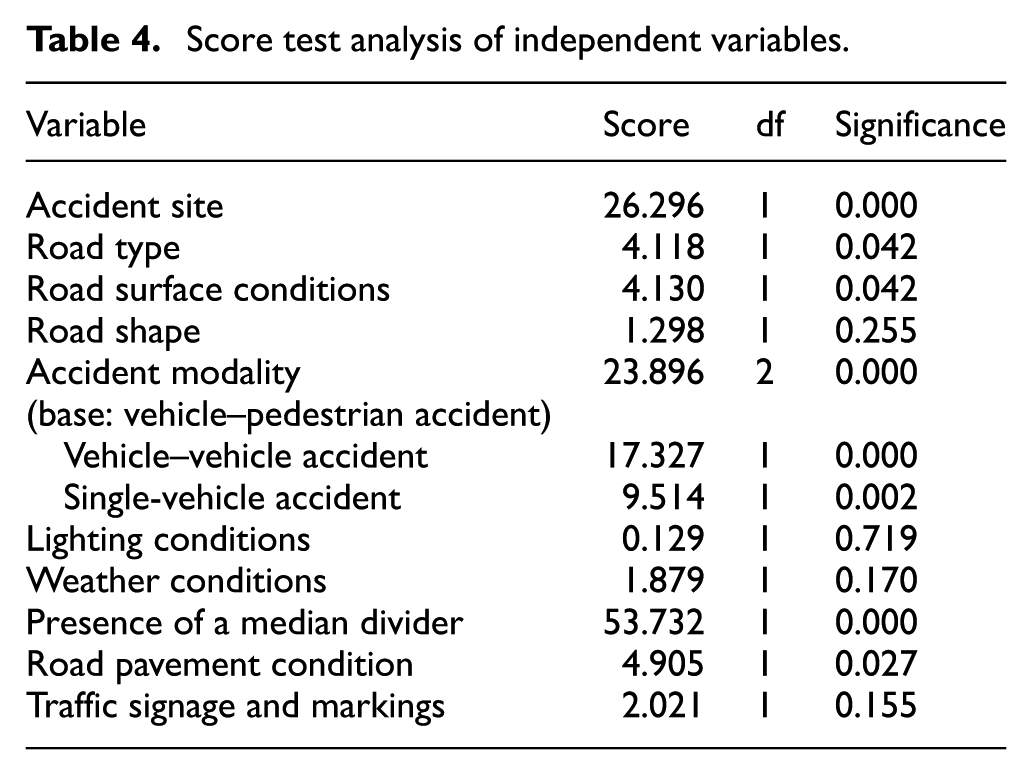
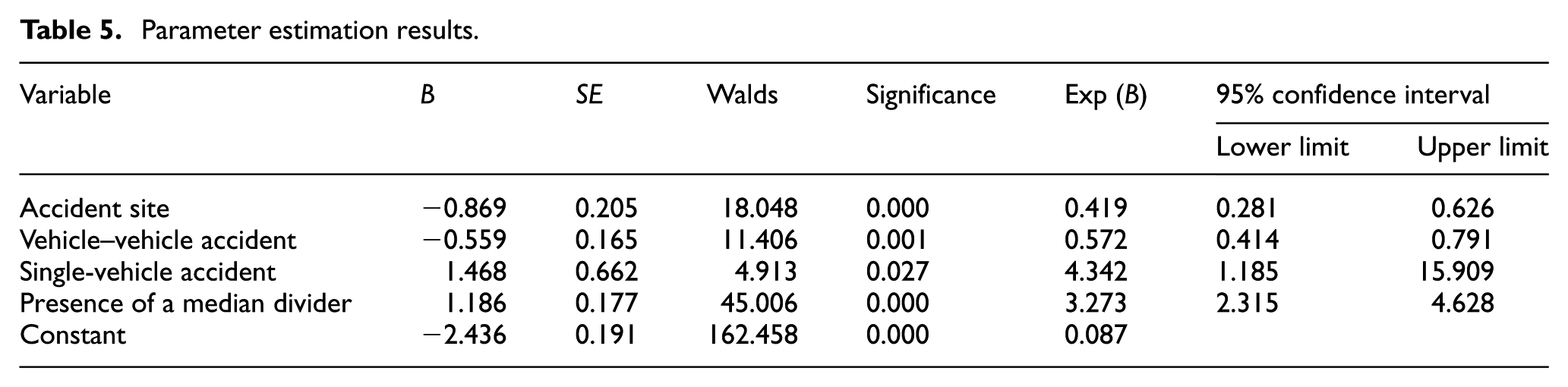
The score test results in Table 4 show that at the 95% confidence level, the accident site, road type, road surface conditions, accident type, presence of a median divider and road pavement condition were found to significantly influence the occurrence of night-time vehicle accidents under low illumination conditions. Thus, these significant variables were included in the binomial logit model for further calculations. The modelling results are presented in Table 5. Finally, three of the independent variables were found to significantly influence the model estimates, namely, the accident site, accident modality and presence of a median divider. The final probability prediction function for fatal night-time traffic accidents is

Parameter estimation results.
A goodness-of-fit test was used to examine the degree of fit of the model. Since the model contains three independent variables, there are two degrees of freedom; consequently, as seen from the critical value table for the chi-squared test, the chi-square threshold is 5.991 when the significance level is
Discussion
The results in Table 5 show that the accident site has a significant impact on the severity of night-time vehicle accidents at the 95% confidence level. The odds ratio is e–0.869 = 0.419, and the coefficient of the variable is negative, indicating that the probability of a night-time fatal accident at an intersection is significantly smaller than that on a road segment. The odds ratio for fatal accidents also indicates that the probability of a fatal night-time accident at an intersection is just 0.419 times that on a road segment. This finding differs from existing reports showing that accidents at intersections account for the majority of fatal night-time traffic accidents. 30 The reason for this discrepancy is that although a road intersection is an inherently dangerous location, the road traffic infrastructure (monitoring, electronic surveillance, lighting, etc.) at an intersection at night is usually excellent, thereby providing better driving conditions. In addition, drivers and other road users are more cautious at intersections. 31 The database of night-time vehicle accidents used in this article includes night-time vehicle accident statistics derived from roads of different grades. Highways have several characteristics that can readily contribute to drivers’ physical and mental fatigue such as medians, grade separations at cross streets and monotonous scenery. In addition, the speed is usually faster when driving on the highway. Once an accident occurs, the driver often has no time to react, resulting in more serious consequences. On low-grade highway segments, due to their distance from the city, the road is narrow, the traffic quality is poor and the road traffic infrastructure and control are relatively weak. Accidents are also frequent, and their consequences are serious. When an accident occurs on such a road segment, the average time elapsed before it is discovered and rescue efforts begin is longer, increasing the probability of death for the driver and passengers. For low-grade highways, improvements in traffic facilities (such as protective speed measuring and lighting facilities) could help to reduce risky driving behaviours and create a safer night-time driving environment. Placing traffic signs with rescue telephone numbers and enhancing traffic patrols at night could be beneficial for improving rescue efficiency for night-time vehicle accidents, thus effectively reducing the probability of fatal night-time accidents.
The probability of fatal single-vehicle night-time traffic accidents caused by single-vehicle accidents is apparently 4.342 times higher than that of fatal vehicle–pedestrian night-time accidents; however, this may be because people seldom report a single-vehicle accident if it causes no casualties. As a result, the consequences of the single-vehicle accidents that are represented in the recorded statistics are generally serious. The delayed discovery of single-vehicle accidents and the long time that elapses prior to rescue also increase the probability of death for the driver and passengers. However, the probability of fatal vehicle–vehicle night-time traffic accidents is only 0.572 times that of fatal vehicle–pedestrian night-time accidents. This is because pedestrians are a vulnerable group lacking protective equipment when participating in road traffic activities. Pedestrians are extremely vulnerable to injury or even death in the event of an accident, as reported in previous studies.8,32 In contrast, due to the development of passive safety technology in vehicles, the safety protection measures for drivers and passengers are relatively complete. In the event of a traffic accident, the devices on the vehicle will help to protect them, thus reducing the severity of traffic accidents between vehicles relative to that of vehicle–pedestrian accidents. More attention and protective measures should therefore be oriented towards vulnerable pedestrians, such as placing street lamps in crosswalk areas to provide sufficient light for crossing streets, placing crosswalk warning signs to remind drivers to slow down and pay attention to safety and reminding pedestrians to wear bright colours when travelling at night.
The presence of a median divider has a significant effect on the severity of night-time vehicle accidents. The probability of a fatal night-time accident on a road with a median divider is 3.273 times that on a road without a median divider, which is consistent with the research results of Hu and Donnell 33 Although a median divider can reduce the impact of a collision with a vehicle from the opposite lane, the typical grades of roads with median dividers and their corresponding speed limits are relatively high, leading to faster speeds at night. Moreover, a driver’s vigilance decreases on a road with a median divider, which can also lead to increased speed and risky driving behaviours. As a result, when an accident occurs, the consequences are often more serious. Therefore, more attention should be paid to the speed limits on roads with median dividers, with the aim of reducing vehicle speeds and improving night-time driving safety.
Conclusions and limitations
This article established a predictive model to explore the factors that influence fatal traffic accidents under low illumination conditions at night. Based on a comprehensive night-time vehicle accident data collected from a city in China, a logistic regression model was used to identify possible contributory factors, such as accident characteristics, road conditions and environmental conditions, affecting the occurrence of fatalities in night-time traffic accidents. The accident site, the accident modality and the presence of a median divider are all important factors affecting the severity of night-time vehicle accidents under low illumination conditions.
Based on the findings of this study, road managers may be able to develop better coping strategies. They can pay more attention to providing suitable corresponding traffic facilities (such as speed measuring facilities, reflective traffic signs and lighting facilities) for dangerous road segments, especially low-grade highway sections and roads with median dividers. Moreover, based on the probability of fatal night-time accidents, road managers can continuously adjust the extent of night-time road traffic safety inspections for different road sections and time periods. In addition, road managers should be more conscious of the importance of public education regarding road traffic safety at night, especially for pedestrians.
This study also has several limitations. The data used in this article are from a single city. Although the sample size is sufficient to achieve reasonably accurate model performance, the study is applicable only to traffic accident data from one city in China. The binomial logistic modelling approach used in this article is a classic method of addressing nonlinear problems, but due to the possibility of unobserved heterogeneity (residual variation) in logistic models, other advanced statistical models should be used to obtain more generalizable conclusions. In addition, there are also some differences in traffic flow characteristics, driving behaviour and traffic control between highways and ordinary roads. It would be interesting to compare the characteristic differences of fatal night-time vehicle accidents between highways and ordinary roads; this can be the focus of future research.
Footnotes
Handling Editor: Zhongxiang Feng
Declaration of conflicting interests
The author(s) declared no potential conflicts of interest with respect to the research, authorship and/or publication of this article.
Funding
The author(s) disclosed receipt of the following financial support for the research, authorship and/or publication of this article: The study was supported by the ‘National Natural Science Foundation of Anhui Province’ (Grant No. 1708085ME125) and the ‘Scientific Research Projects Foundation in Higher Education of Anhui Educational department’ (Grant No. KJ2017A485).
