




Abstract
The lateral load-resisting system of high-rise buildings in regions of low and moderate seismicity and strong wind such as the typhoon in the Korean peninsula considers the wind load as the governed lateral force so that the practical structural engineer tends to skip the evaluation against the seismic load. This study is to investigate wind-designed steel diagrid buildings located in these regions and check the possibility of the elastic design of them out. To this end, first, the diagrid high-rise buildings were designed to satisfy the wind serviceability criteria specified in KBC 2016. Then, the response spectrum analyses were performed under various slenderness ratio and wind exposures. The analyses demonstrated the good seismic performance of these wind-designed diagrid high-rise buildings because of the significant over-strength induced by the lateral load-resisting system of high-rise buildings. Also, the analysis results showed that the elastic seismic design process of some diagrid high-rise buildings may be accepted based on slenderness ratios in all wind exposures.
Introduction
Since the late 1980s, seismic design has become mandatory in the design standards so that there has been controversy about setting the direction of seismic design in the low and moderate seismicity. Lee and Kim 1 proposed elastic seismic design procedures for high-rise buildings; however, the consensus of the seismic design for high-rise buildings is not proposed. Recent seismic design criteria (e.g. ASCE/SEI 7-10:2010 2 ) are suitable for low- and medium-rise buildings but not for high-rise buildings. 3 On the other hand, seismic design guidelines for high-rise buildings to not be limited to the specific seismic zone have been provided such as “Recommendations for seismic design of high-rise buildings” by CTBUH, 4 “TBI (Tall Buildings Initiative) guidelines for performance-based seismic design of tall buildings” by PEER, 5 “An alternative procedure for seismic analysis and design of tall buildings located in the region: a consensus document” by LATBSDC, 6 and so on.
Many studies have been conducted on the seismic design procedure of tall buildings. Ho 7 asserts that the seismic design code for high-rise buildings in the high seismicity may be induced too conservative results for high-rise buildings in the low seismicity because of the reduced seismic demand. Balendra et al. 8 investigated the range of the over-strength of the high-rise building in terms of factors of the seismic capacity using dynamic analysis. And Wei and Qing-Ning 9 proposed the design procedure of high-rise buildings and verified the potential of the performance-based seismic design for it. On the other hand, Chan and Chui 10 and Chan et al. 11 made deal with the optimized design method of high-rise buildings by the wind-induced response and serviceability.
Since the magnitude of the seismic load acting on the high-rise building is relatively small compared to the magnitude of the wind load in Korea, which is in regions of the strong wind and the low and moderate seismicity, verification of the seismic performance practically tends to be skipped or handled briefly. As this is based on the energy dissipation by the inelastic behavior of the structural system under the seismic load, the structural system of high-rise buildings is an undefined system and has a problem that it is hard to classify it into structural system types that are defined in the seismic provisions.1,12,13
The seismic hazard level in the Korean Peninsula is classified as low and moderate seismicity. On the other hand, the Korea Peninsula is a region with strong winds including typhoons occurring frequently in the summer season. The Korean seismic hazard level per ASCE 41-06:2007 14 due to the performance-based design is classified as a low seismicity. The effective peak ground acceleration (EPGA) of the design basis earthquake (DBE), 2/3 of EPGA having the return period of 2475 years (exceedance probability of 2%/50 years) in KBC 2016 15 is 0.147 g. In addition, typhoons in the Korean peninsula are frequent in summer with strong winds. The maximum instantaneous wind speed (3 s average maximum wind speed) measured in Korea is 63.7 m/s (Sokcho in 2006). For reference, typhoons are generally divided into four classes. The lowest maximum instantaneous wind speed of the strongest typhoon grade is 44 m/s. 16 The southeast regions of the United States, Australia, and Hong Kong have the similar environment of low and moderate seismicity and strong wind. In the regions of a low and moderate seismicity and strong wind, the wind design load is very tremendous and the elastic wind design of buildings is performed. Therefore, it is expected that high-rise buildings are designed to be structures with significant system redundancy or over-strength in the wind design process. 17
The demand of high-rise buildings is gradually increasing as the efficiency of the land and a symbol of a nation in the whole world. The design of recent high-rise buildings has changed from regular shapes to irregular shapes. In order to actively respond to the shape change of buildings, many architects have adopted a diagrid frames as the lateral load-resisting system which the only diagrid member can resist efficiently both the vertical and lateral loads. The diagrid frames is a concentrically braced frames (CBFs) as a vertical truss system. In general, the CBFs are difficult to expect the redistribution of force since the redundancy is small in the inelastic region. It has the very low seismic performance with a brittle system due to the weak story, which the inelastic deformation is accumulated in the buckling story after the buckling of the brace. 18 Therefore, it is desirable that the steel diagrid frames is designed to behave almost elastically. In the strong wind region where the typhoon frequently appears and the low and moderate seismicity such as the Korean peninsula, the possibility of the elastic design of high-rise buildings is enough. High-rise buildings in the low and moderate seismicity have the very small the base shear force due to the seismic load and are designed to have the considerable system over-strength due to the required serviceability from the wind design procedure. Especially, as the tallness becomes larger, the magnitude of the seismic load becomes smaller since steel structures take the small self-weight. And the magnitude of the base shear due to the wind load may approach the elastic base shear force of a specific earthquake. 1
High-rise buildings have generally been built in the metropolis. These cities are located at the inland having large rivers or on the beach in close to human activities. In other words, high-rise buildings are and will be located in various exposures. In addition, considering the symbolism and the social contribution of a local society of tall buildings, the engineers should provide the resisting performance for natural hazards that tall building can experience. They should do that more in the low and moderate seismicity because the civilians in this region do not usually prepare the sudden fear by the earthquake. In this study, the potential of the elastic seismic design and the seismic performance of the high-rise steel diagrid frames according to various wind exposures were investigated considering these conditions. To this end, the high-rise steel diagrid frame buildings under various wind exposures were first elastically designed to resist a design strong wind. Then, estimation for structural redundancies (or over-strengths) of the diagrid members in each building was conducted. Second, the seismic performance of the wind-designed buildings was evaluated by response spectrum analysis. Based on analysis results, the possibility of the elastic seismic design of high-rise steel diagrid frame buildings under various exposures was estimated.
Wind-designed high-rise steel diagrid frames
In this study, to evaluate the seismic performance of wind-designed high-rise steel frame diagonal frames, the wind load design conditions in Table 1 were applied. The first natural frequency of a building (
Wind load conditions per KBC 2016. 15


(a) Structural elevation and (b) structural plan of high-rise steel diagrid frames (slenderness ratio of 6.1).
Sectional area of the diagrid in the flange frames is

Sectional area of the diagrid in the web frames is

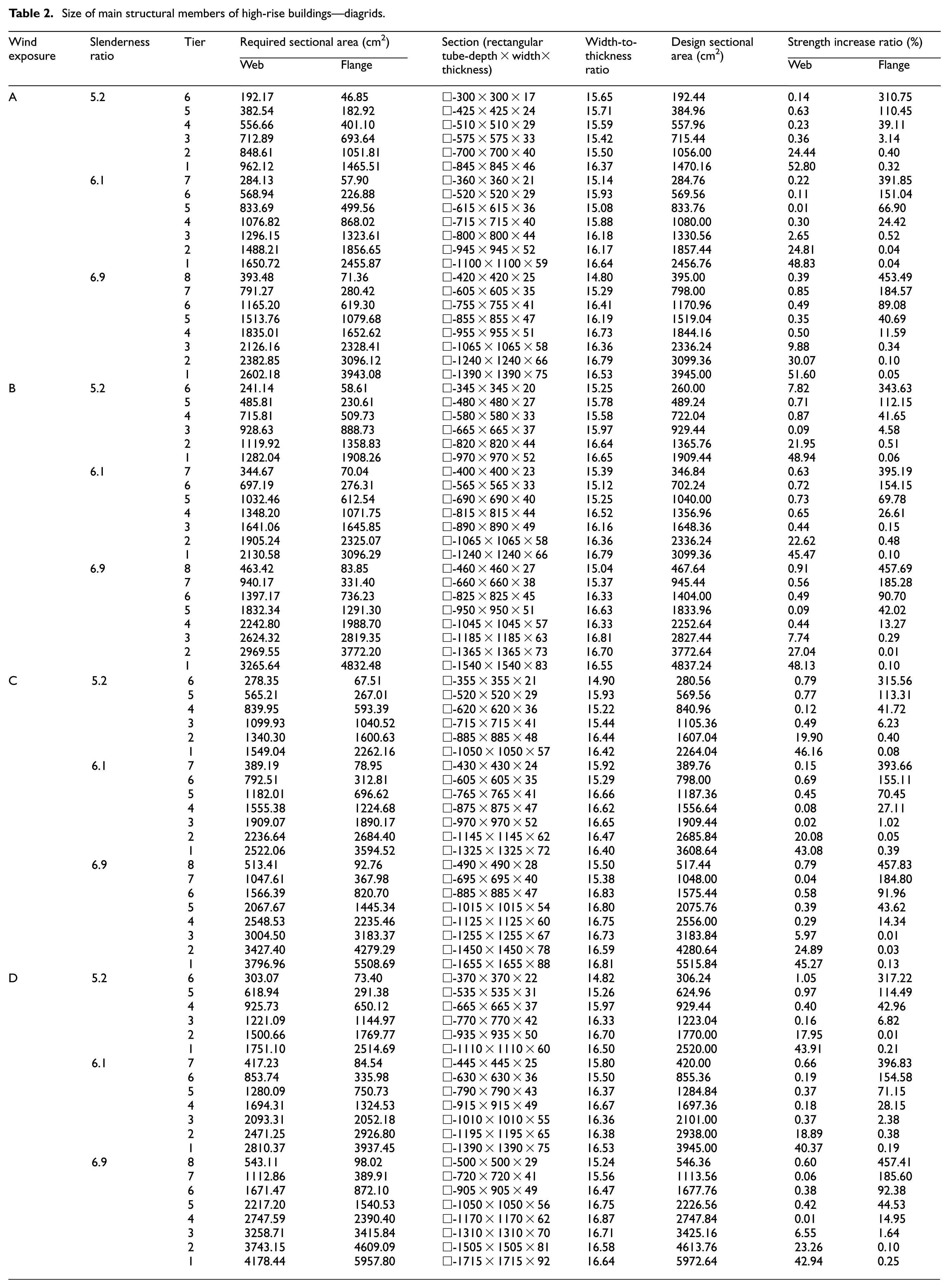
The roof displacement, which is the requirement of the serviceability for the wind load, was designed within H/500 in the calculating process of the sectional area of diagrid members by equations (1) and (2) (see Tables 2–4). 20 Considering the limitations of the roof displacement, the width-to-thickness ratio of the diagrid members for seismic design, and the direction of wind, the size of structural members is largely increased, especially in the upper tiers of the flange frames of the buildings, since the size of the members of the web frames and the flange frames should be the same (see Tables 2 and 3). The possibility of elastic seismic design of the high-rise buildings would be increased due to these over-strength factors under the strong earthquake.
Size of main structural members of high-rise buildings—diagrids.
Size of main structural members of high-rise buildings—girders, beams, and gravity columns.

Check of the roof displacement of high-rise buildings.

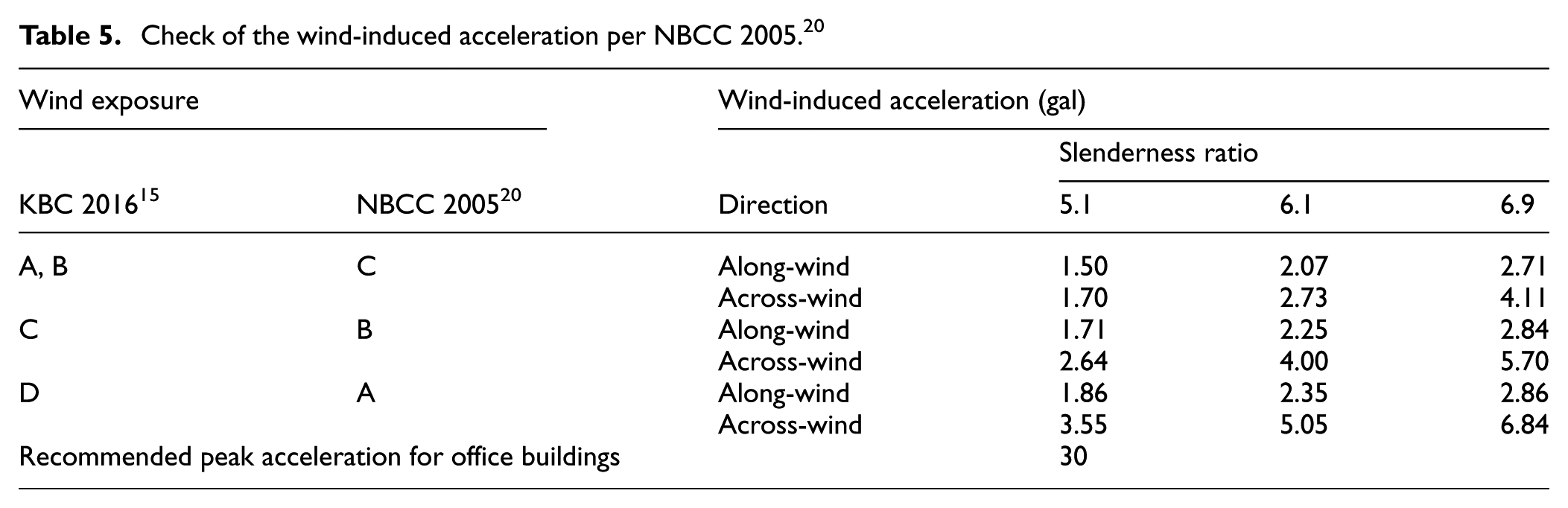
Since the wind-induced vibration of the building causes discomfort to the residents, it is generally required to investigate the wind-induced acceleration in the wind design of the building. NBCC 2005
20
suggests to calculate and examine the design wind load and the effect for the building using the static procedure for the moderate- and low-rise buildings, the dynamic procedure for the slender building and the high-rise building over the height of 120 m, and the wind tunnel test. The target model in this study has over the height of 120 m so that the wind-induced acceleration in the along-wind direction and the across-wind direction was calculated using the dynamic procedure (see equations (3) and (4)). The wind speed (
Check of the wind-induced acceleration per NBCC 2005. 20
Along-wind-induced acceleration is

Across-wind-induced acceleration is

where ar is [

where a and b are 0.42 and 14.32, respectively, as the extreme value of Gumbel’s distribution in Seoul,
21
Seismic performance evaluation by response spectrum analysis
In this section, the potential of elastic resistance and the seismic performance of the diagrid members were evaluated through the response spectrum analysis against seismic hazards with the 975-year return period and the 2475-year return period for the wind-designed high-rise steel diagrid frames in accordance with wind exposures using MIDAS Genw 22 as a structural analysis program. For reference, ASCE 41-13:2014 23 based on the performance-based design suggests the targeted seismic performance of new buildings against two seismic hazards. They are the basic safety earthquake (BSE) of structural design of buildings. The BSE-1N shall be taken as the earthquake having 975-year return period (5%/50 years) or 2/3 of the Risk-Targeted Maximum Considered Earthquake (MCER) as the earthquake having 2475-year return period (2%/50 years). The BSE-2N shall be taken as the MCER. As shown by Lee et al., the results of the linear dynamic analysis for the seismic performance evaluation of high-rise buildings show that the results of the response spectra analysis present more conservative results than the results of the linear time history analysis. The seismic response analysis and the seismic performance of high-rise steel diagrid frames are evaluated by the response spectrum analysis considering the orthogonal effect at a ratio of 100:30.
The elastic and inelastic behaviors of diagrid members were determined by the “DCR (demand–capacity ratio)” calculation of equation (6) using the results obtained from the response spectrum analysis. 23 The demand strength for diagrid members used the SRSS (square root of the sum of the squares) value by the response spectrum analysis to assume the elastic behavior of the structural system. The capacity strength of them in Tables 2 and 3 can be calculated by the equation of the flexural–compressive strength in the limit state design method. 15 And the strength reduction factor is all 1.0. Moreover, the tensile yield strength required to calculate the capacity strength of diagrid members applied the expected tensile yield strength (RyFy) using the material over-strength factor (Ry) of 1.2 for the SM490 steel per KBC 2016. 15 Therefore, diagrid members satisfying equation (6) are in the elastic state. And they can be judged that the larger the degree of the DCR exceeds 1, the more they enter the inelastic region. In other words, the DCR distribution of main structural members obtained by the simple linear analysis using arbitrary input ground motions can be used to easily measure the elastic or inelastic behaviors of the structural system

Figures 2–5(a) and (b) show the DCR distribution of wind-designed high-rise steel diagrid buildings in accordance with the wind exposure obtained from the response spectrum analysis using the BSE-1N and the BSE-2N as the input ground motion in the stiff soil site and the seismic zone with the EPGA of 0.22g, respectively. For the BSE-1N hazard, the model with the slenderness ratio of 5.2 appears the inelastic behavior in some diagrid members of the top tier in the web frames; however, the diagrid members in the flange frames show all the possibility of the elastic resistance. In addition, it presents that all models with the slenderness ratio of more than 6.1 can be enough elastically resistant regardless of the wind exposure. On the other hand, for the BSE-2N hazard, the model with the slenderness ratio of 5.2 is expected the considerable plasticization in the web and flange frames of diagrid members in the whole structure. The model with the slenderness ratio of 6.1 is predicted that the most of diagrid members of the web and flange frames in the top tier are plasticized. In the model with the slenderness ratio of 6.9, the flange frames show the possibility of the elastic behavior. And some diagrid members in the top tier of the web frames appear a little bit of the inelastic behavior. Overall, it can be found that in terms of the degree of the plasticization of the models, the web frames which resist the shear force are obviously larger than the flange frames which resist the overturning moment without the slenderness ratio and the wind exposure. In addition, as the tallness increases, the possibility of elastic resistance of the high-rise steel diagrid frames becomes higher. As described in the previous section and asserted by Lee and Kim, 1 this is the reason that the considerable system over-strength is introduced in the serviceability design process of the wind design and the spectral acceleration of the earthquake is considerably reduced due to the long fundamental period of high-rise buildings (see Tables 2 and 3).

DCR distribution obtained from the response spectrum analysis under the wind exposure A: (a) BSE-1N and (b) BSE-2N.

DCR distribution obtained from the response spectrum analysis under the wind exposure B: (a) BSE-1N and (b) BSE-2N.

DCR distribution obtained from the response spectrum analysis under the wind exposure C: (a) BSE-1N and (b) BSE-2N.

DCR distribution obtained from the response spectrum analysis under the wind exposure D: (a) BSE-1N and (b) BSE-2N.
ASCE 41-13 classifies the seismic performance levels into the immediate occupancy (IO), the life safety (LS), and the collapse prevention (CP) levels. The basic safety objective is the LS level for the BSE-1 and the CP level for the BSE-2. These performance objectives are the same as the other standards (ASCE 7-10, KBC 2016, 15 and so on) that are taking the seismic philosophy of the SEAOC Blue Book 24 as it is. In addition, ASCE 41-13 per the performance-based design has a deformation-controlled action member and a force-controlled action member in the case of the linear analysis procedure for the main structural members constituting the structural system for each structural system. And it is possible to evaluate the accurate seismic performance level at the member level. The deformation-controlled action member having the nonlinear behavior is evaluated the seismic performance level of the structural member using the m-factor in equation (7) to reflect the expected ductility of the member. On the other hand, the force-controlled action member which is difficult to expect the ductile behavior is failed before the inelastic behavior is exhibited, where κ is a knowledge factor in Table 6.1 of ASCE 41-13 and considers the uncertainty of the rehabilitation objective and material of buildings the subject to the seismic performance evaluation. In this study, the knowledge factor is 1.0. In other words, the m-factor obtained in this study has the identical value as the DCR in equation (6). The brace member of the braced frames in ASCE 41-13 is defined as the deformation-controlled action member. Table 6 shows the seismic performance acceptance criteria of the steel brace member subjected to the flexural–compressive force in the linear analysis procedure

Seismic performance acceptance criteria of steel brace members subjected to the flexural–compressive force for the linear analysis procedure per ASCE 41-13.

IO: immediate occupancy; LS: life safety; CP: collapse prevention.
Table 7 summarizes the maximum m-factor value and the seismic performance level of the diagrid members for each model. For the BSE-1N, the model with the slenderness ratio of 5.2, all shows the IO level regardless of wind exposures. For the BSE-2N, it appears the LS level in the only web frames under the wind exposure A to C and the IO level in the wind exposure D. However, its performance level is located in the border between the IO and the LS levels. The model with the slenderness ratio of 6.1 and 6.9 satisfies the seismic performance level of the IO for both the BSE-1N and the BSE-2N in all wind exposures. Therefore, in sum, it can be found that most of the models in this study show the identical seismic performance level according to the slenderness ratio with no wind exposures. For reference, ASCE 41-13 allows to evaluate the seismic performance level in the system level using the maximum story drift, which is a main index of the seismic performance evaluation. Since the accurate seismic performance level cannot be evaluated when the structure appears the inelastic behavior, the seismic performance evaluation by the story drift for these cases in this study was excluded. However, since the fracture of the connections by the story drift can occur apart from the performance of the diagrid members, the further investigation must be performed on the lateral displacement by the nonlinear static and dynamic analyses.
Maximum m-factor value and the seismic performance level by the response spectrum analysis.

IO: immediate occupancy; LS: life safety; CP: collapse prevention.
Summary and conclusion
This article is to confirm the potential of the elastic seismic design and the seismic performance level for the wind-designed high-rise steel diagrid frames in accordance with wind exposures in the strong wind zone and the low and moderate seismicity. The results are as follows:
In this study, high-rise buildings with the strong wind zone and the low and moderate seismicity have been designed by the wind load that is larger than the seismic load considering the nonlinear behavior of structures in terms of static loads. Also, they have the considerably seismic load because of the architectural characteristics with the long natural period. Therefore, it can be found that the design strategies considering the response modified coefficient (R) of 1, that is, the elastic seismic design, for the high-rise steel diagrid frames with these conditions of lateral loads are capable.
This study shows that the inelastic behaviors in the upper layer of high-rise steel diagrid frames are concentrated. The reason for this may be seen in the design practices of high-rise buildings. In general, the structural engineer performs the serviceability design to control the roof drift under wind load as the dominant load of high-rise buildings. This design practice overdesigns the main structural members in the lower layer of high-rise buildings, while they of the upper layer are designed to be relatively inferior. However, when earthquake load, which do not reflect inelastic characteristics, and wind load are compared, the seismic load in the upper layer of high-rise buildings exceeds the wind load. This point is the main cause of the inelastic behavior in the upper part of high-rise buildings. Therefore, the serviceability design should be conducted considering the seismic load pattern appropriately, in order to improve the seismic performance of high-rise buildings.
In terms of the strength, it was confirmed that the wind-designed high-rise steel diagrid frames with the slenderness ratio of more than 6.1 can resist elastically for the BSE-1N (seismic hazard with 975-year return period) without wind exposures and models with the slenderness ratio of 6.9 and the more than the wind exposure C can resist elastically for the BSE-2N (seismic hazard with 2475-year return period). Overall, the degree of the plasticization in the high-rise steel diagrid frames shows that the flange frames to resist the overturning moment are higher than the web frames to resist the shear force.
In terms of the seismic performance per ASCE 41-13, models with slenderness ratio of more than 5.2 for the BSE-1N exhibited the IO performance level regardless of wind exposures. The models with slenderness ratio of more than 6.1 could resist the IO performance level for even the BSE-2N without wind exposures. And in the wind exposure D, even the slenderness ratio of 5.2 takes the IO level, although it is located in the border between the IO and the LS levels. It can be found that most of the models in this study show the identical seismic performance level according to the slenderness ratio in all wind exposures. Finally, these sequences are induced from the extra system over-strength obtained from the serviceability design in the wind design process. They imply that the potential of the elastic design of high-rise buildings may be determined in accordance with the degree of the tallness because the extra system over-strength becomes larger as the tallness increases.
Considering the brittle system which is difficult to basically expect the load distribution, the uncertainty inherent in earthquake loading, and the symbolic presence of the high-rise building, it is desirable that the high-rise steel diagrid frames are designed to get the extra system over-strength.
In this study, it is necessary to propose an optimal design method to appropriately distribute the contribution of the frame to the lateral load in terms of the seismic design, since the high-rise steel diagrid frames are based on the optimized design in terms of economic efficiency related to the quantity of steel.
It is recommended to evaluate the seismic performance by the nonlinear dynamic procedure for the MCER in recent guidelines for high-rise buildings. And the accurate seismic performance of high-rise buildings having the inelastic behavior may not be evaluated through linear procedures as linear procedures are applicable if the DCR value of structural members is less than 2. 25 Also, linear analysis procedures do not provide the reasonable seismic performance evaluation method considering the rotational capacity of structural connections. Therefore, the seismic performance for high-rise buildings with the inelastic behavior should be investigated using the nonlinear dynamic procedure.
Footnotes
Handling Editor: Wen-Hsiang Hsieh
Declaration of conflicting interests
The author(s) declared no potential conflicts of interest with respect to the research, authorship, and/or publication of this article.
Funding
The author(s) disclosed receipt of the following financial support for the research, authorship, and/or publication of this article: This work was supported by the Youngsan University Research Grant in 2016.
