




Abstract
The air-impingement freezing technique is a fast and efficient freezing method, which is widely used in food freezing and electronic industry. A novel air-impingement freezing machine was set up to investigate the food freeze. The freezing process of peeled shrimps by air-impingement freezing technique was studied experimentally and numerically. The freezing time of shrimp (150 count/lb) from +11°C to −18°C was about 100–140 s. The flow field and temperature distribution of peeled shrimp were studied by the solidification and melting model in FLUENT 6.3. The results show that the air jet flows away from the surface of the shrimp after the separation points so that the flow field and heat transfer were bad in the separation resign. In addition, the food freezing time of natural convection and air-impingement was compared, and the result shows that the air-impingement freezing time is about one-tenth than the natural convection freezing in freezer. In order to optimize the air-impingement freezing, H/D’s value was adjusted in the range of 4–8. The result indicates that the freezing time was increasing with the increase in H/D value, and H/D was recommended to be 6 in the impingement freezing.
Introduction
An air-impingement technology is well known as one of the quick cooling or freezing way due to its high velocity and high heat transfer coefficient. 1 The air-impingement technology was widely used in food freezing,2–4 electronics cooling,5,6 and plastic industry.7,8 The air-impingement of food freezing has been reported by many researchers. F Erdogdu et al. 3 comparatively analyzed the heat transfer about cooling the boiled eggs by air impingement and water immersion at the same temperature, and the results indicate that the impingement freezing (IF) is more efficient particularly at the yolk center. Sundsten et al. 9 compared three freezing technologies: spiral freezing (SF), liquid nitrogen (LN), and IF. The study found that IF uses the least time to freeze a 10-mm thickness 80 g hamburger from +4°C to −18°C, and the SF and liquid freezing were increased by double and 8.25 times, respectively. VO Salvadori et al. 10 concluded that in their studies, IF decreased the weight losses by 36%–72% and decreased the freezing time by 62%–79% than conventional freezing at the same air temperature. RG Moreira 11 reported that using superheated steam to impinge for drying potato chips improved the quality due to the decreasing the freezing time.
In the air-impingement, some factors, such as spacing ratio,8,12–14 orifice shape,15–17 and arrangement,18,19 affect the freezing time and quality of the cooled goods. The distance between orifice outlet to frozen goods and air velocity plays crucial roles in improving the heat transfer characteristics and optimizing the equipment performance. SK Singh and Singh 12 found that H/D (jet distance/nozzle diameter) is a significant parameter in air-impingement cooling the cylindrical objects. As there is an increase in H/D, the magnitude of velocity decreases, and the turbulence intensity decreases simultaneously. Therefore, there is a maximum heat transfer on the product surface at a specific H/D. 12 F Erdogdu et al. 13 suggested that H/D = 6–8 is an optimum distance. M Jafari and Alavi 15 studied the effect of nozzle to slab shaped foods distance under two impinging jets, and the research showed H/D = 10–12 were maximum heat transfer rate. V Katti and Prabhu 18 investigated the impact of nozzle to plate distance on heat transfer with a round impinging jets in-line array, and the results show that the optimum heat transfer rate was obtained at S = 4D.
Although the air-IF could improve the heat exchange efficiency and decrease the freezing time, the high velocity easily causes the flow field disorder, especially when the frozen goods are spherical or cylinder. In that way, the heat exchange efficiency could decrease and the energy consumption of freezing machine could increase obviously. In our research, the freezing curve of peeled shrimp by air-IF was investigated experimentally, and the flow field and temperature contours were analyzed based on numerical simulation. In addition, the effect of H/D on the freezing time of shrimp was studied in order to optimize the air-IF.
Material and methods
Experimental methods and apparatus
The experimental apparatus is shown in Figure 1. The air-impingement system consists of plenum chamber (which keeps air-flow steady), blower, orifice plates, frequency converter, and so on. The pressure of plenum chamber was adjusted by the blower with frequency chamber so that the jet flow out of the artifice plate could be controlled.
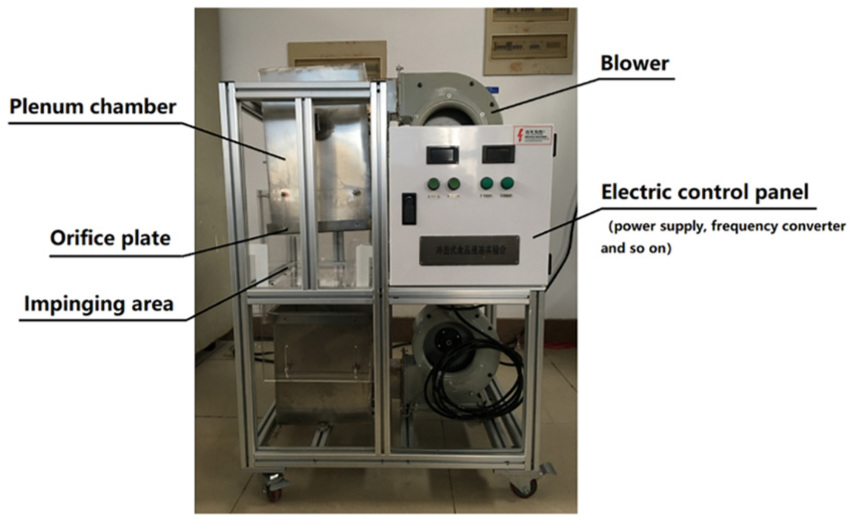
Experimental setup of the air-impingement system.
Shrimps were used as the frozen object, which is a kind of frozen goods at food markets. As known to all, white prawns are rich in protein, potassium, iodine, magnesium, phosphorus, and other essential substances. With these properties, shrimps are widely loved by people around the world. However, the white shrimp is not easy to store, and freezing is recognized as one of the important technologies in shrimp preservation that produces high quality of shrimps with a long shelf life. The shorter the freezing time, the higher the quality of the frozen food, and quick freezing can prevent microorganism growth and maximize the preservation of food nutrition.
The schematic layout of the experimental model is shown in Figure 2. There are a plenum chamber and a detachable orifice plate located at the bottom of the plenum chamber. The peeled shrimps were placed on the impingement plate. Cooling air was supplied to the plenum chamber by an air blower. In the impinging area, the jets discharge from round orifices and impinge to the opposite surface of impingement plate. Then the impinging air flow out through the horizontal channel.

Experimental model of jets impinging.
The specification of experimental setup is shown in Table 1. The power of blower is supplied from a AC power supply and frequency converter at 0–60 Hz was used to obtain different static pressures. The cooling air is supplied from a low temperature cold storage. As shown in Figure 3, the dimensions of the orifice plate were 250 mm × 250 mm × 2 mm. An orifice to orifice distance (S) and the round orifice diameter (D) were fixed at S = 4D. With the sliding rails, the plenum chamber could be moved up and down in order to change the distance (H) between the orifice plate and the impingement plate. Accordingly, the effect of H/D on the IF could be investigated experimentally. The hot-wire anemometer of testo 425 was used to measure the air velocity. The Fluke 2640A network-based multi-point temperature collecting instrument and T-type copper-constantan thermocouple were used to collect and measure the temperature of shrimp.
Specification of experimental setup.

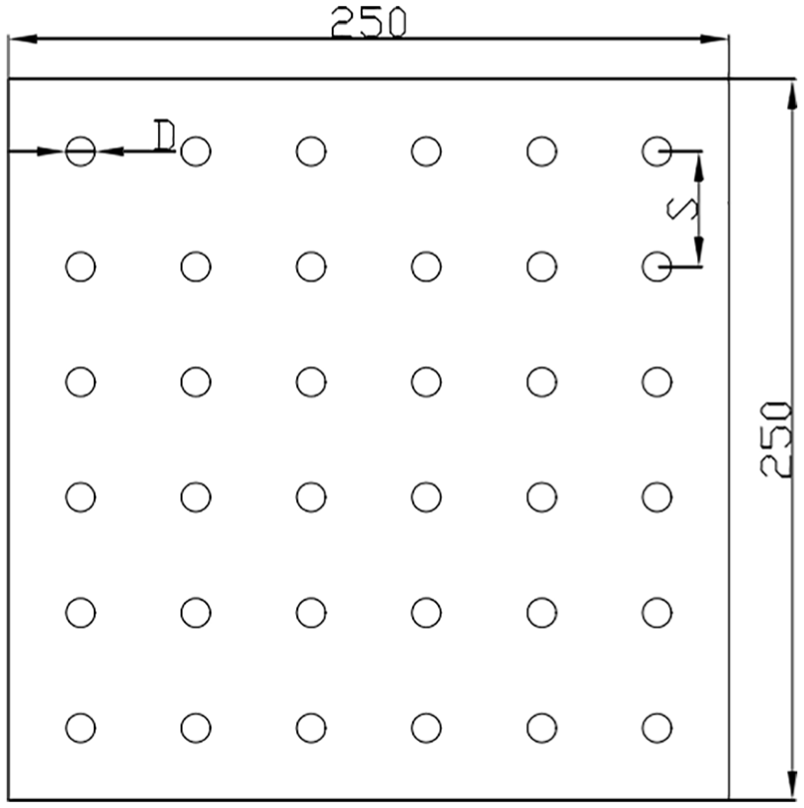
The sizes of orifice plate: S = 4D, D = 10 mm.
Numerical simulation method
Computational fluid dynamics (CFD) analyses of the IF of peeled shrimp were performed to investigate the flow field and the temperature distribution of the shrimp in the freezing process. In the article, the geometry model was established by CAD, and the grids of a shrimp were divided by GAMBIT 2.4 as shown in Figure 4. The geometry model was simplified according to the size of peeled shrimp in experiments. The models of fluid flow and heat transfer used Navier–Stoke (NS) equations, which consist of the continuity equation (equation (1)), the momentum conservation equation (equation (2)), and the energy conservation equation (equation (3)). 3 Based on FLUENT 6.3, the turbulence modeling used the k–ε RNG model and the energy model used solidification and melting model

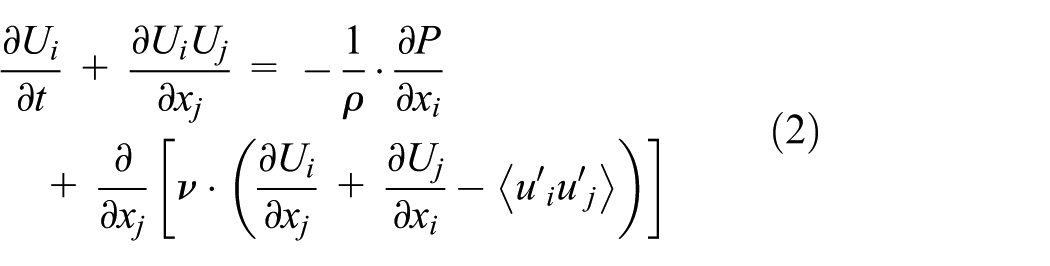

where
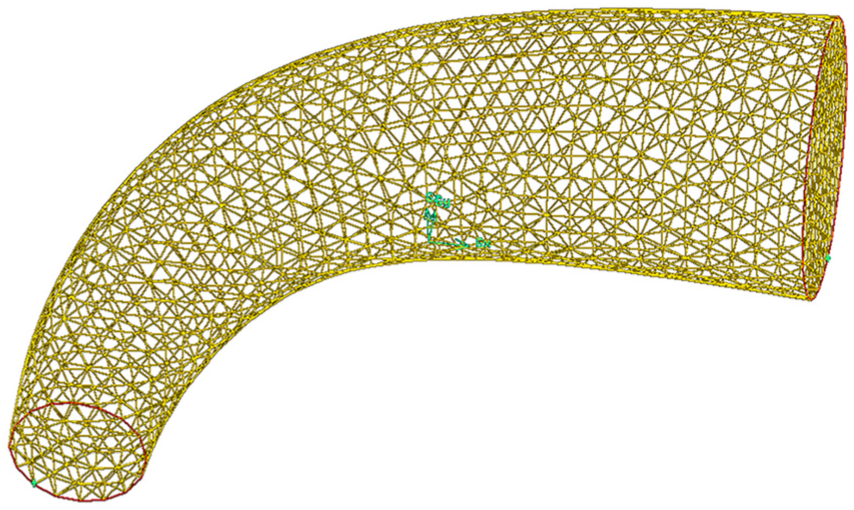
The computational mesh of a peeled shrimp.
Boundary conditions for the simulation
The boundary initial conditions on simulation were according to the experiments. The pressure inlets of 200 Pa were defined at all programs and the outflow was set as the outlet boundary. The inlet temperature was set at 244.15 K (–29°C) and the initial temperature of shrimp was set at 284.15 K (–11°C). The thermal properties of the shrimp were adopted from the handbook of American Society of Heating, Refrigerating and Air-Conditioning Engineers (ASHRAE) 20 as shown in Table 2. The latent heat of peeled shrimp is 254 kJ/kg and the freezing temperature is 271 K(–2.15°C).
Thermal properties of the peeled shrimp.

Experimental verification to simulation
The numerical simulation was accomplished according to the experimental condition: the H/D value is 5, the initial temperature of peeled shrimp is 11°C, and temperature of cooling air is −29°C. When the max temperature of shrimp was lower than −18°C, the simulation stopped. The freezing curves of an experimental data and a simulation result in same condition are shown in Figure 5. There are three periods which are pre-cooling, phase transition, and super-chill. The pro-cooling time of simulation was longer than the experimental result and the super-chill time of simulation was less than the experimental results. The reason is that the thermal properties for calculating have little deviation from the peeled shrimp. The freezing time of the experiment and simulation was 105 and 110 s, respectively. The max temperature error in the pro-cooling was 4.5°C, and the max temperature error was 2.9°C in the phase transition and super-chill. It means that the simulation results conformed to experimental result data well. The parameters of heat transfer by simulation are shown in Table 3. From precool period to super-chill period, the average heat flux and average Nu were decreasing in turn.

Compared with the impingement freezing time of experiments and simulation (H/D = 5, Ts,i = 11°C, Ts,f =−18°C, Ta = 29°C).
The parameters of heat transfer by simulation.

Results and discussion
The freezing time of a shrimp by natural convection and air-impingement
The air-IF technique could improve the freezing efficiency and food quality. The contrast of IF in experimental setup and natural convection freezing in conventional freezer was completed. The different freezing process of natural convection and air-impingement for peeled shrimp is shown in Figure 6. The measure points were located in the same position of the shrimp. In the IF, the initial temperature of shrimp and the air inlet temperature were 11°C and −29°C, respectively. In the process of natural convection freezing, the environment temperature was −29°C. The results show that the IF was much faster than the natural freezing. The freezing time of shrimp from +11°C to −18°C by air-impingement was 105 s and the freezing time by natural convection was about 1000 s. The freezing time of natural convection was 9.5 times than air-IF.

Effect of freezing method on food freeze time (H/D = 5, Ts,i = 11°C, Ts,f = –18°C, Ta = 29°C).
The parameters of heat transfer in impingement and natural convection freezing are shown in Table 3. The results show that the IF is much enhanced than the natural convection freezing. The average Nu of IF was about nine times than the natural convection. The heat flux of IF was about four times than the natural convection. In addition, the super-chill period of natural convection freezing was especially long in whole period. On the contrary, the super-chill period of IF was much shorter than the precool and freeze periods. It means that the IF still has a high heat transfer efficiency.
Flow field and temperature distributions of the shrimp in freezing process
Based on CFD, the flow field and temperature distributions of the shrimp in freezing process were investigated. Figures 7 and 8 show the vertical cross section of the peeled shrimp. Because the cross-shape of a shrimp is nearly elliptical, there are two separation points in the two sides of shrimp, respectively. After the separation points, the air jets near the shrimp surface flows away from the shrimp. In the separation region between the shrimp and the impingement plate, the air flow separated from the dominant jet flow and wake recirculation appeared. Accordingly, the bottom of the shrimp had quite bad flow field. The result of the temperature contour keeps coordination with the flow field. In the bottom half of the shrimp, the temperature contour was loose. By contrast, there were dense temperature contours in the shrimp in face of the air jet. It means that heat transfer in the top half of the shrimp was stronger than in the bottom half.
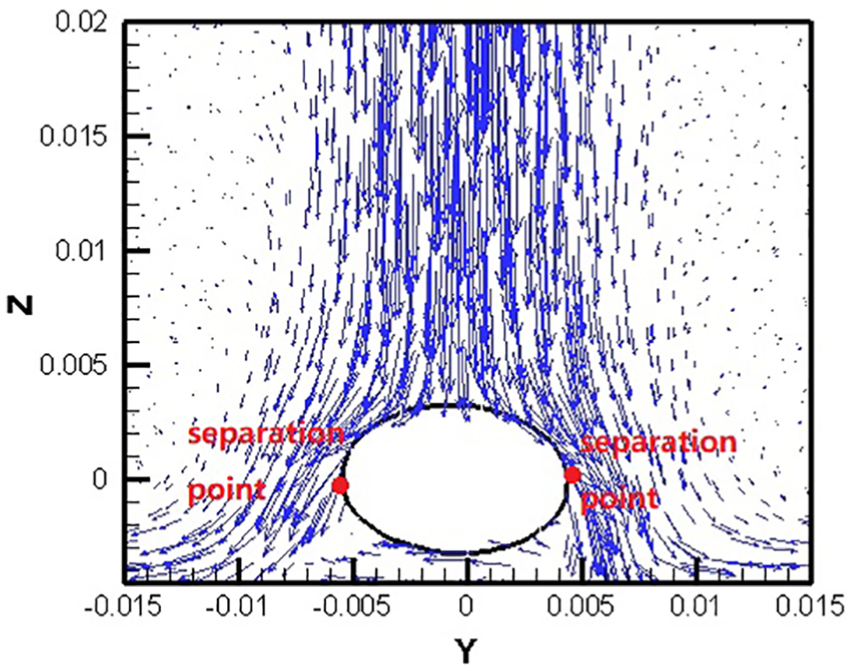
The flow vector in the vertical cross section of a peeled shrimp.
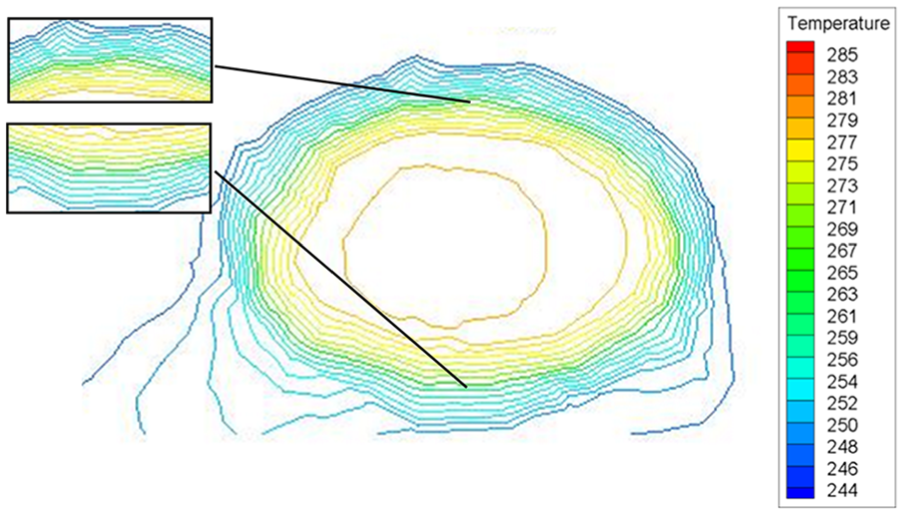
The temperature contour lines in the vertical cross section of a peeled shrimp.
Figure 9 shows the horizontal cross section of the peeled shrimp. In the process of shrimp freezing, the water in shrimp was frozen as ice crystal so that the latent heat of water is the main resistance of temperature decrease. In the beginning of the IF, the temperature gradient was obvious on account of no phase transition. The temperature contours of peeled shrimp have different changes obviously, and the shrimp tail passed the phase transition first when the shrimp trunk was still in the two-phase. With the increase in the freezing time, the non-frozen area shrank gradually. When freezing time is 85 s, the central of the shrimp trunk that includes abdomen and dorsum was frozen finally. When freezing time is 96 s, all peeled shrimp was frozen to −18°C, which is the required temperature of the freezing storage.

Temperature distribution of the symmetrical profile of a shrimp at different times.
Effect of H/D on freezing time by air-impingement
In air-IF, H/D is an important factor of freezing time. Too greater or too lesser H/D value is a disadvantage to food freeze. Greater H/D value increases the attenuation of air jet velocity. The reason is that the loss of kinetic energy of the jet due to shearing with surrounding stagnant air. 12 Lesser H/D value increases the air resistance and leads to more crossflow to blow food away. O Ghaffari et al. 5 reported that H/D = 2 leads to a drop in heat transfer than H/D = 5, which is associated with the coherent vortex structures. Short distance of nozzle to object results in incomplete growth of the vortices, accompanying the impinging air re-entrainment back into the jet flow. Therefore, at a specific H/D, the heat transfer on the food surface is maximum. The H/D’s range of 4–8 was compared experimentally. As shown in Figure 10, the freezing curves of a peeled shrimp were 140, 110, 100, 120, and 130 s, when H/D was from 4 to 8, respectively. With increasing H/D, the freezing time increases H/D’s range from 4 to 8. The reason for the decrease in the freezing time is increase in the air velocity. Due to an increase in the cross section of the horizontal channel and a decrease in the local resistance, the air velocities out of orifices were increasing with an increase in the H/D value from 2 to 8 as shown in Figure 11. In experiments of different H/Ds, the pressure drops were all 200 Pa so that the flow rate was decided by the cross section of the flow channel which was in proportion to H. When H/D was higher, the flow rate was higher and the air velocity was increasing accordingly. However, the increasing rate was decreasing with the increase in the H/D value. When H/D was higher than 6, the air velocity out of orifice was hardly varying. On the contrary, the loss of kinetic energy of the jet made the air velocity near to the shrimp surface to decrease when H/D value was higher than 6. Accordingly, the H/D value of 6 was recommended in the IF.
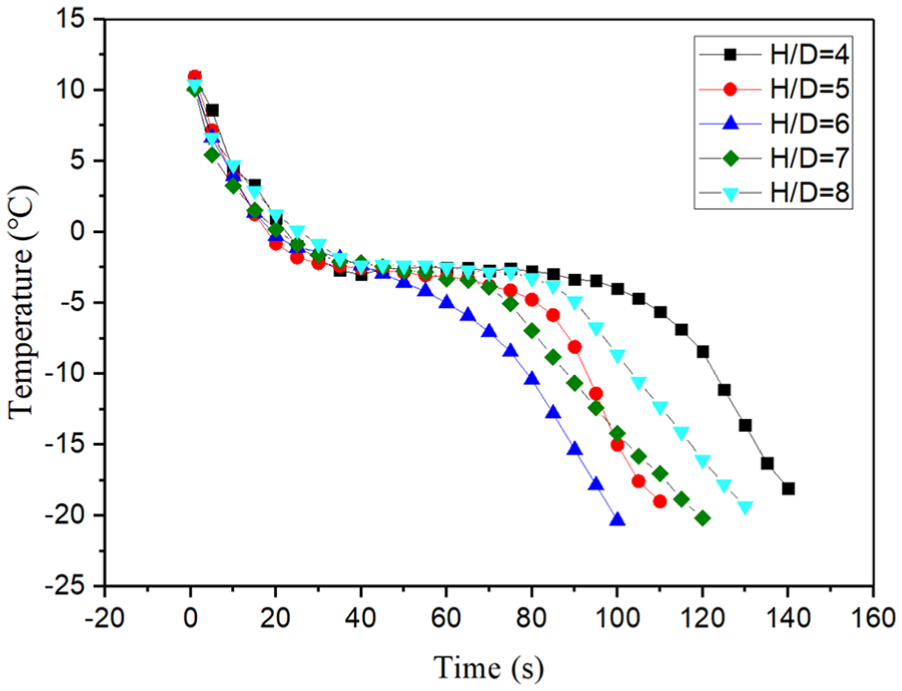
Effect of different H/Ds on the frozen time of shrimps.

Effects of H/D on the air velocity out of orifice.
Conclusion
The air-IF is a high-efficient freezing technique, which is widely used in food industry. In the article, the IF process of peeled shrimp (150 count/lb) was investigated experimentally and numerically. The results show that the heat transfer efficiency of IF was much higher than the natural convection freezing, especially in the super-chill period. According to CFD’s results, the jet flow separated after the separation points due to the interaction of the shrimp shape and air jets. In the separation region between the shrimp and the impingement plate, the flow field of air jet was bad. The flow field of air jets affected the temperature contours of peeled shrimp.
Compared with the natural convection and IF, the results show that IF technique could actually reduce freezing time of the shrimp about one-tenth than the natural convection. The maximum temperature error between experiments and numerical simulation was 4.5°C which appears in the pro-cooling. According to simulation results, the temperature contours in freezing process indicate that the bottom half of peeled shrimp had weakest heat transfer than the top half as well as the associated air flow field due to the interaction of shrimp and air jet.
For optimizing the IF, the effect of H/D on freezing time was studied in the H/D’s range of 4–8. The result indicates that it is the highest heat transfer when H/D was 6 in the IF. With an increase in the H/D value, air velocity out of orifices was increasing as well as the jet velocity near the shrimp surface. However, when H/D was greater than 6, the air velocity out of orifice gradually stabilized and the attenuation of the air jet enhanced which are against to improve the heat exchange efficiency.
Footnotes
Appendix 1
Handling Editor: Jiin-Yuh Jang
Declaration of conflicting interests
The author(s) declared no potential conflicts of interest with respect to the research, authorship, and/or publication of this article.
Funding
The author(s) disclosed receipt of the following financial support for the research, authorship, and/or publication of this article: This paper is supported by National Key R&D Program of China (2018YFD0400605), “Chen Guang” project supported by Shanghai Municipal Education Commission and Shanghai Education Development Foundation (16CG55) and Shanghai Municipal Education Commission project (ZZSHOU16013).
