The augmented thermal conductivity is significant in betterment of heat transfer behavior of fluids. A number of other physical quantities such as density, viscosity, and specific heat play the key role in fluid flow behavior. Investigators have shown that the nanofluids have not only superior heat conductivity but also have better convective heat transfer capability than the base fluids. In this article, the analysis of three-dimensional Williamson fluid has been carried out under investigation. The fluid flow is taken over a linear porous stretching sheet under the influence of thermal radiation. The transformed system of equations has been solved by homotopy analysis method. The impact of embedded parameters on the fluid flow has shown graphically. The velocity profile in x-direction is decreased with the augmented stretching, Williamson, coefficient of inertia, and porosity parameters. The velocity profile in y-direction is increased with the enlarged stretching parameter, while reduced with the augmented Williamson, coefficient of inertia, and porosity parameters. The temperature profile is increased with the enlarged stretching, radiation, thermophoresis, parameter and Brownian motion parameters, and Biot number while decreased with the increased Prandtl number. The concentration profile is increased with the increased thermophoresis parameter and Biot numbers, while decreased with the enlarged stretching and Brownian motion parameters.
There are abundant applications of non-Newtonian fluid in the field of geophysics, biological sciences, chemical industries, petroleum industries, and so on. Such flows appear in polymer processing, biological fluids, plastic manufacturing, food processing, ice and magma flows. The three-dimensional studies of nanofluid flow over a stretching surface have got researchers attention. The theory of pseudo plastic fluid has been presented by Williamson.1 He called this type of fluid as pseudo fluid due to exceptional properties from viscous and ideal plastic fluids. Ariel2 presented the three-dimensional steady laminar flow of incompressible viscous fluid over a stretching surface using homotopy perturbation method. Nadeem et al.3 examined the magnetohydrodynamic (MHD) Casson fluid over an exponentially shrinking sheet. The two-dimensional flow of Williamson fluid under low Reynolds number and long wavelength has been studied by Nadeem and Akram.4 Pop and Na5 examined the incompressible micro polar fluid flow over a stretching sheet. Sakiadis6 examined the three-dimensional viscous fluid flow over a stretching sheet. The three-dimensional Williamson fluid flow over a stretching surface has been examined by Malik et al.7 Gupta and Gupta8 examined the process of suction and blowing together with mass and heat transfer rate over a stretching surface. El-Aziz9 examined the effect of radiation by studying the fluid flow over an unsteady stretched surface. The effect of thermal radiation on the fluid flow over vertically porous stretched surface has been analyzed by Mukhopadyay.10 The change in concentration and mass transfer rates of the fluid flow over a horizontal stretched sheet has been numerically investigated by Shateyi and Motsa.11 The influence of thermal-diffusion and diffusion-thermo on three-dimensional MHD fluid flow over a permeable stretched surface has been analyzed by El-Eziz.12 The effect of thermal radiation on viscous fluid flow over non-linear stretched surface has been examined by Cortell.13 Ishak et al.14 numerically studied the heat transfer phenomena in a fluid flow. Dawar et al.15 analytically examined the effect of thermal radiation on MHD Eyring–Powell fluid flow over a porous stretched surface. The MHD Casson nanofluid and radiative heat transfer in a rotating channel have been examined by Dawar et al.16 Using effective thermal conductivity model, Shah et al.17 examined the electrical magnetite Casson feerofluid over a stretching/shrinking sheet. The effect of thermal radiation on MHD Jeffery fluid has been examined by Abro et al.18 Sheikholeslami and Houman19 examined the effect of Coulomb force on nanofluid heat transfer in a porous enclosure. The influences of Brownian motion on fluid flow and convective heat transfer in a porous cavity have been examined by Sheikholeslami and Houman.20 Considering Darcy model, Sheikholeslami21 examined the effect of Lorentz forces on fluid flow in a porous cylinder. Waqas et al.22 numerically studied the MHD Carreau nanofluid flow model over an exponentially stretched surface. Hayat et al.23 deliberated the stagnation point of MHD flow over non-linear stretched surface under the impact of non-uniform heat generation/absorption. Hayat et al.24 deliberated the relation of Darcy–Forchheimer with water-based carbon nanotubes flow in a rotating disk. Waqas et al.25 analyzed the effect of magnetic field and mixed convection of an Oldroyd-B nanofluid stratified flow. Hayat et al.26 examined the MHD nanofluid flow over non-linear stretched surface. The analysis of Newtonian heating in a stagnation point flow of Burgers’ fluid has been presented by Hayat et al.27 The joule heating impacts on MHD boundary layer flow of Burgers’ fluid over a stretched surface have been analyzed by Hayat.28 The effect of internal heat generation/absorption and Newtonian heating in Erying–Powell fluid over a stretched surface has been examined by Hayat et al.29 The effect of thermal radiation and thermo-diffusion on Williamson fluid flow over a porous stretched/shrinked sheet has been examined by Bhatti and Rashidi.30 The effect of chemical reaction and thermal radiation on MHD flow of nanofluid gyrotactic microorganisms has been examined by Bhatti et al.31 Bhatti et al.32 presented the numerical method for solving stagnation point flow over a permeable shrinked sheet. Alharbi et al.33 analytically studied the MHD flow of Erying–Powell fluid with entropy generation. Sheikholeslami et al.34 examined the heat transfer behavior of nanoparticle enhanced phase change material solidification through an enclosure with V-shaped fins. Sheikholeslami35 presented new computational approach for energy and entropy analysis of nanofluid under the impact of Lorentz force through a porous media. The others related studies can be found in the literature.36–38 Waqas et al.,39–42 Bhatti et al.43,44 recently studied non-Newton fluid using different models with different effects. Sulochana et al.45 studied Darcy–Forchheimer Williamson Nanofluid fluid with nonlinear radiation. Hayat et al.46 and Shah et al.47,48 recently studied nanofluid flow in rotating system.
The main aim of this work is to analyse three-dimensional radiative Williamson nanofluid over stretching surface with Darcy–Forchheimer medium. The fluid flow is taken over a linear porous stretching sheet under the influence of thermal radiation. The transformed system of equations has been solved by homotopy analysis method (HAM).49–58 The impact of embedded parameters on the fluid flow has shown graphically.
Problem formulation
Consider the unsteady three-dimensional incompressible flow of Williamson fluid over a linear porous stretching sheet. The sheet is stretched along xy-direction (Figure 1). The motion of the fluid is caused stretching sheet and the fluid occupy the space . The Williamson nanofluid in porous media is designated by assuming the Darcy–Forchheimer model where saturating porous space obeys the Darcy–Forchheimer expression. According to these boundary layer approximations, the equations of continuity and momentum for the Williamson fluid are given as
where , , , , and are the density, velocity vector, Cauchy stress tensor, the specific body force vector, and material derivative, respectively.
Physical representation of the fluid flow problem.
The mathematical equation for Williamson fluid is
where indicates the extra stress tensor; are the limiting viscosities at zero and at infinite shear rate, respectively; is the time constant; is the Rivlin–Ericksen tensor; and is defined as
where is the second invariant strain tensor.
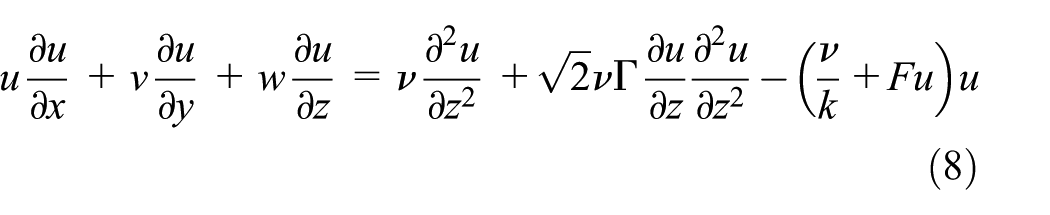
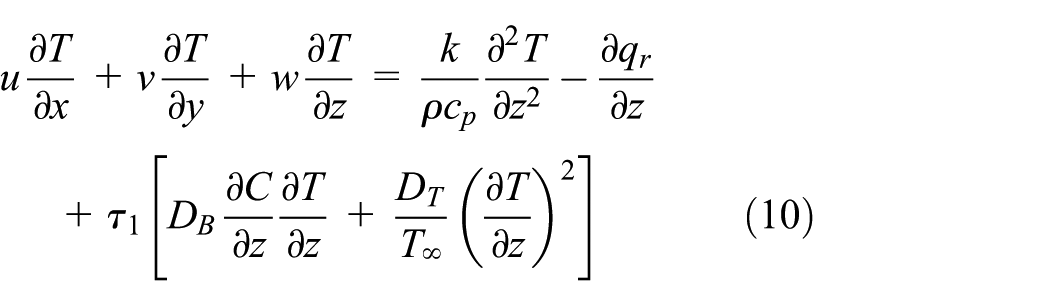
For the above stated problem, the mathematical equations are7,45
where is the radiative heat flux which is defined as
In equations (6)–(14), are the components of velocity in their respective directions; indicates the Williamson fluid parameter; represents the thermal conductivity; and specify the kinematic and dynamic viscosities, respectively; is the variable inertia coefficient of permeable medium; represents the temperature; and specify the heat and ratio of the heat capacities, respectively; and indicate the Brownian motion and thermophoretic coefficients, respectively; represents the absorption coefficient; indicates the Stefan Boltzmann constant; c = a/b is the stretching parameter where are positive constants, respectively; indicate the convective heat and mass transmission coefficients, respectively; represents the convective fluid temperature; and is the concentration below the moving sheet.
The similarity variables is defined as
In view of the above equation, the continuity equation satisfied and equations (8)–(10) and (13) are reduced to
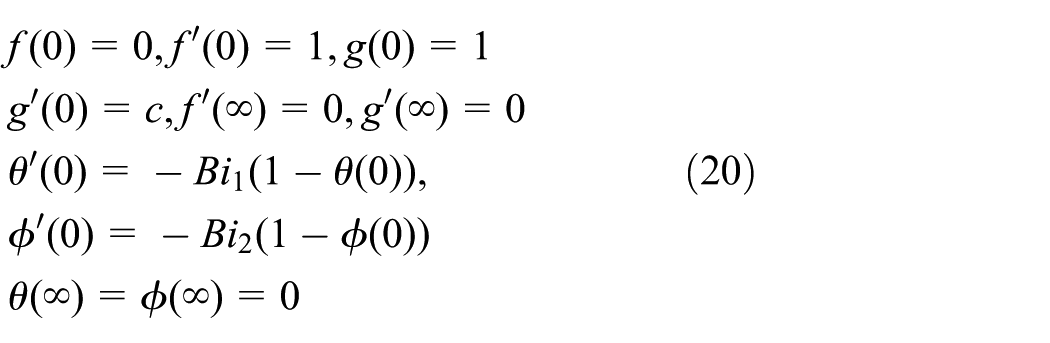
For the modeled problem, the following boundary conditions are defined
In the above equations, signifies the porosity parameter, denotes the Williamson parameter, is the coefficient of inertia, signifies the Prandtl number, signifies the radiation parameter, denotes the thermophoresis parameter, signifies the Brownian motion parameter, and are the Biot numbers.
The skin fraction, Nusselt number, and Sherwood number are defined as
The secondary constraints are nominated in such a way that the series (equation (36)) converges at . Changing in equation (36), we get
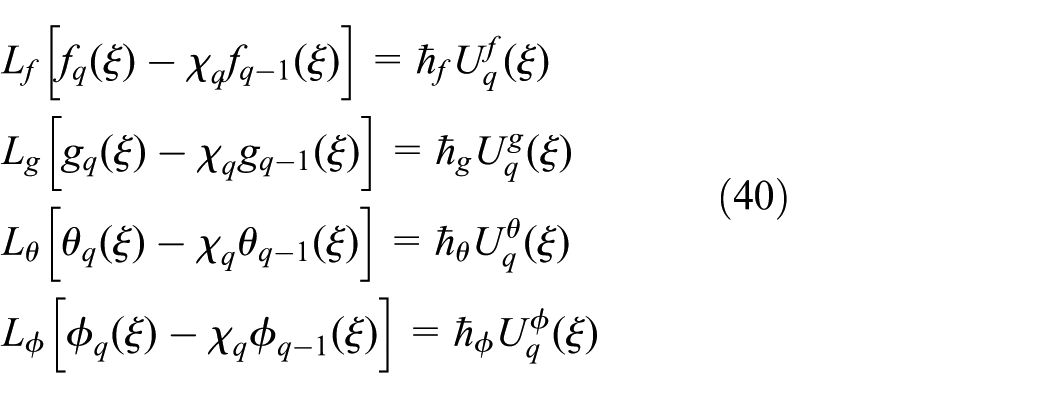
The order problem satiates the following
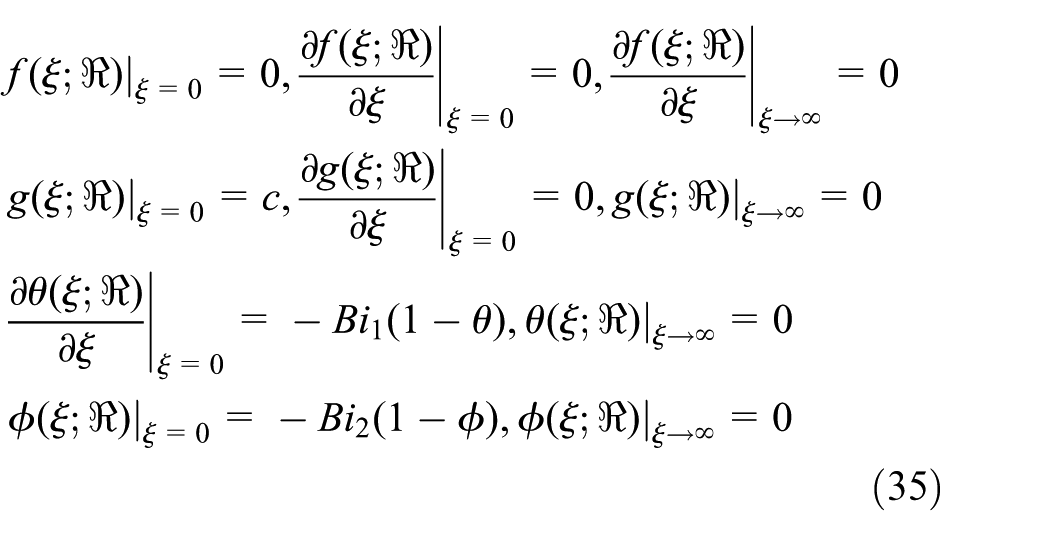
The boundary conditions are
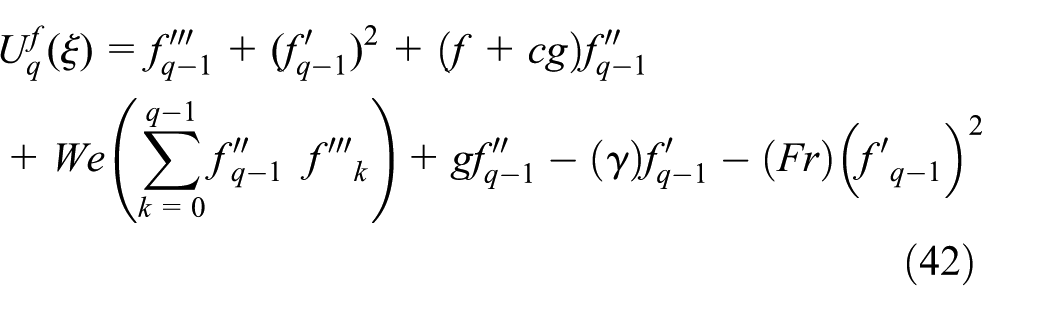
Here
where
HAM convergence
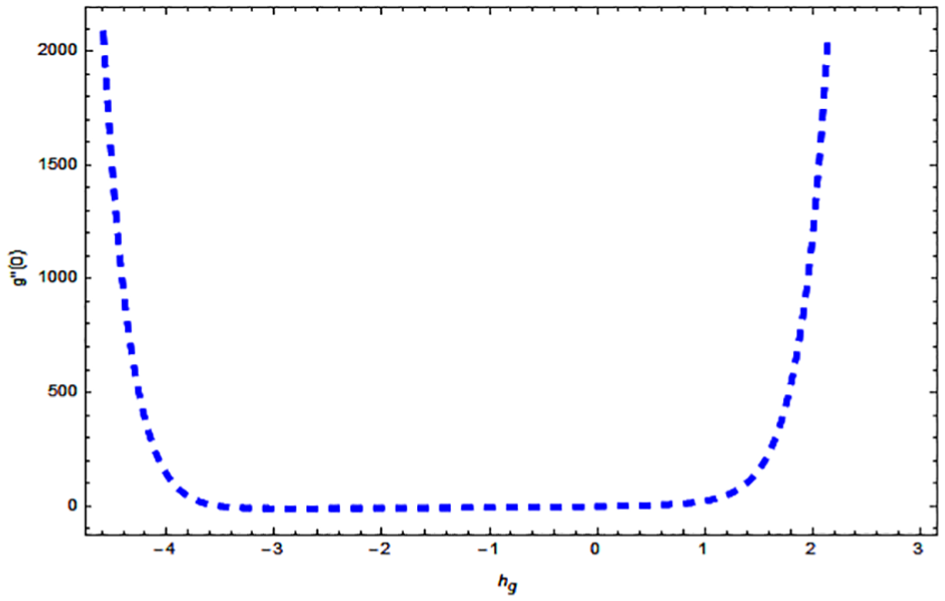
To calculate the series solution of velocity profile in x-direction, velocity profile in y-direction, temperature profile, and concentration profile, the assisting parameters of HAM are in authority of convergence. At 15th order approximations, for are schemed in Figures 2–5. The convergence regions for velocity profile in x-direction, velocity profile in y-direction, temperature profile, and concentration profile are displayed in their valid regions, respectively.
for .
graph of velocity profile .
for .
for .
Results and discussion
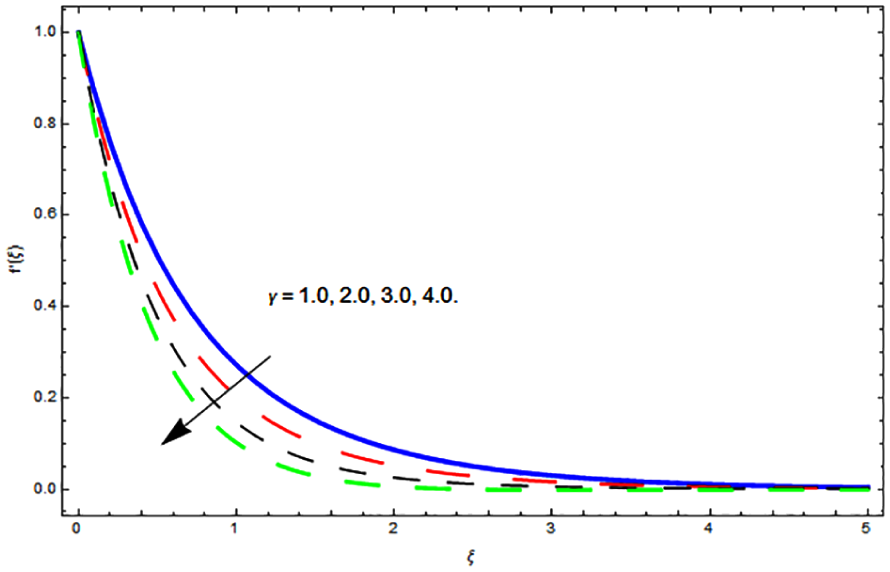
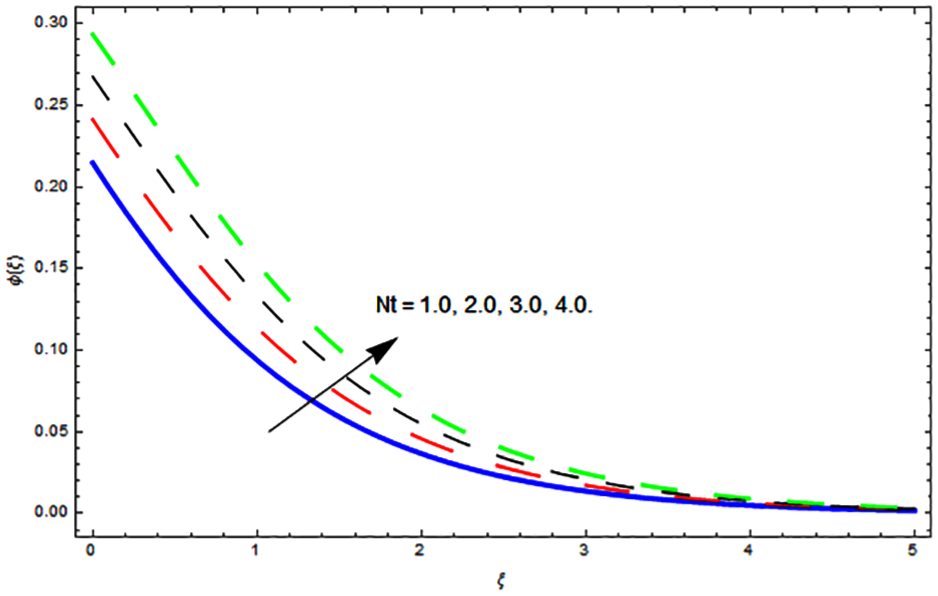
To discuss the influence of stretching parameter , Williamson parameter , Porosity parameter , coefficient of inertia , thermal radiation parameter , thermophoresis parameter , Brownian motion parameter , Prandtl number Pr and Boit numbers on velocity profile in x-direction, velocity profile in y-direction, temperature profile , and concentration profile, Figures 6–24 are plotted. Figures 6–9 are schemed to observe the effect of on velocities , temperature , and concentration profile , respectively. The stretching parameter represents the ratio of velocity of the fluid in x-direction to the velocity of the fluid in y-direction. The stretching parameter declines the velocity profile in x-direction is displayed in Figure 6. This behavior is due to the indirect relation of the stretching parameter to velocity profile in x-direction which resists the fluid flow. The effect of stretching parameter on velocity profile in y-direction is displayed in Figure 7. The stretching parameter is associated with the velocity profile , that is why the velocity profile upsurges with the increasing stretching parameter . The impact of stretching parameter on temperature profile is displayed in Figure 8. Physically, the stretching parameter thicker the thermal and momentum boundary layer which slower the heat dissipation causing the heating up the plate. Therefore, the temperature profile rises with the increasing stretching parameter . Figure 9 displays the effect of stretching parameter on concentration profile . We have observed the reducing behavior in concentration profile with the rise in stretching parameter . The influence of Williamson parameter on velocities profiles is schemed in Figures 10 and 11. It is ratio of the relaxation time to retardation time. The escalating Williamson parameter increases the relaxation time, because of which the fluid particles consume extra time in restoring their position and as a consequence, the increase in viscosity arises, and the particles’ velocity reduces. That is why the velocity profiles reduce with the increasing Williamson parameter . The influence of porosity parameter on velocities profiles is displayed in Figures 12 and 13. The porous medium plays an important role during flow phenomena. Physically, the porous medium affects the boundary layer of the fluid flow which as a result accelerates the fluid velocity. Due to this fact, the velocities profiles decrease with the increasing porosity parameter . The effect of coefficient of inertia on velocities profiles is displayed in Figures 14 and 15. The coefficient of inertia decreases the velocity profiles . The effect of thermal radiation parameter on temperature profile is displayed in Figure 16. Physically, the thermal radiation shows a significant role in the progression of heat transmission. The increase in thermal radiation the temperature of the boundary layer flow upsurges. That is why the velocity profile rises with the increasing thermal radiation parameter . The influence of Prandtl number Pr on temperature profile is depicted in Figure 17. The increasing Prandtl number Pr reduces the thermal diffusion, which results the boundary layer thickness and diminishes the temperature of the fluid. Therefore, the temperature profile diminishes with the increasing Prandtl number Pr. Figures 18 and 19 depict the impact of thermophoresis parameter on temperature and concentration profiles. Here, we witnessed that the increasing thermophoresis rises the temperature and concentration profiles. Figures 20 and 21 show the effect Brownian motion parameter on temperature and concentration profiles. From here, we observed the increasing behavior in temperature profile while reducing behavior in concentration profile . Figures 22 and 23 show the influence of Biot number on temperature and concentration profiles. From here, we observed the increasing behavior in temperature and concentration profiles with the increasing Biot number . A similar impact is observed in Figure 24 with the increasing Biot number .
Impact of on when We = 0.1, γ = 0.2, Fr = 0.3.
Impact of on when .
Impact of on when .
Impact of on when .
Impact of on when .
Impact of on when .
Impact of on when .
Impact of on when .
Impact of on when .
Impact of on when .
Impact of on when .
Impact of Pr on when .
Impact of on when .
Impact of on when .
Impact of on when .
Impact of on when .
Impact of on when .
Impact of on when .
Impact of on when .
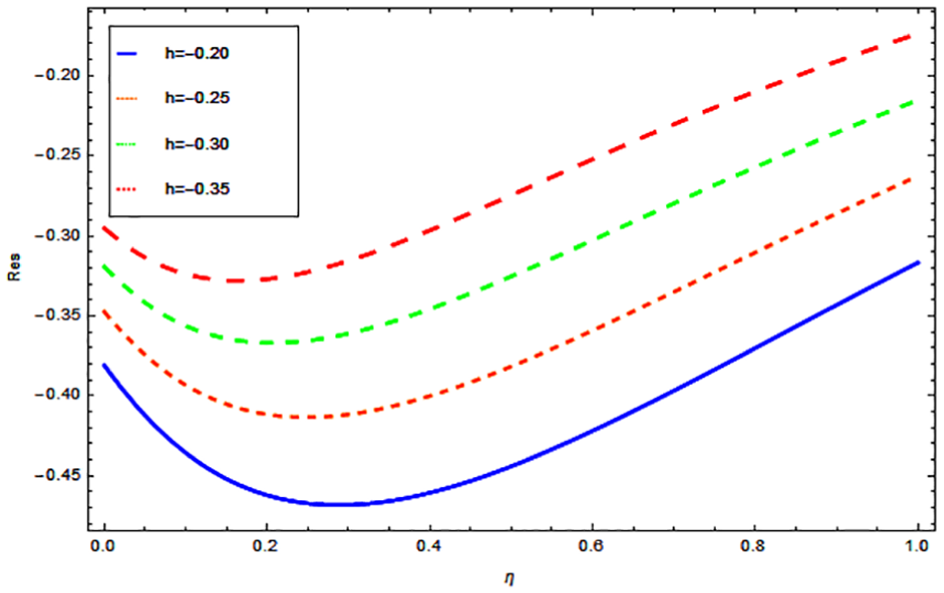
Figures 25–28 are plotted to observe the residual error for velocity in x-direction, velocity in y-direction, temperature, and concentration profiles, respectively.
Residual error for .
Residual error for .
Residual error for .
Residual error for .
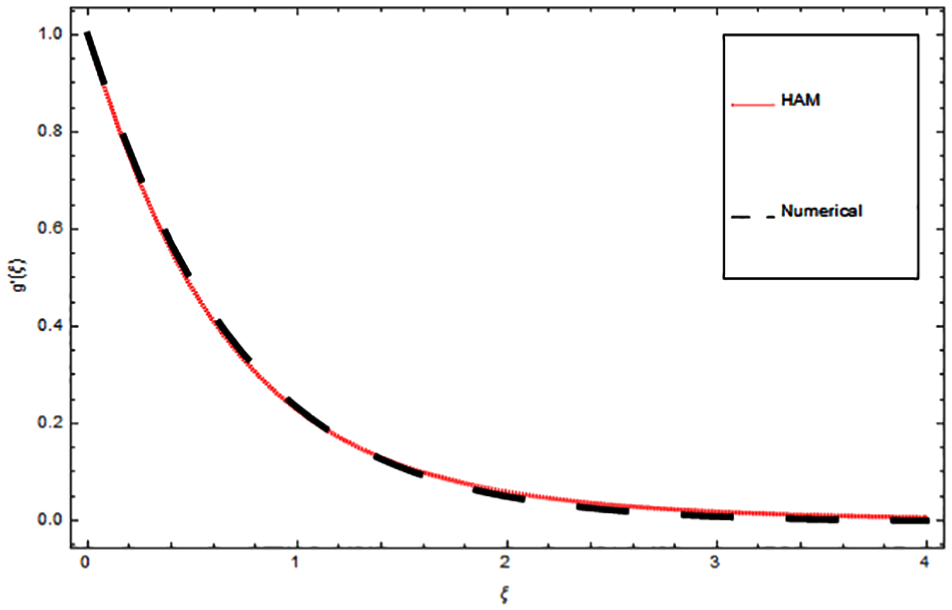
Figures 29–32 are plotted for the comparison of HAM and numerical method (ND-Solve technique) for velocity in x-direction, velocity in y-direction, temperature, and concentration profiles, respectively.
HAM and numerical comparison for .
HAM and numerical comparison for .
HAM and numerical comparison for .
HAM and numerical comparison for .
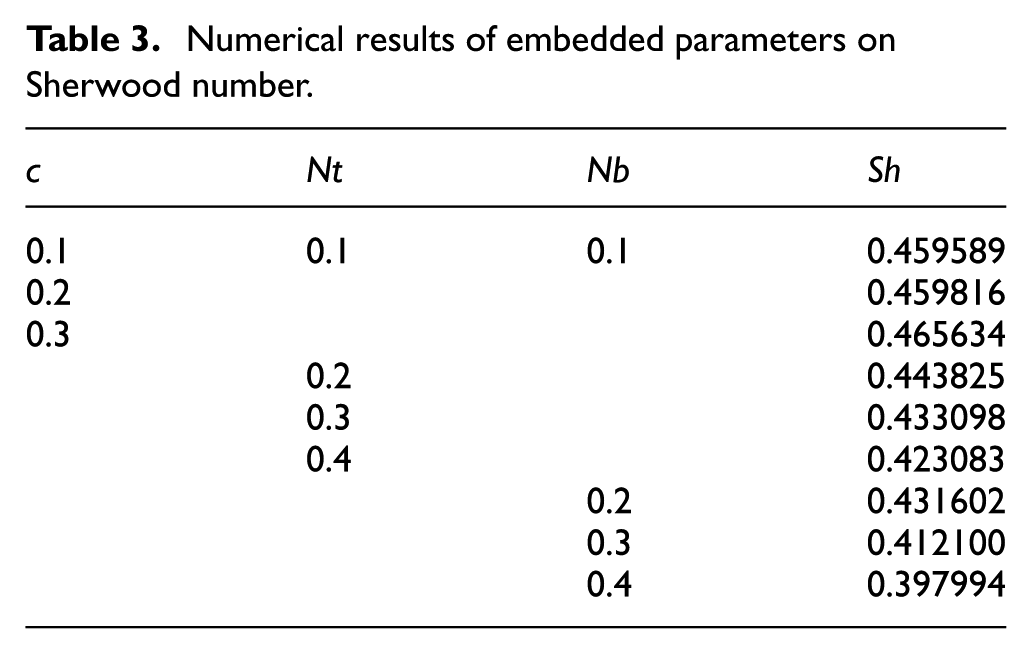
The impact of stretching parameter , Williamson parameter , porosity parameter , thermal radiation parameter , thermophoresis parameter and Brownian motion parameter , and Prandtl number Pr on skin fraction , local Nusselt number , and Sherwood number are shown in Tables 1–3. The increasing stretching parameter reduces the skin fraction. This behavior is due to the indirect relation of the stretching parameter to skin fraction in x-direction which resists the fluid flow, while in y-direction the stretching parameter has opposite behavior to the skin fraction . The Williamson parameter shows increasing behavior to the skin fraction . This behavior is due to the particles of the fluid that take more time in restoring their position and as a result, the increase in viscosity arises, and the fraction of the fluid particles at the surface of the sheet increases. The porosity parameter shows reducing behavior to the skin fraction . Actually, the porous medium affects the boundary layer of the fluid which as a result accelerates the velocity of the fluid particles. This accelerating fluid particles increase the skin fraction . The increasing stretching parameter increases is heat transfer rate . This behavior is due to fact that the stretching parameter thicker the thermal and momentum boundary layer which slower the heat dissipation causing the heating up the plate. The Prandtl number Pr increases the heat transfer rate . The thermal radiation increases the heat transfer rate . Physically, thermal radiation upsurges the boundary layer flow which results increase in heat transfer rate . Thermophoresis and Brownian motion parameters reduce the heat transfer rate . The increasing stretching parameter , thermophoresis , and Brownian motion parameters reduce the mass transfer rate .
Numerical results of embedded parameters on skin fraction.
0.1
0.1
0.1
–0.969150
–0.454130
0.2
–0.970217
–0.455364
0.3
–0.971740
–0.581819
0.2
–0.870760
–1.056940
0.3
–0.768846
–0.825998
0.4
–0.624216
–0.599542
0.2
–0.617283
–0.620103
0.3
–0.602723
–0.562401
0.4
–0.579271
–0.444439
Numerical results of embedded parameters on local Nusselt number.
Pr
0.1
4.5
0.1
0.1
0.1
0.459589
0.2
0.459816
0.3
0.463456
4.6
0.463902
4.7
0.467118
4.8
0.470111
0.2
0.143878
0.3
0.192457
0.4
0.208134
0.2
0.205091
0.3
0.199132
0.4
0.187810
0.2
0.183980
0.3
0.170990
0.4
0.154704
Numerical results of embedded parameters on Sherwood number.
0.1
0.1
0.1
0.459589
0.2
0.459816
0.3
0.465634
0.2
0.443825
0.3
0.433098
0.4
0.423083
0.2
0.431602
0.3
0.412100
0.4
0.397994
Conclusion
The three-dimensional Williamson fluid flow has been examined in this research article. The fluid flow is analyzed over porous stretched sheet with the influence of thermal radiation. The key findings are listed as follows:
The velocity profile in x-direction is decreased with the augmented stretching, Williamson, porosity, and inertial coefficient parameters.
The velocity profile in y-direction is increased with the enlarged stretching parameter, while reduced with the augmented Williamson, porosity, and inertial coefficient parameters.
The temperature profile is increased with the enlarged stretching, thermophoresis, radiation, and Brownian motion parameters and Biot number while decreased with the increased Prandtl number.
The concentration profile is increased with the increased thermophoresis parameter and Biot numbers while decreased with the enlarged stretching and Brownian motion parameters.
The skin fraction is increased with the increased Williamson and porosity parameters while reduced with the increased stretching parameter.
The Nusselt number is increased with the increased stretching and thermal radiation parameters, and Prandtl number while reduced with the enlarged Brownian motion and thermophoresis parameters.
The Sherwood number is increased with the enlarged stretching parameter while reduced with the increased Brownian motion and thermophoresis parameters.
Footnotes
Appendix 1
Handling Editor: Assunta Andreozzi
Declaration of conflicting interests
The author(s) declared no potential conflicts of interest with respect to the research, authorship, and/or publication of this article.
Funding
The author(s) received no financial support for the research, authorship, and/or publication of this article.
ORCID iDs
Abdullah Dawar
Zahir Shah
Waris Khan
References
1.
WilliamsonRV. The flow of pseudoplastic materials. Int J Ind Eng Chem1929; 21: 1108–1111.
2.
ArielPD. The three-dimensional flow past a stretching sheet and the homotopy perturbation method. Int J Appl Math2007; 54: 920925.
3.
NadeemSHaqRULeeC. MHD flow of a Casson fluid over an exponentially shrinking sheet. Sinteia Iranica2012; 19: 1550–1553.
4.
NadeemSAkramS. Peristaltic flow of a Williamson fluid in an asymmetric channel. Int J Nonli Sci Numer Simul2010; 15: 1705–1712.
5.
PopTNaT. Unsteady flow past a stretching sheet. Int J Acta Mech1996; 4: 413–422.
6.
SakiadisBC. Boundary layer behavior on continuous solid surfaces and boundary layer on a continuous flat surface. J Am Inst Chem Eng1961; 7: 221–225.
7.
MalikMYBilalSSalahuddinTet al. Three-dimensional Williamson fluid flow over a linear stretching surface. Math Sci Lett2017; 6: 53–61.
8.
GuptaPSGuptaAS. Heat and mass transfer on a stretching sheet with suction or blowing. Canadian J Chem Eng1977; 55: 744–746.
9.
El-AzizM. Radiation effect on the flow and heat transfer over an unsteady stretching sheet. Int Commun Heat Mass Trans2009; 6: 521–524.
10.
MukhopadyayS. Effect of thermal radiation on unsteady mixed convection flow and heat transfer over a porous stretching surface in porous medium. Int J Heat Mass Tran2009; 52: 3261–3265.
11.
ShateyiSMotsaSS. Thermal radiation effects on heat and mass transfer over an unsteady stretching surface. Math Probl Eng2009; 13: 965603.
12.
El-AzizM. Thermal-diffusion and diffusion-thermo effects on combined heat and mass transfer by hydromagnetic three-dimensional free convection over a permeable stretching surface with radiation. Phys Lett2008; 372: 263–272.
13.
CortellR. Effects of viscous dissipation and radiation on thermal boundary layer over a non-linearly stretching sheet. Physics Lett A2008; 372: 631–636.
14.
IshakANazarRPopI. Heat transfer over a stretching surface with variable heat flux in viscous fluid. Physics Lett A2008; 372: 559–561.
15.
DawarAShahZIdreesMet al. Impact of thermal radiation and heat source/sink on Eyring–Powell fluid flow over an unsteady oscillatory porous stretching surface. Math Comput Appl201823: 20.
16.
DawarAShahZIslamSet al. Magnetohydrodynamic CNTs Casson nanofluid and radiative heat transfer in a rotating channels. J Phys Res Appl2018; 1: 017–032.
17.
ShahZDawarAKhanIet al. Cattaneo-Christov model for electrical magnetite micropoler Casson ferrofluid over a stretching/shrinking sheet using effective thermal conductivity model. Case Stud Therm Eng2019; 13: 100352.
18.
AbroKAAbroIAAlmaniSMet al. On the thermal analysis of magnetohydrodynamic Jeffery fluid via modern non integer order derivative. J King Saud Univ Sci. Epub ahead of print 10July2018. DOI: 10.1016/j.jksus.2018.07.012
19.
SheikholeslamiMHoumanBR. Numerical simulation for impact of Coulomb force on nanofluid heat transfer in a porous enclosure in presence of thermal radiation. Int J Heat Mass Tran2018; 118: 823–831.
20.
SheikholeslamiMHoumanBR. Magnetic nanofluid flow and convective heat transfer in a porous cavity considering Brownian motion effects. Physics of Fluids2018; 30: 012003.
21.
SheikholeslamiM. Influence of Lorentz forces on nanofluid flow in a porous cylinder considering Darcy model. J Mol Liq2017; 225: 903–912.
22.
WaqasMKhanMIHayatTet al. Numerical simulation for magneto Carreau nanofluid model with thermal radiation. Comput Meth Appl Mech Eng2017; 324: 640–653.
23.
HayatTKhalidHWaqasMet al. Homotopic solutions for stagnation point flow of third-grade nanoliquid subject to magnetohydrodynamics. Result Phys2017; 7: 4310–4317.
24.
HayatTKhalidHWaqasMet al. Numerical simulation for radiative flow of nanoliquid by rotating disk with carbon nanotubes and partial slip. Comput Meth Appl Mech Eng2018; 341: 397–408.
25.
WaqasMHayatTShehzadSAet al. Transport of magnetohydrodynamic nanomaterial in a stratified medium considering gyrotactic microorganisms. Physica B: Condens Matter2018; 529: 33–40.
26.
HayatTWaqasMAlsaediAet al. Magnetohydrodynamic stretched flow of tangent hyperbolic nanoliquid with variable thickness. J Mol Liq2017; 229: 178–184.
27.
HayatTAliSAwaisMet al. Newtonian heating in a stagnation point flow of Burgers fluid. Appl Math Mech Engl2015; 36: 61–68.
28.
HayatT. Joule heating effects on MHD flow of Burgers’ fluid. Heat Trans Res2016; 47: 1083–1092.
29.
HayatTAliSFarooqMAet al. On comparison of series and numerical solutions for flow of Eyring-Powell fluid with Newtonian heating and internal heat generation/absorption. PLoS ONE2015; 10: e0129613.
30.
BhattiMMRashidiMM. Effects of thermo-diffusion and thermal radiation on Williamson nanofluid over a porous shrinking/stretching sheet. J Mol Liq2016; 221: 567–573.
31.
BhattiMMMishraSRRashidiMM. A mathematical model of MHD nanofluid flow having gyrotactic microorganisms with thermal radiation and chemical reaction effects. Neur Comput Appl2018; 30: 1237–1249.
32.
BhattiMMAbbasMARashidiMM. A robust numerical method for solving stagnation point flow over a permeable shrinking sheet under the influence of MHD. Appl Math Comput2017; 316: 381–389.
33.
AlharbiSODawarAShahZet al. Entropy generation in MHD Eyring–Powell fluid flow over an unsteady oscillatory porous stretching surface under the impact of thermal radiation and heat source/sink. Appl Sci2018; 8: 2588.
34.
SheikholeslamiMHaqRUShafeeAet al. Heat transfer behavior of nanoparticle enhanced PCM solidification through an enclosure with V shaped fins. Int J Heat Mass Trans2019; 130: 1322–1342.
35.
SheikholeslamiM. New computational approach for exergy and entropy analysis of nanofluid under the impact of Lorentz force through a porous media. Comput Meth Appl Mech Eng2019; 344: 319–333.
36.
HayatTAliSAlsaediAet al. Influence of thermal radiation and Joule heating in the flow of Eyring-Powell fluid with Soret and Dufour effects. J Appl Math Tech Phys2016; 57: 1051–1060.
37.
FarooqAAliZBenimAC. Soret and Dufour effects on three dimensional Oldroyd-B fluid. Physica A2018; 503: 345–354.
38.
WaqasMFarooqMIKhanAet al. Magnetohydrodynamic (MHD) mixed convection flow of micropolar liquid due to nonlinear stretched sheet with convective condition. Int J Heat Mass Tran2016; 102: 766–772.
39.
WaqasMAlsaediAShehzadSAet al. Mixed convective stagnation point flow of Carreau fluid with variable properties. J Braz Soc Mech Sci Eng2017; 39: 3005.
40.
WaqasMIjazMKHayatTet al. Stratified flow of an Oldroyd-B nanoliquid with heat generation. Result Phys2017; 7: 2489–2496.
41.
WaqasMHayatTAlsaediAet al. Analysis of forced convective modified Burgers liquid flow considering Cattaneo-Christov double diffusion. Result Phys2018; 8: 908–913.
42.
WaqasMHayatTShehzadSAet al. Application of improved Fourier’s and Fick’s laws in a non-Newtonian fluid with temperature-dependent thermal conductivity. J Braz Soc Mech Sci Eng2018; 40: 116.
43.
BhattiMMAbbasTRashidiMM. A new numerical simulation of MHD stagnation-point flow over a permeable stretching/shrinking sheet in porous media with heat transfer. Iran J Sci Technol Trans A: Sci2017; 41: 779–785.
44.
BhattiMMAbbasTRashidiMM. Entropy generation in blood flow with heat and mass transfer for the Ellis fluid model. Heat Trans Res2018; 49: 747–760.
45.
SulochanaCAshwinkumarGPSandeepN. Similarity solution of 3D Casson nanofluid flow over a stretching sheet with convective boundary conditions. J Nigeria Math Soc2016; 35: 128–141.
46.
HayatTAzizAMuhammadTet al. Darcy–Forchheimer three-dimensional flow of Williamson nanofluid over a convectively heated nonlinear stretching surface. Commun Theor Phys2017; 68: 387.
47.
ShahZIslamSAyazHet al. Radiative heat and mass transfer analysis of micropolar nanofluid flow of Casson fluid between two rotating parallel plates with effects of hall current. ASME J Heat Trans2019; 141: 022401.
48.
ShahZIslamSGulTet al. The electrical MHD and hall current impact on micropolar nanofluid flow between rotating parallel plates. Result Phys2018; 9: 1201–1214.
49.
IshaqMAliGShahZet al. Entropy generation on nanofluid thin film flow of Eyring–Powell fluid with thermal radiation and MHD effect on an unsteady porous stretching sheet. Entropy2018; 20: 412.
50.
HammedHHaneefMShahZet al. The combined magneto hydrodynamic and electric field effect on an unsteady Maxwell nanofluid flow over a stretching surface under the influence of variable heat and thermal radiation. Appl Sci2018; 8: 160.
51.
AliASulaimanMIslamSet al. Three-dimensional magnetohydrodynamic (MHD) flow of Maxwell nanofluid containing gyrotactic micro-organisms with heat source/sink. AIP Adv2018; 8: 085303.
52.
ShahZBonyahEIslamSet al. Radiative MHD thin film flow of Williamson fluid over an unsteady permeable stretching. Heliyon2018; 4: e00825.
53.
GulTNasirSIslamIet al. Effective Prandtl number model influences on the γAl2O3–H2O and γAl2O3–C2H6O2 nanofluids spray along a stretching cylinder. Arab J Sci Eng2018; 44: 16.
54.
PalwashaZKhanNShahZet al. Study of two-dimensional boundary layer thin film fluid flow with variable thermophysical properties in three dimensions space. AIP Adv2018; 8: 105318.
55.
ZuhraSKhanNShahZet al. Simulation of bioconvection in the suspension of second grade nanofluid containing nanoparticles and gyrotactic microorganisms. AIP Adv2018; 8: 105210.
56.
KhanNZuhraSShahZet al. Slip flow of Eyring-Powell nanoliquid film containing graphene nanoparticles. AIP Adv2018; 8: 115302.
57.
KhanASNieYShahZet al. Three-dimensional nanofluid flow with heat and mass transfer analysis over a linear stretching surface with convective boundary conditions. Appl Sci2018; 8: 2244.
58.
NasirSIslamSGulTet al. Three-dimensional rotating flow of MHD single wall carbon nanotubes over a stretching sheet in presence of thermal radiation. Appl Nanosci2018; 8: 1361–1378.