This article is proposed to discuss the solutions of two-dimensional equations of motion for viscous fluid. Different situations for the solution have been investigated while employing inverse solution methods. On assuming the stream functions in a certain form without prescribing boundary conditions, the expressions for streamlines and velocity components are explicitly presented. Moreover, a series of graphical results for streamlines and velocity components are plotted.
Navier–Stokes equations describing the physical interests of scientific and engineering research are considered to be worthwhile. These equations are mainly used to deal with weather forecasting, ocean currents, water flow in a pipe, and air flow around a wing. Moreover, the structural design of aircraft and cars, the study of blood flow, the design of power stations, and the analysis of pollution are very closely related to Navier–Stokes equations. Furthermore, the study of magnetohydrodynamics is based on the coupling of Maxwell’s equations and Navier–Stokes equations. Since their introduction, different physical models have been exploited in literature to deal with assorted physical situations.1–10
In mathematical sense, these equations are a challenging system of nonlinear equations in the presence of viscous flows. No general analytical method exists for attacking this system for an arbitrary viscous flow problem. However, exact but particular solutions have been found to satisfy the complete equations for some special geometrical designs. Although such exact solutions are very few, yet they are important as they serve as accuracy checks for experimental, numerical, and asymptotic results.
Attempts to investigate exact solutions of Navier–Stokes equations revolve around linearizing them. In this regard, Taylor11 was the first to succeed by assuming the vorticity to be proportional to stream function. This idea was subsequently generalized by Kovasznay,12 Lin and Tobak,13 Wang,14,15 Hui,16 James,17 and others. They all obtained exact solutions of some interesting problems by assuming vorticity to be related to stream function with the relation , where K and U are real constants. In continuation with such studies, Kovasznay,12 for example, studied the downstream flow of a two-dimensional grid, and Lin and Tobak13 discussed the reversed flow above a flat plate with suction.
In this article, we investigate the exact solutions while generalizing the local vorticity to satisfy the following expression , where and b are real constants. Under this assumption, the intention is focused to obtain solution for two-dimensional steady and unsteady flow of an incompressible viscous fluid. By assuming a prescribed vorticity function, we obtain exact solutions which may be useful for the comparison of results obtained numerically. We have given explicit expressions for streamlines and velocity components. Some of these results are provided graphically.
The article is organized as follows. In the “Mathematical formulation” section, problem is formulated, whereas the “Acquisition of solution” section presents inverse solutions for different cases along with graphical discussion. The key findings of the article are concluded in the “Concluding remarks” section.
Mathematical formulation
The basic equations governing the motion of an incompressible fluid are equations of continuity and momentum, given as
and
where is the constant density, is the velocity, is the Cauchy stress tensor in which is the indeterminate part of the spherical stress, is the dynamic viscosity, and is the first Rivlin–Ericksen tensor.
For the motion of an unsteady incompressible Newtonian fluid, the velocity is described in Cartesian coordinates by
where u and v being the velocity components in x- and y-directions, taken, respectively, horizontally and vertically. Making the use of equation (3) into equations (1) and (2), the system of equations reduces to
and
where
and
Equations (4) to (6) are three partial differential equations for three unknown functions u, v, and of the variables . Once u, v, and are obtained, the pressure p can be calculated from equation (8). On cross-differentiating equations (5) and (6) and then using integrability condition , we obtain the vorticity equation as follows
whereas on introducing the stream function by
we find that the continuity equation is satisfied identically, and equation (9) yields
where is the kinematic viscosity, is the usual Laplacian, and
For universal use, we nondimensionalize the last equation by using the following scaling
where V is some characteristic velocity, and dropping the asterisk, we get
In this case, the length scale is of the order of Reynolds number and flow remains stable for the low Reynolds number as discussed by Marner et al.18 In the sequel, we obtain solutions of equation (13) while using inverse method.
Acquisition of solution
Let us assume that
where K, a, and b are real constants, with . On substituting equation (14) in equation (13), it is found that
Here, three cases arise depending upon the sign of .
Case I.
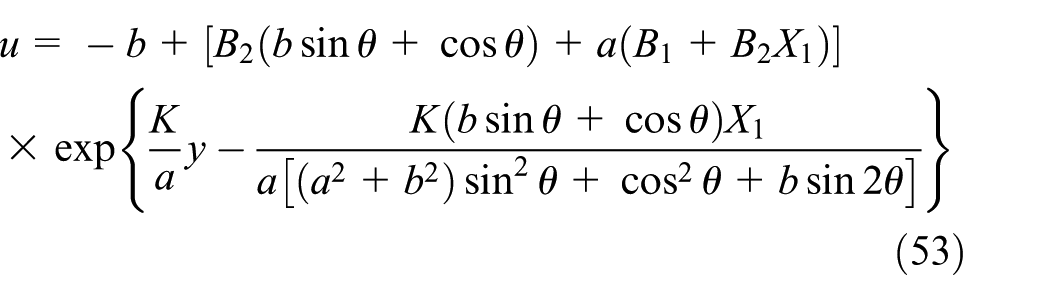
In this case, the solution of equation (22) is given by
and stream function and the velocity components are obtained as follows
For , the obtained solution (equation (24)) represents a uniform stream and with a perturbation part which decays exponentially as y increases.
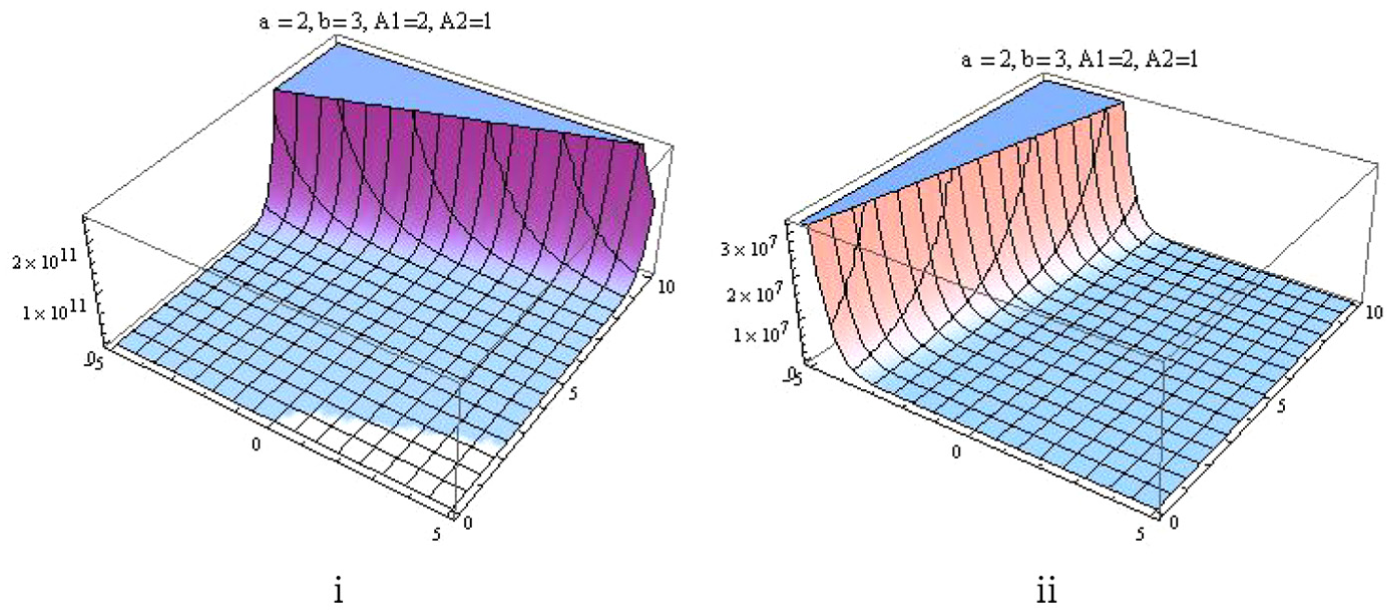
As can be visualized from Figure 1(i-iii), for and , the number of spillways increases from 3 to 8, whereas for and , the number of spillways decreases from 7 to 1, and flow becomes smooth. However, for and , flow remains smooth. For and , there are no spillways and the flow is smooth.
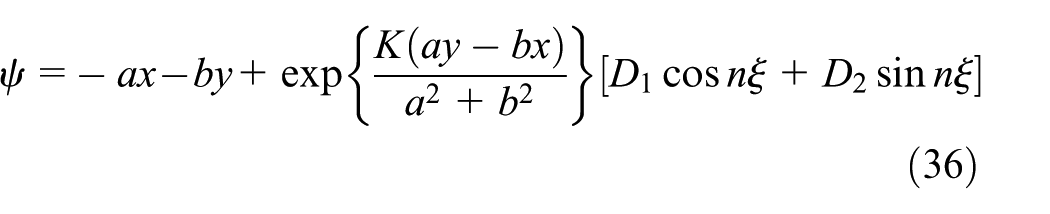
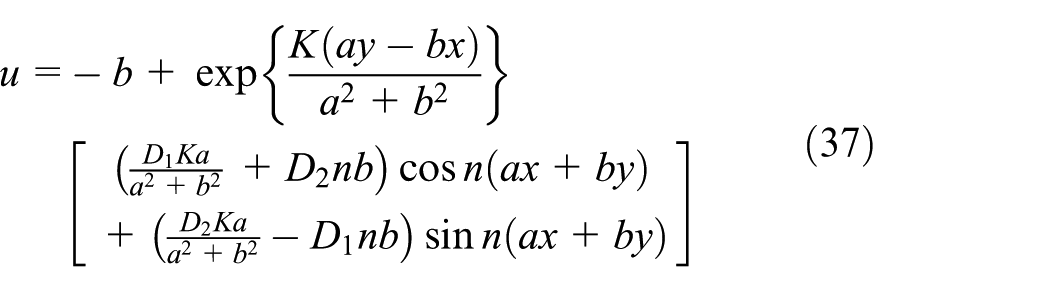
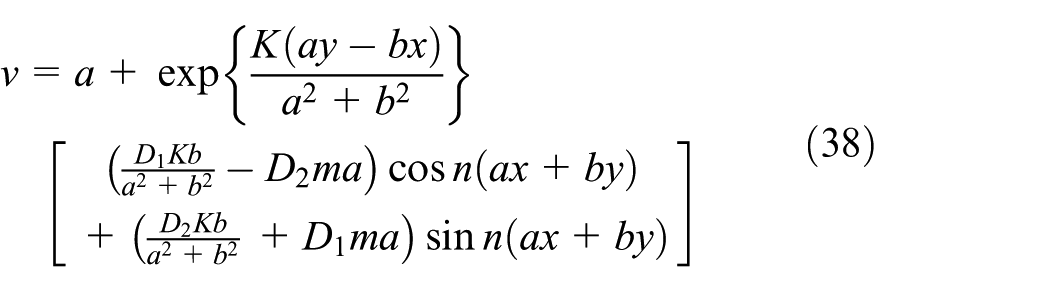
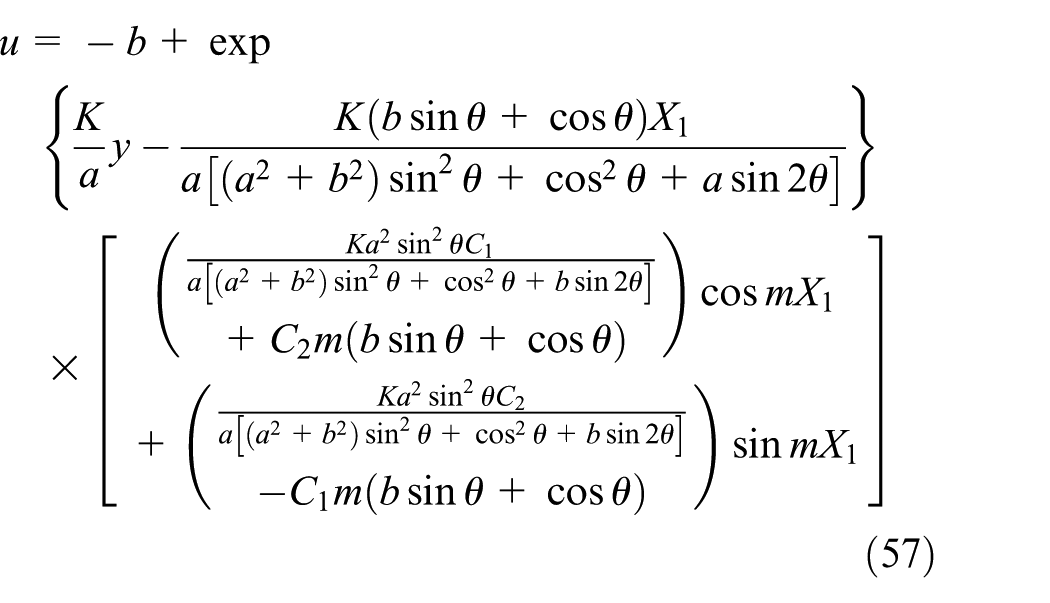
If and therefore , then equation (22) has solution of the form
and, as before, the stream function and velocity components are, respectively, given by
and
where and are arbitrary constants.
If and , the number of spillways increases from 5 to 7, whereas for and , , the number of spillways remains 8. The streamlines pattern is shown in Figure 2(i-ii).
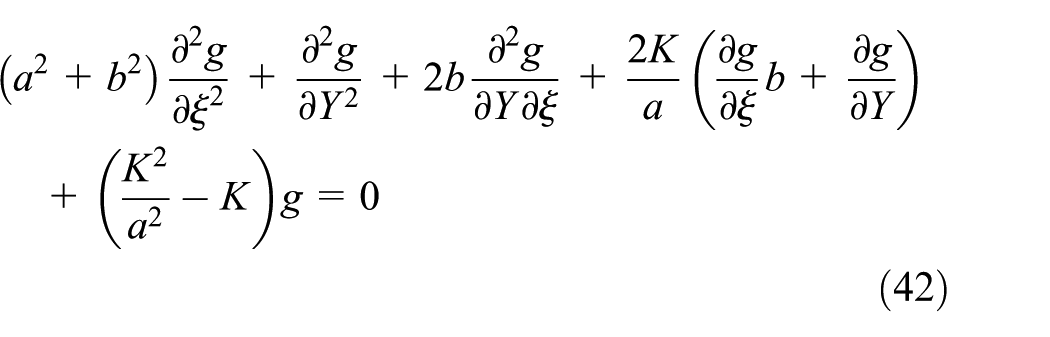
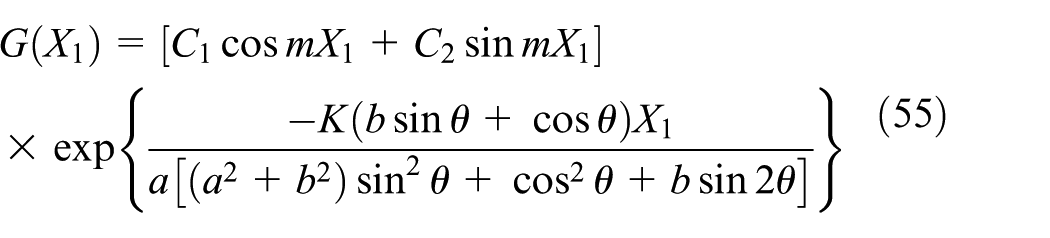
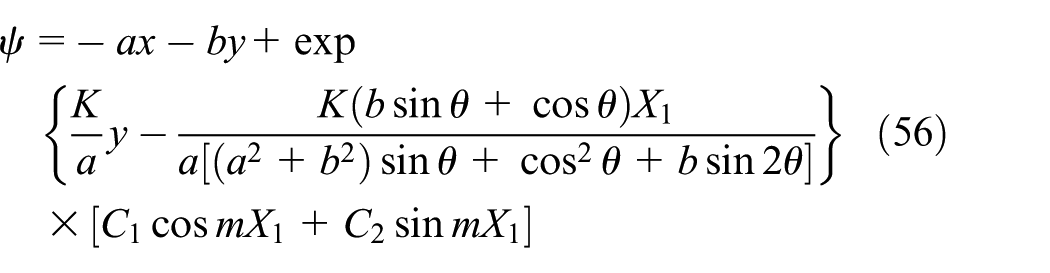
where is a function to be determined. Now, differentiating equation (41) twice partially with respect to x and y, and substituting in equation (17), we have
Exact analytical solutions of the incompressible Newtonian fluid are obtained for steady and unsteady cases. The fluid flow has been considered such that the vorticity function is proportional to the stream function perturbed by a uniform stream. A special solution obtained by taking and in equations (25) and (26) represents a reversed flow above a plate with suction, and this special flow is similar to the flow studied by Lin and Tobak.13 While setting and in equation (18), we readily obtain some results discussed by Hui.16
Footnotes
Acknowledgements
All authors participated in drafting and commenting the manuscript. Also each of the authors read and approved the final draft of the manuscript.
Handling Editor: Jiin-Yuh Jang
Declaration of conflicting interests
The author(s) declared no potential conflicts of interest with respect to the research, authorship, and/or publication of this article.
Funding
The author(s) received no financial support for the research, authorship, and/or publication of this article.
ORCID iD
Tanvir Akbar
References
1.
RasheedANawazRKhanSAet al. Numerical study of a thin film flow of fourth grade fluid. Int J Numer Meth Heat Fluid Flow2015; 25: 929–940.
2.
WahabARasheedANawazRet al. Numerical study of two dimensional unsteady flow of an anomalous Maxwell fluid. Int J Numer Meth Heat Fluid Flow2015; 25: 1120–1137.
3.
VieruDFetecauCFetecauC.Flow of a generalized Oldroyd-B fluid due to a constantly accelerating plate. Appl Math Comput2008; 201: 834–842.
4.
QiHTXuMY.Stokes’ first problem for a viscoelastic fluid with the generalized Oldroyd-B model. Acta Mech Sin2007; 23: 463–469.
5.
PakdemirliMYilbasBS.Entropy generation in a pipe due to non-Newtonian fluid flow: constant viscosity case. Sadhana2006; 31: 21–29.
6.
SajidMAbbasZJavedTet al. Boundary layer flow of an Oldroyd-B fluid in the region of stagnation point over a stretching sheet. Can J Phys2010; 88: 635–640.
7.
TurkyilmazogluMPopI.Exact analytical solutions for the flow and heat transfer near the stagnation point on a stretching/shrinking sheet in a Jeffrey fluid. Int J Heat Mass Transfer2013; 57: 82–88.
8.
ArielPD.A numerical algorithm for computing the stagnation point flow of a second grade fluid with/without suction. J Comput Appl Math1995; 59: 9–24.
9.
AbbasbandySHayatT.On series solution for unsteady boundary layer equations in a special third grade fluid. Commun Nonlinear Sci Numer Simulat2011; 16: 3140–3146.
10.
ShehzadSAAlsaadiFEMonaquelSJet al. Soret and Dufour effects on the stagnation point flow of Jeffery fluid with convective boundary condition. Europ Phys J Plus2013; 128: 56.
11.
TaylorGI.On the decay of vortices in a viscous fluid. Phil Mag1923; 46: 671–674.
12.
KovasznayLIG. Laminar flow behind a two-dimensional grid. Proc Camb Phil Soc1948; 44: 58–62.
13.
LinSPTobakM.Reversed flow above a plate with suction. AIAA J1986; 24: 334–335.
14.
WangCY.Exact solutions of the unsteady Navier Stokes’ equations. Appl Mech Rev1989; 42: S269–S282.
15.
WangCY.Exact solutions of the steady-state Navier-Stokes equations. Ann Rev Fluid Mech1991; 23: 159–177.
16.
HuiWH.Exact solutions of the unsteady two-dimensional Navier-Stokes equations. Zeitschrift für angewandte Mathematik und Physik1987; 38: 689–702.
17.
JamesM.Study of some exact solutions of Navier-Stokes equations for steady flow of viscous fluid (Project Report). Nairobi, Kenya: School of Mathematics, University of Nairobi, 2009.
18.
MarnerFGaskellPHScholleM.A complex-valued first integral of Navier-Stokes equations: unsteady Couette flow in a corrugated channel system. J Math Phys2017; 58: 043102.