




Abstract
A reliable ventilation system is essential for maintaining a comfortable working environment and ensuring safety production in an underground coal mine. The automated fan switchover technique was developed for changing the main fan for maintenance with lower air flow volatility of underground mine in the switchover process. This article established the optimization model in the main fans switchover process, used the improved particle swarm optimization algorithm to solve the model, and achieved minimum air flow volatility in the fans switchover process. Compared to previous studies, computer simulations have shown that the proposed algorithm can effectively find the global optimal solution with less initial parameters and achieved lower air flow volatility in underground mine. The particle swarm optimization solution, searching diversity, prevents it from confining to local optimal solutions and enhances convergence. The reasonable step length is beneficial to reduce the air flow volatility and main fans switchover time. The air flow volatility is larger comparatively when some doors are nearly open or closed fully at the start–stop phase of the switchover process. A case application in a China’s domestic coal mine shows that the air flow volatility of the underground mine in the main fans switchover process is no more than 0.4%.
Keywords
Introduction
The ventilation system of an underground mine provides fresh air to personnel and equipment, dilutes pollutants and hazardous gases, and maintains a comfortable working environment.1,2 On one hand, this system is of greater importance for a coal mine primarily because of the methane emission issues. 3 Most coal mines seams have high level of methane that continuously emit to the airway during the mining process. Ventilation system needs to provide enough fresh air to dilute the methane to the regulated limit for preventing methane explosion hazards. On the other hand, ventilation is used to adjust underground climate conditions, create a good production environment, ensure the normal operation of machinery and equipment to ensure the health and safety for operating personnel, and to achieve the goal of safe production. It is vital in mining industry.
Underground coal mines in China usually have a backup fan, and the two fans alternate every month for maintenance purposes. 4 This process is called the main fans switchover. It is traditionally done by turning off the working fan and closing the air door between it and the ventilation network, and then opening the air door between the backup fan and the ventilation network and turning the backup fan on (Figure 1). One disadvantage of this method is that the ventilation stops for a short period, and in the unlikely event of that the backup fan fails to start, the ventilation will be stopped for a longer period. This may cause the underground methane accumulate to the explosive level, which is a serious safety hazard. To overcome this disadvantage, the main fans switchover system without stopping the ventilation technique was developed.5–7 As shown in Figure 2, in the automated fans switchover system, two horizontal air doors are added on each of the airway between the fan and the vertical door. These doors are of blinds type (Figure 3) and can be mechanically controlled to open and close gradually. If No. 1 fan is the working fan and No. 2 fan is the backup fan, the No. 1 vertical air door and No.2 horizontal air door are opened before starting the fans switchover process. No. 2 fan will be turned on at the beginning of the switchover process and then the closed doors are gradually opened and the open doors are gradually closed by adjusting its blinds angle. At the end, No. 2 fan will provide ventilation to the mine, and No. 1 fan has no load and its horizontal air door could be turned off for maintenance. This technique shortened the time required for the main fans switchover process and eliminated the safety hazards caused by the traditional method.
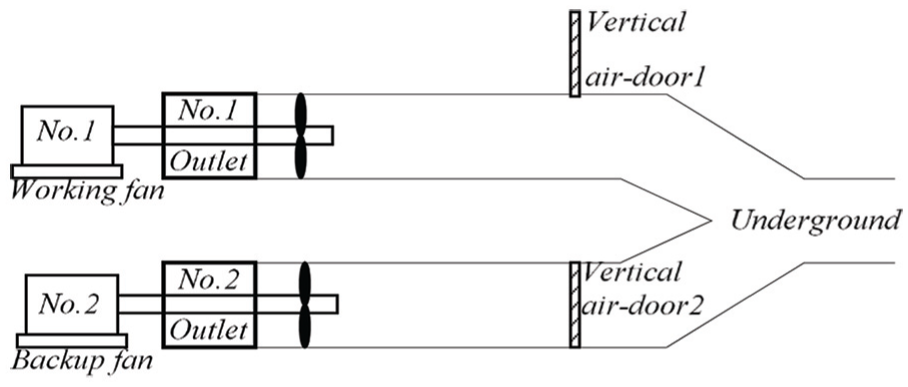
The traditional fans switchover system.

The automated fans switchover system: (a) plan view and (b) side view.

The blinds-type air doors in the automated fans switchover system.
However, the initial technique introduces large air flow volatility, which is not desired in underground coal mines, because that air flow fluctuation underground enlarges the hazards of the gas density out of limit, which may cause methane explosion.8–10 And, air flow fluctuation underground gives rise to dust pollution, shortage of fresh air, concentration of pollutants, and dwindling oxygen levels in working areas, which are harmful to workers health. 11 Obviously, it is necessary to restrain air flow fluctuation underground. But, it is challenging too, because it is hard to establish an accurate mathematical model for the mine ventilation system to control it due to its nonlinear and long lagging characteristics.2,5–7,10,12 One previous research has used a delayed sequence control method to optimize the automated switchover process. 6 It used computer simulation to investigate the influence of different delay factors on the underground flow fluctuation and found that the developed method still has 10%–20% flow volatility under the optimal scenario. Guo 7 has designed a monitoring system for axial flow fan to make main fans switchover process automatic by adjusting the fan rotor blades to maintain the air flow underground. But, it still has 9.4% air flow volatility underground. Neural network method is used to control the air door to make main fans switchover process automatic and reduce the air flow volatility underground to 8.1%. 13 The fuzzy proportional–integral–derivative (PID) method was used to control the air door and achieved 5% flow volatility in the fans switchover process. 14 A constrained nonlinear programming method was used to control the blinded air door, and simulation and application had shown a 1.14% flow volatility. 15
This article proposes to use an improved particle swarm optimization (PSO) algorithm to control the blinds-type air door. It requires less initial parameters and can find the optimal control solution more efficiently. Computer simulation has shown that this method can reduce underground flow volatility down to 0.5%. A case application in a China’s domestic coal mine shows that the air flow volatility of the underground mine in the main fans switchover process is no more than 0.4%.
The optimization model during fan switchover
The automatic control fans switchover system shown in Figure 2 can be equivalent to the model shown in Figure 4. R1 h and R2 h are the horizontal air door resistances, R1 v and R2v are the vertical air door resistances, and R0 represents the equivalent total resistance for the mine ventilation network. R0 is considered as a constant because the main fans switchover process takes short time. The air door resistance, R, can be calculated based on equation (1), where L is the total length of the blinds and S is the air door perimeter. RC is the air door resistance coefficient expressed as equation (2), where α is the blinds angle. When α = 0°, the air door is fully open, and when α = 90°, it is fully closed. The equivalent resistance (R1 and R2) applied to each fan can be expressed as equation (3)



The equivalent model for the automated fans switchover system.
Assuming that the two fans are identical axial fans, the No. 1 fan is the working one, and the No. 2 fan is the backup one. In the switchover process, the vertical air door for No. 1 fan and the horizontal air door for No. 2 fan need to be adjusted from fully open to fully closed gradually, and the horizontal air door for No. 1 fan and the vertical air door for No. 2 fan need to be adjusted from fully closed to fully open gradually. The flowchart for the process is demonstrated in Figure 5.

The flowchart for fan switchover.
A typical axial fan characteristic curve is displayed 16 in Figure 6. K is the stall point, and if the fan operates beyond this point, the fan becomes unstable due to partial recirculation of air at the blade tips. 4 This constraint can be met if the resistance in equation (3) (R1 and R2) is less than RK, which guarantees the operational point of the fan to be on the right of the stall point. A fan curve available in Ge et al. 15 is used in this study for simulation purposes (Figure 9). It can be expressed as a fitted polynomial function shown in equation (4), where H is fan pressure (Pa) and Q is fan air flow quantity (m3/s)

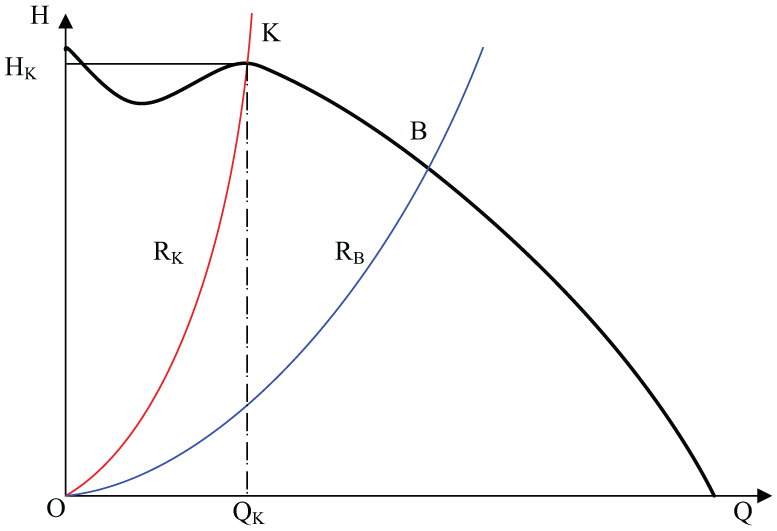
Fan characteristic curve.
Define α1s, α1c, α2s, and α2c as the opening angles for the four blinds of air doors, and δ1, δ2, δ3, and δ4 as the corresponding adjustment levels for each of the blinds of air doors. The air flow fluctuation in underground can be expressed in the following function

where Q0 is the original flow rate in underground, Q1 and Q2 are the flow quantities for the two fans, Qh1 and Qh2 are the flow quantities for the two horizontal air doors. The fan pressures (H1 and H2) can be calculated by substituting Q1 and Q2 in to equation (4). Thus, Qh1 and Qh2 can be calculated as below

In order to guarantee the fan operating away from the stall point, the fan operating pressure is set as less than 90% of HK, the pressure corresponding to the stall point at the fan curve. The corresponding flow quantity can be solved according to equation (4) (when the larger quantity is used, more than one solution is found). Then, using the square law (H = RQ2), the maximum resistance (Rmax) applied to the fan can be solved. Thus, the constraint for R1 and R2 are set to be less than Rmax. Based on the opening and closing of each air door, we can determine that δ1, δ4 ≤ 0 和δ2, δ3 ≥ 0. The adjustment level is also a constraint (Smin ≤|δ|≤ Smax), so the blinds are adjusted in many steps gradually. It is a typical multivariable nonlinear constrained optimization problem in the optimal calculation domain. The overall constraint optimization model can be expressed as follows

The PSO algorithm
The PSO algorithm is an evolutionary computation technique derived from the study of predicting birds’ behaviors. This optimization tool was first proposed by Dr Barnhart and Dr Kennedy in 1995.
17
It solves the problem by randomly assigning an initial solution and searching for the optimal solution iteratively. It has strong advantages in searching both the local and global optimal solutions.18–20 The location of each particle represents a possible solution in the searching space. Each particle has a location vector


where c1 and c2 are positive accelerate factors, rand(0, 1) is a random number generated in [0, 1], d represents one of the dimensions, ω (0 < ω < 1) is the inertia coefficient and usually uses a function that decreases with iteration. For each particle, the optimal experience location
After a certain number of iterations, most particles would converge to a very small domain around a certain position


In view of the main fans switchover system, many scholars have studied and established the related control model. Ren et al. 12 established radial basis function (RBF) model of the blinds adjustment in the fans switchover process and proved that it works well during the switchover process without stopping ventilation in MATLAB simulation. Guo 7 established a sequence control strategy model of fans switchover process with adjustable axial fan blade and achieved constant air flow. Wang et al. 26 built the minimal model of main fans switchover process and combined the branch fluid dynamics with the concept of graph theory, based on the theory of fluid flow network. However, the application of intelligent algorithms to the main fans switchover process control is seldom mentioned in the literature.
From the above discussion, it is obvious that each step of the blinds adjustment in the main fans switchover process is a nonlinear constraint optimization problem, which can be solved by the PSO method with both global and local searching capacity. The fitness function required in the PSO method can be established by converting equation (7) using the penalty function method shown in equation (12), where L1 and L2 are penalty function constants, and CRi and Cδi can be determined by equation (13)

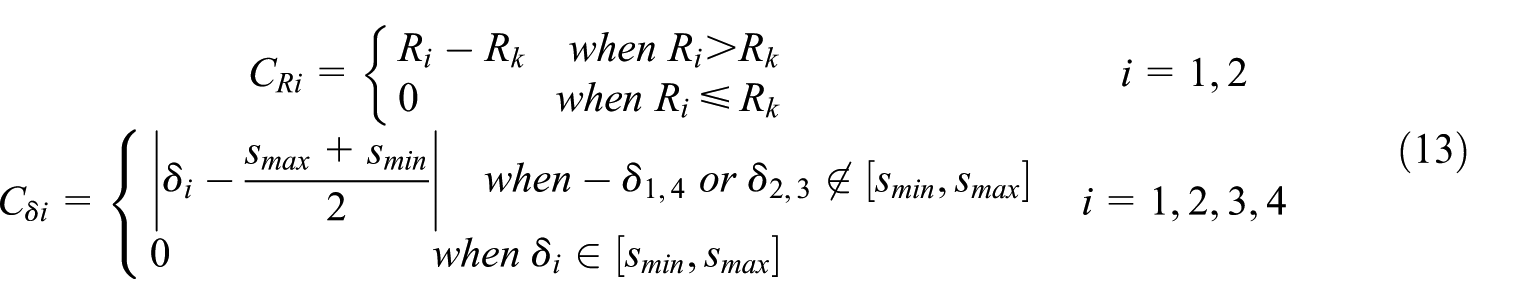
The searching process of the PSO algorithm described above follows the below procedures. First, the particle swarm and blind angles are initialized. Second, particle finesses are calculated, and the optimal value for individual particle and the particle swarm is determined. Third, the particle locations and velocities are updated. The searching process is stopped if the location changes are less than a predetermined residual or if the search has reached the maximum iteration. Finally, the blind angles are updated and the operating above is iterated until the switchover process has been completed. The pseudocode of the algorithm is presented below.
Start
emsp; Init α1h,α1v,α2h,α2v;
LOOP: Init Particles;
RE: Calculate Particles Fitness;
Update pi and pg;
Calculate multiple and dir;
Update Particles position and speed;
If
else goto RE;
NEXT: Update and store the quantity ofα 1h ,α 1v ,α 2h ,α 2v ;
If (α 1h ,α 1v ,α 2h ,α 2v )=(0°, 90°, 90°, 0°) goto FINISH;
Else goto LOOP;
FINISH: End
No. 2 fan needs to be started before the switchover process. To make the process smooth, the blind angles for the horizontal air door are adjusted so that the No. 2 fan operates at the same operating point as the No. 1 fan. These blind angles are used as the initial values. The optimal angle adjustment values are calculated using the PSO algorithm, which minimizes underground air flow fluctuation. These values are sent to executing devices to perform the blinds adjustments. The process is repeated until the No. 1 fan vertical air door and No. 2 fan horizontal air door are totally closed, and No. 1 fan horizontal air door and No. 2 fan vertical air door are totally open ((α1h, α1v, α2h, α2v) = (0°, 90°, 90°, 0°)).
Case simulation
To verify the efficiency of the proposed method, simulations were performed in MATLAB. The used parameters are as follows (Table 1): particle number S is 25, acceleration constants C1 and C2 equal to 2, maximum iteration number T is 300, penalty function constants L1 and L2 are 1000, the search space maximum radius is set as Lr = 2|Smax − Smin|, the inertia coefficient is defined in equation (14), where t is iteration number. The mine total resistance R0 is 0.16 N s2/m8, and the air door dimension ratio L/S equals 0.3. The flow quantity (Q0) before switchover is 77.3 m3/s, and the horizontal door blind angle (α2h) needs to be adjusted to 16° for No. 2 fan operational point to match the No. 1 fan. Thus, the initial blind angles (α1h, α1v, α2h, and α2v) are (90°, 0°, 16°, and 90°)

PSO parameters selection.

PSO: particle swarm optimization.
For comparison purposes, different combinations of the parameter [Smin, Smax] are investigated. Simulations were run for 10 times each combination of [Smin, Smax], and the resulted maximum flow fluctuation, maximum flow fluctuation percentage, average iteration, and blinds adjustment steps are compared in Table 2.
Simulation results.

PSO: particle swarm optimization.
The blind angle changes when [Smin, Smax] = [0.2, 2] as given in Figure 7. It shows how the blinds of each air door are adjusted in the fans switchover process. The levels of angle adjustments for each door are different in each step. The executing devices can determine the proper adjustment speed to ensure the adjustments start and finish at the same time in each step. The underground air flow variations with angle adjustment steps are shown in Figure 8. There is an obvious air flow increase of 0.38 m3/s after the first adjustment step, but this variation quickly reduces to less than ±0.1 m3/s for the rest of the majority of the adjustment steps. This phenomenon is similar to what happened in a different study. 11 Larger variations appear in the last 30 steps. It has increments and decrements, but the absolute variation values are all less than 0.39 m3/s. The larger variations at the start and end of the process are due to the nonlinear exponential relationship between the blind angle and the air door resistance. As indicated in equation (2), the air door resistance constant increases rapidly when the angle is close to 90°. A small change in the angle results in a large variation in the air door resistance, thus causing a larger air flow volatility when the doors are about to open or closed fully. Overall, the air flow volatility is less than 0.5%, which has improved 0.64% compared to that used a nonlinear constrained programming method. 11 The operating points for the two main fans are plotted in Figure 9. In the main fans switchover process, it shows clearly that the main fans operating points are all on the safe part of main fans operating line. It renders certain that the main fans operate within the stable operational conditions in every adjusting step, and there are some overlaps, but no sudden jumps in each angle adjustment step. The overlaps of operating point reveal that the main fans operating status make reciprocation on the safe part of main fans operating line during the main fans switchover process. This guarantees the efficiency and reliability of the main fans.

The blind angle adjustments of air door during fan switchover.

Underground air flow variation during fan switchover.
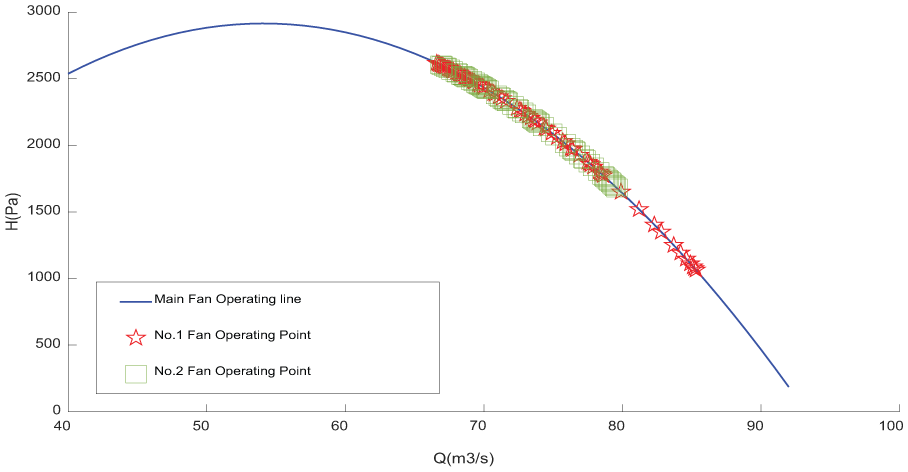
The change of operating points for the two fans in switchover process.
Case application
To reduce air flow volatility of underground coal mine with improved PSO algorithm in main fans switchover process, an automatic control system of coal mine main fans switchover has been applied successfully in a China’s domestic coal mine. The automatic control system of coal mine main fans switchover is shown in Figure 10. And, the main interface of the automatic control system is shown in Figure 11.

The automatic control system of coal mine main fans switchover.

The main interface of the automatic control system.
The ventilation network structure of the China’s domestic coal mine is shown in Figure 12. It is an exhausting ventilation network system with 3 air shafts, 17 branches, and 11 nodes. The three air shafts are equipped with a main fan with a backup, which locates on branches e1, e2, and e3. Three independent automatic control systems of main fans switchover are installed to the three air shafts, respectively. To reduce factors of the air flow volatility underground, it is stipulated that only one system can perform the main fans switchover operation at same time. The automatic control system structure is shown in Figure 13. Programmable logic controller (PLC) receives data from the sensors installed in the ventilation network and sends it to industrial control computer (ICC). When main fans switchover process is started, the backup fan is launched without load with its horizontal air door opened by ICC. Then, ICC seeks for the most optimal adjustment level (δ1, δ2, δ3, and δ4) of the four blinds of air doors with improved PSO algorithm and the data (the data of the sensors; the opening angles α1s, α1c, α2s, and α2c of the four blinds of air doors; and main fans status); updates the opening angles α1s, α1c, α2s, and α2c by adding adjustment levels (δ1, δ2, δ3, and δ4), respectively; and sends to PLC to implement the adjustment of the four blinds of air doors. ICC iterates it until the opening angles α1s, α1c, α2s, and α2c are equal to 0°, 90°, 90°, and 0°, which means that the backup main fan operates in the ventilation network and the former operating main fan quits the ventilation network entirely.

The ventilation network structure of the China’s domestic coal mine.

The structure of the automatic control system.
All the automatic control systems of three air shafts perform well. The maximum air flow volatility of each air shaft in the process of the main fans switchover is shown in Table 3. The maximum air flow volatility of each air shaft is no more than 0.8%. It is better than 1.14% of last research which applies nonlinear constrained programming. The main fans switchover process of each air shaft takes no more than 163 s. Workers underground do not perceive the air flow fluctuations in the process of the main fans switchover.
The maximum air flow volatilities of each air shaft in the process of the main fans switchover.

Conclusion
Underground coal mines usually have a backup main fan, and the two fans are switched over every month for maintenance purposes. To guarantee a stable air flow in the automated fans switchover process, previous research works have different methods to control the angle of blinds on air doors. This article uses an improved PSO algorithm to solve the established constraint optimization model. In the improved PSO algorithm, the solution, searching diversity, was controlled to prevent it from confining to local optimal solutions and improve its convergence ability. The reasonable step length selection is beneficial to control the air flow volatility and main fans switchover speed. Simulation results show the following:
The air flow volatility is further reduced compared to other methods.
There is large air flow fluctuation when some doors are about to open or closed fully at the beginning or ending of the switchover process because the air door resistance constant increases rapidly when the angle is close to 90°.
The maximum of fluctuation of air flow rate underground depends on the difference of maxstep and minstep mainly; the larger the difference, the smaller maximum of the fluctuation of air flow rate underground.
The adjustment time is related to (minstep, maxstep) closely; the larger minstep or maxstep, the shorter adjustment time would be.
The algorithm has the advantages of requiring less initiate parameters and finding the optimal solution more efficiently.
The air flow volatility of the underground mine in the main fans switchover process is no more than 0.4%.
The application and development of the technique and the algorithm in a China’s domestic coal mine show validity and reliability of this method for automatic control main fans switchover.
Footnotes
Handling Editor: Muhammad Akhtar
Declaration of conflicting interests
The author(s) declared no potential conflicts of interest with respect to the research, authorship, and/or publication of this article.
Funding
The author(s) disclosed receipt of the following financial support for the research, authorship, and/or publication of this article: This work was supported by the Key Research and Development Plan of Jiangsu Province: Key Technology Research and Development of Mine Ventilation Safety and Energy Saving Measurement and Control (BE2016046); Industry-University-Research Prospective Joint Research Project (BY2016062-01); and the Independent Research Projects of State Key Laboratory of Coal Resources and Safe Mining, CUMT (SKLCRSM15KF01).
