




Abstract
The proof mass used for gravitational-wave or Earth-gravity-field detection is usually comprised of materials such as gold–platinum alloys, which have a high density and low magnetic susceptibility, in order to reduce the magnetic disturbance produced by the geomagnetic field and the spacecraft itself. This article highlights a novel alloy composed of gold and iridium and having a 17-mm diameter spherical proof mass. Three solid samples of 5 × 5 × 3 mm are presented for application in an inner satellite or proof mass based on an inner-formation flying system. The magnitudes of magnetic susceptibility of gold and iridium are of approximately the same order. A wide range of mixture ratios for gold and iridium are compared to those of gold and platinum with the same magnetic susceptibility. The density and magnetic susceptibility of the new alloy are evaluated. It is noted that the magnetic susceptibility can reach orders of 10−5, and the magnetic disturbance on proof mass can be reduced to less than 10−10 m/s2, which satisfies the inner-formation flying system requirement.
Keywords
Introduction
Space-based gravity-detection systems construct the pure orbit by using proof mass (PM) such as in the detection of Earth’s gravity field,1,2 gravitational waves,3–6 equivalence principle,7–9 geodetic effect, and frame-dragging effect. 10 The gravitational reference sensor (GRS) that is the instrument of measurement and protection for PM, has several functions such as, including providing shielding from magnetic fields, cosmic rays, and thermal noises; sensing the position of the PM; enclosing the PM in a high-vacuum environment; and caging the PM during the launch so that it can be released with a very low velocity on the operational orbit. Primary research has been conducted for constructing PMs by employing satisfactory materials having high density, high thermal conductive, and low magnetic susceptibility (MS) in order to reduce the disturbances such as residual gas, 11 radiometer effects,12,13 and magnetic disturbances. 14
To fulfill such material requirements for PMs, low MS and heavy metals such as platinum (Pt) and gold (Au) and their alloys, were considered. The typical PM design using the Au-Pt alloy for space-based gravity detection has been applied to laser interferometer space antenna pathfinder (LISA Pathfinder) 15 and is expected to be used in LISA, 16 astrodynamical space test of relativity using optical devices (ASTRODs), 17 and satellite test of the equivalence principle (STEP), 7 among others. For LISA, the PM is a cube made of an alloy composed of approximately 75% Au and 25% Pt with a mass of 1.96 kg and a dimension of 46 mm × 46 mm × 46 mm. The expected volume MS is −2 × 10⁻⁵ in SI units. 18 For ASTROD, the PM is designed as a 50 × 50 × 35 mm3 rectangle having a low MS (less than 5 × 10⁻⁵ in SI units). 19 Besides space-based gravity detection, low MS Au-Pt alloy are also of interest in magnetic resonance imaging (MRI)—the volume MS of Au-Pt alloy is 8.8 × 10⁻⁶ in SI units, which causes no artifacts during MRIs. 20 They also have valuable application in standards laboratories in devices such as the Watt balance, for which the volume MS of Au-Pt alloy is from −2.8 × 10⁻⁵ to 8.8 × 10⁻⁵in SI units. 21
However, the mass MS of Pt is nine times larger than that of Au, 22 which means that the range of the mixture ratio of the Au and Pt alloy is small. The metal iridium (Ir) is not only a paramagnetic material, similar to Pt but also its mass MS is similar to that of Au; this implies that for the same magnitude of MS, the range of the mixture of Ir to Au is wider than that of the Pt-Au alloy. The density and thermal conductivity of Ir are higher than those of Pt, which means that, in theory, the Au-Ir alloy may be heavier than the Au-Pt alloy with the same mixture ratio and volume, and Au-Ir alloy could achieve better heat conduction with smaller thermal noise for use in PM. Therefore, in this study, a new type of Au-Ir alloy was designed for the inner-formation flying system (IFS), which was proposed by researchers at Tsinghua University for Earth-gravity-field detection. 2 First, the model of the magnetic disturbance for IFS is provided, followed by a description of the proposed MS computation method for Au-Ir. Second, the preparation and testing of the Au-Ir alloy is introduced, and the results and discussion of the magnetic disturbance are presented.
Analysis of magnetic disturbance requirements of PM
The magnetic field intensity around an inner satellite can be denoted by

According to IFS, possible magnetic sources include the satellite local magnetic field

The magnetic moment

where

In equation (4),
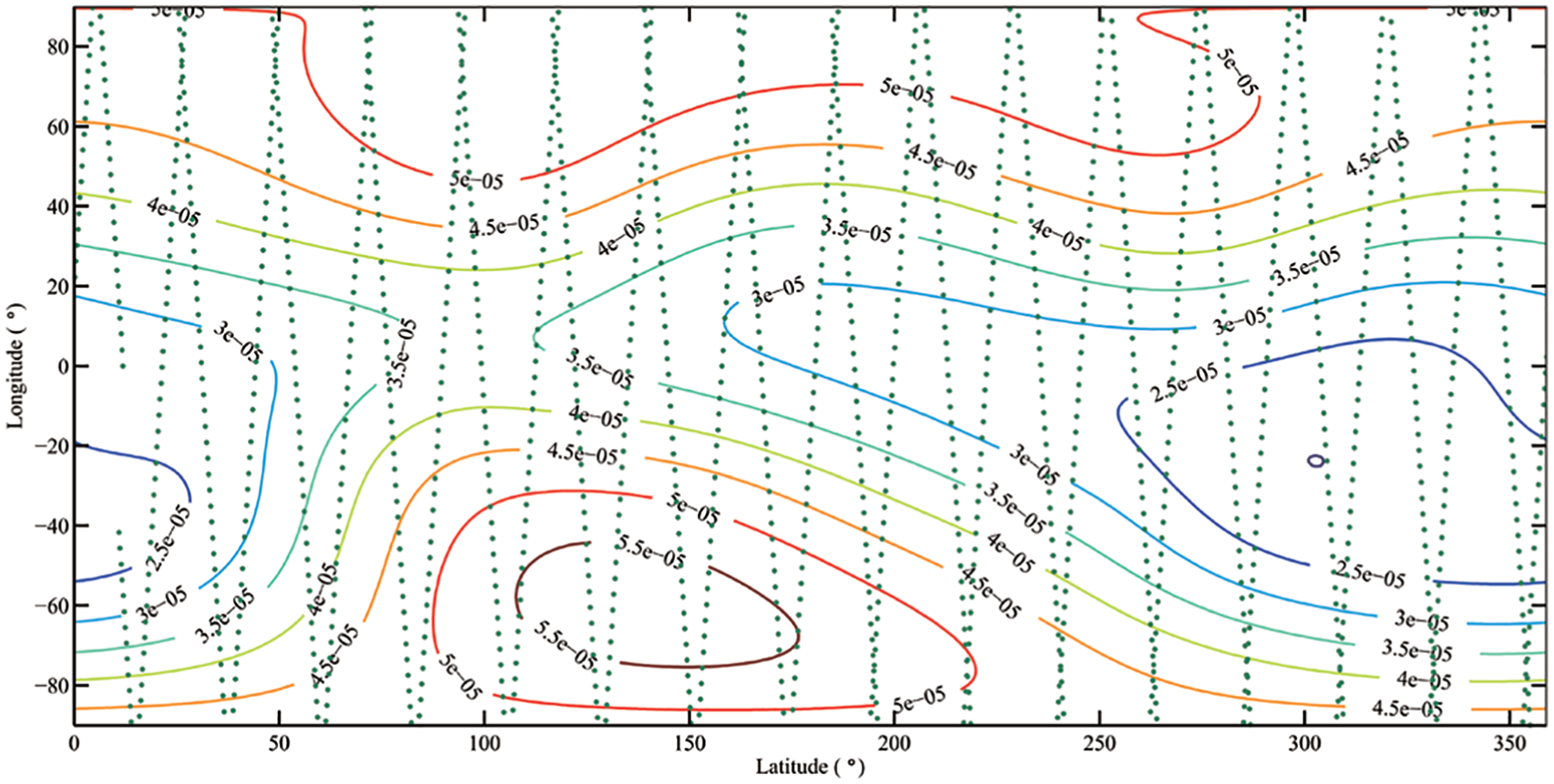
Magnetic field (contour) and subpoint (green dotted line) of IFS with longitude and latitude.
The magnetic field environment is different between IFS and LISA, since the orbit is different. In IFS,
The two dominant terms of magnetic force—the square of the Earth’s magnetic field according to the first right-hand term in equation (4),


The third disturbance of the second term in equation (4) corresponding to the remanent magnetic moment

where
PM requirement for IFS.

Metals with a heavier density and lower MS are considered for the material of the inner satellite. Currently, to reduce the magnitude of MS, the Au-Pt alloy is usually employed as the material. However, the mass MS of Pt is nine times larger than Au, 22 which means that the range of the mixture ratio of the Au and Pt is small. We determined that Ir is also a paramagnetic substance and its MS absolute value is quite similar to that of Au. This means that the range of the mixture ratio of the Au and Ir is wider than that of Au-Pt, which can help achieve lower MS. At the same time, the Au-Ir alloy also satisfies the requirements of PM for space-based gravity exploration missions owing to its high density and high thermal conductivity, as listed in Table 2.
Physical parameters of gold, iridium, and platinum. 22

The MS computation of Au-Pt and Au-Ir alloys was given by Liu 26 and is written as

In addition

Figure 2 indicates that different amounts of Au, Pt, and Ir lead to different magnetic susceptibilities.

MS of Au-Pt alloy (red dotted line) and Au-Ir alloy (green dotted line).
Figure 2 shows the theoretical value of the MS of Au-Ir alloy (green dotted line) and Au-Pt alloy (red dotted line). It can be determined that, for the Au-Ir alloys, if the Au content in Au-Ir alloy changes from 34% to 67%, the MS will decrease to less than 10−6. But for Au-Pt alloys, the Au content in Au-Pt alloy changes from 84% to 92% only.
Preparation and testing of Au-Ir alloy
Preparation of Au-Ir alloy
The melting point of Au is significantly different from that of Ir (Au: 1063°C; Ir: 2454°C), and it is difficult to dissolve Au and Ir in each other. The best possible mutual solubility of Au-Ir is 2%; thus, the melting of the Au-Ir alloy is very difficult. To ensure that a fixed proportion of Au-Ir was mixed to form the alloy, powder sintering technologies 27 were selected as the Au-Ir preparation method.
The preparation of the Au-Ir alloy involves four main steps: milling, powder-mixing, high-temperature sintering, and machining. The milling process involved the use of a chemical method for which Au of greater than 99.5% purity, comprised of superfine powder, was used. The diameter of the powdered particle was approximately 0.5–1.5 μm. The powder was prepared by dehumidifying, drying, and sieve backup. The powder mixture was comprised of a uniform powder composition with a fixed ratio for mixing the Au powder and Ir powder. For the powder sintering mold, a graphite mold and stainless-steel mold were used to prevent carburizing in the sintering process. The sintering was maintained for 45 min to 1.5 h with a temperature of 850–910°C and a pressure at 10–30 MPa. For the first preparation, a sphere of diameter 17 mm and three 5 mm × 5 mm × 3 mm solid cuboids were prepared for the test, as shown in Figure 3. The chemical composition and microstructure of the Au-Ir alloy is mentioned in the Appendix 1, (as this is not the focus of this work).

Samples of Au-Ir alloy.
Density measurement
The density of the Au-Ir alloy was measured using density weighing scales and a Vernier caliper. Table 3 indicates that the density of the PM made of Au-Ir alloy is 16.5 kg/m3, which is lower than that of Au and iridium; this is because the preparation of Au-Ir is by powder sintering in which incomplete compaction of the powder of Au and Ir leads to the real volume of the alloy being larger than the theoretical value.
Density of Au-Ir alloy.

PM: proof mass.
Magnetic properties
The Lake Shore 7410 vibration sample magnetometer (VSM) was used for testing the magnetic moment of the Au-Ir alloy. In accordance with the requirement of the VSM, the three solid-type alloys were chosen for the testing of the magnetic properties. The

Magnetic moment (emu) with various magnetic fields (Gauss) under testing with the Lake Shore 7410 vibration sample magnetometer (VSM).
Results and discussion
Magnitude estimation of MS and remanent moment
A combined estimation of MS and remanent moment is proposed in this section. The estimation is combined owing to the existence of ferromagnetism in the preparation of the Au-Ir alloy, leading to the magnetic moment of the PM obtained by the VSM, including the remanent magnetic moment. For easy calculation, CGS units are adopted here. The environment magnetic field intensity


Because the solid alloy is small, the remanent magnetic moment

MSs of the three PMs in SI units.
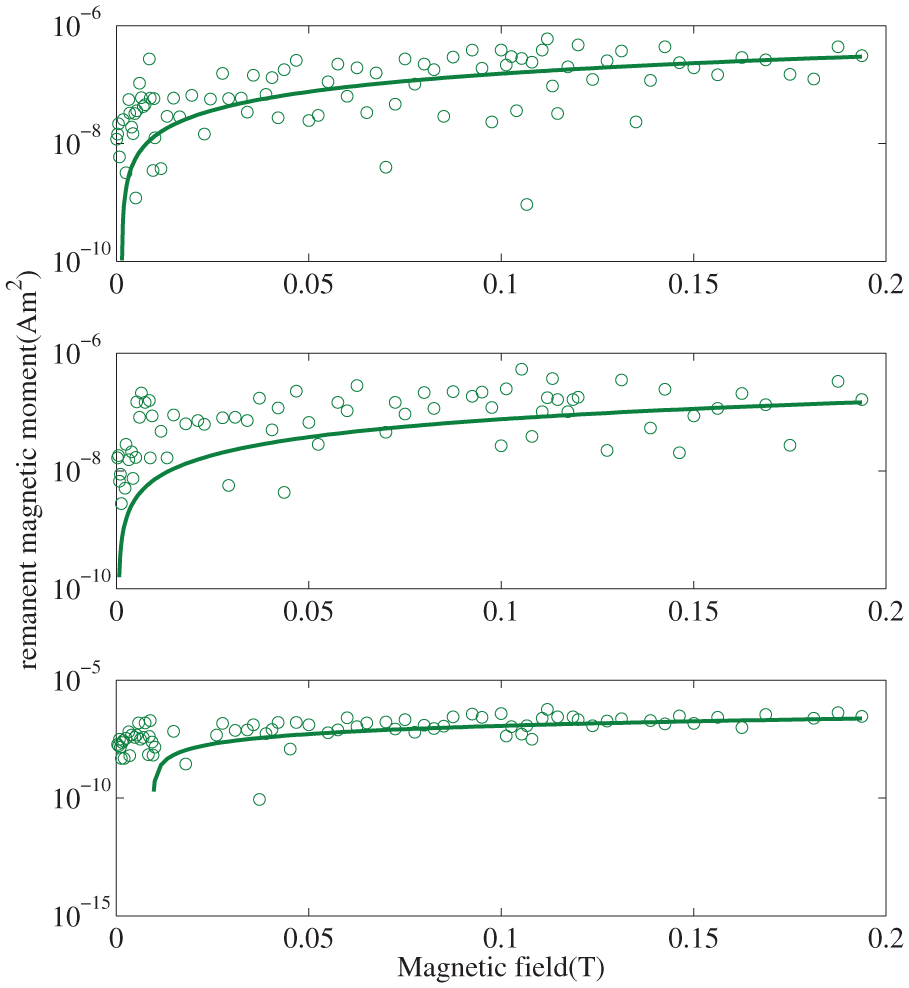
Remanent magnetic moments of the three PMs in SI units.
Figures 5 and 6 show that the MS of the three solid Au-Ir alloys is less than a magnitude of 10−4, and the remanent magnetic moment is lower than a magnitude of 10−7. The maximum, minimum, and mean values of the MS and remanent magnetic moment are shown in Table 4.
MS and remanent magnetic moment of three solid Au-Ir alloys.

Table 4 indicates that the mean value of the MS of the Au-Ir alloy is 4.6–8.0 × 10⁻⁵ level and the minimum value of the MS would reach 10−6; compared to the LISA mission, the MS of the Au-Ir PM could achieve the same magnitude of MS (−2 × 10⁻⁵) for Au-Pt alloy. 18
Magnetic disturbances acting on the PM
The three magnetic disturbances acting on the PM based on MS, density, and remanent magnetic moment results are given in Figures 7 and 8 in accordance with equations (5)–(7). Here,

First and second magnetic disturbances of the three solid PMs.

Third magnetic disturbance of the three solid PMs.
Figures 7 and 8 show the magnitudes of the first disturbance
Three magnetic disturbances acting on the solid PMs.

The magnetic disturbance evaluation of LISA under the condition of using the Au-Ir mentioned in this article is proposed here. The ratio of MS and density of Au-Ir alloy can be written as
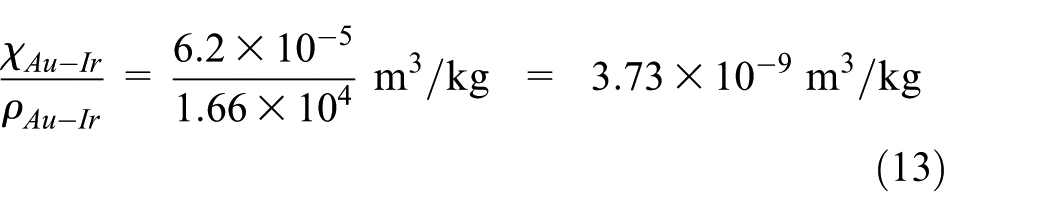
where

We can see that the magnetic disturbance of the PM with the Au-Ir alloy is 3.7 times larger than the Au-Pt alloy for the LISA mission; however, it also satisfies the requirement of baseline goal for the total PM acceleration disturbance (3 × 10⁻¹⁵ m/s2 at 10−4 Hz). 24
Conclusion
In this study, a new type of Au-Ir alloy with high density and low MS was prepared and presented for use as a PM material. The simulation results showed that the magnetic properties of the alloy can reach a low MS in a relatively wide range of Au and Ir. For the Au-Ir alloys, if the Au content changes from 34% to 67%, the MS will decreases to less than 10−6. However, for Au-Pt alloys, the Au content in Au-Pt alloy changes from 84% to 92% only, which means that for the same level of MS, the Au-Ir alloy has a wider mixture ratio than the Au-Pt alloy. The experimental results showed that the MS of the alloy had a min value of 6.6 × 10⁻⁶ and a mean value of 6.2 × 10⁻⁵ in SI unit, which is close to the MS of the Au-Pt alloy in LISA, ASTROD, and some applications in MRI, and the remanent magnetic moment was 10−8 when the Au content was 45%, and the corresponding magnetic disturbances were lower than 10−10 m/s2, which satisfies the requirement of the IFS mission. Compared to the LISA mission, the magnetic disturbance of the PM using parameters of the Au-Ir alloy was 3.7 times larger than that of the Au-Pt alloy, and it also satisfies the requirement of baseline goal for total PM acceleration disturbance. This research provides a novel concept for the study of Au-Ir alloy to reduce the non-conservative force inhibition in a GRS.
Footnotes
Appendix 1
Acknowledgements
The authors are grateful to the many colleagues and associates who helped in this work.
Handling Editor: Francesco Massi
Declaration of conflicting interests
The author(s) declared no potential conflicts of interest with respect to the research, authorship, and/or publication of this article.
Funding
The author(s) disclosed receipt of the following financial support for the research, authorship, and/or publication of this article: This work was financially supported by the National Natural Science Foundation of China (grant no.: 11002076).
